Category

News

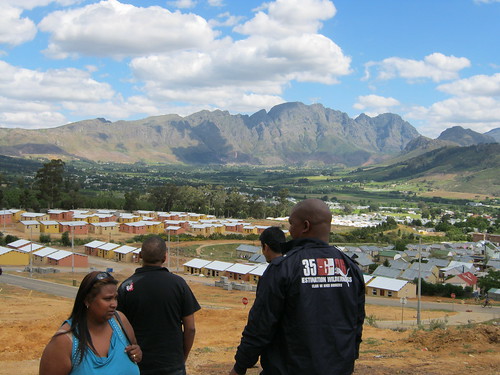
Residents plan their new home at Grassy Park

By News No Comments

By Lindiwe Solani

Grassy Park Rezoning 2
30 years ago the residents of Grassy Park, from two different areas invaded land which was more than 400m² each. They were twelve families who occupied the land. The owner of the plots was originally a man who passed away, then his daughter took over as inheritance. They used to pay rent of up to R3500 per month to the owner. Some of these occupants were unemployed, as a result it was hard for them to fulfil their payments. At a later stage, they all received eviction notices from the landlord’s lawyer. The people were dismayed for they had nowhere else to go. This was their only home for many years.

According to Jennifer Van Wyk, one of  the rent-paying residents, who happened to belong to the Western Cape Backyarders Network, supported by CORC (Community Organisation Resource Centre), arranged a meeting with the owner, so as to negotiate  selling the land to them. They formed a savings club, where they also fundraised, by selling boerewors on weekends, doing karaoke’s, or Valentine’s balls. They  realized that the savings alone was not enough.

The land owner decided to sell the land to the WC Backyarders, this was done in writing. Their next step was to approach the municipality: The city was supportive as a result, they even received title deeds. The network incorporated a few shacks that were also facing the same plight, to be part of the group.

They were so motivated, that they decided to draft up a plan. They drew a chart, whereby bricks were drawn up to make many levels. A brick costs R6 each. This is when these families decided to opt for rezoning, to alter the current structures to be residential ones.

The process of rezoning is still underway. There is so much red tape that needs to be followed, such as handling of land purchase over to the new owners, and renovating the structures to be suitable for residential needs. “We hope and pray that one day we’ll have a place, we can call our own”, explained Jennifer Van Wyk.

Grassy park 7

Settlers put Burundi on the map of Cape Town

By News No Comments

By Sothembela Siyo, Informal Settlement Network (ISN)

Plakker Areas Dvally,Jamestown,Cloetesville  10.03.2011 059

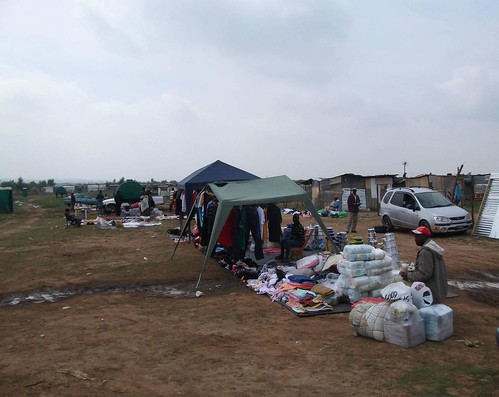
Burundi informal settlement is located in the Western Cape, situated between the informal settlement of the Eastern region and different places of Mfuleni. The nearest town is Kuilsriver, and the formal settlement is Extension 4, Ward number 108. The settlement is 13 years old. The people do not have title to the land on which their shacks are built. Burundi informal settlement has a total population of about 4 500 people. No more shacks are allowed to be built, according to the city’s stipulations, otherwise they would be evicted.

This amounts to 1 900 families whereby there are 1 600 shacks in Burundi .The settlement has 53 toilets and 18 water taps. The reason the community felt profiling is needed, was that the Burundi informal settlement was not known to the City of Cape Town, meaning it was not on the municipal’s database. Burundi joined the Informal Settlement Network (ISN), which deals with and addresses the basic needs of the shack dwellers.

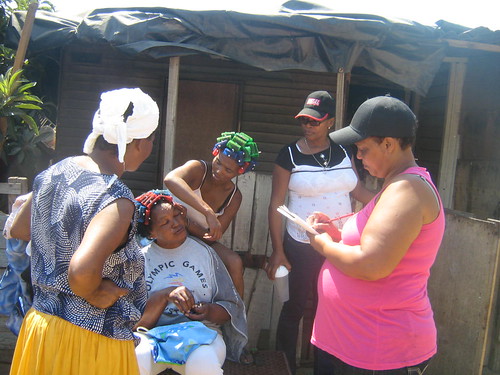
After the application for profiling had been approved by ISN, a profiling team was sent to take all information related to the counting of toilets (bucket, chemical or flushed). The profiling team also took details of the history of Burundi, how it came about to be what it is today. The ISN team used an already compiled questionnaire that guides with questions such as, “To whom does the land you occupy belong to?” and “How far away is the settlement to the CBD (Central Business District)?”.

This kind of information assists the municipality, in terms of planned upgrading or development, so that it is well equipped and knows exactly where to start. Profiling is conducted by a few members of the committee, the community members and three ISN members who know all about profiling. Everyone participates and becomes part of the process. At the end of the profiling questionnaire, there is a page where all details of the three active committee members to be compiled, so as to contact them whenever there are more activities to be done at a community.

The process of profiling so far proved to be successful, for there are 220 informal settlements captured to date (the number is prone to increase, since there have been more communities identified, including the backyard network). The only challenge faced by the profiling team is when a committee member  refuses to disclose information of the community. In this case the team suggests to arrange a meeting with the whole community to clear up the issue.

FEDUP builds 50 houses in QwaQwa

By News No Comments

By Kwanele Sibanda, CORC

GOGO GOALONE MAHLABA

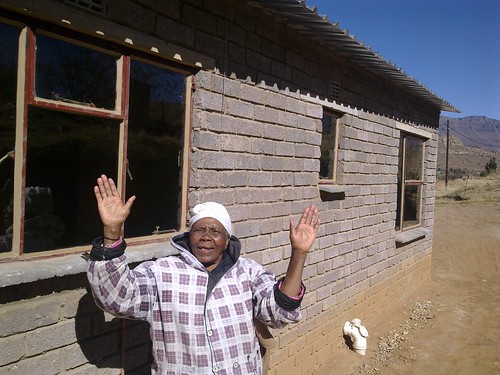
Gogo Goalone Mahlala is proud of her new home

FEDUP has eight saving schemes in QwaQwa. 50 members from two saving schemes, namely Phutaditjhaba and Matebeleng have benefited from the recently completed housing project of 50 houses. The members reside in the following settlements: Makeneng, Phukeng and Thabong. In the process of development, members were not relocated as houses were built within each member’s stand. The project began on the 2nd of April 2009 and was completed on the 22nd of March 2011. Just like all the other FEDUP projects, a People’s Housing Process was followed. A community construction management team (CCMT) was established prior to the commencement of the project. The CCMT was comprised of six members (five female and one male).

FEDUP in Free State has had successful and productive engagements with its government, however there were challenges faced in the process. The first and most positive development was the successful negotiation, agreement and issuing of ‘upfront subsidies’. According to the QwaQwa CCMT, the major challenge that was faced during the project was the delay in payments by the province. Payments from the province were done in batches that varied in number and the payment delays came between one batch and the next. During engagements with the government through Joint Working Group meetings, the FEDUP representatives presented the issue, however the government is said to have shifted the blame to FEDUP asserting that they delayed to submit PTOs (Permission to Occupy) for their beneficiaries. Instead of title deeds, the QwaQwa beneficiaries reside in an area controlled by the Chief who is responsible for the issuing of PTOs. FEDUP however maintains that they always submitted their PTOs on time.

In the combined saving scheme meeting held on the 30th of May 2011, the regional leader Emily Mohohlo encouraged the beneficiaries to continue saving as well as completing their contribution towards the Urban Poor Fund. Members that benefited from the project have continued to save and most of them are saving for plastering and putting ceiling in their houses.

Marshall Fishwick once said ‘A person with half volition goes backwards and forward, but makes no progress on even the smoothest of roads’. 72-year-old “Gogo” Goalone Mahlala is an example for the opposite: She followed all the rituals of the federation and at the end was not only overjoyed by her efforts towards achieving her dream house, but also an improved life through support from her saving scheme members.

31052011435

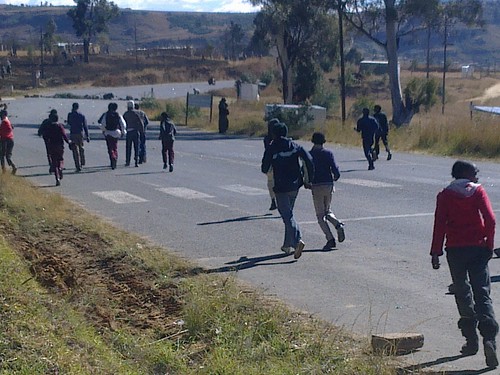
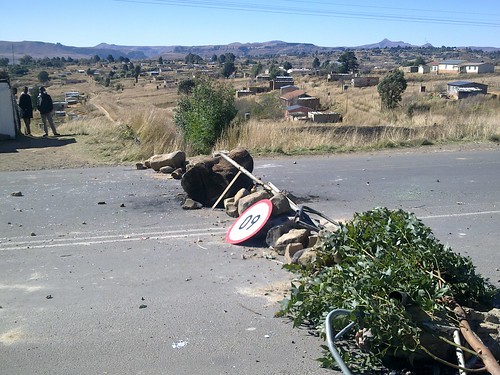
The meeting was accompanied by ongoing service delivery protests in QwaQwa. The protests began on Monday and were being led by students from surrounding schools. The councillor’s house was burnt down yesterday morning. Myself and three Federation members from Bothaville and Odendaalsrus could not leave QwaQwa on Monday as had been scheduled. All main roads were blocked. The saving scheme and CCMT meetings were not affected as they were held indoors, however the practise of Nsukuzonke (daily savings collection) had to be stopped early for safety reasons.

31052011441

Kliptown residents challenge community hall renovation

By News No Comments

By Kwanele Sibanda, CORC

17052011346

The community of Kliptown has for the past 17 years had a problem with accessing and playing a part in the management of their own community centre. The centre was built by the City of Johannesburg, but was never officially handed over to the community. The above amongst other reasons contributed to the reasons as to why the centre and its facilities were vandalized by the residents and outsiders. Poor management of the centre affected the community members in some of the following ways: clashing of events due to a lack of reception where bookings can be done, dominant use of centre by people other than those of Kliptown as well as no option, but using the constantly dilapidating structure.

Towards the end of February 2011 the Kliptown ISN development team decided to take the first step towards addressing this challenge. They approached the City of Johannesburg with the concern; however they were referred to the Johannesburg Property Company (a company that is sub-contracted by the City to manage the Kliptown community Hall amongst other properties owned by the City). On the 4th of March 2011 the team had a meeting with JPC. In the meeting, the ISN presented the challenge and went on to propose how they as the community can have a hand in the development, maintenance and management of the centre. The ISN was requested to put the proposal in writing of which they did within a week. Weeks and months after submission, no response was received. Up-to-date no response has been received.

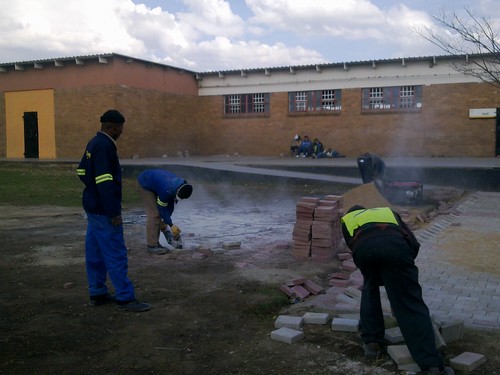
KINGSWAY CONSTRUCTION WORKERS AT WORK

The City gave the job to Kingsway Construction instead of involving the community

Without any community consultation and involvement, a company called Kingsway Construction has been sub-contracted to renovate the centre.  The Kliptown ISN project team strongly believes that the renovation was motivated by their proposal as well as their follow ups. Their reason for this notion is that the centre was left for years to be vandalized and never maintained, but only a month after their proposal, renovations are done. The biggest problem however lies in the fact that (1) there has been no community consultation prior to the renovations. (2) Renovation is being done without community participation. The ISN community leaders of Kliptown view this as a poor approach to community empowerment. “What is being done is good, but the manner in which it is being done is unacceptable” Jeffrey said.

The community is currently attempting to set a meeting with JPC to make a follow up on the above mentioned issue. Besides the follow up, the ISN would like to use the next meeting with JPC as an opportunity for advocating for the community’s involvement in the management of the centre. Since Gauteng now has a teams for all components, the Kliptown community members have requested for support from members that fall under the component of ‘Partnership with Municipalities’ to take part in the next meeting with JPC. The Gauteng ISN component representatives have began supporting their respective components as was witnessed in the case of Majola (one of the representatives of the pilot project and technical team) who supported Kliptown during the last visit dated 17/05/2011.

Spatial Profiling and Smart Planning: the Case of Langrug

By News No Comments

By Barbara Torresi, CORC

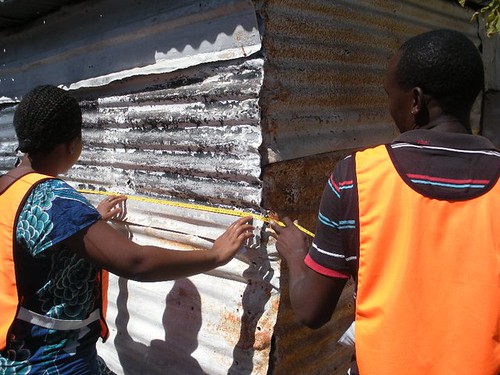
Measuring
On my first visit to Langrug in February 2011 I was surprised to hear that until a few months earlier the relationship between this sprawling hillside settlement and the municipality to which it belongs was very weak. There was also little knowledge of community dynamics on part of the community itself since in the previous few years Langrug’s population had been growing at breakneck speed, destabilising existing ties and creating new ones almost overnight. The opportunity to turn things around came in November 2010, when a court order forced the Stellenbosch-Pniel-Franschhoek municipality to upgrade the settlement’s waste disposal system to prevent toxic seepages to a nearby farm. Far from fighting the order or downplaying the measures needed to comply with it, the municipality grabbed the bull by the horns and incorporated its new waste management programme into a comprehensive slum regeneration strategy. This required a better knowledge of the space that planners, engineers and community leaders would soon to be dealing with, and self-enumeration was identified as the best tool to generate the required information. Therefore, in February 2011 CORC deployed a volunteer team of experienced community members from the ranks of ISN and the Western Cape Backyarders to mobilise Langrug. Enumeration followed suit, uncovering the existence of a diverse, vibrant, yet desperately in need of upgrading settlement of 2118 shacks and over 4700 people, one third of whom have currently access to neither electricity nor sanitary facilities.

profiling team

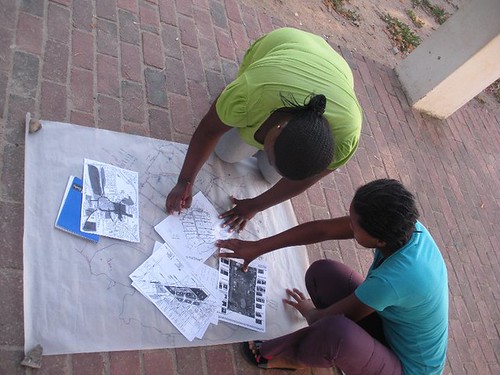
Spatial Profiling

The enumeration was complemented by a thorough physical survey of the built-up land, which was undertaken by three dedicated community members – Kholeka Xuza, Olwethu Mvandaba, and Zukile Mapoko – over the same time period. CORC supplied an aerial photograph of the terrain as well as some guidance on conducting spatial analysis, and in particular on what indicators to look for and how to identify an area’s constraints or opportunities for development. Then, photograph and markers in hand, the team went out into the February heat to locate all the infrastructure and facilities that they had agreed could benefit from improved maintenance or upgrading. The result was an interim map that detailed the position and conditions of all Langrug’s toilets, water taps, drains, drainage gullies, electricity boxes, street lights, and commercial activities, and thus threw light on some of the settlement’s most pressing issues. For example, the map has uncovered that a large ablution block in the upper reaches of Nkanini, the largest of Langrug’s three sectors, is only partially functioning, with just six water taps out of ten in service and doors missing from three of its ten cubicles. This clearly exemplifies the discrepancy between what the municipality thinks it is providing to the community and what the community is effectively provided with: “Sometimes we have to queue to draw water [and] toilets without a door are a big problem: They are dangerous and uncomfortable to use since we have to get a blanket to cover ourselves”, Olwethu explains. Likewise, notwithstanding the municipal engineers’ original intentions, Langrug’s drainage system has become a patchwork of broken concrete drains and community-dug gullies overflowing with garbage, the exact layout of which has also been detailed on the profilers’ map. In March 2011 this was then presented by its authors to the Stellenbosch Municipality’s Board of Directors, who responded to the community’s main infrastructure-related grievances by calling for a list of tangible requests, articulated as a masterplan, to be submitted to the municipality for consideration.

Langrug_20110324_0001 (2)

Scaling up and Exporting Skills

But what is perhaps more interesting is that in line with CORC’s mission of promoting community empowerment by helping people to capacitate themselves, Langrug’s profiling team is now teaching other communities to look at their own settlements with a critical eye. Kholeka has just returned from a successful training mission in nearby Kylemore and is now looking forward to taking on even bigger challenges, such as relaying her experience to profilers in Stellenbosch’s other mammoth slum, Kayamandi: “They are also very large, and they are located on a hill like us, so their problems will be similar to ours. I think they will find the  type of profiling that we are doing here very useful, and we can also learn from the way they are dealing with some of the challenges [posed by] maintaining facilities or dealing with flooding”. “Yes,” Olwethu chimes in “and we are also looking forward to trying GIS mapping as it will make it easier to communicate to the municipality what the problems in our settlement are, and what can be done to fix them”. So, is the profiling team being trained in computer-aided mapping, I ask? “We have already been to a presentation [on the merits of GIS] and CORC is now supervising our training in computer literacy. We are also attending meetings on various topics such as strategic planning and savings; it is important that [we have a good grasp of] different perspectives if we want to involve other communities in the planning of their own space”.

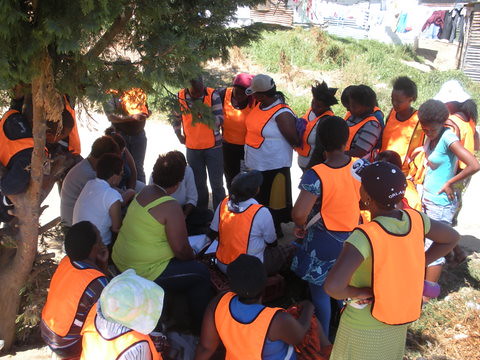
Discussing

The Work on the Ground

Sometimes, however, even the best planning strategies remain at a theoretical stage, with implementation being squashed under the burdensome weight of unfriendly policies, lack of interdepartmental co-ordination, and rampant budgeting inefficiency. But in this case, I am informed, the municipality is going to take up the challenge of making good use of the community’s hard work and improve Langrug’s living environment. Thus, while the profiling team is busy preparing a masterplan for the next budget allocation meeting, agreements are being made to have leaking taps fixed and blocked drains unblocked. Moreover, the survey has uncovered a number of illegal water connections that weaken water pressure and that, since illegal taps tend to have no corresponding drain, contribute to worsening Langrug’s greywater problem. Once alerted of the issue by the profilers, the community agreed to ask the municipality to sever all illegal water connections as a stopgap measure while a more powerful water pump is being installed and a better drainage system built: “We cannot wait for the government to come to us with their plans,” Kholeka says, “but we need to take the matter in our hands as we know what our settlement is like and what we need to improve it”.

Smaller FEDUP houses for Gauteng

By News No Comments

By Max Rambau, CORC

On the 13th of May 2011, the Gauteng Department of Housing and the project manager of the Garankuwa Municipality met with FEDUP representatives  to discuss the housing project in Garankuwa Extension 20 and 23. The Province and the Municipality were complaining that this project had taken a long time and was not yet completed.

We indicated the reasons why the project had delayed completion that the amount of money that the Garankuwa Municipality was giving us for each house was too little. The municipality was giving out only R5 000 instead of R14 000 for the foundation. We told them that FEDUP has been giving reports to the province and the municipality on this project and why there were problems with completion.

We also indicated that we had written a letter to the Province requesting them to increase the money they were giving us but they instead sent it to Mafikeng in the North West.

The Garankuwa municipality Project Manager, Mr. Hlongwane said that we were working with the higher structure and senior officials and mayoral committee members and that is why there were delays. He said that if we worked with them things would work out very well.

The Province indicated that they had abolished PHP in Gauteng and when we challenged this the official changed and said that it was not applicable in the Greater Tshwane area.

The Province and the Municipality wanted us on a clean slate and proposed that if that would be the case then we need to agree that they should work according to the plans that beneficiaries had already drawn (56m²). The Province did not agree on this and suggested that we close the meeting. He then said that but indicated that they would only build 40m² houses and requested us to go to the beneficiaries to hear from them if they would agree that they be built the 40m².

It was not clear what the municipality would do with those houses that had already been built on 56m² and were on roof level.

We indicated that we would be calling a meeting with the beneficiaries and that we would send a report to the project manager on what the beneficiaries agreed on.

After the meeting we agreed that FEDUP would be calling a meeting with the beneficiaries whose houses have not been built. This meeting will take place on Sunday (15/05/2011) to get the beneficiaries to indicate whether they want the municipality to build them houses.

Spatial Profiling: Smart planning for development

By News No Comments

By Barbara Torresi, CORC

IMG_0666

The importance of spatial mapping

Settlement profiling was originally designed to complement the enumeration process and has hitherto consisted of a narrative description of the state of the infrastructure in any given informal settlement. This text-heavy approach, however, has done little to improve our knowledge of the spatial distribution of the settlement’s facilities, rendering the process an interesting but scarcely workable exercise. Yet, the potential applications of spatial analysis are huge, for strategic mapping goes beyond a simple reading of a settlement’s physical layout by deconstructing and decoding its deeper structure. This can thus uncover shortcomings in both the physical and socio-economic environment on one hand, and ways to respond to them on the other. For example, a municipality’s ability to intervene swiftly in the event of an accident is dependent on the emergency team’s knowledge of the space they are being called into. Similarly, a feeding scheme for low-income families can benefit greatly from knowing exactly where the neediest households are located. But above all, a clear understanding of a settlement’s strengths and weaknesses can help communities prepare convincing development plans to be submitted for governmental approval.

Spatial mapping in Langrug, Franschhoek

It was with these thoughts in mind that in March 2011 Langrug’s leadership created a dedicated profiling team to work side by side with its enumerators. The aim of the project was to map the settlement’s existing infrastructure by identifying on a scaled aerial photograph the location and conditions of all toilets, water taps, drains, drainage gullies, electricity boxes, and street lights. Moreover, Langrug’s open spaces, circulation patterns, and commercial services were also plotted on the map, throwing new light on the relationship between the settlement’s physical and social environment. For example, by superimposing the commercial activity layer to the map depicting the state of Langrug’s ablution facilities it became evident that toilets within a certain radius of shebeens are the worse for wear. While this might be pointing out the obvious, visualising causality on a scaled map can help engineers tackle specific problems by providing tailor-made solutions to them, such as – in this case – more resistant, ‘anti-thug’ facilities next to drinking venues and high transit areas. On March 30th 2011, the profiling team presented the results of its efforts to the Stellenbosch municipality’s board of directors, which received the presentation enthusiastically and requested a community masterplan to be submitted to them before the next budget allocation meeting in June 2011.

Technology in Mfuleni, Cape Town

Meanwhile, another dedicated spatial profiling team in Los Angeles, a small informal settlement on the edges of the Cape Town township of Mfuleni, was developing its own mapping strategy by flirting with technology. Here digitalisation was achieved by using GIS software to trace the outlines of all the built-up structures in the study area and then incorporating information from the enumeration into the database to aid thematic analysis. The resulting maps, together with a non-community driven study in another Cape Town slum named Europe, were presented to a delegation headed by the deputy minister of science and technology, Derek Hanekom, on May 4th 2011. His positive response to these maps, which illustrated the analytical sophistication that GIS can contribute to profiling by allowing the spatial representation of cross-referenced socio-economic indicators, will hopefully pave the way for a mutually beneficial cooperation between government and grassroot movements.

Moving forward

What was still lacking, however, was an upgrading proposal to translate the wishes of disadvantaged communities into workable – and budgeteable – interventions that can provide more than a quick fix to some contingent infrastructure-related problem. This spurred CORC’s move into the next phase of its smart planning roadmap, a two-pronged strategy that aims to increase mapping efficiency whilst accelerating the planning process itself. Therefore, CORC is now enhancing the analytical phase of its current profiling strategy by introducing GIS-based mapping across the region’s informal settlements. This will be achieved by seeking collaborative partnerships with government and academia without, however, losing sight of the community-driven nature of the process. At the same time, existing settlement profiles, whether hand-drawn or computer-aided, will be analysed fortwith with the aim of creating developmental, energy conscious, and upgradeable masterplans that are able to respond to the needs, present and future, of the country’s most disadvantaged communities.

New Mind-tour youth federation emphasizes savings

By News No Comments

By Kwanele Sibanda, CORC

The Mind-tour youth federation of North West hosted a successful dialogue that was supported by a number of stakeholders. The event was held on the 7th of May 2011 and was attended by representatives from the following: South African Savings Institute, Lonemill Platinum Mine, NACTO, SASKO, Mugalie’s Juice Produce, CORC, FEDUP (Gauteng and North West), Department of Arts Sports and Culture as well as Shift (TV programme). The one-day-event held at the Oukasie community hall attracted 621 people.

The main objectives of the dialogue were to: expose more youth to the youth federation and the work that it does, strengthen the partnership with the existing companies/CBOs/organisation as well as raising awareness about the importance of savings amongst youth.

Mind-tour was established in February 2011, explained Kopano Molokoane, one of the 20 Mind-tour members. To date it has saved R 1500 which are kept in the group’s own bank account.  More than 85 percent of Oukasie youth that complete their matric are not able to further their studies. Further research into the issue revealed that a lack of sufficient information limits the chances of matriculants to proceed. The kind of information that they are missing includes what is offered by universities and colleges, due dates for applying as well as how and where to apply for bursaries.

The inability to further their studies is one amongst many challenges that are currently hindering a better future for youth residing in a settlement such as Oukasie.

Bearing this in mind, a group of youth – most of them having been exposed to SDI rituals through the membership of their parents in FEDUP – adopted this methodology and began to mobilise others through savings.  Partnerships have been created with organisations that are relevant to the needs of the youth. Some of these organisations are:

LONEMILL PLATINUM MINE – assists them with bursaries for science and technology courses.

NACTO – they identify, create, develop, produce, maintain, and promote arts and culture talent.

DEPARTMENT OF EDUCATION – have partnered in line with expanding the savings concept in schools.

BOSCH AND FIRE STONE – employment for the unemployed.

All speakers emphasized the importance of savings. Ester, one of the North West Federation members, motivated the youth when she said: “There is a huge difference between someone who starts saving at an early age and one who starts at a later stage in life. Save with a goal in mind, and you will achieve it.”

In between presentations and speeches, the audience was kept entertained by inspiring songs and educative drama. The attention of the audience was captured as there were presents given to those who gave correct answers. Questions were asked in line with each presentation.

The presents ranged from caps to T-shirts, donated by SASKO. Cash for correct answers was given by NACTO. SASKO also donated bread and cheese, lunch was provided by Lonemill Platinum Mine and Magalie’s Juice Produce helped with non-alcoholic drinks.

In summary, Mind-tour has been established and driven by youth. Their ability to mobilise, save and establish a meaningful partnership with key stakeholders, plus their ability to successfully organise such an event is an indication of the great potential of impact that they can have in the development of the youth in communities. As a way forward, it can be recommended that the Mind-tour youth federation be given support and opportunity of expanding to other regions using their experience.

In serving the best interests of children, we serve the best interests of all humanity. Let us not view children as property, but people with the ability to do great things. Everyone deserves the best start in life, and our support for them will certainly make a difference in the future of our communities.

Farm labourer pushing for justice after assault

By News No Comments

By Max Rambau, CORC

On April 19, 2011, the ISN met with representatives of the Hekpoort Police Station, namely the station commander, the deputy station commander and the investigating officer. The office of the MEC for Safety was also represented by an official.

This meeting followed the general meeting that was held on the 5th February in Hekpoort where the case of Mr. Sam Manganyi was reported to CORC and the ISN.

CORC and ISN took the case to the MEC’s office after the assault charges against the neighbouring farmer and the police.

These incidences had occurred in the following manner:

Mr. Manganyi’s employer of ten years had sold his farm to another farmer, Mr. Robbie Lehane. It appears that the new owner did not want Mr. Manganyi on the farm where his former employer had given him a place to stay and also given him a tractor, combi and ploughs as part of the retrenchment package.

There are two houses (3 roomed and 2 roomed) that Mr. Manganyi had built by himself as a labour tenant.

The new farmer, Mr. Lehane started accusing Manganyi of stealing some farming equipment and had him arrested by the police who also assaulted him. The charges that Manganyi laid against the police and the farmer have not been considered and the case has not progressed.

The investigating officer brought the file of this case but we found out that the charge had been changed from that of assault to common assault. The investigating officer said that he had found the file written as such. It is clear that the police officers who recorded the case must have known that this case was going to affect their colleagues and then changed it to common assault to protect them.

We agreed that in future, Mr. Manganyi would have to go straight to the station commander should he encounter any problems. It was also agreed that the official from the office of the MEC would accompany Mr. Manganyi to court to reopen the case on the 4th May. Also, they would go to the ICD to report the police who had changed the charges from assault to common assault.

Mr. Manganyi and the official from the office of the MEC would go to the Small Claims Court to claim for the damaged goods during the assault on Mr. Manganyi.

Mr. Manganyi was very happy that this case is finally progressing.

This case is now in the hands of the office of the MEC. CORC and ISN will receive reports of how it is progressing.

Bapsfontein people after relocation: Jobs lost, water spoilt

By News No Comments

By Max Rambau, CORC

Bapsfontein10April2011
On Saturday, 9th April 2011, I went to visit the area where the Bapsfontein families were relocated to in Zenzele (about ten kilometres from Bapsfontein).

I spoke to some families to find out how they were settling down in their new area. They told me that the place they were in was fine because they’ve got water and VIP toilets in one section of the area.

Those families who were in the other section told me that they had problems with people from the nearby township who did not want them around. These people overturned the VIP toilets and poured the contents into water tanks.

I promised that I would report this to the municipality.

Most people had lost their jobs and life was very tough for them as they have to spend a lot of money on transport.

I spoke to the local leadership and asked them to arrange next week’s meeting.