Category

News

Mapping partnership at Ruimsig makes good progress

By News No Comments

By Max Rambau, CORC

MappingRuimsig

Architecture students from the University of Johannesburg recently reported back about the community mapping process at the informal settlement Ruimsig.

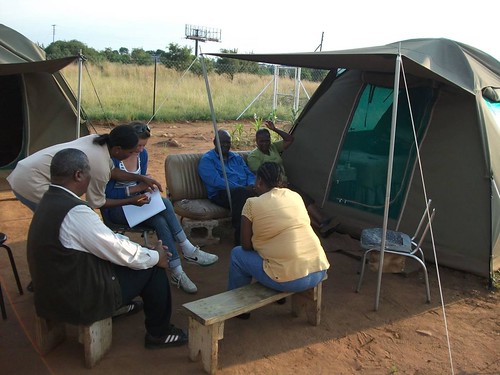
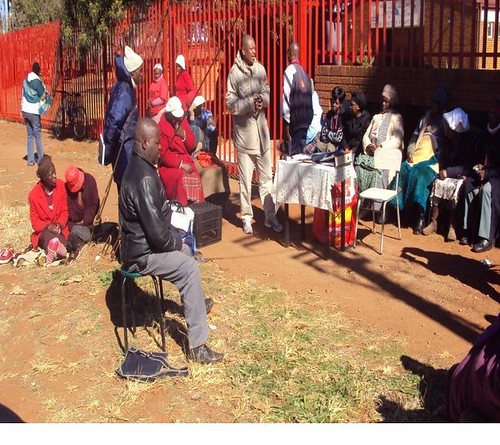
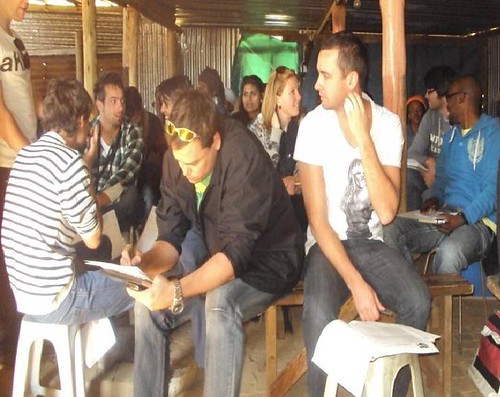
Representatives of the City of Johannesburg, the community and the Informal Settlement Network (ISN) were present. In total,  about 40 people attended the meetings, which were structured into four groups at different venues.

Group A, which met at a local shebeen, reported about their mapping and Mampho’s house which is very big and nice with five backyard shacks in a spacious yard. Mampho built her house with bricks she had collected from a rubbish dump and only spent R1640.00.

They went on to report about Mampho’s family lifestyle and that both her and the husband were unemployed but are managing to fend for their family by doing some piece jobs.

The second report-back by Group B was held at a spaza shop. They chose to report about Thomas’s house (No. 209) because he was the first person to stay there in 1982. Thomas also built his house with used bricks from the dump site. He has built a very big house. Building his house and paving the yard cost him about R21000. The students had not yet measured the size of the house but only the yard and were going to do that later. Thomas generates electricity with four petrol generators. People watch their soccer matches at his house. There are also electronic game machines where local children pay to play them. Thomas has also built fireplaces outside where they cook their food. There are tenants in the yard who pay from R120 to R400 per month.

Group B went on to report about Mashudu’s house. This house (No. 171) was chosen because it has a very beautiful yard. Mashudu comes from Limpopo and her husband is from Mozambique. The husband also does some odd jobs. In December, Mashudu goes home in Limpopo and her husband goes home to Mozambique.

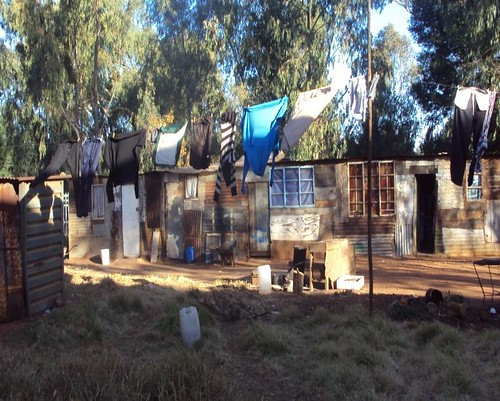
Group C reported from Albert’s house. They reported that most of the people in that section of Ruimsig had big yards and they mostly came from Venda. The yards are big, and there are tenants staying there, but most of the owners do not stay there. More than eight owners are not staying there. They reported that some tenants had moved with their house numbers from where they stayed earlier and as a result, house numbers are confusing in the area.

Group D was the last group to report. They reported from Albert’s house in an area called wetland. This area is not called wetland because it is a wetland. It is called as such because it is at a lower point, and when it is raining all the water from the rest of Ruimsig goes there and floods these shacks. The area is also congested. One resident has got eight tenants in his house. Alfred has a big shack that has many rooms where there are tenants staying. Most people staying there are working at nearby businesses and they walk to work.
Alliance discusses Growth and Development Strategy with City of Johannesburg

By News No Comments

By Max Rambau, CORC

On Thursday, 4 August 2011 I attended a meeting that was called by the City of Johannesburg to discuss its Growth and Development Strategy 2040 (GDS 2040). This meeting was held at the Johannesburg Botanical Gardens (Zoo).

The keynote address was given by Councillor Dan Bovu (MMC for Housing). He welcomed everybody. He said that the Planning Department of the City of Johannesburg must take a lead in the development of the city. He said that the city, in 30 years’ time must look completely different.

He challenged universities and other institutions to help the municipality in planning for the future.

He went on to challenge the participants to also assist in refining the Growth and Development Strategy 2040, so that it is a strategy that has the input of all stakeholders. He said that there were documents like the Freedom Charter, which, according to him, was a living document whose ideals must be realized. He said that the strategy document must take into consideration that Johannesburg is a young city of 120 years. He said that this city was not inhabited before the discovery of gold, and therefore all the people in it have their origins elsewhere. It was first populated by immigrants.

A presentation was then given by Walter Melato (Executive Director: Housing). He touched on the following issues:

  • GDS Context & Livable City
  • Planning Context
  • Housing Context
  • Community Development Context

After the presentation, participants (stakeholders) gave their input. Among the inputs of the participants was the issue of housing relating to rental stock and ownership. It was suggested that the City of Johannesburg, in its growth path must consider different options because not all people would want to own houses, they would prefer to rent because they have homes in other parts of the country. Also, the issue of continuing to build townships instead of integrating suburbs together with townships is like continuing with separate development. The inner-city housing should also be given attention.

It was agreed that issues relating to planning would be discussed in the next meeting.

The conference to finalise GDS 2040 will be held in October 2011.

Fire destroys 200 shacks at Slovoville

By News No Comments

By Max Rambau, CORC

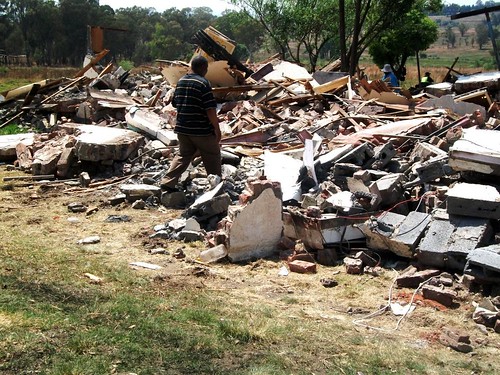
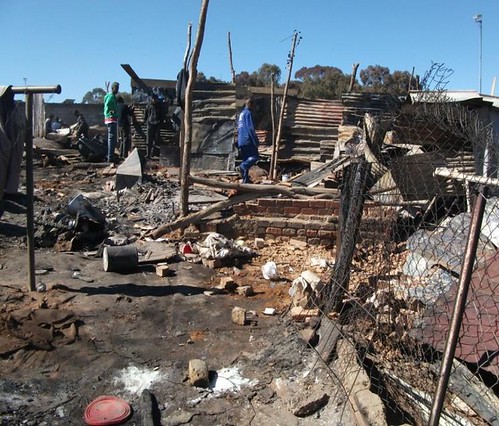
A fire destroyed  almost 200 shacks at Slovoville Informal Settlement near Coronation in Johannesburg. There was confusion as to how the fire started. Some people claim that there was an old lady who had left her primus stove burning and it caught fire. Some people say it was an illegal electrical connection. The shacks and all its belongings burnt to ashes. Fortunately, no people were injured or died.

SlovovilleFire1July30
The burnt out shacks were flattened. Nothing was left except for a few small items like suitcases.  Some people  lost everything including ID documents and valuables.

The fire started at around 8pm and being at the end of the month, some people were not in their shacks and had gone home (homelands).

The City of Joburg’s Disaster Management responded by bringing blankets. The local councillor and the provincial government also responded positively by bringing food for the affected people. The Gauteng Department of Housing also brought building material, corrugated zinc for people to rebuild their houses. Responses were very good from the surrounding community of Coronation.

The affected people were accommodated at the nearby Coronation Secondary School. Food was provided for at the Coronation Hall by the local community.

When we did an evaluation yesterday, we found that there was no control as some people who were not affected by the fire got blankets ahead of some of the affected people. Some people got corrugated zinc and other building material. These people started selling blankets and building material that had been donated. A single corrugated zinc sheet was being sold for R20.

The Gauteng Department of Housing will be bringing additional building material, and they will then check the people who really need this material. Because of the lack of proper organisation, there will be security guards who will ensure that the distribution is done in an orderly manner.

We agreed to meet again on Sunday, and when I went there this morning I found that most people were starting to rebuild their shacks, mostly using their burnt material. Most people were complaining that they did not get blankets and building material.

I tried to get hold of the local leadership, but it was clear that they were not working as a unit. There were different lists of the victims that did not have the same numbers. I then  asked them to try and meet in order to have control and to provide leadership. I promised to keep on checking new developments and that I would also be visiting the area from time to time until everything has been settled.

Ruimsig informal settlement prepares for mapping

By News No Comments

By Max Rambau, CORC

On Monday, 18 July 2011, we went to the informal settlement Ruimsig where there was going to be a community meeting between the students of the University of Johannesburg (Faculty of Art, Design and Architecture, Department of Architecture) and the community of Ruimsig for their three weeks’ programme of mapping in the area.

RuimsigStudents

Students of the University of Johannesburg assist the community with the mapping process

As this meeting was on Nelson Mandela’s Birthday, the community and AfriCem, as well as the ISN members and leadership collaborated in a “Mandela Day” Clean-Up Campaign in the morning until after midday.

AfriCem, a cement company brought their trucks and graters and the dirt roads in the area were grated clean.

After the Clean-Up campaign, a meeting was held between the community, the students and local and provincial leaders of the ISN.

We introduced the students and professors to the community.  The students and the trained community architects will work together in the three-week-program in the area that has been divided into A, B, C and D.

Each team will have its own arrangements on how they are going to work in their respective areas and they will then have their meetings on Thursdays to report back on their work.

The teams will work in the afternoons because the students involved will also be attending the lectures in the morning. Although the UJ professor had requested to thank the teams it was suggested that this should be done after they had finished work.

Court hears Lanseria eviction case

By News No Comments

By Max Rambau, CORC

The leadership of the Malatjie Informal Settlement informed the alliance that the Lanseria eviction case was going to be heard at the Randburg’s Land Claims’ Court.

This case relates to the eviction of people in Lanseria (Bultfontein Farm) by the landowner, Mr. Martin Wood, who also destroyed the houses and damaged their goods.

The case was adjourned from last month, and on July 11 the last three witnesses took the stand.

The Gauteng Provincial Housing Department was not available. The City of Johannesburg Municipality did not take the stand.

What was a bit of a concern, as it also was last month, was the manner of questioning of the witnesses. The lawyers representing the City of Johannesburg Municipality and those representing the landowner asked questions that did not relate to the case at all. They asked questions that were personal. They asked questions about financial status and the possessions of witnesses. We could not understand the reasons for this line of questioning.

One of the lawyers for the City of Johannesburg asked the witness why he had applied for an RDP house, and how much money he was earning. The lawyer also told the witness that he had a lot of money.

The witness ended up getting angry for being asked these type of questions by different lawyers and ended up telling the lawyer that it means they had destroyed their houses because they thought that they had a lot of money. The lawyer then stopped asking the witness any further questions.

Even the judge had to reprimand the lawyer for asking irrelevant and personal questions sometimes.

The lawyers were actually badgering the witnesses and putting words in their mouths.

The court will hear the final arguments from the lawyers on the 19th July 2011.

The ISN and FEDUP in Region A will prepare themselves to go and give support at the Randburg Land Claims’ Court.

Untitled
The people of Lanseria were evicted, their belongings thrown next to the road and their houses destroyed.

Lanseria4
After they were evicted, the residents were housed in tents.

Meriteng settlement in Gauteng prepares for enumeration

By News No Comments

By Kwanele Sibanda, CORC

Meriteng is an informal settlement that was initially mobilised on the 28th of June 2011 during an exchange with ISN/FEDUP representatives from Durban and Cape Town. The exchange led by Patrick Magebhula was a form of support to the Gauteng region as well as encouraging or showing the importance of making follow ups. Meriteng informal settlement falls under Johannesburg (Region G) and it is situated between Finetown and Lenasia South. Information gathered from the recently held meeting suggests that the settlement has been in existence for over fifteen years as there are fifteen year old children who were born on the same piece of land.

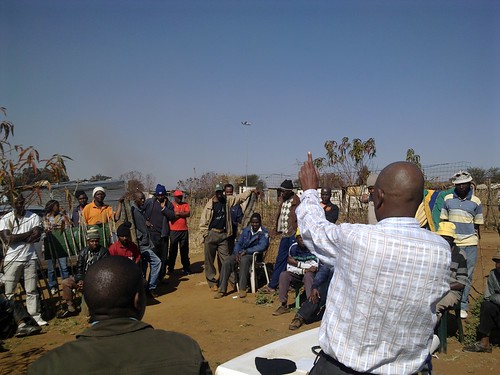
Patrick Magebula addressing the community of Meriteng

ISN Chairman Patrick Magebhula explaining the benefits of a community survey

Upon entry into the community on the first day of mobilisation, it was asked if the community has a committee. The mobilising team was informed that it is only the CPF that is in existence and is active. Two CPF members that were available were briefed about the work of the alliance. As they were interested, they requested for a formal meeting with the entire CPF members. The meeting was set and held on the day that followed at sunset. As the CPF members expressed interest, they requested for some time in order for them to inform their community and then invite the mobilising team to address the community.

The CPF members organised the meeting with the community and it was held on the 3rd of July 2011 (during Patrick Magebhula’s second visit). After giving the background of the alliance as well as emphasizing the necessity of equipping the community with its own information, enumeration was identified as the starting point for the development process. The starting date was set as the 30th of July 2011, however for a few days for preparatory reasons. In addition to the above, the community suggested that the CPF members act as the facilitators/coordinators of the on-going engagements. It was added that the findings from the enumeration will determine the type of committee to be formed.

On the 13th of July 2011, a meeting was held with the CPF members and it was an engagement on enumeration preparation. The meeting was led by enumeration team members that include Lucky (Limpopo) and Thato (Orange Farm). Other ISN/FEDUP members that were present were Alina, Ayanda and Alfred. Below are the key issues that came out of the meeting:

  • Reminder of community’s request for enumeration
  • Explanation of procedure for conducting enumeration
  • Highlighting of needs assessment
  • Need for community to be enumerated to take charge of the enumeration with support from the ISN team
  • Explained the data capture process and how the results can be used

The final arrangement was made as following:

  • 5th – 11th of July 2011. 5th– day of arrival for the enumeration team, 6th – day of enumeration workshop, 7th – 11th of July 2011 shall be the days of enumeration.
  • 20 Gauteng ISN/FEDUP members
  • 16 Meriteng representatives
  • 10 from other regions
  • Stationary and questionnaires required
  • Meeting to inform the Ward Councillor about the enumeration
  • A tent has to be hired for the workshop since there is no community hall
  • Representative from the documentation team

Since the enumeration of Silahliwe will start before that of Meriteng, representatives of Meriteng have already been invited to take part so that by the time their enumeration starts, they will already have members with knowledge of the exercise.

Successful partnership plans future for Barcelona

By News No Comments

After six months of thorough field research, 20 students of the UCT Planning Department presented development models for the Barcelona informal settlement, which is situated on a former landfill alongside the N2 freeway in Cape Town. Representatives of the ISN (Informal Settlement Network), the City of Cape Town, CORC and iKhayalami afterwards discussed the way forward. “We as the ISN encourage partnerships where communities are part of the process,” says ISN leader Vuyani Mnyango. “The Barcelona residents and the students worked closely together on the ground, gathering this information, so it can be used for future development.”

Lwazi Park before upgrading 2

The matter is of urgency, as the settlement which comprises a total of almost 10,000 people including neighbouring Europe, is sitting on toxic waste. Dangerous amounts of methane and carbon dioxide are seeping into the ground water. Due to Barcelona’s position on top of the Cape Flats Aquifer, this could have disastrous consequences for Cape Town’s water supply. The Cape Flats Aquifer is the third largest water resource after the Newlands and Atlantis aquifers to secure the City’s already stretched needs for drinking water. But between 1956 and 1987, the Municipality dumped an estimated 3.5 million cubic metres of rubbish on the site. Uncompounded and uncapped, the dwellers today live on six metres of unidentified waste. “The old landfill could be polluting this important resource of water for the City of Cape Town”, explains Tanja Winkler, UCT lecturer and project manager.

However, rehabilitation of the land will be expensive. Estimates range from R100 million to up to R500 million. The costs should be picked up by national government, but the question is whether this will not pave the way for a developer to snap up the valuable piece of land. The area stretches over 35 hectares – the close proximity to the airport could make it an interesting investment opportunity. The residents are therefore opting for a development plan which proposes incremental rehabilitation and does not call for relocation of the settlement. With the assistance of CUFF, the new Community Finance Facility, they are busy addressing the most immediate need which is proper drainage. Especially in winter, the residents suffer from floods, caused by the overflowing, nearby Lotus river and the high water table.

But the technical work is tricky: The “spongy” land does not support structures like pipes or sewers. In the meantime, the polluted water causes skin irritation, allergies and poisoning, if mixed with drinking water. The residents complain about dampness in their dwellings. Influenza, colds, pneumonia, asthma and bronchitis are common amongst the people in the densely populated area. Tests have shown that the high amounts of methane gas in the underground rubble make explosions probable.

“We are very impressed with the detailed information we have received about Barcelona,” says Natasha Murray, Head of Planning for Informal Settlements at the City of Cape Town. “To get to this level of understanding, it can take us years of working through expensive consultants. In this case, we are ready to ask province for the support we now need.”

News flash from Erasmus, Zuurbekom and Dipatseng informal settlements in Gauteng

By News No Comments

By Max Rambau, CORC

At a recent visit to Erasmus 2 in Ekurhuleni, a local leader took us to the nearby emerging informal settlement. It was very cold and the rest of the leadership was delayed. We could not wait for all of them, but we managed to meet with a few. The meeting went well. The tenant who is renting from the absentee landlord at Erasmus has already started getting people in to build their shacks on the farm. About 50 families are now staying here. Two shacks have been built on the verandah of the house.

Erasmus29June

On Sunday morning we went to Zuurbekom where ISN chairman Patrick Magebhula was addressing the saving scheme on savings and land. Patrick asked the savers whether they knew about the Informal Settlement Network. He then outlined what the ISN is and asked them to get one member to represent them in the network. On the issue of the number of members in the saving scheme it was not clear, from the different answers, how many members they had but promised to compile the data of their membership. On the issue of land it was also not clear how much the land is in the negotiations. There is private land (R500 000 as a part but R2 million for the whole land) as well as land that is owned by Intersite (railway), but the latter’s size is not clear. Patrick will be coming back on the 7th July to assist in checking the progress on the questions raised in the meeting.

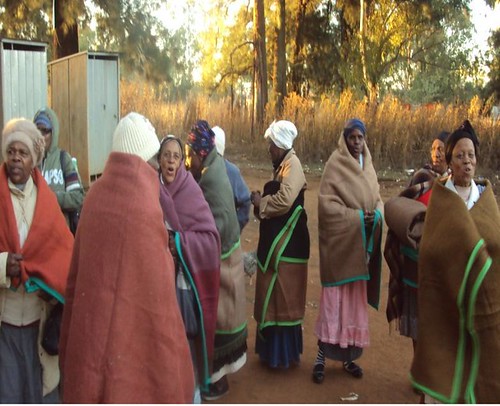
Zuurbekom29JuneIn the afternoon of the cold Sunday we were at Dipatseng Informal Settlement (near Lenasia Trade Route Mall). The purpose of our being there was to distribute blankets to some needy people and the elderly. The winner of the month of May 2011 in saving, the Ipopeng Saving Scheme from Carletonville were also given blankets. We received blankets from with Pastor Jordaan (wife of Danny Jordaan) who came on behalf of four churches, St. Johns, Anglican, Methodist Church, African Methodist Church and a church youth group. They handed over blankets to needy and elderly people from Carletonville (Ipopeng Saving Scheme), Protea South, Kliptown, Eldorado Park, Vegeland and Thembelihle. Slovo Park and other areas that included Orange Farm could not come because they did not have transport. Zuurbekom and Duduza could also not come. There were some people (Protea South, Kliptown and Meadowlands) who had had their shacks burnt who were given blankets. The people were so appreciative and sang songs to show their gratefulness. About 75 people benefitted from this kind gesture.

Untitled

Slum dwellers come out with new uTshani Buyakhuluma

By News No Comments

DSCF0213

The grassroots are talking again: A few days ago the new issue of the community newspaper uTshani Buyakhuluma came off the press. 4000 copies are currently being distributed to informal settlements and backyarder communities all over the country. The second issue boasts more of the same and more: stories about communities mobilizing  for basic service delivery and upgrading. Accounts of disasters, evictions and other land struggles. Reports about learning exchanges between slum dwellers, and enumerations done for capacitated negotiations with government partners. A call for proposal introduces CUFF – the new Community Upgrading Finance Facility, which gives organized slum dwellers the opportunity to apply for up to 90 percent of project funding.

IMG_4305

At a recent documentation meeting at the Lutheran Centre in Cape Town, about 25 editors and writers discussed the way forward: uTshani Buyakhuluma proudly supports the work of the SDI alliance in South Africa – from FEDUP savings schemes, to ISN pilot projects or land issues of the Backyarders. The newspaper also reaches out to communities who are not yet part of the network: It builds the voice of the poor. It creates solidarity to find solutions together. And it instills hope that change is possible.

To read the full issue of uTshani Buyakhuluma go to http://www.sasdialliance.org.za/static/upload/docs/UB_Issue_2_Full_Revised_June_8_3.pdf

To contribute email bukiwe@courc.co.za

Two alliance members on M&G Top 200 list

By News No Comments

The South African SDI alliance gladly announces that the weekly Mail & Guardian has selected two of its members for their prestigious list of Top 200 Young South Africans. Mzwanele Zulu from the Informal Settlement Network (ISN) and Ben Bradlow, research and documentation officer at the secretariat of Slum Dwellers International (SDI), are the nominees. “The yearly search for South African talent cuts through the clichés to find the country’s most thrilling potential precisely where it emerges from a context full of challenge, bewilderment and opportunity”, says editor-in-chief Nic Dawes about the selection process.

vcm_s_kf_representative_640x360

Mzwanele Zulu emerged as a leader after a fire gutted 60 shacks in the Joe Slovo informal settlement  near the N2 freeway in Cape Town. He today heads the Western Cape branch of the ISN, a bottom-up agglomeration of settlement-level organizations of the poor, which is active in five cities. The network’s philosophy includes working with communities who are ready to help themselves and by doing so breaking the culture of entitlement and dependency on government. Zulu: “We want to change the way cities are planned and developed so that people are directly and actively involved”. Strategies include surveying and registering all informal structures in the city and developing the capacity of communities (through exposure to pilot projects) to plan and implement upgrading projects.

SDI documentation officer Ben Bradlow feels privileged to learn from “some of the most imaginative people in some of the most unlikely places”. He supports the new community newspaper uTshani Buyakhuluma. 4000 copies of the June issue are currently being distributed to informal settlements throughout the country.

To read more about the two nominees, please go to the following links

http://ysa2011.mg.co.za/category.php?youngid=79&categoryid=3 (Mzwanele Zulu) and

http://ysa2011.mg.co.za/category.php?youngid=66&categoryid=3 (Ben Bradlow)