Category

News

ISN action plan for Thembelihle residents after bloody service delivery protests

By News No Comments

By Kwanele Sibanda, CORC
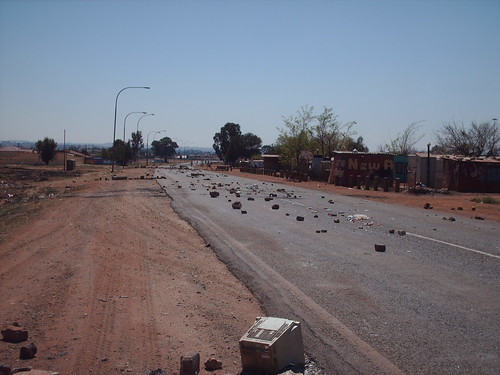
One of the barricaded streets of Thembelihle

Barricaded streets in the Thembelihle: The police used live ammunition to regain control of the informal settlement

On Wednesday, September 7, ISN representatives attended a public meeting in Thembelihle and  collected the contact details of the leadership.

The next day, the ISN members managed to secure a meeting with the leaders and explained to them what ISN is all about. The leaders understood and showed interest in the ISN’s approach to the process. Hence they immediately gave the ISN members a chance to introduce themselves to the community. More than 400 community members were present at the public meeting.

One of the leaders said that as they attempted to march to court, they were blocked by the police and asked to send only five representatives. The police actually accompanied the five to court. To avoid marching in the streets, the leaders arranged with the local taxi association and got taxis to transport the people to court. As they arrived at court, four of their members were arrested and charged with ‘illegal gathering’. The leader that organised the meeting between ISN and the Thembelihle leadership was amongst the four that were arrested.

Those that were arrested on Monday morning were charged with events that took place in the evening. They were denied bail and told that only on Friday could they do their formal applications.

Women who went to the police station were informed by the station commander that the police have three members that are on their wanted list and all of them are community leaders. It is alleged that the police are suspecting them of initiating and leading the protest. The community now feels that taking away the leaders is the police’s approach to disintegrating the community so as to end the protest.

The exact number and names of those seriously wounded is not known by the community.

The community nominated Bhayiza to be the community’s spokesperson for the protest (he is apparently in the list of the wanted).

In the public meeting, the leaders condemned criminal activities such as the looting of shops.

As a way forward, the Thembelihle leadership and ISN drafted a programme of action. The programme mainly seeks to address the critical issues at hand and they are as following:

  • Legal support for those that are arrested and those that are on the wanted list. The ISN has already made an appointment with a lawyer who has previously assisted them in community related struggles.   Three ISN members and three affected Thembelihle residents will be present.
  • Two ISN enumeration members and a team from Thembelihle will work together in gathering information such as the number of those that are injured, received/not yet received treatment, their house/shack numbers etc (a hint to the community about the importance of an enumeration).
  • Community contributions for food for those in the holding cells and children left behind (demonstration of the importance of community savings).
  • Negotiations with private hospitals to assist the two who are fighting for their lives after being shot with live ammunition.

The ISN has begun by working with the Thembelihle community in identifying key or critical issues that need immediate attention. The ISN will use its experience for example in the gathering of information and existing partnerships to link the Thembelihle community with formal institutions that are relevant to their struggles. The current form of support has already created an entry point into the community. A bigger role will come into play when the enumeration and engagements with government start.
The third issue is out: The grassroots are talking once more

By News No Comments

DSCF0206

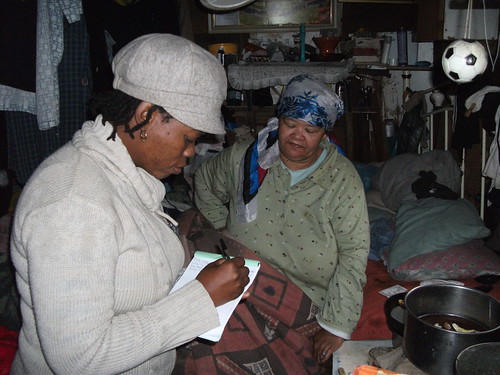
Ayanda Vena from uTshani Buyakhuluma reports about dire living conditions in Athlone, Cape Town

The new and third issue of the community newspaper uTshani Buyakhuluma is being distributed to informal settlements all over the country. 6000 copies tell more stories about  the work of the South African SDI alliance to strengthen the voice of the urban poor: communities mobilizing  for basic service delivery and upgrading, accounts of disasters, evictions and other land struggles, reports about learning exchanges between slum dwellers, and enumerations done for capacitated negotiations with government partners.

To download a copy of the new issue please click here or go to “Docs” on www.sasdialliance.org.za

ISN assists community after bloody service delivery protests in Thembelihle

By News No Comments

By Kwanele Sibanda, CORC

Residents of Thembelihle informal settlement, south of Johannesburg started a service delivery protest on Monday the 5th of September 2011. The informal settlement is situated near Lenasia. On Tuesday the residents were addressed by the Johannesburg MEC who told them that the department cannot build houses for them where they are residing because the land has dolomite. Furthermore it is said that the MEC said that according to his knowledge the original residents of Thembelihle were relocated to Lehayi and the current residents invaded the land after relocation.

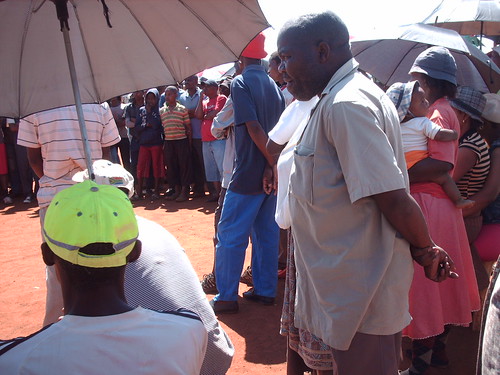
Public meeting in preparation for the march to the magistrate's court
ISN and residents discuss strategy for their march to the magistrate’s court

On Tuesday ISN members decided to arrange and send seven members on Wednesday to go and assess the situation on the ground and also find out from the community how best they can support them. When ISN visited the settlement on Wednesday morning the atmosphere was calm, but accessing the community with a vehicle was still difficult since the roads were still barricaded by burnt tyres and rocks from the Monday demonstration.

ISN’s approach was that of first meeting with the leadership of the settlement. The ISN team arrived shortly before a public meeting started. In the meeting, the residents expressed anger mainly over two issues: the use of live ammunition by the police within people’s yards and the arresting of protesting members. As a way forward the community agreed on taking the following actions:

Ø Marching to the magistrate’s court to demand the release of their fellow community members.

Ø Conducting a survey to count the number of the injured and finding out whether they had received medical treatment or not.

The residents of the community demonstrated community cohesion as they made collective plans of action. As the situation was still tense with residents planning a march to the magistrate’s court, the ISN members found the following to be appropriate to do at that particular moment:

Ø Gave the leaders advice of informing the police prior to the commencement of the march to court and also encouraging their members to engage in a peaceful march.

Ø  Got contact details of the leaders so that arrangements can be done for the mobilisation of the community.

The police however stopped the march to the magistrate’s court and communicated with the leaders that only five representatives could go there and find out what the outcome is.

The documenting team from Utshani Buyakhuluma was also present and they documented a story on the shooting of Lloyd Baloi with live ammunition within his yard at 11pm on Tuesday.

Today at 3pm the ISN team is meeting with the Thembelihle leadership to explain to them the ISN process and also hear their take on it.

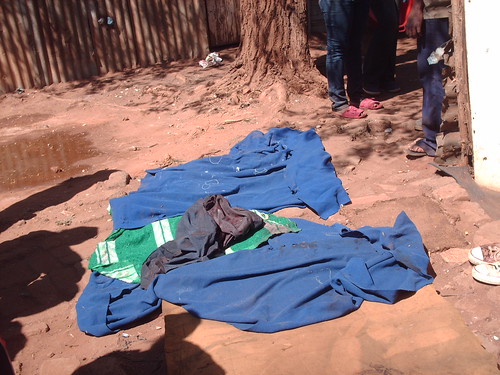
Blood

The blood-stained clothes of the resident who was shot during the protests

iKhayalami’s Andrea Bolnick wins Ashoka fellowship for Southern Africa

By News No Comments

AndyIkhayalami

CORC continues to provide platforms for the growth of dedicated professionals as well as community leaders: The latest award winner is Andrea Bolnick, who as programme director of  iKhayalami  produces affordable, innovative, and incremental technical solutions to the urban poor. After going to a selection panel in Kampala in May, the Ashoka office in Washington informed Andrea last week that her candidacy for an Ashoka fellowship was successful. Ashoka is a global organization supporting social entrepreneurs with innovative ideas in transforming society. Beginning with the first Ashoka Fellows elected in India in 1981, Ashoka has grown to an association of over 2,000 Fellows in  more than 60 countries.

“I realized that there is huge gap between the poor who are lucky enough to get a state subsidized house and the remainder who live in abject poverty in shacks while they wait for the ‘promised’ subsidy,” says Andrea Bolnick.   “It became abundantly clear to me that something had to be done to address the needs of millions of people who fall out of the state grant system. It is for this reason that I set up iKhayalami.”

Her team at iKhayalami, part of the South African SDI alliance and based in Cape Town, designs and manufactures very affordable, interim or incremental infrastructure and housing solutions that improve the living conditions of the people who are forced to live in informal settlements. The housing units are affordable to the very poor, fire and flood retardant, easy to transport and quick to erect. Similarly interim or incremental infrastructure solutions are innovative and alternative since in many situations informal settlements are not able to access state financed bulk services such as water, sanitation or energy.

iKhayalami intends to continue to design different typologies and source different technologies that can vastly improve the living conditions for communities and households. The multi-faceted approach focuses on:

  • The upgrading of shacks
  • Drainage solutions
  • A multitude of sanitation options
  • Alternative and sustainable energy consumption systems

An integral component is to work closely with informal settlement communities as central role players in the upgrading process.  Another key aspect is the notion of drawing government into this process so that the model can be replicated at scale.

ARC Nokwanda Langazana wins WWSF Rural Women’s Prize

By News No Comments

ARC - Nokwanda Langazana

Nokwanda Langazana from the Alliance of Rural Communities (ARC), a pro-poor SA SDI alliance initiative at the Wild Coast,  has won the renowned WWSF  prize for Women’s Creativity in Rural Life. Nokwanda, whose candidacy was initiated  by CORC, is among ten laureates chosen by the WWSF International Prize Jury in Switzerland.

Nokwanda  joined the land and tourism initiative CoConnected in 2003, a programme of the South African alliance of SDI (Slum Dwellers International). She soon became Programme Manager of CoConnected and expanded the network to 13 communities benefitting about 5,000 beneficiaries. She relaunched the organization in 2006 as Alliance of Rural Communities (ARC).

Nokwanda and her volunteer team, as well as the programme beneficiaries are living at the environmentally threatened Wild Coast in Pondoland, a Global Biodiversity Hotspot and area of remarkable endemism.

ARC is a network of rural poor communities that ensures a holistic approach of the communities by mobilizing them around their own resources and capabilities to address those challenges that most affect them. It is ARC’s vision to improve livelihoods through raising environmental awareness, strengthen clusters and implement projects for income generation. “I believe in our people and am irritated by the top-down approach of government which only creates more dependency”, says Nokwanda.

Her team has guided communities in setting up food gardens, meal grinding and sowing projects, as well as organic chicken farming. The new focus is on “green” education at eleven rural schools, where ARC runs workshops, starts nurseries and teaches about recycling. “We tell the young people about how we as human beings are linked to the environment, and what financial benefits can come out of that”.

Nokwanda has impressed the jury with her strong leadership skills, her humble intelligence and her self-motivated and tireless efforts for the benefits of the Wild Coast communities. She is a role model for all young South Africans. Nationally not yet recognized, the award will help Nokwanda to take her influence on environmental development in this country to a different level.

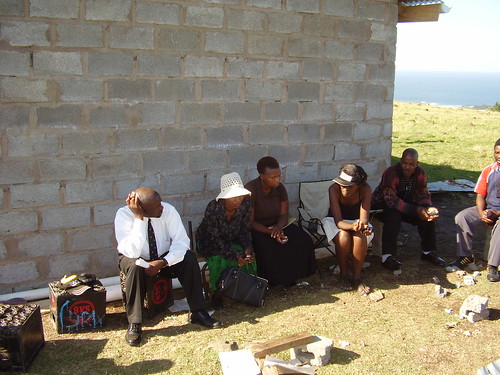
ARC - meeting at  a school

Nokwanda  informing school teachers at the Wild Coast about her green education programme

Gauteng government uses dolomite as reason to evict

By News No Comments

By Mengi Deedee, CORC

Dolomite is a reality that South Africa is facing. Some cases of dolomite are found in Johannesburg as well as in Ekurhuleni. Moray who is a lawyer working at Weber Wenzel has heard from Maryna, a researcher at GCRO (Gauteng City-Region Observatory) that Andre is doing a study on dolomite in Kathehong, more specifically at Thusong. Moray is defending residents of Protea South who are facing eviction from the City of Johannesburg. The aim of his visit at the CORC office of Johannesburg was to collect information about what is happening in Thusong and find a way to defend residents of Protea South. In fact, the community of Protea South is facing an eviction order, and they may return to CORC in the following days.

Moray, Bro Max and Andre were joined by Msibi who is a community leader of Thusong. He came to inform us about the current situation of Thusong related to the dolomite and the negotiation with the Municipality.

The conclusion reached by Moray was that the situation of Thusong is similar to the situation facing Protea South. In fact, between 2005 and 2006 residents of Thusong were relocated to Zonke extension 3 and 6. Thusong has two different zones. One zone is qualified as low risk. Zone B constitutes a high risk in relation to dolomite. Residents were evicted from the low risk area to be relocated to the medium risk area. Presently, housing development (RDP houses) is being developed at Zonke extension 3 and 6. In Protea South, people who are facing eviction are living in medium risk in relation to dolomite. If the government can develop the medium risk zone – as it is possible to build on high risk of dolomite provided some precautions -, the decision to chase people from medium risk areas seems unfair and anti-poor.

After the exchange of what is happening in Thusong and Protea South, the question that was arisen is how to build more houses in low risk areas of dolomite. In fact, the study of Thusong and Protea South recommended to build only 18 houses per hectar. This means that with that instruction, it will be difficult to accommodate everyone.

At the end of the meeting, Moray suggested to meet with Maryna to plan a common action that will guide us to deal with dolomitic situations. Metro has made up its mind and it is not willing to discuss its position or to consult other stakeholders about dolomitic situations.   This gives the impression that Ekurhuleni Metro is more willing to consult than Johannesburg. The conclusion that was drawn is that the government should be clear if it can’t afford to build or to develop low-cost housing. Dolomite becomes a very good reason for the government to refuse to develop a given area.

Ruimsig residents discuss mapping findings with students

By News No Comments

By Mengi Deedee, CORC

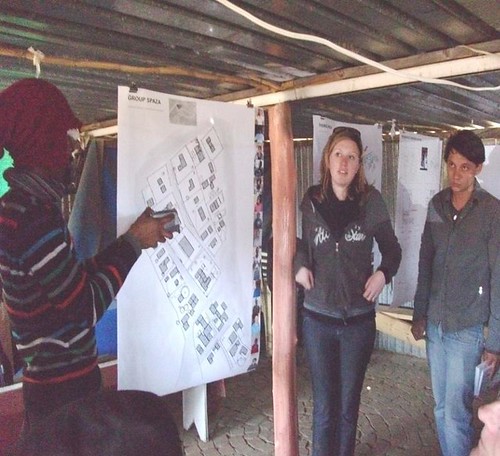
RuimsigMappingStud

After spending almost one month with mapping, architecture students of the University of Johannesburg started the second phase of their activity at Ruimsig on Thursday, 11 August. From the professional side, Bro Max and Andre attended the event. Government officials from the Municipality and the ward councillor were not in the party. ISN was very well represented, FEDUP was absent. The principle has remained the same. Four groups with two community architects in each group presented their what for Ruimsig’s development.

Before the presentation of each group, the community leader of Ruimsig raised two concerns: The first concern is that the community was feeling left aside. They explained to the lecturers their frustration. In fact, from the community side, it exists a plan for re-blocking. After discussing with the lecturers, an agreement was found about the size of the yard. The size that was retained is 15 square meters per yard.  Another concern raised is that people have tenants in their yards. According to the mapping exercise, the students have found that 95% of the residents in Ruimsig are tenants. Their landlords do not stay at Ruimsig. The community leaders believe that as the land on which Ruimsig is established belongs to the municipality, in principle the rental system should be banished. Everyone should benefit from the area, and the residents should avoid the fact that other people are being exploited by others.

The presentation of the four groups went well. Group A focused on strengthening the rental opportunity in Ruimsig. Another scenario suggested by the Group A was to distribute land equally to the residents. The main idea developed in Group B is sectional stands. This means that in re-blocking Ruimsig, a piece of land should be given to everyone staying in the settlement. In their discussion, Group C was concerned about the issue of how to incorporate ownership and the rental option. The community is reluctant toward rental opportunities happening in Ruimsig. The community only wants people who are staying in Ruimsig. The leadership believes that with the development of rentals, residents of Ruimsig would bring other people to the settlement. As a result, the settlement could become overcrowded. This reaction was qualified by the students as too simplistic.  The students raised the concern that there is a need to be rigorous, sensible and intelligent in dealing with social issues.

Group D took another direction in suggesting to take into account the economic benefit of the tenants. The group was asking if tenants can be absorbed somewhere in the settlement. Are they going to have a piece of land as well? To accommodate more people is an ideal to reach. However, design can’t solve this problem. Another issue raised by the group was how to deal with the relationship between extended family and ownership.

Students reached one conclusion which is that social issues surrounding design are not easy to deal with. Questions such as how to reconcile the formal and informal housing, and how should we make abstraction of legal issues and focus only on design were asked by the students. The students will meet again on Monday, August 15. In following the students’ debate, one may argue that there were more questions than answers. This pushed Bro Max to say that we are hoping that the students will help us to find solutions to some of the issues facing the community of Ruimsig.

After the students’ debate, we had a meeting with the leadership of Ruimsig. The aim of this meeting was to discuss with the leadership of Ruimsig some sensible issues raised by the students. It was agreed that the leadership must have control of matters that are happening in the settlement such as the rental issue. The matter related to foreigners should be discussed with the community. However, regarding the issue of foreigners, it was suggested to the leadership to leave the city to resolve that issue. The issue that still causes worries is the court order.

Communities invited to give their input on Growth & Development plan for Joburg

By News No Comments

By Max Rambau, CORC

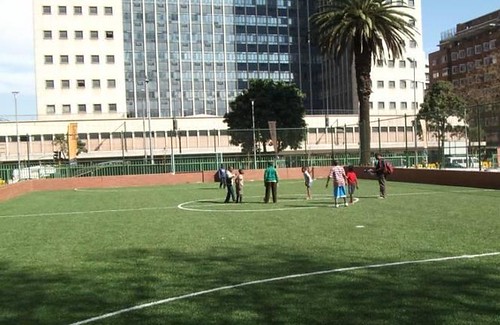
ArtwellGardens

Children play on the new astro-turf at Artwell Garden’s Park in Joburg

On Saturday, 13 August 2011 I attended the City of Joburg’s Projects Tour with the MMC for Development Planning and Urban Management, Cllr. Ruby Mathang and the MMC for Housing, Cllr. Dan Bovu.

This projects’ tour was part of the Growth and Development Strategy theme: “Liveable City”.

There was a Press Briefing by both councillors at the City of Joburg Council Chambers before we were moved by bus to two projects. The councillors explained the theme for this week as part of the City’s Growth and Development Strategy.

Cllr. Mathang explained that the City’s Executive Mayor had instructed all the officials and councillors to go to the people and hear what they want and that the growth and development should be designed by them. He said that for the next eight weeks they would, under different themes, be going to the people for inputs into the Growth and Development Strategy draft document.

Cllr. Bovu also reiterated what Mathang had said about involving the people in planning for the city’s growth and development strategy.

After they had finished addressing the media, they allowed for questions.

We then moved by bus to the first project, the Artwell Garden’s Park located between Rissik, De Villiers, Joubert and Plein Streets in the Johannesburg’s CBD. Here the City of Joburg had spent about R4,5 million regenerating the part into a beautiful park. This park is comprised of an ablution facility, astro-turf soccer field, multipurpose courtyard, a children’s play area paved with a safety surface, paving, landscaping, irrigation, fencing, lighting and furniture.

After short speeches by both councillors, the plaque was unveiled to markthe official opening of the park.

We then moved by bus to Berea to the refurbished Casa Mia. Casa Mia was originally a hotel that was built in the 1940’s. It later became an old age home and in 2007 the residents were sent to other homes.

The City of Joburg refurbished the building after it had burnt down. It has now been converted into family units and bachelor units. There are 178 rooms. This project will accommodate and cater for low income groups.

A series of meetings and workshops will be held over the next eight weeks under different themes.

Joburg strategy paper silent on informal settlements

By News No Comments

By Max Rambau, CORC

The City of Joburg had organised a meeting to present its draft Growth and Development Strategy document. This meeting was held at Emoyeni Conference Centre in Parktown, Johannesburg on the 12th August 2011.

It was held under this week’s long theme: “Liveable City”. Cllr. Dan Bovu, the MMC for Housing, opened the meeting and welcomed the participants. He made a few comments and said that the week’s activities relating to the theme: Liveable City was coming to an end and that the participants need to answer some tough questions as to what do we understand by a liveable city and what needs to be done to realize it. He emphasized the need for all the stakeholders to give inputs on what should happen.

The presenters were from the universities of Pretoria, Witwatersrand and Cape Town. These presenters are experts in planning and research.

One of the presenters raised the question of how this ambitious plan by the City of Joburg would be implemented and sustained when even the national economy was in crisis. He said that in Gauteng only unemployment figures were standing at 26%, most of them in Johannesburg and how did the ‘City’ expect to get people to pay for services in view of this.

He raised his concerns about overcrowding in the city with most foreign nationals from the neighbouring countries like Zimbabwe, Mozambique, Lesotho and Botswana all flocking to the City of Johannesburg. He said this would make it difficult to implement the growth and development strategy and will result in a crisis.

He said that the economies of the neighbouring towns of the Vaal and the West Rand were declining and this would have an impact on the City of Joburg because it would mean people from there would start flocking to Johannesburg. He said that people from all the provinces of South Africa were also coming to Johannesburg.

He said that planning can only be successfully done when population figures are known.

There were issues raised, relating to the Central Business Districts (CBD’s) of Johannesburg. The question was asked by one presenter as to how many CBD’s the City of Joburg had, was it Johannesburg and Sandton. He said Sandton, although it is a nice place with beautiful buildings and offices, it was dying because of traffic jams during peak hours and many businesses are running away to avoid this problem. He asked what would become of Sandton as this would affect property prices.

One presenter emphasized the need to have short-term plans within the long-term GDS 2040 because unforeseen developmental and environmental changes would affect the long-term strategy. He said that GDS 2040 may be faced with a lot of challenges of unpredictable population growth, economic decline and unemployment.

He said that planning around issues of housing should take into consideration that the building of RDP houses in the periphery or outskirts of townships was also not desirable. He said that the “Orange Farms” and other RDP settlements were far away from areas of economic access and people living there have to pay a lot of money on transport.

After the presentations it was question time. Some of the questions related to informal settlements. It was pointed out that the draft GDS 2040 was silent on informal settlements. It did not say anything with the programme of ending all informal settlements by the year 2014 and how the ‘City’ would go about doing this.

In answer to the questions raised, the City of Joburg indicated that their biggest challenge was the availability of the budget.

In his closing remarks, the MMC for Development Planning and Urban Management, Cllr. Ruby Mathang indicated that they were willing to working with everybody and reminded people that the GDS 2040 was still a draft that still needed more inputs from the stakeholders. He then invited us to some up the programme by visiting some projects on Saturday, 13 August 2011.

South African SDI Alliance meets Mayor of Cape Town to cement its partnership with the City

By News No Comments

By Charlton Ziervogel

MayorMeeting

Leaders from the Informal Settlement Network (ISN), CORC staff and City officials met with the Mayor

Community development is often a hard, slow process that requires patience and dedication.  The South African SDI Alliance takes the position that community members are actually the linchpin to the success of community development, and nothing less than full inclusion in their own development processes is sufficient.  But how do you effectively tackle the problems the urban poor face if the very city they live in effectively excludes them and government departments operate in isolation trying to address issues which require an integrated approach?  The solution lies in the concept of inclusion, and the Alliance has learnt that the City needs to be included in its efforts.  But the inclusion of the City does not rest on the shoulders’ of its Informal Settlement Unit alone and the Alliance knows that a more strategic approach is required by drawing in the help of all role-players.

It was in this spirit that the South African SDI Alliance introduced itself to the new Mayor of Cape Town, Patricia de Lille, at a meeting at the Civic Centre on 4 August 2011.  In doing so, the Alliance aimed to garner support from the City for an integrated approach in tackling informal settlement issues and to highlight that community members were a valuable resource along with all government departments.   Representatives from the Informal Settlement Network (ISN) and the Community Organisation Resource Centre (CORC) described the history and nature of the partnership to the gathering, which included representatives from the City’s Human Settlements, Utilities and Urbanisation Departments as well as the Informal Settlement Unit’s manager.  Since 2009, the Alliance has been working with the Informal Settlement Unit within the City of Cape Town’s Housing Department, and together the partnership has identified 23 settlements where joint pilot projects for incremental upgrading would be executed.  The Mayor commended the fact that the Alliance was working towards solving one of the country’s biggest problems and affirmed that the City’s new administration was more than willing to work with them in this regard.

The Alliance representatives revealed that there were advantages in partnering with the City but expressed concern that not all departments were committed to the partnership.  The Director of Urbanisation echoed these sentiments and explained that steps were being taken to address this issue.  The Mayor affirmed this and envisaged practical engagement with the Alliance on a number of fronts and in particular highlighted that the ISN could make valuable input into the City’s five-year Integrated Development Plan, help the City resolve conflicts in areas that the ISN represents, as well as help establish an accurate database of informal settlements and backyard areas.  She felt that a Memorandum of Understanding needed to be signed to formalise the partnership.  The drafting of this document is currently underway and will be signed the next time the Alliance meets with the Mayor.  It is hoped that this will lead to an integrated departmental approach from the City to informal settlement development issues, and through the Alliance the voice of the urban poor would be included in this process.