Category

News

Private company destroys shacks in Lanseria, Johannesburg

By News No Comments

Lanseria

Pictured above: Evicted residents sit under a tree and guard their belongings after their shacks were destroyed.

By Max Rambau, CORC

On Friday, 1 October, I received a call from Lanseria that there had been evictions that had been carried out earlier that morning. I then phoned Mfundisi of the Informal Settlement Network (Media Officer) and asked him to go there and get the story of the evictions and to also contact the media.

I went to the area in the evening to see what had happened. We found people’s belongings strewn all over the place next to the road. Their shacks had been demolished.

When we interviewed the people they told us that Jambo Security carried out the destruction of shacks and they were wearing the “Red Ants” uniform. They loaded the material onto their trucks and took it away.

It is alleged that Jambo Security people also stole blankets, money, cellphones and other items. They also assaulted one of the grandchildren of Gogo Mahlangu.

Jambo Security is notorious for terrorising people around Randburg. It is assisting the people who want to build a ‘volkstad’ in the area and working with the Johannesburg municipality.

The issue of Jambo Security will be raised with the ISN in order to take it up with the Johannesburg municipality in its meetings.

The Mahlangu family is one of the families that were affected by this eviction. This family has long term occupiers’ rights in the area because they were left in the area by their farm employer when he left.

Gogo Sannah Mahlangu (78 years) has been staying in the area for more than 43 years. She says that she had come as a young girl and even got married at the farm and was working for the farmowner.

This family was not supposed to be evicted as long term ESTA occupiers. Even the settlement agreement between Lanseria Commercial Crossing (Pty) Ltd and the occupiers (residents) states that negotiations have to be entered into with the long term ESTA occupiers if they are to be relocated.

Some buildings were left untouched and we believe that somebody must have warned Jambo Security about destroying the Mahlangu house. The kraal and livestock were also not touched.

There were 9 other families that were evicted at Lanseria. They initially came into the area and rented from the landowner for more than 11 years. After the landowners left, they were handed over to the new landowner and continued renting.

These people were not part of Mzala Settlement, so this means that the Lanseria Commercial Crossing is fighting with people with whom it has not reached an agreement with.

The houses of the 9 families were demolished to the ground.

Unfortunately, these people have always thought that they had a lawyer named Daphne. But she was just a ‘fly-by-night’ who has been collecting money (over R18 000).

We found out on Friday when we enquired about this Daphne that she is not a lawyer but a person with trade union background. She only hires a lawyer when there is a case and that is why there are never any follow-ups on cases.

The Legal Resources Centre is assisting the evicted people by making an urgent application to challenge the eviction at the High Court. The case will be heard on Monday (4th October 2010).

The case is now out of the hands of Daphne and a lawyer has been appointed.
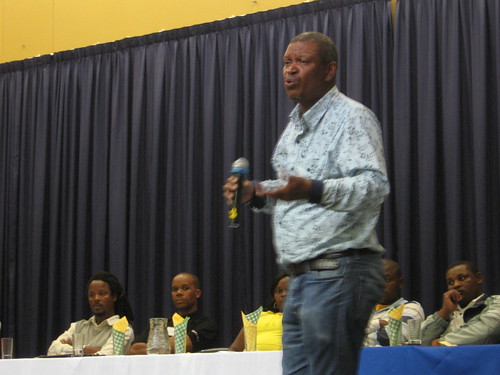
Magebhula to advise Human Settlements Minister

By News No Comments

IMG_1768

Pictured above: Patrick Magebhula speaks at a convention for the Informal Settlement Network in Durban, October 2009.

By Benjamin Bradlow, SDI secretariat

A slum dweller community leader has become a close advisor to Human Settlements Minister Tokyo Sexwale. Patrick Magebhula, a long-time community organizer and activist from Durban, is the only community-based actor on new five person panel to advise the Minister on human settlements policy and practice.

The panel was inaugurated on Tuesday, 31 August, at a meeting in Johannesburg.

Magebhula is a founder and president of the Federation of the Urban Poor (FEDUP), the largest community-based organization in South Africa, which organizes communities around women-led daily savings, and community information gathering. FEDUP has had a relationship with the national department of housing (now “human settlements”), since the tragically brief tenure of Joe Slovo as minister in 1994. That relationship has resulted in over 15,000 houses built by poor communities themselves.

As an advisor to the Minister, Magebhula says that he hopes to begin a dialogue on aligning national policy to maximize the capacities and energy of organized communities of the poor: “It’s important for the poor to build a relationship at that level with the minister. It should go a long way in opening up the space for working with poor people. It has the potential to put people’s struggles and people’s processes at the center of the agenda.”

FEDUP is part of the Informal Settlement Network (ISN), an agglomeration of settlement-level and national-level organizations of the urban poor in all major municipalities in South Africa, for which Magebhula serves as the chair. ISN is the first major initiative since the end of Apartheid to bring together residents’ committees, community development groups, as well as national organizations to work to upgrade settlements, build partnerships with all levels of government, and construct a people-centered agenda for solving the crises of human settlements and poverty.

Prior to helping found FEDUP in 1992, Magebhula was the founder of the United Democratic Front branch in his community of Piesang River in Durban in 1985. In addition to his positions in FEDUP and ISN, he serves as a member of the board for Shack Dwellers International, an alliance of slum dweller organizations in 33 countries in Africa, Asia, and Latin America.

A struggle to assist fire victims in Mangolongolo, Johannesburg

By News No Comments

Mangolongolo committee
Pictured above: The local committee members of Mangolongolo are busy assessing the extent of the damage and trying to find out what can be done to assist with the burial of the deceased.

By Max Rambau, CORC

Another fire disaster happened at “Mangolongolo” Informal Settlement next to Denver Hostel on Monday the 20th September, a day after another nearby informal settlement had 87 shacks burnt to ashes.

The fire was started during daytime in one shack. It is alleged that one resident had left a paraffin stove burning in the shack and it must have caused the fire that spread and destroyed 23 shacks.

The residents lost everything because there were not many people to help put out the fires as most had gone to work and only a few, mainly women were present.

Although the fire brigade came there was not much they could do because the fire had spread very quickly due to windy conditions.

The disaster management did not respond and the residents were left without help and with nothing.

On the 25th September (early hours of yesterday) another fire broke out at “Mangolongolo” Informal Settlement.

This time the fire was caused by a man who burnt another man’s shack. Apparently, the two men had had a fight during the day and the culprit had been defeated. He then decided to go and burn his enemy’s shack.

238 shacks were burnt down and 4 people died. The culprit has been arrested. Of the 4 dead people, 3 were Mozambicans and the other was a Zimbabweans.

I met with the local committee who informed me that they were not getting help from anyone. Only the firefighters came to help.

Although the ward councillor came, he told them that he had a problem the residents of “Mangolongolo” because they did not have a working relationship with them and he then left without helping them.

I phoned the ward councillor to find out what he was doing to help the residents but he told me that he had a problem because these people were burning their shacks as if it was fashionable to do so.

I asked him if it had contacted disaster management he indicated that he had not done so because they (disaster management) would have heard from the media about the fire disaster. He agreed that he would contact Disaster Management on Monday and requested me to work with him in getting help for the residents and that we must keep in touch.

I could sense from the ward councillor that he was not keen to help the people of “Mangolongolo” because the majority of them are foreigners.

I would appreciate it if I can be assisted in identifying organisations that can help these people. As I indicated last week, there is a need to establish a fire disaster fund as the fires in informal settlements always leave people with no help.

Fire at Denver Hostel, Johannesburg

By News No Comments

No materials in denver

Pictured above: Some residents at Denver Hostel Informal Settlement have already started rebuilding their shacks. However, most residents do not have building material to do so.

By Max Rambau, CORC

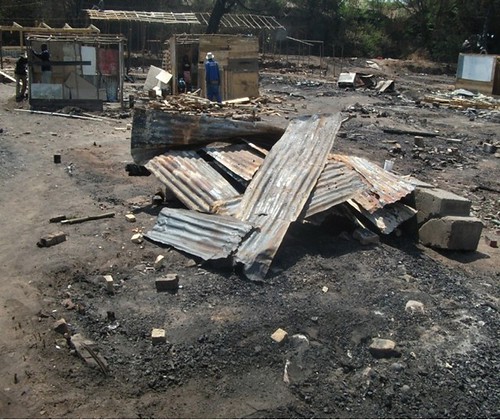
On the night of Sunday 19 September, a fire broke out at Denver Hostel Informal Settlement destroying 87 shacks and leaving one person dead.

I interviewed the residents about how this fire started and I was informed that the cause was arson. Apparently, a woman found his boyfriend sleeping with another woman in his shack. The jealous lover then poured petrol on the shack and set it alight. The fire then spread to other shacks in the area.

The 87 were burnt to ashes and people lost everything and unfortunately, an innocent person who was sleeping in his shack was burnt to death.

The residents tried to put out the fires but the wind was blowing on the night, which made the fire to spread fast. The fire extinguishers and paramedics arrived late when the damage had already been done.

The Joburg Disaster Management services team came on the following morning and distributed blankets to the victims.

When I talked with the residents they raised some concerns with me and said that government did not care about them and conditions they were living in. They said that the fact that because they speak IsiZulu, the ANC government thought that they were members of the IFP, which is not true of all of them. They felt that they were being discriminated and that development will not come to their area.

Also, I learned that there are internal politics in the area. The residents themselves still discriminate against each other according to the regions they come from in the rural areas. The dominant group comes from a certain area in KwaZulu-Natal and they tend to help each other first. For example, the dead man does not come from the dominant group and the collections for his burial are not forthcoming. They have had to send for help in the rural area for collection of funds for burial.

By yesterday some residents had already started rebuilding their shacks but some were still struggling because they did not have building material. One company has donated some timber in order for the residents to rebuild their shacks.

The indunas (local leaders) were not available as they had gone home for the long weekend. I am planning to meet them some time next week to discuss with them how we can seek for help from some NGO’s to help, e.g. Gift of the Givers to donate some cloths, etc. Also, we need to contact government departments like the Home Affairs and Social Development for the lost documents (birth certificates, I.D’s and Social Grant Cards).

Updates on two Gauteng eviction cases

By News No Comments

Eku rebuilding1

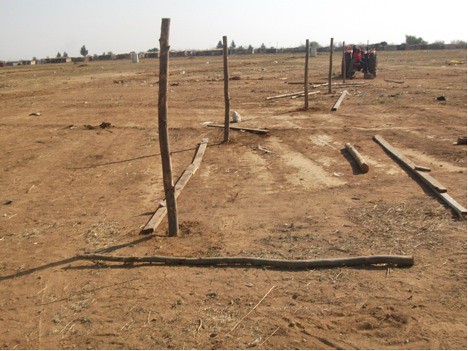
Pictured above: A month after being ordered by a court to rebuild over 70 shacks in Barcelona informal settlement, the Ekurhuleni metropolitan municipality has only constructed a few wooden poles.

By Max Rambau, CORC

On 6 September 2010, as I was going around mobilizing people for the Ekurhuleni Service Delivery Summit, I also went to Barcelona informal settlement to check on the progress of the rebuilding of 72 shacks destroyed by the Ekurhuleni municipality. The court judgement had ordered the municipality to rebuild the shacks.

I found that not a single shack had been rebuilt by the municipality. This was almost a month since the court judgement on 10 August. Meanwhile, the affected families are staying with other families. I also found out that owners of the 72 shacks are the only ones who had come forward and reported that they had been displaced. But there are many more families that were affected, totaling almost 300 people. I met with the local community leadership and I agreed to arrange a meeting between the community and its legal representatives regarding the fact that the municipality has not complied with the court ruling.

***

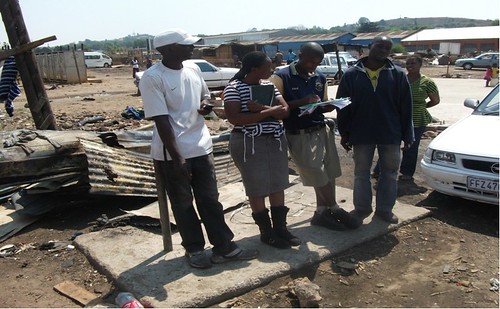
On 8 September I went to Lanseria to check on the application to reinstate the people who were evicted from of their houses. The people were evicted without a court order by the Lanseria Commercial Crossing (Pty) Ltd. Also, this company used the wrong document for Mzala Informal Settlement to evict the people.

The court ruling was that the people should go back to their houses (the people went back on Thursday, 9 September).

The case continues on 15 September to challenge the legality of the eviction, as well as to rule on the community’s complaint that it was intimidated by the Lanseria Commercial Crossing (Pty) Ltd, which used a fraudulent eviction document.

Fire takes a life in Alexandra

By News No Comments

Untitled2

By Max Rambau, CORC

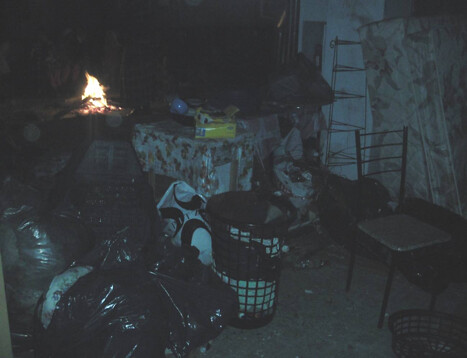
On Sunday, 18th July 2010 I got a report that there was a fire disaster that had happened at Alexandra’s Helen Josephs Hostel in the early hours of the day. I then went there to find out what had happened.

The hostel is situated within ward 75 of the Johannesburg Metropolitan Council under Councillor Ambi Maseko, who also stays at the hostel.

We were unable to meet with her as we were told that she was at a meeting elsewhere.

When I arrived there I found out that 29 shacks had been destroyed by fire. I interviewed some of the people affected and neighbours, and they indicated that the fire must have started between 12h30 and 12h50.

One female resident said that they had people screaming that there was fire and they went out to assist in putting out the fires but it was very strong. She said that the fire fighters and paramedics arrived very late.

One person, known as Smally, died in one of the shacks.

It is not clear how or where the fire started, but it spread to other shacks quickly, as they are very close to each other and overcrowded.

The Johannesburg’s Disaster Management team had come and they donated blanket and food hampers to 28 families of the affected people.

I observed that the shacks are cramped and they are built such that they seem to be built on top of each other. This shows that there is lack of land where these people can expand to.

This fire disaster comes very close to an earlier one at 2nd Avenue, Alexandra where 61 shacks burnt down and 1 person died.

While there are problems of overcrowding and lack of land in Alexandra, there are also positives like the building and management of public toilets. For an area like Alexandra, where there is so much overcrowding, the building of public toilets that are maintained and cleaned by the community itself is a very positive development. Community members are charged R1 each for using the facilities which is used for payment of honorarium for volunteer cleaners and those who monitor them.

Evictions continue to hit Gauteng

By News No Comments

Untitled1

By Max Rambau, CORC

In the past month, shacks have been destroyed due to eviction orders by the municipalities of Ekurhuleni and Johannesburg in Gauteng province. In June the communities of Gabon and Chris Hani (Etwatwa) near Daveyton, Ekurhuleni were dispossessed of their homes through violence and destruction. Last week, residents of Kliptown suffered a similar fate.

On 28 June, the Greater Kliptown Committee, which includes all community organizations in the area, gathered to discuss the demolition of shack by the Johannesburg Metropolitan Muncipality Council. The meeting was well-attended. Some community members blamed community leaders who had not attended the meeting, charging that they were responsible for pointing out shack to be demolished. These leaders, community members claimed, were receiving bribes for such actions.

The community resolved to work with the Informal Settlement Network leadership to get a lawyer to represent the families affected by the demolitions.

The community also took a decision that all the men in the area would go and spend the night with the families whose houses were destroyed. This also included a resolution that the Ward Councilor should be amongst the men who will be at the affected families’ homes.

US Secretary of Housing and Urban Development Visits CORC

By News No Comments

DSC00077
By Louise Cobbett, SDI secretariat

The World Cup kicked off in fine style for the staff of Cape Town’s CORC office with a visit from the United States Secretary of Housing and Urban Development, Shaun Donovan.

Secretary Donovan has had a long career in the field of urban development, serving as the Deputy Assistant Secretary for Multifamily Housing in the Housing and Urban Development department during the transition from Clinton to George W. Bush. After which became Commissioner of the New York City Department of Housing Preservation and Development in 2004 and returned to the Housing and Urban Development department as part of the Obama cabinet in 2009.

Secretary Donovan grew up in New York City during the 60s and 70s, a time thought to be the ‘death of American cities’. He went on to note that American cities have “many of the same historical precedents that have led to issues of racial and economic segregation as South Africa. One of our interests in being here, is understanding – as we try to undo some of the legacy in the US –  [South Africa] is dealing with it, and I hope we can continue to have an exchange over these issues.”

A collection of community members from the ISN, the Backyarders, PPM and FEDUP met with the Secretary as they would be able to give the best answers to issues on exclusion, homelessness and lack of tenure.