Category

News

Red Ants relocate 35 families

By News No Comments

By Max Rambau, CORC

Feb28RedAnts

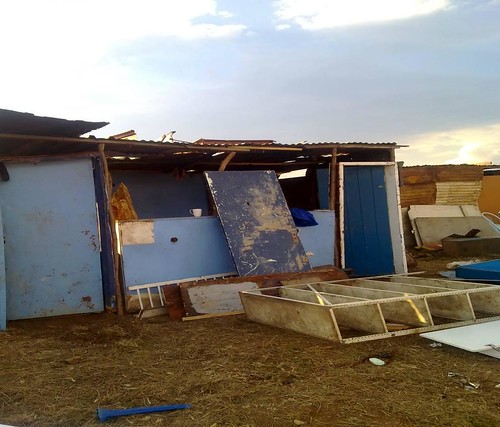
Red Ants offload belongings of forcefully removed families including building materials

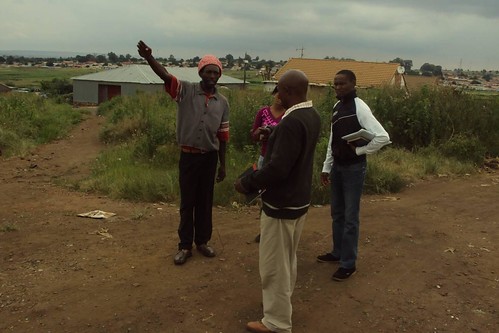
I  went to Malala Informal Settlement together with two sub-regional community leaders in the West Rand to meet the community. There were reports that some officials from the Mogale City Municipality had come to the area and loud-hailed, telling the community that they would be moved from the area but it was not indicated by these officials where the community would be taken to. The Malala Informal Settlement is situated next to the West Rand Mine. The families were mostly retrenched mine workers who were evicted from the mining complex and hostel and they then invaded some land nearby and settled there.

We are planning to arrange a meeting with the Mogale City Municipality to get clarity on the rumour of relocation of the Malala community.

We then went to Tudor Shaft (Studio Shaft) Informal Settlement, also in Mogale City were evictions are being carried out. We met with one of the community leaders, Mr. Jefrrey Ramoruti. Studio Shaft or Malal’ayiveze, as the community calls it, is near the Kagiso Township in Mogale City.

Mr. Moruti informed us that they have been in the area since 1995 since they were moved from Malala Informal Settlement. He said that the community should have been moved to RDP houses at Sinqobile but only a few individuals have moved there. Most have not benefitted and they are still staying at Studio Shaft. There have been promises that the community would be relocated some other place but that has not happened.

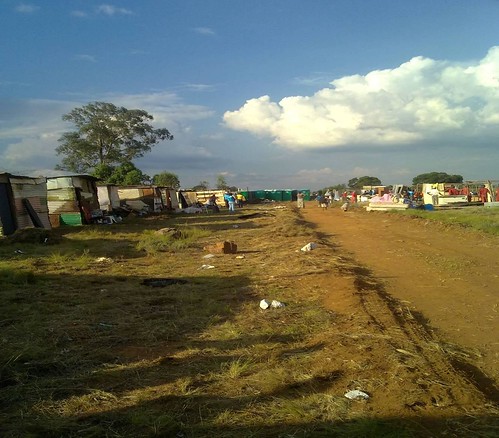
On Thursday (24/02/2011) some 35 families were forcefully removed by the “Red Ants” to an un-serviced area without toilets. Community leaders were not consulted about this relocation. Shacks were demolished and goods and belongings were loaded onto trucks and taken to the new area. This area they were moved to is next to some firms in Chamdor.

In the new area, the Mogale City Municipality has allocated 200 stands (one-roomed shacks). Also, some families were moved from Soul City Informal Settlement to this area.

28Feb4

There is no water in the new area and the mobile toilets were just being offloaded when we arrived

The Mogale City Municipality only consulted the community on Tuesday for relocation at Studio Shaft. They told people not to go to work the following day, Wednesday as they would be moved on this day. This did not happen and instead the “Red Ants” arrived on Thursday to carry out the forced removals.

When this happened some families were not at their homes and they returned to find out that their shacks had been demolished and their goods taken by trucks to the new area. In the process, furniture was damaged.

We then went to the area to see what was happening and what the conditions were.

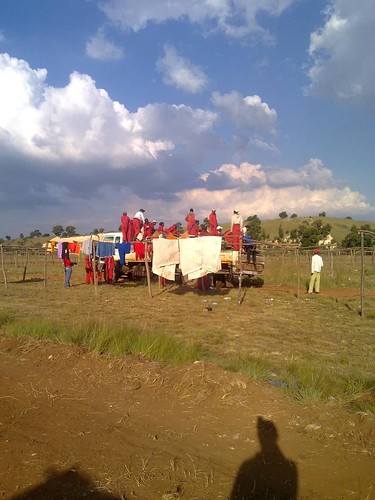
When we arrived there we found some families busy building their shacks and their furniture and other belongings were just thrown on the ground by the “Red Ants”.

28Feb3
Families were moved from bigger shacks to one-roomed shacks, and some of their furniture cannot fit into their new homes.

FEDUP/PPM: One voice, one vision

By News No Comments

Twenty mamas, some heartsore, many excited,  wrote history on February 17 around a conference table at the Lutheran Youth Centre in Athlone,  Cape Town, when they signed a Memorandum of Understanding to merge their national savings schemes into the new organization Poor Women’s Movement. “We trust we will work very well together,” said Marlene Don, founder of the Poor People’s Movement (PPM) which comprises 6500 savers in 75 urban areas in the country. After years of contemplation, she finally urged her members to give up their organizational identity. “It’s about what the communities need, not about FEDUP, PPM or ISN,” agreed Rose Molokoane, Chair of the Federation of the Urban Poor (FEDUP). “Let us use the opportunity and strategize together how we make it happen in unity.”

The  Informal Settlement Network which has been working in close cooperation with FEDUP throughout the country, will “evaluate and assimilate” the merger of the two women’s organizations at a meeting next month, says Zulu Mzwanele, ISN representative of the Western Cape. “We are pleased to hear about this decision, which will strengthen our network, as their members are fully supporting our agenda.”

For twenty years, FEDUP has pioneered a collaborative solution that can transform our cities: empowering poor people to help themselves, teach themselves, and develop themselves. FEDUP has empowered hundreds of communities to start savings schemes, develop their own knowledge and capacities, build houses, and acquire land.

Founded as the South African Homeless People’s Federation in 1991, after shack dwelling communities here interacted with slum dwellers from India, FEDUP has worked with the South African government  to find constructive, constituency-driven solutions to the problems of the poor.  FEDUP has facilitated the building of more than 12,000 houses and secured land for almost 20,000 families.

The “marriage” as the merger was referred to at the Athlone meeting will strengthen savings especially in the Free State, the Western Cape, the Eastern Cape and Kimberley.  Audit teams and regional committees will monitor the improvement of savings. The general consensus was to go back to the roots and serve the poor with loans for illness, education and food. Only when the people on the ground benefit from the savings, they will start put money aside themselves. “Even the very poor can save,” explained Molokoane. “But we must advise them why and how. Then the whole community will come to us.”

It is the women’s role to go from house to house and bring the people together. Once ISN – traditionally run by male leaders – has mobilized the community, the savings teams must follow and create safe spaces, build houses and uplift families, Molokoane said. “We become easily fed-up”, she joked. “We are turning ourselves into handlangers, whereas we should be enumerators and builders. It is a weakness to wait until we are being officially invited to do our work.”

However, it does not seem that any more time is being wasted. The action plan is ready, and at a national Lekotla meeting the deal will be sealed. The new mama’s movement is ready to fight the battle their way: ntwa kgolo ke ya molomo – the highest form of war is dialogue.

The unfolding of a people’s process at Sheffield Road

By News No Comments

By Andrea Bolnick, Ikhayalami

IMG_0450

It is our role as the NGO to highlight and promote a people’s process – and the upgrading of Sheffield Road is exactly that. At each milestone there were amazing glimpses and examples of how peoples’ lives were transformed by the upgrade, also how these people took on responsibility to encourage others to come on board. The dynamics in the community told a story and a justifiable story as well – how they resisted the one-size-fits-all approach, how it took them time to understand the idea of blocking out.

To talk of ISN and CORC in the same vein, as if they are both the same side of the same coin – this diminishes the idea of a people’s process. It is important to mention and showcase how this process from the first engagement with the City right up to now has been an immense learning curve for both the social movements and for CORC staff. Initially everyone, more especially the NGO staff, were not clear as to what informal settlement upgrading was all about.

The Joe Slovo blocking out set a very important precedent for the entire SA alliance and realigned our focus. Up until this point the alliance had not redirected its focus towards informal settlement upgrading. Joe Slovo blocking was a critical turning point for the alliance. As a result of the blocking out and the precedent that was set, the Informal Settlement’s Department were keen to meet with those responsible for the blocking out. This initial meeting brought all the parties together and initiated the idea of working on pilot projects with the City.

2009
9 March to 27 March – Joe Slovo blocking out – 125 shelters re-blocked

17 March – City official comes to Joe Slovo to meet with Joe Slovo leadership & Ikhayalami.

1 April – First meeting with the City – agreed to look into the possibility of doing some joint pilot projects together – however what ISN, CORC and Ikhayalami had in mind was not the same as what the City had in mind. As an alliance we were hoping to focus on Informal settlement upgrading with regard to the reconfiguration of the layout of settlements plus the provision of services. What the City had in mind was what they referred to as Informal Settlement Improvement – i.e. only basic services.

Due to elections and Easter the next meeting to take things forward was the 27 May.

27 May meeting with the City – further discussion around what was actually feasible with regard to working with the City who stressed basic services as an entry point. It was agreed that the City would set out their criteria for pilot projects as would ISN and that both parties would share this information prior to the next meeting. It was also agreed that ISN would identify a number of potential pilot project to present to the City at the next meeting.

The criteria were very interesting and worthwhile mentioning – everything that ISN set as criteria were the exact opposite from the City’s point of view:

City’s list Criteria as follow:
• not located in flood prone/ low lying areas;
• not located in detention/ retention ponds;
• not located over/ under servitude (services or electrical);
• not located in road reserves;
• no immediate or significant risk of natural disasters, natural sensitivity & biodiversity, toxic waste, etc.;
• availability of bulk infrastructure nearby;
• located on accessible land in terms of ownership;
• not an existing housing intervention;
• existence of community cohesion and organisational preparation; and
• age of settlement – i.e. not relatively new.

Our criteria were the exact opposite except for well organised communities. We also had the presence of saving schemes as a possible criteria.

June – In spite of the City’s criteria after ISN’s presentation all 11 pilot sites were accepted as part of the joint pilot projects.

September – at a general meeting in Sheffield Rd ISN introduced themselves as did CORC and Ikhayalami. The possibility of working with Sheffield Rd, the City and ISN was proposed. The community accepted the idea of being one of the pilot projects. ISN suggested the establishing of a projects committee – people were nominated and appointed at the meeting. In addition as an after thought the existing settlement leadership was incorporated into the project committee, collectively comprising 13 people.

October – At a second general meeting in Sheffield Rd, ISN and Alliance present the idea of blocking out Sheffield Rd. A series of exchange visits are set up to see the blocking out in Joe Slovo.

DSC05685

2010
Until March – Engagement at settlement level about the concept of blocking-out, community contribution and savings. Saving scheme grows in numbers but not a big uptake for contributions for blocking out. 5 people in Sheffield Rd show significant commitment to the blocking out idea and collectively contribute R2 000 into the saving scheme. The rest of Sheffield Rd is not as committed, rather wanting to see things happen before they contribute. After numerous engagements with the community, it was agreed that where possible, shacks maintain their current size in the new configuration, shack sizes range from 7sqm to 40sqm.

April – A visiting architect draws a master plan with a lane of 3m that runs throughout the settlement and two ‘site’ options of between 15sqms and 24sqms, a divergence from what the community had in mind . ISN take this further and translate this into a one-size-fits all in line with the precedent that was set in Joe Slovo. This backfires to the point where there is wide scale dissatisfaction and disillusionment especially amongst those families in shacks bigger than 15sqm. Households less than 15sqm support the approach. This led to division in the community.

Late April – need for a total rethink on how to go forward. A realisation that some shack owners are blatantly resisting the blocking out idea. Another realisation that as ISN and the NGO’s trust needs to be rebuilt and that there is a need to retract and adhere to what the community first agreed upon – current shack sizes need to be considered and incorporated into the blocking out design. In addition, many households are refusing to take part and as such an audit into which shacks are in good condition and don’t necessarily need to be upgraded was necessary so that we could use these shacks as anchor points and design around them. The idea was to rebuild trust and then start working at the cluster level. UCT Planning and Architecture Department was approached to assist in this study and with plans for blocking-out. First thing they recommend is that the proposed 3m lane in the master plan be abandoned as it utilises too much valuable space in a small settlement of only 17m wide.

May – UCT, residents of Sheffield Rd, CORC and Ikhayalami go shack to shack assessing whether people are in favour of blocking out, if they would rather keep their existing shack, the quality of the shack and which households operate businesses from their shacks. Two general meetings that were called by the project committee – to restore faith in the blocking out concept – that shack size will be taken into account in the blocking out and to show the findings of the analysis done with UCT – drew little interest. At the second general meeting those present agreed that the project’s committee and NGO could work at cluster level.

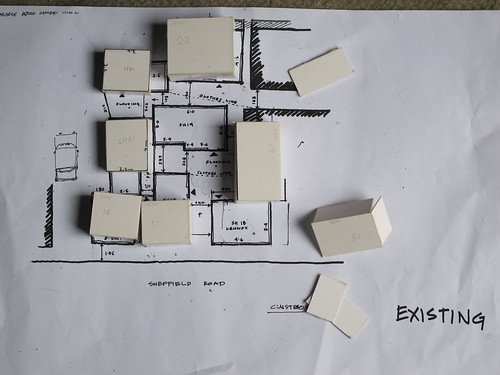
June – Identified a cluster were the majority of the shelters were of poor condition, all were of varying sizes. One shack in the cluster was in good condition and did not need to be upgraded. This cluster was chosen to demonstrate all possibilities for blocking out. A series of engagements with the cluster began. Shack sizes were taken into account, a model of the existing cluster was built, individual shack models were made for the residents to reposition on the cluster map. Residents were excited about the prospect of blocking out – but savings towards this was not forthcoming. Word spread in the settlement that people’s shack sizes would be taken into account.

July – the formation of an ISN pilot team to work in Sheffield Rd on a day-to-day basis. Gogo Rose in first who had saved R500 towards the blocking out became vocal that the blocking out should start with her shack. Focus shifted to Gogo’s area where it was agreed that if her two neighbours contributed, then we would re-block 3 shacks as a start. The ISN pilot team engaged both tiers of leadership in an attempt to unify them and then engaged other families near Gogo.

August – Gogo encourages others in her area to contribute and goes door to door with her savings book to collect contributions. At a cluster meeting the residents negotiate a 50% contribution prior to blocking out rather than the 100%.

September the 14th – first shack gets dismantled followed by 2 others. Then 3 shacks that had a small courtyard dismantled their shacks which were rebuilt in a straight line. This did not take into account the important idea of a courtyard. Discussions around this ensued. It took 3 days for all in the cluster to agree to shift the 3 shacks and recreate a bigger courtyard. Once this was done two more shacks were dismantled and rebuilt.

October – A family in 40sqm shack refused to take part in the blocking out. This shack stood in the way of the cluster being blocked out as it stood at the entrance and stood in the way of other shacks being able to be blocked out. Reasons for not wanting to take part – owner of the shack did not live in Sheffield Rd, those living in the shack were unemployed. After a difficult period of negotiation the project committee and ISN convinced the woman to come on board.

December – 40sqm comes down as well a number of other shacks – all get blocked out in a better layout. Five toilet cement booths get delivered to site and placed were the community has identified.

IMG_1256

2011
January – blocking out moves to the second cluster. Other clusters in settlement are eager to take part and there is a rise in savings. More shelters are dismantled and rebuilt in a blocked out configuration. Blocking out is taking place in 3 clusters

February – 23 shelters blocked out in Sheffield Rd. Both the projects’ committee and original committee are working hand in hand and driving the process with ISN pilot project support.

Bapsfontein families forcefully removed

By News No Comments

By Max Rambau, CORC

At Bapsfontein relocation is still continuing and I visited the area on the Tuesday, 15th February and I discovered that some families were still being intimidated by the Ekurhuleni Metropolitan Municipality through the use of the Ekurhuleni Metro Police and the “Red Ants”. A few families have been forcefully removed to a place called Zenzeleni in Daveyton (near Gabon). Incidentally, this is the area where 300 Gabon people were evicted.

The Bapsfontein families are temporarily relocated to that place.

Bapsfontein221Feb

One of the trucks that is forcefully relocating people to Zenzeleni in Daveyton

The unfortunate thing is that the Ekurhuleni Metropolitan Municipality has devised a strategy whereby they continue to forcefully remove families from Bapsfontein, albeit at a low profile and the focus of the world and media.

They have been preventing us and the leadership of Bapsfontein from meeting with the Gauteng MEC for Housing and Local Government. Meetings have been scheduled with the MEC but Ekurhuleni have asked the MEC not to meet with us before meeting them. We have copies of letters that the MMC for Housing, Vivienne Chauke has sent to the MEC. They even give him dates of meetings they will be having with us, without having communicated with us and, as a result the MEC had to cancel scheduled meetings with us.

We were supposed to meet the MEC on the 16th February but the Ekurhuleni prevented this meeting by indicating that they would be having a meeting with us on the 17th February, this meeting did not take place as they did not communicate details of this meeting to us.

Again, after we had written a letter to the MEC (copy circulated to them) about the failure of the meeting of the 17th February, they wrote another letter to the MEC indicating that they would be meeting with us on the 19th February (Saturday) at 17h00. This has also not been communicated to us.

Fortunately, the office of the MEC copy circulated (Cc) the letter from Ekurhuleni and in their response they asked Ekurhuleni if we knew about the meeting.

We have since written a letter to the office of the MEC indicating that there was no communication between us and Ekurhuleni regarding this meeting and we have appealed to him (MEC) to grant us permission to meet with him to discuss the Bapsfontein issue as it is clear that the Ekurhuleni Metropolitan Municipality is playing hide and seek with us while they continue with the forced removal programme.

As we left Bapsfontein I was invited by one member of the local leadership at Bredel (near Kempton Park). When we arrived there we met with the coomiitee who informed us that the area was a farm and a company called Panner has since bought the land. This company now wants to expand and they want the people to move. The community is seeking advice from us on what to do. The school in the area has already been demolished and moved elsewhere.

The committee informed us that there were some families have moved because they were offered about R25 000 to move out from the area. There are only 30 families that are remaining and they are encouraged to go and find places and the company promised that they would then build for them. The company is no longer offering R25 000 to families.

We advised them to meet with consultants to advice them. They indicated that they would be meeting on Saturday to discuss this matter on whether they would be agreeing to be referred.

On the 18th February we had a mobilizing meeting at Diepsloot because I had been phoned by the Johannesburg Metro Municipality that they were having a programme in partnership with the ISN of visiting Zandspruit and Diepsloot. This was part of the National Human Settlements Research project on informal settlements. They needed us because they did not have access to these areas.

We met with the local Business Forum and a member of SANCO we explained who was coming to visit and the purpose for which they were visiting. They people of Diepsloot were happy and welcomed us.

It was agreed that there would be a pilot project but what the community desperately needed was a meeting with City Power to discuss the installation of flood lights in the area because of crime and the murders that were happening in the area.

They also indicated that they want the ISN to come and address the community before the MEC for Housing and Local Government comes to them. They said that they were very happy that the ISN was facilitating development in their area.

The National Human Settlements Research team indicated that they would need a meeting with us to further discuss the issues of Diepsloot.

Kliptown221Feb
Part of the land where the multi-sports complex is to be developed in Kliptown


KliptownYouthCentre321Feb

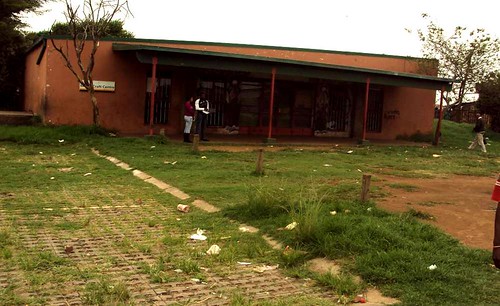
The disused building that the Kliptown Youth Forum is planning to turn into a library and information centre

Change By Design. The Story of Slovo Park, Soweto, Johannesburg

By News No Comments

IMG_1252

Service delivery protests are making the headlines once again. This time in Ermelo in Mpumalanga.

The residents of Slovo Park, in Soweto, Gauteng, know all about service delivery protests. Their protests happened in 2009. They were a violent punctuation mark in a rambling and unfruitful dialogue with the city authorities. In a moment of profound symbolism during those brutal days in 2009, the residents stripped the zinc sheeting off the community hall that the council had built about three years earlier, in order to use as shields to protect themselves from the rubber bullets that the police were firing at them.

Shortly after these service protests, the leadership of Slovo Park made contact with the Informal Settlement Network (ISN)  and began to revise their strategy. Three years of waiting, talking, negotiating, fighting, had produced nothing: no toilets, no running water, no electricity. It was time to take action. The engagement with the ISN had alerted the leadership to the benefits of organising people to deliver these services themselves and then to engage the government around its failure to meet its constitutional obligations and the councillor around his failure to fulfil his election promises.

First the leaders compiled a skills audit in the community and in the process identified all the people who had knowledge and experience in plumbing and drainage. In a general meeting the leadership then encouraged the community to organize themselves into street clusters, and prepare to work with the committee to find their own solutions.

It was agreed that the community as a whole would work together to install a main pipeline from existing water standpipes to every street in the settlement. Individual families would then be able to make household connections to the main line.

The only condition that was prescribed was that there had to be a stopper between the mainline and the individual pipe. The leaders also encouraged people to use the volunteer plumbers to avoid leakages.

There were various ways in which the different streets organized themselves. For example in Mapara Street, it was agreed that residents from each site would contribute an amount of R100 for the main pipeline. Once the pipe was installed each household saved an amount of R350 for the household pipes and fittings. As soon as the household produced the money they were able to connect to the mainline.

In other streets they had different strategies. Some families bought their own pipes and fittings, laid the pipes and then asked the plumbers to connect to the mainline.

The average amount that people spent to have a water connection on site was a mere R450 – including contributions towards a main line.

The Slovo Park leadership encouraged the plumbers not to charge for their services due to the fact that it was a community initiative. However residents generally gave between R20 to R50 as a thank-you to the plumber.

There are 1152 sites in Slovo Park. 1050 now have water connections.

Two weeks after the community had completed most of the installation, City officials from Urban Management arrived on site. In a sorry demonstration of the woeful relationship between city officials and the citizens they are meant to serve, two women who were carrying pipes got such a shock that they dropped their load and ran away. They were convinced they were going to get into trouble for having installed the water connections without formal approval.

But the officials had come for another reason entirely. They had come to check on a rumour that the people of Slovo Park were building their own community hall.

As a result of their encounter with the frightened women they asked the leadership about the standpipes. The leaders showed them around the settlement. The officials were amazed at what they saw. Given the new emphasis in Government on in-situ upgrading they responded positively to this community initiative and agreed to arrange to get the pressure from the mains adjusted.

Then they proceeded to see the community hall – the self built replacement for the one the State had provided, and the community had torn down to protect themselves from the State’s rubber bullets.

Through a connection made between Informal Settlement Network President, Patrick Magebhula, and the University of Pretoria, six architecture students had been working with the community for several weeks on the design and upgrading of the community hall.

Initially the idea was for the students to assist with the blocking-out of Slovo Park. However Slovo Park had been laid out into plots and roads in the early nineties – by the residents themselves.

So instead the students met with community members and ISN leaders and agreed to help them analyse the data they had collected by means of a community driven household survey. As a result a decision was taken to rebuild the community hall, with the students providing technical support.

The students came with no resources other than their enthusiasm, their training and an eight-week time frame. This really helped to make things happen. The community shared their ideas about the design of the hall. It had lost all its cladding, the slab had crumbled and the area in front of the hall was being used as a dumping ground.

The architects took note of the community’s ideas and went to the drawing board. They came back a few days later to show the community their drawings and their models. The community suggested numerous changes, which the students then incorporated. This process took two weeks.

In the meantime the leadership began to recruit people to work on the project. They revisited their skills audit. Bricklayers, tilers, plumbers and welders were asked to come on board to help upgrade the hall. Community members without skills were also encouraged to volunteer. Community leaders also started collecting contributions of R5 per household to go towards food for the volunteer workers.

Construction started in October 2010 and the upgrade was completed on the 19th of November. The upgrade included completion of the hall; use of old dilapidated post boxes as serving containers and benches; paving of the entire area in front of the hall; the planting of 20 trees and the installation of four taps to water the trees with grey water.

A community member was appointed as the project manager. His job was to co-ordinate everyone on site – including the students who became part of the labour force for the full six weeks. The energy and camaraderie on site was palpable.

But it was by no means all plain sailing. It was a struggle to secure materials. But eventually material came from various sources. Through the efforts of the students, private companies supplied the paving.  The students also managed to get trucks with ready-mix to dump left over concrete on site and then they got tiles donated. As the momentum for donations grew the community got involved as well. One resident managed to get ten massive gum-poles donated by his employer. Another resident organized leftover tar from Road Works. Yet another resident used the steel rims of two car wheels for drains. Some residents loaned their generators and others offered the use of their bakkies and cars. All the artisans brought their tools on site – spades, paint brushes, picks, saws, welding equipment, tiling equipment … Finally the community organized the cladding for the walls of the hall by going to the nearby river to cut tbamboo.

On Saturday the 20th November the hall was officially opened. Two officials, one from Johannesburg Municipality and the other from Ekhuruleni attended the function as well as senior lecturers from the Department of Architecture at the University of Pretoria.

The students mentioned that they would like to continue working with the Slovo Park community. However the distance between Pretoria and Slovo Park is too far for them to maintain long term relationships, It was suggested that a link should be established between Pretoria University and Wits and that ultimately Wits Architecture Department should be brought on board. The Pretoria University has since asked whether they could assist the Informal Settlement Network in Tshwane.

And what about the City and the community? If the upgrading process is to go to scale, if other services and amenities are to be provided and if Slovo Park is to be replicated throughout Johannesburg then this partnership has to become central. It takes a lot more work and more courage to design for change than it does to fight for it.

FEDUP as the Vector for a new DNA

By News No Comments

S6301265

A methodological blind spot can significantly generate  challenges on the ground: Fedup is not an ISN affiliate.

This would assume that ISN is the umbrella institution and Fedup one of its composite parts. Fedup is the vector for a new DNA.  NGOs regularly end up trying to be this vector for change. This is because Fedup is weak in  some areas and not able to perform this function. In fact this problem is pervasive in the informal settlement upgrading program of the SA Alliance. Durban, perhaps, is the only exception.

The issue is that ISN is a network of traditional leadership. Their task should be to mobilize and network communities around issues related to urban exclusion: no tenure, no services, evictions and so on. They should use this networking mechanism to engage the state. But at the same time they should open space for women to set up savings collectives which become the instruments for managing the in situ upgrading process. ISN would then interface with CORC staff around the political agenda, while the savings collectives would work with  professionals around the upgrading. This is not a formula and situations  on the ground are indicative of a process unfolding. It is a goal, a work in progress, an ideal state. It is okay that Fedup’s role in some instances has been taken by other institutions, even professionals. One important indicator of progress for CORC will be when the professionals and ISN take up their rightful positions, and women’s collectives coordinate the upgrading process (but not at the exclusion of the men).

Therefore most challenges in upgradings are not linked to the hesitant buy-in of the communities as is easily assumed by the formal sector. That is a given. That is part of the old way of things that we are trying to change: people are passive (or angry) beneficiaries waiting for a hand out. Most challenges are  linked to the fact that in the absence of a women’s savings process (supported by SDI experience in change) partnerships have to rely on 1) professionals who automatically reinforce the dependency syndrome – simply shifting expectations of the people from the state to the professionals and 2) on male leadership from ISN who also do things the old traditional way: mobilizing people around external forces and around internal problems (external forces plus internal problems means that mobilization equals give the internal problem to external forces to solve.)

The DNA metaphor is helpful for those who evidently still struggle with understanding this process. Evolution happens when a recessive gene or a new genetic mutation develops as a result of external stimuli. For a long time this mutation is at high risk of dying out but if it is able to reproduce and survive massive competition from the un-mutated majority it will eventually dominate and pass its mutation on to the rest of the species.

If you do not have the mutation you cannot have evolutionary change. If you do not have a social mutation at community level you cannot have developmental change. Change is not taught or passed on through skills training, and that is why professionals cannot produce change. It happens because environmental conditions push the process in that direction.

What SDI does is try to keep the vector for change alive and assist in the creation of conditions where the mutation becomes so successful that it becomes the new organizational DNA. This new organizational DNA is women, because women (inter alia) are accustomed to organizing around their own capacities, sharing those capacities and finding solutions through accommodation not conflict. That is why male dominated organizations, fighting for rights, cannot produce change.

The Politics of Change at Lwazi Park

By News No Comments

Untitled2

NEW: Listen to the podcast http://www.youtube.com/watch?v=7yNQU4iEuU4

The people are excited about the plan that has been crafted with their active involvement. The consultants are angry and adamant that their plan cannot be changed.

What is at stake here is much more than the design of a relocation site for 36 families. The politics of change in any community is closely related to larger city processes.

Will the relocation of Ulwazi Park signal such a vital change – one that can set an example for the upgrading of all informal settlements in our city, or will it just be one more lost opportunity?

Cape Town is heading for disaster. It faces economic and ecological collapse. Nowhere is this clearer than in the dire situation faced by the majority of the city’s residents: the urban poor who are crowded into makeshift shelters of their own making.

The problem is so acute that efforts to turn things around barely have any significant impact.

Take housing for example. The Government builds 12,000 houses for the urban poor every year, but the housing backlog stands at 300,000 households – and the number keeps on growing.

Then there is the problem of storm water drainage. The Cape Flats has many canals that were built over fifty years ago to drain water from the flood plains so that land could be prepared for the families who were forcibly removed from the inner city.

These canals are hopelessly inadequate. They flood every rainy season. They are severely polluted and their banks are entirely degraded.

Just last week the problem of the canals and the problems of inadequate housing ran headlong into one another.

A section of the Lotus River Canal runs along the N2 Freeway in Cape Town. For some time now the Roads and Storm Water Department was planning to widen the canal where it passes the densely populated informal settlement of Barcelona.

When it became clear that 36 families from the  neighbouring settlement of Lwazi Park were to be relocated, the city, as usual, hired consultants to manage the project.

The city and the consultants identified an alternative site, not far from the place where the people were living along the canal. Then they brought in their planners who produced a very uniform, conventional, layout plan for the shacks that were to be repositioned. In every sense it was to be a replication, but on a smaller scale, of the notorious temporary relocation areas that the people of the Cape Flats despise so much.

What is more, their plan accommodated 26 shacks only – meaning that if the plan were implemented 10 families would have nowhere to go.

Of course consultants do not consult the people. They are called consultants because they consult the engineers and planners in the city departments.

That is how most cities work. That is how Cape Town works, and that is one of the reasons why we are heading for disaster. We pay professionals large amounts of money to plan development for the people, not with the people.

This is because we still think that

changing informal settlements is a technical issue, which it is not. That’s just one element of a much larger change process, which needs various understandings.

Fortunately there are people in this city, including some who work for the government, who understand that this conventional city planning process does not work and in fact is one of the reasons why we are in such a mess. They want to see things change.

Most of the people who want to see change are shack dwellers themselves. They know because they deal with the mess that the formal world makes of our cities on a daily basis.

Some of these shack dwellers, who belong to the countrywide movement by the name of the Informal Settlement Network, went to Lwazi Park when they got wind of the pending relocation.

They helped the community to map and measure their land and their shacks. They helped them to survey every family and get useful information like the size of the households and how long they have been living along the canal.

Then they drew in a community architect from the Community Organisation Resource Centre, who helped the people of Lwazi Park design their relocation area – using exactly the same space assigned by the city but also designing the proposed new settlement according to their everyday needs and priorities.

So instead of a simple grid layout they came up with a layout that takes into account the contour of the land and the existing walkways and pathways that the people already use. They created small open spaces for women to gather and children to play. They provided for different plot sizes because different families have different needs. And finally they suggested that the toilets to be provided by the city be moved into the centre of the proposed new square so that they can become a gathering point for the people and can be protected from vandalism.

The people from CORC and ISN know that relocation or upgrading is not only a matter of changing the physical form. They try to understand the politics of change in slums.

Watch this space.

Bapsfontein community now united

By News No Comments

By Max Rambau, CORC

Bapsfontein 10 Feb 2011

ISN leader Herbert Malewa  addressing the people at Bapsfontein Hotel

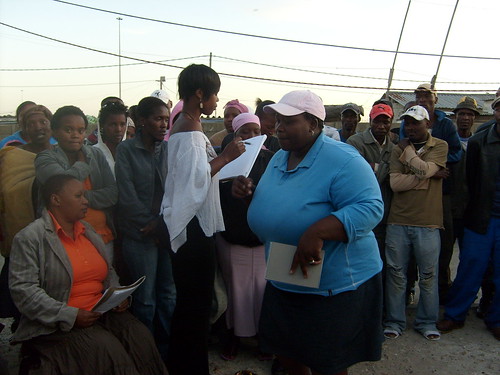
On Thursday I attended the report-back meeting that was held at Bapsfontein Hotel. The purpose of this meeting was to report back on the matter of the arrested community members and to discuss the issue of pressure the community was getting from the municipality. The meeting was well attended with many people having to listen from outside of the venue.

It was reported that all the community members who had been arrested were all released because there was no case against them.

An appeal was made to the community to support their leaders so that they can work well. It was indicated that the leadership of Bapsfontein was almost divided when the forced removals/evictions were carried out.

It was said that some people appeared to have been intimidated into agreeing to move because the municipality threatened to destroy their shacks. It was also reported that the community of Bapsfontein was now united because no families are prepared to move.

There was a question on what would happen if the community would resist for three months because there was a rumour that the municipality would apply for a court order to come and destroy shacks. It was clarified that there was no such thing and the fears of the community were allayed. The community was assured that what happened in December 2010 would not happened because the community was protected by the Bill of Rights. After this report-back the people were happy and they went back to their homes.

We then sat for a meeting with the local leadership to discuss some issues that included the letter they had written to the City Manager of the Ekurhuleni Metropolitan Municipality. This letter seemed to indicate that the local leadership was compromising. In the letter it is indicated that the remaining community of Bapsfontein was in no opposition to being removed from its current land as long as the alternative land meets what they called basic needs, i.e. proximity to places of work and safety and security.

The letter had already been sent to the municipality before it was even given to us for advice. The members of committee indicated to us that this letter was sent by the secretary without their consent because they were expecting this to pass through the ISN and CORC for advice.

We tried to encourage them not to allow themselves to be divided because they were faced with a major problem and had to provide leadership in the community.

It was agreed that in future if there is anything that happens we should inform each other and that no member of the committee would do anything without the knowledge of the other. The Bapsfontein leadership will be part of the Benoni meeting with the Ekurhuleni Municipality. This is the monthly partnership meeting with the municipality.

I was phoned yesterday (11/02/2011) by the leadership that some municipality officials indicated that they were not responsible for the relocations and wanted to apologise to the community. They said that it was the Province that was responsible. There is a meeting planned for today by the municipality for the local leadership to meet with some officials from the province. I then advised them not to agree to meet with these officials but they should demand the presence of the MEC because this matter was already in his hands.

Sheffield Road: an art, not a science

By News No Comments

IMG_3062

Pictured above: Residents of Sheffield Road deliberate over plans to “re-block” their cluster of shacks.

By Benjamin Bradlow, SDI secretariat

Networking informal settlement communities at the city-wide level is perhaps more an art than a science. This is a phenomenon that the growing community-based leadership of the Informal Settlement Network in Cape Town is experiencing on a daily basis. They are working with communities — sometimes their own, sometimes their neighbors — to implement at least 23 projects to upgrade informal settlements, in partnership with the municipality of Cape Town.

The projects serve two main functions: (1) To serve as practical demonstration of how a united community is the number one prerequisite for successful, sustainable upgrades that address the needs of residents; (2) To serve as learning centers for other communities to see and participate in the upgrading process. Taken together with the municipal partnership, these functions point to a greater end: bring together informal settlement community leaders at the city-wide level to ensure that the poor have an influential voice in determining policy and practice for city planning and informal settlement upgrading.

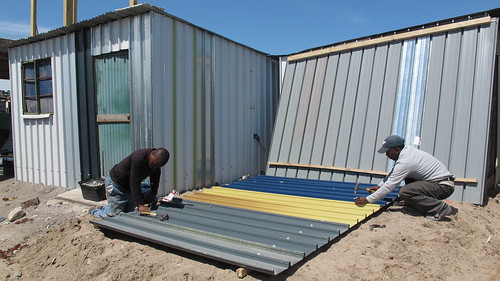
On Thursday, 10 February, I visited one of the first pilot projects in Cape Town, in the settlement of Sheffield Road, Phillipi. The project in this settlement is to “re-block” the very dense arrangement of shacks. This is being done in clusters of approximately 12-15 shacks. Once the clusters are re-blocked, the municipal government has agreed to install toilets where residents desire in each cluster. This has already happened in one cluster, and two more are set to finish by the end of the month.

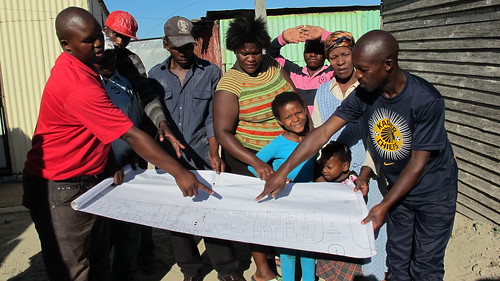
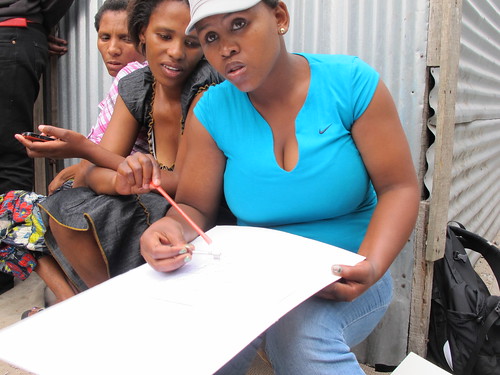
When I arrived at Sheffield Road, the “pilot project team” of the Informal Settlement Network (ISN) was preparing to meet with one of the clusters. They were going over some possibilities for the design of the cluster, using miniature, to-scale blocks for shacks.

Some of the community leaders wanted to make sure that when each shack was rebuilt that it would be as big as possible. At the same time, ISN leaders on the pilot project team talked through the implications for maximizing the space within the cluster. It was an important to-and-fro where ISN leaders gained a greater appreciation for the needs and interests of the community, while all sides reached a greater understanding about how to use space most effectively in this project.

Once the community leaders and the ISN pilot project team agreed on a general outlook that could be presented to the residents of the cluster, they moved to the bigger meeting. We were all crammed into a small space between about five different shacks. The difference between the density of the one cluster that has already been re-blocked is striking, and once residents in the other areas saw what happened in the first, interest in the project grew dramatically.

One of the key elements of the re-blocking process in Sheffield Road is that each household must contribute ten percent of the cost towards rebuilding their shack. This financial contribution has been a major hurdle for each cluster, but it ensures a kind of ownership of the project, that is otherwise impossible.

The importance of the financial contribution had sunk in with the residents of the cluster. One man asked if his shack could be rebuilt with repayment to come later. The rest of the residents immediately shook their heads and said, “no!”

By the time the meeting had ended, the cluster agreed to begin work in the coming week, and scheduled their next meeting.

These are small steps, but the residents of informal settlement communities — in Sheffield Road and throughout the city through the ISN — are grappling on the ground with the kinds of issues, the professionals, the city officials, and the academics tend to keep in a more theoretical realm. The poor are learning from each other. They are both the professors and the students. The rest of us are still waiting to register for school.

IMG_3076

Pictured above: Vuyani Mnyango, an ISN leader from Barcelona informal settlement, talks with Sheffield Road residents.

IMG_3042

Pictured above: Movable, to-scale blocks used by community members to decide on the spatial implications of their plans for each cluster of shacks.

“We Are uSkoteni. We are survivors.”

By News No Comments

By Patrick Magebhula, Chair of the Informal Settlement Network (ISN)

IMG_1768

Magebhula is a member of the SDI board, President of the Federation of the Urban Poor, Chair of the Informal Settlement Network, and Advisor to South African Minister of Human Settlements Tokyo Sexwale

For slum dwellers like myself, there was a time when the word “uskoteni” was a word that police and government officials used to demean us. We were squatters. We did not belong. We were to be removed or, barring that, continuously harassed. But we have changed this word. Throughout South Africa, we now refer to ourselves as “uskoteni” with a feeling of pride. To us, the word means that we are survivors.

The capacity of the poor to survive and innovate in the face of harsh conditions forms the backbone of a shift in South Africa’s approach to changing the living conditions of the poor in cities throughout the country. The Ministry of Human Settlements is changing its approach to slum upgrading. Since 1994, the RDP housing program has produced matchbox houses for a few on the periphery of cities. Though the government has built approximately 2.1 million houses, the backlog of those without housing is actually larger than it was in 1994. Now the Ministry has agreed on a new program of action: incremental upgrading of informal settlements that benefits whole communities where people already live. In December, Minister Tokyo Sexwale made a commitment to upgrade 400,000 informal settlement households on well-located land by 2014. This is one of three major outcomes of his performance agreement with President Jacob Zuma.

For slum dwellers this change in approach is similar to the way we have changed the meaning of the word “uskoteni.” The RDP housing program has created false illusions for the millions who live in hope of a free house that will likely never come. Those who do receive RDP houses often end up living further away from economic opportunity than when they lived in informal shack settlements. More still have faced the cruel hand of a State that evicts shack dwellers from settlements in every major city in the country. Under the RDP program, the poor are dependent, dispensable, and defenseless. 

I write as the chair of a broad network of informal settlement organizations called the Informal Settlement Network. The ISN includes national organizations of the poor like the Federation of the Urban Poor, a network of autonomous, women-led savings schemes and the Poor People’s Movement. But the majority of ISN participants come from organizations constituted at the individual settlement level. These include residents’ committees linked to the South African National Civics Organization (SANCO), crisis committees, development committees, and settlement task teams. The goal of this network is to bring together poor communities at the city-wide and nation-wide scale to share concerns, talk about problems, and develop solutions.

In every municipality where the ISN has come together thus far — Cape Town, Ekurhuleni, Ethekwini, Johannesburg, Nelson Mandela Bay, and Stellenbosch — it has sought out partnerships with municipal government. These partnerships are a key ingredient to our work in pioneering community-led informal settlement upgrading that can go to scale in managing the growth of South Africa’s cities. In total, ISN is working on or has planned 55 pilot projects for informal settlement upgrades in these cities. All are being done to varying degrees of partnership with municipal authorities, and at least two are being done in collaboration with universities.

On Friday, 21 January, the community organizations that work with ISN, as well as the Community Organisation Resource Centre, uTshani Fund, and uDondolo Trust — NGOs linked to Shack Dwellers International — made a historic commitment. After three days of deliberation at the Kolping House in Cape Town, we held a ceremony that will come to be seen as a watershed moment for all interested in the plight of the urban poor in our country, and especially for the participants in our movement. Many of these people have been part of the constituent organizations of ISN for the past two decades.

We recommitted ourselves to a broad agenda for working with local communities to develop an issue-based approach to their own development. This means capacitating communities so that they can collect information about themselves through household surveys, plan for their settlement using this information, and to network at the city level so that the poor are a key ingredient to all city planning activities. It also means building partnerships with city governments in order to create maximum impact for our struggle. We were therefore proud to clasp hands with representatives from the housing departments in the city of Cape Town and Stellenbosch.

Many of us at this conference, like myself, have traveled a long path in the struggle for the poor to live decent and empowered lives in cities in a democratic South Africa. In the late 1980s and early 1990s, we invaded land to create many settlements. These are now home to formal communities with services, legal tenure, and housing developments. We have worked with all levels of government to build a voice for the urban poor in the institutions of South Africa’s developmental state. We have worked with communities to learn to save their money, collect their own information, and upgrade their settlements.

As government shifts to an incremental approach to informal settlement upgrading, it is finding that communities are preparing the ground for a historic possibility. For settlement-wide upgrading can only be done with communities as central partners in the process. With such a strategy in hand, the new policy environment is paving the way to real change on the ground. “Uskoteni,” in partnership with our cities, are now ready to upgrade lives, and build the nation that has long been our hope and dream.