Category

News

Partners agree on upgrading for La Rochelle

By News No Comments

By Barbara Torresi, CORC
IMG_0667

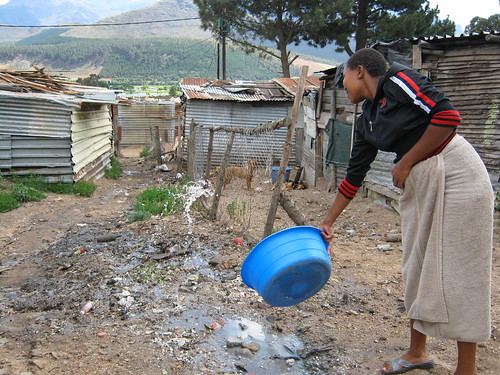
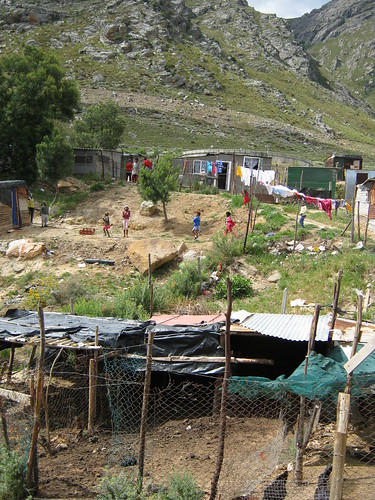
La Rochelle is a small informal settlement consisting of 25 mixed material dwellings, some of them brick and mortar structures dating back to the end of the 19th century. The community was successfully enumerated in March 2011 and the first phase of the settlement upgrading process is now underway. There are 69 people living on the site, including two (husband and wife) who were chased out by the community because of unruly drunken behaviour and who are now sleeping under a makeshift tent a hundred meters from the settlement. There are four portable toilets but they are cleaned only once a week. The municipality does not provide a garbage collection service and the community burns its refuses on site, with the consequent danger of flames spreading to the shacks. With regard to water, there are no access points in La Rochelle and people have to use a tap located outside the camp proper. Moreover, none of the houses is connected to the grid and the high mast lights in the formal settlement are insufficient to create conditions of visibility in La Rochelle after dusk. Darkness is indeed a serious problem as it encourages criminal activity, and in particular the sale of drugs from two derelict houses at the back of the settlement. With gangsters crawling around undisturbed it is now so unsafe to be outside at night that people are living in fear: a woman was raped a few weeks ago and as winter approaches even something as unavoidable as returning home from work is becoming fraught with danger.

On 1st April 2011 a delegation of municipal officials, community leaders from the Backyarders and ISN, and Corc visited La Rochelle with the aim of discussing facilities upgrading. The following actions were agreed on:

  • the municipality will demolish one of the two derelict houses used by local criminals as a logistic base. Since the other house does not lie on a municipal plot, the community will approach the owner of the land with a written request to demolish the structure.
  • the municipality will appoint a service provider to clean the toilets twice a week.
  • a contractor appointed by the municipality will relocate six shacks to a clearing at one end of the settlement. This is necessary to create space for bulk infrastructure placing, and in particular the construction of a road flanking La Rochelle.
  • the municipality will extend the existing water pipe into the settlement to create two water access points. However, the layout of the shacks to be relocated must be finalised before deciding the locations of the new taps.

During the upgrading meeting the possibility of relocating a small informal settlement named Schoopieshoegte to La Rochelle was also discussed. This is a breakaway community of 16 households that left Mandela City – a medium-sized informal settlement at the other side of Klapmuts – a couple of years ago. However, since these settlers are currently squatting on provincial land the municipality is unable to provide them with even the most basic services. On the other hand, moving them to La Rochelle would create enough critical mass for cost-effective infrastructure upgrading in the latter.
People cook on camp fires in Stellenbosch settlements

By News No Comments

By Barbara Torresi, CORC

IMG_0655

On the 22nd of March 2011, a delegation of government officials, community members, and professionals set out on a visit of selected informal settlements in the Stellenbosch-Franschhoek-Pniel municipalities, and in particular in the Kylemore area. The visit started at 3.30pm and lasted approximately 1 hour, during which 2 camps were surveyed.

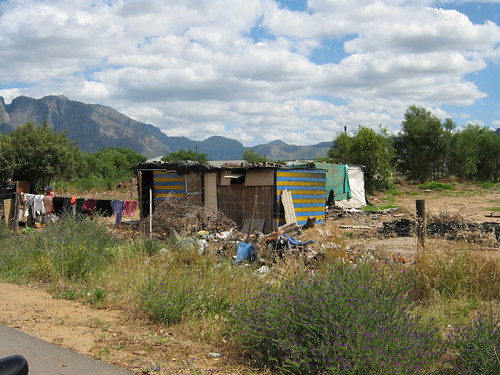
Guff is a gathering of 15 shacks on the side of a gently sloping escarpment four kilometres outside Pniel. The shacks are mostly in poor condition, with some being entirely unhabitable and at risk of collapsing. There are no services: no portable toilets, electricity, or even water points (there is a tap of water at the other side of the main transit road). People cook on camp fires and throw refuse in a gully that runs along the settlement and is by now full to the brim. There is also a makeshift and dangerous looking footbridge over a small crevice in the middle of the settlement. The earliest settlers have been on the site, which they cleared by felling trees, for about ten years, with others joining later after losing their houses. Some of the settlers, all Afrikaans speaking, are employed as seasonal workers on nearby farms or as domestic help, but they also engage in the sale of wine and drugs. People do their shopping in either Stellenbosch or Paarl and use the services of a mobile clinic located 4 km away in Kylemore. The provision of regular services with perhaps the exception of portable toilets is out of question and relocation must be considered.

Jeug camp is located at the back of a school in Kylemore and consists of four large shacks in which 17 families live. The shacks were built a few years ago by the Department of Education to be used as a church youth camp. The area is fenced and the shacks are solid-looking and with raised foundations. They have electricity but no toilets, either flush or portable, and the community uses the bucket system. There are no taps, but the settlers draw water illegally from the nearby school. The garbage is not collected by the municipality on the site, but the settlement looks well maintained because people take their trash to the school’s pick up point. The settlers, all Afrikaans speaking, have been living in the barracks for up to 12 years. They are all on the housing waiting list even though some people might end up not qualifying for the subsidy. There are plans for the whole area to be redeveloped but the final approval is yet to be granted.

Community leaders agree on their Right to The City

By News No Comments

Cape Town is a divided city, community leaders suggested at the first Isandla dialogue which took place on March 17 at the Langa Christian Church. Representatives from communities all over town had gathered to discuss their Right to The City – a political process which aims at empowering urban poor in cities around the world.  It encompasses the right to housing, to clean water and sanitation but also the right to work and public transport which is not yet part of the South African Constitution.

vcm_s_kf_representative_640x360

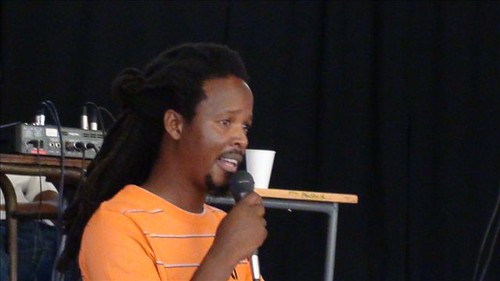
ISN leader Mzwanele Zulu addresses the Isandla dialogue participants in Langa

But in our divided city the West has it all, and the East has nothing, the participants argued: where we live, there exists no safety, no tenure, no services. The government irrespective of its political organization does nothing for us, and the policies in place are the same as during apartheid. “That’s exactly why we need to influence those politics,” ISN leader Mzwanele Zulu responded. “We are fighting with government because they are not including us. Let us learn the system and use it to our own advantage. We can only achieve our goals when we work together and are not divided ourselves.”

Last week’s event was the first of six forums organized by the Cape Town based NGO Isandla Institute, aiming at formulating a joint memorandum between communities, the State and NGOs to be presented to the media at the end of the year. “Where the government spends money in the city affects the poor,” said Isandla project manager Tristan Goergens. “You should have a voice in that and make democracy real.” Going forward the dialogues will look at precedents of successful people-driven engagements, leading to inclusive cities with mutual responsibilities amongst all stakeholders.

A drama act, presented by eight members of the women’s savings organization FEDUP, introduced the audience to the informal settlement of Sheffield Road. There the community has recently united and in partnership with the city reblocked and rebuilt a few clusters of shacks. The result is a safer, more spacious home for 20 families – an inspiring example for surrounding communities  who are currently collecting the necessary savings contributions to be the next in line for upgrading.  “People must be educated so they have the capacity to drive the process themselves,” said Zulu. “I am appealing to the present leaders to mobilize those that are not here today.”

Due to a taxi strike, many community representatives struggled to find transport to Langa. 30 leaders from the ISN, Mandela Park Backyarders, Metro Health Club, the Youth Network Sizakuyenza, Philippi People’s Forum and FEDUP were present nevertheless. The event was supported by CORC and DAG who have recently agreed to cooperate more closely in various areas including the mobilization of urban poor communities.

vcm_s_kf_representative_640x360

FEDUP savings members entertain the audience with a play about the upgrading at Sheffield Road

vcm_s_kf_representative_640x360

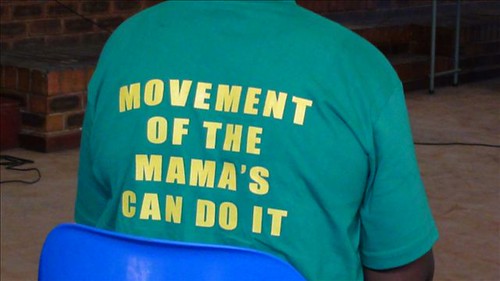
FEDUP mamas collect savings which are the necessary prerequisite for informal settlement upgrading finance

Langrug residents take lead in Stellenbosch dialogue

By News No Comments

By Barbara Torresi, CORC

Whilst Stellenbosch is home to some of the nation’s wealthiest families, hidden amongst its lush vineyards and posh farmsteads lies a smattering of derelict settlements where life is harsh and survival a daily struggle. Improving the conditions of its most disadvantaged citizens has long been on the municipality’s agenda, but it is only recently – thanks to an innovative partnership between local government, Slum Dwellers International, the Western Cape Backyarders, and The Informal Settlement Network – that concerted efforts to upgrade the area’s most degraded shanty towns have started in earnest.

IMG_0682
The enterprise gathered momentum after a court order in November 2010    mandated the re-laying of the sewage lines in Langrug, a large informal settlement located 3km north-west of the centre of Franschhoek. The upgrading of its drainage system, which required the relocation of 16 shacks to make room for new pipes and waste disposal sinks, provided an opportunity to improve the settlement’s conditions at large. To this end, in February 2011 SDI and its partners mobilised the community to number and measure its own shacks, while a relocation committee was formed to assist in the procurement and design of a new cluster of homes at the foothills of the settlement. Meanwhile, the local leadership recruited 31 volunteers to enumerate Langrug’s inhabitants and map both the settlement’s physical infrastructure and its socio-economic profile.

Generally speaking the aim of these efforts is twofold: on one hand they generate knowledge for local authorities, which thus acquire spatial and factual information that is crucial to improving service provision; on the other hand, participatory processes tend to increase cohesion and cooperation within communities by uniting their members in the pursuit of a common goal. But perhaps more importantly, they capacitate marginalised people by providing them with the necessary negotiation skills to engage in a mutually productive dialogue with external stakeholders. So far, Langrug’s leadership has demonstrated a high degree of organisational talent and the confidence that it has gained by having its efforts recognised will no doubt play an important role in the community’s ongoing empowerment.

But if one of the largest and most densely populated, Langrug is just one of the myriad of shanty towns in the Stellenbosch municipality and not necessarily the one most in need. Hence, in March 2011 two small clusters of shacks in Klapmuts called Mandela City and La Rochelle were singled out for immediate enumeration and profiling, while the partnership embarked on a ‘tour’ of the region’s informal settlements to assess needs and determine priorities. The visit uncovered the existence of huge disparities amongst squatter camps irrespective of size and location. Thus, on one end of the continuum lies Upper Graveyard B, a hilltop gathering of 19 wendy-houses that the community has beautified with plants and flowers.  In spite of having no connection to the electricity grid and only 4 toilets, with its tidy walkways, lush lawns, and perfectly tended front yards the settlement looks almost idyllic.

On the other end of the spectrum there are Slabtown and Slabtown Under the Bridge; the first one is a fly-infested and underserviced clustering of approximately 30 derelict shacks next to a Devon Valley sewage plant, the second a crime-ridden corner of metropolitan blight near Kayamandi. Both these squatter camps, along with many other, require the municipality’s immediate attention, and it is hoped that through the newly founded alliance between governmental, non-governmental, and grass-root organisations led by SDI, action will be soon taken to improve living conditions in these communities and enable their members to become partners in their own uplift.

Occupiers of Rose Acres negotiate with landowners

By News No Comments

By Max Rambau, CORC

At a meeting between various stakeholders involved in the land struggle around Rose Acres on March 15, the landowners  indicated that they sympathized with the occupiers. They also indicated that they had written a letter to the Ekurhuleni Municipality, the Minister of Human Settlement requesting to discuss the matter but they had not received any response.

They informed the meeting that failure by government to respond to their letter had forced them to take action of applying to the High Court for the eviction of the occupiers. They had informed government of their intention and had also sent a copy of the High Court application. They said that the Municipality had kept on saying that they had lost the document.

The landowners informed the meeting that they wanted government to either buy or lease the occupied land because they believed that the people deserved to be housed and that it was the constitutional duty of the municipality to provide housing but the municipality is not communicating with them. They were willing to suspend effecting the court order if government would come to the table.

They said that they were losing a lot of money on the land that they were not using and they wanted to rehabilitate it in order to build some light industries as the land is dolomitic. They said that they could not do it while the people were occupying it.

It was clear that the landowners had called this meeting to build and strengthen their case so that they can go back to court and say that they had consulted with the occupiers and were justified to evict people.

Also, we believe that it was the wish of the landowners that the municipality would not respond and this would work in their favour. They wanted the Ekurhuleni Municipality to agree to evictions and commit itself to moving them elsewhere.

The occupiers indicated to the landowners that when they bought the land in 2007 they found people occupying it. It was pointed out to them that the land also includes the cemetery.

Another issue raised by the occupiers is that there are about four landowners in Makause and that they must indicate how much land they own.

The landowners said that they had already had a layout of the area.

The occupiers challenged the landowners to show them the letter that they claim had been sent to the Ekurhuleni Municipality because the latter claims that they had not received any letter. The landowners produced an unsigned copy of the said letter.

The occupiers informed the landowners that they could arrange a meeting between them (landowners) and the municipality because they (occupiers) had a good relationship with Ekurhuleni Municipality.

The landowners then requested to have the name and contact details of the person they could liaise with from the community and it was agreed that this would be communicated at a later stage.

After the meeting we requested SERI to assist us in finding a lawyer to represent us on this matter.

Slum dwellers unite behind Bapsfontein residents at Gauteng High Court

By News No Comments


Bapsfontein9March1

The Bapsfontein residents were supported by hundreds of  shack dwellers outside the Pretoria Supreme Court

By Max Rambau, CORC

The case of the so-called “evacuation” of people at Bapsfontein Informal Settlement by the Ekurhuleni Metropolitan Municipality was heard at the Pretoria Supreme Court following an application by the Lawyers for Human Rights (LHR) on behalf of the people of Bapsfontein.

The court sat on  9th March 2011 and was attended by hundreds of people of Bapsfontein and others from different informal settlements around Gauteng who came to give support.

The Ekurhuleni Metro Municipal failed to respond to the argument filed by the LHR for an interdict against the forced removal. The Supreme Court judge then requested Ekurhuleni Metro to go back and prepare their arguments because they failed, as the judge said, to reply to the arguments put by the lawyer on behalf of the people of Bapsfontein against the interdict application.

Ekurhuleni Metro had argued that this matter was “politically influenced” instead of arguing for the need to evacuate or relocate families from Bapsfontein. The case was postponed to Friday (11/03/2011) to allow the Ekurhuleni Metro Municipality to prepare their arguments on this case.

The support shown by people from various informal settlements around Gauteng was very good. Buses, mini-buses, hired taxis and vans were filled by people organised by the ISN to go and give support at court.

The court was filled to capacity and many other people could not be accommodated inside and they had to continue to protest from outside.

This case (2 sittings), although not yet concluded, has shown that the Ekurhuleni Metro Municipality did not know what they were doing at Bapsfontein.

The grassroots are talking

By News No Comments

uTshaniBuya

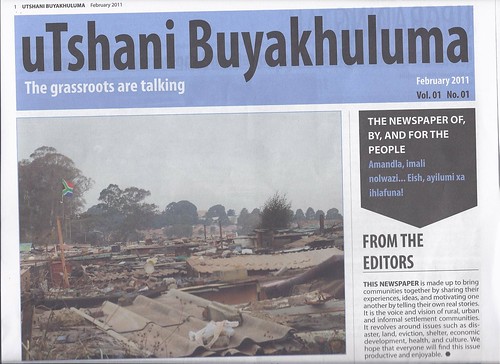
Shack dwellers  all over the country are reading  the first issue of uTshani Buyakhuluma, “The newspaper of, by and for the people – Amandla, imali nolwazi … Eish, ayilumi xa ihlafuna!”

Stories range from reports on settlement upgradings, partnerships and income generation projects to opinion pieces and poetry. “This newspaper is made up to bring communities together by sharing their experiences, ideas, and motivating one another by telling their own real stories. It is the voice and vision of rural, urban and informal settlement communities. It revolves around issues such as disaster, land, eviction, shelter, economic development, health and culture. We hope that everyone will find this issue productive and enjoyable”, say the editors.

4000 copies have been distributed to all provinces via the network of the South African SDI alliance. ISN and FEDUP support the new publication and help to access even remote areas.

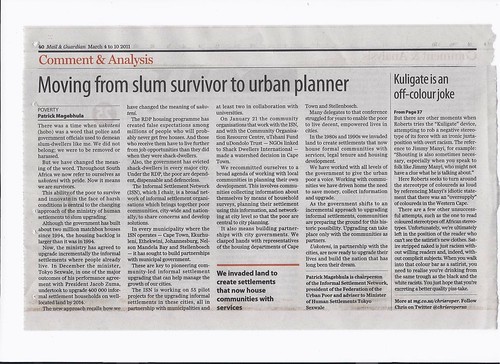
The weekly newspaper the Mail & Guardian has also printed an article by ISN chairman Patrick Magebhula, emerging from January’s Kolping Conference in January.

PatrickM&G

To contribute an article: email skm@webmail.co.za or fax 086 5135279
To receive a copy:  email bukiwe@courc.co.za

To download PDF of uTshani Buyakhuluma, right click and select save as: http://www.sasdialliance.org.za/static/upload/docs/UB_Issue_1_Full.pdf

NEW: Podcasts Slovo Park and Sheffield Road

By News No Comments

The government needs to improve informal settlements because their housing porgramme gave too much to too few and has run out of steam. But the State can not improve any informal settlement on its own. It needs partnerships with resident communities so that they can work together to achieve change.

But if the resident communities are not organized or trained what kind of partners will they make?

Listen and learn: Two communities – Sheffield Road and Slovo Park -have successfully upgraded their settlement.

Podcast Sheffield Road

Podcast Slovo Park

No agreement between Makause residents and municipality

By News No Comments

By Max Rambau, CORC

Untitled2

This meeting was arranged by the Mayor of Ekurhuleni Metro Municipality with the community stakeholders and the landowners at Makause.

This meeting follows a visit by the Mayor. It was chaired by the MMC for Housing but did not have an agenda but the municipality explained that they wanted to provide services for 3 months and they wanted the landowners to give them permission to do so.

The meeting turned out to be a war of words between the landowners and the municipality.

The municipality wanted to clean the area and also put up flood lights and water in the area.

Some of the landowners that included DRD Gold, Roseacres and others wanted to know from the municipality what the reason was for providing service only for 3 months when the people had been in the area for more than 20 years. They also wanted to know what would happen after 3 months. They suggested that the municipality should buy the land as it was available or negotiate for leasehold.

They also indicated that the municipality should give consideration to land tenure rights of the community that has been in the area for 20 years.

The landowners informed the municipality that they have writing letters to the Ekurhuleni Metro Municipality about the community of Makause but they did not get any responses and that they had even written letter to the Minister of Human Settlements asking him to do something about the community. They told the Minister that there was land available for settlement while there was also land that was dolomitic. They also informed the municipality that the people of Makause had put up their shacks on top of graves and this was a shock to the community because they did not know about this.

The municipality accused the landowners of not negotiating in good faith when they wanted permission to provide services for 3 months. The landowners indicated that it was instead the municipality that was not negotiating in good faith by not agreeing to buy land or enter into agreement for leasehold.

The meeting adjourned without any concrete agreements and all the issues raised were just left loose.

The MMC requested the community to remain behind after the meeting but they refused to attend this meeting.

A meeting was proposed between the ISN, community stakeholders (excluding the Ekurhuleni Metro Municipality) and the landowners to further discuss the issue of land. The date of the meeting still to be agreed upon.

98 shacks demolished at Bapsfontein

By News No Comments

By Max Rambau, CORC

In the morning of the 5th March 2011, I received calls from Bapsfontein people who were panicking and sounding emotional informing that there were a lot of police cars (SAPS and EMPD) as well as trucks with “Red Ants”.

The heavy police presence was clearly a show of power and was meant to intimidate people.

BapsfonteinCommunity1

Fortunately the community did not retaliate with violence. Now the Supreme Court will hear their case.

I was not able to go there at that time because I had a problem with my car. I managed to control the situation from afar as I asked people to be calm and not to try to fight with and throw stones at the police and that they must not resist when their shacks are demolished. This must have worked because there was no confrontation between the community and the police.

When I got there I found that demolishing of shacks had started taking place. People’s goods and furniture were being loaded onto trucks by the “Red Ants”. I then went to the police to ask them what was happening and demanded to speak to the person in charge. When I was referred to someone from the EMPD I said that I did not want to speak to municipal employees.

One SAPS officer indicated to me that they believe that this eviction was illegal and that they were just told to go to Bapsfontein.

I was then given a name of the person who was responsible for this eviction project. Her name was Reena from the Legal Department of the Ekurhuleni Metro Disaster Management. She informed me that what was happening at Bapsfontein was not eviction or relocation but evacuation. I then told her that we would meet in court that very same day.

I  contacted lawyers from SERI, LHR and CALS. They all came and it showed that they were interested in this case. I ended up giving this case to Lawyers for Human Rights (LHR) who then applied for an urgent court sitting. The case was heard at the Pretoria Supreme Court at 15h00.

The Judge of the Supreme Court stopped Ekurhuleni Metro from continuing with their action at Bapsfontein until Wednesday when the case will be heard at the Supreme Court.

After the court case I communicated with the ISN about the judge’s decision and they then went to Bapsfontein to give support and help to offload the goods and furniture from the trucks.

Unfortunately, 98 shacks had already been destroyed and some goods and furniture had been taken away without their owners because the people had refused to go.

From Pretoria we went back to Bapsfontein to give report back to the community. I indicated to them that people’s power meant that they had to use strategies without violence and that this had worked because the municipality was expecting resistance and violence which did not happen. I indicated to them that if they had retaliated, some of them would have been arrested and the focus would have shifted from what the municipality was doing to what the people were doing.