Category

News

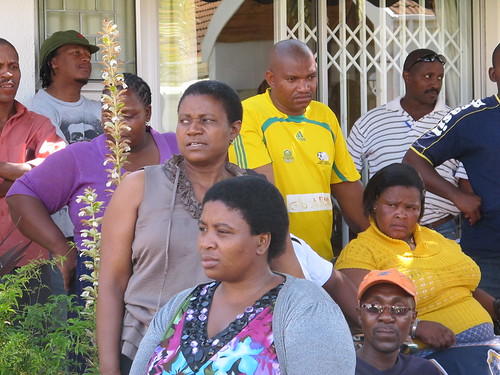
Residents of Hekpoort (Mogale City) get organized

By News No Comments

IMG_1602

By Max Rambau, CORC

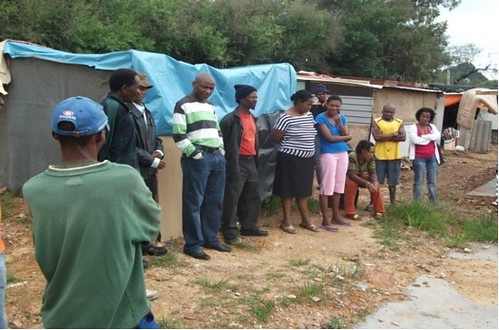
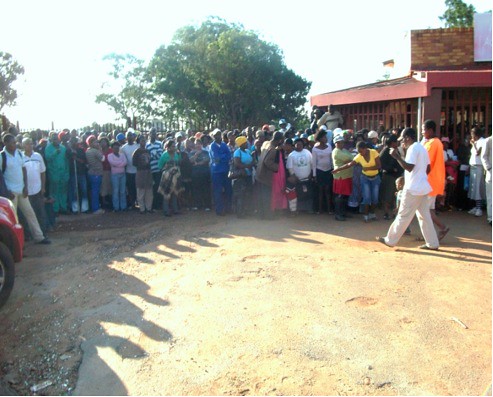
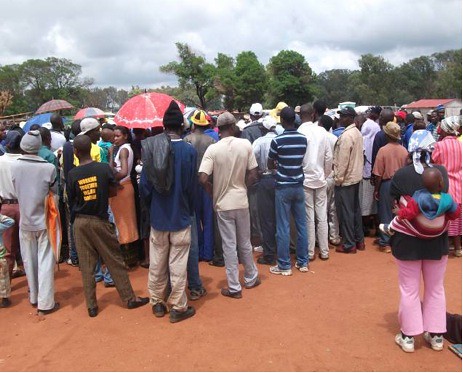
On Saturday (5th February 2011) I went to Hekpoort at the invitation of the local leadership. I had expected to meet only with the leadership but only to find that it was a general meeting instead. The meeting was well attended by people from 4 settlements of Skeerpoort and other surrounding plots. There were more than 150 people.

This meeting was more of a complaints’ meeting whereby the people raised their concerns and dissatisfaction with the local ward councillor who is working with the landowners and farm owners. He assists them in evicting people by taking them to some informal settlements in the area.

It is alleged that the ward councillor is being paid by the landowners and farmers to assist them evicting people.

The Concerned Community group indicated that the ward councillor was taking them from where they had rights and were taken to informal settlements where they did not have rights. They said that they wanted to know how the ISN could assist them because they were working with LAMOSA.

We informed them that we as the ISN we were assisting people but supporting them on their activities.

Some people wanted to give us their individual cases to us but we requested that they should give them to their leadership.

We took one case of Sam Manganyi who was assaulted by the police and the farmer who had taken over the farm he was working in.

Mr. Manganyi’s employer of 10 years had sold his farm to another farmer, Mr. Robbie Lehane. It appears that the new owner did not want Mr. Manganyi from the farm where his former employer had given him a place to stay in the farm and also given him a tractor, combi and ploughs as part of the retrenchment package.

There are two houses (3 roomed and 2 roomed) that Mr. Manganyi had built by himself as a labour tenant.

The new farmer, Mr. Lehane started accusing Manganyi of stealing some farming equipment and had him arrested by the police who also assaulted him. The charges that Manganyi laid against the police but this case has not progressed.

We are contemplating taking this case to the Gauteng Provincial Commissioner of Safety and Security and a  letter will be written to him.

Bapsfontein update: Leaders released from prison

By News No Comments

By Kwanele Sibanda, CORC

There are 29 community members who were arrested on allegations of perpetrating public violance during a forced removal. The members were arrested and they spent nine days behind bars. They were then released on a R500 bail per member. Their bail money was raised through contributions by their fellow community members.

Today, the 9th of February 2011 was a happy day for them and the ISN members that have been supporting them all the way. Charges against them were dropped, however the community now intends to involve the Human Rights Commission to intervene in terms of the violated human rights. A meeting with the Human Rights Commission has already been set by the community and it shall be held tomorrow in Bapsfontein at 5pm.

Three ISN members from different settlements and two Corc staff members were present for support.

A pledge of renewal for the Alliance

By News No Comments

IMG_2818

Slum dwellers community leaders from throughout South Africa made a historic commitment last week to build and network community organizations in order to upgrade informal settlements at scale throughout the country’s cities. The three-day meeting at the Kolping House in Cape Town brought together over 100 delegates from the Informal Settlement Network (ISN), Federation of the Urban Poor (FEDUP), Poor People’s Movement (PPM), Community Organisation Resource Centre (CORC), uTshani Fund, uDondolo Trust, and Shack Dwellers International (SDI).

This wide-ranging alliance of community organizations and non-governmental organizations linked to SDI agreed to a program of action designed to build community leadership around issue-based development. Key activities include capacitating communities to collect their own information through household surveys, so as to be active participants in planning for their settlements and cities.

Further, a cornerstone of the agreed resolutions was an intention for networks of community organizations to build partnerships with municipal authorities. These partnerships will form the basis for a program of community-centered planning for upgrading settlements, and managing urban growth.

“Our strategy is a version of that old rally cry: ‘Nothing for us without us,’” said Patrick Magebhula, ISN chair, FEDUP president, and advisor to Minister of Human Settlements Tokyo Sexwale. “The kind of upgrading we speak of is not about land and services alone. This is about realizing real citizenship and equality in our cities.”

Magebhula made the remarks at a ceremony on Friday, 21 January, where the South African SDI Alliance joined hands with housing officials from the municipalities of Cape Town and Stellenbosch to reaffirm their partnerships to upgrade informal settlements. The Cape Town partnership has already led to upgrading projects in 7 informal settlements with active involvement of the local community, facilitated by the ISN as a network of informal settlement communities throughout the city. In total, the Alliance and the municipality have already agreed to work in at least 20 informal settlements.

“I have been walking this road with the Alliance for two years. I have shared the pain and I have shared the joy,” said Mzwandile Sokupa, director of the Cape Town municipality’s informal settlements department. “We bring all resources to the table, in terms of people, in terms of funding, in terms of will … We are also saying, ‘nothing for you without you.’”

Johru Robyn, Town Planner in the housing department of the Stellenbosch municipality, noted the transforming effects of his department’s partnership with the SDI Alliance. “We have pursued many public-private partnerships, but our partnership with [the Alliance] has led to a total rethink of our housing strategy,” he said.

The shift has been two fold. Firstly, Stellenbosch had never before considered an informal settlement upgrading program. Johru also noted the impact that the Alliance has had on the way Stellenbosch engages with informal settlement dwellers: “Now we don’t go to the community to talk to the community. Now we go to the community to speak with them.”

One of three planned partnered upgrading projects is already underway in Stellenbosch, and the city is exploring the creating of a jointly-managed “urban poor fund,” for wider scale upgrading in the municipality.

Nation-wide, the South African SDI Alliance has 23 pilot projects for informal settlement upgrading underway in 7 cities. Another 32 are planned, for a total of 55 pilot projects. Such work is done in partnership between communities, municipal governments, and, in 2 instances, also academic institutions.

FEDUP has long been the largest civil society initiative to empower the poor to build houses for themselves utilizing the governmental People’s Housing Process subsidy. Since 1994, the Federation has built over 15,000 houses.

Federation national coordinator and SDI deputy president Rose Molokoane reflected the Federation’s shift in focus to incremental upgrading during the round of singing that punctuated Friday’s ceremony. After singing an old Federation song about building houses, “Zenzele” (do it for yourself), she pointed to Magebhula who wrote the song. “ Now I want someone who composed this song to make a remix,” she said.

Reagile (Roodepoort) residents tough negotiations for land

By News No Comments

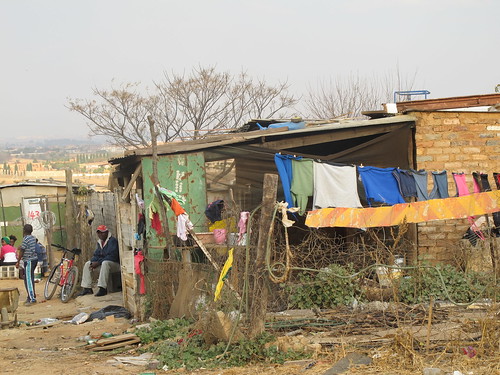
Reagile residents

Pictured above: Residents of Reagile wait for the private landowner to show up.

By Max Rambau, CORC

On 15 Jan, I met with the community of Reagile in Princess next to Roodepoort on Saturday and this was a postponed meeting from the previous day after the landowner, Mr. Robert, whom we were supposed to meet did not turn up.

The landowner did not turn up again on this day.

The meeting had been arranged so that we could discuss the transfer of the land by the landowner to the community. The landowner had previously moved 31 families from two plots and placed at Plot 17 & 18. The community members were labour-tenants who have rights to the land.

We were hoping to meet with him to request him to write a letter to the community to formalise the hand over of land. We then agreed with the community members that we need to engage the ward councillor to assist in facilitating a meeting between the landowner and the community for the hand over of land. The ward councillor is aware of this problem.

The ward councillor in the other ward next to Plot 17 & 18 had once ordered the “Red Ants” to demolish shacks in the area in order to build a bus stop (in a ward that does not belong to him) but the Human Rights Commission challenged these evictions and the people were returned to their place.

For the damaged goods and properties, the community is awaiting a court date.

The community indicated that they were faced with a challenge of some people who want to bring other people to the area and they are apparently selling stands to them but the local leadership is fighting against this and they want only the 31 families to remain in the area.

Bapsfontein update: Residents meet with private landowners

By News No Comments

Bapsfontein report back mtg 6 Jan 2011

Pictured above: An overflow mass meeting of Bapsfontein residents, after the leadership committee met with the private landowners.

By Max Rambau, CORC

We had no idea what this meeting would be all about as it was called by the landowners of Bapsfontein without any indication of what would be discussed. We thought that it was going to be a report-back to the community.

After we had each introduced ourselves individually, the landowners indicated that they had thought we were from the Human Rights Lawyers and had wanted to discuss with us about the intimidation they had received from the Ekurhuleni Municipality. They informed us that they had received a ‘Directive’ letter from the office of the City Manager of Ekurhuleni Metropolitan Municipality which was only addressed to ‘Whom it may concern’.

According to the landowners this letter was advising them that in terms of the Disaster Management Act no persons are allowed to squat/reside on the property.

The owners indicated that they have been the owners of the Bapsfontein  for the last four years  when they bought the farm. They informed us that the people were already on the farm and that they do not have a problem whatsoever with the people living in the area. However, they expressed their sadness about  what they are seeing now is sad as they were seeing  families being split, with the females moving to that area and the males staying behind.  They also indicated that they were the ones who had called in the media when the so-called relocations were carried. They told us that from the little information they have there were no sinkholes and the area was dolomitic either on this farm which they bought and that even if there were, why was it that these affected only the black people in the informal settlement and what about the white people staying in the area. They indicated that there is a hotel, taverns, bottle, houses in the area but they had no problems.

They also informed us that the area is 42 hectares and that the area to which the municipality was relocating the people to is only 20 and cannot accommodate everybody.  They said that they were aware and had been informed by the municipal officials that there is close to R16 million that was invested towards the relocation.

The landowners indicated that they suspected that what Government was really after was the water in the farm.  They also told us that they were awaiting a geotech report about this area. They said that this report would be available in a week’s time

They were however concerned that the “Red Ants” were also destroying their property and they were hoping that the Human Rights Lawyers would help them in this regard.

We requested the landowners to write a report stating all what they had said about the Bapsfontein area and to also include the geotech report so that we can wage a united front on this matter.

Community report –back meeting

In the evening the ISN and committee went on to give a report-back to the community on the arrested community members as well as the meeting with the Ekurhuleni municipality.

It was reported that, of the 28 arrested community members, 20 were out on bail of R500 each and a 17 year old minor was released into the custody of the parents. 7 people are still in prison as they could not afford to pay for their bail amount.

The community agreed to raise funds to pay for bail for the remaining community members.

The report on the meeting with the Ekurhuleni Metropolitan Council Speaker was received well by the community and they indicated that they had hope that something was being done about their plight and they could not sleep as they did not know what was happening.

Update: Bapsfontein residents regroup after eviction

By News No Comments

Mass mtg Bapsfontein 2 Jan 2011

Pictured above: Residents of Bapsfontein informal settlement during a mass meeting.

By Max Rambau, CORC

This morning (2 Jan) I attended a community general meeting at Bapsfontein together with the ISN. The meeting was intended to discuss the recent forced removals and to also to beef up the local leadership.

The problem of the leadership was that there were divisions within the local leadership caused by political affiliations. An apolitical committee representing the community was formed. The names and contact details of this committee will be sent to me because the elections were done before I arrived.

I briefed the community about the manner in which the Ekurhuleni had undermined the people’s rights in terms of policy that requires government to engage in dialogue with the community before carrying out relocations. I indicated that the officials of Ekurhuleni had also not respected the agreements we had with them whereby we had programmes that were cancelled that included a visit (walkabout) to Bapsfontein, which means that they already knew that forced removals would be carried out.

I also briefed them that there were institutions that had been in touch with me that wanted to assist the community by challenging the Ekurhuleni Municipality in court.

The community expressed their disappointment that they were being forced to move to a land that was not suitable for housing.

The community raised complaints that they were being intimidated to move and threatened by some officials that their shacks would be demolished and that they would remain without accommodation.

Some community members reported that the municipality was “buying” them with a bag of mealie meal, coffee and powdered milk when they arrived at the relocation.

The ISN reported about their walkabout programme and that they were surprised about the move that was taken by the Ekurhuleni municipality to relocate people of Bapsfontein. The ISN indicated that the municipality had undermined them by not informing them when they sit together in meetings. They said that they were opposed to people being moved to a place that was far away from their places of employment and schools. It was reported that people would spend about R36 a day from where they have been relocated to when coming to work.

The ISN suggested that an urgent meeting with the municipality and that a letter to Ekurhuleni should be written today.

Bapsfontein residents face eviction by Ekurhuleni municipality

By News No Comments

By Max Rambau, CORC

I responded to a call from one of the local leaders at Bapsfontein that they were being forcefully relocated by the Ekurhuleni Municipality and I went there to find out for myself.

When I arrived on Wednesday there I found out that there was a standoff between the community and the police and the situation was very tense. The community was resisting forced removal by barricading the entrance to their area and burning tyres. The Ekurhuleni Municipality had sent the “Red Ants” to bring down the people’s shacks and relocate them to some temporary (transit) place, about 20 – 22 kilometres away (next to N12) that the municipality had identified.

The Ekurhuleni Municipality did not comply with the law because they did not engage in dialogue with the community prior to carrying out this relocation. An official from the municipality just came to the community on the 16th December and loud-hailed that the people would be relocated from their area on the 27th December 2010. According to the municipality, this relocation of about 3 000 families would be moved between now and January 2011.

I met with the local leadership who briefed me about the situation and we agreed that those people who were prepared to move should be allowed to do so but that those who were not prepared to move should remain until we met with the municipality.

There are some members of the community who were injured during the clashes with the police and some people (28) were arrested. One person was seriously injured and was admitted in hospital.

More than 100 families voluntarily moved out, including some local leaders.

Yesterday (Thursday, 30/12/2010) it was the day of the court case for the 28 people who were arrested. This case was held in Bronkhorspruit. Only one person (a minor, 17 year old girl) was released and the others remained custody until the case is heard on the 6th January 2011 where application for bail will be heard.

Today I received a call from the Human Rights Lawyers who indicated that they were interested in assisting the community of Bapsfontein. They indicated that they were going to prepare a questionnaire for the community and that thereafter they would challenge the Ekurhuleni municipality on this forced relocation.

A community meeting will be held between the Human Rights Lawyers and the community on Tuesday, 04/01/2011. I will be attending this meeting and will keep you updated on the developments in this regard.

As for today, things are quiet at Bapsfontein and there were no attempts to forcefully remove people.

Large-scale evictions in Zandspruit

By News No Comments

Zandspruit1

Pictured above: Building material being loaded onto trucks to be taken away.

By Max Rambau, CORC

I got a call today (22 November 2010) that evictions were being carried out at Zandspruit and the shacks were also being demolished. The City of Johannesburg had been granted an eviction order at the South Gauteng High Court.

When I arrived I found out that about 70 shacks had already been demolished. About 120 shacks will be demolished. When I asked the local leadership why they had stayed with the eviction order for a long time without informing us, they said that they were relying on the municipal area managers and the ward councillor who had assured them that they should not worry they were going to deal with the matter.

There was nothing that could be done because the local leadership had not gone to court to defend the case of evictions and therefore there was nothing that could be done to stop the sheriff and the police from carrying out evictions.

The problem of Zandspruit is that there are too many leadership factions that operate differently from each other and were therefore not able to unite to fight for the community of Zandspruit. There were also rumours that some residents who were evicted would come back from work and demand their money back for the stands they had bought from some leaders and a big fight was expected.

At the time of writing this report I had received reports that 120 shacks had already been demolished. I will be meeting with Seri to find out if there was something that can be done to assist the residents whose building material and belongingshas been confiscated to get them back.

Europe, Cape Town, completes enumeration

By News No Comments

By Blessing Mancitshana, CORC

Europe is an informal settlement located in Gugulethu township, it is situated along N2 road bordering with  Barcelona and Kanana. This settlement is only made up shacks as the only shelter for housing, business and religious purposes. Like any other informal settlement in the country, the community is under the leadership of committee which oversees all the issues concerning their settlement.

The enumeration exercise, which ended on 10 October 2010, was conducted only by the volunteers who took part in different aspects of the whole exercise. These were: data collection, manual data capture, measuring and mapping. As a norm of community driven socio economic surveys, the enumerators volunteered from a number of informal settlements around Cape Town who are in the same predicament as Europe. The community leadership was part of the whole exercise, being helpful in mapping the enumeration road map.

A lot of work was done during the preparation of the enumeration especially to get people to understand the main motive and objective behind the enumeration. Initially, many people were hopeful that the community enumeration survey would lead to housing delivery. The objective of the enumeration was later decoded by the entire community after a series of meetings between the community and the Informal Settlement Network enumeration team. The main motive of the enumeration was outlined as the need to create a platform which will benefit the community in terms of planning and implementation of the basic service delivery and other forms of incremental development. Above all, it was highlighted that the enumeration will help bring in the community to participate in planning and strategising for the development of their settlement together with the city government.

This enumeration was taken as a pilot in terms of mapping, and a new way of mapping was implemented for the first time here in South Africa. This is a GIS related mapping but done by the community members who posses little or no GIS cartographical skills. This is a method which is being used in Kenya by the communities when they do their mapping. Many people had long thought that the method will take away the community’s participation in the process. But this has proven to not be the case, as much of the work is still done by the community members.  During the enumeration, a team comprising of three people was responsible for “manual data capturing” — that is, capturing the information as the completed forms came in with data collectors. This is a method also borrowed from Swakopmund, Namibia. Results are made available just a while after the data collection process.

The community is now developing a plan to begin working with the municipality under the pilot program.

Makause recovers from fire

By News No Comments

Repainting in Makause

Pictured above: Residents paint their replacement shacks after they were destroyed in Makause.

By Max Rambau, CORC

On Saturday, the 2nd October some fire broke out at Makause Informal Settlement near Germiston in one of the shacks.

The main reason I went to Makause was to find out how many shacks had been rebuilt by the “Red Ants”.

Allegedly, one resident came back late at home and decided to light a primus stove to make himself some food. He fell asleep and it is not clear whether the fire was caused by the primus stove or the candle burnt out and caused fire in the shacks.

Fortunately, the man was rescued by other residents and was taken to the hospital. By this time the fire had spread to about 148 shacks in the area. Unfortunately, the man died in hospital after four days.

Residents also informed us that the trees and strong winds in the area also helped to spread the fire.

We asked the local leadership as to how many shacks had been rebuilt they were not able to give us numbers but we observed that while some shacks had been rebuilt, very few had been finished and most shacks were still to be rebuilt.

The “Red Ants” had left after two days without finishing their work. They said they were expecting the Ekurhuleni Municipality to give them another contract in order to finish rebuilding.

Some residents had begun rebuilding by themselves and some neighbouring companies are lending a hand.

PG Bison have pledged to donate doors. Wits Mining are donating beds and the community is compiling lists of people who should be receiving beds.

There are other companies that want to assist the residents by donating building material and other forms of aid.

The Ekurhuleni Disaster Management Department has been supplying foodstuffs and blankets to the residents since the fire disaster.

The Ekurhuleni Housing Department has also been lending a hand by interacting with the affected community.

The local leadership was expected to hold a meeting today (10/10/2010) to prepare for the funeral of the dead man that will be held in Limpopo. The leadership is also busy collecting funds to assist with funeral costs. They were also going to seek donations from the local SAPS as they had good relations with them.

It is unfortunate that it had to take this fire disaster for the local leadership from the many community structures to realize that it was crucial to work together and put their differences aside. Perhaps this is a sign of good things to come at Makause and I indicated to them that if this were to be the situation then it would be good for the community.