Category

News

Unemployed but Making Money: Income Generation in Port Elizabeth

By News No Comments

By Yolande Hendler (on behalf of CORC)

Bulelwa Msila & her mother sell vegetables in New Brighton, Port Elizabeth

Bulelwa Msila & her mother sell vegetables in New Brighton, Port Elizabeth

As Bulelwa Msila arranges vegetables on a small vending stand on New Brighton’s busy Ferguson Road, a chilly gust of wind ushers passers-by into nearby homes. Due to Port Elizabeth’s winter weather, her mother is not braaiing (grilling) fish that day:

“Actually my mom sells fish but today it’s too cold. This is just a small business that I started with my mom, just to survive. I buy the vegetables from the fresh produce market. There is a lot of junk food that people eat, so we decided to sell vegetables because they are affordable and healthy. People buy from us because we are cheaper than supermarkets. Many come at the end of the month [after pay-day]. I also have another job but this one helps us to earn more. We use the money for our day-to-day expenses like electricity and school fees for my daughter.”

(Bulelwa Msila, Federation Income Generation Program)

Linda Mpako, who oversees FEDUPs income generation program (FIGP) in Port Elizabeth, explains that the program provides tangible access to financial assistance through small-scale loans. In particular it supports people who are not formally employed nor earn a regular income.

FEDUP’s Income Generation Program in Port Elizabeth

FEDUP has registered the FIGP as a micro-finance institution that draws its loans from FEDUPs National Urban Poor Fund (UPF). The UPF is built up through the payment of a once-off membership fee of R750 that is asked of each new FEDUP savings group member. In order to access loans in consecutive tranches, an individual needs to become part of a loan group (of 5 members), be an active saver and member of a savings group. Each province is guided by a FEDUP appointed loan facilitator like Linda, who provides support around loan group formation, loan disbursements, repayment cycles and other needs.  Read more background here.

Linda Mpako, FIGP Loan Facilitator Eastern Cape

Linda Mpako, FIGP Loan Facilitator Eastern Cape

In the Eastern Cape, the FIGP has mostly attracted people who are not yet members of FEDUP-based savings schemes.

“People are interested to find out about us because most people already have businesses but they don’t have finances to sustain them. The FIGP interest is very low – we are the best on the ground. We don’t just issue money to anyone. People need to become part of a savings scheme. The repayment is manageable when over four months you are paying back R 276,67 per month”

(Linda Mpako, Eastern Cape, Loan Facilitator)

Motherwell: Income and Strong Savings go hand in hand

Further outside Port Elizabeth, Vivian Gulwa welcomes Linda into her home in Motherwell.  She is on her third loan cycle, making a success of her beading business.

“I usually buy coffee mugs [ traditional metal mugs] in a pack of 6, decorate them with beads and sell them for R150. You will find that most people love to put them into their display units. Many of us make necklaces and traditional artwork so I had to shift and make something different. As long as you start with a small thing and have the spirit to grow, you can think of anything. I thank God for what I learnt from FEDUP: in savings groups we buy groceries in bulk. We will never go hungry in this programme, we are building each other and encouraging each other”.

(Vivian Gulwa, FEDUP member in Motherwell, Port Elizabeth)

FEDUP members showcasing the work they do under FIGP.

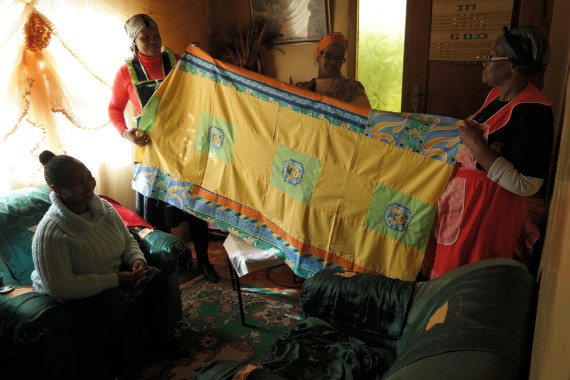
Vivian Gulwa (far right) showcases her beading work financed through the FIGP together with members of her savings group.

Nomsa Dyalom and Busisiwe Tekane are very recent FEDUP members.  Both are seamstresses using FIGP to become more independent in running their business:

“We are a group of 5 women in Motherwell community who make beadwork and sew clothes. We have been working in this field for 5-6 years but only came together as a loan group recently when we heard about FIGP. We are not yet members of FEDUP but we are in the pipeline. The loan group will assist us in getting additional money to make our business more successful – especially since some of us are pensioners. The loan will help us spend our money independently – we will no longer quarrel with our husbands to convince them that we want to use some of the pension money for our business.”

SAMSUNG CSC

Nomsa Dyalom and Busisiwe Tekane

Building business strategy to build long term livelihood

In terms of business strategy Linda advises that new loan groups should use the example of people from outside South Africa. Through working together, it becomes possible to buy products and stock the spaza shop [corner shop] more cheaply. Unsurprisingly, one of the main challenges is competition: if potatoes are in season, you will find people selling potatoes in the same street – or sweets and fat cakes. Linda expresses the necessity for training so that people start checking with their community what people need. Overall, she shares:

“In my experience the FIGP is delivering what people need. It helps with unemployment and growing the FEDUP membership. We are seeing how families that have never worked can make money. Because of savings and small business, FIGP is like a survival skill. It shows when poor people use their own skills they can make money without being employed.”

(Linda Mpako, FIGP Loan Facilitator, Port Elizabeth)

Mama Nobom's small business

Mama Nobom’s small business

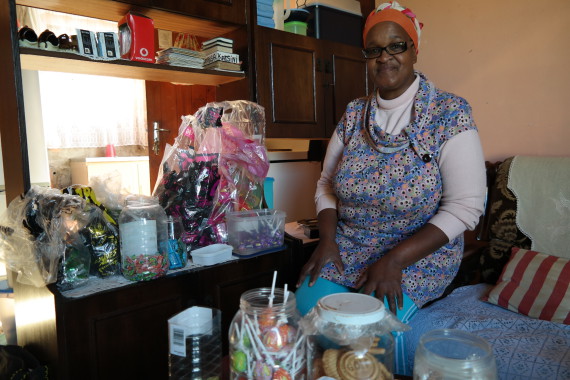
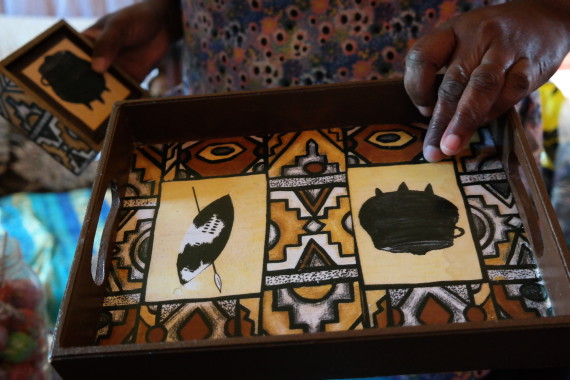
Mama Nobom sells handmade crafts

Mama Nobom sells handmade crafts

‘An eye for an eye makes the world blind’ – FEDUP/ ISN say NO to Xenophobia

By CORC, FEDUP, ISN, News, uTshani Fund No Comments

Authored by SA SDI Alliance

Following the outbreak of xenophobic violence in Gauteng in April 2015, the Federation of the Urban and Rural Poor (FEDUP) and the Informal Settlement Network (ISN) – both members of the SA SDI Alliance – hosted a dialogue on 24 – 25 April 2015 to say NO to Xenophobia.

“When Xenophobia broke out the Catholic Church approached ISN & FEDUP for support because people were fleeing their homes. We decided on a dialogue because we realised that there was a problem on the ground.“

(Sipho Vanga, ISN Coordinator in Gauteng)

ISN facilitators in Holomisa settlement, Gauteng (2014). Sipho Vanga (third from left)

ISN facilitators in Holomisa settlement, Gauteng (2014). Sipho Vanga (third from left)

The dialogue was titled, ‘Is it really xenophobia or violent protest?’ It brought together 32 informal settlement leaders from Johannesburg (COJ) and Ekurhuleni Municipalities (EMM) in Gauteng Province. Represented settlements included Sicelo, Slovo Park, Delport, Marathon, Makause, Ramaphosa, Holomisa (COJ), Holomisa (EMM), Mandela, Kanana Park, Meriting, Denver, Zacharia Park, Siphamandla, Tinasonke and Thembakhoza. In a press release statement, FEDUP & ISN explained,

“In order to try and avoid violent protest and xenophobic acts we will host a series of dialogues with the leadership of informal settlements AND those affected by xenophobia to discuss social ills with the aim to facilitate the integration of affected people back into our communities.

(ISN/FEDUP Press Release)

The program spread over two days and sought to find a common understanding of xenophobia and its causes in South Africa and to propose possible solutions to stop violence and discrimination. Topics of discussion included:

  • Xenophobia
  • Unemployment
  • Social Stereo Typing
  • Crime
  • Gender
  • Water & Sanitation
  • Upgrading
  • Land Tenure
  • Youth
  • Poverty

Day 1: Dialogue on Xenophobia’s Causes and Challenges

The first day engaged Gauteng’s informal settlement leaders who gave voice to their communities’ grievances, perceptions and concerns. Leaders shared first-hand experience of xenophobic violence, their respective perceptions of root causes and avenues of response.

IMG_20150513_105428[12]

As community leaders spoke about experiences and community perceptions in their settlements they highlighted some perceived frustrations relating to:

  • Crime

“Illegal immigrants commit crimes and cannot be identified because their finger prints are not in the system”

  • Lack of employment

“Capitalists employ foreigners over locals because foreigners are willing to work harder and earn below the minimum wage.”

“Foreigners operate … businesses without licences because they can afford to bribe… authorities that approach them.”

“South Africans cannot compete with foreigners who are in a position of purchasing bulk commodities that automatically reduce purchase prices.”

  • Drugs & Poverty

“Foreigner mostly bring in and deal drugs that make a huge contribution to the poverty cycle.”

  • Low service provision and development

“The government uses foreigners as an excuse to not develop a number of areas. Yet when foreigners are displaced from communities, it is the government that advocates for their re-integration.”

Dialogue participants explained that jealousy drives locals as they perceive themselves as unable to compete with skills, knowledge and experience brought into the country by foreigners. For leaders this easy influx was connected to poorly protected borders. As “government only listens when communities take extreme measures” leaders explained that xenophobia was a new discovery by South Africans to ensure that their voices are heard and to catalyse service delivery. Some leaders criticised government for using informal settlements as “refugee camps”. They attributed the lack of service delivery to government’s reluctance to undertake upgrading in settlements that are home to foreign nationals.

“It is crystal clear that informal settlement residents are ignored and side-lined by government at all levels. Government has failed us completely in all areas of service delivery. Yet, we are always trying our level best, no matter what, to meet, plan and partner with government AND we will never stop trying!”

(FEDUP-ISN Press Release)

As the discussion unfolded, leaders analysed the matter in terms of their own context and role within it, recognising that “maintaining peace should start with leaders themselves”. They acknowledged that foreigners did not invade their communities but mostly settled through negotiation with respective community leaders while others rented from South Africans. Despite initially expressed frustration, participants concluded that “an eye for an eye only makes the world blind” and adopted a stance of saying “NO TO XENOPHOBIA”.

Day 2: Supporting the Displaced

Day two’s discussions included members of the police, business forums, perpetrators and affected people. Those affected explained that they had come to South Africa to improve their lives and not to sell drugs. Participants agreed that community members would help each other to communicate openly about illegal activity.

IMG_20150513_105617[8]

Leaders furthermore agreed that no further violence should be experienced. They recommended that illegal immigrants try return to their home countries and apply for relevant travel documents. A further recommendation related to the need for consultative public engagements (between communities and relevant government officials) on integration plans for legal immigrants.

Dialogue participants had previously expressed a growing concern with government’s limited interest in engaging relevant community structures to identify the root causes of xenophobic violence in order to find ways of ameliorating it through community-led processes. Leaders decided that going forward, ISN & FEDUP should facilitate engagements with local authorities and jointly advocate for peace and integration in communities. Community leaders would draft a Memorandum detailing the grievances.

“We are apologetic for what happened in the country. That is why we held dialogues. ISN and FEDUP play an important role: we are not going to sit and watch xenophobia happen. Some foreigners – like our brothers and sisters in Zimbabwe – belong to SDI [Shack Dwellers International), just like us. The solution is to create space for leaders to engage in dialogue. ISN&FEDUP should pressure government to deliver and CORC should be the middle man between us.”

(Sipho Vanga, ISN Co-ordinator Gauteng)

Outlook: Negotiation not Violence

For ISN National Co-ordinator, Mzwanele Zulu,

“The root cause of xenophobia is apartheid. It is something we can’t run away from – discrimination and apartheid realities are still present: people live in conditions where there is no transformation. There has been human rights transformation and perhaps some psychological transformation but no change in living conditions. Political, social and economic issues – especially the high unemployment rate – affect people and cause high levels of frustration.”

Mzwanele Zulu, National ISN Coordinator

Mzwanele Zulu, National ISN Coordinator

When cities act as engines of economic growth based on neo-liberal policies and programs they result in more inequality and poverty. Access to serviced, well-located land becomes increasingly difficult, as urban land markets are exclusionary by nature. More people are forced to access land informally and experience diminished opportunities to access employment, health, education, basic services and housing. In addition people experience diminished levels of political and administrative accountability. It is in this particular political and economic context in which informal settlement communities are trying to make sense of the chaos, their inequality and poverty.

“To address issues relating to informal settlement upgrading, urban poverty and development, the state needs CBOs, social movements and NGOs to work with. The same applies to xenophobia. We need drastic contributions from the state in terms of human and financial support. But the state’s response needs to be exercised through partnership with local channels.”

(Mzwanele Zulu, ISN National Co-ordinator)

Minister Sisulu appoints Rose Molokoane to Council of Social Housing Regulatory Authority

By CORC, FEDUP, News, SDI, uTshani Fund No Comments

The South African SDI Alliance, together with SDI, is excited to announce that last week national minister of Human Settlements, Lindiwe Sisulu appointed Rose Molokoane to the Council of the South African Social Housing Regulatory Authority (SHRA). Molokoane is founding member and national co-ordinator of the SA Alliance, the Federation of the Urban and Rural Poor (FEDUP) and Deputy President of SDI.

Minister Lindiwe Sisulu (left), with Jockin Arputham (SDI president), Zoe Kota-Fredericks (Deputy MInister) and Rose Molokoane (right) at National Human Settlements Indaba 2014

Minister Lindiwe Sisulu (left), with Jockin Arputham (SDI president), Zoe Kota-Fredericks (Deputy MInister) and Rose Molokoane (right) at National Human Settlements Indaba 2014

Rose Molokoane

Rose Molokoane

In her appointment letter Minister Sisulu writes,

“Your appointment to the Council of the Social Housing Regulatory Authority is in recognition of your unique set of skills and expertise, and I am confident that your contribution will be meaningful.”

The SHRA works together with the Department of Human Settlements at all tiers, the National Housing Finance Corporation and international actors to develop the social rental housing sector for the delivery of rental housing accommodation to low and middle income earners.

The SHRA’s vision is to regulate and invest in the development of affordable rental homes in integrated urban environments through sustainable institutions. Some of the functions of the SHRA include:

  • Promote the development and awareness of social housing by providing an enabling environment for the growth and development of the social housing sector.
  • Provide advice and support to the Department of Human Settlements in its development of policy for the social housing sector and facilitate national social housing programmes
  • Provide best practice information and research on the status of the social housing sector
  • Support provincial governments with the approval of project applications by social housing institutions
  • Provide assistance, when requested, with the process of the designation of restructuring zones
  • Enter into agreements with provincial governments and the National Housing Finance Corporation to ensure the co-ordinated exercise of powers
Rose Molokoane facilitates daily savings workshop for FEDUP treasurers and collectors in Limpopo

Rose Molokoane facilitates daily savings workshop for FEDUP treasurers and collectors in Limpopo

Molokoane is a resident of Oukasie township near Brits in North West Province, and a member of Oukasie savings scheme. A veteran of the anti-apartheid struggle, she is one of the most internationally recognised grassroots activists involved in land tenure and housing issues. FEDUP has supported more than 150,000 shack dwellers, the vast majority of whom are women, to pool their savings. This has won them sufficient standing to negotiate with government for a progressive housing policy (People’s Housing Process) that has produced over 15,000 new homes and secured more than 1,000 hectares of government land for development.

Molokoane has initiated federations of savings schemes throughout Africa, Asia, and Latin America. She was awarded the UN-Habitat Scroll of Honor in 2005 for her struggle to bring land and homes to the poor.

Rose Molokoane with members fellow members of SDI board and council from Uganda and Tanzania.

Rose Molokoane with fellow members of SDI board and council from Uganda and Tanzania.

Rose Molokoane with FEDUP Western Cape members

Rose Molokoane with FEDUP Western Cape members


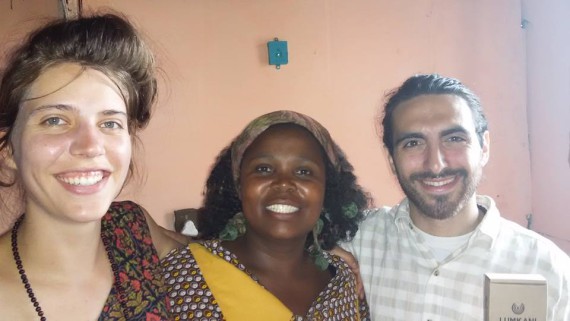
Rolling out Lumkani Fire Device: Preventing Fires, Upgrading Communities

By CORC, FEDUP, ISN, News No Comments

By Yolande Hendler (on behalf of CORC)

The last two months bear witness to the devastation fires can cause. At the height of South Africa’s hottest months, fires pose a continuous threat, often breaking out in informal areas, wiping out entire segments of informal settlements, despite the response of fire departments.

Fire in Langrug, Stellenbosch Municipality, February 2014

Fire in Langrug, Stellenbosch Municipality, February 2014

A proactive response to fire?

In January and February 2015, the Alliance was alerted to two fires in ISN/FEDUP settlements alone, with several more breaking out in the City of Cape Town and Stellenbosch Municipality such as in Langrug informal settlement where an estimated 70 structures were razed to the ground. In 2014 the City of Cape Town’s Human Settlements directorate spent R6.5 million on fire aid by issuing 1 186 enhanced emergency kits to victims of 254 separate fires in a period of two months.

How can the response to informal settlement fires become less reactive and more proactive and preventative? Since early 2014 the SA SDI Alliance has partnered with Lumkani, a social enterprise that has designed and co-developed an early warning fire detection device with ISN and FEDUP affiliated communities in Cape Town.

UT Gardens leadership with Lumkani with installed device on wall

UT Gardens leadership with Lumkani with installed device on wall

2014-11-24 11.50.54

Co-developing the Lumkani device

The Lumkani device uses heat detection technology to sense for fires. It accurately measures the incidence of harmful fires alerting the family inside a shack of the danger. Each device is networked to surrounding devices within a 100m radius. In the event of a fire the detecting device sends a signal to surrounding devices within this range. A solid beep means that the device has detected a fire in your own home while a broken beep indicates that the fire is in the nearby surrounding. A wave of sound creates a community-wide alert and response to danger. This buys time for the community to become proactive in rapidly spreading fire risk situations. Through deep engagement with UT Gardens community leadership, the Lumkani team co-developed the device to optimally suit the informal settlement context. Read more about the device and the co-design process here.

The Lumkani device

The Lumkani device

DSCN7918

Co-developing the device – workshop in UT Gardens ahead of rollout and installation.

DSCN7901

Co-developing the device – workshop in UT Gardens ahead of rollout and installation.

Roll-out and Community Contributions: “We are proud of our device”

In November and December 2015 the first Lumkani devices were rolled out in UT Gardens and Siyahlala’s D-section. Currently ISN and FEDUP community leaders have rolled out 650 devices.

On the first day of distribution and roll-out, community leaders and members of the Lumkani team installed about 20 manufactured devices in the homes of community leaders and general community members. The devices need to be installed 1m away from the cooking area, to avoid triggering a false alarm in the event of close proximity to a heat source. The device is therefore positioned as high as possible while still in reachable distance in order to test or silence the alarm.

As the first batch was installed the community leadership collected a 20% contribution of the overall cost of the devices from community members through door-to-door visits. Contributions are an integral part of the Alliance approach of “Vuku’zenzele” – “Wake up and do it for yourself”.

Nokokheli Ncambele, Western Cape ISN co-ordinator explains,

“[Contributions are important because we want] communities to find solutions to their own problems. If a community contributes, they show that they are interested. With our contributions, we leverage more funds”

Communities that expressed interest in the device during initial mobilisation could apply to the Alliance’s Community Upgrading Finance Facility (CUFF) for co-funding, whereby CUFF covered 80% and community members contributed 20% (i.e R20) of the total cost.

Emily Vining, who facilitates Lumkani’s community interaction, reflects on the significance of community contributions,

“It is our hope that the act of purchasing the device is an exercise of freedom whereby people can increase their own safety and security and that of their community through their own agency and choice. Communities don’t have to wait for external actors to bring about change. They can do it for themselves”

2014-11-24 11.33.33

UT Gardens community leader, Vuyani Ntontela and Lumkani engineer Frank Petousis install device

Lumkani with Nozuko

Siyahlala’s FEDUP co-ordinator, Nozuko Fulani, with Lumkani’s Emily Vining & Frank Petousis

Fire prevention record so far

So far the system has prevented the spread of two fires in UT Gardens. The first (9 Dec 2014) occurred in the late morning when a light breeze blew some embers from a cooking fire into the neighbouring home. Although the homeowner was away, the Lumkani device she had installed triggered her neighbours devices who ran outside their homes to see where the danger had come from. The community managed to keep the fire contained with buckets while one community member used the toll-free emergency number 112 to call the fire department. The fire had burnt the community member’s home to the ground but no other structures where affected. The community attributed this to the early alert the Lumkani system provided.

The second incident occurred in the early morning hours of 22 Dec 2014 when UT and Lumkani leadership were alerted by SMS text messages that the system had triggered. Later that day it emerged that some men had left their pot unattended while making food. Their Lumkani device rang when the pot caught fire alerting them to the danger. They quickly put out the fire and shared the story with UT Gardens community leader, Thamara Hela, as they were very impressed with the functionality of the device.

DSCN7907

UT Gardens community leader, Thamara Hela, with Emily Vining

A broader approach to Upgrading

The Alliance’s partnership with Lumkani is an example of what a proactive community intervention can look like. Its significance lies in the co-design and co-development of the Lumkani device – between community members and Lumkani’s technical team. What sets the Lumkani device apart is the community’s involvement in developing its own technical intervention. Through negotiating additional funds through their own contributions the community expressed its interest in taking the device on as its own – “Vuku’zenzele”.

The partnership is also an example of a broader approach to upgrading, one that reaches beyond housing and basic services. When upgrading includes co-design and relevant co-intervention, communities move from being receptors to actors, taking more control of the development process itself. 

CORC planner honoured with SAPI Young Planner Award

By CORC, News No Comments
On site in Flamingo Crescent Informal Settlement

On site in Flamingo Crescent Informal Settlement

Sizwe Mxobo, a planner at the Community Organisation Resource Centre (CORC) received  the South African Planning Institute’s (SAPI) Young Planner Award in October 2014. In speaking about his work as a planner with community movements affiliated to the SA SDI Alliance, Sizwe explains,

“An important aspect for me is exploring what public participation means in planning and informal settlement upgrading” (Sizwe Mxobo, CORC Planner).

In early 2014 SAPI released a call for nominations for successful young planners and announced its bi-annual summit in Durban titled “Planning Africa” from 19 – 22 October 2014. Nominations were submitted under various categories, one of which was the Young Planner award – to be made out to a “bright young planner (under the age of 35) for his/ her exemplary achievements and promising for the future in the planning profession as well as his/her contribution to the promotion of the planning profession” (SAPI).

The SAPI Awards

The SAPI National Planning Awards were established in 2008 to recognise and create a strong awareness of the valuable contributions and extraordinary performance in all aspects of the planning profession. The awards are an opportunity to appreciate the efforts and contributions of many planners in shaping the built environment, promoting sustainable development and maintaining the integrity of good planning practice amidst competing development interests and challenging situations.

Sizwe with Langrug commnuity leaders Trevor Masiy and Alfred Ratana

Sizwe with Langrug commnuity leaders Trevor Masiy and Alfred Ratana

Planning in the SA SDI Alliance

Sizwe has been working with CORC since 2011, providing technical support, often in informal settlement upgrading initiatives, ranging from community mobilization, capacity building, assisting settlements with preparing development plans or engaging City officials around service delivery issues.

In 2012, Sizwe project managed the upgrading and re-blocking of Mtshini Wam informal settlement in Cape Town. The project set a precedent for informal settlement upgrading, at local and national level whereby the City of Cape Town used it as a benchmark to deliver a reblocking policy. It was also awarded an Impumelelo Gold Award in 2013. Since then Sizwe has spearheaded 3 other upgrading and re-blocking projects in the City. Sizwe’s work has also focussed on Langrug informal settlement near Franschoek in the Western Cape. Through deep engagement with the community Sizwe assisted CORC and the community in devising a pallette of informal settlement upgrading strategies. The planning of Langrug was awarded the SAPI National Award in the Community Category.

Planning reblcoked Layout in Mtshini Wam informal settlement, Milnerton

Planning reblocked Layout in Mtshini Wam informal settlement, Milnerton

Why Planning?

When tracing his steps as a planner, Sizwe links his interest in participatory, community based planning to his roots.

“I was born and raised in an informal settlement and still live in one. I have always wondered what it would take to transform an informal settlement. When I saw the first housing developments in Samora and Delft I asked myself why people had to move away from their current locations and amenities. Why could changes not happen where people lived?”

Sizwe’s fascination with community development – particularly how informal communities could be transformed to formal settlements – inspired him to study Town and Regional Planning. He remembers that although informality was addressed by the curriculum it largely focussed on how to move from a shack to a house.

“My biggest attraction has always been how planning principles can be used in informal settlements. When I was planning chairperson we took students to Nyanga and explored what in-situ upgrading is about. I learnt that my interest in fighting for people who are generally not considered by planning institutions – landless people in urban areas – is called advocate planning. Others did not always understand my approach to planning. Through working at CORC I found my feet and understood what planning is for me. Winning this award has been a further confirmation. We are no longer talking the language of eradication of informal settlements but of upgrading”

In Nyanga, Cape Town

In Nyanga, Cape Town

In Kuku Town informal settlement with community leader Verona Joseph

In Kuku Town informal settlement with community leader Verona Joseph

A different approach to Planning

“In the ever-changing role of a planner, I think a key element for planners is to ensure the relationship between people and land. Public participation should be more than drawing up plans and asking for a community’s approval. It should be about supporting people to come up with their own development plans for their communities”

(Sizwe Mxobo)

As a profession planning is rapidly transforming. Most urban policies developed in South Africa focus extensively on community participation. Both the National Development Plan (NDP) and Upgrading of Informal Settlements Programme (UISP) talk about community participation as a central tenet for development. However, government has also identified this as a missing link and capacity both within the municipal and private sector. Most recently, the National Upgrading Support Programme (NUSP) has floated tenders in 49 different municipalities to develop community based plans. Clearly, community participation in the planning sector is the need of the hour.

SAPI Award Ceremony in Durban, Oct  2014

SAPI Award Ceremony in Durban, Oct 2014

Discussing Plans with Flamingo Crescent Community Steering Committee

Discussing Plans with Flamingo Crescent Community Steering Committee

With Kuku Town Steering Committee, Kensington

With Kuku Town Steering Committee, Kensington

YOUTH: Young. Organised. United. Talented. Hardworking.

By News 2 Comments

By Skye Dobson [Cross posted from SDI Secretariat]

beach3_big

“Poor people have me. Rich people don’t need me. If you eat me you’ll die. I am worse than a demon. Who am I?” 

This was the riddle Rogers, a youth member of the South African SDI Alliance posed to youth from across South Africa, Uganda, Kenya and India at the opening of a peer-to-peer exchange held in Cape Town, South Africa for youth activists last week. He put his phone on the table and said that whoever solved the riddle in 3 minutes would get the phone. To honor the riddle, I will tell you the answer at the end of the blog. 

Unfortunately the phone deal has expired.

“As a girl, I’m always told things happen because of fate. But it’s the things I do, not luck, that determine my fate. So we must forget about fate, and move forward.”

Shikha, India

prayasam_big

The exchange was inspired by the youth activism of Prayasam, an Indian organization founded in 1999 to enable children to participate in the decisions that affect their lives. When Shack/Slum Dwellers International (SDI), an international network of slum dweller federations in 33 countries, learned of Prayasam’s work and the shared strategies used to organize communities to profile and map their settlements as a starting point for negotiations with authorities, it was agreed that the two organizations would do well to promote peer-to-peer learning between youth members and other youth groups trying to make change in their settlements. With support from Sundance Films, SDI, Prayasam, The Community Organization Resource Centre (COURC), and SDI hosted a 6-day learning exchange for youth from informal settlements in Uganda, Kenya, South Africa, and India.

“I taught myself how to share and how to love. The River of Life showed me you can solve your problems as a group.”

Lucky, South Africa

riveroflife_big

A River of Life exercise on the first day – led by the Prayasam youth – kicked off the exchange and supported reflection by the youth on the highs and lows of their lives and their goals for the next three years. The youth drew and presented their personal rivers to the group. The stories were touching, referencing hardships such as the death of family and friends, early pregnancies, gang membership, and lost opportunities owing to a lack of financial resources. On the high points of their rivers, however, they explained the pride experienced when they got into or performed well at school, found spiritual direction, became members of youth groups, and took part in exchanges with other youth both locally and abroad. While their highs and lows were described in individual terms, it was fascinating to note that their aspirations for the future were almost entirely group-centered. The youth spoke of wishing to bring their communities together, of wanting to empower their peers, about increasing the membership and impact of their youth groups, of setting a good example to children, and of advocating for the rights of the young and the disadvantaged. This exercise set the stage for the youth to engage each other more openly. Instead of the standard introductions of formally structured peer-to-peer learning, these introductions stripped the process down to authentic fundamentals: Who am I? Why am I here? How did I get here? It was clear that the process was as much about answering these questions for oneself as it was about sharing it with others.

“The film showed that you’re never too young to make change.”

Sefiso, South Africa

A key inspiration for the youth exchange was a film called The Revolutionary Optimists, which follows Amlan (founder and Director of Prayasam) and three of the children he works with, as they become agents of change in their communities. The film not only captures the incredible work of Prayasm’s children, but the realities of life in Indian slums. On the second day the youth were able to see the film at a community center in Langa as well another from Uganda, The Boda Boda Thieves, which captures some of the realities of life in Uganda’s slums. The feedback from the youth was thoughtful and insightful. They were quick with their praise for the Indian youth and concluded that one is never to young to make change in his/her community. They expressed the similarities they saw between conditions in India and their own countries – particularly related to poor sanitation, teenage pregnancy, and child labor. They joked of the celebrities in their midst! From The Boda Boda Thieves film they concluded youth must be very careful when it comes to peer pressure and a desire to get money quickly. They all had stories about youth who had succumbed to peer pressure and “gangsterism” and they made references to the contributing factors. They discussed the importance of reaching out to parents so that they can support their children to join youth groups and take part in productive afterschool activities as an alternative.

“Statistics might be different from experiences.”

Sibo, South Africa (Sizakuyenza)

IMG_2104

IMG_2106

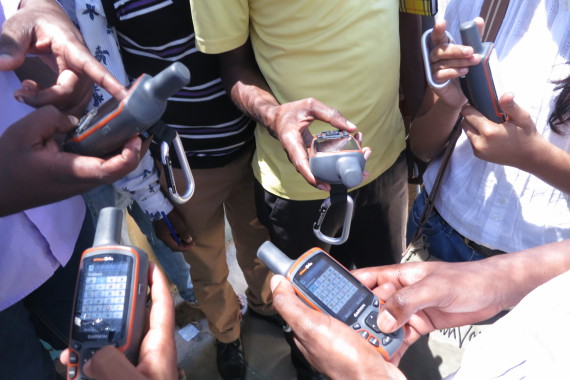
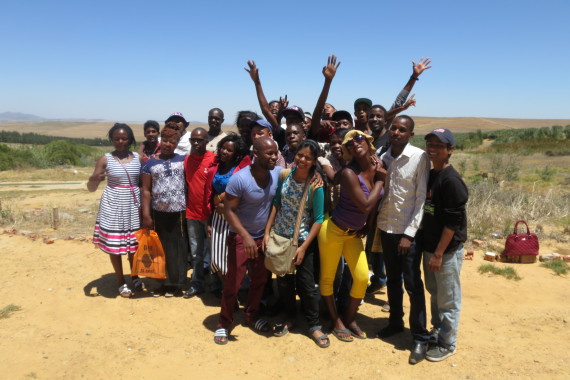
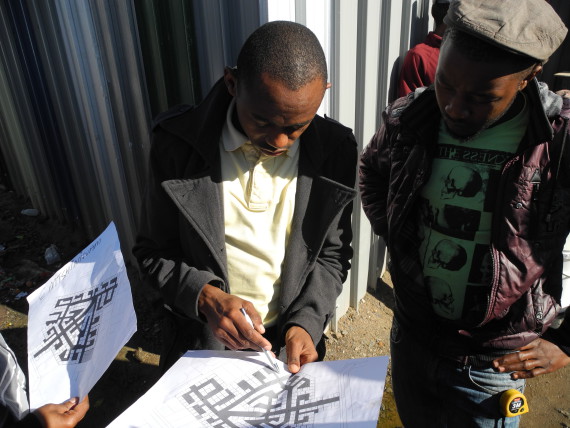
A unifying strategy across many of the groups is the collection of data by youth in order to plan for change and negotiate with other actors – often the State – to implement solutions. Both Prayasam and SDI affiliates profile slum settlements, but their approaches are slightly different and the youth were able to share and reflect on each others strategies, achievements, and challenges. In the spirit of Learning-by-Doing, the youth went to a settlement in Nginalendlovu in Khayelitsha anda settlement profiling exercise which was facilitated by community members and supporting professionals in the South African SDI Alliance. Half the group used GPS devices to map the boundary of the settlement, while the other half conducted the socio-economic profile with the local community, while trying to squeeze into all available shade under the awnings of shacks. Rogers, a youth member from Kwazulu Natal administered the questionnaire with infectious enthusiasm and finesse.

Community members were guided to discuss and generate information on their settlement, from the origin of its name, to issues of tenure security and services, to the biggest challenges facing the community. They expressed major concerns with water supply, flooding, and crime, but they were unanimous that the biggest threat to their community at present comes from rats. One gentleman explained that his cat was eaten by a rat and that children are attacked and one child’s hand was bitten off. It is important to note that a problem with rats was not amongst the check boxes on the questionnaire. This highlighted Rogers’ skill as a profiler and the need to allow sufficient time for communities to make less structured contributions throughout the profiling process. The community was eager for the compiled information to be returned to them and the discussion about their issues to continue so that they can begin to generate solutions.

“…everything in nature has its own reason.”

Rogers, South Africa

IMG_2271

IMG_2248

The reflections from one of the youth on his visit to Path Out of Poverty (POP) on Goedgedacht Farm visit were so poignant. Through a long term, holistic, programme, POP builds confidence and skills in rural youth and offers opportunities for self advancement and for making a real contribution to their own communities. Rogers said he was “blown away by POP” and that he learned “everything in nature has its own reason. You can learn from nature if you’re patient. If you watch it, it will teach you.” One could argue the same is true for these youth, who clearly have so much to teach the world about their realities and how they believe change is possible. Within them, like nature, the solutions can be found for many of the world’s ills. Salim, one of the Indian youth, said the way poems and song are used to “manage the kids” at the Goedgedacht Farm will really help him to strengthen his leadership at the preschool in his community, while Kamalika from Saldanha was inspired to go back to her community and work with small children.

“They come in wrecked and leave as a piece of art”

Sibo, South Africa

img_0256_big

On Wednesday the youth visited Sizakuyenza to see youth projects, including a recycling project, health services, and a women’s home called House of Smiles. The local federation designed Sizakuyenza to serve as a basket of services for the federation saving groups and their wider communities. The recycling initiative (Solid Waste Network) provides employment for youth and supports the municipality to keep the area clean. Many of the youth from South Africa and the youth from India were particularly interested in the waste project, as they have plans to operate waste management businesses of their own.

At House of Smiles the youth asked many questions about the women who live in the shelter and whether they were safe from their husbands once inside. They were interested to hear about the close relationship the center maintains with the police and the confidence they place in them. Many of the youth harbor suspicions about police, but the House of Smiles team has developed a close working relationship with them, which makes their premises and inhabitants feel secure.

IMG_2377

In the afternoon a youth choir by Ubuhle Bendalo, a youth group of about 90 members based in Makhaza, Khayelitsha. The group meets most days after school and uses the performing arts to develop each other’s artistic skills and address challenges in their community. The song, dance, and poetry were moving and had a number in the audience trying to blink away tears. The youth in Makhaza work hand-in-hand with the local police to fight crime and youth participation in gangs. A police officer gave testimony that the settlement has been transformed by the presence of the group. For Shikha, from Prayasam, the afternoon with Ubuhle Bendalo was the highlight of the week – she was infected by the group’s vibrancy and wanted to take that energy and vibrancy back home.

“At first I was not about to swim. I don’t know how to. But when I heard those guys explaining, I decided to try.”

Allan, Uganda

Thursday was a day of physical exertion! The day began with some training at the Future Champs Boxing Gym in Philippi and ended with surfing in Muizenberg. The two events highlighted the powerful role sports can play in the process of team and community building, the humbling and unifying effects of learning something new, and the power of fun in managing some of the stresses of daily life. Manish, from Prayasam, was inspired to take some of the tools of the Future Champs (boxing) and Waves of Change (surfing) programs back to the Sports Academy he is part of in India. Many of the youth had not seen the ocean before. Many could not swim. Yet, they surfed! They laughed in the “salty water” with their faces plastered with white sunscreen and fearlessly took on the challenge.

IMG_2458

IMG_2513


“And to those who sent me here: I will make you proud.”

Sifiso, South Africa

On the final day of the exchange the youth had a reflection on the week and all agreed they had become family. With sincerity they told each other how much they would miss being together and pledged to stay in touch and provide continuous support via social media as much as they can.

And the answer to the riddle? It’s “nothing”. Poor people have me. Rich people don’t need me. If you eat me you’ll die. I am worse than a demon. Nothing.

Though the riddle was a whole lot of fun, the week’s exchange made it very clear that poor people don’t have “nothing” at all. Though poor, the youth showed they have authenticity, compassion, innovation, and commitment to improving their own lives and those of their communities. Exchanges such as these will inspire changes within individuals and communities in ways we cannot possibly predict. But, this is the exact strategy (as much as it sits at odds with increasingly logframe and indicator obsessed NGOs): Bring the people together and let them create new knowledge, develop their own insights, reaffirm their own value, develop new strategies, and then figure out how to implement.

“I am not the same person I was before I came here.”

Patrick, Kenya

SDI and SA SDI Alliance meets Pope Francis at World Meeting of Popular Movements in Rome

By News, SDI No Comments

By Bunita Kohler (on behalf of SA SDI Alliance)

From 27 – 29 October 2014 the World Meeting of Popular Movements was held in Rome. It was initiated by the Pontifical Council of Justice and Peace together with the Pontifical Academy of Social Sciences along with a number of social movements.

The meeting was largely aimed at organisations and movements of excluded and marginalised communities. The event brought together over one hundred delegates from different backgrounds. Delegates represented precarious workers, temporary workers, migrant workers, the landless, homeless and people most at risk. Many bishops and other church workers also participated in the event.

WMPopular Movements Rome1

The theme of the meeting was defined as: Terra, Domus and Labor (Land, Housing and Labour). Shack/Slum Dwellers International (SDI) was among those invited and was privileged to send ten delegates to the event.

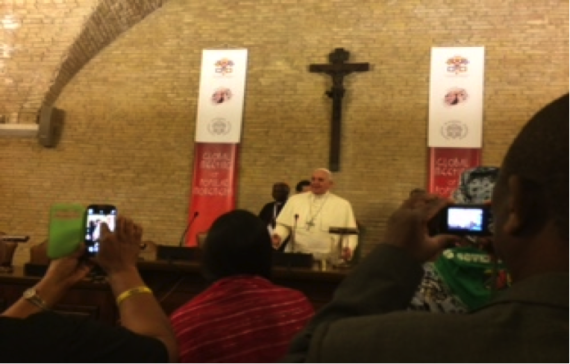
The first day of the conference focused on popular movements sharing their realities, struggles and thoughts on the lack of decent work opportunities , decent shelter and adequate land. On Day 2 Pope Francis addressed the conference and thanked everyone for accepting the invitation to discuss serious social issues.  He described the meeting of popular movements as a positive sign, a sign that the poor are no longer satisfied with mere promises.

“The poor are no longer waiting, they are organized. They put solidarity into action. Solidarity is not just a few sporadic acts of generosity. It means struggling against the structural causes of inequality”.

”You smell of your neighbourhoods and you are a gale of hope for your communities.   Love of the poor is at the heart of the Gospel and the social teaching of the church. God entrusted land to humans to protect and cultivate the land. Land reform he said is not just a necessity but a moral obligation.  Every family should have a home. We must build neighbourhoods and live together with our neighbours.The lack of job opportunities is an outcome of a social option that considers profit more than human beings, a system that views people as disposable objects which demonstrates the worst form of exploitation and a “waste culture”.What we see today is a “Globalisation of indifference” – the world has become an orphan as God has been forgotten.”

WmPopMovements3

The Pope called for a revolutionary programme and a social structure that once again put people at the centre.

Pope Francis was positive that Popular Movements could be the revolutionary force to create a new order and give new energies to society. Popular movements should encourage new forms of participation and leadership that would include rather than exclude. They should create leaders that are subservient and humble and that gives space to the youth, a leadership that is noble and gentle and leaders who are truthful and who will lead by example.

In his final remarks to the delegation the Pope committed to walk side by side with the Popular Movements.

“My wish”, he said, “Is to accompany you on your journey. We will make our way together”

In summary, day two was indeed a historic and emotional day for all the delegates. The Pope treated us like brothers and sisters, was cheerful and very clearly expressed his beliefs and views on the disorder that reigns in our world today. He expressed solidarity with the causes of TERRA, DOMUS and LABOR. He said that the poor needed to be the protagonists, not the “ones being helped”. The poor are able to help themselves when they defend their right to land, housing and jobs.

Day two was a day that spoke to the hearts and minds of us all, an emotional time in which the Pope entered into our “homes”.   We experienced the Pope speak from the heart and we witnessed his respect for human life and his deep love and respect for human beings.

The third and final day was devoted to concrete commitments for continued interaction among the popular movements and their collaboration with the church.  The discussions on day three focused on finding solutions and alternatives to ensure a house for everyone, land for everyone and a job for everyone.

For our movement, Shack Dwellers International, this was an opportune moment to build links, to create greater solidarity and to commit to on-going coordination with other landless, homeless and jobless movements in order to strengthen the voice of the poor internationally.

South African delegates attending mass at the Vatican. Left to Right: Wilma Adams (SDI), Rose Molokoane (SDI & FEDUP), Bunita Kohler (CORC)

South African delegates attending mass at the Vatican. Left to Right: Wilma Adams (SDI), Rose Molokoane (SDI & FEDUP), Bunita Kohler (CORC)


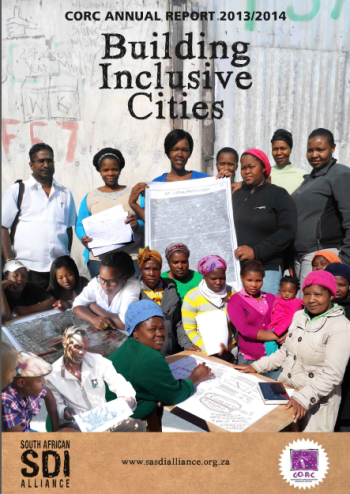
CORC Annual Report 2013/2014

By News, Publications, Reports, Resources No Comments

We are pleased to share with you the CORC Annual Report 2013/14 on behalf of the SA SDI Alliance. This past year we have focussed on our vision of building inclusive cities. As one of the alliance sayings goes, “Nothing for us without us!”. If this is at the heart of what we proclaim, then building inclusive cities is at the heart of what we do.

CORC AR Cover

In this report you will find reflections on the progress of key activity areas for the Federation of the Urban Poor (FEDUP) and the Informal Settlement Network (ISN). You will read reflections from ISN & FEDUP national co-ordinators, and the CORC director. It is in loving memory that we pay tribute to our founding member and mentor, Patrick Magebhula Hunsley, who departed from us too early.

You will receive a picture of the current global and local settings and debates around urban poverty, broader urban development agendas and how SDI and the SA SDI Alliance have responded to these.

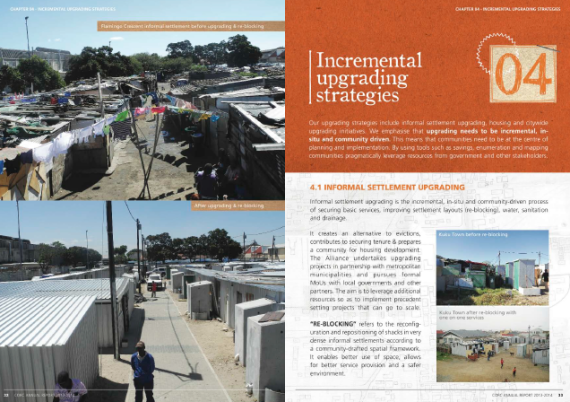
We update you on our savings, profiling, enumeration, exchange and documentation practices. This year we have also included a section on our projects – which we have called “incremental upgrading strategies”. You will receive an overview of informal settlement upgrading projects as well as alliance housing projects. Under this section we also introduce you to our involvement in the Khayalethu Initiative, a city-wide upgrading strategy.

Screen Shot 2014-12-05 at 12.24.19 PM

We keep you informed about the Alliance’s income generation initiatives, such as the Solid Waste Network. We introduce to FEDUP’s funeral scheme, loan programme and solar light initiatives, that we successfully launched this past year. You will also read about Alliance youth income generating activities through clearing alien plants on the South Peninsula in Cape Town.

This annual report contains a detailed outline of FEDUP’s national urban poor fund, the Community Upgrading Finance Facility (CUFF), developments around building a City Fund and our partnerships with organisations like Habitat for Humanity South Africa, Touching the Earth Lightly, Lumkani fire detector, iKhayalami and numerous academic institutions.

Finally, we would like to extend our sincere thanks to all our community members, leaders and national facilitators, to our donors, partners, colleagues and friends for your dedications and support of the SA SDI Alliance over the past year.

[spiderpowa-pdf src=”https://sasdialliance.org.za/wp-content/uploads/2014/12/CORC-Annual-Report-2013-2014.pdf”]

CORC Annual Report 2013-2014

Moegsien

SA Alliance at National Human Settlements Indaba 2014

By CORC, FEDUP, ISN, News, Press, SDI, uTshani Fund No Comments

By Yolande Hendler (on behalf of CORC)

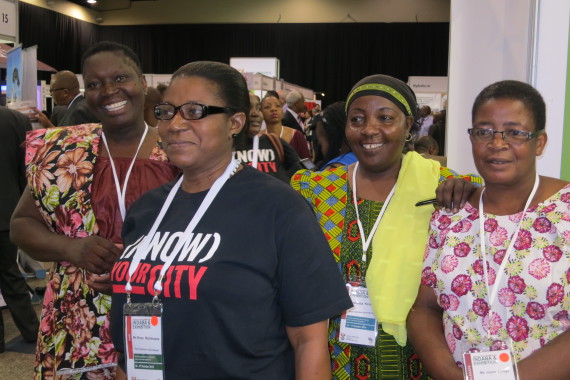
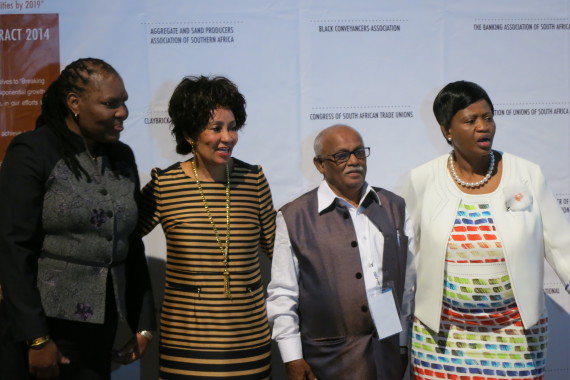
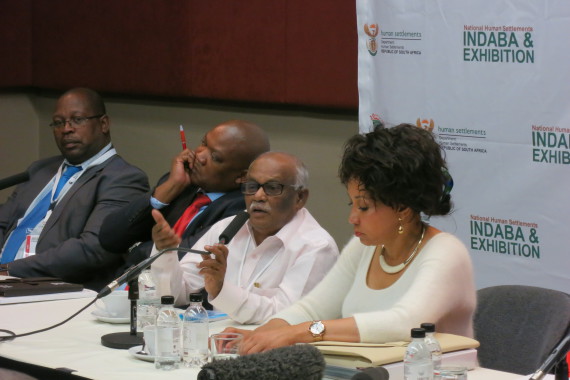
FEDUP members welcome Minister Lindiwe Sisulu and Deputy Minister Zoe Kota-Fredericks at the SDI Exhibition booth

FEDUP members welcome Minister Lindiwe Sisulu and Deputy Minister Zoe Kota-Fredericks at the SDI Exhibition booth

Twenty years after Joe Slovo’s historic Botshabelo Housing Accord, Lindiwe Sisulu, incumbent minister of Human Settlements, invited stakeholders in the human settlements sector to the National Human Settlements Indaba and Exhibition, which was held at the Sandton Convention Centre in Johannesburg from 16-17 October 2014. This included the Federation of the Urban Poor (FEDUP) on behalf of the SA SDI Alliance and Shack/Slum Dwellers International (SDI),

Aims of the Indaba

The Indaba not only marked twenty years of South African democracy but also ten years after the first social contract was signed in 2004 during Sisulu’s first term as Minister of Housing from 2004-2009. The first social contract, similarly, brought together a number of stakeholders in the housing field to discuss and sign an agreement regarding co-operative and collaborative housing practice which would pursue the aims of the then newly launched housing policy: Breaking New Ground (BNG): A framework for Sustainable Housing Development. BNG largely focuses on “promoting the achievement of a non-racial, integrated society through the development of sustainable human settlements and quality housing”. Click here for more on BNG policy. Ten years later, however, the implementation of BNG has been only partially successful.

Against this backdrop, the 2014 Indaba aimed to:

  • Review progress in the implementation of BNG
  • Review the impact of the Social Contract for Rapid Housing signed in 2005
  • Commit stakeholders to a second social contract towards 1.5million housing opportunities by 2019.
Rose Molokoane and SDI delegates from Uganda, Tanzania and Zimbabwe

Rose Molokoane and SDI delegates from Uganda, Tanzania and Zimbabwe

South African and International SDI delegates at Exhibition booth

South African and International SDI delegates at Exhibition booth

Day 1: Pledges towards a second social contract

Amidst actors such as the South African Banking Association, the Chamber of Mines, construction companies and trade union representatives (to mention but a few), SDI and the SA Alliance voiced the interests of the urban poor and advocated for an inclusion of the urban poor in planning, decision-making and implementation.

During the first day’s introductions, Jockin Arputham, SDI President and Nobel Peace Prize Nominee, shared a message of support ahead of the minister’s keynote address which is outlined here. In the afternoon contributors pledged their commitments to the second social contract.

SDI President Jockin Arputham with Minister Lindiwe Sisulu and Deputy Minister Zoe Kota-Fredericks

SDI President Jockin Arputham with Minister Lindiwe Sisulu and Deputy Minister Zoe Kota-Fredericks

Jockin Arputham speaks at Press Briefing

Jockin Arputham speaks at Press Briefing with Minister Sisulu and Director General Zulu

The SA SDI Alliance Pledge

In response to the Department’s larger orientation, Rose Molokoane, national co-ordinator of FEDUP, powerfully shared the pledge of the SA SDI Alliance:

FEDUP pledges to work with national, provincial and local government to deliver 1000 housing actions every month, improving the life of 1000 households. These actions will include

1)   Organising communities through savings

2)   Upgrading services such as water, sanitation, drainage, energy and roads

3)   Building bigger and better houses

4)   Advising the ministry on how to work with communities and organise them to be full stakeholders

We also commit to draw other organisations of the urban poor into the pledge as equal partners. We cannot do this alone. You cannot do this alone. You need our help. “We know the minister is serious about supporting us. What about the MEC’s? What about the local authorities? Are you?

View Rose Molokoane’s speech here:

[vimeo]https://vimeo.com/110123793[/vimeo]

Day 2: Reviewing BNG projects & the second social contract

The second day of the Indaba concluded with presentations by several MECs on the successes and challenges of implementing BNG projects in four provinces, followed by the reading and signing of the second social contract. The specifc commitments of the second social contract are documented here.

Rose & Jockin sign the second social contract on behalf of SA SDI Alliance and SDI

Rose & Jockin sign the second social contract on behalf of SA SDI Alliance and SDI

IMG_0949

Throughout the Indaba the minister repeatedly referred to the value and experience of SDI and the South African Alliance’s work in forming an inclusive atmosphere that engages the urban poor around their own housing development.

Over the last twenty years the SA SDI Alliance has developed an ongoing partnership with the Department which spans from the signing of the Botshabelo accord in 1994, participating in the 2005 national housing accord, the signing of the first social contract in 2005, the 2006 MoU pledge with the Department for subsidies of R285million with which FEDUP has built over 2000 houses to the Department’s most recent pledge of R10million in August 2014.

Throughout FEDUP’s partnership with the Department its core vision has always been: “Nothing for us without Us”. This message is also at the heart of FEDUP’s pledge. As the second social contract is implemented in the next five years, it is the collective vision, experience and practice of the urban poor that is crucial to a truly inclusive implementation not only of housing but also of incremental, in-situ informal settlement upgrading as a vital step towards attaining housing and tenure security.

“We cannot do this alone. You cannot do this alone. You need our help.”

(Rose Molokoane)

Installing Water Taps in Holomisa Gauteng

By CORC, ISN, News, uTshani Fund No Comments

By Blanca Calvo (on behalf of CORC and uTshani)

Holomisa is an informal settlement located in Katlehong (Ekurhuleni, Gauteng). In May 2014, Pumelele Ntanjana, one of the leaders of Holomisa Informal Settlement, contacted the Informal Settlement Network (ISN) to request support for a possible re-location of a portion of his settlement. Today, Holomisa has been profiled and enumerated, new taps have been installed and it has become a learning centre for other ISN communities in Gauteng.

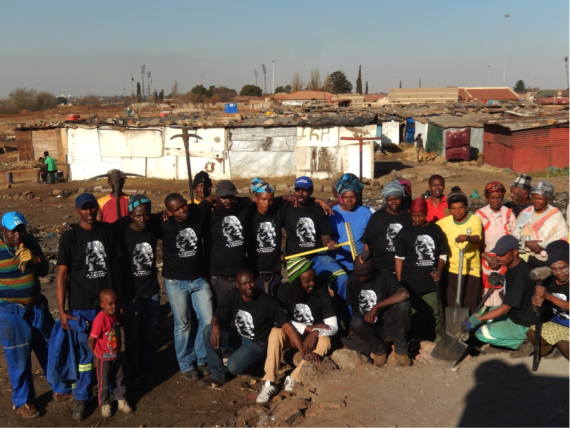
ISN Gauteng co-ordinators with Holomisa residents

ISN Gauteng co-ordinators with Holomisa residents

The Holomisa story tracks back to an ISN leadership meeting that took place in Germiston (Ekurhuleni, Gauteng) in 2008. In that meeting, leaders from all informal settlements in the area had been invited to attend, Holomisa amongst them.

When Holomisa leadership were told by their councillor that a portion of the settlement needed to be re-located because of the enlargement of a neighbouring school, they approached ISN for support. ISN was invited to visit the settlement, where they firstly met with Holomisa leadership and the ward committee members.

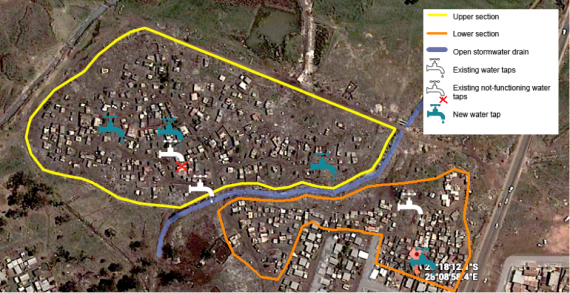
The community and ISN profiled the settlement in May 2014 and identified a need for more sources of water (only 2 functioning taps for about 500 households). This was confirmed in a public meeting, where residents requested support for an immediate improvement of their daily lives through implementing more taps, improving sanitation conditions and electrifying the settlement. The settlement’s improved service delivery would also be an additional step to ensuring land tenure.

Existing Water Taps in Holomisa

Existing Water Taps in Holomisa

Three parallel processes started from there. On one side, enumerations started on the ground, identifying 446 households. Since Holomisa had been identified as a learning centre for the region, leaders from 6 neighbouring informal settlements (Emalahleni, Thintwa, Vlakplaas, Mandela, Makalakaleni and Zola) were invited to join the enumeration process, ending up with capacitated leaders to undertake the process in their own settlements. A total of 10 local and 6 external leaders were capacitated. Besides, the figures highlighted again the need for more taps, with a backlog of 8 taps to meet official standards


Holomisa Textbox1

The mobilisation team engaged with the Ward Councillor, who was informed in a partnership meeting of the intention to install more taps in Holomisa with the support of the South African SDI Alliance. The ISN sent a letter to the ward councillor saying,

“We understand that we are poor humble people struggling to make our way in life. Like every South African citizen, what we expect is a fair and reasonable service delivery from Government in return for the taxes we pay”

Finally, the savings team organised community savings to save 10% of the budget for the project. The outstanding 90% of the budget was financed by the Community Upgrading Finance Facility (CUFF) housed in uTshani Fund.

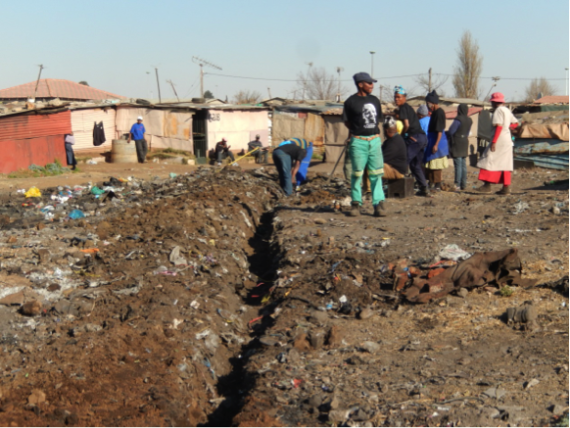
Mandela Day (18 July 2014) was finally the day for the project to start. In the space of 6 days, one tap was fixed and three more taps were installed. 25 local residents volunteered for the project, a technical team of 10 ISN members was on site and 6 leaders from neighbouring informal settlements were invited to participate and learn in the process, thus increasing their skills and building capacity.

New Water Taps in Holomisa

New Water Taps in Holomisa

Holomisa Textbox2

The project was a success for the communities involved, not only because the installation of more taps improved the living conditions of Holomisa residents, but also because some valuable lessons were learnt.

  • Firstly, the will of the people has been proved to be the best tool to work with. The residents identified the need for more taps and lead the project from the first day.
  • Secondly, the power of residents taking ownership of the project. Residents did not wait for external people and institutions for their permissions or to come to the work, they pushed for their needs to be heard and did it themselves.
  • Finally, the learning centre has proved to be a success. 6 leaders from other informal settlements were capacitated using almost the same amount of resources.

However Holomisa’s story does not end here and the process is still on-going. Holomisa residents, are in discussion with their Ward Councillor for the re-location process of a section of the settlement. Continuous engagement with the ISN will ensure that the re-located residents will be allocated a new portion of land, which it is still to be identified.

Holomisa2

Holomisa3