Category

News

Building an organised community through the Shamrock wash trough project in KZN

By Archive, FEDUP, ISN, News, Publications No Comments

Kwanda Lande (on behalf of CORC)

Shamrock informal settlement at a Glance

Shamrock informal settlement is located along a portion of Amrisar Road and Gladiola Road in Belfort Estate suburb, northeast of Pietermaritzburg in Kwa-Zulu Natal. This informal settlement is located on municipal owned land and it contains single storey, stand-alone mud and timber shacks. The area is located along the flood line as a result this makes the settlement prone to flooding. The slope analysis for the settlement shows that the settlement is predominantly characterised by moderate to very steep slopes.

Shamrock informal settlement residents have lived in this settlement for more than 20 years without any adequate basic services. The community of 140 people was using one water tap and the nearby river as sources of water. The settlement location on steep slopes makes it difficult for residents to collect water. The settlement also lacks basic services like paved roads and walkways, which makes it even more difficult to collect water because roads that become muddy especially when it is raining. The distance to collect water that residents are expected to travel is also too long and difficult for old people.
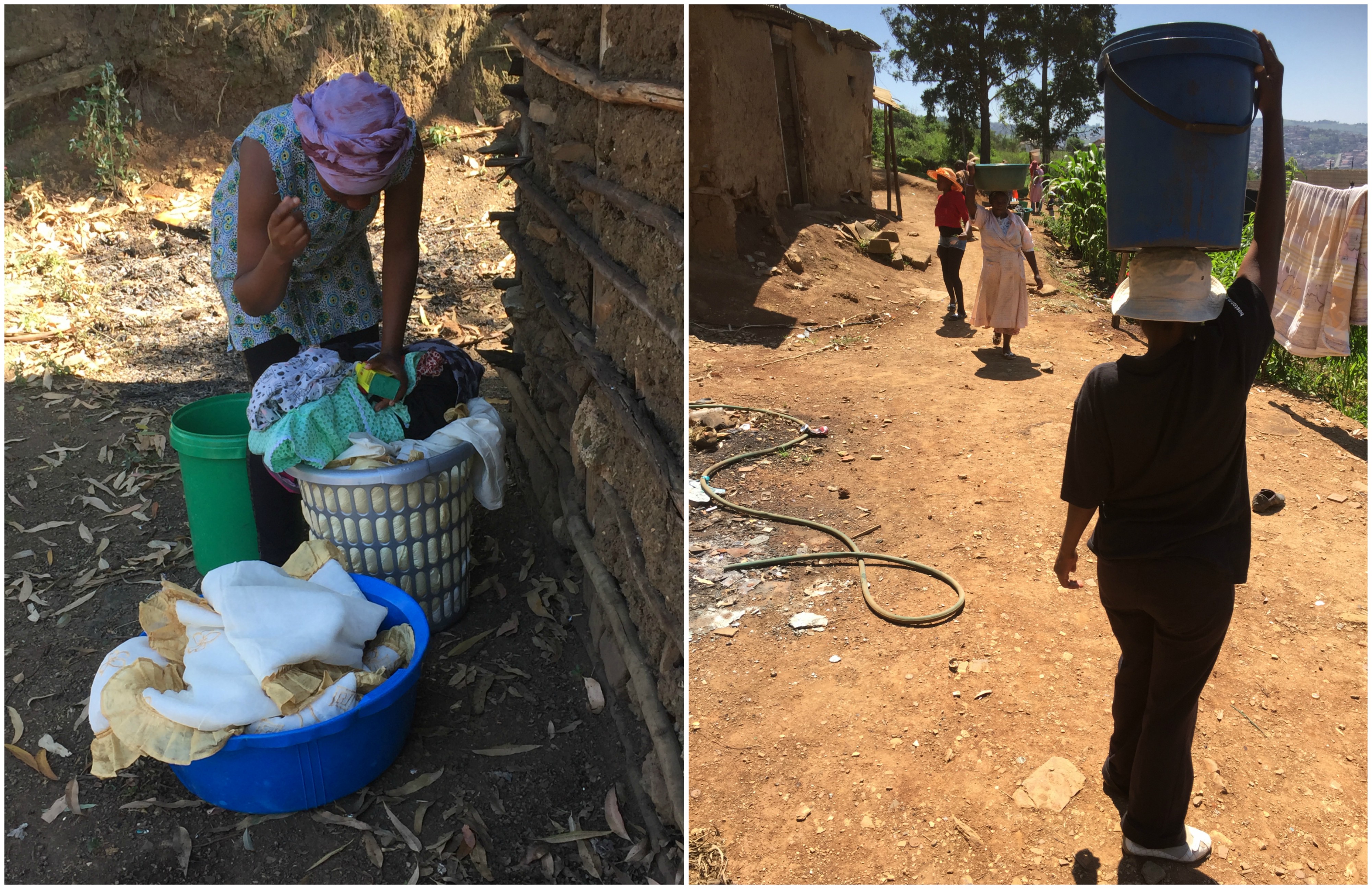
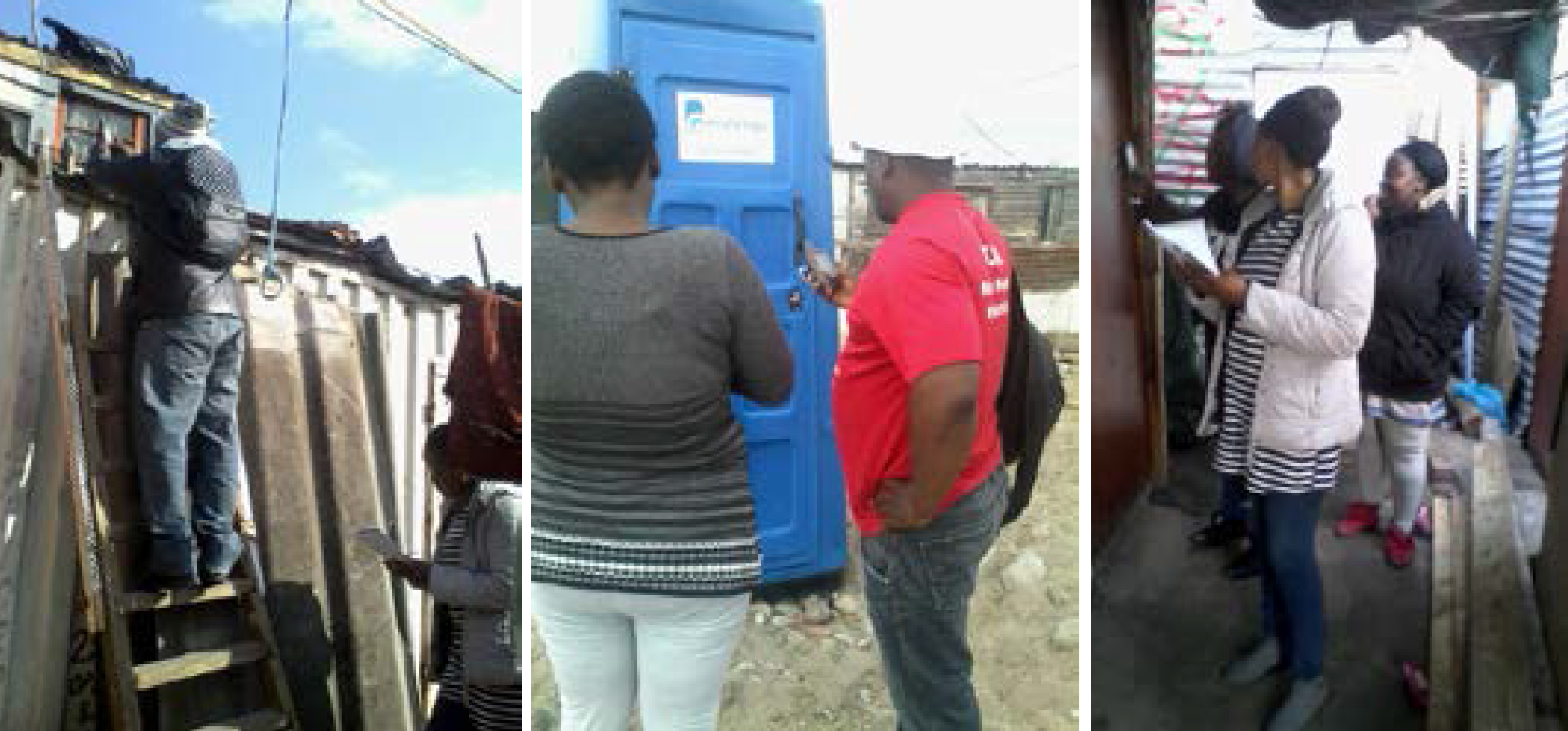
Differrent methods that were used before the wash trough, to wash clothes and collecting water.

Different methods that were used before the wash trough, for wash clothes and collecting water.

The area’s close proximity to various primary and secondary schools and a college is one of the reasons people were attracted to Shamrock. In addition, a special needs school is located within a 30 minute walking radius. The residents of Shamrock were also attracted to the area because of job opportunities. This community is made of 52 structures, and a population of 140 people that migrated from rural areas of Kwa-Zulu Natal.

The Shamrock wash trough Project

In 2013, FEDUP and ISN went to Shamrock and mobilised the community through starting a saving scheme. Prior the implementation of the Shamrock wash trough project in 2016, the community was mobilised through profiling and enumeration. This exercise was important, amongst other things to mobilise community member that were not part of the local saving scheme, and for the community to collective identify issues and solutions. The community identified an ablution and drainage system as one of their priorities and made a decision that they want a wash trough facility after some assistance from CORC technical team on different options to address their priorities and challenges.

The project implementation process of the wash trough commenced in 2016, and the project was completed in January 2018. However, the actual implementation of the wash trough took four days to be completed, in a period of two weekends (13-14 and 20-21 January 2018). One of the challenges that were experienced include that some community members did not participate in the implementation of the project. The reason is that these people felt that the project was only for people who are part of the local saving scheme. The community also had to change initial location of the wash trough, which was at the centre of the settlement. It was changed so that an elderly woman in a wheel chair would be able to access it too. The project was then moved closer to her shack, which is approximately 50m from the initial point.

The total cost of the project was R6426.00. The community contributed 20% to the overall cost of this project from their savings scheme. As a result, not all the community members contributed to the project because not all members of the community were involved in savings. Msunduzi Local Municipality’s water and sanitation, and area based management departments contributed with the additional 80% of the overall cost and with some technical expertise, this include environmental studies.

The wash trough is helping the community, it is now very easy for people to wash their clothes. The community has six water taps in the wash trough, which they can use. People are now interested in the project, even those who did not indicate any interest when we started this project. Everyone is now using the facility and people are demonstrating some excitement now that they do not have to wait long lines or go to the river for water. Those who were rejecting the project, now that they see the benefits that it has brought, they are apologising, they are promising to be part of future projects and they also want to be part of the local saving scheme. Ndodeni Dengo (ISN regional coordinator)

The success of mobilising the community of Shamrock informal settlement through the wash trough project also extends to neighbouring informal settlements. As part of the project, the community members and leaders from neighbouring informal settlements such as Crest place and Mayfair sent two community members to assist and observe. As a result, Crest Place has requested a similar project for their settlement. This community has also started contributing towards their project, which is planned to start soon.
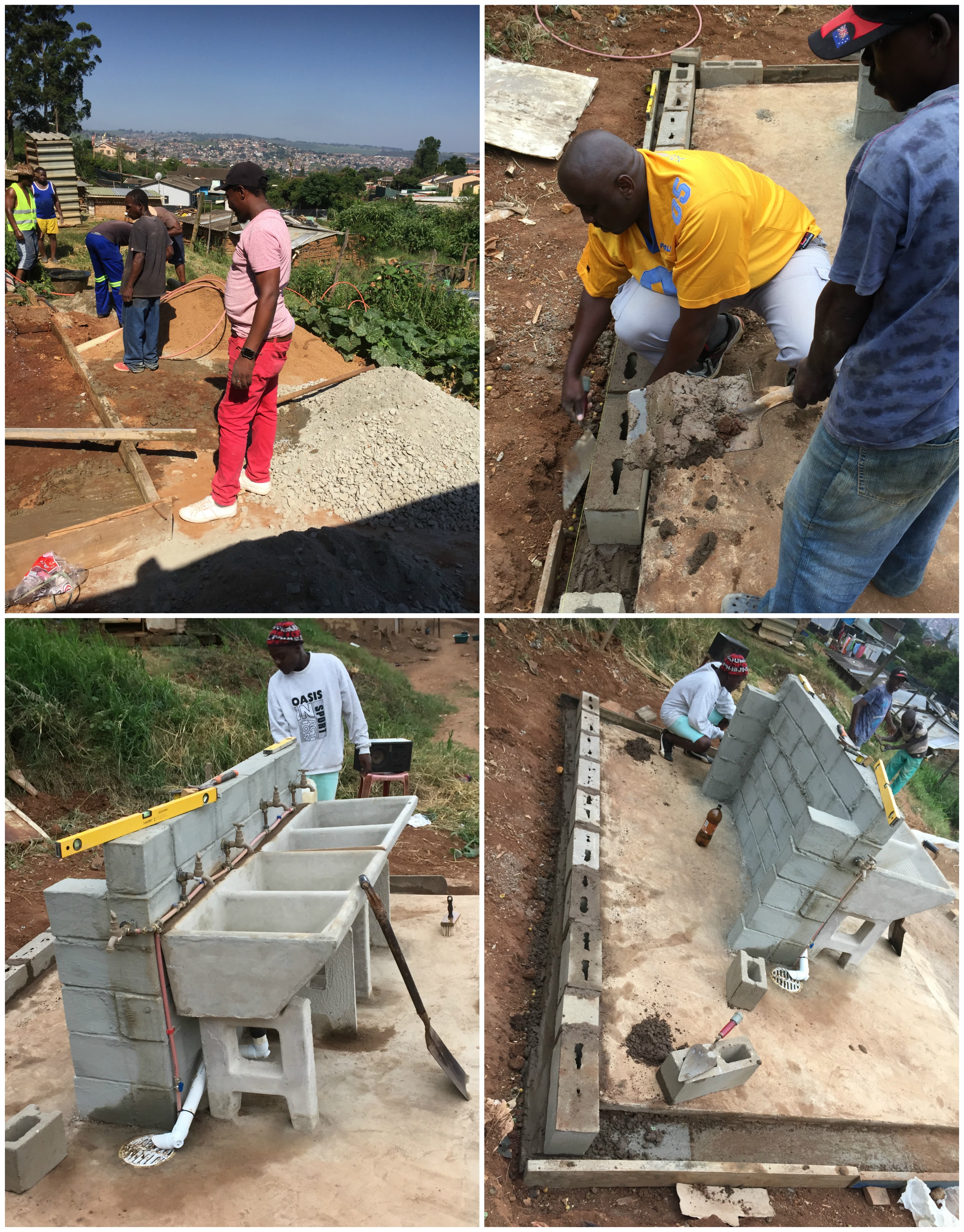
Different construction phases of the Shamrock wash trough

Different construction phases of the Shamrock wash trough. 

Going forward

The SA SDI Alliance has signed a Memorandum of Understanding (MoU) with the Msunduzi Local Municipality. However, there are challenges in terms of making this MoU work for both parties involved. As a result, FEDUP and ISN, want to use this project to showcase the ability of organised communities to the Municipality and other informal settlements.

The community of Shamrock has made their desire to improve this project known. They want to use the MoU signed with Msunduzi Local Municipality to add shelter, refuse removal, a table for children and other services. This will allow the community to use the wash trough facility even when it is raining, and that they could have a place for their children to do their schoolwork while their mothers are using the wash trough. The community also wish to do community gardening and install a grey water collection facility. Currently the municipality is being engaged by the community to request electricity.

Through this informal settlement-upgrading project, therefore, residents sharpened their ability to organise (through daily savings). This in turn contributed to building the community’s ability to engage other actors to continue incrementally upgrading their settlement. In this way poor communities want to demonstrate that they can use their projects to shift government policies and practices to the benefit of their communities.

Social and Physical Impact of Re-blocking: California Informal Settlement, Mfuleni (Cape Town)

By Archive, CORC, ISN, News, Press, Publications, Resources No Comments

by Kwanda Lande and Mariel Zimmermann (on behalf of CORC)

We decided to do re-blocking because we were living in a very congested settlement, we wanted our settlement to be rearranged, we wanted services –  we wanted to have roads, toilets, electricity and water. We also wanted this project because it is going to mitigate fire in the settlement, and we have been careful with the building material we have used to build our structures. (Lindiwe Noqholota, community member and member of the project steering committee) 

In the upgrading of California there is an advocacy purpose, resources were used for the community to demonstrate good practice around upgrading of informal settlements. The project was done so that the community can build itself as a community that is able to come together around issues because re-blocking is just the start, it’s not the end, it’s the starting point to say what’s next? (Oscar Sam, ISN Mfuleni subregional coordinator) 

The story of California informal settlement in Mfuleni, Cape Town is a story of many challenges, but also of many victories and hope. It is through this story where we begin to grasp nuances and multi-layers that capture the impact of re-blocking to the community.This story is told by community members, who have been engaged in a struggle for basic services, land and and housing since 2008.

Look over California informal settlement before and during implementation

Look over California informal settlement before and during implementation


California is an informal settlement located in the midst of formal houses in the Township of Mfuleni, Cape Town. The settlement occupies a space of 2,239 m2 between the streets of Umzumbe on the North, Mgwanda on the West, Dutywa on the South, and M Baba on the East. The community of California has been subjected to some threats since 2008, when the settlement started. This includes the fact that the community existed until 2012 without any services. It became worse in 2012 when there was fire that destroyed almost all their houses threatening their existence.

I remember in 2012 after almost all our shacks were burned down we had to build our shacks again because we had nowhere to go. People from this church in our area did not want  us to build our shacks in this area again. After the municipality had intervene the church then told us that each household should at least pay R50. But we refused because the municipality had told us that the church does not have rights to do this. This is how we fought to stay in this settlement, after which everything became easy and we were also given house/shack numbers. (Nokuthula Mazomba, community member and member of the project steering committee) 

Some of the first signs of collective action and self-reliance

Since 2008 the community of California did not have any legal water source and toilets, people were forced to use water taps provided to people in formal houses. This lack of water and sanitation services led to anxiety and the feeling of insecurity, when using the ‘toilet’ at night. Consequently, there was an attitude that led to restricting access to water from people living in formal houses. The community had to do something as a result they decided to make contributions of R10 each household and installed one water tap for the whole community.  

The installation of water tap is one of the first signs of collective action and self-reliance by the community. After which the community organised itself and went to the ward councillor demanding further access to water, in which they were successful. However, the settlement was still lacking services such as toilets and electricity, and the community needed a partner to intensify their struggle to access better services and improve their lives. Against this backdrop, the community of California meet with the Informal Settlement Network (ISN) in 2015 to enforce their voices.

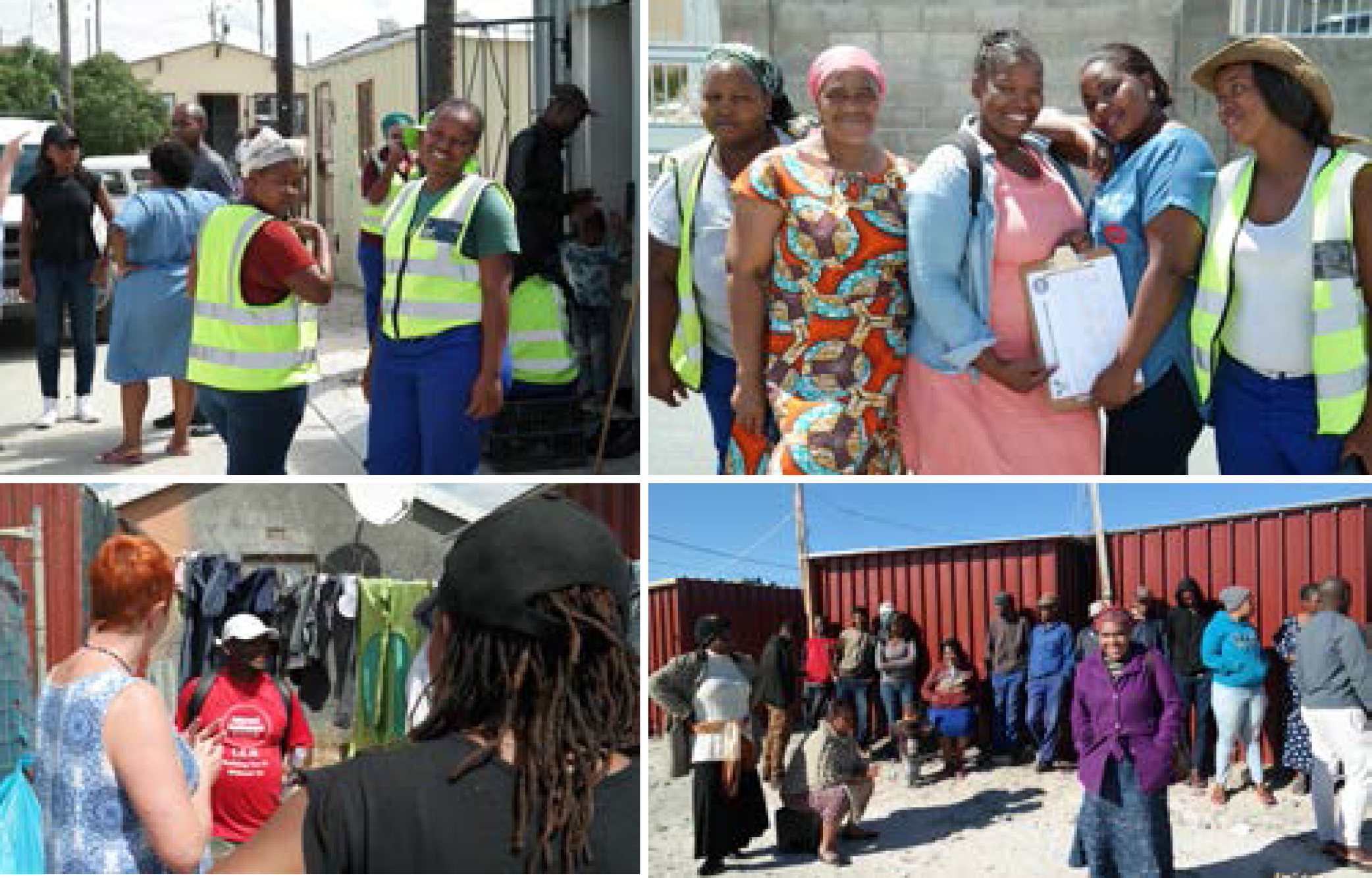
Community members of California, and SA SDI Alliance leaders working together in implementing the project.

Community members of California, and SA SDI Alliance leaders working together in implementing the project.


Community using Data Collection and Community Exchanges

The Informal Settlement Network, partner in the SA SDI Alliance, brought a number of tools to assists the community in their struggles. This includes the data collection tool, which helped the community to engage municipality with facts and community-determined priorities. As a result, seven toilets were installed for the community, through the assistance of ISN, which helped to do data collection that helped the community to negotiate and to demand all these services.

Community of California doing enumeration of their own settlement

Community of California doing enumeration of their own settlement


Based on the data collected (profiling and enumeration) in 2015, the population of California is made of 47 households with 108 residents. Furthermore, this profiling and enumeration exercise done by the residents of California assessed community prioritise, which include electricity, water and sanitation. As a result, the community also went to the City of Cape Town to request electricity. Their first request was, however, met with disappointment. The municipality explained that it could not install electricity because of congestion and limited space for installing electricity.

 Through ISN, in 2016 we went on an exchange to another settlement that was re-blocked by the SA SDI Alliance called Flamingo Crescent. We went to that settlement and saw how that settlement was built and how the settlement was redesigned and reconfigured to create space that would ensure the provision of services. After a year without interacting with ISN we also learnt that the City of Cape Town had made some budget for re-blocking in California and this was through the work of ISN that negotiated for budget to be made available for upgrading California. (Lindiwe Noqholota, community member and member of the project steering committee) 

However, when the community leaders who visited Flamingo Crescent were reporting to the community some members were not convinced about this project and rejected it as they felt that they were not sufficiently informed. After several meetings and explanations of how the project will look like and what the benefits for the residents will be, the community voted for the implementation. The community also knew that if they will not make use of the budget from the city, these resources would be taken elsewhere.

How has the project impact the Settlement?

The implementation of re-blocking in California begun in May 2017 and 47 structures were upgraded and specific building material that reduces the risks of fire was used. Paved access roads were implemented throughout the settlement. Furthermore, a stormwater drainage system has been implemented and electricity is in the process of being implemented. In the case of funding for the project, there was an agreement with the municipality that they will provide services, including water, electricity, and toilets.

Work in progress that involves structures before implementation and the last phase of the project

Work in progress that involves structures before implementation and the last phase of the project. 


The community contributed 20%, and supported by Community Organisation and Resource Centre (CORC) with 80% towards building their structures. Yet, the community is still waiting for the implementation of toilets and water taps per household from the municipality. The community also managed to negotiate for extra piece of land. This municipal land is located adjacent to the settlement but the community was not allowed to use it before. This extra piece of land has helped the community to have more space for access walkways and space for people to dry their clothes after washing them.

The re-blocking project of California allowed people in the community to ‘break walls’, and start learning and talking to one another. It allowed people to take ownership of the process and start personalising their environment where they have change their community and houses to suit their personal taste. Through this re-blocking process, it became evident that compromises are at the centre of re-blocking, and although some might not like an idea and approach, it is important that people compromise on their differences for the sake of development.

I learned that as residents of California, we do not really know each other, as I though before this project. This project has created a chance for us to learn about each other and to tolerate one another because we differ in a lot of things. As a result, it is helpful that we have community leaders that can speak for everyone and that people can raise their issues through and not to one another or direct to government one by one.(Buhle Mthimkhulu, community member and member of the project steering committee) 

What can the future for the community look like?

In regard to the future of the community, the kind of experience that the community has went through is essential because re-blocking is not the end but a starting point. It is a start for individuals to recognise themselves as part of a community. It is a start for the community to establish itself as part of a broader network of informal settlements. The project presents an opportunity for the community to start a saving scheme that will build social capital of the community and allow community members to support each other not only financial but also socially. This project is a start for the community to investigate and make sure that community prioritise are part of government budgets and use that to hold them accountable.

Southern African Slum Dwellers Strategise Ahead of World Urban Forum 2018

By News No Comments

By Kwanda Lande (on behalf of CORC)

On 11 February 2018, the ninth World Urban Forum (WUF9) will take place in Kuala Lumpur, Malaysia. WUF9 will have a specific thematic focus on the implementation of the New Urban Agenda (NUA). This theme of implementation is particularly important to urban poor residents and federation leaders of SDI’s Southern African countries, especially as the NUA relates to informal settlements. 

Twice a year, representatives of SDI‘s Southern African urban poor federations (Namibia, South Africa, Botswana, Malawi, Zimbabwe, Swaziland and Zambia) gather as a regional “hub” to strategise, report, share challenges, and plan for mutual learning. The recent Southern African SDI hub took place between 15 – 18 November 2017 in Johannesburg. Given the timing of the hub ahead of WUF9, the Federations invited Zou Kota-Fredricks, the South African Deputy Minister of Human Settlements, and Parks Tau, president of UCLGA* and SALGA** to open the hub and engage in discussions on the implementation of the NUA.

*United Cities and Local Governments

** South African Local Government Association

SAMSUNG CSCDelegates of the Southern Africa Hub welcoming the Deputy Minister of Human Settlement Zou Kota-Fredericks

The experience of Southern African slum dwellers working towards the New Urban Agenda (NUA)

In 2015, SDI was invited through an initiative called the General Assembly of Partners (GAP), to participate in the process leading up to Habitat III, in October 2017. GAP served as a broad-based deliberative platform for non-governmental partners to develop consensus for joined outcomes for Habitat III. The primary intention was for civil society organisations to influence UN member states that adopted the NUA at Habitat III. As a result urban poor federations in the SDI network used this opportunity to ensure that their voice was heard in the development of the NUA and that their experiences and aspirations were known and considered.

In the lead up to Habitat III, SDI’s East and Southern African federations had a strong presence at the UN Habitat III Thematic Meeting on Informal Settlements in Pretoria in April 2016. The meeting culminated in the Pretoria Declaration on Informal Settlements. SDI federations advocated that the NUA commit to

  • Supporting the self-organising processes of communities (such as data collection and learning exchanges) to partner effectively with governments and other urban actors
  • Using community-collected informal settlement data as the basis of collaborative informal settlement policy making and development planning.

How Southern African slum dwellers view the NUA

The NUA provides a new framework that lays out how cities should be planned and managed to best promote sustainable urbanisation. It talks about strengthening and creating inclusive partnerships, and people centred development. It suggests that the voice of community organisations be heard. However, for urban poor residents, the challenge, is establishing and maintaining partnerships especially at the level of municipalities where most of community organising activities are taking place and where development is expected to happen. This means that urban poor residents are struggling to gain recognition from municipal systems, and that they have not found ways of institutionalising local government – community partnerships in decision making and planning processes.

In Cape Town, for example, the South African SDI Alliance had established a strong partnership with the local municipality and jointly implemented several upgrading initiatives. However, since the last upgrading project in 2014, it has taken more than three years to progress to the next one. One of the contributing factors to this delays relate to the lack of hand-over of the partnership to successive heads of departments and senior project managers. The consequences of which is the loss of institutional memory and knowledge of the working partnership in a time of high staff turn-over within the municipality. 

SAMSUNG CSC

Parks Tau, speaking at the Southern Africa hub meeting during a discussion on the implementation of the NUA


In conversation with Parks Tau and Zou Kota-Fredericks, SDI’s Southern African federation members highlighted their priority of a NUA that is localised, meaning “that we want partnerships at a local government level”. An example is SDI’s partnership with UCLG on the Know Your City campaign, which promotes community-collected data on informal settlements as the basis for partnerships between slum dwellers and their local governments. The Southern African federations expressed:

we want to work – together with government, UCLG and private sector – on collecting data and using this information to participate in decision making, implementation, and monitoring the implementation of the NUA. For example, in South Africa we want to see the Department of Human Settlements creating a forum that will meet more regularly to monitor the implementation of the NUA. This forum should be inclusive to the level that ensures that poor communities are involved.

The fact that government and civil society are working in the same space of local government with similar vision of community development demands a partnership. Both Parks Tau and Zou Kota-Fredericks, agreed for a local forum- South African forum. Parks also suggested for a Southern Africa forum that will sure case a partnership of government and civil society at that level.

At the start of 2018, before the World Urban Forum, we have to work together to convene a meeting to discuss a way forward on how we are going to work together and also to prepare a case study to present at the WUF9. The know your city campaign – data collection by communities is one tool that we are going to use to hold and strengthen our partnership. This will also be an opportunity for all partners to raise their expectations from this partnership. Parks Tau

The state of local government partnerships in some countries in the Southern Africa region

Southern African SDI federations spoke about the state of partnerships between themselves and their local governments as a way of offering some learning points on how to implement the NUA. Some of SDI’s federations have managed to establish well functioning partnerships: In Botswana, the partnership between the local government of Francistown and the Botswana Homeless and Poor People’s Federation involves community members and government collectively collecting community data, identifying and implementing projects. This has allowed the Botswana federation to conduct profiling and enumeration in Francsitown (Somerset West and Somerset East), identify and implement infrastructure projects together with local authorities. A major contributing factor to this work has been the presence of officials on the ground, working hand in hand with federation members around data collection.

In Namibia, slum dwellers have managed to establish local government partnerships with municipalities such as Gobabis where the Shack Dwellers federation of Namibia signed a Memorandum of Understanding with the local authority for upgrading Freedom Square informal settlement. This resulted in the Ministry of Rural Development contributing N$ 8 million and Gobabis local municipality contributing technical expertise. Officials of Gobabis municipality worked with the community of Freedom Square in data collection, community planning and implementation of different upgrading phases. In this project officials made sure that they were always on the ground. As a result they were quick to respond to projects issues. They did not impose solutions or approaches to solving problems but instead provided the necessary support for slum dwellers to implement their plans.

SAMSUNG CSCDelegates of the Southern Africa region hub meeting representing Urban poor federations form Botswana, Namibia, Malawi, Swaziland, South Africa, Zambia, and  Zimbabwe.

What are the main priorities of the Southern African federations ahead of WUF9?

The WUF9 presents an opportunity for urban poor federations of the Southern Africa region to influence how the NUA is implemented.  The primary priority for federations in the Southern Africa regions include localised partnerships that are based on community-collected data. The Southern African federations want to work with government and civil society organisations on collecting informal settlement data and using it to participate in decision making, implementation, and to monitor the implementation of the NUA.

TB community hall – A foundation for community organising

By Archive, CORC, FEDUP, ISN, News, Resources No Comments

By Kwanda Lande (on behalf of CORC)

We would like a type of a hall that can accommodate a lot of activities, like church services, cultural activities and office space for the Informal Settlement Network (ISN). It will be a shared space with other communities, but this will depend on the kind of activities they plan to do. We want to encourage activities that are about community development, and activities that would impact people’s lives in a positive way.

Through these words, one community leader of TB Section in Khayelitsha’s Site B explains how the priority of the community was having a shared space for four different communities located in the area (TT, UT Litha park, UT and TB section). The community of TB section have, for some time relied on a community hall that was in a very bad condition, a community hall that was not able to take care of the many of the activities and needs of the community.

The building of a hall for us was very important because the one that we used to have, was in a very poor condition. It was difficult to have meetings when it is raining because of a hall that was leaking, and this prevented us from discussing community issues. We also have our youth that want to do a lot of things but they could not because we did not have a place for them to meet. We also wanted to use this hall as a place that people can be relocated to when it is raining – as a temporary shelter.

IMG-20170401-WA000

Community members, ISN leadership and contractor for the TB community hall

On 24th of June 2017 the community of TB section had an inauguration event to launch the new structure, however the idea around this hall started in 2015 and the actual construction begun in February 2017. Between 2015 and 2017 the community of TB section spent time on mobilising other residents through saving and data collection, and engaging with the City of Cape Town. Thus, after community profiling and enumeration, TB residents used their data to identify that they want a public space that contributes to their activities and, as a consequence, to community building and strengthening.

We wanted to build the TB hall in 2015, but we had to explain to the community how the Federation of the Urban and Rural Poor (FEDUP) and ISN work, for example, we had to explain to people that they support communities that are prepared and committed to organising and building themselves through saving and contributing to their development. This was necessary since people in this community did not know much about ISN and FEDUP.   

We also had to engage with the City of Cape Town about building a partnership – not only for this project, but for long term planning and development of the community of TB section. This include engagements that we had with the city’s officials – about asking for permission to build the hall, installing electricity and other services. We also had engagements with our ward councillor who endorsed the building of this structure. 

WhatsApp Image 2017-06-24 at 14.56.18

Community members with FEDUP and ISN leaders during inauguration event to launch the new structure

ISN has been working with the community of TB section since at least 2011, and the building of the hall came out of the process of mobilising through the tools of saving, collecting data, and partnership. The utmost achievement of this work by both ISN and FEDUP is that the community has begin to organise itself, identify priorities and established some sense of self-reliance. These are aspects which the community can hold onto and use long after the construction of the hall is complete.

The existence of this hall in an informal settlement like this also makes it easy for us to challenge the municipality and tell them that if we can do something like this with FEDUP and ISN what is stopping you from doing something of the same level like building houses for us?

People on the ground are really motivated and they now understand that you do not have to wait for government for your things to happen. We are now aware that community development only happen for people that work for themselves, if you are sitting at home you do not go out and demand things very limited chances that you will get those things.

FullSizeRender 19

Community members working together with contractor to build their own hall.

This community hall represents a building block for the ‘formalisation’ of the whole sub-region over time. It is a space for this community and surrounding communities to start building themselves as organised communities and start discussing the next step for their community. The community is in a better position, it has developed confidence to confront public issues that have direct and indirect impact on their lives.

The community of TB section, in the process of building the hall – has also demonstrated that it has capacity to collectively confront obstacles and can with time be in a position to do things for themselves with no external assistance. The community was able – during the implementation phase – to manage community dynamic on their own and there was almost no need for external intervention. The community was also able to collectively convince the ward councillor to support the project. As a result through this project a foundation for community organising has been formed and the community is build on it. 

When you get a front door, remember to leave it open

By FEDUP, ISN, News, SDI No Comments

This blog  was first published by openDemocracy, on the 26 September 2017. 

By SOPHIE KING 

A Manchester-South Africa exchange reveals striking similarities in the dynamics of urban inequality.

Members of Mums Mart, Lower Broughton Life and the South African Alliance in South Africa, July 2017. Copyright: Sophie King. All rights reserved

“It’s all about trust” said Marie Hampshire, two days into a week-long community exchange with members of the South African Alliance in July 2017, a grassroots movement of women-led savings schemes affiliated to Slum/Shack Dwellers International or SDI. Marie is a member of Mums Mart, a women’s group from Benchill in the British city of Manchester that brings low-income families together around food, monthly markets and, most recently, a new kind of savings scheme.

Each member saves small amounts with the support of their local group, and in the process of coming together the group learns about their needs and challenges and tries to respond collectively. Mums Mart was introduced to savings-based organising after meeting members of the Alliance in Manchester a year earlier. Now, other groups in the city are starting to explore how women’s savings federations could rebuild trust and solidarity in their neighbourhoods.

Joanne Inglis is the Chair of a new association called Lower Broughton Life, one of these groups that is based in another part of Greater Manchester called Salford. After accompanying members of the South African Federation of the Urban and Rural Poor (FEDUP) on door-to-door visits and listening to plans for a new housing development in Cape Town by the Informal Settlement Network(another partner in the Alliance), she urged her hosts: “when you get a front door remember to leave it open.”

Joanne was reflecting on how segregated life has become on estates like hers, where people look after their own affairs and many of the old spaces for communal life have closed down. She was struck that—while the signs of poverty and inequality in South Africa are only too visible in the townships and settlements she visited—poverty in the UK is often hidden from view: “our houses can look the same on the outside,” she said, “but it’s what’s on the inside that’s different.”

However, in other ways there are striking similarities between the dynamics of inequality and deprivation in both countries’ cities.  All are dealing with sharply rising property prices which push those on lower incomes further away from the city centre, and the concentration of deprivation in particular neighbourhoods which can manifest in gang-related crime and the absence of opportunities for young people. Unequal access to decisions on how public services are delivered perpetuates the disadvantages that low-income people have to deal with on a day to day basis.


Just as importantly, the different groups were also bound together by their experiences of strength and struggle as women and mothers regardless of where they live. During their visit to the UK, the South Africans were shocked to discover homeless people living in tents in the centre of one of the richest cities in the world, which gave rise to questions about the wisdom of looking to the global North for pathways to collective well-being.

For their part, members of Mums Mart and Lower Broughton Life reflected repeatedly on people’s pride and self-organisation despite living in highly challenging circumstances in South Africa. Both gained a fresh perspective on the possibilities of organising collectively in response to poverty.

As a member of FEDUP attested (echoing Marie), “the only thing that makes a person active is when you have trust and belief.” The members of the groups also gained confidence in one another as joint travellers on a journey of discovery—watching each other learn, adapt and embrace the experience (including some fantastic ululations!). People saw that some of the South African ideas might just work in Greater Manchester, and that they might be the ones to make this happen.

The trust they gained in South Africa by staying in people’s homes, accompanying them in their work and being part of their lives (even for a short time) meant that they were comfortable enough to share their doubts and fears—and to be open to the doubts and fears of their hosts in return. As Rose Molokoane from SDI shared:

“We are still doubting ourselves saying how can we keep driving this forward…it’s too big for us…especially because we are informal but the outside world wants to see us being formal. Most of our members are not educated; you have to create enough time and enough space to educate people about what you are.”

Rose also explained the significance for the older black South African activists of sharing their homes and their organising tools with white British women after living through apartheid, and as women continuing to struggle for justice in a highly segregated society.

The exchanges seem to have come at a critical time for the British participants. Combined with rising living costs, public service cuts and welfare sanctions, low-paid work, under-employment and unemployment are fostering severe precarity in post-industrial inner-city neighbourhoods. Thirty per cent of British children (and one quarter of children in Salford) are now classified as living below the poverty line, with two thirds living in families with working parents.

Manchester looks set to become the next beacon of social cleansing after London, with luxury high rise flats and the privatisation of the city centre making it increasingly difficult for individuals and families on low-incomes to find affordable accommodation. People in low-income areas around the edges of the central business district live in constant fear of relocation as they watch rents skyrocket in the plush developments that now surround their estates.

In many of the city’s low-income neighbourhoods, social and economic changes and cuts in public sector funding mean that people don’t come together in the ways they used to through faith-, place- or work-based forms of voluntary association. Libraries, pubs and community centres have closed down, making it almost impossible in some areas for groups to find somewhere to congregate together regularly. Rising living costs and cuts in benefits are pushing people towards pay-day loans and credit-based living, leaving them drowning under the burden of debts they struggle to repay.

The surge in support for the British Labour party under Jeremy Corbyn’s leadership (which is particularly visible in urban centres) suggests that increasing numbers of city-dwellers believe it is indeed, ‘time for a change.’ But how will low-income communities organize themselves and enter into movements ‘for the many and not the few’ in the years to come? That’s where networks like SDI can play an important role by inspiring new forms of mobilisation, and by linking local action into international networks for learning, advocacy and mutual support.

The savings groups they nurture are encouraged to federate, enabling them to have more influence over city and national governments in ways that are grounded in real experience. Members survey, map and profile their neighbourhoods, turning invisible challenges into concrete evidence and locally-proposed solutions. The South African Alliance, for example, has successfully advocated for a more progressive housing policy that has led to over 15,000 permanent new, affordable homes being constructed.

The SDI network used to have members in 37 countries. Thanks to a group of mums from Manchester, it may soon be 38.

What does it mean to “Know Your City” in South Africa?

By Community-led Data Collection, News No Comments

By Yolande Hendler and Kwanda Lande (on behalf of CORC)

“What’s the difference when we collect data on our own informal settlements?” – a question that Melanie and Nozuko asked to a packed room of 150 people, including the South African Minister of Human SettIements, Lindiwe Sisulu. As urban poor residents and coordinators of social movements (FEDUP and ISN), it was noteworthy that both Nozuko and Melanie shared the stage with the minister as equals.

Nozuko Fulani speaking together with FEDUP Chairperson, Minister Lindiwe Sisulu and ISN's Melanie Johnson in a panel discussion on data collection from vulnerable population.

Nozuko (far right) sharing the stage with FEDUP Chairperson Rose Molokoane (far left), Minister Lindiwe Sisulu (centre left) and ISN’s Melanie Johnson (centre right) in a panel discussion on data collection from vulnerable population.

In a world in which digital data (including data on informal settlements) is increasingly collected and owned by “experts”, Melanie and Nozuko introduced a different narrative: “As FEDUP and ISN we have profiled 1500 informal settlements in South Africa over the past 20 years.” This is close to half the number informal settlements in South Africa (currently estimated at between 2700 and 3200).

On 7 September 2017, the South African SDI Alliance co-hosted the Digital Impact World Tour with SDI and the US-based Stanford Centre for Philanthropy and Civil Society in Cape Town’s Langa township. This one-day “stop” – the eighth on the tour and the first in Africa – discussed the role of data collection in the production of social change in the digital age, and in particular the power of community-gathered data for partnerships with local governments.

Minister of Human Settlements Lindiwe Sisulu, welcoming participants of the conference and setting the Setting the stage for a conversation to share ideas and experiences.

Minister of Human Settlements Lindiwe Sisulu, welcoming participants of the conference and setting the stage for a conversation to share ideas and experiences.

With people in attendance who represent fellow slum dweller social movements, civil society, funders, academics, government at all tiers and private sector actors, the event reinforced a commitment to ensure that urban poor communities are part of and shape the conversation. On behalf of informal settlement residents affiliated to FEDUP and ISN, Melanie and Nozuko spoke about the core of community-gathered data:

To us, data collection is about organising communities. We don’t just collect information but collect people too. The minute we start collecting data about ourselves, we begin to understand ourselves as a collective and in a fairly deeper way.

We understand the context of our settlements and we go deep into the household level when collecting data. When we profile and enumerate settlements, data is collected by community members living in that settlement. We make sure that we count everyone. This is why sometimes when you compare our data and government’s data they are totally different. We also communicate the data back to our communities in a way that communities understand – government does not always do this. 

This data helps us to make our own community based plans. It is about looking at problems from our point of view and finding solutions. It is about opening up a space to plan for our own upgrading. It is necessary for government to get involved because we do have solutions on the ground.

SAMSUNG CSC

Melanie speaking during panel discussion on data collection from vulnerable population  

Amidst conversations on digital dependencies and innovative digital organisations, the urgency for government to “get involved” and support community-gathered data was evident. This emerged strongly in contributions made by members of the broader SDI network, South African SDI Alliance, Social Justice Coalition and International Budget Partnership, a fellow social movement and partner in the sector, who spoke about community-gathered data through social audts.

Fellow partners making contributions based on their own experiences and the working that they are doing.

Fellow partners making contributions based on their own experiences and work that they are doing.

The task to the minister and all government representatives in the room was clear, whether local, provincial or national: commit to supporting the Know Your City campaign on community-gathered data for co-productive partnerships between slum dwellers and local governments.

Though organized urban poor communities have been profiling and enumerating their settlements for over 20 years, the campaign (launched in 2014) established a digital platform to house this data and anchor the coproduction of inclusive urban development by communities, city governments and global urban development actors.

We have the power, ability and knowledge to collect data and organise our communities but what we want is for government to walk with us. We already started but we need a partnership to scale up our efforts. We want support from government, non-government organisations, private sector and academia.

SAMSUNG CSC

Rose participating during the conference and emphasising the importance of partnerships between communities and government.

The minister committed to financially supporting the work of community-gathered data in cities across South Africa. For South African organisations and movements in the sector, THE next steps are clear: “We need to follow up the minister’s pledge to support data collection by informal settlement residents for all organisations” (Rose Molokoane, national SA Alliance coordinator).

SAMSUNG CSC

Minister Lindiwe Sisulu committing that her department will support communities in data collection of their settlements.

So what is the difference with community-gathered data? “It’s about organizing ourselves, understanding ourselves and our settlements. It’s about making our own development plans, partnering with our local governments and sharing a stage as equals. It’s about Knowing Our City.”

PRESS RELEASE: Digital Impact World Tour

By News, Press No Comments

Date: 7 September 2017
Time: 9am – 5pm
Location: Guga S’thebe Arts and Cultural Centre | Langa Cape Town

SDI is proud to co-host the 8th stop on the Digital World Impact Tour, and its first stop on the African continent. The event will be launched by the Minister of Human Settlements, Lindiwe Sisulu.

Anchored by the South African SDI Alliance, the event will focus on the role community-gathered data plays in the production of social change in a digital age. The event will be held in the township of Langa, reinforcing a commitment to ensure urban poor communities are part of the conversation.

With the launch of the Know Your City campaign in 2014, slum dweller federations in Africa, Asia, and Latin America firmly entered the digital age. Though organized slum dweller communities have been profiling and enumerating slums for over 20 years, the campaign established a digital platform to house this data and anchor the coproduction of inclusive urban development strategy by communities, city governments and global urban development.

The event will bring together close to 150 people representing slum dweller social movements, civil society, funders, academics, city, provincial and national government, and private sector actors to explore the possibilities and responsibilities for using digital data to inform inclusive urban development policy and practice.

For the event programme and registration please visit https://dataworldtour.org/sessions/cape-town/.

Issued by SA SDI Alliance
Yolande Hendler
Website: https://sasdialliance.org.za/
Email: documentation@corc.co.za
Facebook: South African SDI Alliance || Twitter: @SASDIAlliance

Mourning the Passing of FEDUP leader Nomvula Mahlangu

By News 2 Comments

Nomvula Felicity Mahlangu

13 March 1961 – 11 April 2016

DSCN8088

On Monday night, we received the news of the sudden passing of one our beloved leaders, Nomvula Mahlangu.

Nomvula, a national leader of the Federation of the Urban and Rural Poor (FEDUP) has served the movement and the SA SDI Alliance for many years in Mpumalanga, nationally and internationally.

As we prepare to walk the final journey with our leader and friend we want to remember the valuable contribution made by Nomvula.

Whilst we are all still in shock and getting to terms with this sudden loss we want to remember her for her outstanding qualities and characteristics, as a charismatic leader, focussed and passionate about the Federation, the movement and savings, in particular. We remember her for her constant openness and honesty during very difficult times and tough conversations. We celebrate her cheerfulness, her sense of humour, her ability to love unconditionally and for being the motherly figure in the Federation, always ready to forgive and start afresh.

She will be missed by her fellow leaders and colleagues who had the privilege to work with her throughout her engagement with the Alliance. We thank her family, and especially her children who allowed their Mum to spend so much time and energy with the Federation since the early 2000s.

Nomvula, you have run a good race, and now GOD has called you to greater glory.

May you find eternal rest.

With all our love,

On behalf of the SA SDI Alliance

Nomvula with fellow Federation and Youth coordinators in Mpumalanga

Nomvula with fellow Federation and Youth coordinators in Mpumalanga

Nomvula with FEDUP national leaders

Nomvula with FEDUP national leaders

Nomvula, transporting Mpumalanga savings members in her white pickup

Nomvula, transporting Mpumalanga savings members in her white pickup

Supporting Mpumalanga FEDUP members in building PHP houses

Supporting Mpumalanga FEDUP members in building PHP houses

Rose Molokoane and Nomvula Mahlangu

Rose Molokoane and Nomvula Mahlangu


At Alliance Saving Symposium in December 2014

At Alliance Saving Symposium in December 2014

The Pretoria Declaration on Informal Settlements: Perspectives from the urban poor

By News, SDI No Comments

On 8 April 2016, SDI leader Rose Molokoane delivered an address on the New Urban Agenda at the final plenary session of the UN Habitat III Thematic Meeting on Informal Settlements in Pretoria. The thematic meeting took place in preparation for the upcoming UN Habitat III Conference on Housing and Sustainable Development, to be held in Quito, Ecuador in October 2016.

The plenary session in which Rose spoke was entitled: “Together transforming a billion lives: Participatory approaches in planning, implementing, and monitoring informal settlement/slum upgrading.”

Watch the speech here:

[vimeo]https://vimeo.com/163418761[/vimeo]

As a founding leader of the Shack Dwellers International (SDI), a network of slum dweller federations spanning 38 countries, I understand the critical need for increased focus on informal settlements in the urban agenda as this is where close to a billion of our brothers and sisters live. We’re not the subjects of this discussion. We are part of this discussion.

As chair of the Grassroots Constituency Group of the General Assembly of Partners, representing slum dwellers, informal workers, organised youth and marginalised women in our cities, I am very pleased to take part in this Thematic Meeting on Informal Settlements towards Habitat III and the New Urban Agenda. This is OUR agenda. I only wish this whole venue was full of slum dwellers.

We call for specific mention in the New Urban Agenda of the urgent need to combat the spatial, social and economic exclusion of informal settlements and the informal sector in cities and to mobilise the requisite resources to address this.

This will require a New Urban Agenda that commits itself to support the process of organizing communities to partner effectively with governments and other urban actors. We must find ways of institutionalising these partnerships in the decision making and planning process. Do you Know Your City? This should be the question we ask our communities, our politicians and our technocrats.

We urge partners to recognise the role informal settlement dwellers must play in the implementation of scalable efforts to build urban resilience and promote climate change mitigation and adaptation at the local level.

Effective implementation of the New Urban Agenda demands robust partnerships between local governments and organised communities of the urban poor. These must be at the core of policy making and development planning and implementation in cities and stress the need to strengthen existing cooperation mechanisms, platforms, and partnership arrangements.

Community-collected slum data should form the basis of collaborative informal settlement policy making and development planning, and is a critical tool to implement, monitor and evaluate the SDGs in cities across the globe. When organised informal settlement dwellers gather these data, they become active and organised citizens with the capacity to engage in action-oriented partnerships.

We are going to change this world by hook or by crook.

In solidarity,

Rose Molokoane, SDI
Chair
Grassroots Constituency Group
General Assembly of Partners


Community Voices: “In Tambo Square, residents did not give up”

By CORC, FEDUP, ISN, News No Comments

By Tambo Square community members (on behalf of ISN)

This blog was written by the community of Tambo Square in Mfuleni, Cape Town, namely: Babalwa Sabe, Nomaphelo Voyi, Nosikolise Swaphi,Asanda Kumbaca,Nokubonga Stefans,Lindiswa Lufefe,Ntandazo Mtshonono, Yoliswa Tsono,Tabisa Matiwane,Stutu Yamani,Nolusindiso Zakaza,Nomaphelo Zakaza,Ayanda Langa,Vangeliswa Sobamba,Phindile Faro and Nkosikhona Bangiso.

This is the third blog in the Alliance’s Community Voices series. Community Voices  shares community-narrated experiences that highlight the value of a people-led approach that is underpinned by an organised community structure. For the Alliance, a people-centred approach is crucial for building collaborative partnerships between local governments, informal settlement dwellers and other stakeholders. Through a series of workshops of collaborative documentation and story-telling, FEDUP and ISN members, with the support of CORC’s documentation team, produce community-generated documentation, as part of elevating the voice of the urban poor.

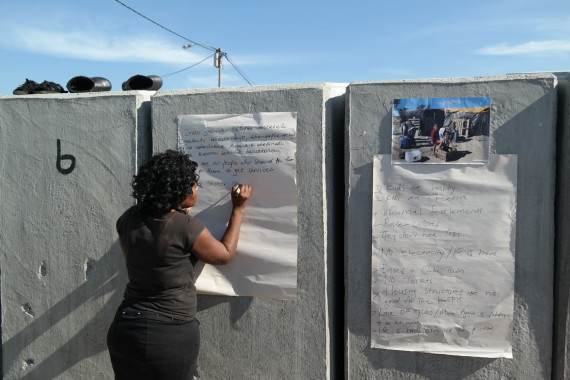
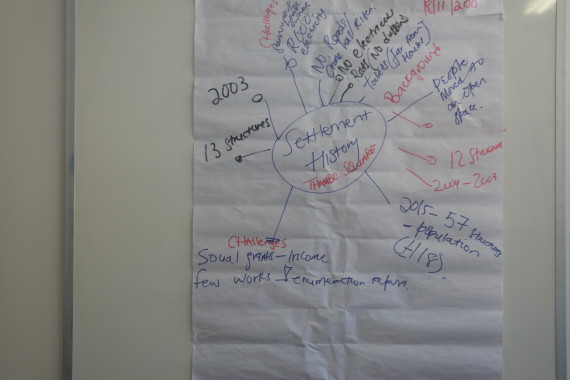
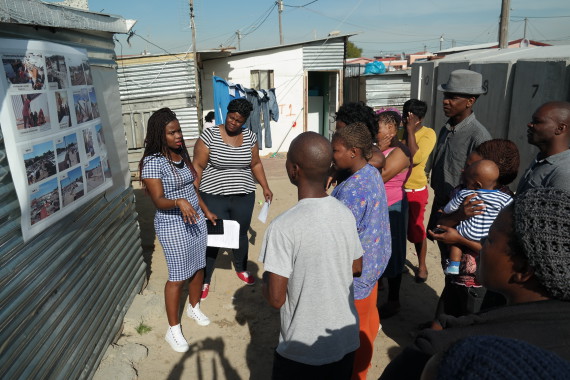
Documentation workshop at Tambo Square

Documentation workshop at Tambo Square

Community Documenting at Tambo Square

Community Documenting at Tambo Square

History of settlement

Tambo Square is situated in Tokwana Street and lies adjacent to the Sandra Child Centre in Extension 6 of Mfuleni. The 1846m² land size holds 60 households with a population of 119 people.

As residents of Tambo Square, we had different reasons for moving to the open space which is now called Tambo Square. Some of us were backyarders. When we saw an open space and decided to occupy it, some moved out from our surrounding family and saw a vacant land and occupied it. Others couldn’t afford renting anymore. When we saw people occupying the space, we then decided to join. In 2008 the City’s anti -land invasion unit demolished our structures, But residents didn’t give up and we decided to build our structures again.

“During winter season, this area gets flooded and our furniture gets ruined but the major issue is watching our children suffer because we can’t afford better homes for them.”

Nomaphelo Voyi, Community Leader of Tambo Square

Community of Tambo square doing house designs with technical team

Community Leaders Nomaphelo Voyi and Nkosikhona Bangiso plan the layout of their settlement with support form CORC technical team

Challenges

  • Electricity

Our biggest challenge is not having electricity. We need to find money every month to be able to connect illegally from the surrounding formal houses.  We spend almost R500 just to get our tap connected.

  • Toilets

The toilets are far for some of the residents and we have to walk quite a distance to access it. During night time or winter season we fear using them because the crime rate in Mfuleni is quite high.

  • Dustbins

We feel that our settlement would be much neater if we had dust bins to throw our unwanted materials.  Since we don’t have bins we now have rats due to people throwing dirt wherever they see a space. This is a health hazard for us.

  • Proper roads

Our settlement is dense, this makes it harder for emergency vehicles to come and help during time of need. If we can catch fire all our shacks would burn in the blaze. Another problem is because of the density of the area, criminals find it easy to do robberies here because one will not know where they went.

Tambo Square Writing and Story-Telling Workshop

Tambo Square Writing and Story-Telling Workshop

documentation workshop in Tambo Square

Documentation workshop in Tambo Square

How we met ISN

In October 2014, we decided to seek help in trying to better our living conditions since we didn’t have any basic services. This is when we met the Informal Settlement Network (ISN). The community approached Western Cape ISN Coordinator, Nkokheli Ncambele, who introduced the community to the SA SDI Alliance. ISN introduced us to the Alliance tools which meant we had to do community-led profiling and enumerations with the support of the CORC technical team. A group of us went on an exchange to Flamingo Crescent  to learn about informal settlement upgrading & reblocking. By June 2015 our community leaders had already partnered with ISN, the SA SDI Alliance and the City of Cape Town for 10 toilets and 5 water stands.This was a victory for us. At first the City said that Tambo Square is too dense for services. ISN suggested that we move a large container that was standing in front of our settlement to make space for services. When we presented this to the City their response changed and they agreed (read blog on water and sanitation here).

Documentation Workshop

Documentation Workshop

Through its partnership with ISN and the City of Cape Town, Tambo Square is set for upgrading and reblocking in February 2016, which will enable 1:1 service installation. The upgrading of Tambo Square is activating a more nuanced and community-led approach. The partnership between Tambo Square, the Alliance and the City draws on organised community (leadership) structures. These activate community- based savings, data collection and joint partnership meetings with City officials and the Alliance throughout project preparation and implementation.

*Blog compiled by Andiswa Meke and Yolande Hendler (on behalf of CORC)