Category

uTshani Fund

Emergency relief in Midvaal on Mandela Day

By CORC, FEDUP, ISN, uTshani Fund No Comments

By Kwanele Sibanda (on behalf of CORC)

IMG_1839

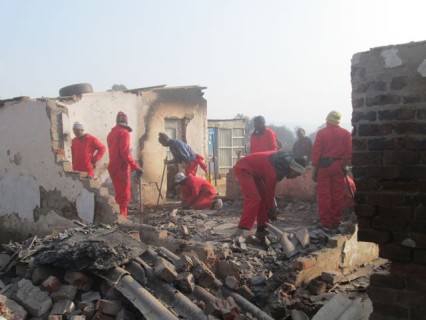
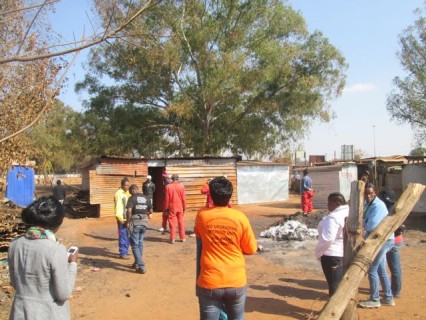
The process of formalizing a working relationship in form of an MOU between the Midvaal Municipality and ISN has not hindered the undertaking of projects in a joint effort between the two entities. Read more about the partnership in progress when enumerating Sicelo informal settlement and formal recognition of the ISN’d contribution. On Mandela Day, the 18th of July 2013, the ISN, Midvaal Municipality and the Red Ants joined hands in supporting seven households whose shacks burnt down in three different settlements. The causes of the fire were due to candle accidents in two settlements and ‘fire-wood heater’ in the third settlement. The names of the settlements are Komdraai, Pillis Farm and Sicelo.

IMG_1756

The Municipality of Midvaal and their contractor Red Ants joined the ISN’s assistance to afflicted families when they donated building material for the reconstruction of the burnt shacks and also provided each household with a food parcel. To support the ISN teams in respective communities, the Red Ants had a team of ten members. In the handing over of the food parcel to Samuel of Pillis Farm, Roy Ponsonby, manager of the regional Red Ants team, said

We fully understand what you went through and what you are going through. The effort we have put today is only an attempt to help you start afresh your life in the community.

Sipho Vanga, community leader from Ramaphosa informal settlement in Ekurhuleni and coordinator of ISN Gauteng, supported and encouraged the participating residents to remain united and committed to finding solutions to their challenges. The affected settlements are communities that the ISN in partnership with the Municipality and the Red Ants recently enumerated. The data gathered and numbering of all structures assisted a great deal in confirming the certainty of the existence of the structures and the information of the occupants prior to the predicament. For the ISN, Midvaal Municipality and the Red Ants, the Mandela Day formed part of an on-going process of demonstrating commitment to love and unity for one another in building a better South Africa for all.

–     Representing the ISN in Midvaal was Oupa and his team was supported by Sipho Vanga from Ekurhuleni.

–     CORC was represented by Kwanele Sibanda

–     The Red Ants team of ten was led by Roy Ponsoby (Red Ants Manager) and Shane John (Red Ant Scout).

–     The Midvaal Municipality was represented by:

  • MMC Development Planning and Housing – Mr Bongani Baloyi
  • Executive Director: Development Planning and Housing – Mr Henry Human
  • Deputy Director: Housing – Ms Sylvia Nkrumah

–     Councillor – Mike Ndebele

The first settlement we visited was Komdraai.

no images were found

The original structures before the fire breakout where two shacks that were built on a foundation within a block of dilapidated old farm houses.

The second settlement we visited was Pillis Farm.

IMG_1817

Shack number 26 belonging to Samuel Moalosi burnt down on the 30th of June when he fell asleep. During the incident, he was lucky to sustained only minor injuries, but the trauma of the event was evident. After the incident, Samuel was forced by circumstances to share a shack with his sister that lives with her husband and children.

The third settlement we supported was Sicelo informal settlement.

no images were found

On the 17th of June four shacks were engulfed by a fire. In response to the incident, the disaster management of the Municipality provided the affected families with tents.

Alliance signs MoU with Habitat for Humanity

By CORC, FEDUP, ISN, uTshani Fund No Comments

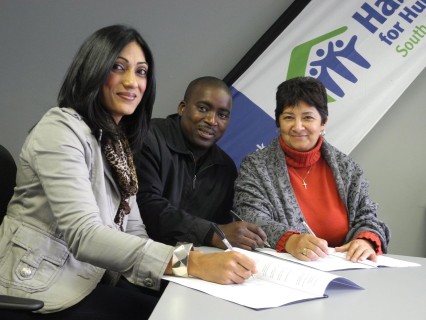
Addressing the scale of the urban crisis requires multiple stakeholders to collaborate around a common vision of change. The partnership between CORC/ISN  and Habitat for Humanity South Africa centrally recognises that if a vision of change is not community centred, it will most likely yield less impact. Moreover, development which is conceptualised and implemented by an external agency will most likely not be able to scale up and reach a city-wide impact. For this reason, the Alliance signed a partnership agreement with Habitat for Humanity South Africa around two key around: 1) collaboration around a to-be-determined schedule of projects, and 2) setting up a city-fund. DSCN4071

The time of saying that any organisation is better off doing things by themselves is over. We have to take hands and work together if we are going to change the way the City works and if we want communities to have a say in development that affects them. That is the kind of space that we share as organisations… This [Memorandum of Understanding] brings us together around different kind of approaches to settlement upgrading. It also creates a space for us to collaborate on setting up a city-fund, which will give communities access to funding for upgrading.

With these comments, Bunita Köhler, director of CORC, introduced today’s proceedings. Salisha Lauton, Programme Development Specialist of HfH, agreed and added that the organisations represented have an opportunity to collaborate around practical areas of intervention.

Since the shift in our strategic direction, we recognise a community-focused approach to housing development. We can not only build houses in formal [greenfields] areas, but we also need to look into ways of housing people in informal settlements. We are so fortunate to partner with well established organisations that have credibility in the communities. We embrace this opportunity to explore the opportunities this partnership will bring to the forefront. We are really excited to journey in this venture with you.

DSCN4073

After the signing of the MoU, the partners caucused around future meetings. It was agreed that a stakeholder engagement meeting will be organised and each partner will present on key strategic programme areas, workplans, operations, and other dynamics. Vuyani Mnyango, who signed on behalf of the ISN, wrapped up the meeting.

This partnership has been coming since 2011, and we are happy to sign now. We think that this partnership will help all the partners and communities involved, instead of having a partnership signed where the communities do not benefit. At the end of the day, all the partnerships are meant for the people on the ground, not for people who have signed. We need to see results now, and we as the community leaders will take this forward and bring the communities on board.

FEDUP’s Lessons from Swaziland

By CORC, FEDUP, ISN, uTshani Fund No Comments

Savings Groups

By Noah Schermbrucker, SDI Secretariat

** Cross posted from the SDI Blog **

“When the NGO disappeared it was like a shepherd looking after the sheep and the sheep were scattered…that is what I was picturing. To my surprise we found that all the people we found last time were still here and it gave us more courage to emphasize our support.”- Rose Molokoane

Recently a team from South Africa visited Swaziland to meet with the communities aligned with the Swaziland Low Income People’s Organisation (SLIPO). The team was made up of South African community leaders and a member of the SDI secretariat.   While professional and leadership processes in Swaziland have stuttered over the years, the exchange team learned that many of the Swazi savings schemes and communities remain committed.  Infighting amongst leadership and a lack of clarity about the core SDI rituals and how to implement them remain significant challenges. The core purpose of the exchange was to assess and re-invigorate the Swazi process and leadership, albeit with the pledge of sustained support from South Africa; in the words of Rose Molokoane “Swaziland will become like South Africa’s baby”. Although SDI’s presence in Swaziland is small, the exchange visit raised a number of issues and examples that speak to much broader and diverse challenges within, and beyond the SDI network. These came up in the nightly reflection sessions conducted by the exchange team.

Dealing with issues of Leadership:

“Lets take our caps down and say we have volunteered as the leaders to make this country better for the poor. We do not use elections we ask who is good at what! All of you come together, assess yourselves and see who is good at what.” – Rose Molokoane

One of the core issues hampering the Swazi process was a lack unity amongst the leadership on the way forward. The South African team emphasized unity of purpose and mapping a clear way forward in their engagements with the Swazi leadership. What struck me was the manner in which the South African leadership engaged their Swazi counterparts. Social movements are complex organisms, comprised of individuals with divergent opinions who simultaneously need to present a united front. Negotiating internal community dynamics involves listening, assessing and intervening in a supportive but decisive manner without undermining individuals. It involves walking a line and speaking a language unique to community members who have faced similar challenges. The anecdotes, similes and comparisons that comprise this rhetoric avoid personal antagonism while making powerful points about unity of purpose.  It is unlikely that a professional will ever understand these dynamics; drawing out points which are important but may seem irrelevant, the manner in which to listen and hear what people say, how to suggest changes subtly, using metaphors to build collective unity of purpose, cutting to the core of the issues which are hidden below the surface and learning from the engagements instead of just “teaching” others.

“We learnt that we must find a good way to solve problems. Fighting is not the way – we must come together and talk and look at the way forward. The mistakes are there to teach us lessons and give us power. From our mistakes it should make a strong way to make SLIPO strong. We have to come together and work together.”- SLIPO member

The lesson here is about the way in which communities speak to and engage one another, what they see differently and how they use practical experience to define such engagements. The Swazi engagement illustrated firsthand what is gained when capacitated community members engage each other on their own terms and in their own language, a learning engagement that is very different to those mediated by professionals.

Sustainable Processes?

SLIPO Office

A topic of discussion that emerged amongst the exchange group was the long-term sustainability of the Swazi process. Despite various interventions made over the years to re-invigorate the process, SLIPO remains unable to leverage resources or move towards internal sustainability. This begs the question of how long external funds can be used to prop up social movements. Is the withdrawal of funding a disservice to the urban poor? Should leaders be doing more to make the movement sustainable since donor funding is never guaranteed in perpetuity? What dependencies emerge when donors continue to fund movements that do not have the capacity to be sustainable or leverage significant resources from government? And do such dependencies ultimately weaken communities and leaderships who continue to rely on external assistance rather than deepening their own capacities?

These questions speak to much broader themes within the SDI network and the development world. The importance of communities being involved in their own development processes is magnified when that involvement implies some form of contribution (whether financial, technical or through sweat equity). The very basis of the entire SDI network, female centered savings groups, stresses savings as a means for enabling communities to bring something to the negotiating table. The process is not merely fiscal, as it builds capacity and a collective agenda alongside a financial basis for negotiation. If a process is truly built from the bottom-up it is these savings schemes that are the building block for leveraging further resources and funding – their sustainability rooted in the social capacities that develop alongside them.

Urban or Rural?

Swaziland

Initial impressions of Mbabane were not of a large bustling urban center but of a town somewhere between rural and urban. While some factories and warehouses dot the road to Manzini, Swaziland remains largely rural.  Can countries like Swaziland, Lesotho and Botswana, were SDI has begun to establish a presence, really be considered urban in the same sense as Kenya? Not that any two pictures of urban poverty are the same but different dynamics are certainly at work. Communities still retain strong rural ties and layouts could be considered peri-urban-a form of urbanism that is evident in many countries in which SDI works (e.g. Malawi, parts of South Africa). The long history of Swaziland as a “labour reserve” for South African industry (especially mining) has created a large migrant labor force undoubtedly affecting the dynamics of communities and urban poverty in cities like Mbabane.

As the SDI network expands it needs to develop varied responses to different cities along the continuum of urbanization. Informality in dense, urbanized and rapidly growing cities is very different to that experienced in Mbabane. Recognizing such dynamics and learning from how they play out at a community level is imperative to deeper and more insightful engagements, not just in Mbabane but also in similar cities across the SDI network.

Way forward for Swaziland:

“The federation in Swaziland is very much alive because even though they have been informed late yesterday about the meeting their attendance did not reflect this.”- Emily Mohohlo

The exchange team ended their visit by drafting, in close conjunction with the Swazi leadership, a work plan. The plan aims to re-invigorate savings schemes, draw Swaziland into the Southern African Regional Hub, capacitate leadership through mentorship by the South African process and complete construction of the SLIPO office so that the federation can have a place to meet and store records.  In the final reflection session, conducted with the Swazi leadership, the team stressed unity of purpose and the strength of local savings groups as key to the way forward.

“Now we have a proper program we can bring back the image of the Swazi federation. We have to become a strong united front. Change can happen if you as an individual can become the change – you have to be the change that you see. You have to build the unity amongst the leaders – there are many issues that are pending and through unity you can move forward with this. For all these days that we have been together we are not doubtful that we have seen progress and that this will bring positive results and positive reports to the Southern African Hub and the entire SDI family.”  – Excerpts from reflection session

Landscape design on Erf 64, Kylemore

By CORC, FEDUP, ISN, uTshani Fund No Comments

By Thandeka Tshabalala (on behalf of CORC)

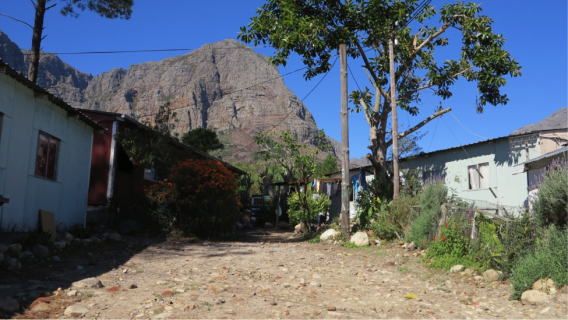
mountain view

On Erf 64, located in the neighborhood of Kylemore in Stellenbosch Municipality, a small community has lived on the land since the early 1980s. The site is located on the edge of a picturesque forest. Sarah Klempton first lived here when the site was still used by the Dutch Reformed Church as a Youth Camp in the 1980s. Sarah and her family grew, and relatives joined her, and today the small community of 9 families consisting of 25 people live here. The land is owned by the Department of Public Works and the residents do not have formal land tenure. Sarah and her relatives continue to stay in very old and dilapidated housing stock, which is starting to fall apart. Some of the newer arrivals have used zinc sheets to make extensions to existing structures.

The community has access to basic services such as four chemical toilets, electricity and a water tap in the vicinity. Although there are no street lights in the long approach through vacant land towards Erf 64, the residents find the neighborhood relatively safe. Regular police patrols comfort them. For social support the community relies on religious services as three churches are located within the wider area of Kylemore. The children attend school at the nearest primary and high schools that are located within a walking distance. nearest clinic is a two hour walk, and on top it costs R10.00 taxi fair to travel to the hospital. Emergency services are often out of reach due to the secluded location of Erf 64 in Kylemore. Having realized this, the community has persistently advocated for a road signage –directing emergency services and new visitors to the settlement, from the main Helshoogte Road.site

Through the CORC/ISN partnership with the Stellenbosch Municipality, a municipal wide program to upgrade basic services was rolled out early this year. To provide a meaningful platform for community participation, the identification of the projects and their subsequent implementation is rooted within community priorities. Prior to the roll out, the ISN coordinator in Stellenbosch held a series of dialogues with community leaders from the several informal settlements with each community listing its priorities.

To advance towards specific project planning and implementation, the CORC technical team, aided by the ISN visited communities that had expressed urgency in upgrading their settlements. It should be noted that community leadership dynamics play a vital role in determining the speed at which communities take up development projects. The small community of Erf 64 often discusses what their aspirations for the area is. To this end, they have worked in collaboration with CORC/ISN and the Municipality. The technical team from CORC met up the community to discuss their developmental needs and the community prioritized on the following needs. At the same time, Marlene of ISN began engaging the households (targeting the women) on the importance of establishing a saving scheme.

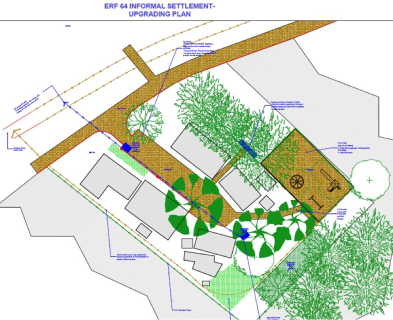
plan

The soil typology is a rough and stony terrain, and surface run off has for a long time eroded the common spaces shared by the community. Consequently, walking became uncomfortable, with the elderly and children being the most affected. The community asked for assistance in improving this surface which covers an approximately 500m2. The site required minor earth works to achieve a fine texture of the surface.

It was identified that there was a need to rehabilitate the existing water point by increasing the water pressure, trap grey water and provide wash basins. So far the additional tap has been fixed. There is an ongoing work of fitting two wash basins and undertaking grey water works- a shallow drain will be used to trap grey water from the water points and reticulate it towards the adjacent storm drain. This drain has infiltration capacity (has grass cover) and environmentally manage the relatively small volume of grey water produced by the 9 households.

playground

Although there exists a playground at the adjacent high school and which is open to the ERF 64 children, the community saw the need of a play park within their settlement. The reasons for this being that, the children prefer playing within the community but on the rugged surface, often incurring injuries in the process. The parents also expressed the need to have a play park within to limit their worries about children whereabouts. A space was identified within the settlement and through the municipal’s consent works began to prepare the play park site. This was followed by the supply of Play park equipment-jungle gym which was mounted and ready for use by the 21st of June. The planned park includes a jungle gym, and a rotating wheel.

The initiatives highlighted in this article are works-in-progress. In addition the community proposed plan to establish a food garden that will be run as a project under the community savings project. The remaining works of landscaping, water supply and sanitation, and perimeter facing are planned to be completed by the end of July. Importantly, the community resolved to take charge in maintaining the park and wash facilities.

Reflecting on upgrading policy and practice

By CORC, FEDUP, ISN, uTshani Fund No Comments

By Baraka Mwau (on behalf of CORC)

Editors note: In April CORC and ISN launched community forums in Khayelitsha with the view on generating an alternative view on city building processes. The first community forum was held in Enkanini close to Baden Powell Drive in Cape Town, followed by workshops in UT Section. This report outlines a parallel forum facilitated by CORC on more inclusive measures in urban and housing policies. 

One-Horse-Town-Illustration-Studio-Ubuntu-Village

My Life Ubuntu Village graphic by One Horse Town

Why did the South African government prioritise housing at the dawn of democracy in 1994?

What has been the role of the civil society in advancing spatial justice and making urbanisation inclusive in the post-apartheid South Africa?

What are the fundamental tenants of the various urban and housing policy frameworks?

These are the fundamental questions that opened up a deliberative forum called “The Learning Space” on Tuesday, 18th June 2013 at the SDI SA Alliance Cape Town office. We created a space to convene conversations on the policy and practice of building more inclusive and pro poor cities. Drawing on the experiences of organised communities aligned to ISN and FEDUP, community leaders and support NGOs are reflecting on the policy trajectory, the evolving urbanisation landscape and try to evaluate ways of advancing a responsive approach towards building more inclusive cities in South Africa. What have been the achievements? What are the obstacles? How are the communities involved in the implementation of government policies related to low-income housing and informal settlement upgrading?

DSC01897

A brief background was provided about the roots of government’s commitment in 1994 to universal access to housing for South African citizens. It emerged that following years of apartheid regime, access to urban land and housing was restricted (or limited to the black labour force working in apartheid industries) and this led to the institutionalisation of adequate housing for all. This echoes the main tenants of the independently drafted Freedom Charter heralding “the people shall govern” in Kliptown, 1955. At the same period, the World Bank promoted a “site and service” approach to housing the urban poor, which called for the state’s intervention for a once-off intervention to fund individual home ownership. This has proven ineffective in diagnosing the urban crises South Africa faces.

South African cities have experienced rapid urbanisation since the undoing of the pass laws in the late 1980s. Housing is one of the largest demands in the post-apartheid city. However, despite tremendous achievement by the government in delivering more than 3 million houses, the rate of housing delivery could not or have not matched the demand to date. The huge housing backlog substantiates this deliberation, that has received a lot of scrutiny in all sectors.

We discussed and examined the most imminent programmes at the national, provincial and local government spheres dealing directly with the conditions of urban poor in South African cities. The Delivery Agreement between the Presidency and the minister of National Department of Human Settlements signed in 2010 has set ambitious targets to provide 400,000 households in informal settlements with basic services and secure tenure by 2014. This entails the provision of 6, 250 ha of public land for low-income housing. The provincial targets are displayed in the ensuing table:

Province Informal Settlement Households Share of National Target Estimated Cost: R000
Eastern Cape 59 400 1 813 546
Free State 26 400 806 021
Gauteng 96 800 2 955 409
KwaZulu-Natal 76 200 2 326 468
Limpopo 31 200 952 570
Mpumalanga 26 480 808 463
Northern Cape 9 320 285 466
North West 28 840 880 516
Western Cape 45 360 1 384 890
Total 400 000 12 213 349

Cost based on UISP subsidy quantum; supported by bulk, connector and land costs where necessary (source: NUSP 2010)

To actualise the attainment of the tenure targets set by NSUP, the Upgrading of Informal Settlements Programme (UISP) was established. UISP is structured for implementation in four phases which address matters of: administrative, legal issues and township establishment framework-layout, infrastructure etc. In addition NSUP has set out various grant and subsidy tools: Human Settlement Development Grant (HSDG) – allocation to provinces which includes: UISP and Integrated Residential Development Programme (IRDP); Urban Settlement Development Grant (USDG) – a capital infrastructure budget to selected municipalities (metros) and Municipal Infrastructure Grant (MIG).

In the forum, UISP was discussed substantively, since the alliance sought to establish the oppourtunities presented by this programme to the urban poor. This programme has room for advancing a case for incremental housing and challenging traditional upgrading practice in South African municipalities.  That was one of the emerging opportunities. Importantly the audience, in relating to experiences of working with various municipalities, observed that UISP has had various interpretations.

Two paradigms (approaches to the informal settlement challenges) were identified: municipalities that have prioritised upgrading agendas end up identifying Greenfields for UISP implementation, and secondly, some municipalities have applied UISP to true in-situ upgrading ethos. UISP and most national and local government programmes in upgrading and housing for the low income, clearly stipulate mandatory integration of a ‘participatory process’.

However, it is important to raise a fundamental question: has participation become mere compliance by local government? An attempt to answer that question opened a debate on how organised communities such as ISN and FEDUP can be on the forefront in ensuring that meaningful participation of affected communities is attained. It is thus inevitable to integrate such critical component without being an active player in the realization of these programmes (planning and implementation). It is a reality resulted to further interrogation of how NGOS and communities should approach partnerships with the local government.

Anchoring partnerships within the implementation of such programmes as UISP was pointing towards such a strategy. However, the debate not conclusive enough, in the nature of strategy to deploy-which partly sets the agenda for subsequent discussions. The agreement was to nurture such a strategy that clearly outlines how communities can be in more influential in municipal budgeting and allocation of expenditure.

Towards the conclusion of the session critical questions were raised:

  1. How is the work of the SDI SA Alliance fitting within or influencing the contemporary informal settlement upgrading and low-income housing delivery regimes in South African cities? A case presented was the formulation of the current City of Cape Town Integrated Development Plan in which the housing and informal settlements chapters directly touches on the work of the alliance. To what level did the Alliance participate in this process, and generally, in other IDP formulation processes?
  2. How has the work of the SDI SA Alliance contributed to restructuring or even provoking the spatial restructuring of the inherited-segregated city? What is the work of the alliance promoting and how responsive is in-situ upgrading to advancing the quest for an inclusive South African city? Most importantly, in what context is in-situ promoted as a spatial restructuring tool? Two cases where analysed in this discussion; Upgrading of Langrug, perhaps strategically located as a settlement with easy access to job areas in the Franschhoek, and secondly the upgrading of informal settlements in Cape Town, since they primarily continue to exist in segregated areas. Evidently, the two cases point to a different conceptualisation of the imperatives of inclusive urbanisation through in-situ upgrading of informal settlements.

The way forward for the Alliance seems to depart from the evaluation of the current impediments facing the desired level of participation in these programmes.  The partnership platforms which the alliance has established with various municipalities can be strengthened towards greater integration. However, this change should also be reflected in the formal planning appartus of the local government, such as the Integrated Development Plan (IDP) and the Spatial Development Framework (SDF). These tools should be co-produced between communities at the ward level, City officials, academics and so forth. This not only advances the agenda of the alliance but also, as strategy for the municipalities to upscale their capacity in addressing informal settlements. This is observable in the relevant municipalities where the partnerships are ongoing.

Exchange Report: ISN Gauteng strengthens Eastern Cape network

By CORC, FEDUP, ISN, News, uTshani Fund No Comments

By Evelyn Benekane (FEDUP), Mohau Melani (ISN) and Motebang Matsela (CORC)

DSC01924

In May 2013, we traveled to informal settlements in and around Port Elizabeth in the Eastern Cape to support the communities who are planning to upgrade their settlements. The purpose of this exchange is related to re-blocking, like the projects of Ruimsig, Mtshini Wam and Sheffield Road. The delegates from the represented settlements in Gauteng have also experienced situations of fire outbreaks and congestion of shacks, therefore calling for support around the broad idea of re-blocking. The settlements in Port Elizabeth are also different from the other cases because of the low-densities. Here are the people who traveled with us to Port Elizabeth, and we met Evelyn Benekane there.

Name Gender Organization (Fed/NGO) Why Chosen?
Mohau  Melani Male ISN CUFF
Motebang Matsela Male CORC Technical
Albert Masibigiri Male ISN Technical
Zandisile Lena Male ISN From affected settlement
Phillip Mnomyiya Male ISN From a congested settlement
Xoliswa Ngwanqa Female ISN From a congested settlement
Yoliswa Jozana Female ISN From a settlement with fire outbreaks

First Visit: Moeggesukkel 

The Gauteng delegation first visited the settlement of Moeggesukkel.  They have been working proactively to prepare plans for their settlement. Read this report published by the SA SDI Alliance a while ago. We had a meeting in the morning after breakfast, where we identified challenges that the leadership is facing in the settlement. One of the key issues that was identified is that the two divisions in the community, those for re-blocking and those against. On arrival, the community committee and technical team identified four of those who are against re-blocking. We talked through the planning processes. The community committee came together with the technical team and we discussed all the processes of re-blocking. The Gauteng delegates from informal settlements Makause, Joe Slovo, Holomisa and Nancefield demonstrated how to measure sites.

DSC01916 IMAG0152

The community of Moegesukkel have organised themselves around the common practices of  enumeration, savings and community based planning. Savings have in part been spent on materials for the re-blocking process. In the community meetings we learnt that there is a buy-in for the project. There are also a few politicians and councillors who want to influence the community against the project as they deem this a threat to their vote base. Therefore the team has agreed to informally influence those who are against the process starting at the household level. Households plan together around incrementally securing access to tenure rights. In many cases, re-blocking has already started organically.

DSC01926

DSC01897

Here are some photos on the reblocking project in progress

no images were found

Second Visit: Midrand

In June we presented the mapping process the Midrand community has undergone. This is reported on in this article. What follows are some observations on our engagement with the community in their process of establishing community steering committees and other governance aspects. 

In a general community meeting, the ISN Gauteng delegation made it clear that the ISN is not a political party. ISN Gauteng argued that it pushes community-based savings and upgrading as key building blocks of strengthening the network. The engagement with the City remains key to changing the lives of the poor. ISN commended the Midrand community on their partnership with the Nelson Mandela Bay Metro. The perceived process will lead to incremental security of tenure, servicing of the sites and in the future ownership. These are important factors outlined to the community. For now the community needs to focus on what they want to achieve, as the majority of the community are contributing, use that money to set the terms of their upgrade. We encouraged the community to sign an MoU with the office of the Mayor and the Human Settlements Doctorate around the progressive upgrading of informal settlements.

no images were found

Meeting 3: Enkanini, Ward 13

Before we left Port Elizabeth, we also had a chance to make contact with Enkanini, a settlement in Ward 13. We set up a meeting with the councillor to express the intentions of the Network, and to indicate the partnership-in-the-making with Nelson Mandela Bay Metro. We will continue to engage the settlement and the councillor.

DSC01957

DSC01946


SDI – SFI Partnership in Action: Profiling in Khayelitsha, Cape Town

By CORC, FEDUP, ISN, uTshani Fund No Comments

SDI - SFI Exchange

Cross posted from SDI blog

By Walter Fieuw, CORC

When the question of collaboratively testing new techniques in profiling informal settlements was raised, Cape Town was proposed as the gathering place for federations from Kenya, Uganda, Malawi, Zimbabwe, India, Namibia, and South Africa. Community leaders and NGO representatives from these countries have in common the quest for improving data capture processes. The agenda has a global imperative: first, to analyse the 7,000 profiles federations have captured over two decades in more than 15 countries, and second, to look forward at improved processes for citywide settlement profiling.

SDI and SFI Partnership Background

Delegations gathered for an intense 10 day programme, which started on the 3rd of June 2013. Old friends reunited, and new contacts were made. This project is a collaboration between SDI and the Santa Fe Institute (SFI), which is supported by an 18-month, $1 million grant from the Bill & Melinda Gates Foundation. It is anticipated that this project could yield a “science of slums” if SDI’s data and SFI’s methodology are successfully paired.

SFI’s special research focus on Cities, Scaling, and Sustainability, which is the key department working with SDI, has a “… particularly important focus [of this research area] is to develop theoretical insights about cities that can inform quantitative analyses of their long-term sustainability in terms of the interplay between innovation, resource appropriation, and consumption and the make up of their social and economic activity”. SFI Professor Luis Bettencourt, who is the SFI project leader, remarked on evolving partnership with SDI in an interview with Txchnologist“We want to find ways to make the greatest use of the data SDI collects,” Bettencourt says. “In this way, the project will help create standards through which informal communities can collect and use data about themselves and develop economic models to sustain these efforts.“

The project has been a work in progress since January 2013, when key representatives from India, Uganda, South Africa and Kenya visited the SFI group in the USA to discuss the make-up of the project. Sheela Patel, Director of the Indian NGO SPARC and Chair of the SDI Board, reflected on the evolving partnership with SFI in a SDI blog article. “As part of its ongoing quest to bridge informal urban settlements into city planning, an important first step has been to get communities of the urban poor living in informal settlements to believe that aggregating information about their settlement and households is a valuable tool towards improving their lives.”

After the 7,000 slum profiles were collected and analysed, Federations came together again in Kenya in April 2013. Read the article on the workshop here.

Cape Town Workshop

The workshop started with a meet and greet, and presentations and informal conversations on the vastly diverse experiences of profiling informal settlements followed. Luis Bettencourt from SFI presented on the work of the institute, bringing into focus the dynamics of city growth by drawing on recent research SFI has conducted through GIS modelling. This was also a touch point for how SDI data could help federations understand cities better. Federations shared different experiences of profiling informal settlements. At the grassroots level, the data helps communities understand their settlements better and build relationships with government. Even though this is a practice commonly shared, SDI affiliates have, over the years, developed different mechanisms and processes for collecting information. The challenge and advocacy agenda of SDI saw it crucially important to start a horizontal conversation on how to integrate all the different data sets.

Sheila, a community leader from the Zimbabwe Homeless People’s Federation, said that the federation has been profiling informal settlements since the early 2000s. Initially they had challenges to store and analyse the data, and this also delayed the feedback to communities. The Federation decided that involving members from the local savings schemes was the most efficient way to move forward. In this way, they were much more involved, and they were also the first to pick up on errors. There were accounts of political interference, because the politicians were still denying the natural urbanisation. We have now come to a point where we can compare and integrate information to find workable solutions to upgrading.
SDI - SFI Exchange

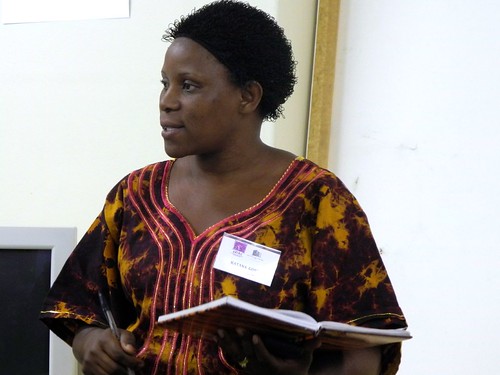
The issue of data management seemed to be familiar in the Ugandan experience. The National Slum Dwellers Federation of Uganda is presently comprised of 355 savings groups operating in six cities: Kampala, Arua, Jinja, Kabale, Mbale, and Mbarara. Katana Goretti elaborated that the question of local language difference was a further motivator to involve local people. For instance, people would lie about how many children they had because they thought there would be a kickback for their families. This is resolved in the verification process, “We had to update the database in response to increased evictions, since the data the government cites in justification of their actions are out of date. The large database helps us assist one another in times when other settlements are facing evictions.”

The cultural and experiential exchanges were important to align the various experiences. But the main focus was on learning by doing, and the Informal Settlement Network (ISN), a South African social movement linked to the Federation of the Urban Poor (FEDUP), the South African SDI affiliate, suggested that UT Section was perfect location.
SDI - SFI Exchange

Learning by Doing in UT Section, Khayelitsha

UT Section is a dense informal settlement in Khayelitsha, Cape Town, located south of iKhusi Primary School. Founded in 1985 when people moved from other neighborhoods such as Crossroads to make a new home, UT section has seen incremental development throughout the years. At first service levels were very low, and the City government handed out buckets since toilets could not be installed. Years later, the settlement received grid electricity. Listen to Snax talk us through his settlement.

[vimeo width=”620″ height=”485″]https://vimeo.com/68050292[/vimeo]

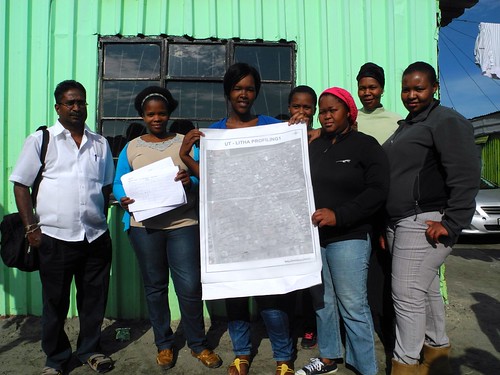
The delegations from Kenya, Uganda, Malawi, Zimbabwe, India, Namibia, and South Africa and SFI team had several meetings in UT Section between 4 – 8 June. The new profiling questionnaire was discussed and tested with various technologies, such as an Android phone application coded with the questions, GPS coordinates, and pictures pinned to certain points of interests, such as waste removal skips. Community also experimented with identifying shack usage and mapping out shack numbers by means of large printed satellite photos.
SDI - SFI Exchange

UT Section community mapping team assisted by Shekar (far left) from the Indian SDI Alliance. 

SDI - SFI Exchange

Structure use identification through community mapping. 

SDI - SFI Exchange

On Saturday the 8th of June, the full settlement enumeration of UT Section was launched with a kick-off party. Government officials from the City of Cape Town’s informal settlement management department and principle field officers (PFO) were invited to the celebration. At the launch, PFO Natalie Samuels remarked:

“In 2009 a partnership was formed between CORC and ISN and the City of Cape Town… and communities were able to petition the City on important needs in informal settlements. The main purpose of this exchange is the profiling of informal settlements and the value that it adds to our communities.”

SDI - SFI Exchange

The on-the-ground learning environment has been a major success. Groups have developed new skills and technologies for profiling and spatially understanding their settlements. The open and transparent learning environment will go a long way in building local capacity to generate better quality spatial and socio-economic enumeration data.

Construction of Langrug road hierarchy starts

By CORC, FEDUP, ISN, uTshani Fund No Comments

By Walter Fieuw (on behalf of CORC)

To the casual observer, a road is simply a tarmac to allow for different usages. Perhaps we can also define it as a line of communication, which is connected to a greater network through bridges, tunnels, support structures, junctions, crossings, interchanges, and so forth. Roads connect our neighborhoods and cities to one another, and give us right of passage. These road hierarchies are usually planned well, and neighborhoods and cities grow around these cadastral maps.

But in informal settlements, smaller pathways emerge as needed. In many ways, the informal city grows exactly in the opposite direction than the formal city. In the formal city, cadastral maps are carefully designed, but in the informal city, planning emerge through means of negotiating space in the process of place making. What then happens when formal regulations start to interact with informal ways of city-building?

langrug2

In Langrug, an informal settlement located 3km outside the town of Franschhoek, an example has emerged where the informal processes of settlement has interacted with formal city-building planning processes. This article will not delve into the history of the settlement, which is available here. Important for contextual purposes, the community has been engaging the Stellenbosch Municipality since 2010 around the in-situ upgrading of the settlement, for which the community won the prestigious award from the South African Planning Institute in the “Community” category. The Stellenbosch Municipality applied for Upgrading of Informal Settlement Programme (UISP), or Part 3 of the National Housing Code, funding from the Western Cape Province. The UISP project has advanced to Phase 3, which includes full services.

PICTURES FROM THE SLUMS 115

Last week, the Municipality started paving secondary roads which has emerged organically through the years of settling on the land. The secondary roads have been well planned by the community, when they conducted an intense spatial mapping exercise in March 2011. The Alliance’s report on the spatial mapping in 2011 gives insight into the spatial knowledge the community has generated, which has made a significant contribution to the servicing of the settlement:

CORC supplied an aerial photograph of the terrain as well as some guidance on conducting spatial analysis, and in particular on what indicators to look for and how to identify an area’s constraints or opportunities for development. Then, photograph and markers in hand, the team went out into the February heat to locate all the infrastructure and facilities that they had agreed could benefit from improved maintenance or upgrading. The result was an interim map that detailed the position and conditions of all Langrug’s toilets, water taps, drains, drainage gullies, electricity boxes, street lights, and commercial activities, and thus threw light on some of the settlement’s most pressing issues.

In the coming month, the Stellenbosch Municipality’s appointed contractor will start the groundworks to implement a central access road. The community’s vision for an incremental upgrading approach to developing the neighbourhood has been a powerful guide in imagining what the community could look like.

Presentation on Langrug at the GLTN

Presentation at the Global Land Tools Network

The 16 week Planning Studio with UCT’s School of Architecture Planning & Geomatics (SAPG), a department in the Engineering & the Built Environment (EBE) faculty, has generated many other proposals for a responsive spatial development framework which can guide the future upgrading of the settlement. The Alliance will continue to report on the development of Langrug informal settlement, and the partnership with the Stellenbosch Municipality.

The Midrand community in Port Elizabeth maps out settlement

By CORC, FEDUP, ISN, News, uTshani Fund No Comments

By Thandeka Tshabalala (on behalf of CORC)

In the past there has been an ongoing notion that poor people are helpless and are generally considered to be passive recipients of services and development. In many ways poverty-reduction and housing delivery has created unsustainable solutions that have discouraged an active involvement of the poor people in the improvement of their living conditions. These plans are drafted and carried out by contractors, appointed on behalf of the municipality, who are sometimes out of touch with what the people want. A need exists to incorporate the needs and aspirations of poor people into the planning process.

DSC02602

But if we consider the situations of landlessness, poor housing and inaccessibility to basic services which define the reality for so many South Africans living in informal settlements, helplessness is the last word you would use to describe the innovative ways that informal settlers have used to house, feed and access services without the help from almost anyone. In reality poor people are the creators and implementers of most comprehensive and far reaching systems for solving problems of poverty, housing and basic services. Poor people build cities from the bottom up, and informal settlements are cheap and accessible to gain access to social and economic opportunities – because their system covers more ground and benefits more lives than any other institutionalised development program.

DSC02583


An example of community- based initiatives can be found in a community called ‘Midrand’ located on the North Western periphery of Port Elizabeth. The informal settlement of Midrand consists of 47 enumerated households with a total population of 191. The settlement is located on municipal land and as yet the settlement has not been included on the metro’s Integrated Development Plan or informal settlement data base as receiving services in the near future. In the absence of municipal priorities, the communities of Port Elizabeth have started to build capacity at the grassroots level.

DSC02595

It is not included in the municipal systems map of the Nelson Mandela municipality – Through an exchange program, a technical team from Moeggusukkel informal settlement assisted in the mapping out process this included the measuring out of each shack dimensions. Shack measurement data allows the community design team to plan the layout of the settlement more accurately. The CORC technical staff supported the community to consider other type of services and the community prioritized on access to clean water and clearly marked roads within the settlement.


no images were found

The community then started saving towards the installation of temporally taps to access clean water, they then asked the councilor and the Nelson Mandela Bay Municipality (NMBM) to connect to the municipal water pipes. The NMBM installed Two temporally taps in the settlement.