Category

uTshani Fund

“Green Shack” features community-based planning at Design Indbaba 2013

By CORC, FEDUP, ISN, uTshani Fund No Comments

By Walter Fieuw (on behalf of CORC)

In 2012 the community of Mshini Wam initiated an innovative approach to the in-situ upgrading of their dense informal settlement. Working closely with the Informal Settlement Network (ISN)—a collective network of informal settlements linking informal settlement civil society groups in five cities in South Africa—and the support NGOs Community Organisation Resource Centre (CORC) and iKhayalami, the community worked with City of Cape Town officials, engineers and field officers to upgrade their informal settlement.

Reblocking is a community-led in-situ re-arrangement of shacks in accordance to a community design framework which opens up safer and more dignified public spaces (called “courtyards”). The community was in charge of implementing this project and more than 50 short term job opportunities were created through the Expanded Public Works Programme (EPWP) in partnership with the City of Cape Town.

Through the “re-blocking” and community mobilisation processes, topographical, institutional and social issues have been overcome. The “re-blocking” is a priority as it will allow better access to services. To further protect against fires, the community is hoping to use fire-resistant materials when re-building their houses. The city will partner to provide sewer and water lines, as well as electrical poles and electrical boxes for each family.

[vimeo width=”620″ height=”485″]http://vimeo.com/52466961[/vimeo]

Re-blocking is more than just technical solutions to improving access to services. It is about a community process that starts with the empowerment of woman through savings schemes, the cohesion and unity of community working together on a broad-based project, and the formation of partnerships with government and other stakeholders in the long term development of the Settlement.

In November 2012, the Mshini Wam community was introduced by long-term development partners Worcester Polytechnic Institute (WPI) to Stephen Lamb and Andrew Lord of Touching the Earth Lightly (TEL). A pilot project was initiated around the building of a “green shack”, which incorporates low-tech, cost effective and sustainable design principles in the in-situ upgrading of informal settlements. By installing vertical gardens on shack walls and “liter of light” which amplifies natural light through a chemical-based dispenser installed in the roof of the shack. The pilot project drew a lot of media attention. The gardens were installed and subsequently the community started greening the courtyards created through reblocking by installing similar gardens.

All sketches courtesy of TEL

According to TEL’s website,

The Green Shack looks at how simple, low-tech design can transform temporary spaces into “home” spaces. It is focused entirely on what we can achieve now… The next two sides of the cube represent the sun-facing walls of the shack. On these two sides The Green Shack suggests they be wrapped with a fire-proof boarding, covered by a vertical thriving organic vegetable garden. This wall garden creates food for the household. This wall is drip irrigated using a low tech, slow-release gravity fed system via a pipe made of re-cycled car tires. Rain water is also captured off the roof and stored on site. The slow-drip nature of the irrigation system ensures that the wall is constantly wet.

The term “blocking” refers to building or re-building shack according to a spatial development plan. The concept of the “Green Shack” is intended to “piggy-back” this infra-structure development and create what we call “Green Blocks”

With TEL’s low-tech, cost effective and sustainable design products, embedded in the social processes of ISN and the reblocking support from CORC, iKhayalami and ISN technical coordinators, the “green shack” and “green blocks” could inform a new way of looking at productive spaces in informal settlements. For this reason, the South African SDI Alliance partnered with TEL at this year’s Design Indaba at the Cape Town International Convention Centre. This is a opportunity for exhibiting community based planning meeting innovative design.

Be sure to visit the green shack from 1 – 3 March 2013 and have a first hand experience of “green shack” built on site.

Stephen Lamb showcasing the vertical gardens at Design Indaba 2013

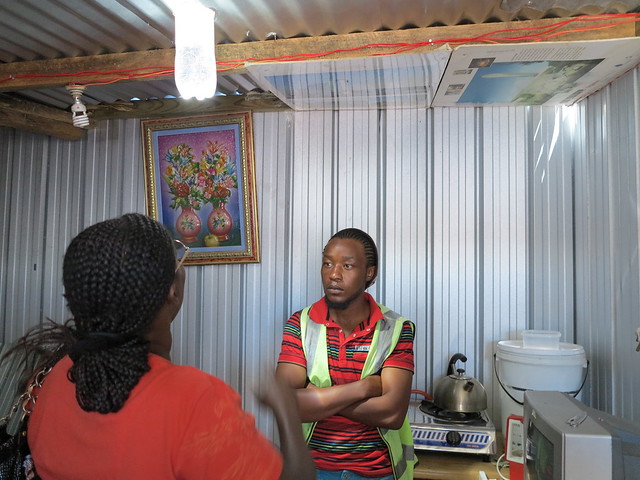
The “green shack” from the inside, a 20sqm floor space

Speaking truth to power: Sicelo enumeration update

By CORC, FEDUP, ISN, uTshani Fund No Comments

By Kwanele Sibanda (on behalf of CORC)

In November 2012, ISN and CORC reportedon the unfolding partnership in the Midvaal Municipality which was largely unlocked through the enumeration of the Sicelo informal settlement. It was said that the municipality aims to build about 450 houses in the near future, but this will never cater for more than 4,500 households living in Sicelo Shiceka. The settlement is also subjected to fierce political contestation between the Democratic Alliance and the African National Congress. On a recent walkabout in the informal settlement,  MEC for Local Government and Housing Humphrey Mmemezi commented on the situation,

I realized after the walk  about in the area that there are no toilets and people use nearby bushes and open pit toilets to relieve themselves. I made  a commitment that we will get funds  so that  we can buy toilets for the community. There are also only 9 taps for the community of 4000 shacks.

The Midvaal Municipality previously contracted the controversial Red Ants Security Company to conduct the enumeration. As reported in November, the community decided to speak truth to power in becoming central stakeholders in the process of gathering data. This was done as a parallel programme to the work of the Red Ants, but later on the work of the ISN was held in equal regard as to what the Municipality originally contracted Red Ants to do! The ISN facilitated enumeration supported the community to organise around a common voice for upgrading the large majority of the informal settlement.

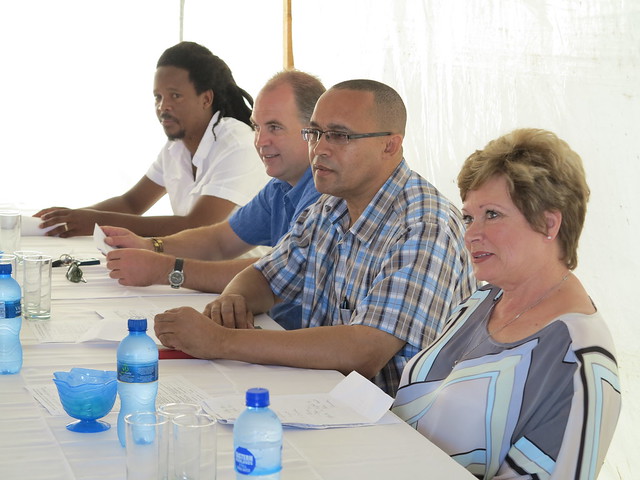
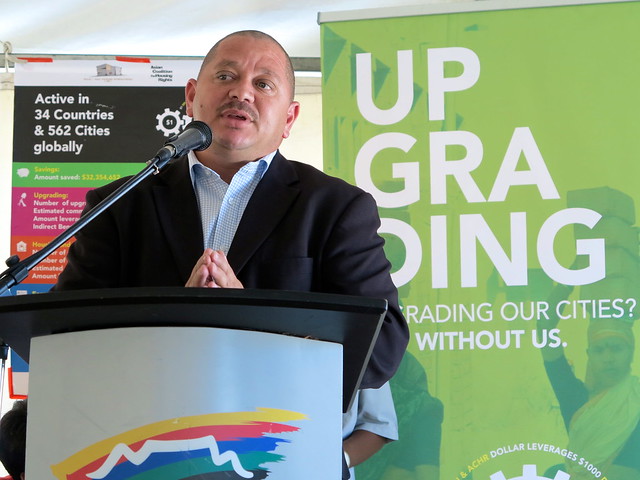
Midvaal Municipality Executive Mayor Timothy Nasy delivering a speech at the handover ceremony

The working relationship between ISN and Midvaal has continued to grow and it is giving signs of a positive future. Today the Executive Mayor of Midvaal handed certificates to the ISN members that participated in the enumeration process of their settlement. The one hour session held was attended by the Mayor (Timothy Nasy), MMC for Development and Planning (Bongani Baloyi), Councillor of Ward 28 (Mike Ndebele), H.O.D of Human Settlements, the Deputy H.O.D (Sylvia Nkrumah), CORC (Kwanele Sibanda), FedUp member (Rosy Mashimbye) and fifteen ISN members of Sicelo.

 From left to right: Councillor Mike Ndebelel, Alinah Kubu (community enumerator), and Timothy Nasy (Mayor)

The SDI alliance was given an opportunity of making a presentation and the following key points were outlined:

  • Background of the alliance dating back from the establishment of FedUp and how the partnership with the department of housing led to the successful construction of houses through the PHP process.
  • The creation of a broad platform of engagement for communities to find solutions to their challenges through the establishment of ISN.
  • Memorandum of Understanding to be formalised for a future partnership.
  • Background on the engagements with Midvaal officials that led to the conduction of the enumeration in partnership.
  • Production of the I.D cards and the need to use the enumeration outcome effectively for planning purposes especially with regards to the housing project for Sicelo that is in progress as well as the upgrading of the informal settlement for the community members to remain.
  • Exchange programme for the Midvaal officials to Cape Town to be held on the 6th and 7th of March 2013 and further engagements thereafter.

After the ceremony the Midvaal Municipality certificates and appreciation letters were issued. In this letter, Councillor Bongani Baloyi (MMC for Development and Planning) said  the following:

The Sicelo Enumeration Survey project can be classified as collaboration at its best, and it is hoped that future projects will be met with similar report and enthusiasm


FEDUP visits Lesotho Federation

By CORC, FEDUP, ISN, uTshani Fund No Comments

By Kwanele Sibanda (on behalf of CORC and SDI)

The Kingdom of Lesotho is a landlocked country in the South Eastern region of South Africa. The country’s population is still largely rural, and major multilateral organisations have supported the Government of Lesotho on strategies for poverty reduction. Despite the growing investments in public infrastructure, especially around agricultral reforms. Little has been done in strengthening civil society’s ability to generate livelihood opportunities for poverty alleviation. The South African Federation of the Urban and Rural Poor (FEDUP) has been mobilising and sharing experiences with an emerging federation of community leaders in Lesotho since 2011.

Alina (FEDUP) making a presentation in Butha-Butha

According to Shack / Slum Dwellers International:

Through exchanges with the South African federation, savings schemes were established in a number of urban and peri-urban areas including: Qopo, Ramagwebe, Buwasono, Mabote, Hatetsane and Qalaheng. These exchanges also resulted in the identification of four community leaders who have engaged the South African federation in the activities taking place in Lesotho.

In January 2013, a delegation from FEDUP visited the emerging Lesotho federation. This two-way exchange was beneficial to both groups: FEDUP brings a lot of experience in brokering deals with formal institutional, especially the government, while the Lesotho groups, with very limited support from the state, continues to inspire and rejuvenate the real spirit behind self-reliance through savings and livelihoods opportunities.  Some of the central discussions facilitated included the following:

  • Importance of determination, unity and honesty as demonstrated by the Butha-Butha members who started and are successfully running a livestock (pigs) project. In line with the above is the importance of identifying a need before an individual or groups starts saving.
  • The South African group developed links with nine groups in Lesotho. The relationship created between the two is now a platform of sharing experiences around dealing with day to day developmental challenges as well as means of engaging with various institutions. The relationships created are very important for the South African affiliates since Lesotho members have already started demonstrating enthusiasm of using various poverty alleviation methods with limited support from formal institutions.
  • At this stage, the above is crucial for the FEDUP as it is a way of curbing dependency on formal institutions like government and NGOs.
  • The lessons learnt of self-reliance can be applied back at home in the form of strengthening income generating projects to support savings for the targeted goals.
  • The Lesotho community water supply system uses a tag to monitor water wastage and maintenance. The South African delegation was very impressed with this system, which could inform a new community-based monitoring approach of water usage in informal settlements.
Emily (FEDUP) facilitating a conversation at Hatetsane 
In this January 2013 exchange, the FEDUP delegation visited nine groups in Lesotho. Some of the groups asked for support on recording savings in their savings booklets, and presenting these at community meetings. Some new groups were also visited and strengthened through a two-way exchange of ideas. Moreover, the Lesotho delegation who visited South Africa in 2012 also had the chance to give feedback to the communities. Some of the main points of discussion in the nine meetings are outlined below:
QOPO
  • The group started off with 107 members; however it is now left with 20 committed members.
  • The members have saved up R1 300, but they have not yet opened a bank account.
  • They named their saving scheme Kopanang Basuthu meeting ‘Let the Suthu tribe unite’.
  • The members are saving for a poultry project as well as a catering business.
  • The group was advised by the South African delegates to open a bank account for the security of their savings.

HATETSANE

  • The group has twenty-one active members.
  • The group has been saving, however it has just started disintergrating because of a member who collected money for savings books from members, but did not deliver them.
  • The S.A delegates played a role of re-emphasizing the importance of choosing trustworty members to deal with their transactions, making constant follow ups as well as ensuring that women lead the process.
  • Hatetsane is not the only group that was affected by the deeds of the dishonest man. In a report given in a meeting with the last group, it emerged that the man in question swingled members in different groups and it is estimated that about 450 members fell victim.
  • In order to try and ease the commotion or re-unite the members, the visiting team left 132 savings books for the members to start saving while the matter is being dealt with. The decision of leaving the books for the members was well considered and it was made in the light that the value of the books can not be compared to the image of the organization especially at its establishment. This however does not mean that it is always the alliance’s responsibility to correct the wrong doing of members.

 MOTIMPOSO

  • A group of 18 interested members were mobilized by the leaders prior to the South African delegation visit via SDI.
  • An alliance presentation was made and it was followed by an answer and question segment.
  • A thorough explanantion was made on how the saving system works.

HAARIA

  • The group has twenty active members.
  • Since this was a new group, a presentation was done and the savings recording system was explained to them.

MAJAHA

  • The group has 25 members
  • The group was assisted in making corrections in their books.
  • They named their group Sebetsang Kalerato meaning ‘show love in the work that you do’.
  • The group also mobilized the youth and they formed their own group called Future World. The youth have saved R100

BUTHA-BUTHA

  • Before the goup was mobilized by the federation leaders, they were already organized. The 10 members made contributions and started a Pig Project.
  • The only challenge is that the members are from different settlements.
  • The group was encouraged to continue with the project and again start saving schemes in their various settlements.

MATLAKENG – HLOHLORA BOFUMA SAVING SCHEME

  • The group was mobilized by the Lesotho leaders. The members have started saving however they mentioned that they infrequently meet and the moral of the members became low when they could not get savings books after paying for them.
  • The members were encouraged to stay focused on their vision, be vigilent, and expect some uncertainity along the way and to also work as a team in addressing their own challenges.
A meeting with the Majaha group

The exchange visit to Lesotho was a two way learning process for all the participants. The community members of Lesotho can be alikened to those of Zambia and Zimbabwe in the sense that in the midst of economic and unemployment challenges, they still remain with self-reliance approach to life. It is for the same reason that most groups already had income generating projects even before being mobilized. Lesotho therefore has the potential of having a strong federation. Savings in most groups is mainly meant for expanding existing projects. In terms of upgrading, a great population has houses however most of them require rennovation and being extended. The South African SDI delegates leant about a water supply system that can be of use to most South African informal settlement. The water system is a simple community tap that is in form of a hose pipe that has a mechanism that uses a tag for producing water. The tags can be topped up at most tuckshops. The system saves water since it can not be left running unless a tag is inserted and it also saves the copper that is normally stolen from tapes.

The South African delegation team had two main concerns and recommendations regarding the Lesotho federation. The first one is the need for groaming savings champions and that can be done starting with a national savings workshop. The Lesotho leaders proposed that it must be done during the first week of February 2013. The second concern from the team was the coordination of activities that requires at least one external person to act as an NGO for example for the distribution of savings books and compiling savings reports.   The Lesotho leaders are capable of identifying one such person.

Running diary of Delport/Marathon CUFF implementation: Second week

By CORC, FEDUP, ISN, News, uTshani Fund No Comments

By Tuliza Sindi (on behalf of CORC)

In November, ISN with support from CORC launched a renewed focus on small scale projects funded by the Community Upgrading Finance Facility (CUFF), an Alliance initiative currently housed in uTshani Fund. Marathon and Delport informal settlements were established in 1995 by mineworkers who got evicted from the surrounding mine hostels as a result of the mines closing down. Both these settlements have been grossly neglected in service delivery, and three taps services more than 1,000 people in each of the settlements. here follows an account by an intern architect, Tuliza Sindi, who worked with the community in installing new taps, and upgrading existing ones. Read the account of week one here. 

Tuesday, 04 December 2012 – Marathon Build Day 10; Delport Build Day 5

Marathon:

Sipho continues to support the community around conflict resolution emerging from last week’s project initiation. Majola and I drive around the settlement to count the amount of installed and working taps. Ten taps have been installed in the last week, double of what was proposed. However, these were installed without slabs, which complicates the consolidation of wash-up areas around the taps. This is not an unworkable situation.

Some of the newly installed and working taps. The sign in the middle image can be seen above one of the new taps. It reads: “Asifuni-muntu owashala nezingane khana amanzi uwashele khaya” meaning that no-one is allowed to let the water run freely, eroding the gravel around the tap. The community should collect water at the tap and take it home. 

Two of the taps have a low water pressure, caused due to a leaking pipe connection. The tap seemed to have this leak since Saturday and was not fixed over the weekend. 

Delport:

We find 3 washstands built and some pipes placed in the ground. Some dig the trenches while others proceed to build the fourth washstand. The construction team is working well together, and is showing high levels of efficiency.

Wednesday, 05 December 2012 – Marathon Build Day 11; Delport Build Day 6

Marathon:

Sipho, the leadership from Ramaphosa and ISN coordinator, is still mediating the leadership struggle in Marathon. The project is running in serious delays but new leaders are emerging that are willing to by-pass individualistic interests.

Delport:

As we arrive in Delport, Blanco explains how there is no truck available to bring the heavy loads to the far away taps. This has slowed down the building of slabs significantly. The company bakkie is used to carry sand, cement, water and aggregate to the far taps. They are now able to complete two of the slabs that day.

 Blanco loads some sand onto the company bakkie.

The bricks are loaded off the bakkie.

Friday, 06 December 2012 – Marathon Build Day 13; Delport Build Day 8

Marathon:

Even with all the leadership tussles, the community has gone ahead with installing and finishing their second slab and preparing for the third. The community’s unity around project implementation is impressive.

 The second washstand almost complete.

 Delport:

As the supplies arrive, the community construction team plans to finish the slabs in the late afternoon to then commence with some trench digging for the pipes. Due to the excessive distances they expect to finish laying all of the pipes on Sunday. Some pipe connectors need to be changed, due to better paths found and directions changed. Due to this, the project is expected to finish on Tuesday.

Collecting aggregate for the final washstand.

Running diary of Delport/Marathon CUFF project implementation: First week

By CORC, FEDUP, ISN, uTshani Fund No Comments

By Tuliza Sindi (on behalf of CORC)

In November, ISN with support from CORC launched a renewed focus on small scale projects funded by the Community Upgrading Finance Facility (CUFF), an Alliance initiative currently housed in uTshani Fund. Marathon and Delport informal settlements were established in 1995 by mineworkers who got evicted from the surrounding mine hostels as a result of the mines closing down. Both these settlements have been grossly neglected in service delivery, and three taps services more than 1,000 people in each of the settlements. here follows an account by an intern architect, Tuliza Sindi, who worked with the community in installing new taps, and upgrading existing ones.

Thursday, 22 November 2012 – Marathon Build Day 1

The project implementation of Delport and Marathon was delayed for several reasons. Since some of these hurdles have been overcome in the past few weeks, Majola (technical team from FedUP) and I (technical team from CORC) are able to better support the community. The materials have been delivered and Mfundisi, one of the leadership members and main contact person, has started collecting the bricks needed to build up the slabs around the tap, but only a few so far.

Marathon only has one tap that services the whole community. The community has identified the need to build a new tap, and it needs a new connection to the municipal line to not affect the current water pressure from Delport. A new valve has been ordered for a new connection to the main municipal supply, but they have found a new source for water, higher and closer than the original source. Connecting to this new source could solve some of the pressure issues.

The new water supply into the settlement will come from this municipal water source.

With Mfundisi as head of the builders and Jane as head of finance, the project starts at 10h00 in the morning with digging of trenches, half a lower leg deep, to place the water pipes. An allocation is made for food per person, but in general, eight to ten community volunteers are driving the installation of the new tap.

Mfundisi commences the digging.

The 8 volunteers working as a team to get the work done quickly.

Debris is moved away as the trench digging continues, exposing black, infected water and soil. As work continues, the community workers hit tightly compacted soil making it hard to continue the work. They decided to dig out shallow trenches and direct leaking water over and along it, in order to soften the soil. They plan to leave the water flowing over it overnight to make digging easy tomorrow.

I leave as some of the Delport community members arrive, excited to see the implementation process.

Friday, 23 November 2012 – Marathon Build Day 2

On our arrival at 08h00, we find several men working on rebuilding two houses that burned down right next to where the trenches were dug the day before. According to Mfundisi, the shacks burned down upon his arrival to the digging site at 07h00. A shebeen that was intact the day before is found no longer standing the next day.

The soil is softer due to the water that was channelled over it the day before, so the digging is much faster. More men have come to help, but many are left standing and staring due to the lack of digging tools. Majola and I leave early to try and organise more tools, to speed up the process. They stop digging as soon as we leave to have a meeting about conducting the Saturday work as the whole community to get the job done quickly and effectively.

The community members take turns to dig due to the lack of available building tools.

Saturday, 24 November 2012 – Marathon Build Day 3

The heavy rain has brought a halt to all work today. We’ve instead decided to have an administrative meeting in the office around a fire to discuss the building time limits. The initial idea was to have a technical team to pay to finish the job. The lack of continuity in the construction team slowed down the work pace. However, lack of clear guidance left some of the community members quarreling with others. The leadership members decide against working today and have opted to continue early tomorrow morning when it’ll be drier and less cold.

A meeting is held in the cold office with cooldrinks around a fire.

 Sunday, 25 November 2012 – Marathon Build Day 4

The energy starts at an encouraging pace! Most of the community members have woken up at 05h00 to start digging the pipe trenches. They finish digging and placing all of the pipes by 10h00. At this pace, we aim to finish building no later than Monday.

The pipes cut and laid in the dug trenches.

A T-joint pipe connection being made.

The community leaders showed me around the settlement what pipe fittings are still missing. As the project progressed, the community decided to add 12 more taps in addition to the 5 originally proposed from the Community Upgrading Finance Facility (CUFF). The community’s savings was strong contributed an extra R2 000 to cover the cost. I drew up a quote for the addition of the 12 extra taps, which amounted to R2 500. They are hopeful about the additions.

Work stops due to the lack of pipe fittings now needed to cover 17 taps. Building is said to continue tomorrow upon the arrival of the much needed fittings.

Monday, 26 November 2012 – Marathon Build Day 5

Majola and I arrive to take Jane to the bank. A claim has been made to get the piping supplies so we are left to wait for those while Majola and I instruct them on building washstands.

The community members have not started collecting bricks, although they were told weeks before to do so. As we walk around the settlement, we see several heaps of useable bricks and instruct them to make a collection of 500 bricks to be placed at each site where building is to happen.

Tuesday, 27 November 2012 – Marathon Build Day 6; Delport Build Day 1

Marathon:

A disagreement between community leaders on the usage of the bricks resulted a interim cease works, until consensus could be reached.

Delport:

The morning is spent at the suppliers ensuring that all of the pipe fittings are properly quoted and ordered. We also ensure delivery of Delport’s materials.

We arrive to Delport as one of the delivery bakkies arrive. Contrary to Marathon’s building process, Blanco (Delport’s leader) opt of start with building the washstands before installing the pipes, as it requires more effort than digging, so it gets the hard job out of the way to speed up the building process.

The delivery bakkie from Incledon arrives to deliver pipes and pipe fittings.

Wednesday, 28 November 2012 – Marathon Build Day 7; Delport Build Day 2

Marathon:

The community met with ISN leader from Ramaphosa informal settlement Sipho Vanga in sorting out small disagreements in the leaderships structure. The project was being delayed by the ceaseworks, and Sipho mediated the differences in opinions of the leaderships factions.

Delport:

The Delport community has started with the process of building the washstands. They have mixed and laid the concrete strip foundations and have assembled the bricks that they will be using for all of their stands.

The first laid strip foundation for the washstand in Delport.

The bricks placed close to the laid foundation to start using as soon as it dries.

Majola and I leave them as they start digging trenches for the next washstand while they let the foundation of the first washstand dry. The piping connections are scheduled for the Saturday, when the whole community will be available to join in.

Partnering with the City of Cape Town in Mtshini Wam: Day 2 of the 5 Cities Seminar

By CORC, FEDUP, ISN, uTshani Fund No Comments

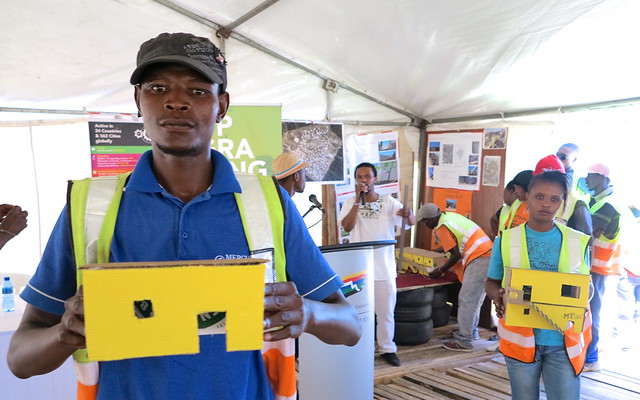
IMG_0845

Community members showcase model homes in Mtshini Wam. 

By Ariana K. MacPherson, SDI Secretariat (cross posted from www.sdinet.org)

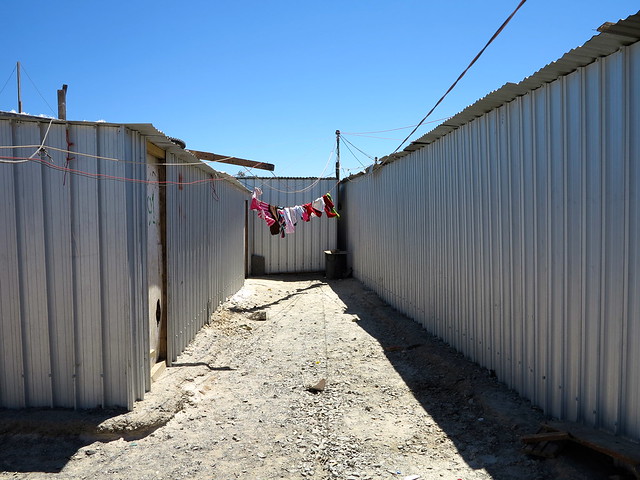
The second day of the 5 Cities Seminar kicked off in Mtshini Wam, a settlement of roughly 200 households located in the greater Joe Slovo Park area of Milnerton, Cape Town. The day focused a lot of attention on the change that is possible through re-blocking, or blocking out, a community-led upgrading methodology that reconfigures a community’s layout to transform tiny passageways, dangerous and impassable, into wide walkways with courtyards where children can play and women can hang washing to dry. Shacks upgraded with fire-retardant material face each other, providing added safety for families who can now find shelter from the Cape’s sometimes harsh conditions.

IMG_0856

A wide walkway and upgraded shacks in re-blocked Mtshini Wam. 

Mtshini Wam was founded in 2006 when settlers occupied open spaces of a government-funded housing settlement in Joe Slovo Park. Though the Western Cape Anti-Land Invasion Unit responded with threats of demolitions, The South African National Civic Organization (SANCO) and Informal Settlement Unit (City of Cape Town) were able to prevent evictions.

Mtshini Wam settlement expanded and continued to grow. Households in Mtshini Wam depended on water and services from the formal RDP houses, paying up to R50 (USD $6) a month for water. When Mtshini Wam asked the City to provide them with service delivery, they were told this could not be done because the settlement’s density was too high and there were no access roads. Greg Exford, Informal Settlements Manager for the City of Cape Town, said during his welcoming remarks on Wednesday that, “This area was, per capita, so dense that under normal conditions the City would never have been able to make it work.”

In 2009, responding to a lack of services and the challenges they had faced in trying to work with City, community leadership from Mtshini Wam approached the Informal Settlement Network (ISN) for support. “Prior to re-blocking, the settlement was very dense,” said community leader Nokwezi Klaas, “There were no passageways and when there were fires it was virtually impossible to get into the settlement. All the toilets were on the outskirts and there were only three water taps for over 200 households in the settlement.”

Mshini Wam Site Visit

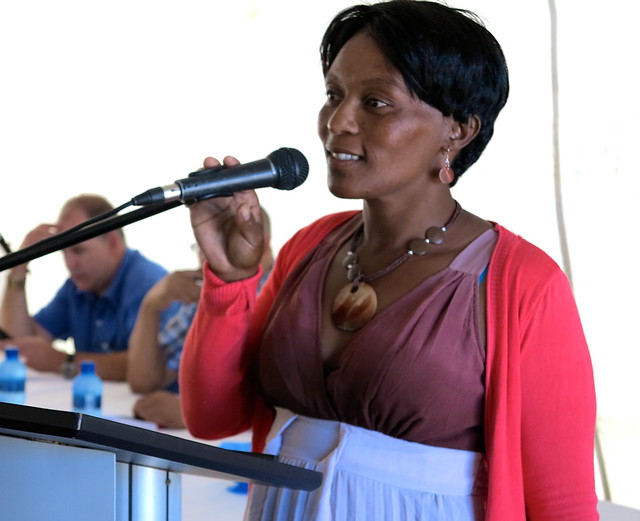
Local community leader Nokwezi Klaas describes her work in Mtshini Wam.

2009 was the starting point of a partnership between the Mtshini Wam community, CORC and ISN and the City of Cape Town. To date, this partnership has allowed the community to carry out a settlement-wide enumeration and re-blocking process, install chemical toilets and water taps, and upgrade their shacks using durable, fire-resistant material. Both the City and the community agree that this would never have been possible without a strong, dialogic partnership.

Mshini Wam Site Visit

Mshini Wam Site Visit

Representatives from ISN, including Western Cape coordinator Mzwanele Zulu (pictured on far left) and the City of Cape Town, including Greg Exford, Informal Settlements Manager for the City of Cape Town, were present at the gathering in Mtshini Wam on Wednesday. 

“This project will go down in the history books of human settlements,” said Mr. Exford, “It shows what can be done when the community works together with partners in government… In order to make government work for informal settlements, we have to fuse the conventional with the unconventional, otherwise it’s not going to work.”

Mshini Wam Site Visit

Councillor Ernest Sonnenberg, the Mayoral Committee Member for Utilities Services, echoed this point, stating that, “Unless you physically take the community with you and ask them how we are going to achieve change together, you are going to get nowhere. In this way, you can find the synergy between what is demanded and what is feasible.”

Luthando Klaas, another community leader and supervisor for the Mtshini Wam technical team, described some of the more technical aspects of the upgrading process in Mtshini Wam. There are seven teams, made up solely of community members, responsible for different aspects of upgrading. These include a technical team, gardening team, carpentry team, cleaning team, compacting team, demolition team and a building team.

Mshini Wam Site Visit

Mr. Klaas describes the various aspects that influenced the design process for the layout planning of the settlement. “When they started the design process,” he says, “one of the important things was to see how to improve services and improve safety and security so that police and emergency vehicles can come into the community and the community can feel safe in their space.”

In addition to this, he describes the sometimes-challenging process of negotiating with the community about the size of structures. During the enumeration, it became apparent that the size of structures varied considerably from one household to the next. In order to make adequate space for each household, community members agreed that no structure would exceed 20 sq. meters in size, allowing those households occupying the smallest shacks (some under 5 sq. meters in size) to live in more comfortable, livable spaces. This willingness to sacrifice individual gain for the benefit of the whole community is something that is quite understandably nearly impossible without a community-led process.

Mr. Klaas spoke confidently about the community’s plans for the future, stating “we don’t want to be in shacks forever.” Members of the technical team showcased housing models that illustrate the community’s hopes for permanent, brick houses and their determination to continue upgrading their settlement. Klaas emphasized that, “it does not end with iKhayalami [upgraded] shacks. The community was able to move from wooden shacks to safer structures, and now they want to continue to move up to more livable structures for themselves – brick houses.”

Following these presentations by the community, the group of roughly 100 participants had a chance to walk around the settlement and witness the change made through the processes of re-blocking and upgrading. Wide walkways give way to courtyards where clothes hang to dry and kids play under their mothers’ feet. Each cluster contains between 10-15 shacks and is built around a courtyard, sharing a communal vegetable garden that grows everything from spinach to dill to tomatoes. Shacks without adequate exposure to sunlight are lit with low-cost solar lights made from a plastic soda bottle filled with water and bleach. A community member welcomes a few others and me into his home so that we can see just how much light one of these bottle-lights can provide.

Mshini Wam Site Visit

A community member from Mtshini Wam describes his solar-powered light to another community member from Zimbabwe. 

Mshini Wam Site Visit

Community leader Nokwezi Klaas shows a community garden to a community member from Ghana. 

All in all, the most striking thing about Mtshini Wam is the spirit of the community. They have transformed their impassable settlement into a neighborhood. There is a sense of pride and enthusiasm that is contagious, a reality which is evident in the inspired words of the city officials present at the gathering.

After a morning in Mtshini Wam, the afternoon was spent in the chambers of the City of Cape Town government building. Participants were given the opportunity to discuss and reflect on their experiences in Langrug and Mtshini Wam. The afternoon session began with introductions by Vuyani Mnyango, a local ISN leader, and Mkhabela Estavao, a FEDUP leader from KwaZulu-Natal province. Mr. Mnyango began by describing the formation of the ISN in Cape Town and the steps that were taken to build a partnership with the City.

Mshini Wam Site Visit

“In 2011,” Mnyango says, “it was decided that the partnership needed to take action on the ground.” Today, CORC, ISN and the City of Cape Town are engaged in re-blocking processes in the settlements of Mtshini Wam, BBT Section of Khayelitsha, Vygieskraal and Masilunge.

Mkhabela Estavao describes South Africa’s Federation of the Urban Poor (FEDUP), a national network of women’s centered savings groups that, in partnership with CORC and ISN, mobilizes poor people to improve their lives. FEDUP was started in 1991 and is one of the oldest federations in the SDI network, having given birth to a number of other affiliates across the African continent. Membership currently sits at roughly 20,000, but Ms. Estavao emphasizes that this number does not even begin to capture the number of families that have been impacted by the work of FEDUP. For example, she states that over 80,000 families have received housing through the Federation’s processes. When FEDUP realized that they could have even greater impact by involving men more actively, ISN was formed.

Leon Poleman, Project Manager with the City of Cape Town, was next to speak. He spoke of his experience working with CORC and ISN on upgrading and re-blocking, of his inexperience planning for informal settlements and his initial skepticism at the somewhat unconventional methods already being implemented by ISN in Mtshini Wam when he arrived on the scene.

Mshini Wam Site Visit

“I come from a formal engineering background,” he said, “When you go to university and technikon, no one speaks of the design of informal settlements, or at least not in my time. So it was quite simple: In my day there were no informal settlements, and this re-blocking thing, we don’t know anything about it, so off you go! And back into our meetings we went to keep discussing how we go about this.”

But what Mr. Poleman quickly realized was that these unconventional methods were the perfect compliment to his formal engineering background, and that through working hand in hand with the community, they were able to find solutions that would have been impossible had the community not been involved. He concluded with a reminder to the other professionals in the room: “We have to understand that this is informal by its nature,” and that therefore, the solutions we find must speak to this informality.

Shortly after this, the discussion was opened up to comments and questions from the floor. Councillor James Slabbert, Portfolio Head for Human Settlements for the City of Cape Town, expressed a keen interest in learning more about the work being done in Langrug, and welcomed CORC and ISN’s input in utilizing their experience with re-blocking to provide input to the drafting of policy around informal settlement upgrading for the City. Mzwanele Zulu, ISN Coordinator for the Western Cape, was pleased to hear the City’s willingness to make re-blocking part of informal settlement upgrading policy, and urged the City to stick to its word on this point. Following the meeting, arrangements were made by CORC staff and ISN leaders to meet with Mr. Slabbert at a later date to continue these discussions.

Another issue that came to the fore during this session was the question of secure tenure for residents of settlements like Langrug and Mtshini Wam, questioning whether upgrading and re-blocking do enough towards this aim. Patrick Magebhula, national coordinator for ISN, confirmed that  “the reasons for upgrading is to allow people to live where they are now, so re-blocking is just another way to give people land tenure where they live.”

Mshini Wam Site Visit

Greg Exford echoed this point, stating, “If we do upgrading [in our informal settlements], people are given security of tenure. If we do enumerations, as soon as we have that person on [the City’s] database, they have security of tenure.”

The meeting closed on a positive note, with a colleague from Zambia commending CORC, ISN and the City of Cape Town. “What you have achieved in Mtshini Wam is a huge achievement. This is a wonderful first step. Now how do we get other communities on board so that we can spread upgrading to more communities?”

This is the key question for the 5 Cities Programme. Earlier in the day, Mzwanele Zulu had expressed his eagerness to scale up the activities in Mtshini Wam to settlements across Cape Town. In Cape Town, thanks to a growing partnership with the City, this becoming more of a reality. Despite challenges and setbacks, experiences like that of Mtshini Wam is evidence of the promise these partnerships can bring when the community takes the lead.

Running diary of BM Section Fire response: Community empowerment in crisis

By CORC, FEDUP, ISN, News, uTshani Fund No Comments

By Andy Bolnick (on behalf of iKhayalami and CORC)

Before

On the 1st January 2013, Tuesday in the early hours of the morning a man in the furthest eastern part of BM Section informal settlement in Khayelitsha fell asleep while he was cooking food on a hotplate stove. A fire started at 4am. With gale-force winds blowing the fire quickly swept out of control. With the strong southeaster and being hampered by lack of access the middle of the settlement the fire department failed to contain the blaze, finally ‘putting out’ the fire at 10.30am when it had virtually run its course – blazing a trail of destruction right through the settlement leaving approximately 5000 people homeless, 1 000 shacks guttered, 3 confirmed deaths and one person in a critical condition. On January the 2nd of January a fourth body was found in the debris and on the 4th of January the man who had 80% burns passed away in hospital.

After

 On the 2nd of January, Wednesday Phumezo Sibanda, an ISN leader from Khayelitsha, called Andy Bolnick from Ikhayalami to talk to her about the disaster and start thinking through what kind of support could offered. It was agreed that Phumezo would go to site to assess things and meet with the BM leaders.


no images were found

 Shortly after Phumezo’s call one of Ikhayalami’s main funder for disaster relief/re-blocking efforts (for the past 6 years), Mr. Gerald Fox from the Percy Fox Foundation, called. He had heard about the devastating fire and offered immediate resources so that Ikhayalmi could respond with a sizeable number of shelters in order to potentially attract more resources to a response effort and to do a re- blocking.

In the meantime Phumezo who rallied support from two other ISN leaders in the Khayeltisha area – Thozama and Nombini Mafikhana – attended the tail end of a Disaster Management meeting at the OR Tambo hall, which has since become the nerve center of relief efforts.  Following the meeting they engaged with some of the BM leadership.

Phumezo then asked Bolnick to come to site to meet with some of the leadership who informed us that they ‘want the city to level the area and open up roads’. They said that this is what they discussed in the meeting with the city that morning.

Bolnick enquired about whether the leadership had a list of all the residents of BM. The leadership said that there is a list that the city has. Bolnick suggested that they get hold of this list, verify it and if need be start compiling their own list. Phumezo and Bolnick also spoke about the potential of spatial reconfiguration in addition to merely demarcating roads. Mention was made to the potential of the availability of between 150 – 200 shelters from Ikhayalami (20 immediately and the remainder after the 15th) to assist with a spatial reconfiguration/re-blocking if the community decided to go this route. There was also some discussion about the potential of arranging an exchange visit to Sheffield rd and Mthisni Wam for BM leaders.

While on site the leaders were informed that a fourth body had been found in the debris. We left the leaders to attend to the pressing issues at hand.

The site is so vast – standing in the middle of the site – on the one side people were still collecting rubble and clearing the site, on the other side the site was almost cleared.  

3rd of January, Thursday community leaders and NGO support staff attended a joint meeting of stakeholders. Those present were members of a crisis committee that was formed the day before comprising of a few leaders from BM section, delegates from the city (Disaster Management dept), Social Dev Services, SASSA, Home Affairs, Law Enforcement, KDF, SANCO, VPUU, Amaxesibe Traditional Council, an ANC delegation, a church group and other people from the community and our delegation. Important points were raised but no one was listening to each other. As soon as an important point was made another person would talk about something inconsequential or petty and the vital point would be lost. There was also information that a separate disaster response committee comprising of provincial government members was meeting separately in Belville. This created further frustration. Party political issues were being raised that included laying blame and arguing. The BM leadership were getting angry and wanted action.

Issues that were raised pertained to insufficient food, the need for more mattresses, frustration that the city had not started leveling. The city called for all the debris to be removed by the community, talk also revolved around how to take care of people’s debris who were still in the Eastern Cape on holiday – where could it be stored and how the city would take care of the debris so that when construction began people could get their burnt material back to use for reconstruction. It was agreed that all the debris would be removed from site by 2pm the following day. There was also an urgent plea to get the ‘list’ verified. This task was given to the Principle Field Officer (PFO) and VPUU.

Bolnick suggested that it would be imperative that the BM leadership be involved in this process. On behalf of the SDI alliance delegation attending the meeting she offered support to the city and VPUU to work with the leadership on getting the list of victims sorted. This being a key SDI tool it was felt that it could act as an entry point for ISN to start mobilizing the community and give them the power with regards to information (the list) and start building a working relationship with VPUU.

Bolnick also mentioned that should the BM leadership and the people of BM (as well as the city) agree to do a blocking out Ikhayalami had raised funds for the provision of 200 shelters and would support this process together with our alliance partners.

With regard to the ISN supporting the City, VPUU and the leadership in compiling a verified list the first time Bolnick mentioned this, the point was lost. The second time she managed to get the offer accepted by City’s the Principle Field Officer.

After the meeting the ISN members as well as NGO support staff met with four of the BM leadership to discuss a way forward. It was agreed that at 4pm that afternoon an exchange would go from BM section to Sheffield Rd and Mshini Wam. Vuyani and Nkokeli felt that ISN should not be involved with supporting the leaders, VPUU and the city in sorting out the list of victims. Their rationale was that the leadership knows their own communities. Corc staff felt that they could not support the BM leadership if ISN had decided not to assist with the compilation of a verified list. At 2pm we all left the OR Tambo Hall.

Vuyani and Nkokeli went to Du Noon to offer support and assess the situation following a fire that occurred there on the 31st of December where 125 shacks had burnt down. A meeting was arranged for the following morning at the Corc offices for ISN and staff to regroup especially if we needed to make a decision concerning supporting Du Noon and or BM section.

At 4pm Melvyn from Ikhayalami and arrived at the OR Tambo Hall to fetch members of the BM community who had been elected to visit Sheffield Rd and Mshini Wam. The exchange was positive. The leaders from BM who attended the exchange were able to get a better grasp of what was meant by blocking-out.

4th of January, Friday – the regroup meeting scheduled for 8.30am was called off. Nkokeli reported that people in Du Noon had already rebuilt their shacks and that ‘we should focus our attention on BM’. It was agreed to meet at OR Tambo Hall to attend the crisis committee meeting. The Mayor of Cape Town, Patricia De Lille, Councilor Sonnenberg, E.D Mr. Seth Maqetuka and Head of Informal Settlements Department Mr. Zwandile Sokupa as well as other officials from the various departments’ attended this meeting.

The Mayor would hear non-of-this and became angry that people were meddling in politics while there was a crisis at hand. She also confirmed all the support that the city had provided up to that stage. Fortuitously Naledi Pandor the Minister of Home Affairs walked into the meeting. She too said that it was not a time for politics and that the focus should be on aiding the people and moving forward. Minister Pandor made a number of practical recommendations with regard to processing ID’s and the immediate provision of portable toilets.

A site-specific report was given. Mr. Maqetuka reported that ‘the City is working on a short-term plan and is also developing a short to medium term plan’.  The Mayor asked that the meeting focus on the immediate disaster response. The city engineer reported that ‘there was an agreement for Solid Waste to clear the material and that they were on site and machinery will come on site this afternoon to do leveling’.

Councilor Sonnenberg stressed the importance of a verified beneficiary list. Mr. Sokupa and Mr. Maqetuka acknowledged Ikhayalmi’s offer to support the process with the provision of 200 shelters should there be a need for a re-blocking.

The Mayor agreed to be part of the crisis committee and said that all her engagements will be done through the Ward Councilor in line with protocol.

After the meeting Mr. Maqetuka and Mr. Soup met with the SA SDI Alliance delegates briefly. Bolnick requested access to the site layout for fire-breaks/roads. They informed us that the City was not yet sure in which direction the relief effort would go as they were in consultation with the Province and there was a likelihood that they would embark on a UISP project, so as of yet there were no concrete plans. They asked us to be a patient and said they would draw us in when needed. Thereafter most of the officials and political leaders went on a site visit. The alliance delegates stayed in the vicinity of the hall and managed to meet a city engineer who said that there was layout for the roads but that he did not have it with him.

On 5th of January, Saturday Phumezo, Thozama, Nombini and Bolnick went to the OR Tambo Hall to meet with the engineer and attend the crisis committee meeting. Disaster Management chaired the crisis committee meeting. The Mayor and officials who had been in the meeting the previous day were not present. Disaster management reported on progress with regards to the delivery of more mattresses, medi-packs and nappies. The responsibility of distribution had been given to the BM leadership. The confirmed number of people registered and staying in the OR Tambo hall was 1660 made up of almost an equal number of males, females and children and 55 babies. The confirmed list of fatalities were given – 3 deaths reported on the 1st, one found on the 2nd of January in the rubble and the fifth person who passed away in hospital from 80% burns on the 4th of January.

It was also confirmed that disaster management and social services would remain on site until further notice. Discussion arose around WB Section where there had also been a fire on either the 31st Dec affecting 54 households. People complained that WB Section was not getting the same kind of support that BM was getting. It was reported that people in WB had already received the city’s starter packs and that most people had rebuilt their homes. The crisis committee agreed to find ways of supporting victims in WB section.

With regard to work on the site it was reported that two front loaders and one digger loader where on site clearing and leveling the land and that a land surveyor was on site assessing where the firebreaks should go. Another plea, this time from SASSA was made for the urgent need for a verified beneficiary list. The meeting was then adjourned.

Phumezo, Nombini and Bolnick decided to go to site with two BM leaders. En route they checked the measurement of an existing road to get a sense of scale in anticipation of finding out the width that the city was planning to use.

The main reason why they decided to go to site (apart from viewing the leveling) was to find a land surveyor, engineer or even a truck driver, in fact anyone who could give them some information about the proposed fire breaks as these would be key starting points in thinking through a new layout and at the very least to consider if the proposed roads make sense to the community.

While on site they found a city official who was able to disclose the type of information they had been seeking. Firstly he told them that the width of the roads would be 5m. Secondly the City is planning on putting in two roads through the settlement and one ring road around the area that was burnt (there was previously a road at the bottom of the settlement) and thirdly the city was going to arrange for a plane to fly overhead and take high-resolution aerial photographs. From these photographs the proposed roads would be confirmed.  As things progress it is clear that these images will be vital for planning purposes and are images that the alliance should try to access as soon as possible.

After this engagement the group walked to the middle of the site to assess things and think things through from a spatial perspective.

Looking at the site it did not make sense to put a ring road around the burnt area (the sides and bottom were virtually from one section of the settlement to the other so this could make sense but the top section still has shacks that did not burn and is about 17m to the main road). The width of the burnt out area looked around 35m wide with a length of approximately 100m. The top part of the ring road was the road that did not make sense as in essence if they are to go ahead with this it would mean that 500sqm would be taken up (over and above the other justifiable roads) for purpose of a road as apposed to land for those affected. It would make more sense to extend the two roads in the middle of the settlement to meet Landsdowne Rd. From the edge of where shacks still remained to Landsdown rd it is approximately 17m. This would mean that 17m x 5m x 2 roads = 170sqm would be used for roads as apposed to 500sqm. It is reasons like these that it is important that community leaders get drawn into the design processes so that they can make recommendations that make sense and work better for the broader community.

On the 6th of January, Sunday at 9.30am Mr. Sokupa phoned Bolnick to confirm the number of shelters that Ikhayalami could provide, how soon and how many per day. Bolnick confirmed that should a plan be reached and all parties including the BM leadership and ISN agree then Ikhayalami could make 20 shelters available immediately and from the 17th of January when factories re-opened could supply 20 per day.

Thozama, Nombini and Phumezo went to the OR Tambo Hall to attend the crisis committee meeting where the Mayor was scheduled to attend. The Mayor and the Premier arrived at the confirmed time, that being 2pm. They insisted that the crisis committee and other people in the boardroom vacate so that they could hold a meeting with the Ward Councilor. People who were in the boardroom (where meetings had been held every day since the disaster) were outraged. After some commotion two separate meetings took place –one with the Premier, Mayor and Ward Councilor and one with the crisis committee. The Ward Councilor came to the crisis committee meeting and said that he would represent the crisis committee in the meeting with the Mayor and Premier. At times he came out of the meeting to consult with members of the crisis committee.

The Premier and Mayor stated that only 250 families will return to the site, the rest will be relocated to the area next to the OR Tambo hall and others next to Busasa on SANDF land. The BM leadership informed the Ward Councilor that the Premier should not put a set number to how many households will return to the site ‘as the community intends to work on their own layout that would accommodate many more than the 250 households.

On Monday the 7th of January it was time for the SA SDI alliance to regroup. A meeting was convened to reflect and strategise going forward. Vuyani, Nkokeli, Bunita, Olwetu, Zipho and Andy formed part of this meeting. A report on the past 5 days was given comprising the above.

In the reflection meeting it was agreed that the situation in BM is a complex and that the community is ‘about to go to a big war without any tools’ (Vuayni). As such it is imperative that the ISN work with the BM leaders with whom there is now a connection and go deeper so as to reach the street committee leadership and the community at large. The idea is that three Khayelitsha ISN leaders who have been involved in meetings on site since the 2nd of January will work with Vuyani and Nkokeli to develop a strategy on how to deepen ISN’s presence within the broader community. It is also vital that FEDUP get drawn in into this process so that woman can start supporting one another in this difficult time.

It also became clear that Vuyani and Nkokeli’s reluctance to get involved had to do with fact that they are not from the Khayelitsha are, that they view the situation in BM as highly political and that previously in 2010 as leaders of the ISN they did not succeed (through no fault of theirs) in doing what the BM leadership had asked of them and were worried this would come back to haunt them. It was agreed that in spite of all the difficulties and complexities it is vital that the ISN support the BM community in their time of need.

On Tuesday the 8th of January Phumezo, Nkokeli, Thozama, Vuyani and Nombini met at the OR Tambo hall. They agreed that they should call a meeting with the BM leadership that includes the street committees. Unfortunately this meeting did not materialize and ISN are planning to do it as soon as possible. That evening a leader from BM called Phumezo and Bolnick saying that the crisis committee (of which Ikhayalami had previously been invited to participate by the broader committee) would be meeting with the Mayor on the 9th of January.

Wednesday morning the 9th of January at 9am Ikhayalami’s support at the meeting at the Civic Centre was confirmed by the BM leadership.

In the coming days things will unfold and we will constantly assess what type of support we can offer. Politics is firing and misfiring everywhere from petty politics to political mud slinging to high level politics. The petty politics and mud slinging politics are bedfellows. Every community forum/organisation in Khayelitsha has been jostling to be ‘powerful’. Disaster Management and other government relief effort departments are trying to complete their tasks and get the hell out of there. The high level politics are invisible to most, taking place behind closed doors and off site.

In an attempt to offer support and respond to the disaster Ikhayalami’s involvement has been to 1)to support the BM leaders/community to see through and make sense of the murky waters so as to be in a better position to plot an equitable as possible way forward, to assist them in starting to  think one step ahead and to open doors for the ISN and FEDUP.

The alliances role going forward should include the following agenda – to support the BM leadership to negotiate with the state, to act as a bridge between community and the state, to support our city partners in this huge task in a way gives voice to the BM community, to gain access to the plans and aerial images and draw the community into the planning and t set up women savings groups.




Grey water project starts in Kwa-Mathambo, Durban

By CORC, FEDUP, ISN, uTshani Fund No Comments

By Phumelele Kumalo, Patience Phewa and Jeff Thomas (on behalf of CORC Durban office)

Some of the largest and most dense informal settlements settlements are found in the eThekwini Municipality. These informal settlements are concentrated on the peripheries of Durban. Living conditions are characterised by overcrowding and the lack of basic services such as piped water, sanitation and health care. Kwa-Mathambo is an informal settlement that faces these problems. It is located around 10 kilometres north from Durban’s city centre on North Coast Road in an area called Avoca.

[vimeo width=”620″ height=”485″]https://vimeo.com/54512453[/vimeo]

Kwa-Mathambo was established in 1991. According to community reports, the first settler was an informal domestic worker who built a shack in the premises of the landowner. More people settled on the land in subsequent years, and today 565 people are living in Kwa-Mathambo in 294 shacks. Three different private owners own the land occupied, which deepens the questions of tenure and service delivery. Despite the difficulty of negotiating for adequate services and tenure, the informal settlers have a good standing relationship with the land owners, who are keen to sell the land to the eThekwini Metro. The settlement is built against a steep hill on a relative small piece of land and the shacks are built against and sometimes even on top of each other.

The first engagement with the ISN was in 2011, when a mobilising team visited the settlement. The community was well organised with strong leadership, and the community requested support to conduct an enumeration to plan for the future improvement of the settlement. The enumeration process is not only crucial to obtain all the necessary information on household level, but also to mobilise the members of the community for the following steps in the upgrading process. Through the enumeration process, the community prioritized sanitation facilities, solutions to flooding and grey water contamination, and the improvement of the shacks.

Ntodeni Dengo, a community leader in Kwa-Mathabo, said that the mobilisation process was crucial in getting the community on board.

So we start here in Kwa-Mathambo and designed the place how it should look like. We designed a model about how the new place could look like. We started with the mobilisation of the community, and we also do the enumeration to count the people. We know now that we have 565 people in our community.

The community prepared a proposal to the Community Upgrading Finance Facility (CUFF) for a small-scale grey water drainage and water taps extension project. Several meetings took place between CORC technical support staff, the broader community, and the community leadership. As a result, a local technical team was established as a monitoring structure, which is called a Community Construction Management Team (CCMT). The CCMT is a team of three: two project “bookkeepers”, who will oversee paperwork, delivery of materials and checking of quantities and safe keeping and record keeping for the project, and one project manager responsible for smooth running and implementation of the project.

An fundamental process in the CCMT is the effective role woman play in the organising and collectivisation of the community. Nomsa Khumalo, a community leader who has lived in Kwa-Mathambo for more than 17 years, said

Over the past 17 years, there has not been a single thing done to improve our lives. Right now we are working with ISN and CORC so we can improve this place to be better for all. We are also saving a few cents every day so that we can also contribute to the improvements that will come.

Another lady, Thenjiwe Nzama — a shop owner in Kwa-Mathambo — called attention to how the community is organising around common community health issues. Her shop is above a blocked and contaminated greywater channel, which attracts flies and other pests.

I have a shop here in Kwa-Mathambo but we have a big problem. The flies come from the dirty water inside my shop. I sell fruits and bread and the flies come from outside into my shop. We end up being sick and cough. Even my neighbor caught TB (Tuberculosis) and was very sick. The smell of the dirty water is terrible. We have this terrible problem.

In the general community meeting a team of skilled volunteers within the community emerged such as plumbers, builders and ordinary community members who were willing to make a change in their settlement. The community then began by clearing the area and made rough design of the plan to be executed. The area surrounding the Greywater drainage was fenced as the work of reshaping the drain began. The second step will be to tube the water pipe underground to an area where the community plan to construct a basin and put up a washing area, which will comprise of 2 sinks and a standpipe for water drawing purposes, which started on Monday 26 November.

The greywater and drainage project in Kwa-Mathambo has generated a lot of community cohesion. The project was initially seen as a start to a re-blocking project but due to some difficulties faced including land ownership, the community ended up realizing the need for grey water channel and extension of water access points project. This is a small project but it has led a good collection/mobilization of the community.

This project made it clear that a small project for newly ISN mobilized settlement can be a good enhancement of community participation. Rather than jumping into a big project like re-blocking which needs a lot of community engagement/participation, small projects help build the critical community capacity for government engagement around better service delivery.

Home Comforts – Sheffield Road nominated for the FT Urban Ingenuity awards

By CORC, FEDUP, ISN, uTshani Fund No Comments

Home Comforts, by Andrew England, July 26, 2012 (cross posted from the orginal FT blog)

Standing in front of a clutch of shiny tin shacks, Priscilla Siziwe reels off a litany of challenges that go hand in hand with life in one of South Africa’s impoverished informal settlements.

There is having to line up to use one of the few toilets serving hundreds of residents; the fire hazards of having shacks cobbled together from bits of wood and other materials; and the chore of walking to collect water from a communal tap. And then there are the elements. “We are living inside the shack, but it was like living outside,” she says. “Because of the materials, the wind would come inside and the rain would come inside.”

Siziwe is among the hundreds of people living in Sheffield Road, an informal settlement of ramshackle, makeshift homes built on land reserved for a road extension. The settlement is illegal and bereft of services, with a community crammed into a small section of Cape Town’s sprawling Philippi township.

In Sheffield Road, however, conditions have begun to change after the intervention of an alliance of non-governmental organisations led by iKhayalami. Under the NGO’s initiative, clusters of shacks have been demolished and rebuilt with walls of zinc aluminium. And, critically, while the “new” homes continue to cover the same land area, they have been reorganised to make the best use of the space.

This has meant that where there was once a haphazard warren of shacks, there are now relatively neatly aligned rows of huts, allowing courtyards and clearly defined alleyways to emerge. The structured formation increases security and the zinc aluminium walls – thicker and more flame resistance than the materials traditionally used – reduce the ever-present risk of fire. It has also created more space for the municipal authorities to install additional toilets.

The concept, dubbed “blocking out”, was conceived by Andy Bolnick, iKhayalami’s founder. She was seeking a solution to help ease South Africa’s massive housing challenges, which are a result of decades of segregation under apartheid and people flooding from rural areas to urban centres in the years since.

The government has built about 2.7m subsidised housing units for poor black families since the first full-franchise election in 1994, but it has failed to keep pace with demand as more people have moved to cities in search of work.

It is estimated there were 300 informal settlements in the country 18 years ago, but by the end of 2010, the number had mushroomed to 2,700, home to some 1.2m families, while another 1m are stuck in “backyard shacks”, says Steve Topham, director of the National Upgrading Support Programme at the Department of Human Settlements.

Many informal settlement dwellers have applied to receive free government housing and see their situation as a temporary predicament. But most end up waiting for years to be allocated homes as the government struggles to meet the demand.

Given the backlog, the hope is that the blocking-out model can be extended across the country and make informal settlements more liveable, with improved access to basic services.

“There needed to be a way of addressing this huge problem, which affected so many millions of people, in a way that was far quicker and more affordable,” Bolnick says.

The iKhayalami NGO, supported by funding from Selavip, a Chilean NGO, and South Africa’s Percy Fox Foundation, first had an opportunity to test its model after a fire in 2009 in another Cape Town township destroyed more than 500 homes. Working with the Informal Settlements Network (ISN) and the Community Organisation Resource Centre (Corc), it replaced 125 of the shacks.

Sheffield Road was then chosen as pilot to implement blocking out under more normal conditions and to gauge whether residents would support the concept. Not only did the community have to accept their homes being knocked down and rebuilt in a day, but they were also expected to contribute 10 per cent of the R3,000 ($370) cost for a 15 sq m shelter.

“It’s a means of convincing the state or other donors that … they are committed to this process, that they themselves are prepared to put something in,” Bolnick says.

The initiative is intended to be community-led, with residents involved in the replanning, but initially there was resistance as people waiting for government housing questioned why they should have to make a financial contribution. “They didn’t see the logic of an improved layout,” Bolnick says. “Their minds and their focus was: ‘we want the promised house’.”

Gradually, however, increasing numbers of households have been convinced of the programme’s benefits and, working in clusters of about a dozen houses at a time, the project has rebuilt 152 homes since it began in 2010.

“What we have seen is members of the community are much more positive now they have seen how it is panning out,” says Nozusakhe Mandlevu, who moved to Sheffield Road when the settlement first sprung up in 1994. “In the past we did not even have enough space for the children to play in.”

She shares her shack with her husband and four children, a curtain splitting the home in two – a bedroom and a living area. A small courtyard – a result of the blocking process – looks out on to the road and provides space for the family car and, importantly, a washing line that Mandlevu shares with just three neighbours. Before, she had to dry clothes on a communal line, which meant she or one of her children had to guard the laundry to ensure nothing was stolen.

After the success in Sheffield Road, Cape Town municipality has earmarked another 22 informal settlements where it will work with NGOs to implement the blocking-out model, says Ernest Sonnenberg, a councillor who sits on the mayoral committee for human settlements.

“We are very optimistic about this process. We believe it should be rolled out in all municipalities where people have to wait long [for housing],” he says.

Hundreds of thousands of people in Cape Town fall into this category. There are almost 194,000 informal units in the city, which has a housing waiting list of 310,000 families. In the financial year that ended in June, the municipality targeted providing 8,800 new homes, and yet Cape Town has an inward migration of 18,000 new households per year, Sonnenberg says, highlighting the housing challenge the city faces.

Topham at the central government’s human settlement department says there are already plans to use the blocking out model around the country.

“While they [the projects] are small, they are really significant in the sense that what they are doing is putting the community in the driving seat,” he says. “It’s demonstrating a better way of doing things for the state and the community … and will lead to stronger and better organised communities.”

There is an acknowledgment that it is not a long-term solution to South Africa’s housing problems. Shacks still rely on electricity illegally tapped from nearby houses for power; there are only five water taps for the entire Sheffield Road settlement, and in spite of efforts to raise up the newly built huts, they are still susceptible to floods.

But in Sheffield Road there is a genuine sense that blocking out has provided the community with an uplift and helped inject a little more pride into the shack dwellers.

“The place was dirty, it was smelly,” Siziwe says, sitting in her shack, the walls painted bright orange and the roof blue. “After blocking out, people started to feel they are living differently.”

Constitutional victory for displaced Marlboro families

By CORC, FEDUP, ISN, uTshani Fund No Comments

By Sandra van Rensburg (on behalf of CORC and ISN)

After more than four months of legal proceedings, the Constitutional Court delivered a ruling in favor of the displaced Marlboro families following evictions in Marlboro South, an industrial area in Sandton, Johannesburg. This ruling rendered the action of the City of Joburg as unlawful and the court called on the parties to “engage meaningfully to reach agreement on the supply of materials for building, the type of shelters allowed to be built and the final date for completion”, according to the Lawyers for Human Rights.

The following resolutions were delivered:

  1. COJ must provide the 141 families with sites in Marlboro.
  2. COJ must provide material for the construction of temporay shelters.
  3. COJ has 4 months to more land if needed to accomodate the 141 families.
  4. COJ must start a meaningful engagement regarding the balance of families evicted later during the month of August.
  5. COJ must pay all legal costs.

Louise du Plessis, attorney for LHR’s Land and Housing Unit, was cited in the Lawyers for Human Rights press release,

This is a significant settlement in getting the City to provide the building materials but the onus is now on the City to deliver on its responsibilities to the community and to engage with everyone involved. We are happy that our clients will be able to get their own shelter and hope that this is the last time that a municipality will use excuses like sinkholes, dilapidated buildings and bylaws to act unlawfully and evict occupiers without following due process

The Marlboro settlement, and more specifically the Warehouse Crises Committee, is a networked structure under the Informal Settlement Network. In September, the ISN organised a provincial wide solidarity march to raise the plight of the poor struggling against evictions and lack of meaningful engagement with the cities of Joburg, Ekurhuleni, Tswane, Mogale City, and Midvaal municipality. Subsequent meetings with the office of the Gauteng premier has been around the formation of memorandums of understanding between affected informal settlement communities and city governments, with clearly defined schedules of activities attached. While these informal settlements wait for government to get its house in order, communities have been implementing small scale improvement projects through the Community Upgrading Finance Facility.

[vimeo width=”620″ height=”485″]https://vimeo.com/49744961[/vimeo]

Going forward, CORC will be supporting the Marlboro in finding situational responsive solutions for the re-occupation of allocated plots as per the court ruling. A design studio was launched with the University of Johannesburg (UJ) in July 2012 before the evictions started. The aim of this process was to produce a tangible and clear set of document that could be used to engage the city, and other stakeholders, in discussing a developmental future and possible solutions for the residents of Marlboro. Many of these proposals will be taken up again as the community engages the City on appropriate resettlement terms.

Read more