Category

uTshani Fund

Ben Bradlow MCP thesis: Quiet Conflict

By CORC, FEDUP, ISN, uTshani Fund No Comments

Editor’s Note: Ben Bradlow has worked with Shack/Slum Dwellers International and the SA Alliance since 2009. Ben’s thesis considers the experience of the Informal Settlement Network (ISN) in building coalitions of the urban poor and partnerships with local government, which he calls the “Quiet Conflict”. During his time at Massachusetts Institute of Technology (MIT): International Development Group where he studied Master’s in City Planning, Ben was active in promoting critical thinking of African urbanism and co-founded the UrbanAfrica group, and a MIT student group on planning and development issues in African cities. For his active contribution to learning, Ben was rewarded with the “Harold Horwitz Research Fellowship” by MIT School of Architecture & Planning and received an  ”Honourable mention for intellectual contribution”. The SA Alliance is proud to showcase Ben’s research.

ABSTRACT

The South African government’s attempts to provide land and housing for the poor have been focused primarily on interventions at the policy level and within internal state bureaucracies. But experiences of social movements for land and housing have shown that significant opportunities for formal institutional change occur through relationships of both contestation and collaboration between such movements and state institutions, especially at the local level. Such a relatively underexplored mechanism of institutional reform enables us to understand exactly how such change processes gain legitimacy and potency. This thesis draws on case studies of two recent, formalized partnerships between grassroots social movements and local authorities in the metropolitan municipality of Cape Town and the municipality of Stellenbosch. The studies examine exactly how such relationships create the space for both conflict and collaboration between communities and city government. They are based on semi-structured interviews with government officials, community, and movement leaders, and participant observations of engagements between the movements and city authorities in January and June-August 2012. The evidence suggests that theories of the state and institutional change require much greater attention to the multiple ways in which social movements interact with the state in order to realize rights of access to land and housing. The contingent endowments of these actors allow them to be more or less able to trigger institutional reform processes. When change has occurred, collaboration has been essential. But these cases also highlight the value of a credible threat of conflict based on city-wide mobilization, no matter how quietly such a threat lurks in the background. Policy interventions in the urban land and housing sector in South Africa, pitched as rational bureaucratic recipes, are unlikely to realize such rights without institutionalized engagements, especially at the city level, with organized social movements of the landless urban poor that articulate both conflictual and collaborative tendencies.

Download the full thesis here (1.4MB)

NIMBYism blocks development in Havelock

By CORC, FEDUP, ISN, uTshani Fund No Comments

By Jeff Thomas (on behalf of CORC)

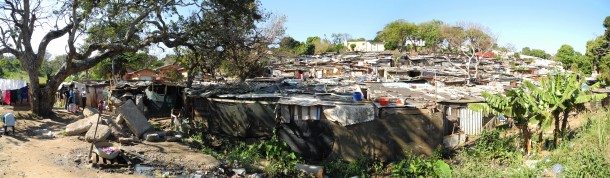
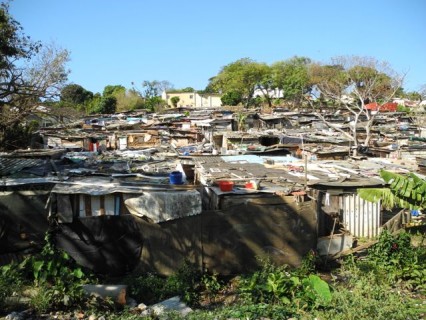
Havelock from the front

Havelock informal settlement is located 8km outside Durban central, close to the northern suburb of Greenwood Park. The first settlers – a coloured man and his wife – settled on this land in 1986. Since they were “scared of living alone” – as they put it – they invited other people to join them. In the early years, the new settlers were continually harassed, especially the women, who were vulnerable to attacks on their way to the main water sources. In subsequent years, the settlement grew to a sizable settlement of 389 residents living in more than 200 shacks. The land is privately owned; one part by the Kwa-Zulu Natal Provincial Department of Human Settlements and another part by a private owner. Havelock is built against a hill and the shack density is high. Read more about the background to the settlement in this profile.

[vimeo width=”620″ height=”485″]https://vimeo.com/49666284[/vimeo]

In the following report, I endeavour to give context to the unfolding dynamics in Havelock, where to community has completed all the design, received an in-principle go-ahead from government, and started preparing the site. The re-blocking project has been approved by Community Upgrading Finance Facility (CUFF), an alliance seed capital fund, and the eThekwini Metro has indicated a willingness to collaborate. The report tracks the activities over the weekend of 10 – 12 May. The Not-In-My-Backyard (NIMBY), a wicked complex layered with racial, class and land rights dynamics, have blocked the incremental upgrading of the settlement.

Thursday 9 May 

Over the past few weeks, the reblocking site has been cleared which required tree felling, clearing away undergrowth, and gathering together discarded pieces of building material. A consulting Civil Engineering firm manager and his operator arrived in the morning to discuss how we should proceed with the terracing work.  Points made were:

  • need to stay well clear of the sewer line that runs between the site and the church property above it
  • further cutting up of the logs from the felled trees to allow the tractor to carry them up to Havelock road for later disposal
  • need to remove various bottles lying around that could puncture the tractor’s tyres

the engineer’s preliminary assessment of the work was that it would take at least 4 days. We arranged for the tractor would come on site on the morning of Monday 13. In the afternoon another engineering firm, a subcontractor to the municipality’s Water and Sanitation Department tasked to install new services (following a presentation by the Havelock community on their re-blocking layout plan and dire shortage of ablution facilities), came to site to assess the need and contemplate possible locations for further ablution containers.   The outcomes of the visit were:

  • confirmation of the position of the sewer line between the site proposed for locating the re-blocked structures and the church property
  •  there is another sewer line across the settlement  parallel to the first but about half-way down – almost where CORC architect and the community had allowed for additional ablution facilities in the layout designs
  • the open area on the other side of the small stream and adjoining the bottom of Sanderson Road is the best first option with the one within the settlement to be contemplated only once re-blocking has progressed to that point
  • community should liaise with the owner of the property adjoining the site at the bottom of Sanderson Road to identify if the manhole that is shown on the map the engineer had with him is indeed there. Poor visibility meant that surveyors could not accurately plan the line from the proposed ablution container to this existing line.
  • the engineer also commented on the extremely poor condition of the existing ablution containers and said he would propose that these be replaced with new ones.

havelock10

Community presentation of reblocking plan

Monday 13 May

Over the weekend the community had attended to the preparations required by the civil engineering firm to bring their tractor on site.  Having cleared a way through the bushes down to the area to be terraced it proceeded to cut a “road” down past the ablution containers, thus creating easy access for possible removal of these and replacement with new ones, as suggested by the subcontractor. Then a line was pegged across from South to North to ensure no encroachment on or damage to the sewer line between the area to be terraced and the church property.  After this, the community and supporting engineers started to work on the top terrace, cutting and leveling the soil and removing stumps.

At this time, they were approached by a group of people from the Greenwood Park neighborhood’s ratepayers association, who demanded that the work stop.  Allegedly the ratepayers went as far as threatening to burn the tractor if it continued to operate.  The Havelock community was obviously angered by this perceived interference in something that they felt had been well-negotiated with all parties and there was then a stand-off between the two groups.

havelock08

Somebody from the formal community group had already contacted the Land Invasion Unit of the eThekwini Metro and some of their staff, including a senior officer, arrived on site.  Somewhere within the ensuing discussion the issue of a High Court interdict order (Order 3329/2013) allowing the Municipality and the police the right to demolish structures and to evict people who occupy or attempt to invade certain designated pieces of Municipal land was introduced. This comes after the courts’ clampdown on alleged “land grabs”, as a front page article of the Mercury, a local Durban paper, reported.

The upshot was that the Land Invasion Unit told the Havelock settlement that in terms of this broad order granted by the High Court they could not proceed with the terracing and re-blocking. The small area that had been leveled would need to have some of the stacked soil returned to it so that there was no place where a structure could be constructed.  However, this seems to be highly inconsistent: Why now, when the ratepayers called the Anti Land Invasion Unit a week prior regarding tree-felling activity – at which time the community explained about the re-blocking – they didn’t refer them to this Court Order?

Once the Land Invasion Unit had left, a group of the neighbouring residents continued to stand at the top of the site where it adjoins Havelock Road in order to see that the tractor operator adhered to the instructions of the Land Invasion Unit.

At this point I arrived and was confronted by the ratepayers with a barrage of questions and complaints, on the one hand, and an understandably irritated Havelock community on the other.  The ratepayers complaints were ill-informed despite the fact that ISN had printed notices some of which were distributed in the area and others put on light poles. I then contacted the Land Invasion Unit to confirm exactly what his instructions had been. I wanted to understand whether the tractor should replace the soil.

By this stage the local DA Councillor for Ward 34, Mr Ganesh, arrived and was also vociferously greeted by the questions and complaints of the ratepayers. The Havelock community was displeased at the situation since their continuous interactions with him and the ANC PR Councillor up to date. The community felt that the councillor had failed to keep the Municipality adequately informed about what was happening. A pastor from a local church stepped into the situation and suggested a mediated meeting between grievances of the ratepayers and the community. The meeting is scheduled for the 1st of June at the nearby Greenwood Park Primary School. Representatives from CORC, ISN and the Municipality will also be present.

Way Forward

In order to find a way forward that might allow for the re-blocking project to continue the following actions are proposed:

  • Make contact Legal Resources Centre, who has recently been involved in the Madlala Village community in Lamontville. We need to come to grips with the implications of the High Court order. But the primary litigation point will be the 37 sites to which it apparently refers as well as to possibly explore any legal action the community can take.
  • Set up a meeting with the Land Invasion Unit to understand why the project was not stopped when the trees were felled.
  • Co-ordinate a meeting of CORC and ISN with the Housing Unit who is also a member of the Interim Services Committee (responsible for informal settlement upgrading) on Havelock project plans issue tabled at the many previous meetings
  • Attend the mediated meeting with the ratepayers to negotiate outcomes
  • Discussion of the Havelock issue at the next Ward Committee meeting to be held on 15/5

FEDUP’s Mafikeng runner up in North West Govan Mbeki award

By FEDUP, uTshani Fund No Comments

By Walter Fieuw (on behalf of uTshani Fund)

Mafikeng FEDUP 50m2 house

The annual Govan Mbeki awards recognises excellence in the development of human settlements. Speaking at the Provincial Govan Mbeki Awards held at the Rustenburg Civic Centre on May 2nd, North West MEC for Human Settlements, Public Safety and Liaison, Nono Maloyi recognised the value of partnerships between government, civil society and the private sector. In her address, Maloyi said

Human Settlement is not just about building houses, it is about transforming our cities and towns and building cohesive, sustainable and caring communities with closer access to work and social amenities, including sports and recreation facilities.

uTshani Fund, as the Account Administrator of FEDUP, signed a contract with the North West Provincial Government allotting  200 greenfields sites. These sites are located in various settlements across Mafikeng Municipality: 77 in Mogogoe, 45 in Lethakane, 44 in Dithakong, 17 in Madibe Makgabane and 17 in five other villages. The FEDUP approach to People’s Housing Process developments is centred  on community construction, and the administration and project management is also managed by the Community Construction Management Teams (CCMT). The CCMT teams consist of project manager, procurement officer, bookkeeper, administrator and community liaison officer.

no images were found

FEDUP’s work has had a significant impact on the Province’s ePHP housing policy. In the application, uTshani Fund argues

Changes in this regard are noticeable in that the Province’s Housing Department is now pushing for policy change to institute minimum RDP/BNG units to be between 40m2 and 45m2 (compared to 36m2) with some project requiring finishes such as plastering, electrification, painting and installing baths, hand wash basins, sinks and toilets.

Mafikeng House Plan

FEDUP was the runner up to the North West award for best enhanced People’s Housing Process. The model that the Federation of the Urban Poor promotes builds on the assumption that providing housing pre-finance to qualifying beneficiaries who adhere to a collective savings scheme increases both yield and quality of the state subsidized housing stock. In particular, providing bridging loans to established savers allows families to be housed quickly on one hand, and promote responsibility, self sufficiency, and independence on the other. Moreover, since the beneficiaries, who source the materials, design their houses and contract local labor to erect them, handle construction itself building costs are significantly reduced. This allows the construction of larger and better quality houses than those provided by government appointed developers whilst generating training opportunities and temporary jobs for local communities.

Duduza wins Gauteng Govan Mbeki award for ePHP

By FEDUP, uTshani Fund No Comments

By Greg van Rensburg (on behalf of FEDUP and uTshani Fund)

Each year government recognises the partnerships with all sectors involved in developing sustainable and integrated human settlements. The Govan Mbeki Human Settlements awards are a prestigious ceremonies hosted by the National Department of Human Settlements in two stages: the Provincial and the National. The award ceremony aims to showcase and demonstrate the partnerships with the department at both tiers and promotes best practices in meeting the delivery mandate of the Presidency’s Outcome 8, which is aligned with the vision of building sustainable human settlements and meeting the Millennium Development Goals. The MEC of Human Settlements at the Provincial tier nominates projects in the five specified categories which displays exceptional quality, promotes best practice, brings together stakeholders, and most importantly, improving the quality of life for the beneficiary-partners.

According to the Gauteng Province’s Department of Local Government and Housing, a thorough investigation was initiated to access the quality of the projects nominated. The Department’s website says the following of the Gauteng evaluation process:

Prior to the ceremony of the Govan Mbeki Awards, there is a preceding quality monitoring process of projects submitted by entrants throughout Gauteng. The awards ceremony, to be held on Thursday, signals the end of the Gauteng Leg of the process. The awards are named after the liberation stalwart Govan Mbeki whose life work and struggle envisioned landlessness and homelessness as some of the inhumane legacies of the apartheid system. The ceremony will celebrate those contractors in Gauteng whose work and delivery is symbolic of the quality and dignity of human settlements that Govan Mbeki strove for.

The Federation of the Urban and Rural Poor (FEDUP) has been transforming housing policy from the bottom up for the past two decades. Premised on the notions of social and political change, savings groups linked to the Federation has built more than 12,000 since 1994, and continue to set a precedent in woman’s empowerment through self-build and collaboration with government. FEDUP’s work has been recognised at the highest levels of government, and has been showcases to international audiences such as UN Habitat, Cities Alliance, World Bank and other multilateral organisations.

On the 11th of April, FEDUP was nominated in the Gauteng Provincial Govan Mbeki awards. This event, hosted at the Emperors Palace, Kempton Park in Johannesburg and chaired by the MEC for Local Government and Housing, Ms Ntombi Mekgwe, FEDUP was awarded the award for the Duduza project. uTshani Fund acts as Account Administrator to FEDUP, and provides technical support to the Community Construction Management Team (CCMT). The contract signed with the Province allocated 150 stands in Duduza, of which 134 houses have been completed. In this year alone, 93 houses were built. On average, FEDUP builds houses with the same subsidy quantum but the differences are vast! Houses are larger than 50m2 in size compared to government build of 35 – 40m2.  These houses are fully fitted with a bathroom, a kitchen with a sink as well as two spacious bedrooms. The houses are fully electrified. The finishing include plaster inside and outside, and is painted inside and outside. These are achievable through the savings and contributions of the beneficiaries from their savings.

The FEDUP alternative is continuing to reshape the policy and institutional landscape. But most importantly, it is the building of a strong woman’s federation that opens many other avenues for livelihoods and poverty alleviation.

Burundi secures electricity through community planning

By CORC, FEDUP, ISN, News, uTshani Fund No Comments

By Sizwe Mxobo* (on behalf of CORC)

This is a map of the floodlines in Mfuleni, Cape Town. The Green, Blue, Yellow and Red lines indicate the possibilities of this area being flooded in 10, 20, 30 and/or a 100 years respectively. 1/3 of Burundi settlement lies below all four these areas, indicating a high risk area for flooding and disaster. Some of these areas have been evacuated, and affected families were relocated to the close by Temporary Relocation Area (TRA) called Busasa. Like many other informal settlement in Cape Town’s low lying areas, called the Cape Flats, Burundi has many service delivery problems. The settlement is situated in flood zone and thus far the City has refused to regularise and upgrade the area. Hence, there are no legal electricity poles. Only those closer to the formal houses have electricity through illegal connections and paying premiums for the service.

In 2011, when the community of Burundi first made contact with the Informal Settlement Network (ISN), an enumeration was conducted, which was followed by a mapping exercise. The community wanted to find solutions to their settlement-wide issues, such as flooding, low service levels, insecure tenure and lack of infrastructure development and ground work. The community struck the ISN as being self-organised with a willingness to engage with government. The enumeration and mapping exercise really strengthened the community’s plight, and it was presented that more than 3/4 of the settlement was located in what the City of Cape Town deemed as “land unsuitable for development”.

When the MoU with the City of Cape Town was signed in 2012, Burundi was one of the 22 projects in partnership with the City, where an in-principle commitment was made to roll out electricity services. This could then also have been seen as a step towards tenure regularisation, and an application for Upgrading of Informal Settlements Programme (UISP) was a viable option. Despite these potential forward looking alignments, there were considerable hesitation on the part of the City to move on the community’s plans, citing ten reason why this wouldn’t work for every new recommendation. Yes, the area is flooded, but a careful analysis of the site reveals large areas that can be upgraded. This was incorporated into the community’s plans they presented to the city.


The sketches above shows the elaborate work done by the community to point to all the major points of interest in the settlement. The second drawing shows that only certain parts of the area under the red “floodline” is prone to flood. With this level of spatial information, the community continued to engage the City in a number of “partnership meetings” with the City. After this broke down, the community decided to protest, and in the process one of the housing offices in Mfuleni was vandalised. This unfortunate event however did draw the attention of the senior decision makers in the City, who organised a community meeting three days after the protest. At this meeting, the City agreed to test the viability of installing electricity in areas under the floodline identified by the community.


Last week the community started digging test holes to review the viability of erecting electricity poles and infrastructure. This was done under supervision of City engineers and field officers  The roll out of the electrification of Burundi will be scheduled for a future date. We will continue to update the blog to track the story.

* Proof read and edited by Walter Fieuw

Community forums take shape in Khayelitsha

By CORC, FEDUP, ISN, uTshani Fund No Comments

By Nkokeli Ncambele* (on behalf of ISN)

Nkanini is a large section of about ten informal settlements on the far south-east region of Khayelitsha. In 2002, when the railway station Chris Hani servicing the area was completed, many people from Makhaza, Site C, Langa, Gugulethu, and other areas settled on the land. Many of the new settlers were living in overcrowded backyarder shacks, where rents and utility services were charged at a premium. Law enforcement often clashed with the new settlers, but could not prevent the inevitable. Today, Enkanini consists of more than ten informal settlements on this low lying area.

Many of these settlements are associated with the Informal Settlement Network (ISN), particularly Chris Hani and lower Chris Hani, Stendini, Shuka Section, Newlands, Isigingqini, ARC Section, and Zweledinga. On Friday the 5th of April, a coordination meeting was called to bring together all these settlements and start up a conversation about the needs and aspirations in the settlements.

I, Nkokeli Ncambele, an ISN coordinator, gave the delegates from the above mentioned informal settlements a welcome brief and upfront said that the ISN has not been in contact with the area for some time, but it is time to re-connect and talk about the future upgrading of the settlements. I gave a brief background the work of the ISN over the past three years and the progress made in ensuring a partnership with the City of Cape Town. We talked about the kinds of upgrading projects that have been completed, and how these could be a reference point for some of the settlements. This includes 22 informal settlements planned to be upgraded, with different priorities. There is emerging consensus from the City to provide 1:1 toilets in re-blocked settlements, but this remains an ideal. All these intiatives are aimed at building a network across the City to create a platform for the voices of the urban poor to be united and stand in solidarity.

The question of representation of settlements were a significant point of discussion. Anton, a community leader from Newlands, asked whether each of the settlements in Enkanini would form part of these “sectional forums”. Do we need to publicly elect people in each of the areas to distribute the information. I reflected on our experience of setting up a community committee where I lived in Mfuleni. We were democratically elected at a general meeting. The community entrusted us to represent them in matters of engaging government on development and service delivery. All the people sat down together and we talked collectively about the problems and needs in the area. After that we create a plan for development and talk to the City. Services are now coming to Mfuleni because we stood together. So each area needs to have at least 4 people. But you need to tell ISN what you need. You need to take the initiative and come up with solutions.

Some of the community members suggested that a general meeting is needed to discuss in more depth the needs and aspirations of each of the settlements. Bonwisa, the representative from Standini settlement, called out that these meeting should happen at times convenient for all to attend, such as weekends or after a day’s work. I responded by saying that yes, Nwe need to have a big date to call together the whole community. We need to have an agenda for that large meeting, and then discuss with all the community. At that time, we need to discuss the completion of the enumerations, which was stalled in 2009 for a number of reasons. I told those present that as the network coordinator, we can not plan anything if you are not with us. All the leaders need to agree on the programme, and then we will have real representation. We are not coming in and tell you what to do; you need to tell us.

The settlement representatives spoke among themselves and a number of core issues were presented. For instance, in Newlands and Isiginqini, there were no post boxes and people had no proof of address. This complicated a lot of everyday life, such as applying for jobs, opening a bank account, and so forth. Chris Hani settlement said that many of the mama’s were ready to start saving towards school fees for their children, but because they did not have a bank account, they often had to travel to Zone 40 to deposit money. I mentioned to them that we can support them around setting up local savings schemes, and our partner grassroots network, the Federation of the Urban Poor, has a lot of experience in doing so.

Nkanini section is located far from the city, and accessing opportunities remains a large challenge. Despite the geographic disadvantage, Anton from Newlands said,

We live here in a beautiful area. Here in the plain we have the best view of the city. You can see Table Mountain there and Stellenbosch mountains on that side. But we do have issues regarding moving around and the busses are scarce. I am frequently on the community forums with the City. We usually talk about the lack of busses, but they usually say they can not allocate more bustime to us. 3,000 drivers need t0 service this whole area, but there are only 10 controllers in this Nkanini area. Chris Hani train station is close by, but people living on that wide [Western side – Stendini, Town 3, etc] have to go to the far [Eastern] end, which means you have to take a taxi to go there. The station was designed for Makaza people, not for us.

Another community leader reflected that there big promises of job creation with the construction of the Monwabisi Beach, which they said will become like a Waterfront. The City promised that there will be many jobs. Some people travel to Stellenbosch for seasonal work on the wine farms. But it is very dangerous, and people are frequently attacked. Others work in the light industries in Durbanville and Kraaifontein, and as far as Houtbay.

ISN will continue to host community forums in Site B, Site C, Victoria Mxenge and other surrounding areas. These forums aim to bring the communities together to talk about their daily challenges and the ways to which they respond to these. Forums are also linked to prioritising development, and starts the community process at the grassroots.

* Proof read and edited by Walter Fieuw (CORC)

Havelock installs a flood prevention measure

By CORC, FEDUP, ISN, uTshani Fund No Comments

By Phumelele Mbali and Olwethu Jack (on behalf of CORC)

Havelock informal settlement is located 8km outside Durban central, close to the northern suburb of Greenwood Park.

The land is privately owned; one part by the Kwa-Zulu Natal Provincial Department of Human Settlements and another part by a private owner. Havelock is built against a hill and the shack density is high. In June 2012, an extensive mobilisation, enumeration and mapping exercise was undertaken in Havelock. This is documented in the Havelock project profile. The communtiy built a model for the potential future development and in-situ upgrading of the informal settlement (pictured above).

[vimeo width=”620″ height=”485″]http://vimeo.com/49666284[/vimeo]

The Havelock settlement has been one of the key actors in the frequent dialogues with the eThekwini metro, as arranged by the Informal Settlement Network (ISN). At these dialogues, the community has raised their concerns of high densities and low levels of services. The high densities have been a conducive environment of shack fires and flooding, and shacks closer to a water stream have struggled with the torrents of water flushes in the rain seasons.

During December 2012, the community experienced major floods in the low-lying area of the settlement again. Early this year, the CORC Durban office received a group of planning students from the University of Botswana who supported the community in designing a flood prevention measure for the river at the lower sections of the settlement. The community prepared a plan for the channeling of river to prevent flooding. The community initially wanted to approach the Community Upgrading Finance Facility (CUFF) to co-fund the project, but on rethinking the project, the community realised that recycled materials will work equally well.

The community leaders worked closely with the students from the University of Botswana and spoke to the residents most affected by the floods. Moreover, it was ascertained the source of the floods which was a blocked municipal drain hidden in the bushes. This exercise mobilised a lot of community members to assist. The team decided to do this exercise as practical as possible. The following day they started clearing the area according to their sketch.

However, community participation was very weak in the initial stages. Only after the students left, the community started the implementation of the project. The site clearing was done very quickly and they started digging the catchment area in one day. This realy motivated alot of people to come assist including people from formal houses were helping and not holding back.

We left the chanel clear and dugout to see how water will flow. The following day after a rainy night we realised that the ground water seeps through the ground to the surface kept the ground muddy. This made us realise that we can not use concrete but to lay stones in the channel and hold them with a wire mesh. Retaining walls were needed (see below) in other areas and the community members collected tyres and rocks to retain. The community participation at the end of the project was very impressive. At the end the community members appreciated and ecknowledged the students saying that Umntu ngumntu ngabantu.


Moeggesukkel community in Port Elizabeth maps out settlement

By CORC, FEDUP, ISN, uTshani Fund No Comments

By Olwethu Jack (on behalf of CORC)

An incredible story is unfolding in the Moeggesukkel informal settlement, a community of about 320 households located 30km north from Port Elizabeth towards Uitenhage. At the end of 2012, the community started mapping out the existing layout of their settlement and started allocating lots to individual households. With very little professional or technical support, the community is now taking proactive measures to start a regularisation process which the Nelson Mandela Metropolitan Municipality (NMMM) can initiate the upgrading of the area.

In the Eastern Cape, the ISN and its grassroots partner the Federation of the Urban Poor (FEDUP) – a movement of woman-led savings collectives addressing poverty, homelessness and landlessness – have made significant in-roads in building a partnership with the Nelson Mandela Bay Metropolitan Municipality (NMBM). More specifically, the settlements of Seaview and Moeggesukkel are anchoring the engagements with the NMMM. Seaview is a settlement of 320 households located 30km south on the N2 from Port Elizabeth. Moeggesukkel is home to 370 households and is located approximately 20km from PE towards Uitenhage. Both the settlements have been enumerated, they are actively saving towards contributing to their own development, and the are in the process of drafting local implementation plans for improved services and settlement upgrade. The Community Organisation Resource Centre (CORC), an NGO that provides socio-technical support to ISN and FEDUP, has been supporting these two communities for the past 8 months. This has resulted in interest from the Nelson Mandela Bay University (NMBU) who has pledged inter-disciplinary support to the upgrading of these two informal settlements.

The Moeggesukkel technical team is leading the procces by measuring the plots and assisting the community with moving and building the shacks. Working from satellite image, the technical team has started mapping informal walk ways, public water and sanitation infrastructure, electricity poles and so forth. The existing layout of the shacks, as per the satellite image, were noted, and potential reconfiguration of this low-density peri-urban informal settlement was suggested. The team has been working in close collaboration with Mr Ndaba, the director of Spatial Planning in the NMMM.

This mapping exercise informed a potential new layout for the settlement in blocks the community self-designed. With very little technical and professional support, the community has initiated the re-blocking of their settlement by themselves! No new materials, no equipment and on-site supervision was present. Rather, the community started their own reguralisation process for the NMMM to replicate and recognised and start allocating plots to the community.

This is not a static process. People are often coming and going, and in the mapping process, the community is facing challenges of people who left the community coming back to claim their land. Services are desperately needed in the area, and the municipality has not been collecting the debris in the process of moving the shacks.

The way forward for this settlement is arranging a meeting with the Department of Human Settlements to present the layout, and the associated actions taken, together with Mr Ndaba and myself, technical support person to Port Elizabeth, Olwethu Jack (I am based in Cape Town). After presenting to municipality we need to ask the city to provide us with engineers drawings with servitudes. The community has saved more than R9 000 towards the improvement of their settlement.

It is worth mentioning that the ‘soft aspects’ of developmental interventions are often just as important as the hard, technical aspects. These two communities have demonstrated their ability to articulate complex matters such as regularisation, in-situ upgrading and productive spaces in informal settlements in simple language, and in their own vernacular.

Turning Waste into Profit: Ghana Visits Cape Town’s Recycling Programme

By CORC, FEDUP, ISN, uTshani Fund No Comments

Ghana & SA Waste Management Exchange

By Chantal Hildebrand, SDI Secretariat (cross posted from SDI’s blog)

As part of their initiatives to improve the sanitation situation in the slums of Accra, Ghana, a delegation of four members of the Ghana Federation of the Urban Poor (GHAFUP) – Haruna Abu, Janet Abu, Imoro Toyibu and Naa Ayeley – participated in a learning exchange to Cape Town, South Africa to learn more about the waste management initiative underway in the settlements of Cape Town. Painting a picture of the waste and sanitation situation in the slums of Accra, Ghana, Janet Adu, a member of GHAFUP, described the discarded plastic bags and other trash littering the narrow pathways of Ghana’s slum communities, adding to the already poor sanitation situation. To begin addressing this issue, GHAFUP and People’s Dialogue Ghana began brainstorming about waste management programmes that will clean up the slums while simultaneously generating income for the Federation.

The Blue Sky Solid Waste Management Company is the business side of the waste-management facilities. The initiative operates out of the offices of Sizakuyenza, a small community based NGO that originated from the FEDUP health network’s cleaning programme. Starting as a small initiative, with volunteer slum dwellers sorting waste for a small income, the initiative has grown into a completely self-sustaining programme with about 400 volunteer community trash collectors, or waste pickers, from various informal settlements across Cape Town who sort through waste to collect recyclables.

The sorted waste is then collected through the initiative’s mobile buy-back programme in which two pickup trucks manned Blue Sky drivers pick up the collected waste from various settlements around Cape Town, paying the pickers cash upon pickup for their recyclables. After another sorting at the Blue Sky Solid Waste Management facilities, the waste is sold to buyers and recycling companies.  Using the profits made from these business transactions, the Blue Sky Solid Waste Management programme pays the pickers for their trash collection, salaries for the workers that run the company while also revolving the remaining profits back into the programme to sustain it and maintain its facilities.

Over the two-day exchange, the Ghana delegates focused their attention on the business side of the Blue Sky Solid Waste Management programme: observing the market opportunities in waste collection and recycling, meeting with local pickers in the Bengali community, learning waste sorting techniques and how to build relationships with recycling companies. The days were split into two sections: 1) interactions with the buyers and learning the market and 2) interacting with the pickers and how this activity has helped slum communities around Cape Town.

Day 1:

Day one of the visit fell on the day Blue Sky Solid Waste Management meets with buyers to sell the recyclable material that the pickers collected throughout the week, giving the Ghanaians an opportunity to learn the values of various recyclable goods. As explained by Mr. John Mckerry, team leader at Blue Sky, certain companies are looking for certain types of waste, which is why it is so important to look at the market opportunities in your city before beginning a recycling program. This way the federation can be well informed on what types of materials companies are looking for in order to generate the most income.
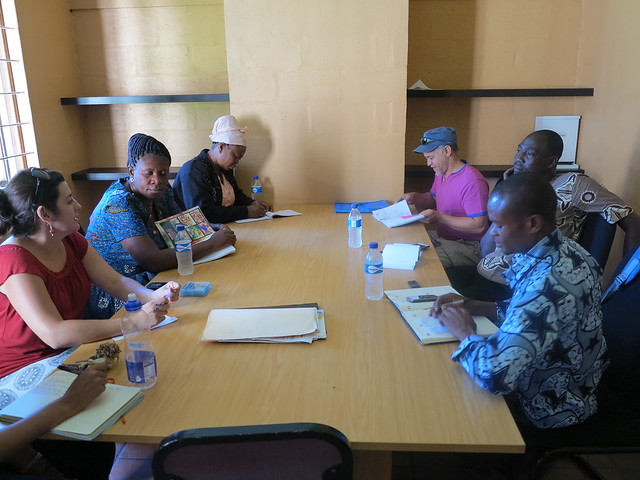
Ghana & SA Waste Management Exchange

Following a lively discussion inside, Mr. Mckerry and Mr. Gershwin Kohler, the project consultant for the Blue Sky Solid Waste Management programme took the group on a quick tour of the Blue Sky Solid Waste Management facilities. They described the structure of staff and participants in the programme and identified the various types of waste collected and how it is sorted and its value (per kilo).

After the tour, the Ghana delegates joined Mr. Mckerry, Mr. Kohler and two of the of the Sky Blue waste collectors. Together the group visited waste companies such as S.A.B.S., where the Blue Sky staff negotiated and sold the collected and sorted waste. Through these interactions, the delegates were able to witness the market opportunities for recyclable goods in South Africa and compare these prices to the Ghana values.
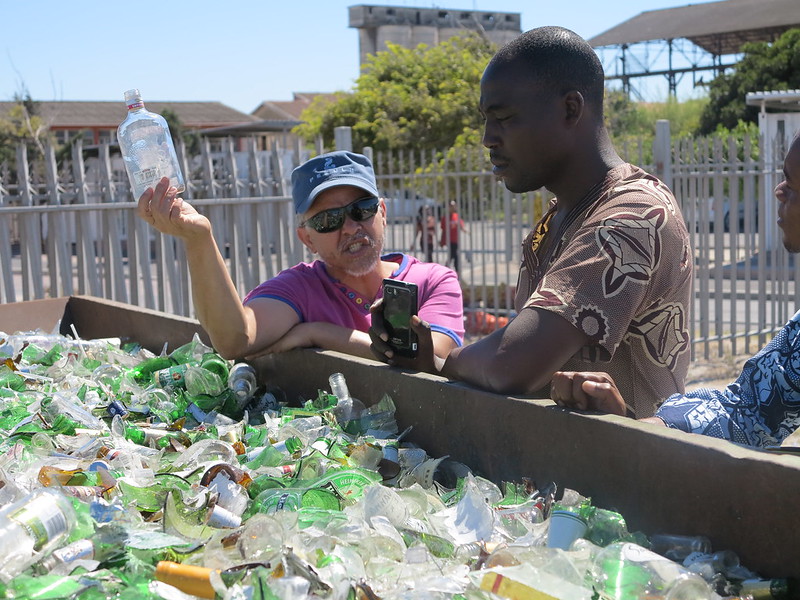
Ghana & SA Waste Management Exchange

Mr. Gershwin Kohler discusses the value of glass recyclables. 

Day 2:

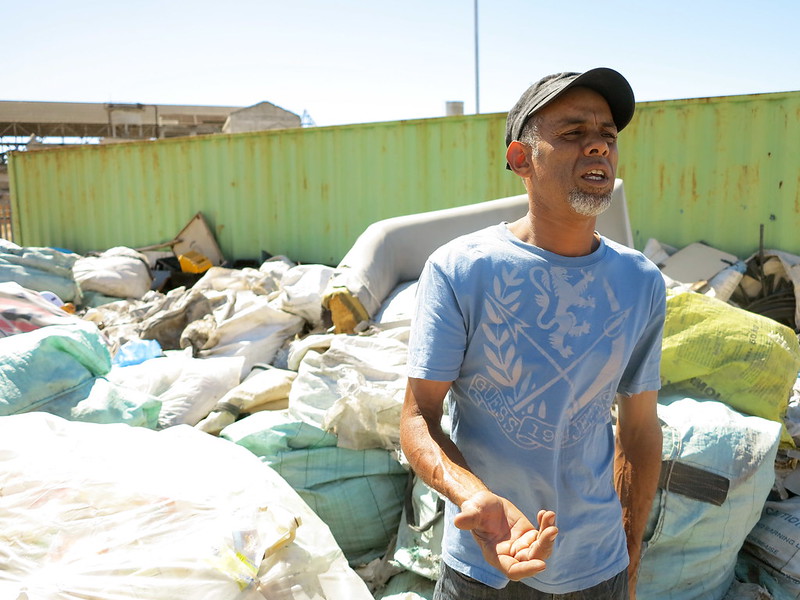
Waking bright and early on a Saturday morning, the delegation met with the Bengali community where community pickers had begun the work of collecting and sorting waste. As explained by Mr. Kohler the day before, “their job is to collect garbage and they focus on what they want to collect.” Some participate in the programme once in a while to generate some extra income for themselves and their families; for others this is a full time job, picking and sorting daily in order to make as much profit as possible. Furthermore, there are some people who choose to only collect one or two types of waste (e.g. plastic bottles and newspaper), while others collect and sort whatever types of waste they know Blue Sky might be interested in. When the sun has reached its highest point the pickers’ day of work is complete, though there are some dedicated individuals who will continue through the afternoon.

Upon collection by the mobile buy-back truck, the pickers’ collections are weighed separately to determine payment  – paid by the kilo for paper, crushed glass, cardboard, plastics, etc. or paid by each whole plastic or glass bottle collected. Pickers are informed of the different rates for each type of waste collected and the importance of sorting waste before collection. Each individual’s collection is recorded to maintain accurate data collection and minimize conflict between people. Pickers are then paid for their collection, no matter how little or big the amount collected.
Ghana & SA Waste Management Exchange

Mr. John McKerry describes the process of collecting, sorting and selling recyclables. 

Providing a job opportunity within the slums of Cape Town, the waste management programme motivates people to participate as pickers to sustain their livelihoods; however, this programme has also helped clean up the slums, creating a cleaner and healthier community environment. Simply put by Mr. Kohler, “[slum communities] become reverse supplier of raw materials.”

Throughout the exchange, the Ghana delegates brainstormed the aspects of the Blue Sky programme that would be applicable to their planned project in Ghana. This is not the first waste management programme for GHAFUP. Having started a waste project in Old Fadama, the largest slum in Accra, the Ghana federation has already begun to address the slum’s sanitation and waste issues. Thinking on a larger scale, GHAFUP began planning how to scale up the project in Old Fadama and create an income generating aspect of the programme in order to sustain the project and add to the general funds of the federation.

Using the lessons learned from the Blue Skye Solid Waste Management programme in Cape Town, the Ghana delegates took ideas from the process used in Cape Town to adapt to their situation in Accra. As stated by the team in their exchange report, “the system of waste management [in Cape Town] is different from Ghana because they buy the waste from the household/pickers.”

The Cape Town programme’s mission is to mobilise slum communities around recycling and waste collection, demonstrating the benefits of clean communities and how participating in this programme can help generate income for individuals/families.

According to the delegation, GHAFUP is planning to manage and run the solid waste management programme as a service for slum communities in Accra, where federation members act as pickers, from the picking and waste collection to building relationships and selling to recycling companies in the Accra area so as to generate income and sustain the project.  The funds from this project can also help finance some of the federation’s other activities if possible.

Following Mr. Kohler’s advice to “start in your on house”, the Ghana delegates plan to begin the project amongst themselves. Collecting, sorting and recycling materials in their own households, GHAFUP will begin mobilising and educating other slum dwellers around recycling and waste management. While doing this, GHAFUP members will begin researching the recycling industry in Ghana; identifying the waste that has a market – keeping in mind that the market values will fluctuate – and beginning to build relationships with potential buyers. However, the main outcome highlighted by the Ghana team was that the exchange “encouraged [GHAFUP] to act as a community on waste management,” which is the main lesson the Ghana delegates plan to share with their fellow slum dwellers in Ghana.