Tag

Community Planning Archives - Page 3 of 5 - SASDI Alliance

Alliance and Community Architects Network plan inclusive cities in Philippines

By CORC, FEDUP, ISN, SDI No Comments

By Andiswa Meke (on behalf of CORC)

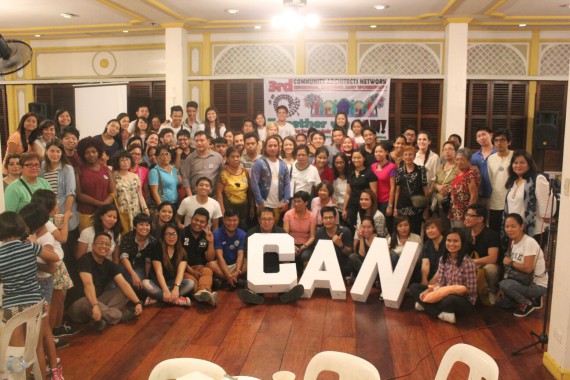
From 16-23 June 2015, the SA SDI Alliance joined community designers and architects for the third regional workshop of the Community Architects Network (CAN) in Metro Manila, Philippines. The Alliance team consisted of 3 FEDUP and ISN community members who are involved in managing community construction as well as two of CORC’s community architects. The workshop was hosted by CAN’s Philippine Alliance organisations of HPFI (Homeless People’s Federation Philippines Inc.), TAMPEI (technical Assistance Movemnet for People and Environment Inc.) and PACSII (Philippine Action for Community-led Shelter Initiatives, Inc.),
CAN 8

The theme of the 2015 workshop was “Together we CAN! People Planning for future inclusive cities”, emphasizing that strong partnership can yield excellent achievements. There was an estimate of one hundred attendees from different countries (representatives from public institutions, academia, CBOs and NGOs). The workshop spanned eight days and involved several activities: getting to know the Philippine context, sharing various country experiences updates on approaches and experiences of community architecture, reflection sessions and exhibits.

The group split to do community fieldwork in two locations in Metro Manila, the heritage site Intramuros and Muntinlupa City. The SA SDI Alliance members had the honor to work on more than two groups and with different communities. The Alliance sent five members to attend with the aim of exposing them to the programme and gaining knowledge to apply in South African community upgrading. The alliance looked to build and strengthen partnerships and lobby potential stakeholders.

CAN 13

CAN Background

CAN is a regional network of community architects that focuses on improving the living conditions of poor communities in Asian countries through community-based projects under the Coalition of Community Action Program (ACCA) regarding people housing, city-wide upgrading and recovery from disaster . CAN has opened opportunities for interested young professionals, academic institutes NGOs, CBO`s to come and engage with design skills to support communities in finding solutions to their own needs.

CAN 2013 Workshop: PEOPLE CAN MAKE CHANGE

In 2013, a workshop of the same nature took place under the theme “People CAN make change and progress”, where communities were introduced to bringing about change through acquiring tools, skills and information. Communities were taught different skills from mapping and savings to profiling. After the ten day workshop, the community members and architects came up with solutions that would push local government towards building avenues that would represent the people as well as a building plan that would be community driven and understood. The network strongly believes that the role of community architects is to build the capability of people through participatory design and planning so that people themselves become the solution.

CAN 2015 workshop: TOGETHER WE CAN

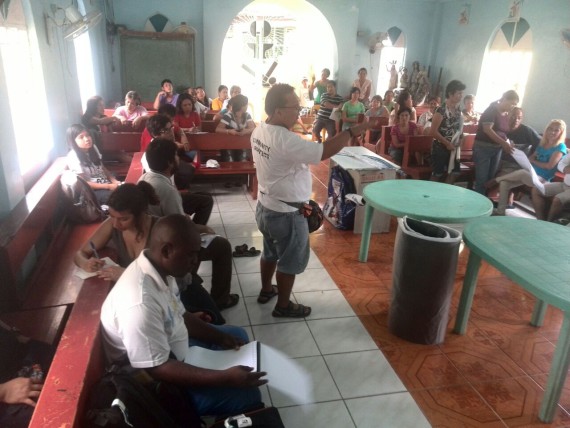
On the opening day, the host city Intramuros held a number of talks that gave an overview of Philippines informal settlements and introduced city-wide development approaches in Asian cities. The delegates were split into groups and sent to different cities around the Philippines. The purpose was for delegates to identify and resolve issues and share knowledge around the communities.

A public forum took place on the eighth day, where all groups presented their findings and suggestions and were given the opportunity to select the best plan for each community and share their experiences surrounding their visit.

CAN 53

CAN 45

Challenges for the re-blocking group in informal settlement Sitio Pagkakaisa, Manila

  • Community members who don’t want re-blocking.
  • Critical challenge was the materials the houses were built in, which would not be easy to remove. In some informal settlements people have already secured land tenure with their subsidy money and their savings, they now fear that they will be unable to build houses once the re-blocking takes place

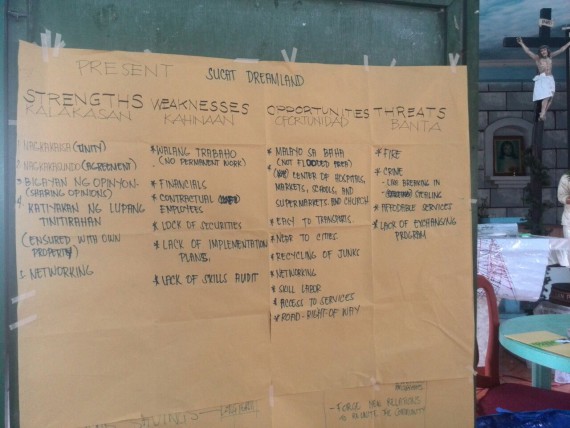
Challenges for the Intramuros, Manila

  • Finding a solution to better the high density of the settlements
  • The most challenging part was designing an upgrading plan that would address the needs and embrace the heritage of the Intramorous communities
  • Issue of land tenure and people living in private land deemed as a major challenge in upgrading –related processes.
CAN 33

Learning points

  • A community’s knowledge of its settlement is essential for drafting development plans and interacting with government officials about pressing issues in informal settlements. The community seemed informed of the development plan and where they are lacking in terms of services.
  • The partnership between local officials and the community is vital. It is kept strong to an extent that the municipality is willing to communicate and engage with communities regarding housing and informal settlement upgrading.
  • When community leaders have a good relationship with community members, they make informed decision together.
  • Savings is the pillar of creating communal consistency in the informal settlement
  • SA SDI Alliance members learnt how to engage with problem solving in the context of a different country, how to use existing SDI tools in a completely different setting and an approach to building communities with a strong heritage value who showcase this in their planning.
SA SDI Alliance Team

SA SDI Alliance Team

Outcomes of the exchange

  • Intramuros: Suggestions for sustainable and participatory options for informal settlements in Intramuros heritage site, in context of its revitalization plan.
  • Muntinlupa: Suggestions for holistic solutions for informal settlements located in high risk zones with insecurity of tenure
  • CAN delegates managed to advocacy for interaction between Muntinlupa City and its Barangays.
  • New CAN attendees were exposed to the practical implementation of SDI rituals
  • CAN delegates gained membership of the CAN
From Re-blocking to Housing: Lwazi Park – CPUT Studio 2015

By CORC, ISN No Comments

By Yolande Hendler & Andiswa Meke (on behalf of CORC)

In April 2015, the community of Lwazi Park embarked on a four-week design studio that investigated affordable solutions for incrementally improving dwelling structures in the settlement. Through its affiliation to the Informal Settlement Network (ISN) and Community Organisation Resource Centre (CORC), the community partnered with fourth year students of Architectural Technology from the Cape Peninsula University of Technology (CPUT) as well as a visiting group of students from the Reunion Island arm of the Ecolé National Superier d’Architecture Montpellier (ENSAM).

CPUT & Reunion Students visit Lwazi Park.

CPUT & Reunion Students visit Lwazi Park.

Lwazi Park Informal Settlement

Lwazi Park is situated in Gugulethu, near the N2 freeway in Cape Town. The settlement is now home to thirty-eight households and a primary school adjacent to the area. Its first inhabitants are alleged to have occupied the space in the mid- 1990s, when they built informal dwellings near the Lotus River. In 2001 the informal settlement stretched from Klipfontein Road up to the Eastern edge of Gugulethu. Lwazi Park is characterized by canals that were built fifty years ago, with the purpose of draining the flood plains for communities who were forcibly removed from the city centre during the apartheid era. Today, these canals are polluted and flood every rainy season.

View of Lwazi Park canal

View of Lwazi Park canal

Past Studios Paving the Way for Lwazi Park

The relationship between Lwazi Park community and the SA SDI Alliance dates to 2011, when the community, Alliance and City of Cape Town began to address a pending relocation of the informal settlement. Click here for more background. CPUT’s architectural technology students first participated in joint design studios with ISN & CORC in 2011 working on subsequent collaborative design in Vygieskraal and Manenberg.

The 2015 Lwazi Park studio was convened as a response to the community’s desire to explore options for further in situ upgrading after re-blocking in 2011. This is one of the first Alliance studios focused on incremental housing typologies for a settlement that has already undergone re-blocking. The studio thus reflects the incremental and cumulative nature of informal settlement upgrading. Perhaps even more significantly it speaks to a context-specific and community-centred approach.

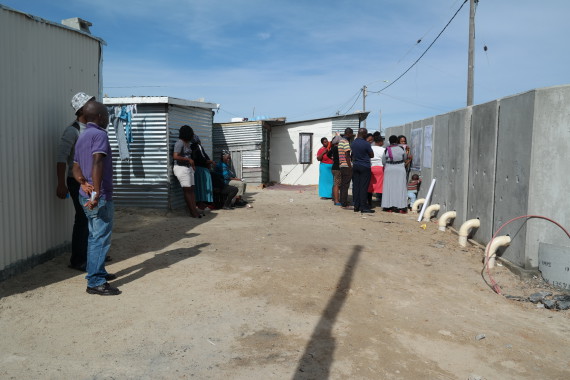
Lwazi Park after reblocking in 2011

Lwazi Park after reblocking in 2011

Within the Alliance, studios play a significant role. On the one hand they support community negotiations with local authorities: through a collaborative approach studios bring about community-informed design typologies. On the other, they challenge and extend existing disciplinary norms in architectural thought and practice. CPUT Lecturer, Rudolf Perold, explains that such approaches are anomalies in

“the field of architecture, which often does not make provision for design in informal areas let alone consider the community’s lived context as informing appropriate and relevant design solutions*.”

In this sense collaborative design studios generate ideas and debate on alternative housing design and delivery options that address residential environments within existing and challenging urban conditions.

Lwazi Park Studio Content: incremental housing typologies

In practice, the studio comprised a site visit to Lwazi Park and two collaborative design instances between community representatives, students and Alliance representatives (ISN & CORC) who provided social support and facilitation. The students were tasked to develop a spatial development/master plan for the settlement’s in-situ upgrading to two to three story residential buildings as well as housing typologies that would respond to the social needs and spatial context of Lwazi Park community.

Lwazi Park community leader engages students around their questions.

Lwazi Park community leader engages students around their questions.

During the site visit community members introduced students to the physical layout and context of their settlement, lived realities, daily challenges and needs. These include the lack of a multipurpose / community hall or a nearby school. A central concern was the lack of funding provided by the city to help improve the standard of living. The community also expressed a desire for a safe place for their children to play in. A further concern related to drug abuse by the youth and the unsettling rate of crime.

Once the site visit had been completed and some preliminary insight gathered from community members, the design process began. CPUT lecturer Rudolf Perold explains,

“Their [the students’] point of departure was the community representatives’ assertion that they were set on obtaining tenure security and upgrading their settlement. Having had to adjust their approach based on the input received (albeit not representative of the entire community’s wishes) the complexity of balancing the community’s needs with your own design intent became clear”.

Challenges and Learning Points

In reflecting on the studio, CPUT lecturer Rudolf Perold highlights learning points for the students

  • The relationship between designer and occupant was crucial to the design process and triggered an empathy which contributed to the success of the design outcomes
  • The situated knowledge of community representatives and the Alliance proved integral to the development of the site layout and housing typologies
  • Students were sensitized to lived realities in informal settlements
  • “These experiences show that designers require a broadened skill set if they are to prove themselves useful in a context of mediation between poor urban communities and local government…- acting, as Stephen Lamb of Design-Change says, as interpreter of community needs rather than the holder of professional knowledge”
  • CPUT-based studio with input by community representatives, ISN & CORC.

CPUT-based studio with input by community representatives, ISN & CORC.

In addition a CPUT student added,

“Realising how people adapted to their living conditions in Lwazi Park and how these conditions push people to learn to survive, was a learning curve for me.”

For both the students and the Alliance a core challenge was experienced by the lacking attendance of enough community representatives in campus-based contact sessions. The students gained some community input during the site visit, which helped to contextualize and ground their work. The lack of community representation, however, speaks to a need for more social facilitation between the different actors involved so that the jointly designed plans can indeed be presented to the municipality.

  • CPUT quotations taken from “Perold.R., Devish, O., Verbeeck, G. 2015. Informal Capacities: Broadening Design Practice to Support Community –Driven Transitions to Sustainable Urbanism. Working Paper.
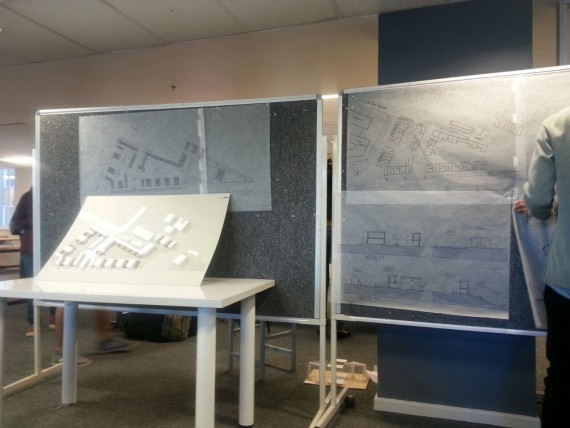
Presentations of master plans and housing typologies

Presentations of master plans and housing typologies

Final Student Presentations

Final Student Presentations

Building Continuity: Denver Community and University of Johannesburg Studio 2015

By CORC, FEDUP, ISN No Comments

By Motebang Matsela (on behalf of CORC)

From 27 April to 22 May 2015, the community of Denver informal settlement in Johannesburg partnered with students from the University of Johannesburg’s (UJs) Department of Architecture in a collaborative design studio. Such studios focus on co-producing ideas, scenarios, plans and typologies on informal settlement upgrading and housing. Denver’s first collaborative studio took place in 2014. It was the first of consecutive, annual studios that would build on previous work and span a period of 3-5 years. The 2015 studio therefore started where the last studio ended, focusing on establishing tangible outputs such as a collaborative design handbook and a catalogue of dwelling typologies.

20150605072345

Co-producing Ideas: Denver Studio 2014

In 2014 the studio catalysed the generation of co-produced mapping and socio-demographic data on the settlement. The aim was to formulate community action plans (CAPs) for Denver Settlement in an effort to encourage short-term community initiatives and to support further productive discussion with local government agencies and other stakeholders regarding incremental upgrading in informal settlements. It also introduced students to the necessity and value of planning with communities, shifting the focus from traditional ‘top down’ delivery towards ‘responsive’, community-orientated approaches. For more background on the settlement and the 2014 studio click here.

Aerial view of Denver informal settlements

Aerial view of Denver informal settlements

A growing partnership

The idea of co-production suggests the involvement of different stakeholders. For this studio, therefore, the role players included Denver community members and leadership, the Ward Councillor and community representative, a collective of community volunteers assembled at various stages of the long-term studio, Aformal Terrain in partnership with the Department of Architecture at UJ and its students and the Alliance’s ISN, FEDUP and CORC who offered technical and social support and facilitation.

Unlike previous studios that customarily take place in informal settlements, the Denver studio had to change venue when xenophobic violence broke out in Johannesburg. The socio-political atmosphere of the violence and hostel raiding was deemed an unsafe environment to operate under.

20150605070039

As indicated, the collaborative outcomes are valuable aspects of the studio’s work. Based on the experience of last year’s studio, Gauteng’s ISN leaders highlighted the need for community members to gain tangible skills throughout the studio and upgrading process just as the students do. Each stage (module) of the studio therefore couples a community member’s practical participation in the studio with project management skills. In this year’s studio, more emphasis was placed on community participation and benefit.

This led to a revision of the 2014 Memorandum of Understanding (MoU) formalising the partnership between the SA SDI Alliance and UJ’s Architecture Department.

Some of the changes were highlighted in terms of:

  • The precedence of the relationship between Denver community and SA SDI Alliance
  • Denver community decisions will be respected and take priority within this project
  • Any data generated by the community residents will remain the property of the residents. Copies of any formal information packages generated from the studio engagement will be made available to community leadership.
  • All parties agree to inform each other in writing around documentation, marketing or exhibiting of the Denver project. The documentation will sufficiently acknowledge the role of each party and most importantly the residents’

Building Continuity: Denver Studio 2015

The objective of this studio was to incrementally build on the content of the 2014 studio, creating continuity and ongoing engagement between past and future studios. It also aimed to develop a collaborative design ‘handbook’; a catalogue of typologies of dwellings in informal settlements with related strategies for improvement through self-build, co-ops, CBOs, local government assistance, infrastructure etc.

This investigation focused on three main issues;

  • site (the physical)
  • planning (spatial and developmental)
  • policy (strategies from governmental level)

20150605070105

The intention was that these three focal areas would form a broad scale critical inquiry into current upper strategies for informal settlement upgrading and as a starting point suggested possible linkages with existing bottom-up initiatives.

It is envisioned that the outcomes will come to fulfilment in various forms through the studio process over the next 3-5 years in the form of awareness and knowledge packs about the settlement, site handbooks and guides on in-situ upgrading at various scales (shelter, site, policy, planning etc.), design studies for future densification and longer term formal development. A number of other valuable outputs not limited to this list will be determined through the studio process.

These potential outputs aim to bridge the gap between current bottom-up and top-down strategies already active in Denver – aiming to ‘connect’ community initiatives and local government intentions in more productive conversations toward improvement.

20150605070125

The studios final presentations tabled prototype-scenarios generated in response to a three-week focused research exercise focusing on 3 scales;

  • Dwelling-and-Neighbourhood,
  • Planning
  • Policy

In this final week (loosely termed ‘rapid design prototyping’) students worked in mixed groups, integrating information from the 3 earlier foci with the aim of generating scenarios for the potential improvement of Denver Informal Settlement. It is intended that these scenarios become useful tools for engagement with the residents of Denver in focused workshops and engagements during the course of this year.

Taps, Toilets & Beyond: ISN partners with Water & Sanitation Dept

By CORC, ISN No Comments

By Nkokheli Ncambele (on behalf of ISN)*

Nkokheli Ncambele is the regional co-ordinator of the Alliance’s Informal Settlement Network (ISN) in the Western Cape.

Emseleni Community leader, Nomfundo Lungisa

Emseleni Community leader, Nomfundo Lungisa

In Mfuleni, informal settlements have been without basic services for five years. People had to buy water from surrounding formal houses; at night it was difficult for them to get to a toilet. Last year, ISN started creating a partnership with the City of Cape Town’s Water & Sanitation Department. We kept reporting these problems to the City until we saw that there was a light: the Department came to us saying, “Yes we are going to do something in those communities”.

The City is very important as a partner because when they come on board we see results: in March 2015 they installed a total of 15 standpipes for taps and 57 flush toilets in five settlements (Tambo Square, California, Constantia, Strong Yard and Emseleni) in Mfuleni region which is one of four ISN sub-regions in Cape Town. Every settlement’s leadership sends two or more members to our weekly sub-regional meetings to discuss issues. After we collect all issues we decide where to start. This is how we chose these five settlements for Water & Sanitation installation.

ISN co-ordinators Nkokheli Ncambele and Melanie Manuel with Kuku Town community leader, City of Cape Town councillor and officials

ISN co-ordinators Nkokheli Ncambele and Melanie Manuel with Kuku Town community leader, City of Cape Town councillor and officials


From backyards to informal settlements

You will find that most settlements like Tambo Square, California, Constantia, Strong Yard and Emseleni were established when formal housing was introduced. When there is a big housing improvement project there are always people who move in as backyard dwellers. Why are there so many new settlements like these? Because backyarders are tired of paying rent and being mistreated by homeowners who cut off services without notice. That’s why backyarders move into nearby open spaces.

Constantia informal settlement is in close proximity to formal housing.

Constantia informal settlement is in close proximity to formal housing.

Constantia Steering Committee members, Nolusapho Thandela and Phindiswa Payiti

Constantia Steering Committee members, Nolusapho Thandela and
Phindiswa Payiti


The beginnings of ISN in Mfuleni

Before ISN, we as community leaders used to have a joint leaders forum in Mfuleni. When we heard about ISN, we decided to join because the movement was talking about what we were already doing for a long time.

“We realised that actually we are ISN – anyone who is staying in an informal settlement is ISN. Let’s take this forward”.

New sub regional leaders asked us to explain the ISN process to them. Other community movements, development forums and Councillors also know about us. I can say that 99% of informal settlements in Mfuleni have gone on exchanges to see what other ISN communities are doing. That’s why they want to be part of ISN and why Mfuleni is becoming an ISN base. Look at the people of Tambo Square – they want to be involved in their own project. When the ISN coordinators go to Emseleni, people just come out to greet us. We see that people are hungry to solve their problems.

“Tambo Square started in 2007 when backyarders moved here. We had no toilets or taps and used to get water from the formal houses. We took our problems to ISN who helped us go to the municipality. These changes came to us with ISN – they play a big role for us”.

(Nkosikhona Bangiso, Tambo Square Steering Committee Leader)

Tambo Square community leader, Nkosikhona Bangiso

Tambo Square community use back of newly installed toilets for mapping workshop to plan further upgrading initiatives in their settlement.

Tambo Square community use back of newly installed toilets for mapping workshop to plan further upgrading initiatives in their settlement.


Building our partnership with the City

As ISN, we know that the Department of Water & Sanitation has an interest to deliver basic services to communities. The difficulty is that many settlements have little open space for services to be installed. When ISN started mobilising communities and speaking about the value of basic services, community members began thinking about how to create more space in their settlement. In Tambo Square, for example, it looked like there was no space. We suggested that the community remove a large container that stood at the entrance of the settlement. Now there are ten toilets in that space. In this way it was easy to convince Water & Sanitation to partner with us. I think I can say that they see us (ISN) as a solution. We told them,

“We’ve got the space, now you can come and install the toilets. Don’t say there is no space in our community”.

The role of ISN & CORC in partnership building

What is unique about our Alliance is that CORC created a space between ISN and the City. In 2009 there was opposition between communities and the City. Because of that CORC was there to neutralise the relationship. I can say that CORC was a bridge that connected us to the City. The City used to say, “We don’t want to go to meetings with the communities because they will swear at us and toyi-toyi (protest) and do all these things.” But CORC has a belief that communities won’t do that. Through the engagement with CORC we (ISN) understood that we need to go to the table, and not to the street. Then at the end of 2009, the City started saying, “This thing is working”. I think that is why they are happy to work with us.

Flamingo Crescent informal settlement community members with ISN facilitator Melanie Manuel, CORC Director Bunita Kohler (left) and City of Cape Town Mayor Patricia de Lille

Flamingo Crescent informal settlement community members with ISN facilitator Melanie Manuel, CORC Director Bunita Kohler (left) and City of Cape Town Mayor Patricia de Lille

Nkokheli Ncambele (second from left) with fellow ISN co-ordinators Mzwanele Zulu and Melanie Manuel (far left and right), CORC technical support, Sizwe Mxobo (centre) and Western Cape MEC for Human Settlements.

Nkokheli Ncambele (second from left) with fellow ISN co-ordinators Mzwanele Zulu and Melanie Manuel (far left and right), CORC technical support, Sizwe Mxobo (centre) and Western Cape MEC for Human Settlements.


The bigger picture: taps, toilets & beyond

We recently met with an Mfuleni councillor and asked what he thought about Mfuleni as a whole. He said he has a bigger picture – that in the next 20 years he doesn’t want to see informal settlements. For that to be possible I see that he needs a movement like ISN that will make sure that his vision is pushed. What is our vision? That all settlements have basic services and that all people who are living in informal settlements have houses. Our vision and his vision are on the same page.

* Compiled by Yolande Hendler (on behalf of CORC)

Newly installed water & sanitation in Strong Yard settlement, Mfuleni

Newly installed water & sanitation in Strong Yard settlement, Mfuleni


Alliance at Human Settlements Learning Exchange in Durban

By CORC, FEDUP, ISN No Comments

By Jeff Thomas (on behalf of CORC)

A SA SDI Alliance team comprising FEDUP and ISN community leaders, regional co-ordinators and CORC representatives was invited to attend the International Human Settlements Learning Exchange in eThekwini Municipality from 15-17 April 2015.

The exchange, a first of its kind, was hosted by the Municipal Institute of Learning (MILE) in partnership with eThekwini’s Human Settlements Department and the Affordable Housing Institute (AHI). It included about 200 local, national and provincial government officials, eThekwini Municipality councillors, private sector housing, NGO and academic representatives.  

Screen Shot 2015-05-05 at 11.42.19 AM

It aimed to “share different organisation’s perspectives and experiences within the human settlements sector to improve housing service delivery” (Reference). The exchange focussed on new funding models for affordable housing finance, effective new housing typologies and guidance for establishing socially inclusive and responsive housing settlements.  For the Alliance it was an opportunity to share concrete experiences in community participation that move beyond infrastructural approaches to human settlements development.The event was billed as an international exchange in that the keynote speaker, Professor Jeremy Gorelick, is a globally acclaimed expert in the area of alternative, more-sustainable funding models for housing finance. Among other things, he is the Managing Director of Capital Markets for the USA-based Affordable Housing Institute, a non-profit and tax exempt pro-poor consulting and research firm which operates in 43 countries.
Community-Based Implementation at Alliance's Namibia Stop 8 Housing Project in eThekwini Municipality

Community-Based Implementation at Alliance’s Namibia Stop 8 Housing Project in eThekwini Municipality

Examining Sustainable Funding Models 

His presentation on the first day examined factors relating to the opportunities and challenges of financing housing development in Sub-Saharan Africa, followed by a brief exploration of “Public-Private Partnerships” and “Municipal Development Funds”. The day also involved presentations by KZN MEC for Human Settlements and Public Works, SALGA’s Sustainable Human Settlements Specialist and the Treasury’s DDG who spoke on the South African Model of Human Settlements Finance. Seated around tables in the audience, participants were given the opportunity to discuss the presentations and share feedback on these at a plenary session.

SA SDI Alliance Team at Exchange

SA SDI Alliance Team at Exchange

Visiting Cornubia housing project 

While the first day focused on a sustainable funding model, the second day comprised two key parts: presentations and a field trip.  The presentations related to a series of existing and proposed human settlement projects while the field trip took us to two of them: KwaMashu Centre where a multi-storey 1000-unit social housing development is planned and Cornubia, a 25000-unit housing project and associated social and light industrial precinct to the north of Durban. At both these projects participants were afforded an opportunity to engage in a question and answer session with municipal officials leading the visit.

Cornubia Housing Project,

Cornubia Housing Project, eThekwini Municipality


Cornubia, eThekwini Municipality

Cornubia, eThekwini Municipality

Community-Centred Human Settlement Development

The third day’s focus shifted to issues of community participation in human settlements development discussed by the Project Preparation Trust, the SA SDI Alliance and Habitat for Humanity South Africa. The CEO of Project Preparation Trust examined the meaning of ‘people-centred development’ and its relationship to infrastructural development’. He shared 8 actions that South African cities need to take in order to become more people-centred. Key amongst these were

  • the need to understand local communities and circumstances
  • approaching participation as ‘negotiation’
  • focusing on partnership and trust-building
  • asset not deficit-based thinking
  • understanding informality by working with it not against it
  • and most importantly, focussing on improving livelihoods and quality of life

The SA SDI Alliance team shared its experience in pioneering people-centred development initiatives since 1991. The presentation focussed on the Alliance’s experience in community-driven human settlement upgrading in relation to ‘project preparation’ and ‘project implementation’. While project preparation was explained as comprising community-based savings, data-collection (profiling & enumerations) and planning, implementation looked at upgrading in terms of improved services, re-blocking and housing.

Screen Shot 2015-05-05 at 12.31.08 PM


The emphasis in both regards was on how the Alliance approach provides opportunities for people to participate in and drive their own development, leading to self-pride and greater sense of ownership of the final product. It also emphasised the central role of women in driving the process and the need for partnerships between poor communities and government. A series of quotes about the Alliance process from significant national human settlements ministers concluded the presentation, clearly communicating that,

“It’s only a fool who cannot support this process”

(Derek Hanekom, SA Human Settlements Minister, 1999)

Habitat for Humanity SA’s final presentation shared its new strategic direction since 2012 and its use of the 4P model: People-Public-Private Partnerships. Habitat shared its approach to leadership capacity-building workshops, the role of asset-mapping and sustainable livelihoods analysis, the artisan audit towards providing appropriate skills training which is part of a social scoping exercise run in communities that participate in their own development programs.

Outlook

Discussions aimed to broaden thinking and practice by municipal officials and sector practitioners alike. As a result of the presentations and discussion on community-centred participation on Day 3, the concept of ‘Public-Private Partnerships’ introduced on the first day had been broadened out to include People-Public-Private Partnerships, in which communities become central role-players in project preparation (community driven savings, data collection and planning) as well as implementation. As the Alliance continues to seek out a partnership the municipality, the exchange indicated a growing awareness concerning the significance of community-driven process and collaborative partnership between stakeholder sectors.

Tinasonke Community: Our show houses help us negotiate with Gauteng Province

By FEDUP, uTshani Fund No Comments

By Cynthia Ntombekhaya Yalezo and Philda Mmole * (on behalf of FEDUP)

This piece of land – where we now live – was not always called Tinasonke**. When we still stayed across the road – there in Tokoza township – as backyarders, it was called Caravan Park. There were only labour tenants living on this land because it was used to farm apple and apricot trees and mielies (maize).

**(Tinasonke township is located in Ekurhuleni Metropolitan Municipality, near Alberton in Gauteng. It was formally established in 2009).

IMG_2759

Tinasonke community leaders, Philda Mmole and Cynthia Ntombekhaya Yalezo

Walking through Tinasonke

View of Tinasonke

From Tokoza to Tinasonke

When we lived in Tokoza, about 1500 of us backyarders came together in 1997 to form the Zenzeleni Housing Savings Scheme as part of what we now call the Federation of the Urban and Rural Poor (FEDUP). We wanted to improve our conditions by living on our own land and in our own houses. This is when we identified Caravan Park and negotiated with the owner of the land, who sold it to uTshani Fund on behalf of FEDUP in 1998 for R1.2 million. As a savings scheme we contributed R 260 000 of the cost which we used as a deposit for the land.

Each member of our savings scheme had to contribute R600 to cover the cost of the deposit. Some of us were working, others not. But we tried to help people. We lent money to Mama Msani to buy and resell bananas to earn the R600. There was a split and not everyone contributed to the cost of the deposit but we all moved away from Tokoza in 2003.

Philda and Cynthia outside FEDUP office in Tinasonke

Philda and Cynthia outside FEDUP office in Tinasonke

The beginning: our plans for houses

At this time we submitted our housing subsidy applications to the provincial government. Once they were approved we planned the site layout with the support of consultants who drew the layout professionally and submitted it for approval. We are now about 1200 people in Tinasonke, living on 514 sites. When we drew the layout plan – the municipality asked us to name our land.

We chose “Tinasonke” which means “all together”. We want everyone in FEDUP to get access to land together.

Since we moved here our savings group separated. Some members wanted RDP houses while the rest of us wanted FEDUP houses (Through the People’s Housing Process FEDUP members can directly access housing subsidies and construct larger houses through Community Construction Management Teams. FEDUP houses are generally 50m2 or larger, depending on the extent of additional savings. RDP houses are 40m2 in size.)

RDP house (left) , FEDUP show house (right)

RDP house (left) , FEDUP show house (right)

Far left: Lucky Khwidzili (uTshani Fund), Elias Matodzi (Owner of show house) Far Right: Philda Mmole, Cynthia Yalezo, Emily Mfundisi Mofokeng (Tinasonke Steering Committee members)

Far left: Lucky Khwidzili (uTshani Fund), Elias Matodzi (Owner of show house)
Far Right: Philda Mmole, Cynthia Yalezo, Emily Mfundisi Mofokeng (Tinasonke Steering Committee members)

Plan of Action: Building our show houses

Some community members have RDP houses. As FEDUP members our subsidies have been approved but we haven’t received them yet. We don’t want to fold our arms and wait for government to deliver houses. We want to do something ourselves – because when you wait for government you can wait 100 years. We try practice freedom, democracy.

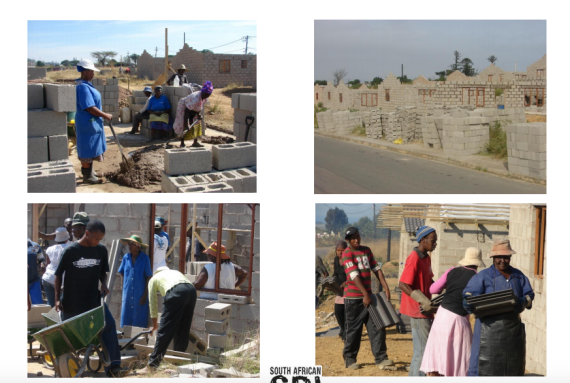
We decided to build two show houses in Tinasonke to show government that we can do it ourselves. We used our own savings money from our Urban Poor Fund to pre-finance the two houses. In Tinasonke we have three savings schemes that meet every Saturday. Two are made up of FEDUP members in Tinasonke, and one is a savings scheme of landless people.

For the show houses we selected FEDUP members according to their age and participation. One of the show houses belongs to Nthathe Elias Matodzi. He has been a member of FEDUP since we moved to Tinasonke. FEDUP is in his blood. We like FEDUP because being part of this organisation gives us knowledge.

We want to negotiate with our show houses. We want government to see that we are doing things for our selves. We want government to match us with money so it can meet us half way and give our subsidies to us. Even now the rest of the community want FEDUP houses because they have seen our show houses. We want provincial government to see that we can do it for ourselves.

* Compiled by Yolande Hendler (on behalf of CORC) 

Elias Matodzi's 'two' homes, (showhouse on right)

Elias Matodzi’s ‘two’ homes, (showhouse on right)

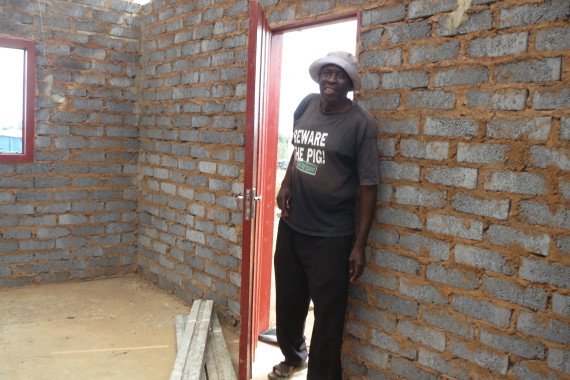
Elias in his soon-to-be-completed house.

Elias in his soon-to-be-completed house.

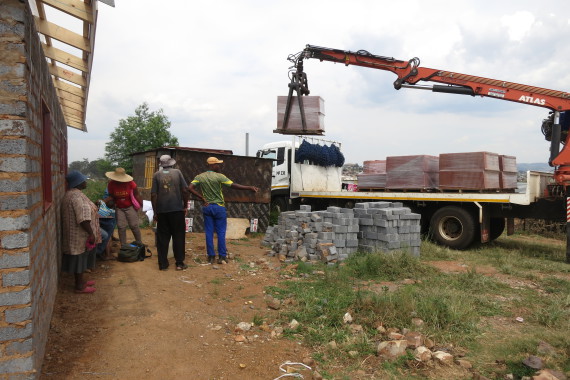
Roof tiles delivered to Elias' showhouse.

Roof tiles delivered to Elias’ showhouse.

CORC planner honoured with SAPI Young Planner Award

By CORC, News No Comments
On site in Flamingo Crescent Informal Settlement

On site in Flamingo Crescent Informal Settlement

Sizwe Mxobo, a planner at the Community Organisation Resource Centre (CORC) received  the South African Planning Institute’s (SAPI) Young Planner Award in October 2014. In speaking about his work as a planner with community movements affiliated to the SA SDI Alliance, Sizwe explains,

“An important aspect for me is exploring what public participation means in planning and informal settlement upgrading” (Sizwe Mxobo, CORC Planner).

In early 2014 SAPI released a call for nominations for successful young planners and announced its bi-annual summit in Durban titled “Planning Africa” from 19 – 22 October 2014. Nominations were submitted under various categories, one of which was the Young Planner award – to be made out to a “bright young planner (under the age of 35) for his/ her exemplary achievements and promising for the future in the planning profession as well as his/her contribution to the promotion of the planning profession” (SAPI).

The SAPI Awards

The SAPI National Planning Awards were established in 2008 to recognise and create a strong awareness of the valuable contributions and extraordinary performance in all aspects of the planning profession. The awards are an opportunity to appreciate the efforts and contributions of many planners in shaping the built environment, promoting sustainable development and maintaining the integrity of good planning practice amidst competing development interests and challenging situations.

Sizwe with Langrug commnuity leaders Trevor Masiy and Alfred Ratana

Sizwe with Langrug commnuity leaders Trevor Masiy and Alfred Ratana

Planning in the SA SDI Alliance

Sizwe has been working with CORC since 2011, providing technical support, often in informal settlement upgrading initiatives, ranging from community mobilization, capacity building, assisting settlements with preparing development plans or engaging City officials around service delivery issues.

In 2012, Sizwe project managed the upgrading and re-blocking of Mtshini Wam informal settlement in Cape Town. The project set a precedent for informal settlement upgrading, at local and national level whereby the City of Cape Town used it as a benchmark to deliver a reblocking policy. It was also awarded an Impumelelo Gold Award in 2013. Since then Sizwe has spearheaded 3 other upgrading and re-blocking projects in the City. Sizwe’s work has also focussed on Langrug informal settlement near Franschoek in the Western Cape. Through deep engagement with the community Sizwe assisted CORC and the community in devising a pallette of informal settlement upgrading strategies. The planning of Langrug was awarded the SAPI National Award in the Community Category.

Planning reblcoked Layout in Mtshini Wam informal settlement, Milnerton

Planning reblocked Layout in Mtshini Wam informal settlement, Milnerton

Why Planning?

When tracing his steps as a planner, Sizwe links his interest in participatory, community based planning to his roots.

“I was born and raised in an informal settlement and still live in one. I have always wondered what it would take to transform an informal settlement. When I saw the first housing developments in Samora and Delft I asked myself why people had to move away from their current locations and amenities. Why could changes not happen where people lived?”

Sizwe’s fascination with community development – particularly how informal communities could be transformed to formal settlements – inspired him to study Town and Regional Planning. He remembers that although informality was addressed by the curriculum it largely focussed on how to move from a shack to a house.

“My biggest attraction has always been how planning principles can be used in informal settlements. When I was planning chairperson we took students to Nyanga and explored what in-situ upgrading is about. I learnt that my interest in fighting for people who are generally not considered by planning institutions – landless people in urban areas – is called advocate planning. Others did not always understand my approach to planning. Through working at CORC I found my feet and understood what planning is for me. Winning this award has been a further confirmation. We are no longer talking the language of eradication of informal settlements but of upgrading”

In Nyanga, Cape Town

In Nyanga, Cape Town

In Kuku Town informal settlement with community leader Verona Joseph

In Kuku Town informal settlement with community leader Verona Joseph

A different approach to Planning

“In the ever-changing role of a planner, I think a key element for planners is to ensure the relationship between people and land. Public participation should be more than drawing up plans and asking for a community’s approval. It should be about supporting people to come up with their own development plans for their communities”

(Sizwe Mxobo)

As a profession planning is rapidly transforming. Most urban policies developed in South Africa focus extensively on community participation. Both the National Development Plan (NDP) and Upgrading of Informal Settlements Programme (UISP) talk about community participation as a central tenet for development. However, government has also identified this as a missing link and capacity both within the municipal and private sector. Most recently, the National Upgrading Support Programme (NUSP) has floated tenders in 49 different municipalities to develop community based plans. Clearly, community participation in the planning sector is the need of the hour.

SAPI Award Ceremony in Durban, Oct  2014

SAPI Award Ceremony in Durban, Oct 2014

Discussing Plans with Flamingo Crescent Community Steering Committee

Discussing Plans with Flamingo Crescent Community Steering Committee

With Kuku Town Steering Committee, Kensington

With Kuku Town Steering Committee, Kensington

Launch of Upgrading at Flamingo Crescent with Cape Town Mayor Patricia de Lille

By CORC, FEDUP, iKhayalami, ISN, Press No Comments

Authored by CORC

“People said Flamingo Crescent [Upgrading] will never happen. But today is here and this is the proof that it has happened – one cannot do it alone we need to work as a collective!”

Melanie Manuel, Informal Settlement Network (ISN) Co-ordinator

Mayor of Cape Town, Patricia de Lille, with Flamingo Crescent Community Members, SA SDI Alliance, PFO's and City Officials

Mayor of Cape Town, Patricia de Lille, with Flamingo Crescent Community Members, SA SDI Alliance, PFO’s and City Officials

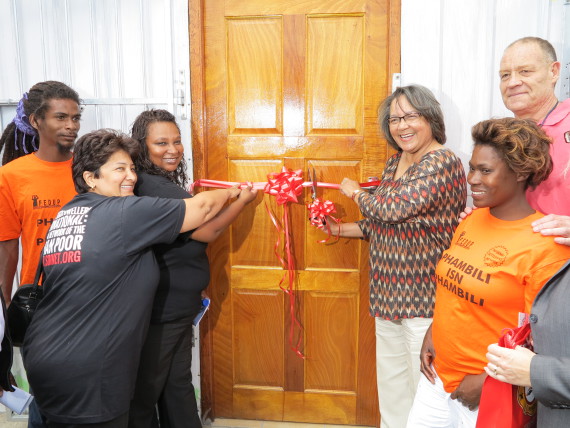
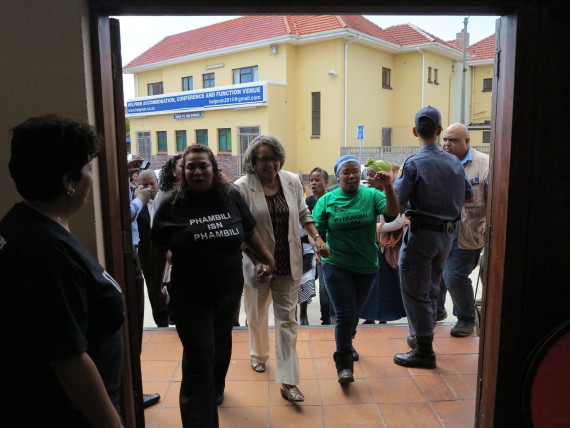
Last week’s upgrading launch at Flamingo Crescent informal settlement celebrated the completion of re-blocking, installation of water, sanitation and electricity services for each of Flamingo’s 104 households, the unveiling of Flamingo’s first formal street names and opening of the settlement’s own crèche, Little Paradise. Moreover it marked a milestone in an ongoing upgrading process, showcasing what is possible when communities, intermediaries, governments and stakeholders form partnerships.

Delegates from community organisations and networks, the Mayor of the City of Cape Town, delegates from various government departments, ward and sub-council politicians, NGOs and support organisations gathered in the Lansdowne Civic Centre from 11:00 on Monday 10 February.

The re-blocking project is lauded as a successful demonstration of community-led, participatory planning, collaborative implementation and improvement of informal settlements. The uniqueness of the project was that despite the settlement’s density no one was displaced and grossly inconvenienced during the implementation of upgrading 104 structures.

ISN & FEDUP welcome the Mayor to the launch at Lansdowne Civic Centre

ISN & FEDUP welcome the Mayor to the launch at Lansdowne Civic Centre

First engagements around Flamingo Crescent 

First engagements began in 2012 after the City of Cape Town signed a Memorandum of Understanding with the SA SDI Alliance around joint community-led upgrading of 22 informal settlements, of which Flamingo Crescent is the third, having built on the experiences of Mtshini Wam and Kuku Town. It differs from the previous two in the severity of its socio-economic challenges – high levels of crime, unemployment, violence and poverty. Given these circumstances the Alliance’s Informal Settlement Network (ISN) facilitated implementation and engagement between the City and the community.

Melanie Manuel (Flamingo Crescent ISN facilitator) shared,

“When we started the partnership with the City of Cape Town in 2011 in Vygieskraal it was a day of celebration and no one knew the hardships that would lie ahead. As time went on we realised we fundamentally believe in community participation, a bottom up approach because we know communities understand their settlements best.”

Read more background here.

Flamingo Before Upgrading

Flamingo Before Upgrading

The Launch: Messages on Upgrading and Inclusion in Services

At the launch, the first speaker, Councillor Anthea Green shared,

“Since 2012 I have said that we need to upgrade Flamingo Crescent, despite resistance from the rate payers and residents’ groups. We were committed to work with the community, and now this is a transformed settlement”.

Informal settlements not only face substandard basic services like water, sanitation and electricity but are also cut off from functions of city administration such as receiving a residential address. The re-blocking project allowed the City and the Post Office to give Flamingo Crescent street names and addresses, after the community made this requirement upfront in their development plan.

Gerald Blankenberg, regional director of the Post Office, said that the Post Office Act and other regulations require the post office to expand addresses to underserviced communities.

“Informal communities are often times socially and economically disconnected from basic administrative functions, and therefore a residential address will give the Post Office an opportunity to serve the community with dignity”, he said.

In the keynote address, Mayor Patricia de Lille emphasised the significant role of Flamingo community’s steering committee, the Alliance’s ISN and Community Organisation Resource Centre (CORC) in the success of the project. She, however, expressed concern about the slow pace of project implementation, emphasizing the need to boost municipal and community capacity to ensure the roll out of more projects in the City’s 200 informal settlements.

“The aim of re-blocking is the improvement of informal settlements while people wait for a housing opportunity”, she observed.

In closing of the ceremony, the Mayor handed over certificates of tenure to community members, ensuring formal recognition of residence and tenure security.

Mayor, Patricia de Lille with Flamingo Community Leader, Maria Matthews

Mayor, Patricia de Lille with Flamingo Community Leader, Maria Matthews

The Impact of Upgrading : Before and After

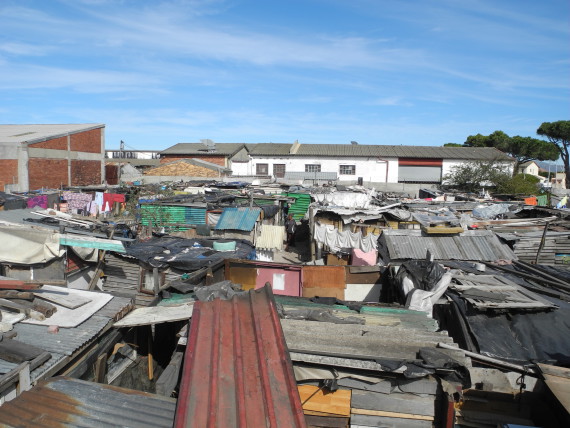
Before re-blocking, the community of 405 residents had access to only 14 chemical toilets (of which 7 were serviced) and 2 water taps. There was no electricity so that contained fires in tin drums dotted the settlement’s dusty pathways. The community was especially concerned about the safety of its children playing in the busy street.

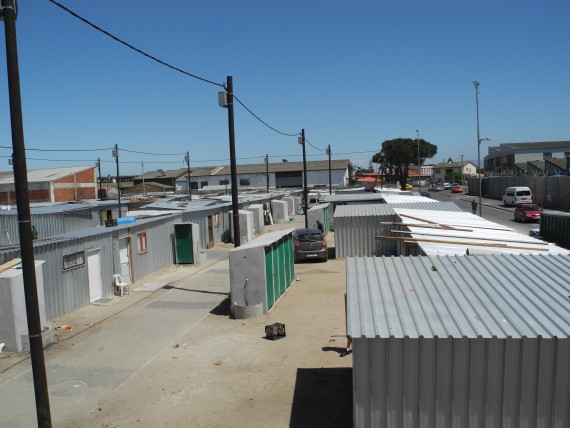
Re-blocking restructured space in the settlement, opening courtyard areas and clearly designated access roads, enabling the City of Cape Town to install individual water, sanitation and electricity services per household. What sets Flamingo apart from previous projects are its paved pathways, with official road names as well as the construction of a crèche.

The community contributed 20% to the cost of its structures through community-based daily savings. During the implementation phase, 20 jobs were created through the Expanded Public Works Programme.

Before upgrading

Before upgrading

After upgrading

After upgrading

Into the Future: Community voices on Partnership and City Fund

“Since 2010 we have been thinking about improvements in our settlement. This is when we got in touch with ISN, who introduced us to CORC, and we then made a partnership with the City [of Cape Town] We explained what we wanted from the city – our own taps, toilets and electricity. But we needed to come together and draft our own plans”.

(Maria Matthews, Flamingo Community Leader)

Through the SA SDI Alliance the community additionally partnered with several organisations. iKhayalami supported the community, ISN/FEDUP and CORC around training community members and top structure construction. The community established the re-blocked layout and community-based maps in partnership with students from Cape Peninsula University of Technology and support staff from CORC. With the support of Worcester Polytechnic Institute (WPI, USA) the community drew up plans for the crèche. Habitat for Humanity South Africa contributed to construction by supplying the roof sheets and windows. The Centre for Early Childhood Development (CECD) donated funds to build the crèche. CECD will also support around the training and registration of the crèche.

From Melanie’s speech it was clear,

“This project is successful because of the methodologies we use. We allow communities to do their own designs. The community also made a [financial] contribution [in a settlement] where 95% of community members were unemployed. How do we change the mind-sets of people who are still waiting for adequate housing? Let’s change the way we are living now while we are waiting for housing to come.”

(Melanie Manuel, ISN Facilitator)

Melanie Manuel, ISN Co-ordinator in Flamingo

Melanie Manuel, ISN Co-ordinator in Flamingo

As important as settlement improvement is in itself, the methodology is just as significant. Moreover, Flamingo Crescent serves as a precedent for informal settlement upgrading on a larger scale. The day ended with the community leading the Mayor through their settlement, unveiling Flamingo’s new street names and officially opening the Little Paradise crèche together. It is Melanie Manuel’s closing words that speak of the future:

 “We need to look at a holistic plan for the metro. Let’s look at how we can reach basic services much quicker and how we can scale up. The Alliance projects do not only focus on reblocking but on basic services in every form. The Alliance has designed a City Fund with which communities can directly access money for upgrading in Cape Town. In Flamingo the Aliance’s Community Upgrading Finance Facility (CUFF) helped us match the 20% that each community member contributed to their structure. This kind of facility on a city-level will go a long way – we challenge the City to continue partnering with us and match our contributions in the City Fund!”


Putting K2 and Green Park on the Map – Mapping Exchange in Cape Town

By FEDUP, ISN, SDI No Comments

By Julia Stricker (on behalf of SDI Secretariat)

***Cross-posted from SDI Blog***

During a very successful learning exchange focused around settlement level data visualisation and mapping, community members from K2 and Green Park, two informal settlements in Cape Town, created digital maps of their neighbourhoods. 

img_0105_medium

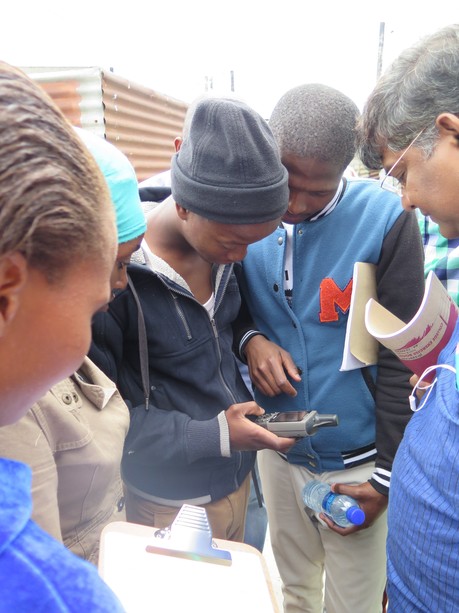
Siyaunya puts his head over the GPS device and enters the code for water tap, WT 001. Next he records the geographic coordinates of the location: -34.0289, 18.6731. He and his team repeat this process for every water tap and toilet in K2, the informal settlement in Khayelitsha that Siyaunya calls home. Different codes are used for each type of facility and with regards to their functional status. A broken toilet, for example, gets an N added to its code. These codes together with the coordinates form the raw data for the maps. Apart from the team mapping the basic services there are two other teams on the go to map the settlement boundaries and other interesting features like shops, taverns, and restaurants. Each of the three teams consists of community members, Informal Settlement Network (ISN) and Federation of the Urban Poor (FEDUP) members from across South Africa, and SDI federation members from India, Uganda and Ghana. The latter travelled to Cape Town to support the South African SDI Alliance in refining their digital mapping skills – skills that will help take SDI’s community mapping process to another level, making it easier and quicker, and increasing impact.

Through a hands-on, learning-by-doing approach Siyaunya and his fellow community members, most holding a GPS device for the first time that day, used these devices with confidence by the end of the day. They also understand that the need to stand next to the service or feature you are mapping is about more than getting an accurate reading on the GPS device. It is about the process of gaining intimate knowledge and understanding of one’s settlement and being able to share this knowledge with authority.

img_0104_medium

A geographic profile of the settlement consisting of the boundaries and the basic services, at a minimum, is a crucial part of the standardised profile. It is not enough to know the number of toilets – one also has to know their spatial distribution. If all the toilets of a settlement are located on one corner, the numbers alone are a bad indicator for the reality a woman from the other end of the settlement experiences when going to the toilet at night. The spatial dimension adds value to the data and is highly relevant for planning upgrading projects. To put it in a nutshell: Numbers are good – but maps make the numbers come alive. In addition to that John Samuel, from NSDF/SPARC India and part of the data team at SDI, points out that maps are more intuitive to understand than plain numbers and respond better to the variable literacy level of slum dwellers.

There is no perfect map and there never will be one. Maps are by nature abstractions and only a limited inventory of the reality on the ground, a complement of both objectively observable phenomena, as well as the subjective relationships to these. Bearing this in mind they remain highly important as a means to communicate our location in the world and our view on the world. The data used to generate maps of informal settlements must therefore be gathered by the slum dwellers themselves. Maps generated from community-collected data naturally put the emphasis on issues that matter to the community. This in turn is critical for the successful planning and implementation of slum upgrading projects

img_0102_medium

When speaking about Know Your City, Sumaya, a young delegate from the National Slum Dwellers Federation of Uganda (NSDFU) puts it like this:

“First you have to know what you have, then you can decide what you need, and only then you can tell somebody what you want. This is what Know(ing) Your City is all about.”

She was part of the team that profiled and mapped 62 settlements in the city of Kampala. The comprehensive report with the maps generated was handed over to the Kampala City Authority in September this year and is a good example how the data can be used to drive communities’ dialogues with government for slum upgrading and development at the city-wide scale. The profiling and mapping of settlements is a powerful tool for promoting active citizenship in communities of the urban poor.

SDI’s focus for the coming years will be to routinize and consolidate the learning around city-wide profiling and mapping for the cities it works with. Concretely, the idea of going city-wide is to push the federations to think beyond their existing network so as to include the voices of other settlements in the city, meet new leaders and together create concrete alternative plans with which they can begin to talk to their cities. Community mobilisation and mobilising city-wide federations are then also among the first goals Celine D’Cruz, SDI co-ordinator anchoring and supporting the data collection process for the SDI network, mentions when she talks about the Know Your City process. It is about the creation of a momentum of inclusion and of identity making for the community of the urban poor. Furthermore, the data collected supports the development of alternative participatory plans for slum upgrading strategies based on prioritised needs; it offers federations and communities at large the ability to monitor their own settlements and, last but not least, grounded and consolidated data at the local level, once aggregated, opens up the space for advocacy at the national and global level.

The maps of K2 and Green Park were visualised the same weekend and brought back to the respective settlements. They are as different as the settlements themselves are. Spread out Green Park contrasts with dense K2. In the latter, all the toilets are located on one site, leading to a situation mentioned above, where a map paints a clearer picture of reality then just numbers.

The learning exchange made clear that settlement profiling and mapping is an essential tool to leverage upgrading, monitor settlements and for regional and global advocacy. The young leaders from K2 and Green Park definitely seemed eager to continue the work and make the realities and needs of the city’s urban poor majority visible through maps.

k2_service_map_medium

green_parkmap1_medium

Co-producing Ideas: Denver community and University of Johannesburg Studio

By CORC, ISN No Comments

By Motebang Matsela and Yolande Hendler (on behalf of CORC)

Over the years, the SA SDI Alliance has been involved in several architecture and planning studios in which university students and community members co-produce ideas and scenarios around housing and upgrading. The most recent of these studios took place from July to August 2014 in Johannesburg’s Denver informal settlement together with community members, students from the University of Johannesburg’s (UJ) Department of Architecture, the Informal Settlement Network (ISN) and Community Organisation Resource Centre (CORC) who offered technical and social support and facilitation.

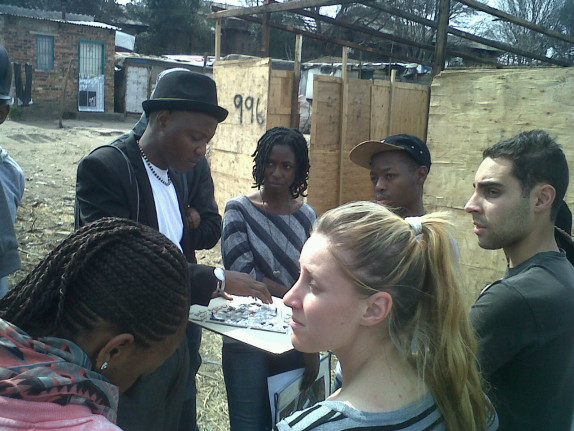
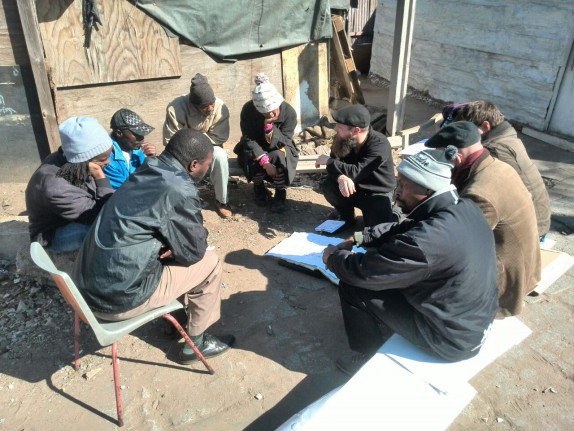
UJ students and community members in Denver informal settlement

UJ students and community members in Denver informal settlement

IMG-20140820-WA0007

Motebang Matsela (CORC technical support and CORC studio facilitator) (centre), with community members and students

Denver informal settlement

Denver informal settlement is situated in a light industrial zone that spans the southern section of Johannesburg’s central business district. It was formed in response to Denver hostel, an inner city accommodation, established around 1946 by the government of the time to house rural labour migrants. As the hostel operated for men-only, Denver informal settlement sprang up as an accommodation option for the wives of men living in the hostel. Over the years the settlement has continued to grow along with an increasing demand for housing by its residents.

IMG-20140820-WA0059

Aerial view of Denver

The studio: co-producing training for students and communities

The studio developed out of a longer engagement between UJ’s Department of Architecture, CORC and ISN, who had already collaborated on past studios in Ruimsig (2011) and Marlboro South (2012) informal settlements in Gauteng. The Denver Studio, however, differed from past studios because it introduced the first of a series of project management modules.

For the SA SDI Alliance, studios lay a foundation for productive discussions with local government that voice communities’ views, opinions and requirements. They also introduce students to the necessity and value of planning with communities, which contributes to a focus that shifts away from traditional ‘top down’ product and ‘delivery’ approaches towards ‘responsive’, community-orientated approaches.

While these outcomes are valuable aspects of collaborative work, Gauteng’s ISN leaders highlighted a current gap: community members need to gain tangible skills through the studio and upgrading process, just as the students do. Each module therefore couples practical participation in the studio with project management skills. Upon completion of every module, community residents will receive a certificate of participation. The vision is that these modules will run as an ongoing series throughout future studios and that they will incrementally build on the content of past studios, creating continuity and ongoing engagement between past and future studios.

Community members receive certificates of participation

Community members receive certificates of participation


DSCF9550

The Studio: co-producing ideas

The course engaged eighty 3rd and 5th year students in a site-specific situation that used joint mapping and data to generate community action plans (CAPs). These investigated short, medium and long term planning scenarios that would encourage short-term community initiatives and support further productive discussion with local government around incremental upgrading

The students were divided into ten groups, each of which partnered with two or more residents from Denver settlement who took the lead as designated community planners and explained the community’s various concerns to the students. One of the community leaders, Chief Mbata shared his views on the studio as a platform to commence a dialogue about the urban poor and their conditions of living. He went on to speak about the over crowdedness and the illegal electrical connections that have claimed a lot of shacks and their contents in and around Denver.

“I wish to see these dangerously exposed cables go, and better connections made by the municipality, but when shall that happen?”

(Chief Mbata, Community leader at Denver informal settlement)

Students and community members then investigated the following key themes for ten areas in the settlement:

  • Spatial Justice
  • Humane Environments
  • Scenario Planning
  • Context
  • Spatial / Physical / Social
  • Systems / Networks
  • Interfaces / Thresholds
  • Undercurrents / Threats
  • Aspirations / Perceptions
Students and community members in Denver informal settlement

Students and community members in Denver informal settlement

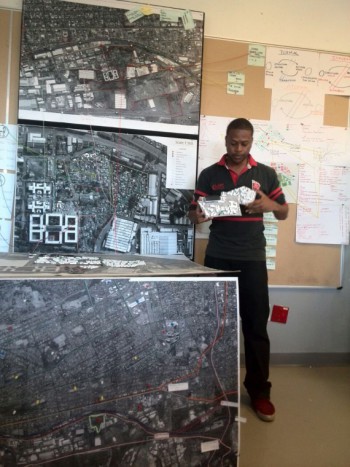
Final Student Presentations in August 2014

Final Student Presentations in August 2014

While they engaged with these themes, the community, supported by ISN and CORC, also undertook an enumeration of its settlement with the support of iSN – in a combined effort to collect comprehensive information.

As a community member, Daphne Ntombenhle Mabuso used her in-depth knowledge of the community and its history to compile the studio’s data in a collective documentation of Denver that represents the settlement as accurately as possible. Some of the studio’s content includes figure-ground drawings, actual land-use maps and various other maps that identify needs, constraints, observations and possibilities within Denver. This documentation can serve as the basis for continuing discussions between the community of Denver and the City of Johannesburg. (Click here to access the students’ documentation of the studio).

In the last week of August, the students presented their socio-spatial analyses of courtyards, pathways, open spaces,permanent vs. temporary structures and rental vs. owned units to Denver community. These open up a space to begin small-scale projects and a discussion with the local authorities. During this time community members also received their certificates signalling their participation in the studio and the project management skills they acquired. In this way community residents are becoming formally skilled participants and drivers of their own development in a collaborative, co-productive training space.

(Photos: Motebang Matsela, CORC)

DSCF9444