Tag

Community Planning Archives - Page 5 of 5 - SASDI Alliance

Re-blocking Kuku Town Informal Settlement

By CORC, FEDUP, iKhayalami, ISN, uTshani Fund No Comments
IMG_1266

View of Kuku Town in the process of re-blocking

Kuku Town informal settlement is located on a little triangle of open land opposite the railway line in Kensington, Cape Town. It is also home to about 50 people that make up 20 households.  The past week has been an eventful one as community members have seen the physical layout of their settlement transform day by day. They have taken down their old homes, structures made largely from pieces of old wood, plastic, cardboard and aluminium that were a safety risk, especially during fires.  Together with iKhayalami, an Alliance partner and support NGO the community cleared and levelled the ground as the more fire-resistant structures were erected.

3 years of preparation

Over the last three years Kuku Town prepared for upgrading by building up a relationship with the City of Cape Town, the Informal Settlement Network (ISN) and Community Organisation Resource Centre (CORC). During this time the Alliance also established a partnership with Habitat for Humanity South Africa (HFHSA). In establishing its interaction with the City, the community partnered with the alliance to organise and mobilise itself. Community members were actively involved in modeling, planning and mapping the re-blocked layout as well as collecting savings to contribute to the re-blocked structures. They gathered knowledge and experience about upgrading in community exchanges and collected information about Kuku Town in community-run profile and enumeration surveys.

Re-blocking: an Alliance approach and a City policy

IMG_1267

Community-drafted plan of Kuku Town before re-blocking

‘Re-blocking’ is a term used by the South African SDI Alliance to refer to the reconfiguration and repositioning of shacks in very dense informal settlements in accordance with a community-drafted spatial framework. Generally, re-blocking occurs in “clusters” identified by the community, which result in “courtyards”, ensure a safer environment and generally provide space for local government to install better services.

As Kuku Town is a small and dense settlement the re-blocked layout had to consider creative options. Together with CORCs technical team community designers erected the new structures along the sides of the neighbouring walls with a few re-blocked structures in the centre, opening up an L-shaped pathway throughout the settlement that enables public space and easy vehicle access in emergency situations. HFHSA stepped in at a crucial time to support the re-blocking process by sourcing G5 fill material to raise the new structures and mitigate potential flooding. As part of the community’s re-blocking proposal, the City agreed to install one-on-one water and sanitation services for every structure. This made a big difference to the 50 families who previously had to share 2 taps and 4 toilets.

The re-blocking of Kuku Town is also part of three pilot projects the City of Cape Town sought to support in the coming financial year after it adopted re-blocking as an official policy on 5 November 2013. The City thus indicated a long-term commitment of resources to re-blocking projects, to departmental alignment and to meaningful interventions in informal settlements.

DSCN5728

Community designed re-blocking plan for Kuku Town


Mobilising the community, engaging the City

In 2006 Kuku Town first appeared on the City’s informal settlement database, after a community leader engaged local councilors around poor service delivery. Later, in mid-2011 after the City and ISN / CORC signed a Memorandum of Understanding (MoU) the community joined the ISN network and clarified a way forward for collaborative partnership with the City.

ISN community leader, Nkokheli Ncambele explains that the interaction between ISN and Kuku Town began when the PFO (Principal Field Officer) of the City’s Informal Settlement Management Department introduced Kuku Town community leaders to other upgrading processes in the informal settlements of Burundi and Sheffield Road. These exchanges provided an opportunity to learn, ask questions and share experiences about informal settlement upgrading. Once community leaders had met with the city and ISN a big meeting took place in Kuku Town to explain upgrading to the community.

DSCN5708

Mzwanele Zulu (ISN), City officials, Verona Joseph (Community leader)


After some initial resistance the community decided to opt for re-blocking. This meant that they needed to start saving toward contributing to their own structures.Verona Joseph, Kuku Town community leader, explains that

“over 3 years we managed to save R 15 000. Most people in our community are above 50 years. Only 3 are employed and 5 get a pension. But even the old people managed to save money”

64-year old Auntie Hana Olyn and her husband Piet Jordaan, remember how

“when we collected two bottles we would save the deposit from one bottle. We also collected tins, did the gardening or ironed people’s clothes. This is how we managed to save quickly. Most people could earn R 100 a day. Some of this they used for savings.”

Most community members chose 12m2 and 20m2 structures for which they respectively needed to save R740 and R1000.  The remaining cost of the structure was covered by the Community Upgrading Finance Facility (CUFF). Savings are recorded in personal savings books and are deposited in a community savings account. Regular bank reconciliations are communicated to the group.


IMG_1237

Verona and Auntie Hana Olyn in her new home


DSCN5727

Community savings records


In April 2012 community members also led an enumeration in Kuku Town through which they gathered relevant, verifiable, and specific data that was used to build models and draft the re-blocking plans. For Verona, the enumeration brought about another success:

“Before the enumeration we had people from different families staying in one structure. Only some of them were registered with the council. I wanted to push for every family to get their own structure. The problem was that some people did not qualify because they were not registered with the council. But with the enumeration we re-counted everyone and got them re-registered.  This was the most important thing! The council then agreed that every family could have its own structure.”

 “As a community we are more comfortable now”

Lydia and Verona, both on the leadership committee, agree that this is one of the biggest changes.

 “We don’t have rats any more and when it rains we won’t lose our clothes. But people’s way of life is also changing. It was a struggle to convince them, but now they have other things to focus on – they are fixing things in their homes. With the new structures everyone’s lives will pick up because this is a very upgraded informal settlement now”.



Building Partnerships: Comic Relief vice chair and film director Richard Curtis visits SA Alliance

By CORC, News No Comments

By Yolande Hendler (on behalf of CORC)

DSCN5524 - Kopie

Richard Curtis, Melanie Manuel (ISN), Emma Freud, Bunita Kohler (Director of CORC), Marlene Don (FEDUP) and Bukiwe Marawu (CORC)

Last week, the South African Shack Dwellers Alliance welcomed Comic Relief vice-chair and film director/producer/writer Richard Curtis with his wife, Emma Freud, and family at the Cape Town office. Before arriving he told his children,

“Today I’m meeting the people I work for”.

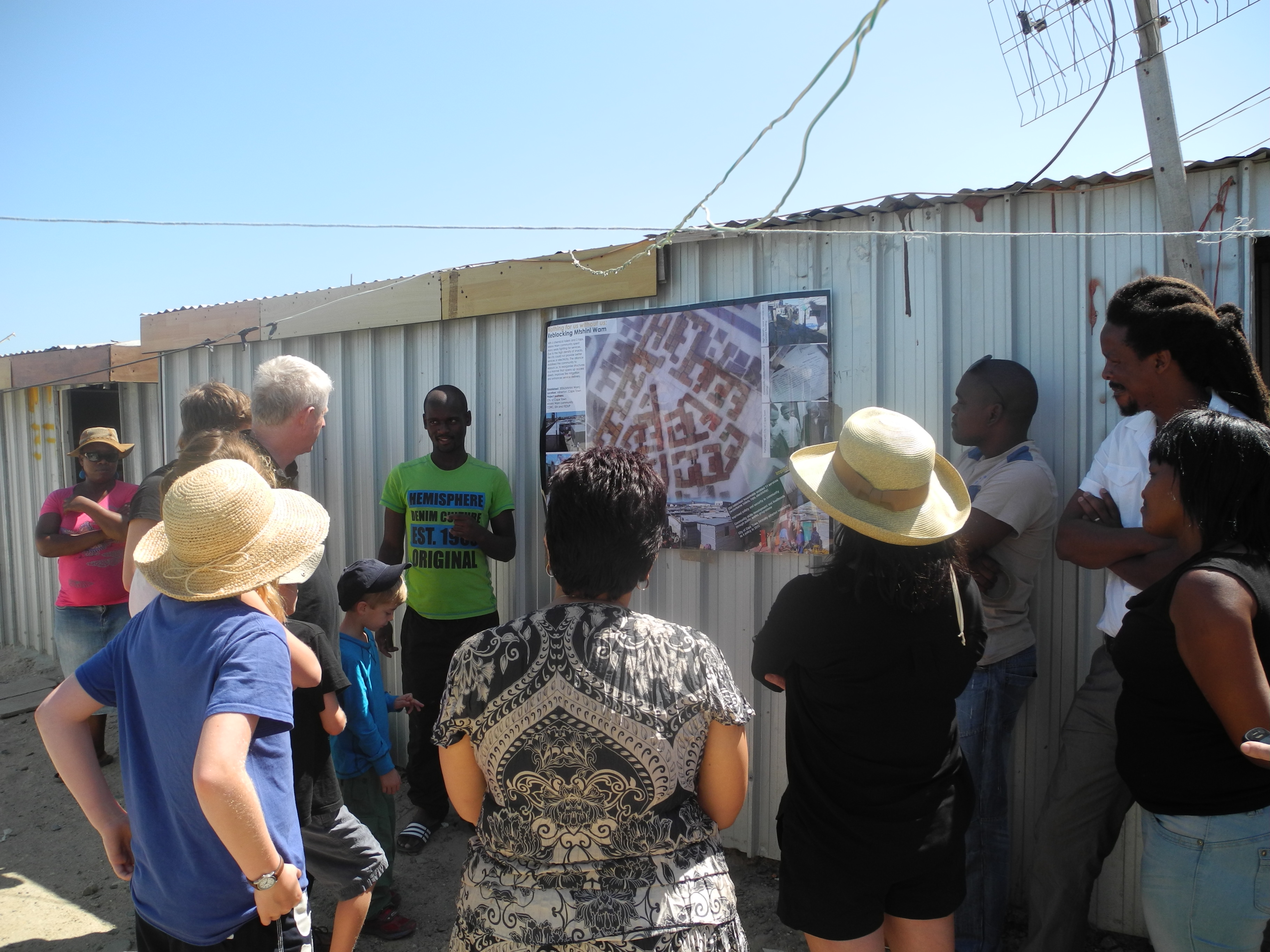
As a renowned film-maker, Curtis is also co-founder of the UK based charity Comic Relief which has been one of the alliance’s principal development partners since 2011. Together, they spent a morning meeting the alliance partners, visiting Mtshini Wam informal settlement where community members explained the process of re-blocking and showed Curtis and his family what a re-blocked settlement can look like. They also visited the Solid Waste Network, one of the alliance’s income generation initiatives.

DSCN5533

Mthsini Wam community members explain reblockingDSCN5542

Building Partnerships

To achieve the vision of more inclusive and pro poor cities it is critical to build partnerships with urban development actors who support this vision. The alliance’s association with Comic Relief as a development partner is a platform for organised communities to be at the core of building such cities. Communities are best positioned to contribute to design and to plan development solutions that have greater impact and sustainability than external development interventions. The alliance’s partnerships not only include the network of SDI affiliated countries or partnerships with government but also focus on partnerships with international aid agencies and donors, such as Comic Relief.

Founded in 1985, Comic Relief’s vision is of a “just world, free from poverty” (Reference). By raising funds through campaigns such as Red Nose Day and Sport Relief, Comic Relief spends these on projects that tackle the “root causes of poverty and social injustice in the UK and across the world” (Ibid). In particular Comic Relief supports projects “on the ground”, giving people a “leg up, not a hand out” (Ibid). Comic Relief displays a long term view of achieving this vision and therefore forms lasting partnerships with local organisations. Some projects are supported for up to six years whereby the progress of projects is tracked and funds are paid in phases.

Comic Relief and the South African Alliance

Comic Relief has been a core funding partner of the Alliance’s work since 2011 when uTshani Fund secured a grant for supporting the core activities of FEDUP housing development process. The grant is in its second year of operations and aims to support community lead projects in housing development and informal settlement upgrading (via the uTshani Fund housed funding facility Community Upgrading Finance Facility). uTshani Fund and CORC have formed a close working relationship in addressing the challenges of homelessness, landlessness and urban poverty.

The Community Organisation Resource Centre (CORC) has also been successful in applying to Comic Relief for grant funding. As part of its UK Aid Match scheme, Comic Relief formed a partnership with the Department for International Development (DFID). In December 2011 DFID agreed to provide a further £10m of funding for Comic Relief’s Urban Slums work. This sum would be matched by Comic Relief through funds raised during Sport Relief 2012, thereby totaling £20m. This new fund is intended to transform the lives of a million slum dwellers in a limited number of African cities through the strategic collaboration of agencies. The funding spans five years in total.

CORC and the South African alliance partners responded to the call for proposals and were successful in their application. The core of the funding proposal focussed on setting up a local city fund which will deliver informal settlement upgrading projects in the area of Khayelitsha in the City of Cape Town. The city fund is a responsive mechanism that aims to achieve a long term sustainable fund which could be replicated and/or recapitalised by City and Provincial government.

The beginning of Comic Relief funded projects in Khayelitsha

DSCN5045

Community leaders plan and design in KhayelitshaDSCN5063

As part of the Comic Relief grant, the alliance has been engaging with several neighbouring communities in Khayelitsha that live in UT, TT and BT sections, Litha Park and UT Gardens. Since mid 2012 these communities have been forming a horizontal relationship with ISN structures. After community members living in UT Gardens profiled and enumerated their section, they expressed the need for a crèche / multi-purpose centre for the community on a nearby open field.  Since the start of 2014 community leaders have continuously met with each other and CORC’s technical support team.

The meetings have had two aspects: On the one hand the community leaders expressed some key issues to address such as drainage and managing waste disposal. On the other, they co-designed and co-conceptualised the first drafts of the crèche / multi-purpose centre and identified existing footpaths and transit spaces. As the discussions continue, community leaders are eager to see this project lift off the ground.

This, then, is one of the projects that the Comic Relief grant supports. On the surface, it looks entirely different from Mtshini Wam or the Solid Waste Network which Curtis and his family visited. Yet the similarity lies in the tools that each community uses to organise itself. It lies in communities who lead their own design and planning. The SA SDI Alliance values long term funding agreements with international development partners such as Comic Relief (and its associations and members) that recognise the imperatives of informal settlement upgrading, housing and land, and livelihoods development.


FEDUP’s Gogo Mohale saved up for “the house of her dreams”

By FEDUP, uTshani Fund No Comments

By Patrick Matsemela (on behalf of FEDUP)

2013 was a special year for Gogo Mmapule Mohale.  After she saved for 14 years, we began building her house in Maboloka in North West Province. She started saving with the Federation of the Urban Poor (FEDUP)  in 1999. FEDUP is a women-led social movement that empowers communities to start community saving schemes. It is also one of two social movements that forms the South African Shack Dwellers Alliance. At meetings Gogo Mmapule Mohale would always tell other members,

“I am not in a hurry. I know that I will have the house of my dreams. What needs to happen is that we must negotiate with government for more support”

Now, Gogo Mohale is 87 years old and received her house.

07032013006-002

Gogo Mohale in front of her old house


16082013038-001

Gogo Mohale’s new house


FEDUP – North West Network

In the North West, the FEDUP network is formed by four to six savings groups. We have six local facilitators and one regional facilitator. Federation network members meet once a month, where they bring different reports from different savings groups. They also share information on their different groups and compile a report for the regional meeting. The report also requests support on issues raised in network meetings.

Through FEDUP saving schemes, communities can develop their own knowledge and capacities, build houses and acquire land. In South Africa FEDUP has about 1500 savings and credit groups which range from a minimum of 15 to a maximum 500 members. If communities save small amounts of money, collect information and use this to negotiate with government they have a better chance of securing entitlements, strengthening themselves and leading their own development plans. FEDUP has used its collective power to lobby government and access the housing subsidy programme. In this way it strongly influenced the governments’s low-income housing policy, the People’s Housing Process (PHP) and later, the enhanced People’s Housing Process (ePHP). uTshani Fund is FEDUPs own housing finance facility and account administrator.

A FEDUP member calculates our her savings at our network meeting in Mafikeng (North West Province)


The North West / FEDUP Pledge

Gogo’s house was one of 200 hundred houses that were pledged to be built in Maboloka. The Maboloka project was part of several housing projects in Mafikeng Municipality in North West Province which was part of a national housing pledge signed in 2006 between uTshani Fund and the National Department of Housing and then minister, Lindiwe Sisulu. The pledge was for 1000 subsidies with which to build houses throughout South Africa. The other projects in North West Province were in Lethabong, Jericho&Legonyane, Oukasie Lethabile, Mafikeng and Madinyane.

Lethabong, for example, would receive 96 subsidy houses. As FEDUP we managed to build 89 houses. For this we won the runner up to the North West award for best enhanced People’s Housing Process (ePHP).  For us as FEDUP the PHP needs to be focused on the community. The most important thing about this project was that it was led by the community. We want them to lead the construction, administration and project management. This happens through the Community Construction Management Team (CCMT) which is formed by community members who hold the positions of project manager, procurement officer, bookkeeper, administrator and community liaison officer.  The houses that FEDUP members receive are bigger (54m²) than RDP houses (36m² or 40m²).

We are happy that after so many years of saving together, Gogo Mohale now has her own house. For other FEDUP savings groups to achieve what Gogo Mohale did, we still need more support from government.


07032013004

The CCMT team manages construction


Rethinking ‘successful’ cities – SA SDI Alliance wins runner-up at Ingenuity Awards 2013

By CORC, iKhayalami, ISN No Comments

Re-blocking as an innovative approach to urban informal settlements.

By Yolande Hendler (on behalf of CORC)

If “the most successful cities will be those that embrace ground-breaking solutions to meet the changing needs of their citizens” (Ingenuity Awards)

the question really is: What constitutes a  ‘successful’ city – and ‘ground-breaking’ solutions?

In a time of mass urbanisation these questions caught the attention of the Financial Times (FT) who in 2012 decided to publish a series of three magazines along with a global awards scheme, the FT / Citi Ingenuity Awards: Urban Ideas in Action programme. The awards aimed to recognise and honour “ingenious individuals or organisations that have developed solutions to urban challenges” (FT publication, July 2012, p.3). The South African Shack Dwellers Alliance participated in both award rounds (2012 – 2013) and won runner-up for the regional Africa submissions in 2013. The FT and Citi – financial service giants in global business news and banking – ran the awards together with Insead, a leading global business school who joined as a research partner.

2012 Awards

In 2012 the award entries were grouped in the categories of energy, education, health and infrastructure. Together, these were seen as providing a good overview of contemporary urban innovation. iKhayalami – an NGO part of the South African Shack Dwellers Alliance – used this platform to share its work around the community-driven, re-blocking process in Sheffield Road informal settlement in Cape Town. The community’s ideas were at the centre of the re-blocking process which addressed pertinent issues of decent sanitation and water, thereby uniting the community and restoring a sense of dignity. In short, every level of the project dealt with design, capacity building, engaging the state, policy-making and replicability. Nairobi’s Community Cooker Foundation won the 2012 awards while Sheffield Road reached the final round in its category. As the impact of re-blocking became more significant through its replication and growing support base, a new submission was entered under the banner of the South African Shack Dwellers Alliance which is affiliated to Shack Dwellers International (SDI).

SR 2

A courtyard in Sheffield Road informal settlement after re-blocking.

2013 Awards

In the meantime the 2013 award categories had changed to regional areas (Africa, Asia-Pacific, Europe, North and South America) to allow for a broader scope of applicants. A panel of judges (that included architects, city planners, academics and public policy specialists) would judge regional submissions based on the criteria of originality, impact (how much of a difference the project made), sustainability and project transferability to other cities.

By this time, the increased scope of re-blocking in South Africa was evident: it had expanded from iKhayalami to the South African Shack Dwellers alliance and its associated communities. One of the alliance’s social movements – the Informal Settlement Network (ISN) – was at the forefront of the blocking-out agenda as its reach and relationship extended to numerous informal settlement communities throughout South Africa. The re-blocking approach also expanded to policy level whereby it was being drafted as a policy document for implementation in the City of Cape Town. This was done in consultation with the alliance partners.

The idea of re-blocking

As in 2012, the idea of re-blocking was again at the centre of the alliance’s submission in 2013. This innovative and community-centred approach responds to the haphazard spatial layout of many informal settlements that makes it difficult for social or emergency services to gain access to settlements, particularly when there is a fire.

Re-blocking is a social, community-driven process.

On the one hand the re-blocking process is technical. It encompasses a spatial reorganisation of shacks that opens up courtyards and creates clear pathways in a settlement. This gives officials an opportunity to provide improved services as well as making the settlement more safe and secure. Re-blocked shacks are built using Zinc aluminum, which is more fire resistant than conventional materials.

On the other hand, re-blocking is deeply social. Throughout the re-blocking process, the community’s ideas and impetus are key. Re-blocking is led by community designers together with technical assistance from alliance development practitioners in iKhayalami and the Community Organisation Resource Centre (Corc). Community Designers are community members whose design skills are grounded in past project experience.  Andy Bolnick, director of iKhayalami explains,

“Reblocking is about poor communities coming together, redesigning their spatial layout and upgrading their communities in partnership with the state which leads to more equitable and inclusive cities” (Andy Bolnick, Director of iKhayalami)

For Cape Town municipality, its “work with the alliance has provided a solution to the enormous housing backlog [it] is dealing with” (Seth Maqetuka, Executive Driector for Human Settlements in the City of Cape Town).

2013 Runner’s Up: SA SDI Alliance

Nkokheli Ncambele (ISN community leader) and Andy Bolnick (director of iKhayalami) at Ingenuity Awards Ceremony in New York.

Nkokheli Ncambele (ISN community leader) and Andy Bolnick (director of iKhayalami) at Ingenuity Awards ceremony in New York.

After FT journalists visited the alliance in 2013, a panel discussion of the African finalists was held in London in September 2013. The award winners were announced in December 2013 in New York. Both Andy Bolnick and ISN community leader Nkokheli Ncambele attended the award ceremony. The alliance’s submission won runner-up in the Africa region, following Nairobi-based Sanergy, a network of low-cost franchised toilets which also won the overall award for 2013. Social entrepreneur and Sanergy co-founder, David Auerbach explains that Sanergy’s approach is a market-based one which follows the idea of creating something that can scale up (FT publication, July 2013, p. 13). In addressing the persisting problem of human waste Sanergy creates “a network of low-cost franchised toilets which are operated by resident micro-entrepreneurs on a pay-per-use basis” from where waste is collected, organically fertilised and sold to farmers for profit (Ibid).

Rethinking ‘success’

The Ingenuity Awards certainly saw a fascinating variety of innovative projects, of which the African submissions addressed some of the most pressing challenges faced by people living on the informal, social and economic margins of cities.

In addressing the question of a ‘successful’ city, the FTs suggested that

“…the success of a city should be measured not in terms of economic transactions per square metre over a given period of time but in terms of social transactions” (Architect Teddy Cruz,  in FT publication July 2012, p.3)

For FT architecture and design critic, Edwin Heathcote  this view “would dramatically redefine our notions of what a successful city looks like – drawing it in terms of population rather than its turnover … It turns on its head our idea of economic success in terms of personal space and residential footprint… In a stroke, [it] democratises our view of the city [whereby] innovations propose solutions for the informal as well as the developed city” (FT publication, July 2012, p.7).

Yet, from the past two winners it seems apparent that the FT and Citi view business and market-based solutions as answers to addressing the pressing challenges of urbanisation. Should ‘successful’ cities and ‘ground-breaking’ solutions not also expand on market based approaches to challenge the political status quo and existing power relations between the formal and informal sectors? The social processes of community mobilisation are just as significant as the ‘technical’ outcome of re-blocked shacks or a micro-entrepreneurial approach to waste disposal. ISN community leader, Nkokheli Ncambele reflects on the social processes of re-blocking,

 “Blocking-out focuses on so many aspects not only just sanitation but on all aspects of people’s lives. I was surprised that the alliance did not win the award but it is good that we were recognised for what we are doing”

(Nkokheli Ncambele, ISN community leader)

The question of a ‘successful’ city then reaches beyond mere ‘technical’ engagements to how these engagements happen. It is a question that asks, how can urban poor communities engage with the state and other actors in a way in which they are more equal and not more powerless?