Category

CORC

CORC Architect receives honourable mention by CA-ASI

By CORC, ISN, News, Press No Comments

visuel_projet8A young architect working with CORC, Mr. Olwethu Jack, was awarded one of nine “honourable mentions” in the most recent international architectural competition hosted by CA’ASI Association, an international ” “club” open to all those who love contemporary architecture and design“. In a press release dated 2 April from CA’ASI Paris headquarters, the international jury, after having reviewed 194 projects submitted, announced the winners of Young Architects in Africa competition which aims to highlight African project creativity, and help a rising generation of young architects achieve worldwide recognition. This follows the successful previous editions of the awards of New Chinese Architecture in 2010 and Young Arab Architects in 2012.

The CA’ASI Association has been established to promote the dialogue between architecture, contemporary art, and the Biennale visitors. For the 14th International Architecture Biennale, the CA’ASI has opened the doors of Palazzo Santa Maria Nova to emerging African architects in order to emphasise the creativity and originality of new African architecture, and to help it gain world-wide recognition.

Mshini Wam profile

In Mr. Olwethu Jack’s submission form, primarily citing his supportive work with the communities of Mtshini Wam and Langrug, he writes

Personally as a designer working for CORC I value the opportunity of designing with community members whereby I am able to use my architectural background to fulfil the community’s developmental vision. This process is informed by the community’s vision of their settlement and after discussing the vision, we, together with the community assist in putting that vision on paper sometimes through models, which is 3D visual to assist the community to understand the context better. The most important thing for me is building a model together with the community because sometimes it is hard for the community members to understand the terminology, scale and space thus the models helps eliminate some of the language barriers.

The Wash Facility

The Wash Facility

The Young Architects in Africa competition recognizes and concerns architecture in a broad sense, and “there is no particular type of project to submit. You can submit either built or unbuilt projects. The program, category or size are not imposed. All types of projects are welcome.” (Project Information FAQ). AS.Architecture-Studio defines architecture as “an art which is socially committed and engaged in the construction of mankind’s living environment”. It is based on team work and shared knowledge.

These projects will be exhibited at the CA’ASI, AS.Architecture-Studio’s Common House in Venice, as part of the 14th Architecture Biennale’s Collateral Events (June 5th – August 30th 2014), then at arc en rêve centre for architecture in Bordeaux, the Academy of Architecture in Paris, and several other cultural institutions across Africa. All projects from the candidates to the YAA competition will be published in a widely distributed bilingual catalog.


Amandla Imali Nolwazi! Alliance marches to eThekwini Municipality

By CORC, FEDUP, ISN, uTshani Fund No Comments

After weeks of preparation and community mobilization, thousands of shack dwellers gathered on Durban’s Dinuzulu Square early on Monday morning, 24 March 2014. As people arrived by foot, mini-bus taxi and on numerous busses, they were met by songs of protest sounding from an ever-growing crowd of shack dwellers affiliated to the Federation of the Urban Poor (FEDUP) and the Informal Settlement Network (ISN).  The mass of black and white t-shirts, placards, banners and cardboard signs bore powerful messages

“Did you know the majority of people in eThekwini are still without title deeds?”

“Phambili nge community participation – Forward with community participation!”

“No Upgrading without Us!”

These messages pointed to the purpose of the march: to hand over an agreement of co-operation to eThekwini Municipality which outlined a more inclusive, implementable and participatory partnership between the municipality and organized groups of shack dwellers affiliated to FEDUP and ISN.

First marchers gather at Dinuzulu Square

First marchers gather at Dinuzulu Square


From Dinuzulu Square to the City Hall

The date of the march coincided with national celebrations around Human Rights Day. Most shack dwellers in eThekwini municipality and the country, however, do not benefit tangibly from the achievement of human rights in South Africa. Land acquisition, housing, water and sanitation, refuse removal, access to electricity and informal settlement upgrading are urgent and daily recurring concerns. For shack dwellers in eThekwini municipality these issues are particularly expressed in the lack of a meaningful engagement between themselves and the municipality.  The march, therefore, aimed to set the scene for an inclusive and participatory working relationship.


IMG_1387

A crowd of about 2500 marchers set off from Dinuzulu Square at 11h00, marching in peaceful and powerful protest, singing and loud hailing slogans that express the hardships of life in informal settlements and the power of organised communities. In the mid-day heat of a bright summer’s day, the streets of Durban CBD came to a standstill as shopkeepers, pedestrians and on-lookers absorbed the lively and determined atmosphere. The slogan was clear:

“Amandla, Imali Nolwazi, eish! Ayilumi Mayihlafuna” – Power is Money and Knowledge! Eish! You can’t bite while you are chewing!

IMG_1439IMG_1426

The alliance slogan directly speaks to the low response many urban poor communities receive from local municipalities.  ISN community leader Sifiso Nobani, explains that

“We chose to march because this is the only language that the municipality understands. Roads will be closed and people and businesses will take notice of us”

After 2km, the marchers, representing numerous informal settlement communities in eThekwini gathered in front of the City Hall to hand over the Agreement of Co-operation.

Towards an Agreement of Co-operation

The agreement was drafted as a response to some of the most pressing challenges faced by the urban poor in eThekwini. Sithembile Doncabe, FEDUP savings scheme leader, explains that

“ We are sick and tired of living in informal settlements. We are losing our dignity. We want to raise our dignity. We are citizens. We want houses. But they are not listening to us”

Ma Mkhabela, provincial FEDUP coordinator adds,

“There is some commitment from the municipality but they keep pulling back. When we meet in joint working groups once a month, municipality members are often missing. The provincial and national response is better. The problem is that our ‘partnership’ with the municipality is not a written one”

“We don’t know anything about the municipality’s plans for upgrading our settlements. We need to be informed about time lines and planning. We want to be independent communities. We have rituals that help us, like enumerations that show that one shack does not equal one family. If we have a chance to submit this information to the municipality we can develop our country nicely, like the constitution says!”

At Durban City Hall

At Durban City Hall

The co-operation agreement outlined these concerns in more detail. They relate to: a lack of updated facts and figures concerning the urban poor, a slow approach to land acquisition and assembly for informal settlements, inadequate delivery of basic services and disaster management, inadequate inclusion of the urban poor in municipal budgeting and planning processes, lack of municipal commitment to Joint Working Group structures to deal with uTshani Fund old debt and Pledge Housing implementation, limited social development, poverty alleviation, livelihood generation and nutritional programs as well as inadequate access to finance in funding community based upgrading projects. The agreement of co-operation also outlines the purpose and joint activities for future collaboration, emphasizing practical and implementable suggestions.

Several provincial alliance members shared their experiences around lobbying and mobilization with the marchers. Joe Nene, advisor to the Mayor, then joined national coordinators Rose Molokoane (FEDUP), Mzwanele Zulu and Patrick Magebhula (ISN) as the agreement was read out and handed over.

Mr. Nene received the agreement, emphasizing that he could not promise a signature but that it would be passed on to the mayoral office, which would respond within seven days.

As communities wait for a response from the municipality, Ma Mkhabela is clear,

“We want to plan together with the municipality so that they know our priorities. They need to talk to us. There’s nothing for us without us. We want to know that we have agreed together”.

Joe Nene (Advisor to the Mayor), Patrick Magebhula and Mzwanele Zulu (ISN national coordinators)

Joe Nene (Advisor to the Mayor), Patrick Magebhula and Mzwanele Zulu (ISN national coordinators)

2014 UCT – Europe Community Studio “The Beginning”

By CORC, ISN No Comments

By Thandeka Tshabalala and Yolande Hendler (on behalf of CORC)

Community members and students locate structures and amenities in Europe informal settlement.

Community members and students locate structures and amenities in Europe informal settlement.

On 19 February 2014, Europe community members welcomed about thirty masters students of Urban and Regional Planning from the University of Cape Town (UCT) to their informal settlement, which is located in Gugulethu, Cape Town. This first gathering kicked off a four month long ‘planning studio’ in which community members and students will work together to address some of the community’s most pressing concerns. The studio also aims to expose students to alternative planning approaches to urban informality. The Informal Settlement Network (ISN) facilitates and supports the community leadership while CORC offers technical support as the community and students develop plans for upgrading. Read more on the background leading up to the 2014 studio.

First meeting in Europe

Community members and students gathered in Europe’s community hall where ISN and CORC shared opening insights on the importance of community participation, mobilization and capacitation. Such an approach forms a solid foundation for planning community-relevant issues such as access to basic services and housing. Situated close to employment opportunities at the Airport Industria and the N2 corridor, Europe’s location is ideal for its residents. For this reason students and community members decided that it would be ideal to look at in-situ, incremental upgrading projects. In order to give students a more concrete idea of ‘life in Europe’ community members showed them around their settlement. This opened up a platform for both community members and students to reflect and share their expectations for the studio ahead.

Students' first visit to Europe.

Students’ first visit to Europe.

The purpose of the studio is two-fold: For the community, technical support around housing and upgrading are advantageous for engaging government. For the students it is advantageous to gain valuable experience in working in a highly collaborative and participatory environment around some of the most pressing issues in the city.

After the visit, CORC’s technical team joined the students at UCT in order to reflect before the next joint planning session with community members. Based on the students many impressions – for some it was the first visit to an informal settlement – a variety of ideas, concerns and suggestions arose. Some students related Europe to studies of urban informality in the global South, others explored how the meaning of boundaries in communities impacts opportunities and community interaction.  Some concerns related to the lack of public interaction spaces, lack of socio-economic activity and the need to value recycling as a source of income. Other students emphasized the importance of collaborative and participatory planning methods.  Towards the end, one of the students seemed to capture the general sentiment that

“We need to develop new sets of eyes to understand the logic systems, local assets and already present ways of doing things in Europe. We need to identify local systems. The community needs to identify its own opportunities”

Joint planning for action

The next session was an interactive one with a printed map of Europe. It was marked with some reference points, landmarks and amenities that would serve as a collaborative working document to gather information about the settlement from community members.  This meeting focused on sharing expectations and establishing specific issues the community wanted to address. Furthermore, it established where students’ interests and abilities aligned with community priorities.  With great excitement, students and community members located their homes on the map, marked off the boundaries of Europe and identified central spaces. Community members also expressed that they would like the studio’s incremental projects to support their long-term vision of attaining housing. This focus is linked to the question: “how permanent is our temporary?” As communities wait for permanent housing, there is a need of assisting well located settlements such as Europe to upgrade, but not lose sight of the long term vision.

DSCN5652

Interactive mapping at UCT

After several visits to Europe, students expressed the significance they perceived in planners moving away from physical planning to focus on the people they are planning with, i.e. understanding their background and socio-economic context within the larger context and potential of the city. The students thus based their analysis of Europe community on reinforcing socio-economic opportunities.

Through engaging with residents’ already present coping mechanisms students researched opportunities, constraints and concepts for future action. The opportunities they presented included access to employment, recreational spaces, spaces of interaction, education and small businesses. The identified constraints comprised flooding, crime, physical and social barriers, pollution and poor soil quality affecting food production. Together, community members and students developed working groups that respectively looked at socio-economic issues, transport, housing / land / tenure issues and water, sanitation and storm water services.

Working Groups 2

A working group in Europe

The working groups then identified more concrete concepts:

  • Socio-economic opportunities around Klipfontein Road

Klipfontein Road was presented as a main artery of opportunity as Europe’s main entry point and connecting point to other neighbourhoods. The industrial area at the airport was presented as a potential source of employment. A further point related to taking advantage of existing business that represent high activity nodes.

  • Easing access to public transport routes

This was particularly relevant due to the community’s reliance on pubic transport.

  • Potential upgrading and re-blocking
  • Strengthening food production

The focus would lie in increasing food security whilst decreasing poverty levels.

  • Overcoming barriers to neighboring communities

This would facilitate greater interaction between communities.

During the presentation students emphasized the knowledge they had gained from the community in developing these concepts,

“ We regard the community as experts, they have all along been able to use their human architecture to deal with the physical constraints of the space they live in.”

The next phase of the studio will comprise developing a spatial development framework. CORC and ISN will continue to share the studio’s upcoming developments.


Re-blocking Kuku Town Informal Settlement

By CORC, FEDUP, iKhayalami, ISN, uTshani Fund No Comments
IMG_1266

View of Kuku Town in the process of re-blocking

Kuku Town informal settlement is located on a little triangle of open land opposite the railway line in Kensington, Cape Town. It is also home to about 50 people that make up 20 households.  The past week has been an eventful one as community members have seen the physical layout of their settlement transform day by day. They have taken down their old homes, structures made largely from pieces of old wood, plastic, cardboard and aluminium that were a safety risk, especially during fires.  Together with iKhayalami, an Alliance partner and support NGO the community cleared and levelled the ground as the more fire-resistant structures were erected.

3 years of preparation

Over the last three years Kuku Town prepared for upgrading by building up a relationship with the City of Cape Town, the Informal Settlement Network (ISN) and Community Organisation Resource Centre (CORC). During this time the Alliance also established a partnership with Habitat for Humanity South Africa (HFHSA). In establishing its interaction with the City, the community partnered with the alliance to organise and mobilise itself. Community members were actively involved in modeling, planning and mapping the re-blocked layout as well as collecting savings to contribute to the re-blocked structures. They gathered knowledge and experience about upgrading in community exchanges and collected information about Kuku Town in community-run profile and enumeration surveys.

Re-blocking: an Alliance approach and a City policy

IMG_1267

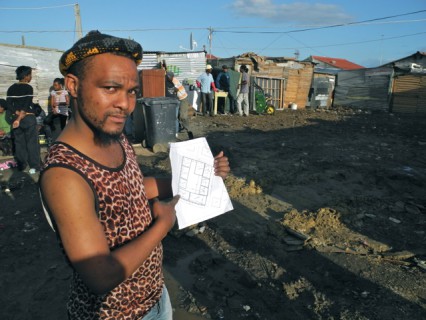
Community-drafted plan of Kuku Town before re-blocking

‘Re-blocking’ is a term used by the South African SDI Alliance to refer to the reconfiguration and repositioning of shacks in very dense informal settlements in accordance with a community-drafted spatial framework. Generally, re-blocking occurs in “clusters” identified by the community, which result in “courtyards”, ensure a safer environment and generally provide space for local government to install better services.

As Kuku Town is a small and dense settlement the re-blocked layout had to consider creative options. Together with CORCs technical team community designers erected the new structures along the sides of the neighbouring walls with a few re-blocked structures in the centre, opening up an L-shaped pathway throughout the settlement that enables public space and easy vehicle access in emergency situations. HFHSA stepped in at a crucial time to support the re-blocking process by sourcing G5 fill material to raise the new structures and mitigate potential flooding. As part of the community’s re-blocking proposal, the City agreed to install one-on-one water and sanitation services for every structure. This made a big difference to the 50 families who previously had to share 2 taps and 4 toilets.

The re-blocking of Kuku Town is also part of three pilot projects the City of Cape Town sought to support in the coming financial year after it adopted re-blocking as an official policy on 5 November 2013. The City thus indicated a long-term commitment of resources to re-blocking projects, to departmental alignment and to meaningful interventions in informal settlements.

DSCN5728

Community designed re-blocking plan for Kuku Town


Mobilising the community, engaging the City

In 2006 Kuku Town first appeared on the City’s informal settlement database, after a community leader engaged local councilors around poor service delivery. Later, in mid-2011 after the City and ISN / CORC signed a Memorandum of Understanding (MoU) the community joined the ISN network and clarified a way forward for collaborative partnership with the City.

ISN community leader, Nkokheli Ncambele explains that the interaction between ISN and Kuku Town began when the PFO (Principal Field Officer) of the City’s Informal Settlement Management Department introduced Kuku Town community leaders to other upgrading processes in the informal settlements of Burundi and Sheffield Road. These exchanges provided an opportunity to learn, ask questions and share experiences about informal settlement upgrading. Once community leaders had met with the city and ISN a big meeting took place in Kuku Town to explain upgrading to the community.

DSCN5708

Mzwanele Zulu (ISN), City officials, Verona Joseph (Community leader)


After some initial resistance the community decided to opt for re-blocking. This meant that they needed to start saving toward contributing to their own structures.Verona Joseph, Kuku Town community leader, explains that

“over 3 years we managed to save R 15 000. Most people in our community are above 50 years. Only 3 are employed and 5 get a pension. But even the old people managed to save money”

64-year old Auntie Hana Olyn and her husband Piet Jordaan, remember how

“when we collected two bottles we would save the deposit from one bottle. We also collected tins, did the gardening or ironed people’s clothes. This is how we managed to save quickly. Most people could earn R 100 a day. Some of this they used for savings.”

Most community members chose 12m2 and 20m2 structures for which they respectively needed to save R740 and R1000.  The remaining cost of the structure was covered by the Community Upgrading Finance Facility (CUFF). Savings are recorded in personal savings books and are deposited in a community savings account. Regular bank reconciliations are communicated to the group.


IMG_1237

Verona and Auntie Hana Olyn in her new home


DSCN5727

Community savings records


In April 2012 community members also led an enumeration in Kuku Town through which they gathered relevant, verifiable, and specific data that was used to build models and draft the re-blocking plans. For Verona, the enumeration brought about another success:

“Before the enumeration we had people from different families staying in one structure. Only some of them were registered with the council. I wanted to push for every family to get their own structure. The problem was that some people did not qualify because they were not registered with the council. But with the enumeration we re-counted everyone and got them re-registered.  This was the most important thing! The council then agreed that every family could have its own structure.”

 “As a community we are more comfortable now”

Lydia and Verona, both on the leadership committee, agree that this is one of the biggest changes.

 “We don’t have rats any more and when it rains we won’t lose our clothes. But people’s way of life is also changing. It was a struggle to convince them, but now they have other things to focus on – they are fixing things in their homes. With the new structures everyone’s lives will pick up because this is a very upgraded informal settlement now”.


Building Partnerships: Comic Relief vice chair and film director Richard Curtis visits SA Alliance

By CORC, News No Comments

By Yolande Hendler (on behalf of CORC)

DSCN5524 - Kopie

Richard Curtis, Melanie Manuel (ISN), Emma Freud, Bunita Kohler (Director of CORC), Marlene Don (FEDUP) and Bukiwe Marawu (CORC)

Last week, the South African Shack Dwellers Alliance welcomed Comic Relief vice-chair and film director/producer/writer Richard Curtis with his wife, Emma Freud, and family at the Cape Town office. Before arriving he told his children,

“Today I’m meeting the people I work for”.

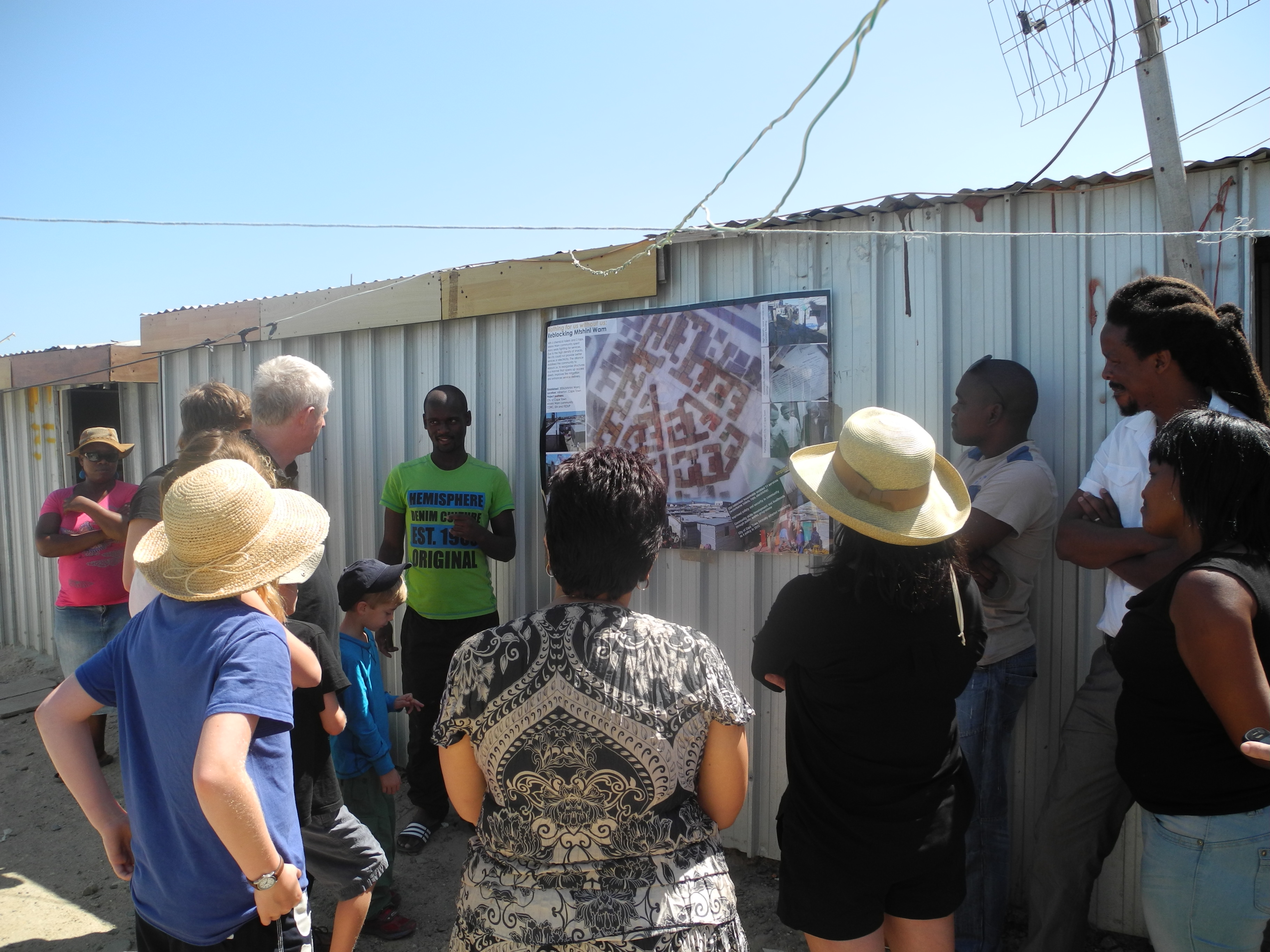
As a renowned film-maker, Curtis is also co-founder of the UK based charity Comic Relief which has been one of the alliance’s principal development partners since 2011. Together, they spent a morning meeting the alliance partners, visiting Mtshini Wam informal settlement where community members explained the process of re-blocking and showed Curtis and his family what a re-blocked settlement can look like. They also visited the Solid Waste Network, one of the alliance’s income generation initiatives.

DSCN5533

Mthsini Wam community members explain reblockingDSCN5542

Building Partnerships

To achieve the vision of more inclusive and pro poor cities it is critical to build partnerships with urban development actors who support this vision. The alliance’s association with Comic Relief as a development partner is a platform for organised communities to be at the core of building such cities. Communities are best positioned to contribute to design and to plan development solutions that have greater impact and sustainability than external development interventions. The alliance’s partnerships not only include the network of SDI affiliated countries or partnerships with government but also focus on partnerships with international aid agencies and donors, such as Comic Relief.

Founded in 1985, Comic Relief’s vision is of a “just world, free from poverty” (Reference). By raising funds through campaigns such as Red Nose Day and Sport Relief, Comic Relief spends these on projects that tackle the “root causes of poverty and social injustice in the UK and across the world” (Ibid). In particular Comic Relief supports projects “on the ground”, giving people a “leg up, not a hand out” (Ibid). Comic Relief displays a long term view of achieving this vision and therefore forms lasting partnerships with local organisations. Some projects are supported for up to six years whereby the progress of projects is tracked and funds are paid in phases.

Comic Relief and the South African Alliance

Comic Relief has been a core funding partner of the Alliance’s work since 2011 when uTshani Fund secured a grant for supporting the core activities of FEDUP housing development process. The grant is in its second year of operations and aims to support community lead projects in housing development and informal settlement upgrading (via the uTshani Fund housed funding facility Community Upgrading Finance Facility). uTshani Fund and CORC have formed a close working relationship in addressing the challenges of homelessness, landlessness and urban poverty.

The Community Organisation Resource Centre (CORC) has also been successful in applying to Comic Relief for grant funding. As part of its UK Aid Match scheme, Comic Relief formed a partnership with the Department for International Development (DFID). In December 2011 DFID agreed to provide a further £10m of funding for Comic Relief’s Urban Slums work. This sum would be matched by Comic Relief through funds raised during Sport Relief 2012, thereby totaling £20m. This new fund is intended to transform the lives of a million slum dwellers in a limited number of African cities through the strategic collaboration of agencies. The funding spans five years in total.

CORC and the South African alliance partners responded to the call for proposals and were successful in their application. The core of the funding proposal focussed on setting up a local city fund which will deliver informal settlement upgrading projects in the area of Khayelitsha in the City of Cape Town. The city fund is a responsive mechanism that aims to achieve a long term sustainable fund which could be replicated and/or recapitalised by City and Provincial government.

The beginning of Comic Relief funded projects in Khayelitsha

DSCN5045

Community leaders plan and design in KhayelitshaDSCN5063

As part of the Comic Relief grant, the alliance has been engaging with several neighbouring communities in Khayelitsha that live in UT, TT and BT sections, Litha Park and UT Gardens. Since mid 2012 these communities have been forming a horizontal relationship with ISN structures. After community members living in UT Gardens profiled and enumerated their section, they expressed the need for a crèche / multi-purpose centre for the community on a nearby open field.  Since the start of 2014 community leaders have continuously met with each other and CORC’s technical support team.

The meetings have had two aspects: On the one hand the community leaders expressed some key issues to address such as drainage and managing waste disposal. On the other, they co-designed and co-conceptualised the first drafts of the crèche / multi-purpose centre and identified existing footpaths and transit spaces. As the discussions continue, community leaders are eager to see this project lift off the ground.

This, then, is one of the projects that the Comic Relief grant supports. On the surface, it looks entirely different from Mtshini Wam or the Solid Waste Network which Curtis and his family visited. Yet the similarity lies in the tools that each community uses to organise itself. It lies in communities who lead their own design and planning. The SA SDI Alliance values long term funding agreements with international development partners such as Comic Relief (and its associations and members) that recognise the imperatives of informal settlement upgrading, housing and land, and livelihoods development.


A Decade after BNG: Does UISP work?

By CORC, FEDUP, ISN, News, uTshani Fund No Comments

delport + marathon_lr2

By Walter Fieuw (on behalf of CORC/uTshani Fund)

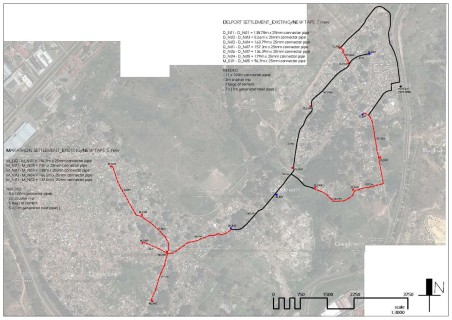
South Africa celebrates two decades of independence this year. It is also a decade after the then-Department of Housing issued its guiding framework document, Breaking New Ground (BNG): A Comprehensive Plan for the Development of Sustainable Human Settlements. Since 2004, when BNG was introduced and all subsequent National Housing Codes were amended to give meaning to the concepts and principles contained therein, we have experienced escalated protests in informal settlements around the country. These “service delivery protests” are often in response to lack of basic services. Politicians claim to have radically improved access to water and sanitation, but these claims can not be validated, and the devil lies in the detail. Its a critical time to reflect on housing praxis ten years after Breaking New Ground, and in this blog post we consider Part 3 of the National Housing Code: the Upgrading of Informal Settlements Programme (UISP).

Never before has civil society, urban sector NGOs and new state institutions been as interested in the upgrading agenda. An example of this was the Isandla Institute and African Centre for Cities conference in 15 and 16 October 2013 titled ‘Partnership-Based Incremental Upgrading of Informal Settlements in South Africa’. ISN and CORC, as part of the South African Alliance linked to SDI, have made strides in upgrading and have received a number of awards for its work in Langrug, Stellenbosch Municipality (UISP Phase 3) and Mtshini Wam (incremental upgrading). Other social movements such as Abahlali baseMjondolo traditionally lobbying only for housing and land have also called for alternatives, of which settlement upgrading and governance reform are primary.

MW 2

UISP in retrospect

UISP has been through various iterations since 2004, with major amendments in 2007 and 2009. Academics such as Marie Huchzermeyer has called attention to various progressive elements of the policy being removed. Part 3 of the National Housing Code (2009) argues that informal settlement upgrading is ‘one of the Government’s prime development initiatives and that upgrading projects should be dealt with on a priority basis’ (DHS 2009:25). However, the application of UISP before the establishment of National Upgrading Support Programme (NUSP)[1], Outcome 8 of the Presidency, and perhaps to a lesser extent Chapter 8 of the National Development Plan has been extremely weak.

There has also been varied interpretations on how UISP should be applied to different types of informal settlements. Cape Town, as an example, illustrates this point, and two examples – one quite bottom-up, participatory and empowering, and the other top-down and “modernist” – are worth considering. Hangberg in Houtbay was one of the City’s first UISP projects. It had all the right elements to make it a successful upgrading: strong and transparent community leadership and structures, mediation and capacity building by an urban sector NGO Development Action Group, and a strong political will by the City’s mayor and line departments. After moving through Phases 1 and 2, the project broke down in draconian police violence in 2010. Ever since, there has been little progress. The other example is the N2 Gateway Project, which was also packaged as a UISP. Here government departments eradicated the Joe Slovo informal settlement in 2004, moving many residents to Temporary Relocation Areas (TRA), to stabilise and rehabilitate the land. The project was challenged in the Constitutional Court, and the state was forced to house the relocated families. Needless to say, many still remain in the TRAs.

Often times its not so much about the “What?”, but about the “How?”. The UISP does not yet solve many of the complex issues that informal settlements represent, since it falls back on very linear logics. If the UISP were to be restructured, it needs to consider the following themes, which is followed by more practical recommendations for restructuring the programme.

Ramaphosa panorama

Themes to be addressed by the UISP

Theme 1: Partnership approach: Most Metros, where the majority of informal settlements are located, have been accredited as housing developers. The City’s role as the developer is essential, but local democratic structures need to be create to facilitate effective upgrading. There should be a stated recognition and budgetary allocation to allow for intermediary support, such as NGOs, community networks, organisational development consultants and mediators (in conflict cases). Without intermediation, the ideals and goals of developing partnerships will remain rhetoric with no execution power.

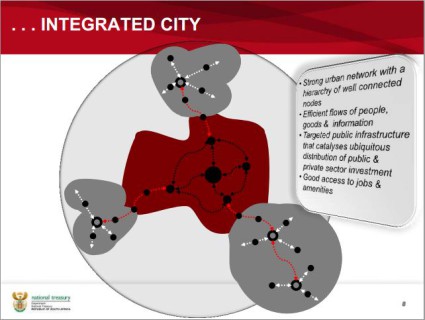
Theme 2: Area-based planning. Upgrading (brownfields development) is not the same as housing (greenfields development). Grants need to be available for communities to work closely alongside experienced urban designers, planners, architects, surveyors, engineers, transport planners to plan at the neighbourhood scale, and not individual sites for housing consolidation. At the neighbourhood scale, the metro needs to demonstrate how the UISP project will interact with other public investments in the built/urban fabric, which is guided by the Integrated Development Plan, Spatial Development Framework, the Built Environment Performance Plan (BEPP), and a number of other grants such as the Integrated City Development Grant (Treasury) and the Urban Settlements Development Grant (USDG). This also connects with Treasury’s new Urban Network Strategy, which understands the remaking of the apartheid city by means of prioritised investment in new nodes and development corridors.

Capture 2

National Treasury’s Integrated City Development Grant utilises the “Urban Network Strategy”

Theme 3: New tenure arrangements: The UISP is currently locked into a reverse greenfields development trajectory: people have occupied the land, they should be removed, trunk services to be installed, houses to be built, and the community needs to move back onto the land. The reality is that informal settlement upgrading is brownfields development, and the phasing of development needs to be planned in partnership with the community. Incremental upgrading means that more allocations for temporary accommodation is required. Design proposals by Cape Town based architecture firm ARG Design in respect to very dense informal settlement upgrading point to the need for “roll-over” accommodation in disruptive times of infrastructure development. The work of ISN and CORC, with partners University of Johannesburg and 26’10 South Architects on Marlboro in Johannesburg, also make proposals for upgrading in industrial areas. This also means that alternative tenure arrangements other than individual ownership needs to be further developed and local municipal officials needs training and capacity development to apply these new tenure arrangements.

Theme 4: New kinds of consolidation housing: The provision of Community Residential Units (CRU) is an option under phase 4 (housing consolidation) of the UISP and falls under Social and Rental Interventions of the National Housing Code (DHS 2009). Higher density and social and rental housing needs to be provided for, and government needs to prioritise a move away from the 40x40x40 housing paradigm: 40sqm house, 40km outside the city, where you spend 40% of your income to get to work.

Theme 5: Analysis of patterns of informality in a metro region: By having strong local design and implementation plans for individual informal settlements, patterns in metropolitan areas can be analysed. This is important to transport apartheid spatialities. It might become clear that in one metro, informal settlements are concentrated along prominent transport corridors, which might be core informants to a metro’s Transit-Orientated Development (TOD) strategies. Other areas, such as mining town, will have a very different needs and requirements for upgrading informal settlements. The link between individual settlements are the city-region might not be a UISP function, but a clear link between settlement grants (UISP, Access to Basic Services) and city restructuring grants (ICDG, USDG, Transport Grants, etc) needs to be clearly articulated for UISP is have maximum impact.

DSC_0067

A community plan presented by Umlazi community, eThekwini

Capture

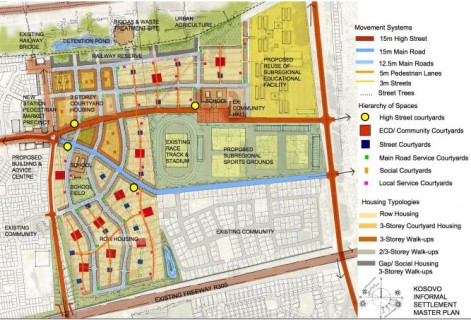
Professional layout plan design by ARG Design, Kosovo informal settlement, Cape Town

Practical recommendations:

We agree that the phased approach to upgrading is essential, and the logic and structure that the four phases of the UISP is sensible and binds the metro to a progressive and forward looking programme of action. Recommendations are made for each of the four phases:

Phase 1: Application

In addition to the listed activities:

  • Increase community participation grants from 5% to 12% of subsidy quantum
  • Options for new governance arrangements between communities and city officials/departments facilitated by intermediary players (e.g. NGOs)
  • In their business plan, Metros need to demonstrate how UISP plans fit into public investment into the region, citing the IDP, SDF, District and Local Spatial Plans, BEPP, Integration Zones of the ICDG, and sectoral plans (e.g. Transport, Economic Development, Industrial Action Plans, etc)
  • Research into the informal market for demand and supply factors of informal housing including intra- and inter “push and pull” factors

Phase 2: Project Initiation

In addition to the prioritisation of rapid delivery of interim basic services, studies commissioned, and other priorities already mentioned (typically water taps and toilets):

  • Structuring of tenure arrangements (multiple options that ties back into major Land Use Management and Planning)
  • Allocations for interim housing and intra-settlement relocation (ensure zero displacement)
  • Set up block committees that drive local needs assessment through enumeration, profiling, spatial mapping and action planning
  • Representatives of block committees serve on project steering committee

Phase 3: Project Implementation

In addition to the prioritisation of full services (trunk infrastructure, roads, amenities, etc):

  • Project steering committee (read: a special task team) mandated, constituted and multi-party planning and project managing
  • Line departments and formal IDP and public participation processes of the Metro needs to be aligned to the Project Steering Committee’s workplan
  • Consultants appointed by the Metro to be accountable to the Steering Committee

Phase 4: Housing Consolidation 

See recommendations under themes 3 and 4

 In conclusion

UISP remains government’s formal response to the progressive and forward looking ideas contained in the Breaking New Ground framework document. The recommendations presented in this blog is based on a partnership approach, and recognises that structures and delegated authority and tasks are required for upgrading projects to be successful. Only when people living, using and dreaming about the future of their settlements are made to be central actors in the development process, can upgrading truly succeed.


[1] The NUSP has four main activity streams: 1) policy promotion and refinement (raise the profile of UISP and refine and improve implementation); 2) networks and forums (fill the knowledge gap and improve information flows by establishing ‘community of practice’); 3) tools and information (furnish practitioners with good practice and shared experiences over and above the guiding framework of the National Housing Code (DHS 2009)); and 4) technical assistance (help provinces and municipalities develop upgrading programmes at project level) (DPME 2010b:48).


Rethinking ‘successful’ cities – SA SDI Alliance wins runner-up at Ingenuity Awards 2013

By CORC, iKhayalami, ISN No Comments

Re-blocking as an innovative approach to urban informal settlements.

By Yolande Hendler (on behalf of CORC)

If “the most successful cities will be those that embrace ground-breaking solutions to meet the changing needs of their citizens” (Ingenuity Awards)

the question really is: What constitutes a  ‘successful’ city – and ‘ground-breaking’ solutions?

In a time of mass urbanisation these questions caught the attention of the Financial Times (FT) who in 2012 decided to publish a series of three magazines along with a global awards scheme, the FT / Citi Ingenuity Awards: Urban Ideas in Action programme. The awards aimed to recognise and honour “ingenious individuals or organisations that have developed solutions to urban challenges” (FT publication, July 2012, p.3). The South African Shack Dwellers Alliance participated in both award rounds (2012 – 2013) and won runner-up for the regional Africa submissions in 2013. The FT and Citi – financial service giants in global business news and banking – ran the awards together with Insead, a leading global business school who joined as a research partner.

2012 Awards

In 2012 the award entries were grouped in the categories of energy, education, health and infrastructure. Together, these were seen as providing a good overview of contemporary urban innovation. iKhayalami – an NGO part of the South African Shack Dwellers Alliance – used this platform to share its work around the community-driven, re-blocking process in Sheffield Road informal settlement in Cape Town. The community’s ideas were at the centre of the re-blocking process which addressed pertinent issues of decent sanitation and water, thereby uniting the community and restoring a sense of dignity. In short, every level of the project dealt with design, capacity building, engaging the state, policy-making and replicability. Nairobi’s Community Cooker Foundation won the 2012 awards while Sheffield Road reached the final round in its category. As the impact of re-blocking became more significant through its replication and growing support base, a new submission was entered under the banner of the South African Shack Dwellers Alliance which is affiliated to Shack Dwellers International (SDI).

SR 2

A courtyard in Sheffield Road informal settlement after re-blocking.

2013 Awards

In the meantime the 2013 award categories had changed to regional areas (Africa, Asia-Pacific, Europe, North and South America) to allow for a broader scope of applicants. A panel of judges (that included architects, city planners, academics and public policy specialists) would judge regional submissions based on the criteria of originality, impact (how much of a difference the project made), sustainability and project transferability to other cities.

By this time, the increased scope of re-blocking in South Africa was evident: it had expanded from iKhayalami to the South African Shack Dwellers alliance and its associated communities. One of the alliance’s social movements – the Informal Settlement Network (ISN) – was at the forefront of the blocking-out agenda as its reach and relationship extended to numerous informal settlement communities throughout South Africa. The re-blocking approach also expanded to policy level whereby it was being drafted as a policy document for implementation in the City of Cape Town. This was done in consultation with the alliance partners.

The idea of re-blocking

As in 2012, the idea of re-blocking was again at the centre of the alliance’s submission in 2013. This innovative and community-centred approach responds to the haphazard spatial layout of many informal settlements that makes it difficult for social or emergency services to gain access to settlements, particularly when there is a fire.

Re-blocking is a social, community-driven process.

On the one hand the re-blocking process is technical. It encompasses a spatial reorganisation of shacks that opens up courtyards and creates clear pathways in a settlement. This gives officials an opportunity to provide improved services as well as making the settlement more safe and secure. Re-blocked shacks are built using Zinc aluminum, which is more fire resistant than conventional materials.

On the other hand, re-blocking is deeply social. Throughout the re-blocking process, the community’s ideas and impetus are key. Re-blocking is led by community designers together with technical assistance from alliance development practitioners in iKhayalami and the Community Organisation Resource Centre (Corc). Community Designers are community members whose design skills are grounded in past project experience.  Andy Bolnick, director of iKhayalami explains,

“Reblocking is about poor communities coming together, redesigning their spatial layout and upgrading their communities in partnership with the state which leads to more equitable and inclusive cities” (Andy Bolnick, Director of iKhayalami)

For Cape Town municipality, its “work with the alliance has provided a solution to the enormous housing backlog [it] is dealing with” (Seth Maqetuka, Executive Driector for Human Settlements in the City of Cape Town).

2013 Runner’s Up: SA SDI Alliance

Nkokheli Ncambele (ISN community leader) and Andy Bolnick (director of iKhayalami) at Ingenuity Awards Ceremony in New York.

Nkokheli Ncambele (ISN community leader) and Andy Bolnick (director of iKhayalami) at Ingenuity Awards ceremony in New York.

After FT journalists visited the alliance in 2013, a panel discussion of the African finalists was held in London in September 2013. The award winners were announced in December 2013 in New York. Both Andy Bolnick and ISN community leader Nkokheli Ncambele attended the award ceremony. The alliance’s submission won runner-up in the Africa region, following Nairobi-based Sanergy, a network of low-cost franchised toilets which also won the overall award for 2013. Social entrepreneur and Sanergy co-founder, David Auerbach explains that Sanergy’s approach is a market-based one which follows the idea of creating something that can scale up (FT publication, July 2013, p. 13). In addressing the persisting problem of human waste Sanergy creates “a network of low-cost franchised toilets which are operated by resident micro-entrepreneurs on a pay-per-use basis” from where waste is collected, organically fertilised and sold to farmers for profit (Ibid).

Rethinking ‘success’

The Ingenuity Awards certainly saw a fascinating variety of innovative projects, of which the African submissions addressed some of the most pressing challenges faced by people living on the informal, social and economic margins of cities.

In addressing the question of a ‘successful’ city, the FTs suggested that

“…the success of a city should be measured not in terms of economic transactions per square metre over a given period of time but in terms of social transactions” (Architect Teddy Cruz,  in FT publication July 2012, p.3)

For FT architecture and design critic, Edwin Heathcote  this view “would dramatically redefine our notions of what a successful city looks like – drawing it in terms of population rather than its turnover … It turns on its head our idea of economic success in terms of personal space and residential footprint… In a stroke, [it] democratises our view of the city [whereby] innovations propose solutions for the informal as well as the developed city” (FT publication, July 2012, p.7).

Yet, from the past two winners it seems apparent that the FT and Citi view business and market-based solutions as answers to addressing the pressing challenges of urbanisation. Should ‘successful’ cities and ‘ground-breaking’ solutions not also expand on market based approaches to challenge the political status quo and existing power relations between the formal and informal sectors? The social processes of community mobilisation are just as significant as the ‘technical’ outcome of re-blocked shacks or a micro-entrepreneurial approach to waste disposal. ISN community leader, Nkokheli Ncambele reflects on the social processes of re-blocking,

 “Blocking-out focuses on so many aspects not only just sanitation but on all aspects of people’s lives. I was surprised that the alliance did not win the award but it is good that we were recognised for what we are doing”

(Nkokheli Ncambele, ISN community leader)

The question of a ‘successful’ city then reaches beyond mere ‘technical’ engagements to how these engagements happen. It is a question that asks, how can urban poor communities engage with the state and other actors in a way in which they are more equal and not more powerless?


2012 / 2013 CORC Annual Report

By CORC, FEDUP, ISN, Publications, uTshani Fund No Comments

Cover

With great pleasure CORC ‘s annual report looks back on an event-filled 2012-2013 which set the scene for community mobilisations, beginning and continuing partnerships with government, valuable developments on urban sustainability and our documentation strategies. However, the past year was also marked by the effects of the global financial crisis which were acutely felt by urban poor communities in the form of rapid urbanisation and a continuing lack of government service delivery.  By supporting urban poor informal settlements CORC supports communities in building a “platform of the urban poor”.

In this report outlines an overview of CORC’s general activities and supportive role to its alliance partners, the Informal Settlement Network (ISN) and the Federation of the Urban Poor (FEDUP) both of which are social movements involved in community-led upgrading processes. You will get an impression of dynamics around community savings, community mobilisations, enumerations, international events and exchanges. Please note that detailed project reports can be found in the separate publication, Masikhase: Community Upgrading Finance Facility (CUFF).

In addition to comments from our regional offices and a financial overview, the report also contains updated developments on our existing partnerships and new working relationships with government. Partnerships with local governments include the City of Cape Town, Stellenbosch Municipality (mature partnerships), City of Joburg Ekurhuleni Metropolitan Municipality, eThekwini Metropolitan Municipality, Nelson Mandela Bay Municipality, Midvaal Municipality (partnerships in progress), Breedevalley and Drakenstein Municipalities (signs of potential working relationships).

“We know that when the poor are not involved in development decisions they will care less about their surroundings or even use their initiative to resist paying for their services. our new approach means we will build partnerships with communities, and to give them ‘voice and choice’ in the design and construction of settlements that build sustainable livelihoods and can fulfil their needs” Deputy minister of Human Settlements, Ms. Zoe Kota-Fredericks”

As CORC supports communities making meaningful alternatives to change the structural causes of informality we aim to shift the focus of service delivery from government to partnerships and collaborative relationships.  This year, our work with organised communities, academic and non-governmental partners therefore centred on realising issues of urban sustainability. Some of these include the Solid Waste Network, partnering with Habitat for Humanity South Africa in establishing a city fund or introducing solar electrification in informal settlements.

The report outlines some of the successes and challenges of building coalitions of the urban poor in the contexts of landlessness, homelessness and urban poverty. We wish to congratulate our community partners for the number of awards and nominations for projects delivered, the hard work of collecting data and the patience of building partnerships.

CORC wishes to thank international donor organisations for believing in the vision and supporting the work of the SA SDI Alliance. These donors include:

  • Bill and Melinda Gates Foundation: (“Aligning communities and government”)
  • Ford Foundation (“Promoting Transparent Effective and Accountable Government”)
  • Charles Steward Mott Foundation (“General Purposes” and “Learning through Practice”)
  • Comic Relief (Ikhayalethu grant)
  • Misereor (“Building partnerships between communities and local authorities”)

More about the FEDUP and ISN joint charter

By CORC, FEDUP, ISN, uTshani Fund No Comments

One of the main events in the calendar of the SA SDI Alliance in 2013 was the National Conference, which brought together FEDUP and ISN affiliated groups from across the country. At this 4 day conference, which was also attended by senior government officials, the two social movements made a commitment to a much closer working relationship in the context of landlessness, homelessness and urban poverty. Read more about the National Conference in this blog post.

Pre-eminence is given to the joint action-orientated charters of the two social movements, and this blog post aims to give a historical background to the emergence, peaks and troughs, and the horizon of the future of these national social movements.

734198_601228813248421_1511199618_n

The struggle years *

The 1980s was a decade marked by open conflict between the white-minority apartheid regime and a sustained mobilisation of the black majority. Liberation movements such as the United Democratic Front (UDF), founded in 1983 with the slogan “UDF Unites, Apartheid Divides”, was at the forefront of making urban space ungovernable through protests, strikes, rent and service charge boycotts, and other forms of direct and confrontational politics (Seekings 2001:21). Other marginalised racial groups such as Indians and coloureds were also centrally involved in the mobilisation against apartheid, having been displaced by major spatial reconstruction through the 1913 Land Act and the 1950 Group Areas Act. Church- and faith-based groups also played a significant role in promoting the ideals of a free and fair society, and took advantages of the slightly more lenient conditions due to recognised religious freedom.

By 1986 the beleaguered apartheid state called a State of Emergency, which saw tens of thousands of opponents detained. Movements such as the UDF, which played a role in forging a sense of unity and coherence in community based organisations (CBOs), significantly enhanced and escalated the opposition against apartheid, by that time led by exiled African National Congress (ANC) diaspora, Congress of South African Trade Unions (COSATU) and smaller anti-apartheid groupings under the banner of Black Consciousness.

uMfelandaWonye WaBantu BaseMjondolo is born *

In 1994, these savings schemes united to form the new social movement, uMfelandaWonye WaBantu BaseMjondolo, or the South African Homeless People’s Federation (SAHPF). Khan and Pieterse (2004) have further observed that the SAHPF advanced a “people-controlled development [which] is about fostering self-replicable and self-reliant social development practices” (2004:10). South Africa’s first democratic elections saw the ANC voted into power, the SAHPF was an important actor in the urban sector, uniting communities around the common struggle against homelessness, landlessness and poverty.

On 26 November 1995, President Nelson Mandela visited the SA Homeless People’s Federation. In his speech, he said

“In approaching this task we have learned a great deal from the people – from those who are the biggest providers of housing in the country, the homeless themselves. We have learned the value of partnership between ourselves and the people in their communities. We recognise the efforts but into housing by the people themselves. We are proud of the way our people use their initiative, mobilise their meagre resources, sharpen their skills, and put in their labour, in order to provide shelter for their families. Government has committed itself to supporting the people’s housing process. We will provide mechanisms and funds to support it in such a way that the standard of housing can improve – particularly for the poorest of our people”

Despite the lack of “an enabling environment”, the SAHPF engaged the first minister of the Department of Housing and member of the Communist Party, Joe Slovo. At a national meeting with the SAHPF, Minister Slovo remarked, “Look here, show us the way and we will support you. We will rely on your creativity and energy. You have our hearts with you” (SA SDI Alliance 2008:9). A subsequent agreement with the National Housing Board placed the uTshani Fund as a conduit for housing subsidies. This arrangement was called the ‘uTshani Agreement’ (Ley 2009:261). Through this agreement, the Provincial Housing Board – who, at that time, was responsible as the “developer” of housing projects – paid the eligible beneficiary’s capital subsidy into the uTshani Fund, allowing the Federation to oversee implementation. This was a radical departure from mainstream housing delivery supply, in which private companies secured contracts through an open tendering process, to build the agreed number of houses (Khan and Pieterse 2004; UN Habitat 2006).

The Pledge agreement *

In the period 1996 – 2000, the Federation constructed more than 7,000 in the informal settlements of South African cities and uTshani Fund administrated more than R60 million in loans and subsidies. In the period 2000 – 2005, uTshani Fund was financially crippled, since state agencies no longer honoured the uTshani Agreement. Housing delivery slowed down rapidly, and the uTshani Fund only constructed 300 houses between 2004 – 2007 (Mitlin 2008b:20). Despite the financial constraints, SAHPF was able to demonstrate to government a compelling argument: Poor people were able to build larger and better quality houses with the same capital subsidy compared to the private sector housing contracts.

After a significant revision of the terms to which housing subsidies were allocated to the Federation, a new era broke with the Department of Human Settlements. Six Provinces signed the Pledge and those were: Gauteng, Western Cape, KwaZulu Natal, North West, Limpopo and Free State. Each of these provinces pledged to ring-fence 1,000 subsidies for FEDUP groups, tallying more than R220 million (more than US$ 30 million). The agreement stipulated that provinces would pay top structure subsidies (roughly 40% of the subsidy quantum) upfront and provide serviced greenfield plots (remaining 60% of the subsidy quantum). However, many provinces were uncomfortable with these arrangements, and in most cases, uTshani Fund continued to pre-finance loans to FEDUP groups, and retrospectively claim back subsidies back into the revolving fund.

285779_393783720659599_1622420411_n

The emergence of the Informal Settlement Network *

At the same time, a daunting realisation pressed national coordinators: “… for every Federation member with tenure security, there were another 20 without land” (FEDUP 2010:5). At this point, “the men in the Federation decided to reach out to community organisations of the urban poor, to form the Informal Settlement Network (ISN) and to use Federation capacities and [practices] to start to upgrade these settlements as well” (ibid). A series of dialogues were organised in 2008/09 starting in Johannesburg and Durban.

The growth of informal settlements over the past two decades have by far exceeded government’s efforts to deliver better services, provide adequate housing and mitigate against disasters and vulnerability. The Informal Settlement Network (ISN) has responded to the urban and land crises in South Africa by mobilizing communities around internal capabilities and capacities, and around specific settlement issues relating the incremental upgrading, tenure regularization and land. Building solidarity and unity among the urban poor, the ISN aims to creating a change process by connecting “political opportunity structures” (cf Tarrow 1996 cited in Bradlow 2013) to partnership formations with government.

The FEDUP-ISN alliance *

ISN and FEDUP have in common a shared value system and practices that build community capacity and generates knowledge. These practices are widely employed by all country federations in the Shack / Slum Dwellers International (SDI) network.

There is a reciprocal relationship between ISN and FEDUP, and the agencies and practices of the two national social movements complement one another. It is worth citing an internal concept note at length to illustrate the working relationship:

ISN networks and links communities around specific needs and issues, especially land and access to basic services. When the need arises for information gathering and savings mobilization, FEDUP moves in to establish women’s savings collectives, forge links with formal institutions and to leverage development finance. ISN plays the lead political role, which is oriented towards a people-centered engagement with a democratically-elected government” (SA SDI Alliance 2010:6).

1044242_532997750071528_1852307003_n

A learning network *

Peer-to-peer horizontal exchanges are central to building networks and platforms of the urban poor. This is also the primary learning space, and communities that have generated learning on a certain aspect become “learning centers”. FEDUP and uTshani Fund’s experience in building strong local capacity to drive projects in the form of the Community Construction Management Teams (CCMTs)  (Each CCMT has a bookkeeper, a procurement officer, and administration assistance and a project coordinator) could be compared to ISN “learning centres”.

Organising dynamics FEDUP Community Construction Management Teams (CCMTs) ISN Learning Centre
Primary modality of community mobilisation Woman’s saving schemes Woman’s saving schemes and socio-spatial data collection
Governance structure Highly organised and roles and responsibly defined Open governance structure with undefined roles and responsibilities
Purpose Project management and coordination Learning and reflection
Project focus Housing developments and subsidy allocation Informal settlement upgrading and growing the network
Outcome Effective project management and pre-financed subsidy recovery Nodes of experience towards city-wide upgrading agenda

Charting the way forward

The Joint FEDUP-ISN charter has special relevance for the future. Drawing on the two movements’ particular qualities has the potential to define a strong bottom-up and people-centred approach to addressing some of the most daunting challenges cities and towns face in the post-apartheid era: the growth and continued marginalisation of “informality” and the urban poor.

ISN understands its vision “to create solidarity and unity among the urban poor by building a national network in order to make the flow of resources and planning of cities more inclusive and pro poor.” ISN’s core focus areas of mobilisation (profiling), governance (establishing committees), networking (exchanges), knowledge generation (enumeration) and partnership development with government agencies creates a strong platform for sustained engagement. This process lends itself for an authentic “bottom-up agglomeration” of local community based organisations. By introducing locally responsive knowledge generating tools,

FEDUP, as a founding member of the SDI network, regards itself “an affiliate of the SDI network, FEDUP is a nationwide federation of slum dwellers in South Africa dedicated to building united, organized communities, to address homelessness, landlessness and creating sustainable and self-reliant communities led by women through informal and formal incremental human settlement upgrading.” The gendered-focus and -sensitive mobilisation by which FEDUP sets up saving schemes and CCMTs  has a lot of potential to

The Joint Charter draws together the synergies created in these social movements two decades of experience. The Charter not only commits the social movements to the SDI organising principles, but also localises the agenda:

Wherever possible the skills, expertise and experience of both social movements shall be used to help further the vision, mission and goals of either movement. In practice this means the formation of joint working teams supported to sharpen and implement the agreed SDI rituals in all informal settlements of South Africa. FEDUP and ISN agree to wherever possible, conduct joint planning sessions that would allow for resources to be maximized through efficient use

The Charter ends by saying “the ISN shall strive to open up spaces within communities for FEDUP to establish new savings groups.  The FEDUP shall strive to support ISN in their communities and promote the ideals of a networked movement of the urban poor”. Considering the historical narrative framed in this blog, the charters are a reminder of the part, and starts to create a roadmap for the future.

* Excerpts taken from: Fieuw, W. forthcoming. A Politics of Resolve: people-centre development in South Africa .

Selected reference list:

  • Bradlow, B. 2013. Quiet Conflict: Social Movements, Institutional Change, and Upgrading Informal Settlements in South Africa. Submitted to the Department of Urban Studies and Planning on May 23, 2013 in Partial Fulfillment of the Requirements for the Degree of Master in City Planning. MIT
  • Khan, F and Pieterse, E. 2004. The Homeless People’s Alliance: Purposive Creation and Ambiguated Realities. A case study for the UKZN project entitled: Globalisation, Marginalisation and New Social Movements in post-Apartheid South Africa. Durban: University of Kwa-Zulu Natal
  • Ley, A. 2009. Housing as Governance: Interfaces between local government and civic society organisations in Cape Town, South Africa. DrIng thesis, Von der Fakultät VI – Planen Bauen Umwelt der Technischen Universität Berlin
  • Mitlin, D. 2008b. Urban Poor Funds: development by the people for the people. Poverty Reduction in Urban Areas Series, Working Paper 18. London: International Institute for Environment and Development (IIED).
  • South African SDI Alliance (SA SDI Alliance). 2011a. uTshani Buyakhuluma: the grassroots are talking. June 2011, Vol.1, No. 2.
  • United Nations Human Settlements Programme (UN – Habitat). 2006. Analytical Persepctives of Pro-Poor Slum Upgrading Frameworks. Nairobi

SA SDI Alliance 2013 in Review

By CORC, FEDUP, ISN, News, uTshani Fund No Comments

Ayanda 20120209 212

Its that time of the year when we, the SA SDI Alliance, reflect on our achievements and work in progress. 2013 was a year of growth, maturation, and sharing knowledge and experiences. On the housing front, FEDUP was awarded with the Gauteng Provincial Goven Mbeki awards (runner up in North West), when the re-blocking of Mtshini Wam earned ISN and the community a Gold Impumelelo social innovation award.

The City of Cape Town’s adoption of the re-blocking policy has surpassed recognition and honor of the alliances work to realizing one of its main goals, which is creating precedent setting projects that have the ability to change policy and influence resource flows. Although the importance of upgrading of informal settlements has been recognised in the National Development Plan and actioned by the National Upgrading Support Programme (Department of Human Settlements), more needs to be done to promote community participation.

Creating partnerships with Government is one of the alliance’s aims of increasing the reach and impact of participatory development, and in this year we have spread our wings through sharing of knowledge and experiences by partnering with a number of stakeholders. These include the Santa Fe Institute, Habitat for Humanity, Touching the Earth Lightly and local and international universities (Worcester Polytechnic Institute, University of Cape Town and the University of Melbourne).

This year also marked a much closer working relationship between FEDUP and ISN, resulting in the signing of a joint charter. Such a review happens once in four years, and this year at the national forum the ISN/FEDUP charter was launched to strengthen and clarify the roles of each network. In 2014 we are looking forward to showcasing four of the Alliances projects that have been acknowledged by the World Design Capital 2014 committee and we will continue working with different stakeholders to make the voices of the poor heard.

We look back on the year past, and in anticipation, look forward to the coming year.

1: Policy transformation at the local government level

On the 5th of November 2013, Thandeka Gqada, Mayoral Committee Member for Human Settlements, City of Cape Town announced the adoption of the reblocking policy by The City of Cape Town. This policy has been influenced by the Mtshini Wam reblocking project, which is one of 22 pilot projects scheduled for re-blocking in the 2014.

Mtshini Wam before and after

Blocking-out” and “re-blocking” are interchangeable terms the South African SDI Alliance uses to refer to the reconfiguration and repositioning of shacks in very dense informal settlements in accordance to a community-drafted spatial framework. The aim is to better utilize the spaces in informal settlements to allow for better service provision. Moreover, re-blocking is done in “clusters” identified by the community, and after implementation, “courtyard” are created to ensure a safer environment for woman and children via neighborhood watches (all shacks face the courtyard), productive places (such as washing lines, food gardens), and generally provides space for local government to install better services. Read more on the City of Cape Town Adopts Reblocking policy.

2: Innovative projects nationally recognised

Dududza Project Wins Govan Mbeki award

On the 11th of April, FEDUP was nominated in the Gauteng Provincial Govan Mbeki awards. The award ceremony aims to showcase and demonstrate the partnerships with the department at both tiers and promotes best practices in meeting the delivery mandate of the Presidency’s Outcome 8, which is aligned with the vision of building sustainable human settlements and meeting the Millennium Development Goals. The Federation of the Urban and Rural Poor (FEDUP) has been transforming the housing policy from the bottom up for the past two decades. Premised on the notions of social and political change through community savings. The Federation has built more than 12,000 houses since 1994, and continues to set a precedent in women’s led leadership and collaboration with government. The MEC of Human Settlements at the Provincial tier nominated projects in four specified categories 1) which displays exceptional quality 2) promotes best practice 3) collaboration of stakeholders 4) improving the quality of life for the beneficiary-partners. Read more: Duduza Wins Gauteng Govan Mbeki Award for ePHP and Mafikeng in the North West with the runner up prize

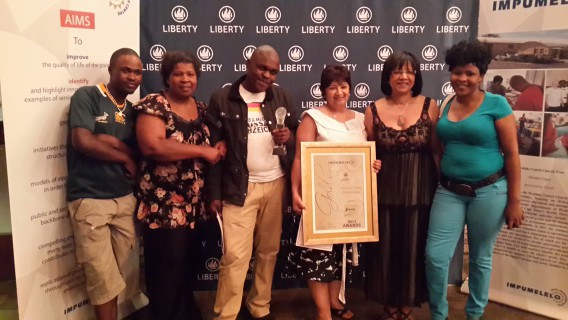
Mtshini Wam Reblocking Project Wins Impumelelo Award

Mtshni Wam was one of the 33 finalists that have been selected out of the 80 shortlisted projects. The finalist are from all over South Africa in a wide range of sectors such as Health, HIV/AIDS, ECD, Education, Skills Training, Environment, Agriculture, Infrastructure, Social Welfare, Community Development, Food Security, Job Creation, and Animal Welfare.  This project showcases community led planning and design, the use of innovative material and layout design to decrease the level of disasters such as fires, flooding and food security, and the collaboration of stakeholders.  Read more  on Mtshini Wam Reblocking Project wins a Gold Impumelelo award.
20131201_205542_LLS_resized

3:  Collaboration and Partnerships

SDI- Santa Fe Institute Partnership

SDI has collaboratively partnered with the Santa Fe Institute in testing new techniques in profiling informal settlements with the quest of improving data capture processes. The importance of this collaboration is to develop theoretical insights about cities that can inform quantitative analyses of their long-term sustainability in terms of the interplay between innovation and resource appropriation. At the grassroots level, the data helps communities understand their settlements better and use it as an engagement tool with government. Read more on the profiling of UT Section, Khayelitsha, Cape Town

Habitat for Humanity South Africa

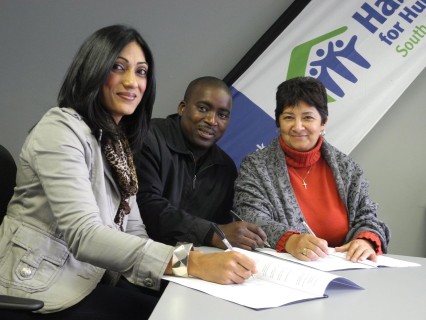
The partnership between CORC/ISN and Habitat for Humanity South Africa centrally recognises that if a vision of change is not community centred, it will most likely yield less impact. Moreover, development, which is conceptualised and implemented by an external agency, will most likely not be able to scale up and reach a citywide impact. For this reason, the Alliance signed a partnership agreement with Habitat for Humanity South Africa around two key around: 1) collaboration around a to-be-determined schedule of projects, and 2) setting up a city-fund. Read more about this collaboration on: Alliance Signs MOU with Habitat for Humanity.
DSCN4071Touching the Earth Lightly

The partnership with Stephen Lamb and Andrew Lord of Touching the Earth Lightly resulted in a first pilot of the Green Shack, which drew a lot of attention at Design Indaba 2o13. This showcase of innovative and cost effective solutions for shack upgrading addressing the problems of fire, flooding and food security was well received.

The aim of growing food vertically is to use the limited spaces that communities have to decrease poverty and hunger in informal settlements. Due to the shift of poverty from rural areas to urban areas, food gardening is an alternative to providing food security in informal settlements, with the high unemployment rate in informal settlements it is difficult for households to provide nutritious meals for their families because food security in urban areas is tied to purchasing power.

The initiative to start a food gardening projects in communities in realizing food provision at a cheaper price in order to decrease household spending on food, increasing food security for poor households and creating livelihood opportunities. The broader idea is to have most of the community members growing gardens either for consumption at a household level or selling to the community to increase the household’s income. Touching the Earth lightly provides innovative ways of growing food in limited spaces such as the creation of vertical gardens, using crates and tyres.

4. SA SDI collaboration with Universities

University of Cape Town (Europe Community Studio)

Tanja Winkler, senior lecturer in Urban and Regional Planning, University of Cape Town, joined CORC staff and the Europe informal settlement leadership on a planning session at Europe, an informal settlement located in Gugulethu, just of the N2 national highway in Cape Town.  The purpose of the planning meeting was to align the 2014 UCT Urban Planning practical learnership with that of the Europe community leaderships’s agendas in a “planning studio”. This studio will form part of the Master Students in Urban and Regional Planning curriculum, and have direct interactions with the community.  The aim of the studio is to expose the students to alternative planning approaches when considering one of the most pressing challenges of our post-apartheid cities: urban informality in its various expressions. Moreover, the nature of the studio also means that technical support is given to the community’s plans for upgrading the settlements, and hence a two-way beneficial relationship is established from where new tools of engagement with the state can be created.  Read more on Community Studio|2014 UCT-Europe Studio’The Planning Session’ . 

IMG00285-20131129-1144

Worcester Polytechnic Institute, USA (Langrug WASH facility)

The construction of the WASH facility is a precedent setting partnership outlining that the provision of water and sanitation services in communities should be executed in a manner that does not simply add-up to the statistics of facilities, or a mere provision of basic utility services as a basic constitutional right. The government is currently the primary entity responsible for sanitation facilities provision in South Africa. However, too often, its top-down and subsidized approach has not been successful in meeting the imperatives of socio-economic sustainability. The facilities are typically undignified and mostly located in the peripherals where residents often find inconvenient to access and more so the facilities are poorly maintained. In addition, residents regularly vandalize them. The dilemma of how, where and which type of service level to provide in informal settlements is far off a challenge too great for the government to solve alone. In that regard, multi stakeholder approaches, with urban poor communities at the core, are needed. This is to enhance dignity-associated with the use of a communal toilet, contribute towards place making in communities, and create job opportunities in asset management, as well as impact policy and practice towards meaningful participatory urban development.

This innovative design, implementation and management of the WASH facility in Langrug is a ‘precedent’ setting for a multi-stakeholder co-production of infrastructure services, which triggered meaningful community engagement and consequently creating a sense of entitlement and redefining government-community relations. Read More on  The Langrug Wash Facility A new Common Space for the Community.

University of Melbourne (Planning studios in Mtshini Wam, Shuku Shukuma and Ruo Emoh)

In February a planning studio was organised between the communities of Mtshini Wam, Shuku Shukuma and Ruo Emoh and architecture and planning students from the University of Melbourne to investigate new solutions for informal settlement upgrading and housing development. In Shuku Shukuma, 80sqm plot size placeholders were cut to scale and laid out on an aerial photograph. The location of visible infrastrcuture was mapped, such as electricity poles, toilet blocks and water taps. The Mtshini Wam group looked at alternative typologies for densification and formalisation after re-blocking projects. A visual fly through model was created, building on the new layout of re-blocked settlement.

We also hosted Tim Budge, a PhD student at Deakin University in Melbourne, Australia. The PhD is focused on the topic of “The Legacy of Paulo Freire and Saul Alinsky for communities seeking change in sub-Saharan Africa”. As part of his studies, he is doing field research in Zambia and South Africa. The research is deliberatively focused on case studies, narratives of change and an appreciation of local context and of the way local people learn and act in their own worlds. In August he gave three communities (Siyahlala, Busasa and Langrug) cameras and diaries where they can record community stories /activities that relate to change.

5: Projects

CORC and Alliance partners was proud to present the publication Masikhase: The Community Upgrading Finance Facility. This publication articulates the spaces created by communities and local government to make decisions and work together towards the incremental improvement of informal settlements.  These new participatory spaces often create conditions for informal settlement upgrading to be more effective and sustainable. The Community Upgrading Finance Facility (CUFF) aims to enhance the agencies and practices of the organized poor by providing a platform and institutional support for communities to engage government more effectively around collaborative upgrading and livelihood projects. Please download the booklet here: CUFF Booklet.

6: World Capital Design Projects

World Design Capital Yellow Logo

The prestigious accolade of World Design Capital is awarded by the International Council of Societies of Industrial Design every two years. It recognises that “the future success of each city is therefore largely reliant on those who plan, design and manage the shared spaces and functions of their city”.

The Alliance of community organisations and social networks Informal Settlement Network (ISN) andFederation of the Urban and Rural Poor (FEDUP) and support organisations CORC, uTshani Fund and iKhayalami saw this as an opportunity to display, on a global stage, how communities go about designing, inhabiting and reproducing spaces that increase accessibility and productivity of poor people in the city. The WCD committee selected four of the Alliances projects namely Mtshini wam reblocking project, Langrug informal settlement upgrading project, Solid Waste management and Community led spatial design and reconfiguration of informal settlements both pre and post disaster. Read More on: Four Alliance Projects Recognised by World Design Capital 2014 Committee.

7: SA SDI Alliance national forum

This year national forum started from the 11th-14th November 2013, more than 200 members of the ISN and FEDUP regional facilitators from all the provinces of South Africa were present. They discussed and shared experiences on income generation programs, savings, enumeration, profiling, informal settlement upgrading, land ownership and partnerships.   The forum is an event where the alliance reports on its past achievements and challenges while the supporting NGO CORC (Community Organization Resource Center) uses this platform to understand the challenges faced by all regions on the ground.  The event also included the launch of the ISN/FEDUP charter. Read More on SA SDI National Forum and Charter Launch. 

IMG_6034

Conclusion:
2013 was a year marked by local and national recognition of the power and possibilities of collaboratively partnering with communities organisations. By building local community capacity, communities have built a bridge to local government officials. Partnerships are pending with the Nelson Mandela Bay Metropolitan Municipality after the profiling and mapping of Midrand informal settlement and also in Moeggesukkel informal settlement. The power of exchanges were visible, considering the role of Gauteng ISN played in strenthening the emerging Eastern Cape ISN . In Midrand municipality, the community of Sicelo showcased alternative options when they demonstrated the effectiveness of community based enumeration. There are also a pending partnership in this local government.

These loose threads will be pursued next year, while implementation in the mature partnerships with City of Cape Town and Stellenbosch Municipality will be stepped up. We want to thank our partners, especially international donors Bill and Melinda Gates Foundation, Comic Relief, Ford Foundation, Charles Stewart Mott Foundation, and Misereor for funding these operations. Early next year our 2013/14 annual report will be ready, expounding on these experiences.