Tag

FEDUP Archives - Page 5 of 6 - SASDI Alliance

FEDUP and ISN Leadership Retreat 2014

By CORC, FEDUP, ISN No Comments

By Yolande Hendler (on behalf of CORC)

Leadership Retreat in KZN, Durban

Leadership Retreat in KZN, Durban

From 20 – 25 June 2014 national leaders from both FEDUP and ISN met in Durban, Kwa-Zulu Natal, for a leadership retreat. The aim of the retreat was to open up a space for leaders to reflect and reassess the different methods and tools they have been using to mobilise their communities.

These tools – mobilization and savings, exchanges, enumerations, mapping, and community-led implementation – are a shared set of rituals that all federations affiliated to Shack / Sum Dwellers International (SDI) practice. The retreat was not only a time of reflection, reorientation and discussion. It was also one of practical learning, especially in mapping, enumeration and savings practices, in which leaders refocused on the strength of these tools to mobilise new informal settlements and savings schemes.

The retreat

At the beginning of the retreat, Rose Molokoane, national co-ordinator of FEDUP explained,

“The last time we were here in Durban was for the march [to eThewkini Municipality] on 24 March 2014. We realized then that we need to continue building our leadership to make our work and these kind of events successful because an organisation is not a project, but a process. This is when the idea developed to call most if not all our leaders to a retreat”

This went hand in hand with developing and discussing a joint focus for the retreat. In thinking about the nature of a retreat, the group responded that it viewed the retreat as a time of reflection, co-operation, re-affirming vision, working together and a reminder of the Alliance’s current position. The group also highlighted that it wanted to achieve this focus by better understanding the Alliance’s vision and background as well as getting practically involved in community activities.

Rose Molokoane facilitates a discussion at the Leadership Retreat

Rose Molokoane facilitates a discussion at the Leadership Retreat

While the first day of the retreat looked back at the history and foundation of the Alliance, the other days focused on building the capacity of Alliance leaders for current and future activities. On the first day therefore the group focused on the Alliance’s founding gathering at Broederstroom and reminded each other of five pillars: love, availability, transparency, trust and commitment.

On the remaining four days Alliance leaders split into teams to do enumeration and mapping exercises in Boxwood and Johanna Road settlements in Kenville and to collect savings in Kwa Bestar. This meant that FEDUP and ISN members, some for the first time, became actively involved in one another’s tools of enumeration and savings.

These days also included training with the CORC enumeration team and workshops on the organisational roles and structure of the SA Alliance (ISN, FEDUP, CORC & uTshani Fund).

Rose Molokoane (National Co-ordinator of FEDUP) and Charlton Ziervogel (CORC Programme Officer)

Rose Molokoane (National Co-ordinator of FEDUP) and Charlton Ziervogel (CORC Programme Officer)

Enumerations and mapping

The enumeration activities in Boxwood and Johanna Rd introduced FEDUP members to the practice of numbering, shack measuring, data collection and capturing, and settlement mapping. For Rose, it was clear that celebrating information is vital. This is why enumerations are so powerful – the socio-demographic questionnaires collect valuable information that communities can use to better organize themselves and lobby local government. Ma Mkhabela, from FEDUP KZN agreed that,

“It’s important that leaders are present at enumerations so that they can be in touch with community issues. Enumerations help to give people a space to relate to each other”

(Ma Mkhabela, FEDUP KZN)

Similarly, mapping and measuring give community members a further tool for planning and lobbying. By knowing the number of pathways in one’s settlement, or the incline of gradients, communities can contribute to developing a plan for their settlement.

Right: MaMkhabela (FEDUP KZN)

Right: MaMkhabela (FEDUP KZN)

Savings

During the savings collection in Durban’s Kwa Bestar, ISN members received a direct insight to the power of savings. They saw how savings can strongly connect communities through regular savings collection visits that also offer a personal opportunity to enquire about the welfare of a fellow savings scheme member.

Ndodeni Dengo ,Durban’s ISN co-ordinator, reflected,

“It was my first time collecting door-to-door savings. We need to take this back to our communities”

ISN National Co-ordinators Front: Ndodeni Dengo

ISN National Co-ordinators Front: Ndodeni Dengo

Looking back and moving forward

During the feedback session many groups expressed the value they saw in working together as a team and emphasized the need to continue sharing ideas and establishing a good working relationship between ISN & FEDUP.

“This retreat has revived me. I’m now able to remember things I had forgotten. I learned how things should be done in our organisation. Our pillars are there to grow the organisation. In our region, we now also know about the power or enumerations”

(Rosina Mufumadi, FEDUP Limpopo)

Rosina Mufamadi (FEDUP Limpopo)

Rosina Mufumadi (FEDUP Limpopo)

The Dept. of Human Settlements honours Patrick Hunsley & pledges R10 million to FEDUP

By CORC, FEDUP, ISN, SDI, uTshani Fund No Comments

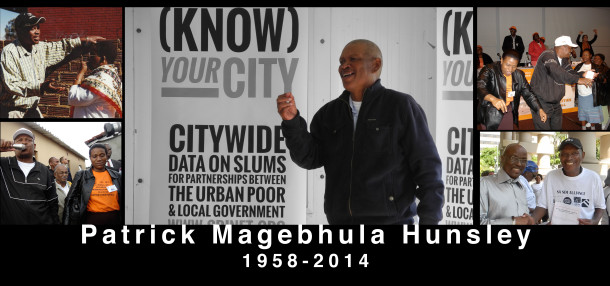
Patrick Magebhula Hunsley, founding member and stalwart of the South African Alliance and Shack Dwellers International (SDI), was awarded the Lifetime Achievement Award by Lindiwe Sisulu, Minister of Human Settlements on behalf of the Department of Human Settlements on Thursday 14 August 2014 at the annual Govan Mbeki Human Settlements Awards ceremony held in Johannesburg.

Patrick Magebhula Hunsley

Patrick Magebhula Hunsley

Patrick's son, Charles Hunsley, receives the Lifetime Achievement Award on behalf of his father from Minister of Human Settlements, Lindiwe Sisulu

Patrick’s son, Charles Hunsley, receives the Lifetime Achievement Award on behalf of his father from Minister of Human Settlements, Lindiwe Sisulu

This prestigious award ceremony (established in 2006) aims “to promote and inculcate a culture of excellence within the human settlement sector in the delivery of quality human settlements and dignity to South Africans” (Reference). The awards acknowledge excellent achievements on a Provincial and National level, in order to showcase and demonstrate the work done by the department at both tiers and to promote best practices in meeting the delivery mandate of the Presidency’s Outcome 8, which is aligned with the vision of building sustainable human settlements and meeting the Millennium Development Goals.

This year, however, the minister included an additional category of awards – the Lifetime Achievement Award – that was given to only two people in honour of excellent and noteworthy contributions. When attending Patrick’s funeral in Durban on 16 August at the KwaMashu Christian Centre in Durban, the minister shared

“For the first time this year, we honoured people with outstanding qualities and recognized them as life time achievers in this area. Of all the people who have been active in this field we chose two people. The first was Joe Slovo, the first minister of housing and the second was Patrick Magebhula”.

Lindiwe Sisulu, Minister of Human Settlements and Rose Molokoane, National Coordinator of FEDUP at Patrick Hunsley's funeral on 16 August 2014.

Lindiwe Sisulu, Minister of Human Settlements and Rose Molokoane, National Coordinator of FEDUP at Patrick Hunsley’s funeral on 16 August 2014.

Lindiwe Sisulu, Minister of Human Settlements pledges R10 000 000 to the Federation of the Urban Poor at Patrick's funeral

Lindiwe Sisulu, Minister of Human Settlements speaks at Patrick’s funeral

The Federation of the Urban Poor (FEDUP) has had a long-standing relationship with government. In the lead up to the 1994 elections, the federation of women’s savings collectives lobbied for an alternative approach to housing that focused on people-centred and controlled development – this model was appropriated by government in 1998 in the form of the People’s Housing Process (PHP). Read more here. Patrick was instrumental in these processes, negotiating with government and ‘un-blocking’ strategic regions in the country. In 2006 FEDUP secured a long term ‘subsidy pledge’ with the department of human settlements which was signed by FEDUP, uTshani Fund and then national minister of housing, Lindiwe Sisulu for 1000 housing subsidies per province in South Africa. In 2010 Patrick served as special advisor to then minister of human settlements, Tokyo Sexwale, on human settlements policy and practice. In 2011 Patrick was asked to serve on a Ministerial Task Team on Water and Sanitation, headed by Ms. Winnie Madikizela-Mandela, tasked with addressing the issues of open-air, incomplete and dilapidated toilets in poor communities across South Africa.

Having worked together closely with Patrick, current Minister of Human Settlements, Lindiwe Sisulu, recognised him at the award ceremony as

 “an outstanding, humble man who helped us shape our policies and understand how people who live in slum conditions are not victims, that they have the power, together with our support, to take themselves out of their poverty. His name is Patrick Magebhula and he passed away on Monday 4 August 2014. It is a sad loss for us. We will bury him on Saturday with all the dignity that he deserves. Today we honour him as an internationally recognised champion and pioneer of the empowerment of the poor and acknowledge his outstanding contribution. We and his broader family of the Federation of the Urban Poor and SDI will have to double our collective effort to further his work to ensure that his life passion was not in vain.” (Reference)

At Patrick’s funeral, which was attended by family, hundreds of fellow activists, friends and comrades the minister remembered how she and Patrick had first met in Barcelona (Cape Town) when she was a new minister together with FEDUP and Rose. As she got up to speak at one of the occasions she explained that Patrick had humorously asked her to explain who she was, who had sent her, who she was representing and what her promise would be to the Federation. After the minister had shared this anecdote, she pledged R 10 000 000 in housing subsidies to FEDUP. Kwa Mashu’s church – packed to the brim – erupted in song, cheers and ululations.

 “My only regret is that Patrick is not here today to hear me but I want him to know that the promise I made to him, today, I kept in his honour. The federation will not be in want while I am around, the federation will not want for anything while the DG, the deputy minister and the department is there. The partnership we have will live in honour of this man whose humility is amazing. As the Department of Human Settlements we count ourselves as the broader family of Patrick.”

She also honoured the work of Shack Dwellers International (SDI) and its nomination for the Nobel Peace Prize, which South Africa has decided to second.

“We as South Africa have pledged to second SDI’s nomination and lobby all African countries who are part of us to second the nomination so that we can celebrate with Patrick should we win the peace prize”.

The Minister then led the gathering in the song: “Lihambile iQhawe”, a famous freedom song that was also sung as Mandela was buried in December last year. The refrain goes: “Lihambile iQhawe lamaQhawa” – The Bravest of the Brave has departed.


Memoir and Tribute Booklet for Patrick Magebhula Hunsley

By Publications, Resources No Comments

After 56 years, our dear friend and comrade, Patrick Magebhula, breathed his last on 4 August 2014. This memorial booklet is a memoir and a tribute to Patrick’s life. The Alliance, together with his family, hundreds of national and international comrades and friends, including housing minister Lindiwe Sisulu, attended his funeral on Saturday 16 August 2014, at the Kwa Mashu Christian Centre in Durban, KwaZulu-Natal to bid Patrick farewell and celebrate and honour his life.

patrick hunsley-1

This memorial booklet is compiled of his own writings and reflections, as well as those of his friends and comrades. It is a collection of some of Patrick’s poetry, sayings and song as well as tributes from friends and comrades, fellow activists and community leaders in the South African SDI Alliance, international SDI affiliate countries, international friends and government, to name but a few of the many people and places that tributes have been streaming in from.

Patrick’s life and times encapsulate much of a quintessential life of a poor black South African childhood under apartheid and adulthood during a time of social and political change. His life was dedicated to the work of community mobilisation, network building, and deal-making. Those who knew and worked with him, will remember his persuasive oratory, marvellous sense of humour and his poetic soul.

[spiderpowa-pdf src=”https://sasdialliance.org.za/wp-content/uploads/2014/08/Patrick-Magebhula-Hunsley_Memoir-Booklet-August-2014-2.pdf”]Patrick Magebhula Hunsley_Memoir Booklet August 2014-2


Patrick Magebhula Hunsley | 1958 – 2014

By CORC, FEDUP, ISN, uTshani Fund No Comments

patrick hunsley-1

Patrick Magebhula Hunsley, our comrade, our brother and our very special friend passed away on Monday 4 August.

Patrick has been dodging bullets all his life – literally and figuratively. He survived being stabbed in the lung. He survived vicious assaults. He survived stints in reformatory and in prison. He survived being gang-pressed into an Ihkatha Impi. He survived a prolonged fight in the shacklands of Inanda to bring a progressive civic organisation into being in his settlement. He survived wave after wave of attacks from forces of reaction and crime to unseat him.

In the 1980s and 1990s we invaded land to create settlements that now house formal communities with services, legal tenure and housing development. We have worked with all levels of the government to give the urban poor a voice. Working with communities we have driven home the need to save money, collect information and upgrade. – Patrick Magebhula writes in an opinion piece in the Mail and Guardian

Since the early 1990s, Patrick has been instrumental in building community networks and local savings schemes. He negotiated with government departments, and even turned away offers when it jeopardised the needs of the community. From his home in Piesang River between the shacklands of Inanda, Durban, where the Federation built 1,431 houses between 1992 and 2000, Patrick mobilised communities across South Africa as a leader of the Federation of the Urban and Rural Poor. Since 2008/09 he served as the chairperson of the Informal Settlement Network. He built progressive partnerships with government agencies and as a special advisor to the previous minister of Human Settlements Mr. Tokyo Sexwale, served as a committee member of the Ministerial Sanitation Task Team, and presented at numerous international conferences such as World Urban Forum 7.

[vimeo width=”620″ height=”485″]http://vimeo.com/43888528[/vimeo]

Patrick has breathed his last. The accumulated batterings of poverty wore him down. It is hard to imagine a future without him – without his marvellous sense of humour, his poetic soul, his fiery oratory, his capacity to find common ground with one and all, his deep compassion for his fellow human being. A flawed genius has passed on. Our movement will be immeasurably more poor who share his dream for a just and equitable world in which poverty and exclusion, oppression and intolerance are consigned to the past.

Unknown

The sun shines for the chosen few.

The sun rises for the lucky ones.

The sun sets for the majority of the poor.

I end up counting the stars


For the next few weeks there will be mourning for Patrick in hundreds of informal settlements, backyard shacks, pavement dwellings in dozens of countries. There will be mourning for him in places of power where his sparkle and his candour, his determination and his unwavering commitment earned him enemies but won over many, many more.

Everyone is invited to share their stories, memories and moments with Patrick on a dedicated social media channel.


Invalid Displayed Gallery


A selection of Patrick’s poems are available for download:

How Community Construction Management Teams (CCMT) can lead upgrading projects

By CORC, FEDUP, ISN, uTshani Fund No Comments

By Yolande Hendler (on behalf of CORC)

20140722_141359

The venue : Makhaza Day Care Centre in Khayelitsha Cape Town

If designing and planning with communities are key aspects of people-led projects then people-led implementation and -construction are too. The SA Alliance – through the Federation of the Urban Poor (FEDUP) – has pioneered this people-led approach since 1994. By lobbying government, FEDUP strongly influenced low-income housing policy that came to be known as “the People’s Housing Process” (PHP), a special housing subsidy that allowed for much greater involvement of communities in the construction of their houses. Since then, FEDUP members have successfully implemented the construction of their houses through Community Construction Management Teams (CCMTs).

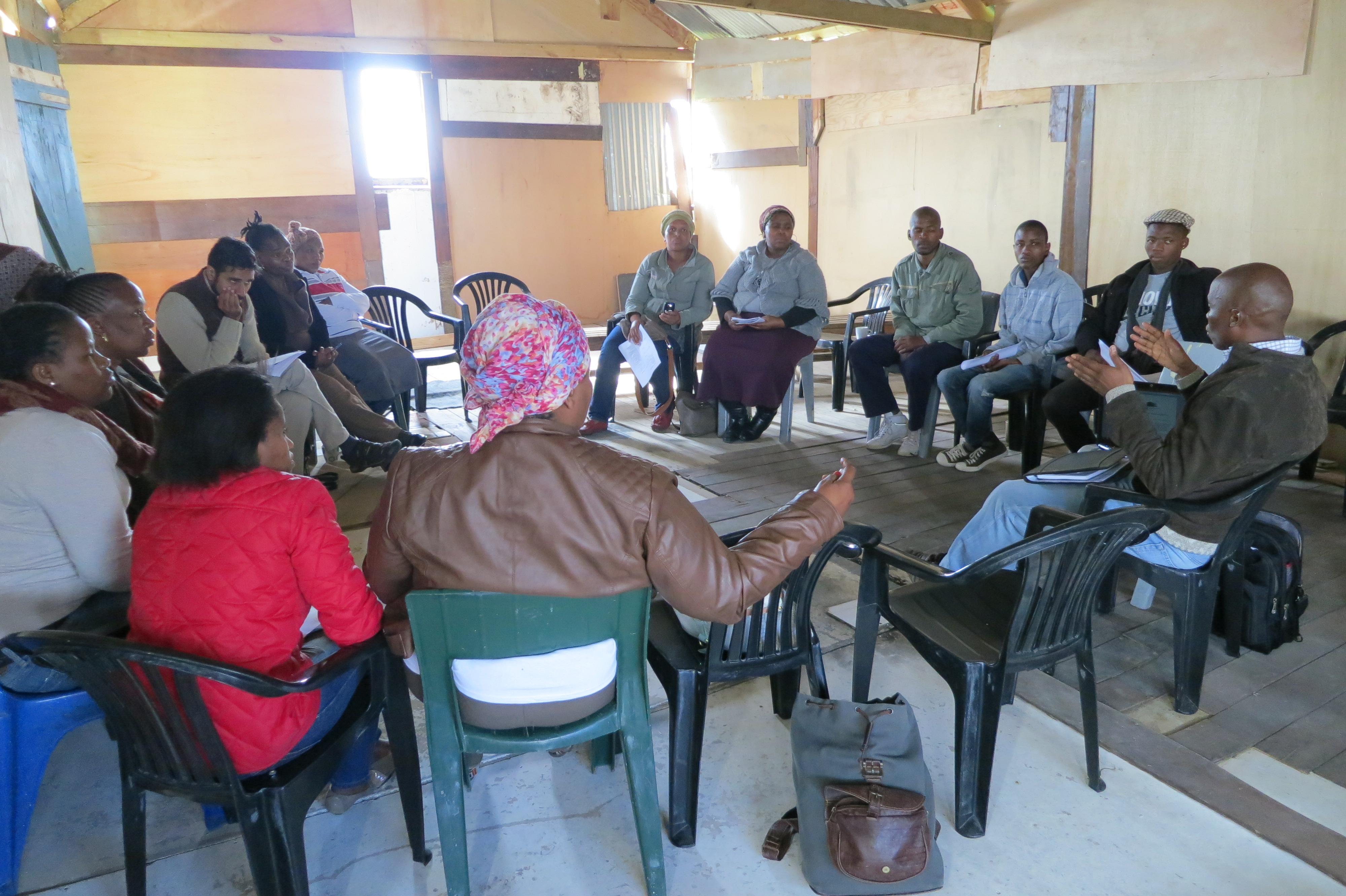
Although CCMTs have for the most part been linked to housing projects in the Alliance, setting them up is just as relevant to the Alliance’s more recent involvement in informal settlement upgrading. During this week’s three day CCMT workshop, experienced CCMT members introduced Cape Town community leaders to the CCMT model of community-led construction and explored how it could function in informal settlement upgrading.

The Exchange

Over three days Hasane Khoza (Abi) and Maureen Skepu from Gauteng shared their experiences in community construction with about 30 leaders from 6 settlements in Cape Town. With a background in construction management, Abi has helped to train and set up CCMTs and monitor housing projects. Maureen has a rich experience in CCMTs – she became a member of FEDUP in the early 2000s, accepted a volunteer position with a local CCMT five years later, and in 2011, moved into her own CCMT constructed house in Orange Farm, Gauteng. Read more about Maureen’s story here.

IMG_1730

Day 1 of exchange: background and formation of CCMTs

During the exchange, Abi and Maureen provided some background on the formation and strcuture of CCMTs, roles and responsibilities of each CCMT member and how to introduce the model of CCMTs to informal settlement upgrading.

The group also spent an afternoon in Flamingo informal settlement, which is currently upgrading and re-blocking. The visit offered an ideal opportunity for Flamingo’s steering committee to explain the way in which they have organised themselves so far and to explore the potential for them to form a CCMT to further streamline and ease the overall management of re-blocking. For the other communities present the site visit offered a first hand impression of what to consider for managing an upgrading project.

Terence Johnson, who has been involved in Flamingo from the outset on behalf of the Informal Settlement Network (ISN) explained,

“There are so many challenges and things you need to consider during upgrading. Some people don’t want to be moved, the rain causes flooding and leakages…. but we need to see these things not as a problem but as a challenge. And we can overcome challenges, especially if we work in a group like a CCMT. ”

Flamingo steering committee putting during on-site construction

Flamingo steering committee putting during on-site construction

How CCMTs work

On the first day Maureen explained,

 “The idea behind CCMTs is that communities oversee and implement projects themselves. In this way the community can make sure that the job is done properly. Because of this you need dedicated and thorough people on the team. The benefit of CCMTs compared to general steering committees are that each member has clear roles and responsibilities”

(Maureen Skepu, FEDUP housing project coordinator, Gauteng)

Within FEDUP, the CCMT process includes all the stages of house building: from drawing plans (which are formalised by qualified architects and engineers) to the construction process, which is contracted out to community members. The construction team consists of five members who each have a specific task: the technical officer requests specific items and provides quality control, the bookkeeper sources the best and cheapest materials, the storekeeper controls the inflow and outflow of stock, the loan and savings officer looks after the community’s finances, and the project manager oversees the whole process. And, unlike in the private and public building sector, most of the construction team’s members are women.

“The idea is to capacitate a community to move from being just employed in a project to driving the project themselves. Project management is a skill that can be learnt. Everyone can be taught and everything we know we have learnt. Managing a project leads to empowering a community.”

(Abi / Hasane Khoza, CCMT Construction Manager)

IMG_1731

Abi answering questions about CCMTs

Community Questions, Discussions and Insights

The workshop was a space of many questions and lively discussions. These were about how to break down the budget at community level so each person knows exact quantities and costs of materials to expect, at what stage in a project process a CCMT could be formed, or that women’s strength, resilience and thoroughness are good qualities for CCMT members. The communities present also liked the idea that CCMTs share the overall responsibility of an upgrading project – a shift from one person to a team of people.

In reflecting on the three days that passed, the community members expressed their value for exploring how the CCMT process can work in informal settings and upgrading projects. The suggested next steps are to establish guiding templates for establishing CCMTs as well as monitoring and documenting project processes on the ground, so that these can be shared with others as well.

“What we can learn from the CCMT workshop is that we need to continue learning, especially from the mistakes we make. Let’s not only make a habit of learning but actually do something with what we learn”

(Lindiwe Ralarala, Masilunge community leader)

Discussing the role of slopes and gradients on the upgrading site.

A discussion on the role of slopes and gradients on the upgrading site.

Durban and Port Elizabeth Leaders on Sanitation Exchange

By CORC, iKhayalami, ISN, SDI No Comments

By Stefanie Holzwarth and Yolande Hendler (on behalf of CORC)

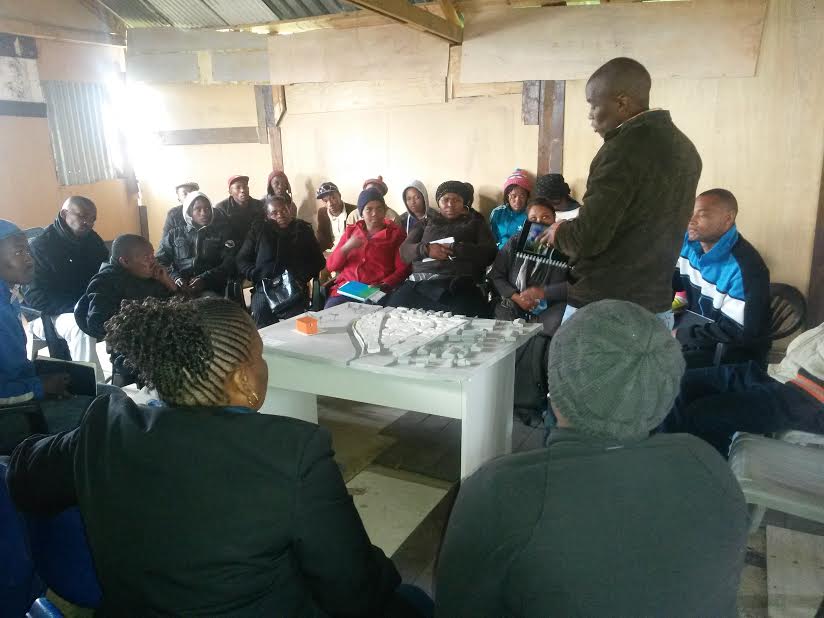
Over the past years, the communities of Midrand in Port Elizabeth and Havelock in Durban have been upgrading their settlements, step by step. Last week’s exchange (8-11 July 2014) – in which community leaders visited Cape Town settlements – formed the next step in activating solutions to their specific needs for water and sanitation upgrading.

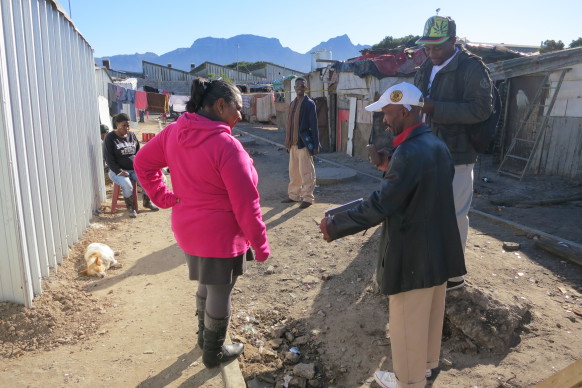
Site visit in Kuku Town

Site visit in Kuku Town


Midrand and Havelock

Midrand is located on municipal land but is not yet listed on the municipality’s database and therefore experiences great difficulty in accessing services. The community consistently experiences severe flooding. Havelock, on the other hand, is built on privately owned land and has been earmarked for “interim services” by eThekwini Municipality, indicating a willingness to deliver basic services in the short term and habitation in the long term. It is built against a hill with high shack densities that have led to shack fires, flooding and torrents of water flushes in the rainy seasons. Read more background on Havelock and Midrand.

The exchange

During the four-day exchange about ten community leaders visited five settlements in and around Cape Town. The exchange was linked to the SHARE Program (Sanitation and Hygiene Applied Research for Equity) linked to Shack Dwellers International (SDI). Read more about SHARE here. It was facilitated by the Informal Settlement Network (ISN), Community Organisation Resource Centre (CORC) and iKhayalami. It centrally focussed on how communities can use sanitation as a tool for upgrading and mobilisation, particularly in response to ever present and severe flooding.

Midrand community leaders, for example, spent time investigating the most suitable and relevant options for sanitation upgrading in their settlement:

  • Communal toilets and wash facility at the edge of the settlement (ablution blocks) without re-blocking
  • Sanitation and wash facility in the centre of the settlement with partial re-blocking
  • Individual sanitation facilities in courtyard (one-on-one sanitation) with settlement wide re-blocking

These would all require engagement with local government institutions.

Havelock’s central challenge is drainage. The settlement has already engaged with local government about constructing a sanitation unit as well as providing more sanitation units in the centre of the settlement. This would coincide with the communities’ already existing plans to re-block its settlement. Midrand and Havelock’s leaders therefore visited upgrading sites that provided an example of different options available to them.

DSCN7284

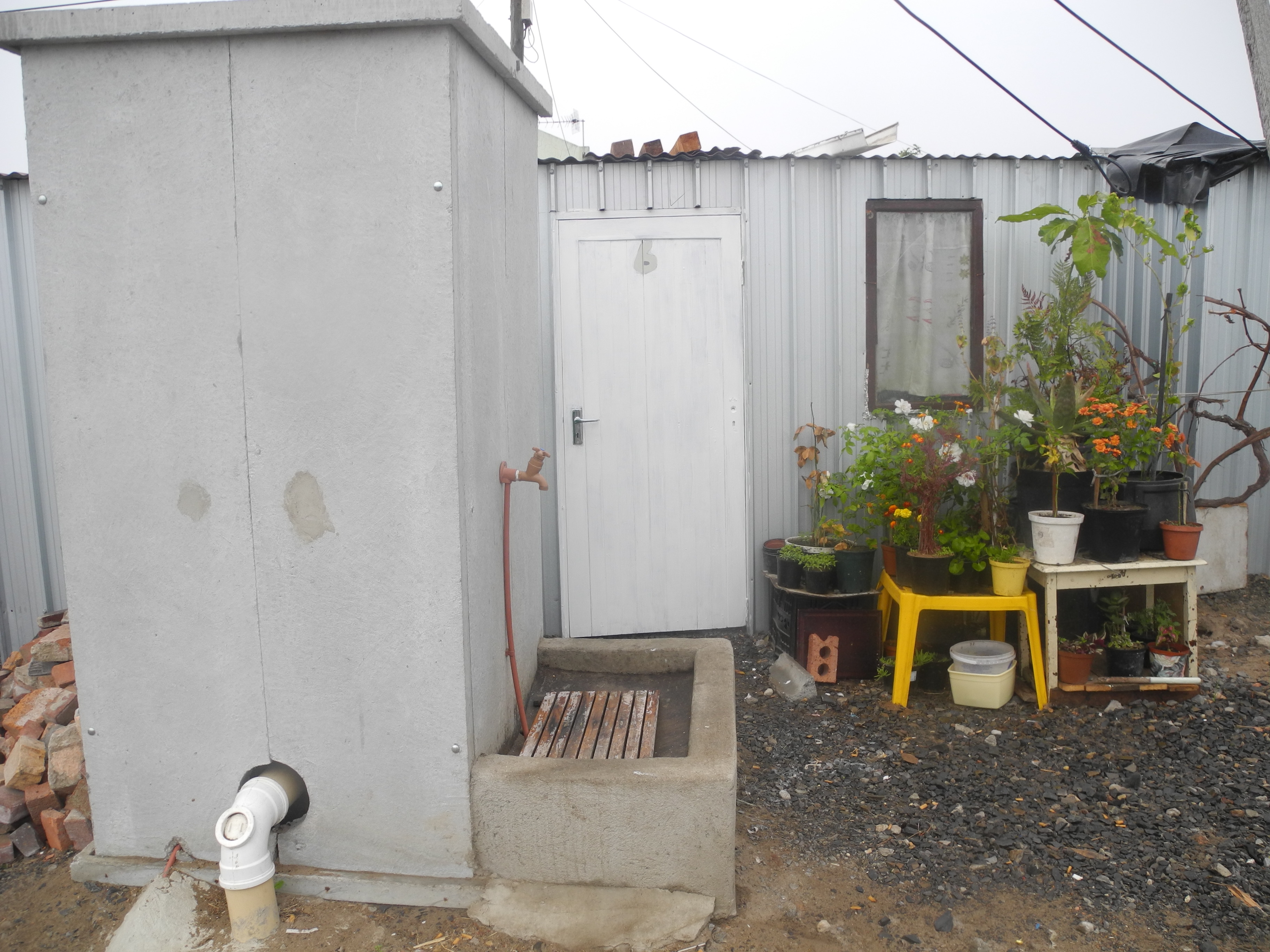
Example of sanitation in a community-run Water, Sanitation and Hygiene (WaSH) facility

One-on-One Sanitation in Kuku Town

The visitors spent the first day in Kuku Town where the community recently completed re-blocking with individual sanitation per upgraded structure. They were particularly interested in how Kuku Town managed to re-block without having to relocate people to other areas. Other questions focused on why the community chose individual toilets. Kuku Town’s leaders explained that

“single toilets are manageable because the owner is responsible for their own toilet and because there are no conflicts within the community with regards to hygiene.”

The leaders also reflected on Kuku Town’s successes and challenges throughout planning and implementation. The visitors learned how Kuku Town approached the municipality for support in terms of infrastructure services. Both Midrand and Havelock were impressed by the Council´s successful involvement in providing water and sanitation.

6. After reblocking 3

Sanitation and water services per upgraded structure in Kuku Town

Sanitation facility in Langrug, Stellenbosch & BM Section, Khayelitsha

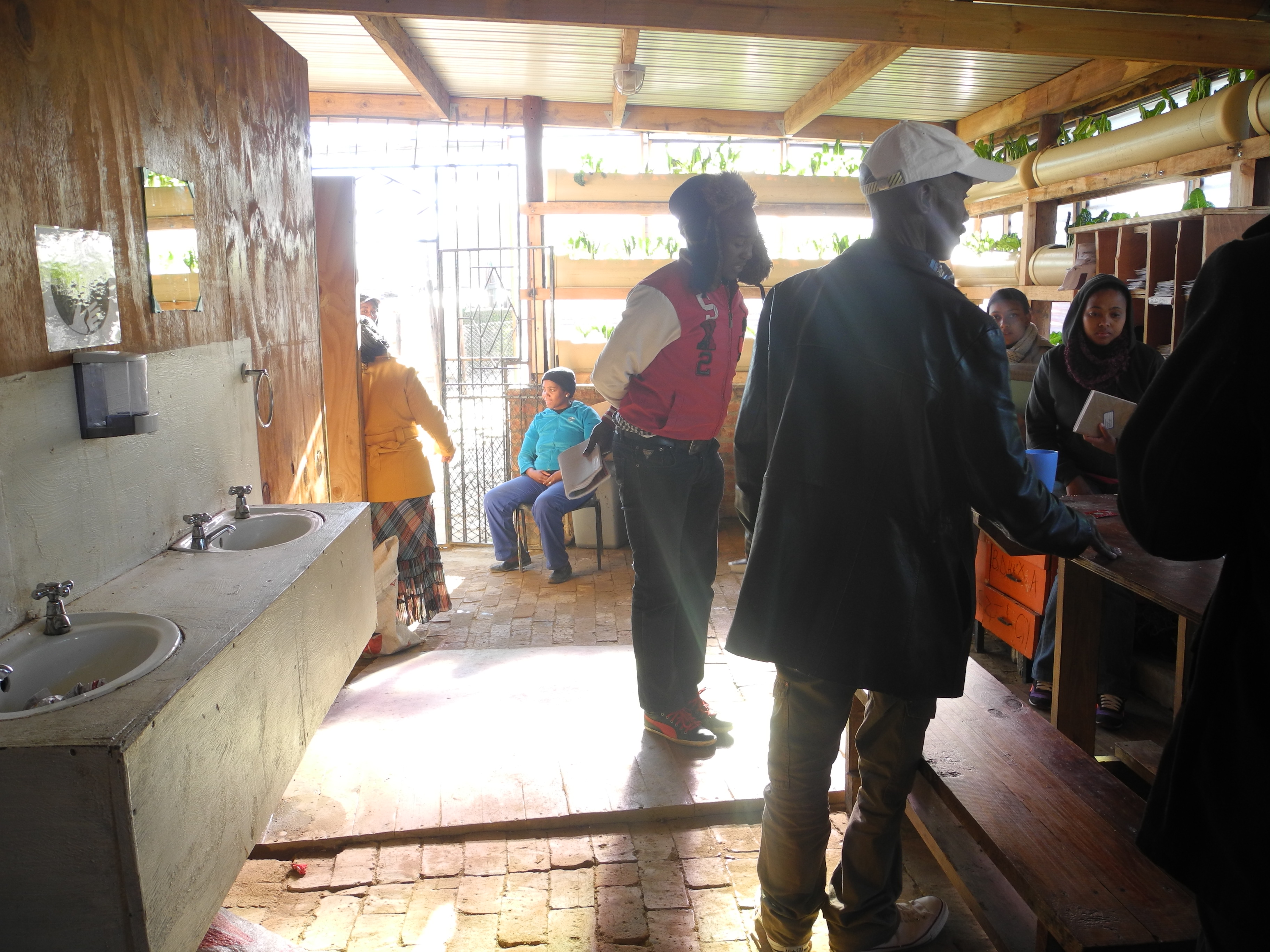
In Langrug, Franschoek. the visitors saw an example of upgrading that included relocating 16 families, the construction of a second access road and grey-water and drainage channels, and a community designed, multi-purpose Water, Sanitation and Hygiene (WaSH) Facility. The visit offered insight into the WaSH facility, the drainage project and the local playground. The subsequent discussion facilitated an exciting learning environment with questions about the maintenance of the WaSH facility and funding. They also discovered the opportunity of hot water provision via solar heating systems in summer. The afternoon centred on projects in BM section, Khayelitsha. Its similarity (due to an uneven slope) to Havelock made it an ideal site for the exchange and delivered an essential input for its visitors.

DSCN7392

Interior view of Langrug’s WaSH facility


DSCN7455

Courtyard in BM section

Shared Sanitation in Mtshini Wam & ongoing re-blocking in Flamingo

The visit to Mshini Wam provided valuable lessons for the visitors – particularly in the field of funding and engaging the local authority. The visitors took special interest in understanding how Mtshini Wam managed to convince some residents to share toilets on a cluster basis while others had single toilets. The challenges relating to communal toilets were thoroughly discussed.

“The main idea was to have single toilets but due to the number of shacks and the limited space, the plan was diverted in order to accommodate communal toilets. The maintenance and cleaning of the toilets depends on the cluster groups.”

The visitors concluded their site visits in Flamingo Crescent, an ongoing re-blocking project. During a walkabout the visitors observed how shacks were broken down, how ground works were installed and how the new structures were erected.

Site visit in Flamingo during re-blocking

Site visit in Flamingo during re-blocking

Midrand community discusses the way forward

On the last day, Midrand leaders and iKhayalami discussed the sanitation options available to the community and the future steps each would imply. Community leaders agreed that re-blocking with one-on-one services would be the most realistic and feasible option.

“The ablution block won´t work for us because there is lots of friction. No one wants to wait for a long time when using the facility. Community blocks won´t work because some of the people are not responsible. They leave it without taking care.” (Community Leader, Midrand)

Midrand’s leaders agreed to start saving to upgrade their structures instead of solely blocking out. They hoped to convince the municipality to come on board. Re-blocking would be conducted in phases – identifying clusters for incremental re-blocking.

One major challenge in Midrand is the lack of space. Part of the settlement land is still in private hands – which causes major tenure insecurity. Together with iKhayalami the leaders discussed various solutions. While the community leaders resolved their questions, the next step is to share these with the rest of their communities when they return.

The exchange not only offered a learning space but also enabled leaders to grow their ability in community-driven upgrading,

“I have learned a lot by being a community leader and by being part of this exchange. It has built up my confidence and my professional experience. I was a very shy person before – now I can stand up and work for our development goals.” (Midrand community leader)

Midrand Consultation

Andy Bolnick (iKhayalami) discusses sanitation options with Midrand community leaders

Grooming future leaders ‘ the youth federation on youth day’

By CORC, FEDUP, ISN, uTshani Fund No Comments

by Thandeka Tshabalala on behalf of FEDUP

About 70 youth federation members gathered at Kwamashu in Durban to discuss challenges that are facing the youth and how they can use the federation (FEDUP) rituals to influence change in their lives and communities.

Rose Molokwane enjoying her time with the youth.

Rose Molokwane enjoying her time with the youth.


To set the platform Rose Molokwane, the national federation coordinator shared her story about her experience when she joined the federation and the importance of grooming a youth federation in South Africa.

“I was 31 years of age when I joined the federation in 1991 and today I am happy to share my experience with the youth, the purpose of the meeting is to prepare the youth and help in changing their mindsets to influence change in their communities, like we have” she said.

She further stated that her aspiration as the national coordinator of the movement is to build a sustainable and successful organization and it is vital that the youth are at the forefront of bringing change in their communities.

“ We need an organized youth that will be able to create an agenda of change in their lives, our children grew up seeing their mothers creating an impact and opportunities for the poor in their communities. It is now time that we pull you (youth) next to us so that you can learn from us. There are so many service delivery protests in South Africa and it is heartbreaking to see the youth leading them thus we need to groom new youth leaders that want to learn about new avenues to negotiate with the state” said Rose.

Rose further challenged the youth to think about the ‘youth’ rights, how they can achieve them and who was responsible for making sure that their rights were protected.

re- thinking the youth rights

Bunita Kohler, the managing director of CORC (Community Organisation Resource Center) additionally challenged the youth to think about

“ the brave youth of 1976, the youth that had very little resources but persevered for what they believed to be right for them. As activist we felt that we could do something in our communities, we had a vision, thus it is important that the youth of today has a vision, what is it that you want to see in your life? What are we striving for and how do we want to achieve it? Which Values will we embrace in order to achieve these goals?”

In acknowledgement that the youth is experiencing a lot of challenges in their communities she urged the youth to use knowledge from the ‘old’ experienced federation members to advance themselves.

20140615_125617


The Youth reports  on challenges and ways to overcome them 

The youth presented their regional challenges such as unemployment, poverty, drug abuse, unplanned pregnancies, derelict living conditions, lack of education and support to establish youth activities. They all discussed a way forward in overcoming some of these challenges such as:

Creating platforms for Partnerships

  • The youth discussed using partnerships as a platform to bring positive change in their communities. From their main big challenge – unemployment, they all agreed to partner with government departments and NGO’s that assist in skills development and creating job opportunities.
  • Partnerships with the local councilor were seen to be important in unlocking local resources and using them to get more community involvement in youth projects.

Pule shared his story about  the benefits of creating partnerships 

  Savings has enabled the youth to negotiate with government. We belong to a savings group called yona yethu a savings scheme with 120 members. Some of the members have formed a co-operative which will enable us to gain more support from the government and also allow us to bring more income for our households.   At the mean time the group  washes dirty dustbins after the municipal trucks have collected the gabbage  , we clean them using chemicals and take them back to the owners at a certain fee.   We have further engaged with the solid waste management  department and city parks about the vacant land in our settlement that is used as dumping sites. We have proposed to clean them and then change them to parks for the children in the settlement to use. In order to stop people from dumping again we further engaged with the local councilor to speak with the community and appoint certain community members to be responsible for keeping an eye on anyone dumping. We meet weekly to discuss new views and challenges.

An organized youth-for- change

  • The youth realized that they needed to be organized in order to make an impact in their communities. An organized youth would be able to fight against poverty, landless issues, and lack of housing, unemployment and dealing with drug abuse. The youth was tasked to mobilize more youth members and form youth activities that will assist in influencing change in their communities.
  • The youth also asked experienced federation members to help them to create a youth federation organisation structure.

Adopting the federation rituals

  • Because savings is the backbone of the federation, the youth was urged to start forming savings groups in order to leverage more resources from the state and other partners. In the past the federation has used savings to leverage resources from the state through the people housing process (PHP). The savings helps the federation members to contribute in the building costs of their houses , increasing their subsidies to build bigger houses that can accommodate their family needs.
  •  They requested that they have more regional Exchanges to see what other youth members are doing in their communities so that they can exchange knowledge.

In order to spark more youth involvement in creating partnerships Harambee and the NYDE  (National Youth development Agency) presented about their programs.Most of the youth were excited in seeing that they can influence change in communities by ‘just’ giving information to the youth. Rose further reminded them that information was vital to bring about change thus she urged the youth to collect data from the enumeration reports that would be relevant to them such as regional youth challenges, number of unemployed youth.

A group photo during the historical site visit.

A group photo during the historical site visit.


Celebrating being the youth

The youth was taken on a cultural tour to enhance their knowledge on the South African history. The two sites at Inanda route Mahatma Gandhi and John Libalele Dube historical sites were chosen to inspire the youth about leadership that instigates change in communities despite facing challenges. They further celebrated youth day with cultural activities – some highlighting the challenges they are faced with in their communities.

IMG_2196

“We Build Ourselves” – FEDUP Permaculture Exchange 2014

By CORC, FEDUP, uTshani Fund No Comments

By Nozuko Fulani (on behalf of FEDUP)*

We are Siyazakha Savings Group. We are a group of 26 members and first started to meet in 2010 in Siyahlala informal settlement in Philippi, Cape Town, where I live. We decided to form the savings group when we got introduced to the Federation of the Urban Poor (FEDUP). It was during a time that we were stuck on private land and did not know how to start organising ourselves. The savings group was a good way for us to improve conditions for ourselves and for our settlement. We chose the name ‘Siyazakha’ because it means ‘to build ourselves’. The name was my idea – it reminds us that we are the only ones who can build our families and ourselves. This is why we save.

P1020034

Visiting permaculture gardens at Makhaza Day Care Centre

DSCN6618

Nozuko Fulani

Over the years we have been saving towards different things. Some savings are long term and others are short term. This winter, for example, we are saving for paraffin heaters. Every member is going to save R150 from which we want to buy 3 heaters every month. We use long-term savings for things like school uniforms and groceries. This is a strong support because we don’t have to worry about taking loans. At the moment we have 15 active members and many new members joining, especially older mamas who are the most energetic.

As a savings group we also have a permaculture garden in my yard. I helped to develop this garden after I became a permaculture trainer in 2013 through uTshani Fund and FEDUP. At this time FEDUP and uTshani Fund introduced Project Permaculture as a new income generation and skills programme into the Alliance. Project Permaculture taught us the skills we need to grow fruit and vegetables. By growing our own food and reselling it, the permaculture gardens help us to make sure that we have enough food and can even make an income.  Many gardens are in crèches and day care centres. (Read this blog for more background on Project Permaculture.)

P1020056

Mama Darkie from Makhaza hosts the first day of the exchange

P1020048

Clearing the Grass

P1020018

Preparing the Soil

Three of us from Siyazakha savings group decided to do a permaculture exchange at Masizame savings group in Makhaza (Cape Town) from 24-26 May 2014. We chose Masizame savings group because we heard that many members were no longer active.  Mama Jim, Thembiso and I went around door-to-door and managed to collect 5 women from Masizame savings group for the exchange.

On the first day we explained that permaculture is about using all available materials and that there is no need to use chemicals or to buy anything. Permaculture believes that before you start with the garden you must design it and check up on things like rainfall and wind direction. Permaculture also uses the idea of mixing the vegetables we plant. This means that we plant onions and garlic next to spinach – because these plants chase away insects. It is also important to alternate the seeds between plants that grow above and below the ground.

On day two we went straight to the vegetable gardens at Makhaza Day Care Centre. As we were gardening I showed the women how to prepare the soil by using old grass called mulch and layering it with water and old food. This makes the soil fertile. We also cleaned some vegetable beds and replanted seedlings. We learnt by using what we can see and touch.

On the last day the women said that they were very excited because permaculture gardening is a method that they know from home. Through the permaculture exchange they could see how alive a savings group can be. If you see that something is happening and that a group is active, it is very motivating. The ladies were so excited that they collected some money to buy spinach, cabbage and herb seedlings for their own garden. They decided that now they wanted to meet as a savings group every Tuesday to catch up on the meetings they had missed.

*Photos taken by Nozuko Fulani, blog compiled by Yolande Hendler (on behalf of CORC)

P1020020

Day Care Centre in Makhaza


SDI President Jockin Arputham in Cape Town

By FEDUP, ISN, News, SDI No Comments

Jockin Arputham, president of Shack / Slum Dwellers International (SDI) received a warm welcome from the South African Alliance in Cape Town yesterday on the last of his four-day visit. As a long-standing, much-valued friend of the Alliance he spent the day with community leaders in Khayelitsha and with representatives of the City of Cape Town and Western Cape Province.  Jockin spoke about the power of savings and the Indian Alliance’s partnership with the Municipality of Greater Mumbai. In this context, Jockin was accompanied by Rajiv Jalota, the Additional Municipal Commissioner for Projects in Greater Mumbai Municipality.

SDI President Jockin Arputham (Right) & Rajiv Jalota (Additional Municipal Commissioner for Greater Mumbai Municipality)

SDI President Jockin Arputham (Right) & Rajiv Jalota (Additional Municipal Commissioner for Greater Mumbai Municipality)

The Informal Settlement Network (ISN) has mobilised and profiled several settlements in Khayelitsha that are set to proceed on water, sanitation, drainage, re-blocking and community facility projects.  Jockin’s visit linked Khayelitsha’s community leaders – many of whom are fairly new to ISN and SDI processes – to the broader context of the South African Alliance and SDI as a global network.

Community Leaders greet Jockin

Community leaders welcome Jockin

Word of welcome by Tamara Hela, Community Leader from UT Gardens Khayelitsha

An official word of welcome by Tamara Hela, Community Leader from UT Gardens Khayelitsha

National coordinators of the South African Alliance’s two social movements, Patrick Maghebhula (ISN) and Rose Molokoane (FEDUP) welcomed Jockin by speaking about the Alliance’s history with the Indian Alliance. They referred to the South African slogan – Amandla Imali Nolwazi: Power is Money and Knowledge – and its roots in the relationship with India.

“This slogan started influencing me after we went to India (in 1991). We shared ideas around democracy with the Indians. We saw that after 40 years of democracy millions of people in India were extremely poor. We realized that if you sit around and wait for democracy it will come…but it will come with its own laws that might not cater for you. We need to do something to translate these laws to our own life. And so we learnt the experience of self-reliance from the Indians. We need to drive our own lives – and we do that with savings. This is how relationships with government were formed in India. Our savings and our information give us power to influence laws. We know, that yes, we may be poor, but we are not hopeless“

(Rose Molokoane, National FEDUP co-ordinator)

Rose Molokoane (National FEDUP co-ordinator)

Rose Molokoane (National FEDUP co-ordinator)


In the keynote address, Jockin emphasised that

“Savings are a life line. We talk about savings the whole time because money is what speaks.  But when you collect money – door to door – you also collect information. When you have information you can plan action and if you act, something will happen. This is why money and information guarantee us power.  We need to think about how to support ourselves”

As 40 – 50 % of Mumbai’s population – 19 million people – lives in slums, many millions do not have access to toilets. In fact, the ratio translates to about 1 toilet for every 800 people.  The NSDF has therefore been working together with Mr Jalota and the Municipality to construct community planned and -owned toilet facilities. This experience, Mr Jalota explained, would help to develop more policies for Greater Mumbai.

Jockin founded the National Slum Dwellers Federation of India (NSDF) in the 1970s. Often referred to as the “grandfather” of the global slum dwellers movement, Jockin was educated by the slums, living on the streets for much of his childhood with no formal education. For more than 30 years, Jockin has worked in slums and shantytowns throughout India and around the world. After working as a carpenter in Mumbai, he became involved in organising the community where he lived and worked (Reference). He helped found SDI and has been awarded many prestigious global awards, most recently the Skoll Foundation award for social entrepreneurship. On behalf of SDI Jockin has also been nominated for the Nobel Peace Prize.

Jockin Arputham, SDI President

Jockin Arputham, SDI President

FEDUP and uTshani Fund introduce ‘Project Permaculture’

By FEDUP, uTshani Fund No Comments

By Barbara Torresi (on behalf of uTshani Fund)

f. Trainers Site Visit November 2013

While the provision of housing to the poorest of the poor remains uTshani Fund’s main objective, it has become increasingly indisputable that, to be effective and for its effects to be long-lasting, the fight against a multifactoral phenomenon like poverty must take place on multiple fronts. This is particularly true in metropolitan areas, where shelter is but one of the necessities that the surging masses of rural-to-urban migrants are in short supply of. With dwindling job opportunities, even the satisfaction of a fundamental human need like adequate nutrition has become uncertain, as has the achievement of the well-being determinants (education, employment, health) that normally cascade from access to a balanced diet.

To use a practical example, when children are undernourished their learning ability suffers, and so does their capacity to stay in school in the face of more pressing concerns such as putting bread on the family table. Similarly, malnutrition renders adults susceptible to a host of chronic ailments, which can dramatically decrease their opportunities to secure  or keep a job in an already crowded employment market. And the lower people’s income, the worse their diet – a vicious circle that exemplifies the sinister self-replicating nature of dependency and economic deprivation.

i.  2nd week training Group 2 photos.5docx

Second week of training


It was with all of the above in mind that uTshani Fund and Fedup began to look at ways to work poverty alleviation measures such as income generation and skills training into the Alliance’s saving and upgrading rituals. A perfect opportunity to tackle more than one issue at once – and therefore to reap the benefits of synergic action – was seized by uTshani in June 2013, when the organisation won a grant by the South African National Lottery to teach informal settlement dwellers, and in particular women and other vulnerable individuals, the skills required to grow fruit and vegetables right at their doorstep. Since it provides participants with the ability to cultivate fresh produce for both their own consumption and resale in local markets, the program offers the dual advantage of addressing the issue of food security together with that of the chronic lack of income generating opportunities in the townships.

In actual fact, the scope of Project Permaculture is even larger, since the establishment of horticultural gardens in day-care centres is enabling Fedup and uTshani to not only create sustainable job opportunities in deprived communities, but also to provide education for children in disadvantaged areas, to improve the health of the urban poor, to enhance the physical environment in which slum dwellers live, to teach children from a young age the value of working with nature, and to pilot a livelihood program that can be replicated in other Federation groups.

In other words, Project Permaculture is a sustainable and scalable strategy that targets some of the major issues currently affecting the country’s most deprived urban areas.

d. 1st week training Group 1 photos

Snippet_309548D50

From a practical point of view the project, which is run by uTshani Fund’s partner Rucore and is currently in its concluding stages, started in October 2013 and took place in various settlements of the Eastern Cape (Queenstown and Port Elizabeth), Western Cape (Mossel Bay, Khayelitsha, Philippi), Gauteng (Garuankua, Nigel, Soweto, Orange Farm), and the North West (Oukasie and Hartebees). Training was divided into two phases. The first phase consisted of a six day workshop during which starter packs containing the required materials (spades, hosepipes, fencing, water tanks, shade nets, gutters, compost, manure, fruit trees, seeding trays, herbs, seeds, and posters) were handed out to the beneficiaries. After participants were given a chance to put in practice what they had learnt and to get their gardens started, Rucore conducted a second six day training session in January 2013 to troubleshoot problems and fine-tune skills.

To date, 54 Fedup members (43 of which women) have been directly capacitated by the permaculture program, but in reality the enterprise’s indirect benefits are farther reaching, since it is estimated that between 250 and 300 individuals will take advantage of the improved diets and larger incomes that the workshop attendees will be able to secure through the monetisation of their new skills. As one woman put it,

“What I learned will help my sons grow into strong and healthy adults with the ability to look after their own families and children”.

So here is proof, if any was needed, that not only poverty but also ingenuous ways to mitigate this scourge can, with the help of commitment and organisation, become powerful self-replicating forces.

Group picture at first week of training

Group picture at first week of training