Tag

Inclusive Planning Archives - Page 2 of 3 - SASDI Alliance

Building Continuity: Denver Community and University of Johannesburg Studio 2015

By CORC, FEDUP, ISN No Comments

By Motebang Matsela (on behalf of CORC)

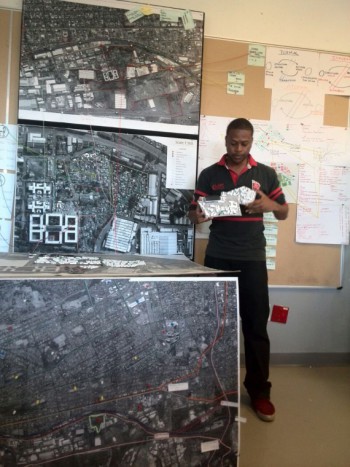
From 27 April to 22 May 2015, the community of Denver informal settlement in Johannesburg partnered with students from the University of Johannesburg’s (UJs) Department of Architecture in a collaborative design studio. Such studios focus on co-producing ideas, scenarios, plans and typologies on informal settlement upgrading and housing. Denver’s first collaborative studio took place in 2014. It was the first of consecutive, annual studios that would build on previous work and span a period of 3-5 years. The 2015 studio therefore started where the last studio ended, focusing on establishing tangible outputs such as a collaborative design handbook and a catalogue of dwelling typologies.

20150605072345

Co-producing Ideas: Denver Studio 2014

In 2014 the studio catalysed the generation of co-produced mapping and socio-demographic data on the settlement. The aim was to formulate community action plans (CAPs) for Denver Settlement in an effort to encourage short-term community initiatives and to support further productive discussion with local government agencies and other stakeholders regarding incremental upgrading in informal settlements. It also introduced students to the necessity and value of planning with communities, shifting the focus from traditional ‘top down’ delivery towards ‘responsive’, community-orientated approaches. For more background on the settlement and the 2014 studio click here.

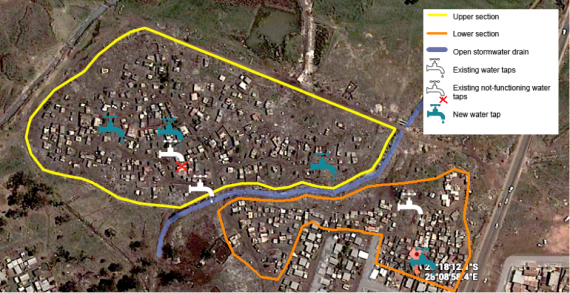
Aerial view of Denver informal settlements

Aerial view of Denver informal settlements

A growing partnership

The idea of co-production suggests the involvement of different stakeholders. For this studio, therefore, the role players included Denver community members and leadership, the Ward Councillor and community representative, a collective of community volunteers assembled at various stages of the long-term studio, Aformal Terrain in partnership with the Department of Architecture at UJ and its students and the Alliance’s ISN, FEDUP and CORC who offered technical and social support and facilitation.

Unlike previous studios that customarily take place in informal settlements, the Denver studio had to change venue when xenophobic violence broke out in Johannesburg. The socio-political atmosphere of the violence and hostel raiding was deemed an unsafe environment to operate under.

20150605070039

As indicated, the collaborative outcomes are valuable aspects of the studio’s work. Based on the experience of last year’s studio, Gauteng’s ISN leaders highlighted the need for community members to gain tangible skills throughout the studio and upgrading process just as the students do. Each stage (module) of the studio therefore couples a community member’s practical participation in the studio with project management skills. In this year’s studio, more emphasis was placed on community participation and benefit.

This led to a revision of the 2014 Memorandum of Understanding (MoU) formalising the partnership between the SA SDI Alliance and UJ’s Architecture Department.

Some of the changes were highlighted in terms of:

  • The precedence of the relationship between Denver community and SA SDI Alliance
  • Denver community decisions will be respected and take priority within this project
  • Any data generated by the community residents will remain the property of the residents. Copies of any formal information packages generated from the studio engagement will be made available to community leadership.
  • All parties agree to inform each other in writing around documentation, marketing or exhibiting of the Denver project. The documentation will sufficiently acknowledge the role of each party and most importantly the residents’

Building Continuity: Denver Studio 2015

The objective of this studio was to incrementally build on the content of the 2014 studio, creating continuity and ongoing engagement between past and future studios. It also aimed to develop a collaborative design ‘handbook’; a catalogue of typologies of dwellings in informal settlements with related strategies for improvement through self-build, co-ops, CBOs, local government assistance, infrastructure etc.

This investigation focused on three main issues;

  • site (the physical)
  • planning (spatial and developmental)
  • policy (strategies from governmental level)

20150605070105

The intention was that these three focal areas would form a broad scale critical inquiry into current upper strategies for informal settlement upgrading and as a starting point suggested possible linkages with existing bottom-up initiatives.

It is envisioned that the outcomes will come to fulfilment in various forms through the studio process over the next 3-5 years in the form of awareness and knowledge packs about the settlement, site handbooks and guides on in-situ upgrading at various scales (shelter, site, policy, planning etc.), design studies for future densification and longer term formal development. A number of other valuable outputs not limited to this list will be determined through the studio process.

These potential outputs aim to bridge the gap between current bottom-up and top-down strategies already active in Denver – aiming to ‘connect’ community initiatives and local government intentions in more productive conversations toward improvement.

20150605070125

The studios final presentations tabled prototype-scenarios generated in response to a three-week focused research exercise focusing on 3 scales;

  • Dwelling-and-Neighbourhood,
  • Planning
  • Policy

In this final week (loosely termed ‘rapid design prototyping’) students worked in mixed groups, integrating information from the 3 earlier foci with the aim of generating scenarios for the potential improvement of Denver Informal Settlement. It is intended that these scenarios become useful tools for engagement with the residents of Denver in focused workshops and engagements during the course of this year.

Taps, Toilets & Beyond: ISN partners with Water & Sanitation Dept

By CORC, ISN No Comments

By Nkokheli Ncambele (on behalf of ISN)*

Nkokheli Ncambele is the regional co-ordinator of the Alliance’s Informal Settlement Network (ISN) in the Western Cape.

Emseleni Community leader, Nomfundo Lungisa

Emseleni Community leader, Nomfundo Lungisa

In Mfuleni, informal settlements have been without basic services for five years. People had to buy water from surrounding formal houses; at night it was difficult for them to get to a toilet. Last year, ISN started creating a partnership with the City of Cape Town’s Water & Sanitation Department. We kept reporting these problems to the City until we saw that there was a light: the Department came to us saying, “Yes we are going to do something in those communities”.

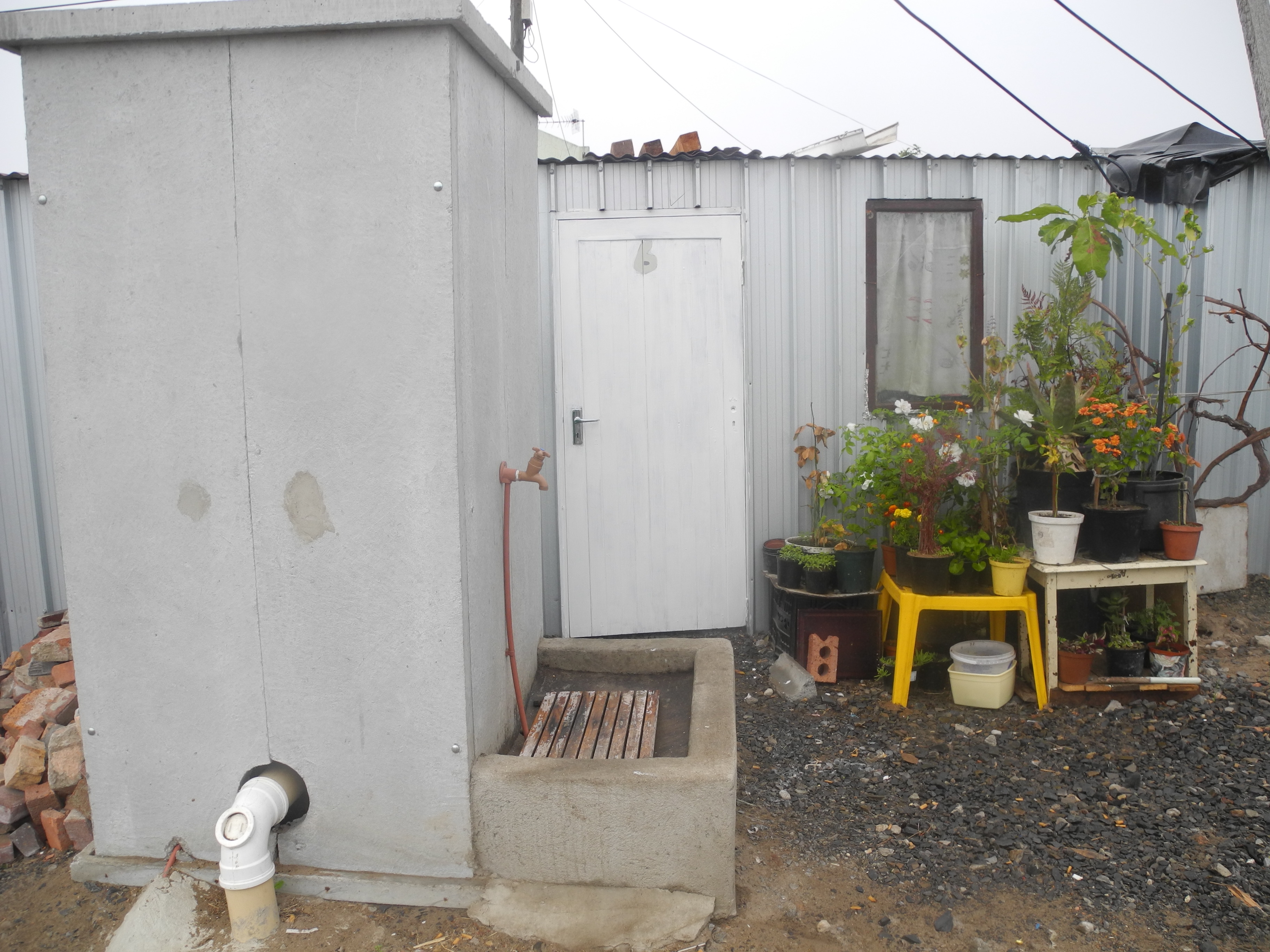
The City is very important as a partner because when they come on board we see results: in March 2015 they installed a total of 15 standpipes for taps and 57 flush toilets in five settlements (Tambo Square, California, Constantia, Strong Yard and Emseleni) in Mfuleni region which is one of four ISN sub-regions in Cape Town. Every settlement’s leadership sends two or more members to our weekly sub-regional meetings to discuss issues. After we collect all issues we decide where to start. This is how we chose these five settlements for Water & Sanitation installation.

ISN co-ordinators Nkokheli Ncambele and Melanie Manuel with Kuku Town community leader, City of Cape Town councillor and officials

ISN co-ordinators Nkokheli Ncambele and Melanie Manuel with Kuku Town community leader, City of Cape Town councillor and officials


From backyards to informal settlements

You will find that most settlements like Tambo Square, California, Constantia, Strong Yard and Emseleni were established when formal housing was introduced. When there is a big housing improvement project there are always people who move in as backyard dwellers. Why are there so many new settlements like these? Because backyarders are tired of paying rent and being mistreated by homeowners who cut off services without notice. That’s why backyarders move into nearby open spaces.

Constantia informal settlement is in close proximity to formal housing.

Constantia informal settlement is in close proximity to formal housing.

Constantia Steering Committee members, Nolusapho Thandela and Phindiswa Payiti

Constantia Steering Committee members, Nolusapho Thandela and
Phindiswa Payiti


The beginnings of ISN in Mfuleni

Before ISN, we as community leaders used to have a joint leaders forum in Mfuleni. When we heard about ISN, we decided to join because the movement was talking about what we were already doing for a long time.

“We realised that actually we are ISN – anyone who is staying in an informal settlement is ISN. Let’s take this forward”.

New sub regional leaders asked us to explain the ISN process to them. Other community movements, development forums and Councillors also know about us. I can say that 99% of informal settlements in Mfuleni have gone on exchanges to see what other ISN communities are doing. That’s why they want to be part of ISN and why Mfuleni is becoming an ISN base. Look at the people of Tambo Square – they want to be involved in their own project. When the ISN coordinators go to Emseleni, people just come out to greet us. We see that people are hungry to solve their problems.

“Tambo Square started in 2007 when backyarders moved here. We had no toilets or taps and used to get water from the formal houses. We took our problems to ISN who helped us go to the municipality. These changes came to us with ISN – they play a big role for us”.

(Nkosikhona Bangiso, Tambo Square Steering Committee Leader)

Tambo Square community leader, Nkosikhona Bangiso

Tambo Square community use back of newly installed toilets for mapping workshop to plan further upgrading initiatives in their settlement.

Tambo Square community use back of newly installed toilets for mapping workshop to plan further upgrading initiatives in their settlement.


Building our partnership with the City

As ISN, we know that the Department of Water & Sanitation has an interest to deliver basic services to communities. The difficulty is that many settlements have little open space for services to be installed. When ISN started mobilising communities and speaking about the value of basic services, community members began thinking about how to create more space in their settlement. In Tambo Square, for example, it looked like there was no space. We suggested that the community remove a large container that stood at the entrance of the settlement. Now there are ten toilets in that space. In this way it was easy to convince Water & Sanitation to partner with us. I think I can say that they see us (ISN) as a solution. We told them,

“We’ve got the space, now you can come and install the toilets. Don’t say there is no space in our community”.

The role of ISN & CORC in partnership building

What is unique about our Alliance is that CORC created a space between ISN and the City. In 2009 there was opposition between communities and the City. Because of that CORC was there to neutralise the relationship. I can say that CORC was a bridge that connected us to the City. The City used to say, “We don’t want to go to meetings with the communities because they will swear at us and toyi-toyi (protest) and do all these things.” But CORC has a belief that communities won’t do that. Through the engagement with CORC we (ISN) understood that we need to go to the table, and not to the street. Then at the end of 2009, the City started saying, “This thing is working”. I think that is why they are happy to work with us.

Flamingo Crescent informal settlement community members with ISN facilitator Melanie Manuel, CORC Director Bunita Kohler (left) and City of Cape Town Mayor Patricia de Lille

Flamingo Crescent informal settlement community members with ISN facilitator Melanie Manuel, CORC Director Bunita Kohler (left) and City of Cape Town Mayor Patricia de Lille

Nkokheli Ncambele (second from left) with fellow ISN co-ordinators Mzwanele Zulu and Melanie Manuel (far left and right), CORC technical support, Sizwe Mxobo (centre) and Western Cape MEC for Human Settlements.

Nkokheli Ncambele (second from left) with fellow ISN co-ordinators Mzwanele Zulu and Melanie Manuel (far left and right), CORC technical support, Sizwe Mxobo (centre) and Western Cape MEC for Human Settlements.


The bigger picture: taps, toilets & beyond

We recently met with an Mfuleni councillor and asked what he thought about Mfuleni as a whole. He said he has a bigger picture – that in the next 20 years he doesn’t want to see informal settlements. For that to be possible I see that he needs a movement like ISN that will make sure that his vision is pushed. What is our vision? That all settlements have basic services and that all people who are living in informal settlements have houses. Our vision and his vision are on the same page.

* Compiled by Yolande Hendler (on behalf of CORC)

Newly installed water & sanitation in Strong Yard settlement, Mfuleni

Newly installed water & sanitation in Strong Yard settlement, Mfuleni


CORC planner honoured with SAPI Young Planner Award

By CORC, News No Comments
On site in Flamingo Crescent Informal Settlement

On site in Flamingo Crescent Informal Settlement

Sizwe Mxobo, a planner at the Community Organisation Resource Centre (CORC) received  the South African Planning Institute’s (SAPI) Young Planner Award in October 2014. In speaking about his work as a planner with community movements affiliated to the SA SDI Alliance, Sizwe explains,

“An important aspect for me is exploring what public participation means in planning and informal settlement upgrading” (Sizwe Mxobo, CORC Planner).

In early 2014 SAPI released a call for nominations for successful young planners and announced its bi-annual summit in Durban titled “Planning Africa” from 19 – 22 October 2014. Nominations were submitted under various categories, one of which was the Young Planner award – to be made out to a “bright young planner (under the age of 35) for his/ her exemplary achievements and promising for the future in the planning profession as well as his/her contribution to the promotion of the planning profession” (SAPI).

The SAPI Awards

The SAPI National Planning Awards were established in 2008 to recognise and create a strong awareness of the valuable contributions and extraordinary performance in all aspects of the planning profession. The awards are an opportunity to appreciate the efforts and contributions of many planners in shaping the built environment, promoting sustainable development and maintaining the integrity of good planning practice amidst competing development interests and challenging situations.

Sizwe with Langrug commnuity leaders Trevor Masiy and Alfred Ratana

Sizwe with Langrug commnuity leaders Trevor Masiy and Alfred Ratana

Planning in the SA SDI Alliance

Sizwe has been working with CORC since 2011, providing technical support, often in informal settlement upgrading initiatives, ranging from community mobilization, capacity building, assisting settlements with preparing development plans or engaging City officials around service delivery issues.

In 2012, Sizwe project managed the upgrading and re-blocking of Mtshini Wam informal settlement in Cape Town. The project set a precedent for informal settlement upgrading, at local and national level whereby the City of Cape Town used it as a benchmark to deliver a reblocking policy. It was also awarded an Impumelelo Gold Award in 2013. Since then Sizwe has spearheaded 3 other upgrading and re-blocking projects in the City. Sizwe’s work has also focussed on Langrug informal settlement near Franschoek in the Western Cape. Through deep engagement with the community Sizwe assisted CORC and the community in devising a pallette of informal settlement upgrading strategies. The planning of Langrug was awarded the SAPI National Award in the Community Category.

Planning reblcoked Layout in Mtshini Wam informal settlement, Milnerton

Planning reblocked Layout in Mtshini Wam informal settlement, Milnerton

Why Planning?

When tracing his steps as a planner, Sizwe links his interest in participatory, community based planning to his roots.

“I was born and raised in an informal settlement and still live in one. I have always wondered what it would take to transform an informal settlement. When I saw the first housing developments in Samora and Delft I asked myself why people had to move away from their current locations and amenities. Why could changes not happen where people lived?”

Sizwe’s fascination with community development – particularly how informal communities could be transformed to formal settlements – inspired him to study Town and Regional Planning. He remembers that although informality was addressed by the curriculum it largely focussed on how to move from a shack to a house.

“My biggest attraction has always been how planning principles can be used in informal settlements. When I was planning chairperson we took students to Nyanga and explored what in-situ upgrading is about. I learnt that my interest in fighting for people who are generally not considered by planning institutions – landless people in urban areas – is called advocate planning. Others did not always understand my approach to planning. Through working at CORC I found my feet and understood what planning is for me. Winning this award has been a further confirmation. We are no longer talking the language of eradication of informal settlements but of upgrading”

In Nyanga, Cape Town

In Nyanga, Cape Town

In Kuku Town informal settlement with community leader Verona Joseph

In Kuku Town informal settlement with community leader Verona Joseph

A different approach to Planning

“In the ever-changing role of a planner, I think a key element for planners is to ensure the relationship between people and land. Public participation should be more than drawing up plans and asking for a community’s approval. It should be about supporting people to come up with their own development plans for their communities”

(Sizwe Mxobo)

As a profession planning is rapidly transforming. Most urban policies developed in South Africa focus extensively on community participation. Both the National Development Plan (NDP) and Upgrading of Informal Settlements Programme (UISP) talk about community participation as a central tenet for development. However, government has also identified this as a missing link and capacity both within the municipal and private sector. Most recently, the National Upgrading Support Programme (NUSP) has floated tenders in 49 different municipalities to develop community based plans. Clearly, community participation in the planning sector is the need of the hour.

SAPI Award Ceremony in Durban, Oct  2014

SAPI Award Ceremony in Durban, Oct 2014

Discussing Plans with Flamingo Crescent Community Steering Committee

Discussing Plans with Flamingo Crescent Community Steering Committee

With Kuku Town Steering Committee, Kensington

With Kuku Town Steering Committee, Kensington

Putting K2 and Green Park on the Map – Mapping Exchange in Cape Town

By FEDUP, ISN, SDI No Comments

By Julia Stricker (on behalf of SDI Secretariat)

***Cross-posted from SDI Blog***

During a very successful learning exchange focused around settlement level data visualisation and mapping, community members from K2 and Green Park, two informal settlements in Cape Town, created digital maps of their neighbourhoods. 

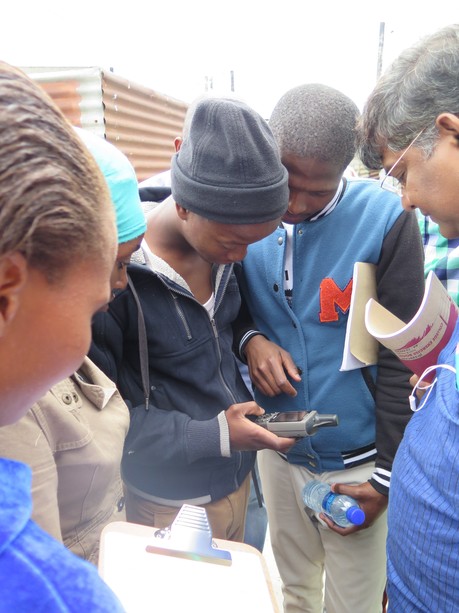
img_0105_medium

Siyaunya puts his head over the GPS device and enters the code for water tap, WT 001. Next he records the geographic coordinates of the location: -34.0289, 18.6731. He and his team repeat this process for every water tap and toilet in K2, the informal settlement in Khayelitsha that Siyaunya calls home. Different codes are used for each type of facility and with regards to their functional status. A broken toilet, for example, gets an N added to its code. These codes together with the coordinates form the raw data for the maps. Apart from the team mapping the basic services there are two other teams on the go to map the settlement boundaries and other interesting features like shops, taverns, and restaurants. Each of the three teams consists of community members, Informal Settlement Network (ISN) and Federation of the Urban Poor (FEDUP) members from across South Africa, and SDI federation members from India, Uganda and Ghana. The latter travelled to Cape Town to support the South African SDI Alliance in refining their digital mapping skills – skills that will help take SDI’s community mapping process to another level, making it easier and quicker, and increasing impact.

Through a hands-on, learning-by-doing approach Siyaunya and his fellow community members, most holding a GPS device for the first time that day, used these devices with confidence by the end of the day. They also understand that the need to stand next to the service or feature you are mapping is about more than getting an accurate reading on the GPS device. It is about the process of gaining intimate knowledge and understanding of one’s settlement and being able to share this knowledge with authority.

img_0104_medium

A geographic profile of the settlement consisting of the boundaries and the basic services, at a minimum, is a crucial part of the standardised profile. It is not enough to know the number of toilets – one also has to know their spatial distribution. If all the toilets of a settlement are located on one corner, the numbers alone are a bad indicator for the reality a woman from the other end of the settlement experiences when going to the toilet at night. The spatial dimension adds value to the data and is highly relevant for planning upgrading projects. To put it in a nutshell: Numbers are good – but maps make the numbers come alive. In addition to that John Samuel, from NSDF/SPARC India and part of the data team at SDI, points out that maps are more intuitive to understand than plain numbers and respond better to the variable literacy level of slum dwellers.

There is no perfect map and there never will be one. Maps are by nature abstractions and only a limited inventory of the reality on the ground, a complement of both objectively observable phenomena, as well as the subjective relationships to these. Bearing this in mind they remain highly important as a means to communicate our location in the world and our view on the world. The data used to generate maps of informal settlements must therefore be gathered by the slum dwellers themselves. Maps generated from community-collected data naturally put the emphasis on issues that matter to the community. This in turn is critical for the successful planning and implementation of slum upgrading projects

img_0102_medium

When speaking about Know Your City, Sumaya, a young delegate from the National Slum Dwellers Federation of Uganda (NSDFU) puts it like this:

“First you have to know what you have, then you can decide what you need, and only then you can tell somebody what you want. This is what Know(ing) Your City is all about.”

She was part of the team that profiled and mapped 62 settlements in the city of Kampala. The comprehensive report with the maps generated was handed over to the Kampala City Authority in September this year and is a good example how the data can be used to drive communities’ dialogues with government for slum upgrading and development at the city-wide scale. The profiling and mapping of settlements is a powerful tool for promoting active citizenship in communities of the urban poor.

SDI’s focus for the coming years will be to routinize and consolidate the learning around city-wide profiling and mapping for the cities it works with. Concretely, the idea of going city-wide is to push the federations to think beyond their existing network so as to include the voices of other settlements in the city, meet new leaders and together create concrete alternative plans with which they can begin to talk to their cities. Community mobilisation and mobilising city-wide federations are then also among the first goals Celine D’Cruz, SDI co-ordinator anchoring and supporting the data collection process for the SDI network, mentions when she talks about the Know Your City process. It is about the creation of a momentum of inclusion and of identity making for the community of the urban poor. Furthermore, the data collected supports the development of alternative participatory plans for slum upgrading strategies based on prioritised needs; it offers federations and communities at large the ability to monitor their own settlements and, last but not least, grounded and consolidated data at the local level, once aggregated, opens up the space for advocacy at the national and global level.

The maps of K2 and Green Park were visualised the same weekend and brought back to the respective settlements. They are as different as the settlements themselves are. Spread out Green Park contrasts with dense K2. In the latter, all the toilets are located on one site, leading to a situation mentioned above, where a map paints a clearer picture of reality then just numbers.

The learning exchange made clear that settlement profiling and mapping is an essential tool to leverage upgrading, monitor settlements and for regional and global advocacy. The young leaders from K2 and Green Park definitely seemed eager to continue the work and make the realities and needs of the city’s urban poor majority visible through maps.

k2_service_map_medium

green_parkmap1_medium

Installing Water Taps in Holomisa Gauteng

By CORC, ISN, News, uTshani Fund No Comments

By Blanca Calvo (on behalf of CORC and uTshani)

Holomisa is an informal settlement located in Katlehong (Ekurhuleni, Gauteng). In May 2014, Pumelele Ntanjana, one of the leaders of Holomisa Informal Settlement, contacted the Informal Settlement Network (ISN) to request support for a possible re-location of a portion of his settlement. Today, Holomisa has been profiled and enumerated, new taps have been installed and it has become a learning centre for other ISN communities in Gauteng.

ISN Gauteng co-ordinators with Holomisa residents

ISN Gauteng co-ordinators with Holomisa residents

The Holomisa story tracks back to an ISN leadership meeting that took place in Germiston (Ekurhuleni, Gauteng) in 2008. In that meeting, leaders from all informal settlements in the area had been invited to attend, Holomisa amongst them.

When Holomisa leadership were told by their councillor that a portion of the settlement needed to be re-located because of the enlargement of a neighbouring school, they approached ISN for support. ISN was invited to visit the settlement, where they firstly met with Holomisa leadership and the ward committee members.

The community and ISN profiled the settlement in May 2014 and identified a need for more sources of water (only 2 functioning taps for about 500 households). This was confirmed in a public meeting, where residents requested support for an immediate improvement of their daily lives through implementing more taps, improving sanitation conditions and electrifying the settlement. The settlement’s improved service delivery would also be an additional step to ensuring land tenure.

Existing Water Taps in Holomisa

Existing Water Taps in Holomisa

Three parallel processes started from there. On one side, enumerations started on the ground, identifying 446 households. Since Holomisa had been identified as a learning centre for the region, leaders from 6 neighbouring informal settlements (Emalahleni, Thintwa, Vlakplaas, Mandela, Makalakaleni and Zola) were invited to join the enumeration process, ending up with capacitated leaders to undertake the process in their own settlements. A total of 10 local and 6 external leaders were capacitated. Besides, the figures highlighted again the need for more taps, with a backlog of 8 taps to meet official standards


Holomisa Textbox1

The mobilisation team engaged with the Ward Councillor, who was informed in a partnership meeting of the intention to install more taps in Holomisa with the support of the South African SDI Alliance. The ISN sent a letter to the ward councillor saying,

“We understand that we are poor humble people struggling to make our way in life. Like every South African citizen, what we expect is a fair and reasonable service delivery from Government in return for the taxes we pay”

Finally, the savings team organised community savings to save 10% of the budget for the project. The outstanding 90% of the budget was financed by the Community Upgrading Finance Facility (CUFF) housed in uTshani Fund.

Mandela Day (18 July 2014) was finally the day for the project to start. In the space of 6 days, one tap was fixed and three more taps were installed. 25 local residents volunteered for the project, a technical team of 10 ISN members was on site and 6 leaders from neighbouring informal settlements were invited to participate and learn in the process, thus increasing their skills and building capacity.

New Water Taps in Holomisa

New Water Taps in Holomisa

Holomisa Textbox2

The project was a success for the communities involved, not only because the installation of more taps improved the living conditions of Holomisa residents, but also because some valuable lessons were learnt.

  • Firstly, the will of the people has been proved to be the best tool to work with. The residents identified the need for more taps and lead the project from the first day.
  • Secondly, the power of residents taking ownership of the project. Residents did not wait for external people and institutions for their permissions or to come to the work, they pushed for their needs to be heard and did it themselves.
  • Finally, the learning centre has proved to be a success. 6 leaders from other informal settlements were capacitated using almost the same amount of resources.

However Holomisa’s story does not end here and the process is still on-going. Holomisa residents, are in discussion with their Ward Councillor for the re-location process of a section of the settlement. Continuous engagement with the ISN will ensure that the re-located residents will be allocated a new portion of land, which it is still to be identified.

Holomisa2

Holomisa3

Co-producing Ideas: Denver community and University of Johannesburg Studio

By CORC, ISN No Comments

By Motebang Matsela and Yolande Hendler (on behalf of CORC)

Over the years, the SA SDI Alliance has been involved in several architecture and planning studios in which university students and community members co-produce ideas and scenarios around housing and upgrading. The most recent of these studios took place from July to August 2014 in Johannesburg’s Denver informal settlement together with community members, students from the University of Johannesburg’s (UJ) Department of Architecture, the Informal Settlement Network (ISN) and Community Organisation Resource Centre (CORC) who offered technical and social support and facilitation.

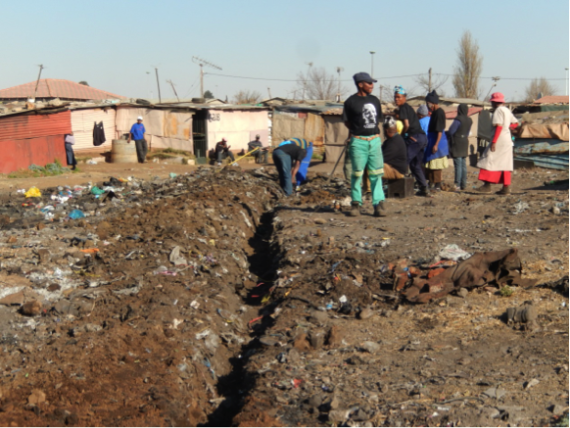
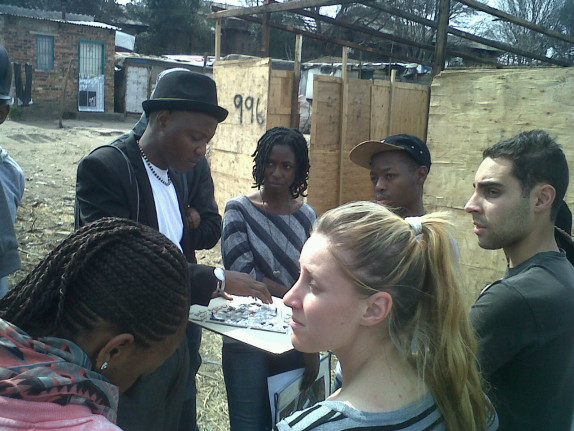
UJ students and community members in Denver informal settlement

UJ students and community members in Denver informal settlement

IMG-20140820-WA0007

Motebang Matsela (CORC technical support and CORC studio facilitator) (centre), with community members and students

Denver informal settlement

Denver informal settlement is situated in a light industrial zone that spans the southern section of Johannesburg’s central business district. It was formed in response to Denver hostel, an inner city accommodation, established around 1946 by the government of the time to house rural labour migrants. As the hostel operated for men-only, Denver informal settlement sprang up as an accommodation option for the wives of men living in the hostel. Over the years the settlement has continued to grow along with an increasing demand for housing by its residents.

IMG-20140820-WA0059

Aerial view of Denver

The studio: co-producing training for students and communities

The studio developed out of a longer engagement between UJ’s Department of Architecture, CORC and ISN, who had already collaborated on past studios in Ruimsig (2011) and Marlboro South (2012) informal settlements in Gauteng. The Denver Studio, however, differed from past studios because it introduced the first of a series of project management modules.

For the SA SDI Alliance, studios lay a foundation for productive discussions with local government that voice communities’ views, opinions and requirements. They also introduce students to the necessity and value of planning with communities, which contributes to a focus that shifts away from traditional ‘top down’ product and ‘delivery’ approaches towards ‘responsive’, community-orientated approaches.

While these outcomes are valuable aspects of collaborative work, Gauteng’s ISN leaders highlighted a current gap: community members need to gain tangible skills through the studio and upgrading process, just as the students do. Each module therefore couples practical participation in the studio with project management skills. Upon completion of every module, community residents will receive a certificate of participation. The vision is that these modules will run as an ongoing series throughout future studios and that they will incrementally build on the content of past studios, creating continuity and ongoing engagement between past and future studios.

Community members receive certificates of participation

Community members receive certificates of participation


DSCF9550

The Studio: co-producing ideas

The course engaged eighty 3rd and 5th year students in a site-specific situation that used joint mapping and data to generate community action plans (CAPs). These investigated short, medium and long term planning scenarios that would encourage short-term community initiatives and support further productive discussion with local government around incremental upgrading

The students were divided into ten groups, each of which partnered with two or more residents from Denver settlement who took the lead as designated community planners and explained the community’s various concerns to the students. One of the community leaders, Chief Mbata shared his views on the studio as a platform to commence a dialogue about the urban poor and their conditions of living. He went on to speak about the over crowdedness and the illegal electrical connections that have claimed a lot of shacks and their contents in and around Denver.

“I wish to see these dangerously exposed cables go, and better connections made by the municipality, but when shall that happen?”

(Chief Mbata, Community leader at Denver informal settlement)

Students and community members then investigated the following key themes for ten areas in the settlement:

  • Spatial Justice
  • Humane Environments
  • Scenario Planning
  • Context
  • Spatial / Physical / Social
  • Systems / Networks
  • Interfaces / Thresholds
  • Undercurrents / Threats
  • Aspirations / Perceptions
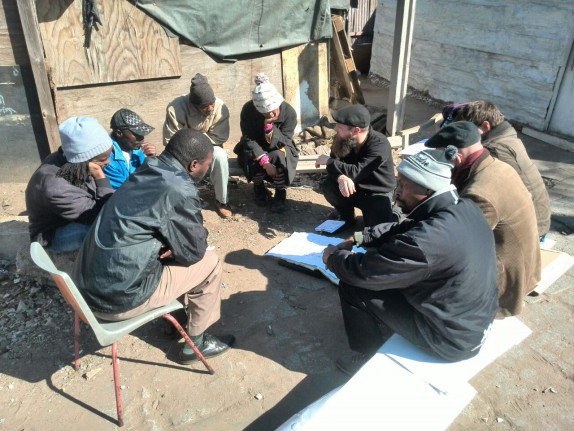
Students and community members in Denver informal settlement

Students and community members in Denver informal settlement

Final Student Presentations in August 2014

Final Student Presentations in August 2014

While they engaged with these themes, the community, supported by ISN and CORC, also undertook an enumeration of its settlement with the support of iSN – in a combined effort to collect comprehensive information.

As a community member, Daphne Ntombenhle Mabuso used her in-depth knowledge of the community and its history to compile the studio’s data in a collective documentation of Denver that represents the settlement as accurately as possible. Some of the studio’s content includes figure-ground drawings, actual land-use maps and various other maps that identify needs, constraints, observations and possibilities within Denver. This documentation can serve as the basis for continuing discussions between the community of Denver and the City of Johannesburg. (Click here to access the students’ documentation of the studio).

In the last week of August, the students presented their socio-spatial analyses of courtyards, pathways, open spaces,permanent vs. temporary structures and rental vs. owned units to Denver community. These open up a space to begin small-scale projects and a discussion with the local authorities. During this time community members also received their certificates signalling their participation in the studio and the project management skills they acquired. In this way community residents are becoming formally skilled participants and drivers of their own development in a collaborative, co-productive training space.

(Photos: Motebang Matsela, CORC)

DSCF9444


Building the Siphumelele WaSH facility / Innovation Centre in Langrug, Stellenbosch

By CORC, FEDUP, ISN No Comments

By Aditya Kumar and Yolande Hendler (on behalf of CORC)

Zwelitsha is a section of Langrug informal settlement, located on the rocky ground of a mountain slope that overlooks the lush valleys and nearby town of Franschoek in Stellenbosch Municipality. Zwelitsha’s residents make up 604 people who reside in 318 structures. Langrug as a whole is home to 4700 people who live in 2118 structures. While Langrug’s other sections have access to water and sanitation facilities – including the Langrug Water Sanitation and Hygiene (WaSH) facility – Zwelitsha’s steep incline and rocky terrain have made it extremely difficult to build water and sanitation points. To this end, Zwelitsha currently has only one tap and no toilets.

Zwelitsha community members developing plans for the Siphumelele WaSH facility

Zwelitsha community members developing plans for the Siphumelele WaSH facility

Yet this situation is about to change, as community members began work on the foundations of the Siphumelele WaSH Facility and Innovation Centre last week in partnership with the Informal Settlement Network (ISN), Federation of the Urban Poor (FEDUP), Community Organisation Resource Centre (CORC), Touching the Earth Lightly (TEL), Sculpt the Future Foundation, Stellenbosch Municipality, Worcester Polytechnic Institute (WPI) and Enviro Loo (a waterless sanitation provider).

Site of Siphumelele WaSH facility in Zwelitsha section of Langrug informal settlement

Site of Siphumelele WaSH facility in Zwelitsha section of Langrug informal settlement

Building on Experience: Learning from the Langrug WaSH facility

Based on the monitoring, evaluation and learning around the existing WaSH facility (read more here) in Langrug, Zwelitsha’s residents initiated a discussion about the possibility of a second WaSH facility. They approached ISN and CORC, WPI and Stellenbosch Municipality, all of whom had partnered with the community in building the existing WaSH facility in 2011.

Learning from the existing WaSH facility in Langrug

Learning from the existing WaSH facility in Langrug

The discussion related to the outcomes of a sample survey that was conducted over 12 days in July and August 2013. This survey looked at the benefits of data collection, the various uses of the existing WaSH facility (economic and small enterprise, health and food security, educational, organisational meeting point) and its upkeep and maintenance.

More specifically the outcomes of the survey of the Langrug WaSH facility included:

  • The collection of inception data for Siphumelele WaSH facility
  • Current data collection for usage at both WaSH facilities from July 2014
  • Increased use of the Langrug facility by crèches in Langrug. (An estimated 40 children served per day at the facility around issues related to basic hygiene)
  • A fully functioning post-office hosted in the Langrug WaSH facility, based on previously collected enumeration (socio-demographic) data
  • Support for HIV / AIDS awareness in Langrug WaSH facility
  • Potential for small businesses selling health and hygiene products in Langrug facility
  • Increased food security through the greening of the existing facility in partnership with Touching the Earth Lightly
  • Langrug WaSH facility as a space for youth education, workshops and meetings
  • Dramatic increase in usage of Langrug facility due to consistent cleanliness and ancillary functions within the facility
  • Comparatively low maintenance and upkeep of Langrug facility
  • Success in preventing vandalism
  • Significantly, the community expressed a higher degree of ownership in relation to the Langrug WaSH facility as it was community designed, built and maintained

The challenges that emerged around the facility enhanced the monitoring, evaluation and learning around the delivery and maintenance of services, and assisted in conceptualising the Siphumelele WaSH facility.

Some of these challenges and learning points related to:

  • The low usage of communal showers
  • The slow inception of the hair salon

Building the Concept: Co-Designing the Siphumelele WaSH facility

Given the cost of maintenance and operations, the community and partners involved explored the idea of a livelihood-linked wash facility where a portion of the facility would generate revenue (through a kiosk, crèche, health and educational programme) to reduce the burden on municipal funds for maintenance. Given the community’s experience of struggling for a space of safety and dignity, the Zwelitsha design and construction team named the wash facility “Siphumelele” – “We have achieved it”.

From March to April 2014 the community, together with TEL, began co-designing the facility. The designs include toilets for men and women, a wash area and a kiosk on the ground floor. The second floor will contain a crèche and soup kitchen that will be managed by the community. After conducting a survey with Zwelitsha’s families about amenities to be included in the facility, community leaders chose to exclude showers due to their infrequent use in the Langrug WaSH facility. The community also chose to make use of Enviro Loo toilets after they visited Enviro Loo in November 2013 and received detailed explanations on how the toilets are maintained and operated. The Enviro Loo is a waterless toilet system that provides a safe, non-polluting, cost-effective solution to sanitation.

Co-designing with Touching the Earth Lightly

Co-designing with Touching the Earth Lightly

IMG_6272

Co-designing the WaSH facility

Model of Siphumelele WaSH facility

Model of Siphumelele WaSH facility

Building the Team: Community-led Implementation

Apart from the partners already mentioned, the community has put together different teams to lead the implementation process. These include a leadership committee, a savings group and an Informal Settlement Upgrading Team (ISUT). This team is led by 8 women and includes a Community Liaison Officer, a storekeeper and a project manager who spearhead the construction process. After an exchange to a savings scheme linked to the Federation of the Urban Poor (FEDUP), the community set up their own savings group in July 2014 so as to manage finances to maintain and operate Siphumelele WaSH facility.

Building a voice of the urban poor in Langrug

The foundations for both WaSH facilities were laid when Stellenbosch Municipality signed a Memorandum of Understanding (MoU) with the community and ISN / CORC in 2011. Since this date Langrug’s community leaders have been developing a formal relationship with the Municipality and are making a strong case for how urban poor communities successfully organise themselves to lead their own upgrading processes, and how co-design and co-planning is a step towards a more tangible ‘inclusive city’.

(Photographs: Stephen Lamb, TEL)

Phase 1 of construction

Phase 1 of construction

The construction team

The construction team

Preventing Shack Fires in UT Gardens with Lumkani Fire Detector

By CORC, ISN No Comments

By Yolande Hendler (on behalf of CORC)

Vuyani Ntontela and Thamara Hela are community leaders in UT Gardens, an informal settlement of about 400 structures in Khayelitsha, Cape Town. UT Gardens forms part of UT section in Khayelitsha’s Site B. Since the community was introduced to the Informal Settlement Network (ISN) in 2013, Thamara explains that UT Gardens has been organising itself for upgrading. Yet she also speaks of one of the biggest challenges the community faces: on-going fires that ravage homes and livelihoods, the most recent of which occurred last month.

UT Gardens Community leaders with Lumkani. From left to right: Phatiswa Nzima, Thamara Hela, Emily Vining, Ntombentle Qinga

UT Gardens Community leaders with Lumkani. From left to right: Phatiswa Nzima, Thamara Hela, Emily Vining, Ntombentle Qinga

Since March 2014 Vuyani (chairperson of UT Gardens), Thamara and the rest of UT Gardens’ leadership committee (15 in total) have been building a relationship with ‘Lumkani’, a social enterprise that is focussed on overcoming the challenge of shack fires in urban informal settlements. Lumkani has been developing a device that acts as an early-warning alert against shack fires.

The Lumkani device

The Lumkani device uses heat detection technology instead of smoke detection (not suited for the shack environment given the heating, lighting and cooking methods that take place in homes) to sense for fires. As a heat detector it accurately measures the incidence of harmful fires, alerting the family inside the shack of the danger. Each device is networked to surrounding devices within a 100m radius. In the event of a fire, the detecting device will send a signal to surrounding devices within this range. A solid beep means that the device has detected a fire in your own home whereas a broken beep indicates that the fire is in the nearby surrounding. A wave of sound creates a community-wide alert and response to danger. This buys time for the community to become proactive in rapidly spreading fire risk situations. Emily Vining, who facilitates Lumkani’s community interaction, explains that

“The networked functionality of the device is a way to confront the challenge of density and the rapid spread of fire. The devices are networked because it is not enough for one person to be alerted – everyone needs to be alerted. As a device Lumkani intends to stop the spread of fire through a community-wide response. It is most effective in communities with a strong leadership who can create strategies to respond to fire”

The Lumkani device

The Lumkani device

Building the relationship between UT Gardens and Lumkani

Thamara remembers how UT Gardens first heard about Lumkani through ISN and the Community Organisation Resource Centre (CORC).

 “When I heard about Lumkani I liked it. Because I am a mobiliser I proposed it to the other leaders. When we first met with Lumkani, they explained the fire detection device to us and asked if the community wants to be one of their pilot communities. As leaders we also liked the project. But we first called a general meeting to check with the community. They accepted the idea because we have a problem with fires. We meet with Lumkani every week to share our plans with each other. ”

(Thamara Hela, UT Gardens community leader)

Emily explains how Lumkani first met Thamara and the UT Gardens leadership in December 2013. From February/ March 2014 Lumkani met with UT Gardens leadership weekly to grow a relationship. David Gluckman, Lumkani’s financial director, explains that

“from the earliest phase of the project we met with community leaders and sought out their input – which had direct implications on the design of the device and its functionality – after all nobody knows the fire situation in informal settlements better than the people living there”

Emily elaborates that Lumkani was interested in developing the device through a deep-participatory approach that values horizontal learning. This means: inclusive design solutions and continuous innovation driven by testing and feedback. Both Emily and David emphasise how the community’s guidance was key, especially during on-site meetings with Max Basler, Lumkani’s industrial designer and Samuel Ginsberg, Lumkani’s technical director. It was during the first meetings with the community that the Lumkani team became aware of the need for a community wide and –networked device that could share information as fast as possible. Apart from on-site meetings, Lumkani formalised its community research in a short 12 question survey distributed to about 70 households in order to better understand how the community is affected by and responds to shack fires.

IMG_1610

Making plans to install 10 test devices last week

IMG_1616

Measuring out the distance between structures for installing the test devices

Looking forward

At the moment the device is in a general testing phase – which includes technology tests and a sound test that took place last week, for which the first ten devices were installed. The pilot is set to begin in October 2014 and will seek to test 2000 devices in four high fire risk communities in Cape Town, one of which is UT Gardens.

Thinking back of the past months of working together with Lumkani, Thamara shares,

“Since we started our relationship with Lumkani I would like to say that they are doing a good job. What I like about Lumkani is that after we have a meeting, we see things happening on the ground. Even when people from other settlements in Site B visit me and see the fire detector they like what Lumkani is doing”

(Thamara Hela, UT Gardens community leader)

Durban and Port Elizabeth Leaders on Sanitation Exchange

By CORC, iKhayalami, ISN, SDI No Comments

By Stefanie Holzwarth and Yolande Hendler (on behalf of CORC)

Over the past years, the communities of Midrand in Port Elizabeth and Havelock in Durban have been upgrading their settlements, step by step. Last week’s exchange (8-11 July 2014) – in which community leaders visited Cape Town settlements – formed the next step in activating solutions to their specific needs for water and sanitation upgrading.

Site visit in Kuku Town

Site visit in Kuku Town


Midrand and Havelock

Midrand is located on municipal land but is not yet listed on the municipality’s database and therefore experiences great difficulty in accessing services. The community consistently experiences severe flooding. Havelock, on the other hand, is built on privately owned land and has been earmarked for “interim services” by eThekwini Municipality, indicating a willingness to deliver basic services in the short term and habitation in the long term. It is built against a hill with high shack densities that have led to shack fires, flooding and torrents of water flushes in the rainy seasons. Read more background on Havelock and Midrand.

The exchange

During the four-day exchange about ten community leaders visited five settlements in and around Cape Town. The exchange was linked to the SHARE Program (Sanitation and Hygiene Applied Research for Equity) linked to Shack Dwellers International (SDI). Read more about SHARE here. It was facilitated by the Informal Settlement Network (ISN), Community Organisation Resource Centre (CORC) and iKhayalami. It centrally focussed on how communities can use sanitation as a tool for upgrading and mobilisation, particularly in response to ever present and severe flooding.

Midrand community leaders, for example, spent time investigating the most suitable and relevant options for sanitation upgrading in their settlement:

  • Communal toilets and wash facility at the edge of the settlement (ablution blocks) without re-blocking
  • Sanitation and wash facility in the centre of the settlement with partial re-blocking
  • Individual sanitation facilities in courtyard (one-on-one sanitation) with settlement wide re-blocking

These would all require engagement with local government institutions.

Havelock’s central challenge is drainage. The settlement has already engaged with local government about constructing a sanitation unit as well as providing more sanitation units in the centre of the settlement. This would coincide with the communities’ already existing plans to re-block its settlement. Midrand and Havelock’s leaders therefore visited upgrading sites that provided an example of different options available to them.

DSCN7284

Example of sanitation in a community-run Water, Sanitation and Hygiene (WaSH) facility

One-on-One Sanitation in Kuku Town

The visitors spent the first day in Kuku Town where the community recently completed re-blocking with individual sanitation per upgraded structure. They were particularly interested in how Kuku Town managed to re-block without having to relocate people to other areas. Other questions focused on why the community chose individual toilets. Kuku Town’s leaders explained that

“single toilets are manageable because the owner is responsible for their own toilet and because there are no conflicts within the community with regards to hygiene.”

The leaders also reflected on Kuku Town’s successes and challenges throughout planning and implementation. The visitors learned how Kuku Town approached the municipality for support in terms of infrastructure services. Both Midrand and Havelock were impressed by the Council´s successful involvement in providing water and sanitation.

6. After reblocking 3

Sanitation and water services per upgraded structure in Kuku Town

Sanitation facility in Langrug, Stellenbosch & BM Section, Khayelitsha

In Langrug, Franschoek. the visitors saw an example of upgrading that included relocating 16 families, the construction of a second access road and grey-water and drainage channels, and a community designed, multi-purpose Water, Sanitation and Hygiene (WaSH) Facility. The visit offered insight into the WaSH facility, the drainage project and the local playground. The subsequent discussion facilitated an exciting learning environment with questions about the maintenance of the WaSH facility and funding. They also discovered the opportunity of hot water provision via solar heating systems in summer. The afternoon centred on projects in BM section, Khayelitsha. Its similarity (due to an uneven slope) to Havelock made it an ideal site for the exchange and delivered an essential input for its visitors.

DSCN7392

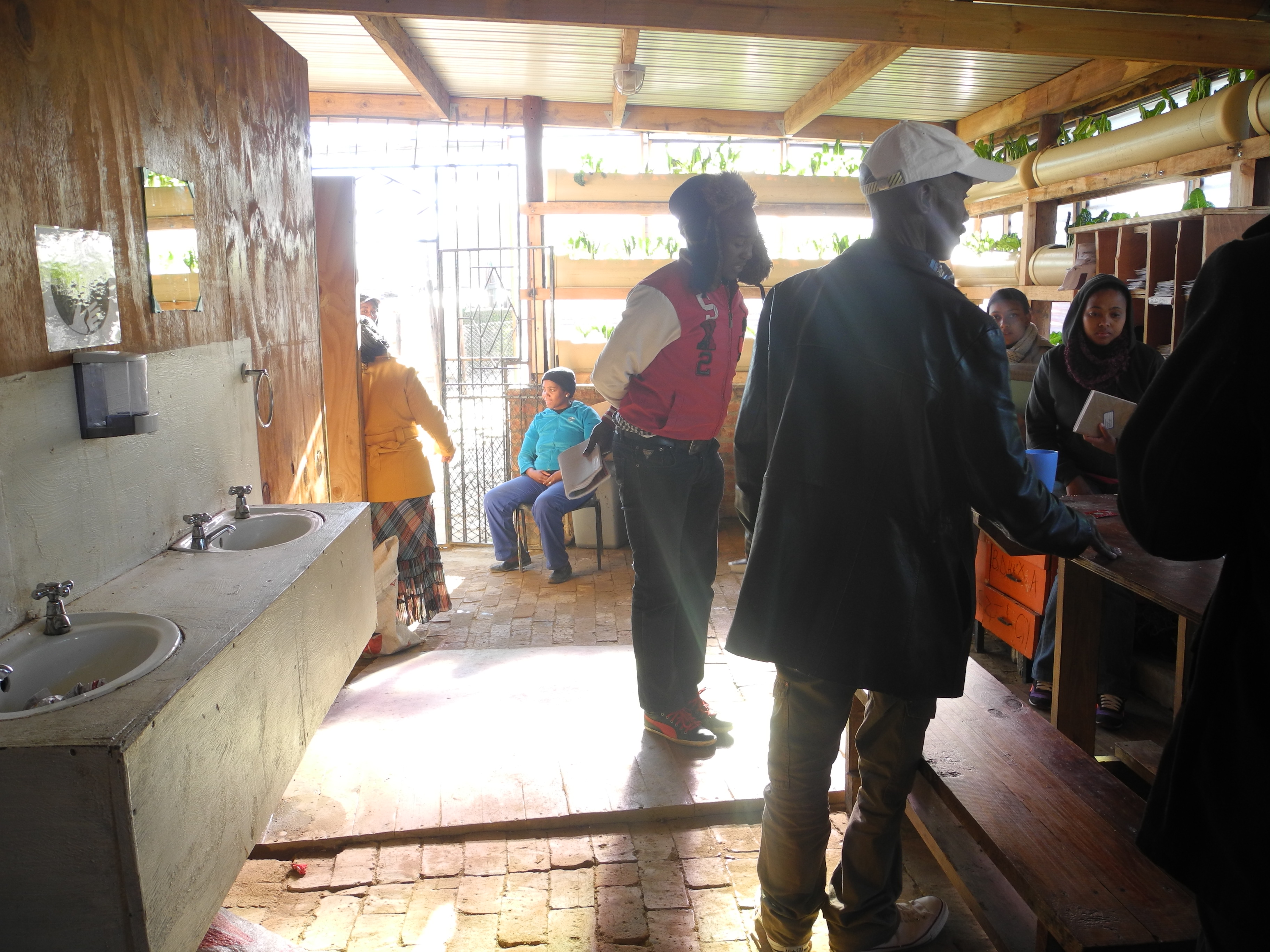
Interior view of Langrug’s WaSH facility


DSCN7455

Courtyard in BM section

Shared Sanitation in Mtshini Wam & ongoing re-blocking in Flamingo

The visit to Mshini Wam provided valuable lessons for the visitors – particularly in the field of funding and engaging the local authority. The visitors took special interest in understanding how Mtshini Wam managed to convince some residents to share toilets on a cluster basis while others had single toilets. The challenges relating to communal toilets were thoroughly discussed.

“The main idea was to have single toilets but due to the number of shacks and the limited space, the plan was diverted in order to accommodate communal toilets. The maintenance and cleaning of the toilets depends on the cluster groups.”

The visitors concluded their site visits in Flamingo Crescent, an ongoing re-blocking project. During a walkabout the visitors observed how shacks were broken down, how ground works were installed and how the new structures were erected.

Site visit in Flamingo during re-blocking

Site visit in Flamingo during re-blocking

Midrand community discusses the way forward

On the last day, Midrand leaders and iKhayalami discussed the sanitation options available to the community and the future steps each would imply. Community leaders agreed that re-blocking with one-on-one services would be the most realistic and feasible option.

“The ablution block won´t work for us because there is lots of friction. No one wants to wait for a long time when using the facility. Community blocks won´t work because some of the people are not responsible. They leave it without taking care.” (Community Leader, Midrand)

Midrand’s leaders agreed to start saving to upgrade their structures instead of solely blocking out. They hoped to convince the municipality to come on board. Re-blocking would be conducted in phases – identifying clusters for incremental re-blocking.

One major challenge in Midrand is the lack of space. Part of the settlement land is still in private hands – which causes major tenure insecurity. Together with iKhayalami the leaders discussed various solutions. While the community leaders resolved their questions, the next step is to share these with the rest of their communities when they return.

The exchange not only offered a learning space but also enabled leaders to grow their ability in community-driven upgrading,

“I have learned a lot by being a community leader and by being part of this exchange. It has built up my confidence and my professional experience. I was a very shy person before – now I can stand up and work for our development goals.” (Midrand community leader)

Midrand Consultation

Andy Bolnick (iKhayalami) discusses sanitation options with Midrand community leaders

2014 UCT – Europe Community Studio: Spatial Development Framework

By Academic, CORC, ISN No Comments

By Thandeka Tshabalala (on behalf of CORC)

Over the last four months Europe community members and Masters students of Urban and Regional Planning at the University of Cape Town (UCT) collaborated on a joint planning studio to address some of the community’s most pressing concerns. Together, they began by conducting a site analysis and researching the opportunities and constraints presented in Europe. This research and site analysis led to developing concepts for in-situ, incremental upgrading projects. Read more about the concepts and the first developments of the studio here. The students then split into three groups and used these concepts to produce spatial development frameworks (SDFs), which act as a guiding document on the future development of Europe and surrounds.

Together with Europe residents the students recently presented their proposed SDF’s to their classmates and to City of Cape Town officials.  All three SDF’s had underlining themes, which were

1) Maximising the use of existing infrastructure

2) Developing activity nodes linked to existing major business and transport nodes whilst maintaining the transit character of the main spine (Klipfontein Road)

3) Increasing socio economic opportunities in Europe.

These proposals fittingly introduced the concept of incremental settlement upgrading.

SDF1SDF2

The SDF in summary

1. Creating cultural and ecological nodes

  • The site analysis revealed the presence of several aquifers and wetlands on the site and along Klipfontein Road. In order to protect and enhance Europe’s scenery this natural biodiversity could be joined with pedestrian routes to attract different users to the site.
  • The area around Europe contains several sites of recent South African history that could increase the area’s potential as a cultural node. By connecting to sites such as the Gugulethu Memorial 7 and cemetery and cultural tours to the Cape Flats, residents could increase their access to economic opportunities.

2. Property sales

  • Although residents in Europe do not have tenure security, Europe’s leadership has recorded an enormous amount of property transfer in the settlement due to the high demand for well located affordable housing. During a transaction, the leadership keeps certified identity documents of both parties. These serve as a proof of sale of one’s property. Even in their derelict state most shacks have sold between R10 000 to R15 000.
  • Through their engagement, the students picked up on the importance of location – in terms of one’s own shack and in terms of the settlement location as a whole. They therefore introduced the concept of re-blocking as an incremental approach to housing which would decrease the level of flooding, open spaces for the provision of basic services, communal spaces and spaces of interaction. Moreover, it would improve the quality of life in the whole settlement.
  • Many groups viewed re-blocking as a short-term strategy that could be implemented easily without displacing people. It would also provide residents with the opportunity to access short-term housing structures.

20140528_SDF3

3. Creating activity nodes

  • The Cape Town SDF sets out a hierarchy of different movement routes across the metropolitan area. It focuses on North – South and East – West accessibility. Europe’s location between an urban freeway (N2) and a development route (Klipfontein RD) means that Klipfontein Road presents a greater potential for activity nodes than the impenetrable N2.
  • Heideveld station also provides a critical link between the road and rail network, making this an important node for future development.
  • The analysis uncovered that the Golden Arrow bus route bypasses an important section of Klipfontein Road. This means that the residents of Europe and surrounds, who are already earn a low-income, need to pay for additional taxi transport to reach the closest bus and train station. Some residents also use the local transport ‘Amaphela ‘ due to the area’s high crime levels, which make walking unsafe.
  • As a MyCiti bus station will soon be implemented in Mitchell’s Plain, the intersection between Bocherds Quarry and Klipfontein Roads will in all likelihood grow as a transit node. It therefore has potential to develop into a transport interchange with supporting activities.

Throughout this discussion it was crucial to see Europe as a functional settlement in its own terms and thus limit the distance travelled to access jobs and other socio –economic opportunities.

4. Maximising existing neighbouring corridors

  • Much developmental activity has focussed on improving upcoming North-South corridors such as Parklands and Mitchell’s Plain. There is a need therefore to establish linkages to upcoming opportunities.
  • There is also a need to increase vertical connections to the settlement such as access to Voortrekker Road, which is one of the busiest roads connecting Bellville and Cape Town.

SDF5

5. Short term interventions – livelihoods and food security

  •  After several discussions with the community, the importance of access to employment and food security was clear. Residents felt that they needed to be able to support their households in order for them to start looking at broader issues such as upgrading.
  • After this discussion the community came together and collected their names and livelihood interests on a piece of paper. Those with common interests were then grouped together to begin discussing how they could start livelihoods programs. These included hair dressing, carpentry, gardening etc.  The students put together a pamphlet in isiXhosa with a list of organisations that assist in skills development such as Abalimi Basekhaya and The Carpentry Shop.
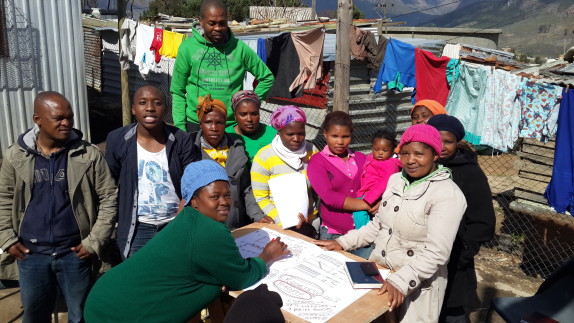
In the next phase of the studio the students will develop precinct designs of the settlement and write a short reflection of the studio as a whole.