Tag

Inclusive Planning Archives - Page 3 of 3 - SASDI Alliance

Designing with Communities: CPUT – Manenberg Studio 2014

By CORC, ISN, News No Comments

By Yolande Hendler (on behalf of CORC)

Manenberg community leaders and architectural students from the Cape Peninsula University of Technology (CPUT) recently collaborated on a six-week long planning studio in Cape Town (March-May 2014). The studio aimed to generate ideas around alternative housing design and delivery options that would address the needs of Manenberg residents within their existing challenges and ‘urban’ conditions.

DSCN6957

CPUT students with Manenberg community leaders Terence Johnson, Melanie Manuel, Na-eema Schwartz & Errol Snippers (left to right)

Manenberg

Manenberg was established in 1966, during a time of forced removals when the apartheid government relocated low-income coloured families from District Six and other parts of the city to an area known as the Cape Flats, 20km away from Cape Town city centre.  During Manenberg’s construction phase in the late 1960s it was classified as a ‘sub-economic housing development area’. Although the design and structures of these semi-detached houses and project-like flats differed, this term indicates that most did not have ceilings, inside water or doors to their rooms (Reference). As construction continued into the mid 1980s, other buildings and social amenities sprang up. Many people currently live in backyard dwellings. Along with experiencing overcrowded living conditions Manenberg’s communities are continuously exposed to high crime and gangsterism.

Screen Shot 2014-05-20 at 4.20.36 PM

The studio brought together about 40 students from CPUT’s Department of Architectural Technology and Manenberg community leaders who represented the Manenberg Slum Dwellers, the Movement for Change, the Backyarders Network, the Federation of the Urban Poor (FEDUP) and the Informal Settlement Network (ISN). The studio was facilitated by ISN and supported by the technical team of the Community Organisation Resource Centre (CORC).  For more background on ISN-affiliated communities in Manenberg and backyard dwellings click here.

ISN representative and Manenberg community leader, Melanie Manuel, explained that the studio offered an opportunity for Manenberg residents to come up with a better proposal to address overcrowded conditions and inadequate basic services. For the students the studio offered valuable exposure to inclusive planning practice. They were tasked to assist the community in the design and planning of housing and the related community ‘place’ layout.  This required students to work closely alongside community leaders to explore innovative and relevant concepts that would generate flexible solutions. Mizan Rambhoros, Senior Lecturer at CPUT, explained that

“Traditionally, architectural students work on hypothetical projects. This makes working with a community in a studio and involving a community in the design process a completely different scenario. In a ‘live’ project it’s not possible to follow a rigid process – this really opened the student’s eyes.”

IMG-20140520-WA0012

Sharing planning concepts with community leaders

The studio began with a site visit to Manenberg in which community leaders highlighted their primary concerns to the students – recurring floods, fires and security issues. Together, they identified the site they would engage with – the block between Red River Street and Red River Walk that experiences a high prevalence of crime and overcrowding. Students continued to meet with community leaders on a weekly basis, altering and adjusting their housing design and concepts according to the communities’ feedback.

“By working together with the students we could share our experiences and give them more in-depth input on what would work and what wouldn’t – especially because they were honest and open to criticism”

(Melanie Manuel, Manenberg community leader and ISN representative)

‘Incremental Growth’ and Final Presentations

On 9 May, the students presented their final design and concepts. Each group presented their understanding of the contextual and conceptual issues they encountered, designs of a detailed layout and a model of proposed housing units.  The idea of ‘incremental growth’ presented a common strand through all presentations. Several groups highlighted how external circumstances influence mind-sets and subsequently how people interact with each other. This caused them to ask: how can space facilitate a change in mind-set and interaction with people?”

DSCN6931

In responding to the presentations, Na-eema Schwartz from the Manenberg Backyarders Network, commended the students for addressing aspects that were highly relevant to community members – such as idle time and space, fire, flooding and security. In reflecting on the studio, Errol Snippers (Manenberg’s Movement for Change) shared his experience:

“These youngsters have opened my eyes to the way I look at buildings and safety features. Maybe they’ve learnt from us, but I’ve learnt from them too. In this short time we’ve gotten to know each other. I love their passion and drive and would love the kids in Manenberg to have the same passion”

DSCN6942

Errol Snippers (Manenberg Movement for Change)

By the end of the studio it was evident that ‘incremental growth’ was not only reflected in architectural concepts and designs. Even more so it was reflected in both community leaders’ and students’ reflections.

“The studio presented our first opportunity to work on a ‘live’ project in which we needed to feed back our ideas to the community and think about what would be relevant to them.  At the beginning, some of us had quite a stereotyped mind-set. Working together with community leaders in the studio was a learning curve for us all. We now design and accommodate for people’s social situations because we understand them.  How do you design with communities? You have to become ‘part’ them”

(Nomfundo Dlamini, CPUT student)

The next step will see community leaders share the students’ work with the rest of their communities and establish how to use and implement the concepts and design. Such community-based, participatory planning practices contribute to harnessing local knowledge and packaging it into an action plan. In this way communities become key agents in their own development plans.

National Community Exchange – Durban to Cape Town (Part 2)

By CORC, iKhayalami, ISN No Comments

By Yolande Hendler (on behalf of CORC)

A four-day community exchange was underway from 29 April to 2 May 2014, during which community leaders from Durban visited informal settlements in and around Cape Town.  This blog continues to trace the experiences and reflections collected on the exchange, the first two days of which have been recorded here.

Day 3 in Langrug informal settlement – Sanitation, Drainage and ‘Greening’

View of Langrug informal settlement, Franschoek

View of Langrug informal settlement, Franschoek

Located in the affluent wine-farming area of Franschoek, Langrug informal settlement, home to about 4500 people, is characterised by extreme poverty, poor housing and sanitation. In the face of these challenges the community signed a precedent-setting Memorandum of Understanding (MoU) with the locally presiding Stellenbosch Municipality that channelled government funds to community-based upgrading initiatives. This translated into relocating 16 families, the construction of a second access road, the construction of grey-water and drainage channels and a community designed, multi-purpose Water, Sanitation and Hygiene (WaSH) Facility. The facility includes a communal homework area for children, a hair salon, benches and laundry basins. Click here for a comprehensive profile of Langrug. Currently, Langrug is involved in the second phase of upgrading: ‘greening’ the existing WaSH facility with vertical vegetable gardens and developing a dry sanitation facility in Zwelitsha, an ‘informal’ section of Langrug without taps and toilets.

Existing WaSH Facility after 'greening'

Existing WaSH Facility after ‘greening’

KZN visitors taste Langrug's spinach

KZN visitors taste Langrug’s spinach

The exchange visitors were introduced to all these aspects on a detailed walk-about. Langrug community member, Alfred Ratana, indicated the differences in depth and purpose of the drainage and grey water channels and explained the processes accompanying relocation. He emphasised the uniqueness of Langrug in that it was a municipality-driven project which was not community financed.

“Langrug shows that municipalities can have a different approach to communities. Our experience shows that municipalities can include us in their plans and construct with us – not for us”

(Alfred Ratana, Langrug community member)

Langrug community member, Alfred Ratana, speaks about Langrug's grey water drainage

Langrug community member, Alfred Ratana, speaks about Langrug’s grey water drainage

DSCN6652

Viewing a community-constructed drainage channel

Langrug community members also explained the breakthrough presented by Zwelitsha’s dry sanitation facility: due to its location on a steep mountain slope it has been impossible to provide water and sanitation services to around 600 families. The dry sanitation facility, however, is a step towards changing this. The vertical vegetable gardens in Langrug’s existing WaSH facility (developed in partnership with Touching the Earth Lightly) showed the visitors how the community secures food and generates income. By selling the spinach it grows, the community intends to generate income to sustain daily running costs of the facility.

The visitors were also impressed by a crèche facility that had been established between external partners and mothers in Langrug who wanted to provide an alternative, more affordable option for their children. The teachers of the crèche explained that,

“getting something started is not about presenting an idea to social services. You just need to start. Once the idea is happening, you can take the outcome to social services and get it registered”.

Once back at the WaSH facility Langrug’s steering committee shared details around the developments in their settlement. The group was also joined by Diana Mitlin and visiting colleagues from Manchester University. Read about their impressions here.

Sharing impressions after the walkabout

Sharing impressions after the walkabout

Langrug's steering committee explains the steps it took in the upgrading process

Langrug’s steering committee explains the steps it took in the upgrading process


Day 4 in Mtshini Wam – Reflections on how to continue

The final visit to Mtshini Wam showed the visitors what a large-scale re-blocking project could look like. During upgrading, the settlement also received one on one services, some in-structure toilets and public water points. More details on Mtshini Wam’s re-blocking are documented here.

Over four days the group had seen much, listened intently, exchanged questions and pondered how to take these impressions back home. Some key points:

  • Visiting Langrug presented a highlight for the visitors from Durban as the topography and accompanying challenges (steep inclines, drainage and flooding) are similar to the conditions in their own settlements.
  • Langrug’s drainage and sanitation facilities therefore presented relevant options for the Durban visitors
  • The visitors were inspired by the initiative and commitment they encountered in their fellow community leaders, something they wanted to take back in responding to circumstances in their own settlements
  • The exchange highlighted the importance of partnerships and the ever-present opportunity to form partnerships as a foundation for wielding large scale change
A street view of Mtshini Wam after re-blocking

A street view of Mtshini Wam after re-blocking

KZN leaders in conversation about securing service provision

KZN leaders in conversation about securing service provision

Durban’s Kenville and Foreman Road settlements will share their experiences of the exchange in mass meetings with their communities this weekend (16-18 May). Their next steps are to enumerate their settlements and establish a relationship with their councillors.

As the visitors embarked on the journey home, ISN community leader, Nkokheli Ncambele, reminded them that

“it is important not to impose everything you have seen on this exchange on your communities at home. Rather take what you have learnt and present it to the community as a suggestion. Then you can decide together what you want and how to make it work in your own settlement”

Exchanges certainly are the most important learning vehicle in the South African Alliance. They facilitate the direct exchange of information, experience and skills, thereby building a horizontal platform for learning between urban poor communities. Through sharing successes and failures in projects, giving and receiving advice on engaging government, sharing in work and life experiences and exchanging tactics and plans communities become central actors.

National Community Exchange – Durban to Cape Town (Part 1)

By CORC, iKhayalami, ISN No Comments

By Yolande Hendler (on behalf of CORC)

Informal settlement leaders from Kenville and Foreman Road in Durban are mobilising their communities to upgrade their settlements with better services and improved spatial layouts. Last week’s exchange to Cape Town (29 April – 2 May 2014) therefore presented a first-hand opportunity for them to draw insights from fellow community leaders.

DSCN6359

Group picture in Kuku Town: Durban and Cape Town communities on exchange

Over the week the Durban visitors were hosted by Kuku Town, Flamingo Crescent, Langrug & Mtshini Wam communities in and around Cape Town. Each day was dedicated to an in-depth visit of each settlement. This included a detailed site visit, discussions on  collecting savings, enumerating and profiling settlements and contributing to planning and mapping. Besides bringing leaders together on a national level, the exchange also connected communities locally: for leaders from Kuku Town, Flamingo and Langrug the exchange comprised a first time visit to the other settlements. Exchanges are thus the most important learning vehicle in the South African Alliance, facilitating the direct exchange of information, experience and skills between urban poor communities.

DSCN6297

Introductions and briefing on the week ahead at CORC office in Mowbray

Day one in Kuku Town: Upgrading & Savings 

Community leaders met in Kuku Town, a small settlement that recently completed re-blocking and in the process secured one-on-one water and sanitation services from the City of Cape Town. Read more about Kuku Town and re-blocking here. In the discussion community leaders took the visitors through a step-by-step picture of Kuku Town’s experiences. ISN representative, Melanie Manuel, explained that

“What we do in ISN is not only to beautify our settlements but to actually change the way we live. Savings and partnerships – like we had with Habitat for Humanity and the municipality – are an important part of this.”

DSCN6325

Community leaders share their experiences around organising and upgrading in Kuku Town community hall

Yet, before partnerships can be formed, a community needs to know its settlement in terms of the number of (un)emloyed people, the number of structures and families and details on service provision (electricity, sanitation and water). This information is collected in enumerations. Kuku Town community used its enumeration data to plan its re-blocked layout and to negotiate the provision of one-on-one services and short-term employment opportunities through the City’s Expanded Public Works Programme (EPWP).  Community leaders explained that they organised themselves in clusters to be able to navigate the logistics around communication and construction during re-blocking.

Among a variety of questions, the visitors took special interest in understanding the connection between savings and upgrading, especially the role of community contributions. Melanie explained that

“Savings contributions enable us as communities to take ownership and responsibility of the changes and upgrading in our settlements. We want to move away from a ‘free for all mindset’ and restore dignity and pride to our communities”

Melanie Manuel, ISN representative

Melanie Manuel, ISN representative

But collecting savings poses a continuous challenge. How to go about motivating communities and responding to accusations? Flamingo Crescent’s community leader, Auntie Marie, shared her experience:

“Getting the community’s commitment for daily savings is difficult. People only want to act when they see that things are happening. You’ve got to be tough. If you’re not tough you won’t get anything right”

For Kuku Town community leader, Verona Joseph, the partnership with the City and its support in this regard, was crucial.  This became evident at Kuku Town’s official handover that afternoon which was attended by the ward councillor and City officials.  The handover and a site visit completed the first day of the exchange, demonstrating what a tangible community-government partnership can look like.

DSCN6393

Exchange communities join Kuku Town handover ceremony

Inspecting the water and sanitation services provided by the City

Kuku Town site visit: inspecting water and sanitation services provided by the City

Day two in Flamingo Crescent: Re-blocking and Partnerships

Flamingo Crescent is about to begin re-blocking and – in partnership with the City of Cape Town – is set to receive one-on-one services. On a walkabout through the smoke and dust-filled pathways community leaders received a thorough impression of the settlement’s layout. Most structures – consisting of old cardboard, zinc, timber and plastic pieces – are situated around a broad, u-shaped pathway that is intersected by smaller, narrow footpaths. Flamingo’s population of about 450 people resides in 104 structures. The entire settlement makes use of only 2 taps and 14 chemical toilets that are emptied three times a week. The absence of electricity means that fire is used as a central source for cooking and warmth.

1. Overview 2

Flamingo – view from above

Site visit in Flamingo

Site visit in Flamingo

In a nearby community hall, Flamingo’s steering committee explained its relationship with ISN and the challenge of collecting savings contributions due to its high unemployment rate (50%). Flamingo’s enumeration acted as a powerful entry point to negotiating an improved layout and service provision with the City of Cape Town. Together with students from the Cape Peninsula University of Technology and Worcester Polytechnic Institute (USA) the community designed the re-blocked layout and conceptualised plans for a crèche and a play park.  Later, the visitors joined the steering committee’s meeting with a Cape Town City official who provided an update on the City’s contribution to upgrading.  For the visitors this was of particular value as it emphasised the crucial role of partnerships and the number of actors involved in a given project. The question at the forefront of many minds was: how can we do this in our communities at home?

For Auntie Marie, Flamingo community leader, it is evident that

“If it wasn’t for ISN, I don’t know where we would be. Through ISN we were introduced to the City and we got a partnership. We started thinking, ‘Now something is going to happen’. Flamingo is going to be re-blocked!”

Continue reading Part 2 of the exchange here.

(Flamingo steering committee presents its partnerships

Flamingo steering committee presents its partnerships

Auntie Marie, Leader of Flamingo Community and Steering Committee

Auntie Marie, Leader of Flamingo Community and Steering Committee

Report back to Flamingo Community

Report back to Flamingo Community


Official Handover of Kuku Town Re-blocking

By CORC, ISN, News, uTshani Fund No Comments

By Walter Fieuw and Yolande Hendler (on behalf of CORC)

Kuku Town before re-blocking

Kuku Town before re-blocking

Kuku Town after re-blocking

Kuku Town after re-blocking

There is a growing recognition that services need to be delivered to informal settlements in new ways. Such new approaches should aim at building community capacity through participatory planning, design and service implementation. Informal settlements are characterised by very different shapes and sizes, ranging from smaller inner city settlements located in residential neighborhoods to large sprawling settlements on the periphery of cities. Different approaches are needed to effectively transform these settlements into more dignified living spaces.  Working with communities is paramount to succeeding in upgrading initiatives. The re-blocking of Kuku Town is an example of an alternative approach to thinking through aspects of place, safety and security through improved settlement layouts, and better located services.

The South African Alliance and Kuku Town community celebrated the official completion of re-blocking on 29 April 2014. Community leaders welcomed delegates from ISN and FEDUP, NGOs such as CORC, iKhayalami and Habitat for Humanity South Africa (HFHSA), City of Cape Town officials from the Department of Human Settlements and the Councillor of Ward 32, Cllr. Derrick America to the hand over last Tuesday.

DSCN6393

ISN & FEDUP co-ordinators speak at handover

Verona Joseph, Kuku Town community leader, opened the ceremony by welcoming guests and sharing some of Kuku Town’s history and the process of community mobilisation. Diverse partners involved in the upgrading process held a variety of speeches that gave thanks, recognised and acknowledged the community’s achievement after three years of negotiations and preparations. ISN and FEDUP community representatives, Mzwanele Zulu & Thozama Nomnga, voiced the importance of continuing the relationships and partnerships, beyond the completion of re-blocking.  Cllr America echoed this sentiment and emphasised that upgrading a settlement is about restoring dignity. Every community member received a personalised ID card containing demographic information  – a symbol of having taken one step closer to reaching security of tenure. The ceremony therefore marked an important milestone for the community, who founded the settlement in 1985.

Cllr Derrick America (right) hands over ID card to community leader Verona Joseph (centre) with Salisha Lauton (left, Habitat for Humanity SA)

Cllr Derrick America (right) hands over ID card to community leader Verona Joseph (centre) with Salisha Lauton (left, Habitat for Humanity SA)

In the meantime, the City of Cape Town has formally adopted re-blocking as an informal settlement upgrading strategy. It is included in the City’s IDP and Urban Settlement Development Grant (USDG) budgets for the next five years. The strength of re-blocking stems from the central participation of community members in the planning, design and implementation of their settlement upgrade. Unless community members are seen as central participants in the design of their settlement, the exercise remains futile, and not responsive to local conditions. 

Invalid Displayed Gallery

SA SDI Alliance at World Urban Forum 7 in Colombia

By CORC, FEDUP, ISN, SDI, uTshani Fund No Comments

By Ariana MacPherson (on behalf of SDI secretariat) and Yolande Hendler (on behalf of CORC) 

WUF Logos

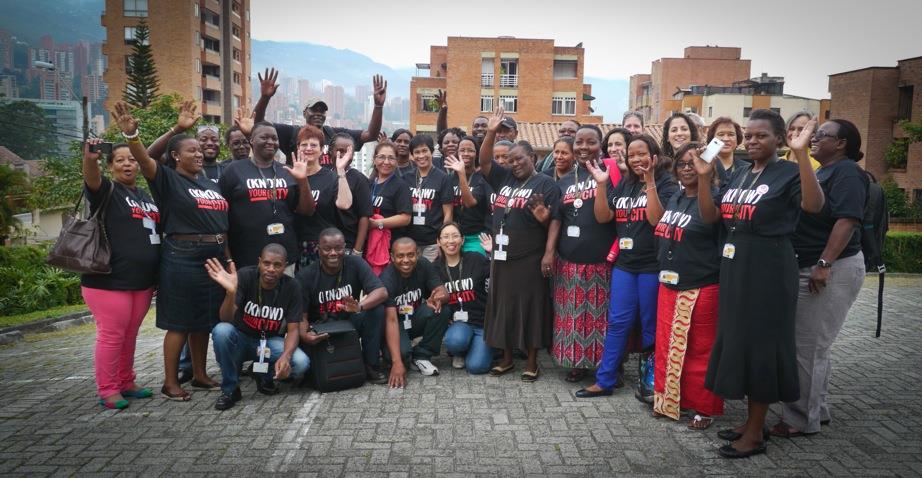
Today marks the last day of the 7th World Urban Forum (WUF), which took place in Medellin, Colombia from 5-11 April 2014. Patrick Maghebula, Rose Molokoane and Marlene Don – national co-ordinators of the South African Alliance – attended the forum together with numerous members affiliated to Shack / Slum Dwellers International (SDI).  Convened by the United Nations Human Settlements Programme (UN-Habitat), WUF is regarded as the ‘World’s Premier Conference on Cities’ that examines the most pressing issues concerning “human settlements, including rapid urbanization and its impact on cities, communities, economies, climate change and policies” (WUF 7).  Given that the design, governance and infrastructure of cities directly impacts on social, cultural and economic inequality, this year’s forum was themed “Urban Equity in Development – Cities for Life’.

Delegates on Day 1

SDI affiliates from Africa, Asia and Latin America on day one at WUF7 in Medellin

SDI launches the ‘Know Your City’ campaign

A lot of discussion at the past week’s WUF focused on the use of data as a key tool in the development of inclusive, sustainable cities. Key to this discussion is how data can be used in the cities of Africa, Asia and Latin America, most of which still face major challenges around urban poverty and whose city development strategies, for the most part, continue to exclude the large majority of these cities’ populations – the urban poor.

But at SDI’s networking event on Wednesday, a strategically different approach to data was presented and discussed. The ‘Know Your City’ campaign – a global campaign for gathering citywide data on slums as the basis for inclusive partnerships between the urban poor and their local governments – was presented as a critical component of the push for urban data. When communities of the urban poor collect data about their own communities, in partnership with their local and national governments, they are armed with the necessary tools to become key players developing urban development strategies that take into account the realities and needs of the city’s urban poor majority.

SDI-affiliated federations of the urban poor have been collecting information about themselves for decades. This data has led to upgrading projects in affiliates across Africa, Asia and Latin America, and has formed the basis of large-scale slum upgrading interventions in India, South Africa, Zimbabwe, Kenya and more recently, Uganda. Read more about the ‘Know your City’ campaign here.

Patrick 4

Patrick Maghebhula (Informal Settlement Network National Co-ordinator)


SA Alliance on People Centred Strategies, Community-Collected Data and Partnerships with Local Governments

On Monday, Patrick Maghebhula joined alliance leaders from Kenya and Uganda in a discussion around how to put poor people at the centre of strategies on urban development. They highlighted how organised urban poor communities triggered new institutional responses to poverty in their cities and how urban poor communities across the Global South are developing relationships with governments that can lead to scaling up slum upgrading and improving quality of life.

Rose moderated an event on “Creating Resilient & Equitable Cities through Partnerships for Community –Collected Data” on Tuesday. The focus was on the critical role of such partnerships at the city-wide and global scale which can serve as a means to explore how data collected by the poor, about the poor and for the poor can become standard benchmarking data used by urban policy makers and planners. The key point was that every city can and should be generating data about urban poor communities with urban poor communities.

Yesterday’s UNDP event on “Strong Local Government for Development through Partnerships in Ghana, South Africa & Uganda” highlighted a new partnership between the United Nations Development Program (UNDP) and SDI. This partnership aims to support deliberative engagements between local governments and organised slum dweller communities to build a base of data and skills. This approach is based on the experience that, all too often, city development initiatives have been based on a narrow comprehension of the cultural and socio-economic dynamics of the urban poor. However, informal settlement communities have begun organizing and networking at city wide and national scales in order to catalyse innovations with formal authorities for responding to land, sanitation, shelter, and opportunities for employment.

Rose song SDI networking session

Rose Molokoane begins the SDI networking session with a song

At today’s event, Marlene joins the discussion on “Smart Cities from the Bottom Up” which will look at the scarcity of hard data on which communities, governments and international agencies base development decisions. The discussion will elaborate on how community-driven profiling, enumerations, GIS mapping and data management are some core methodologies of urban poor federations such as the South African Alliance and other federations linked to SDI. By working together with experts in urban data analysis and research at the Santa Fe Institute (SFI) the data collected by slum dwellers becomes of a standard suitable for local poverty analysis, advocacy and planning.

As WUF7 comes to a close, it is all the more evident that

“There cannot be transformation of the city if slum dwellers are not integrated” (Rose Molokoane, National Co-ordinator SA SDI Alliance)

Rose 1

Rose Molokoane (National Co-ordinator, Federation of the Urban Poor)

Amandla Imali Nolwazi! Alliance marches to eThekwini Municipality

By CORC, FEDUP, ISN, uTshani Fund No Comments

After weeks of preparation and community mobilization, thousands of shack dwellers gathered on Durban’s Dinuzulu Square early on Monday morning, 24 March 2014. As people arrived by foot, mini-bus taxi and on numerous busses, they were met by songs of protest sounding from an ever-growing crowd of shack dwellers affiliated to the Federation of the Urban Poor (FEDUP) and the Informal Settlement Network (ISN).  The mass of black and white t-shirts, placards, banners and cardboard signs bore powerful messages

“Did you know the majority of people in eThekwini are still without title deeds?”

“Phambili nge community participation – Forward with community participation!”

“No Upgrading without Us!”

These messages pointed to the purpose of the march: to hand over an agreement of co-operation to eThekwini Municipality which outlined a more inclusive, implementable and participatory partnership between the municipality and organized groups of shack dwellers affiliated to FEDUP and ISN.

First marchers gather at Dinuzulu Square

First marchers gather at Dinuzulu Square


From Dinuzulu Square to the City Hall

The date of the march coincided with national celebrations around Human Rights Day. Most shack dwellers in eThekwini municipality and the country, however, do not benefit tangibly from the achievement of human rights in South Africa. Land acquisition, housing, water and sanitation, refuse removal, access to electricity and informal settlement upgrading are urgent and daily recurring concerns. For shack dwellers in eThekwini municipality these issues are particularly expressed in the lack of a meaningful engagement between themselves and the municipality.  The march, therefore, aimed to set the scene for an inclusive and participatory working relationship.


IMG_1387

A crowd of about 2500 marchers set off from Dinuzulu Square at 11h00, marching in peaceful and powerful protest, singing and loud hailing slogans that express the hardships of life in informal settlements and the power of organised communities. In the mid-day heat of a bright summer’s day, the streets of Durban CBD came to a standstill as shopkeepers, pedestrians and on-lookers absorbed the lively and determined atmosphere. The slogan was clear:

“Amandla, Imali Nolwazi, eish! Ayilumi Mayihlafuna” – Power is Money and Knowledge! Eish! You can’t bite while you are chewing!

IMG_1439IMG_1426

The alliance slogan directly speaks to the low response many urban poor communities receive from local municipalities.  ISN community leader Sifiso Nobani, explains that

“We chose to march because this is the only language that the municipality understands. Roads will be closed and people and businesses will take notice of us”

After 2km, the marchers, representing numerous informal settlement communities in eThekwini gathered in front of the City Hall to hand over the Agreement of Co-operation.

Towards an Agreement of Co-operation

The agreement was drafted as a response to some of the most pressing challenges faced by the urban poor in eThekwini. Sithembile Doncabe, FEDUP savings scheme leader, explains that

“ We are sick and tired of living in informal settlements. We are losing our dignity. We want to raise our dignity. We are citizens. We want houses. But they are not listening to us”

Ma Mkhabela, provincial FEDUP coordinator adds,

“There is some commitment from the municipality but they keep pulling back. When we meet in joint working groups once a month, municipality members are often missing. The provincial and national response is better. The problem is that our ‘partnership’ with the municipality is not a written one”

“We don’t know anything about the municipality’s plans for upgrading our settlements. We need to be informed about time lines and planning. We want to be independent communities. We have rituals that help us, like enumerations that show that one shack does not equal one family. If we have a chance to submit this information to the municipality we can develop our country nicely, like the constitution says!”

At Durban City Hall

At Durban City Hall

The co-operation agreement outlined these concerns in more detail. They relate to: a lack of updated facts and figures concerning the urban poor, a slow approach to land acquisition and assembly for informal settlements, inadequate delivery of basic services and disaster management, inadequate inclusion of the urban poor in municipal budgeting and planning processes, lack of municipal commitment to Joint Working Group structures to deal with uTshani Fund old debt and Pledge Housing implementation, limited social development, poverty alleviation, livelihood generation and nutritional programs as well as inadequate access to finance in funding community based upgrading projects. The agreement of co-operation also outlines the purpose and joint activities for future collaboration, emphasizing practical and implementable suggestions.

Several provincial alliance members shared their experiences around lobbying and mobilization with the marchers. Joe Nene, advisor to the Mayor, then joined national coordinators Rose Molokoane (FEDUP), Mzwanele Zulu and Patrick Magebhula (ISN) as the agreement was read out and handed over.

Mr. Nene received the agreement, emphasizing that he could not promise a signature but that it would be passed on to the mayoral office, which would respond within seven days.

As communities wait for a response from the municipality, Ma Mkhabela is clear,

“We want to plan together with the municipality so that they know our priorities. They need to talk to us. There’s nothing for us without us. We want to know that we have agreed together”.

Joe Nene (Advisor to the Mayor), Patrick Magebhula and Mzwanele Zulu (ISN national coordinators)

Joe Nene (Advisor to the Mayor), Patrick Magebhula and Mzwanele Zulu (ISN national coordinators)

2014 UCT – Europe Community Studio “The Beginning”

By CORC, ISN No Comments

By Thandeka Tshabalala and Yolande Hendler (on behalf of CORC)

Community members and students locate structures and amenities in Europe informal settlement.

Community members and students locate structures and amenities in Europe informal settlement.

On 19 February 2014, Europe community members welcomed about thirty masters students of Urban and Regional Planning from the University of Cape Town (UCT) to their informal settlement, which is located in Gugulethu, Cape Town. This first gathering kicked off a four month long ‘planning studio’ in which community members and students will work together to address some of the community’s most pressing concerns. The studio also aims to expose students to alternative planning approaches to urban informality. The Informal Settlement Network (ISN) facilitates and supports the community leadership while CORC offers technical support as the community and students develop plans for upgrading. Read more on the background leading up to the 2014 studio.

First meeting in Europe

Community members and students gathered in Europe’s community hall where ISN and CORC shared opening insights on the importance of community participation, mobilization and capacitation. Such an approach forms a solid foundation for planning community-relevant issues such as access to basic services and housing. Situated close to employment opportunities at the Airport Industria and the N2 corridor, Europe’s location is ideal for its residents. For this reason students and community members decided that it would be ideal to look at in-situ, incremental upgrading projects. In order to give students a more concrete idea of ‘life in Europe’ community members showed them around their settlement. This opened up a platform for both community members and students to reflect and share their expectations for the studio ahead.

Students' first visit to Europe.

Students’ first visit to Europe.

The purpose of the studio is two-fold: For the community, technical support around housing and upgrading are advantageous for engaging government. For the students it is advantageous to gain valuable experience in working in a highly collaborative and participatory environment around some of the most pressing issues in the city.

After the visit, CORC’s technical team joined the students at UCT in order to reflect before the next joint planning session with community members. Based on the students many impressions – for some it was the first visit to an informal settlement – a variety of ideas, concerns and suggestions arose. Some students related Europe to studies of urban informality in the global South, others explored how the meaning of boundaries in communities impacts opportunities and community interaction.  Some concerns related to the lack of public interaction spaces, lack of socio-economic activity and the need to value recycling as a source of income. Other students emphasized the importance of collaborative and participatory planning methods.  Towards the end, one of the students seemed to capture the general sentiment that

“We need to develop new sets of eyes to understand the logic systems, local assets and already present ways of doing things in Europe. We need to identify local systems. The community needs to identify its own opportunities”

Joint planning for action

The next session was an interactive one with a printed map of Europe. It was marked with some reference points, landmarks and amenities that would serve as a collaborative working document to gather information about the settlement from community members.  This meeting focused on sharing expectations and establishing specific issues the community wanted to address. Furthermore, it established where students’ interests and abilities aligned with community priorities.  With great excitement, students and community members located their homes on the map, marked off the boundaries of Europe and identified central spaces. Community members also expressed that they would like the studio’s incremental projects to support their long-term vision of attaining housing. This focus is linked to the question: “how permanent is our temporary?” As communities wait for permanent housing, there is a need of assisting well located settlements such as Europe to upgrade, but not lose sight of the long term vision.

DSCN5652

Interactive mapping at UCT

After several visits to Europe, students expressed the significance they perceived in planners moving away from physical planning to focus on the people they are planning with, i.e. understanding their background and socio-economic context within the larger context and potential of the city. The students thus based their analysis of Europe community on reinforcing socio-economic opportunities.

Through engaging with residents’ already present coping mechanisms students researched opportunities, constraints and concepts for future action. The opportunities they presented included access to employment, recreational spaces, spaces of interaction, education and small businesses. The identified constraints comprised flooding, crime, physical and social barriers, pollution and poor soil quality affecting food production. Together, community members and students developed working groups that respectively looked at socio-economic issues, transport, housing / land / tenure issues and water, sanitation and storm water services.

Working Groups 2

A working group in Europe

The working groups then identified more concrete concepts:

  • Socio-economic opportunities around Klipfontein Road

Klipfontein Road was presented as a main artery of opportunity as Europe’s main entry point and connecting point to other neighbourhoods. The industrial area at the airport was presented as a potential source of employment. A further point related to taking advantage of existing business that represent high activity nodes.

  • Easing access to public transport routes

This was particularly relevant due to the community’s reliance on pubic transport.

  • Potential upgrading and re-blocking
  • Strengthening food production

The focus would lie in increasing food security whilst decreasing poverty levels.

  • Overcoming barriers to neighboring communities

This would facilitate greater interaction between communities.

During the presentation students emphasized the knowledge they had gained from the community in developing these concepts,

“ We regard the community as experts, they have all along been able to use their human architecture to deal with the physical constraints of the space they live in.”

The next phase of the studio will comprise developing a spatial development framework. CORC and ISN will continue to share the studio’s upcoming developments.