Tag

In-Situ Upgrading Archives - Page 3 of 4 - SASDI Alliance

Taps, Toilets & Beyond: ISN partners with Water & Sanitation Dept

By CORC, ISN No Comments

By Nkokheli Ncambele (on behalf of ISN)*

Nkokheli Ncambele is the regional co-ordinator of the Alliance’s Informal Settlement Network (ISN) in the Western Cape.

Emseleni Community leader, Nomfundo Lungisa

Emseleni Community leader, Nomfundo Lungisa

In Mfuleni, informal settlements have been without basic services for five years. People had to buy water from surrounding formal houses; at night it was difficult for them to get to a toilet. Last year, ISN started creating a partnership with the City of Cape Town’s Water & Sanitation Department. We kept reporting these problems to the City until we saw that there was a light: the Department came to us saying, “Yes we are going to do something in those communities”.

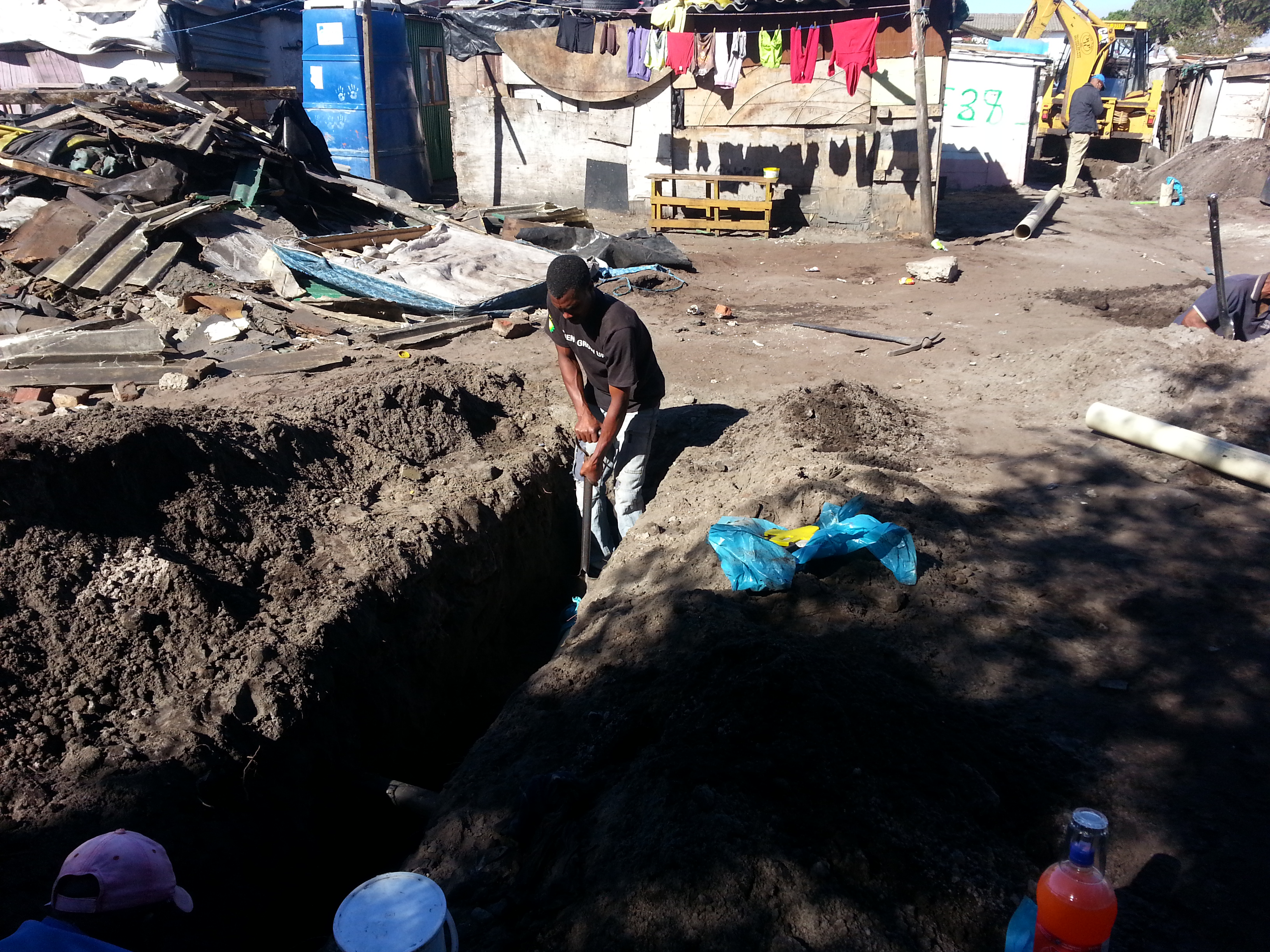
The City is very important as a partner because when they come on board we see results: in March 2015 they installed a total of 15 standpipes for taps and 57 flush toilets in five settlements (Tambo Square, California, Constantia, Strong Yard and Emseleni) in Mfuleni region which is one of four ISN sub-regions in Cape Town. Every settlement’s leadership sends two or more members to our weekly sub-regional meetings to discuss issues. After we collect all issues we decide where to start. This is how we chose these five settlements for Water & Sanitation installation.

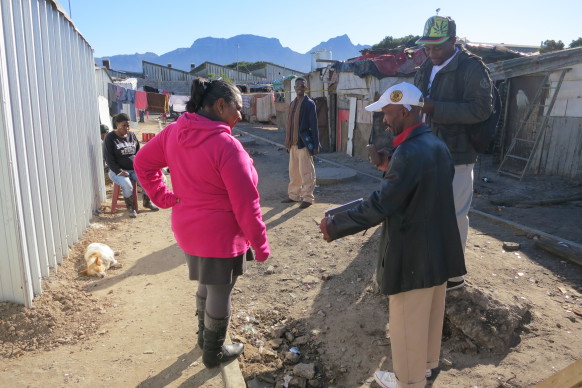
ISN co-ordinators Nkokheli Ncambele and Melanie Manuel with Kuku Town community leader, City of Cape Town councillor and officials

ISN co-ordinators Nkokheli Ncambele and Melanie Manuel with Kuku Town community leader, City of Cape Town councillor and officials


From backyards to informal settlements

You will find that most settlements like Tambo Square, California, Constantia, Strong Yard and Emseleni were established when formal housing was introduced. When there is a big housing improvement project there are always people who move in as backyard dwellers. Why are there so many new settlements like these? Because backyarders are tired of paying rent and being mistreated by homeowners who cut off services without notice. That’s why backyarders move into nearby open spaces.

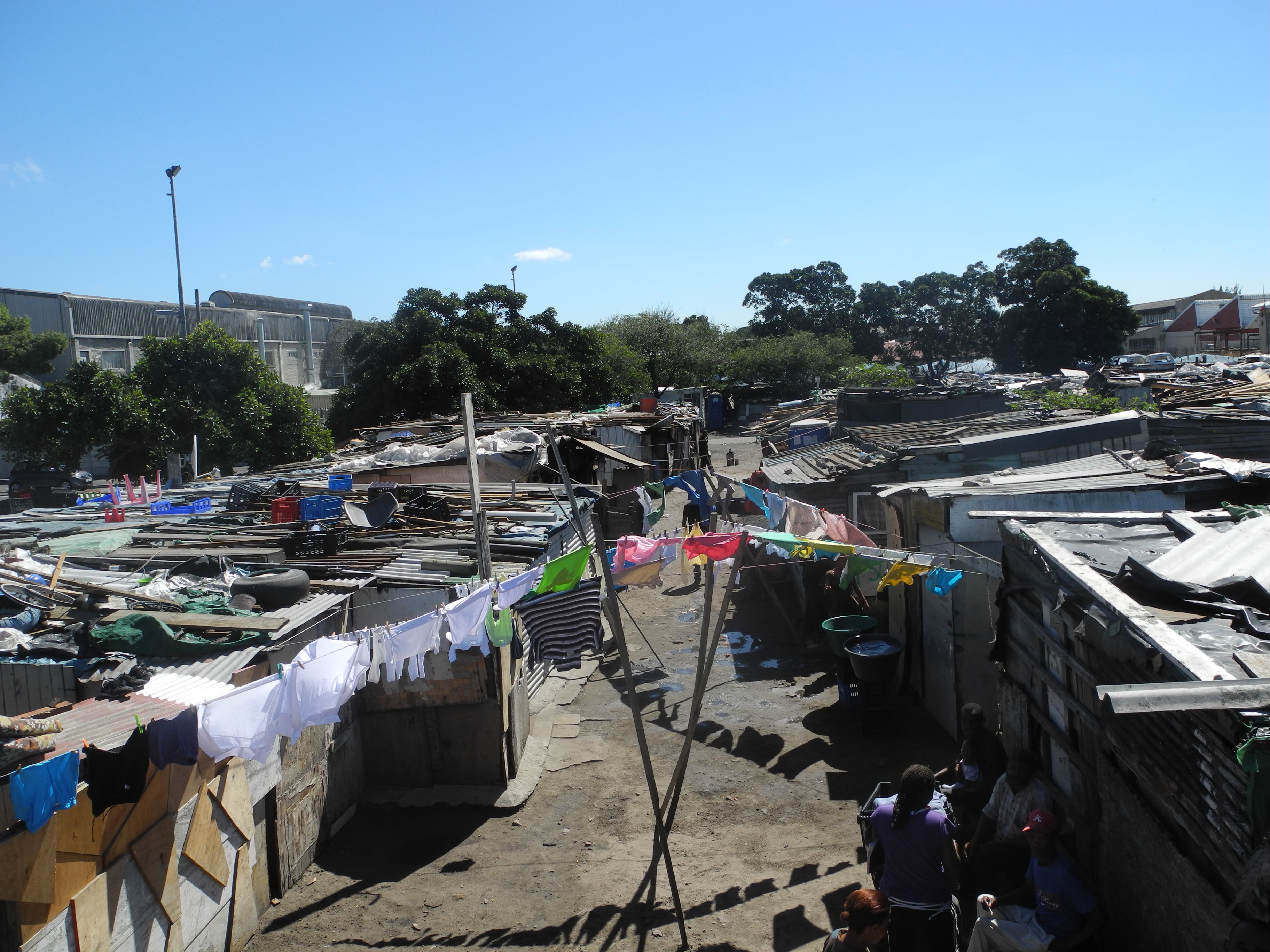
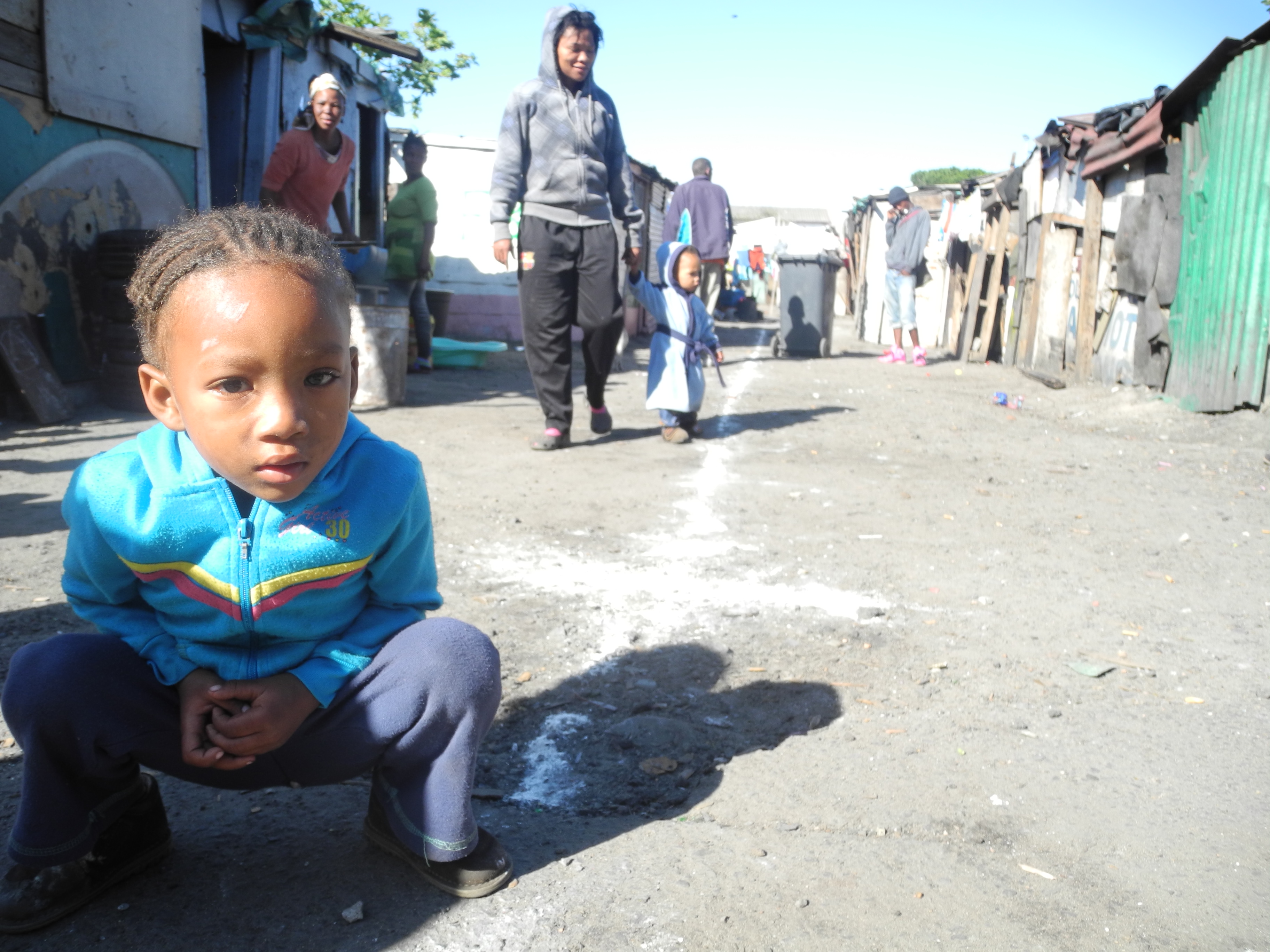
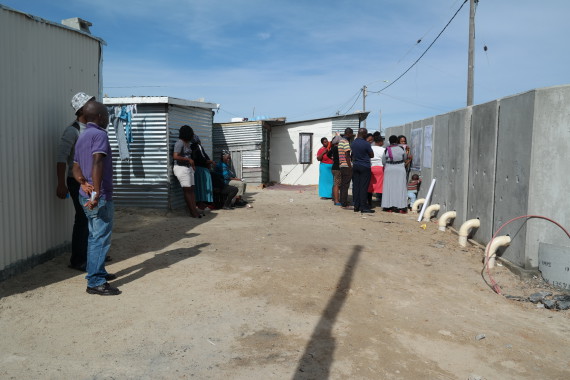
Constantia informal settlement is in close proximity to formal housing.

Constantia informal settlement is in close proximity to formal housing.

Constantia Steering Committee members, Nolusapho Thandela and Phindiswa Payiti

Constantia Steering Committee members, Nolusapho Thandela and
Phindiswa Payiti


The beginnings of ISN in Mfuleni

Before ISN, we as community leaders used to have a joint leaders forum in Mfuleni. When we heard about ISN, we decided to join because the movement was talking about what we were already doing for a long time.

“We realised that actually we are ISN – anyone who is staying in an informal settlement is ISN. Let’s take this forward”.

New sub regional leaders asked us to explain the ISN process to them. Other community movements, development forums and Councillors also know about us. I can say that 99% of informal settlements in Mfuleni have gone on exchanges to see what other ISN communities are doing. That’s why they want to be part of ISN and why Mfuleni is becoming an ISN base. Look at the people of Tambo Square – they want to be involved in their own project. When the ISN coordinators go to Emseleni, people just come out to greet us. We see that people are hungry to solve their problems.

“Tambo Square started in 2007 when backyarders moved here. We had no toilets or taps and used to get water from the formal houses. We took our problems to ISN who helped us go to the municipality. These changes came to us with ISN – they play a big role for us”.

(Nkosikhona Bangiso, Tambo Square Steering Committee Leader)

Tambo Square community leader, Nkosikhona Bangiso
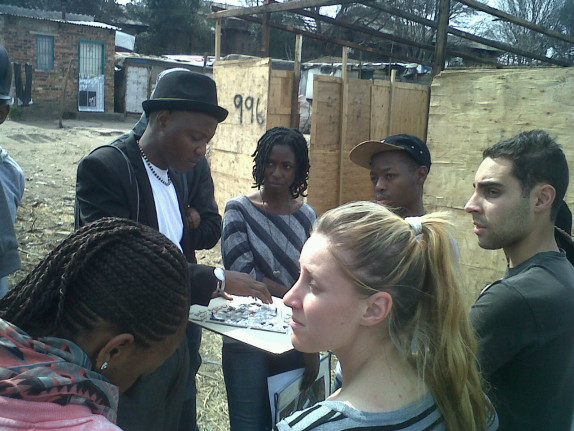
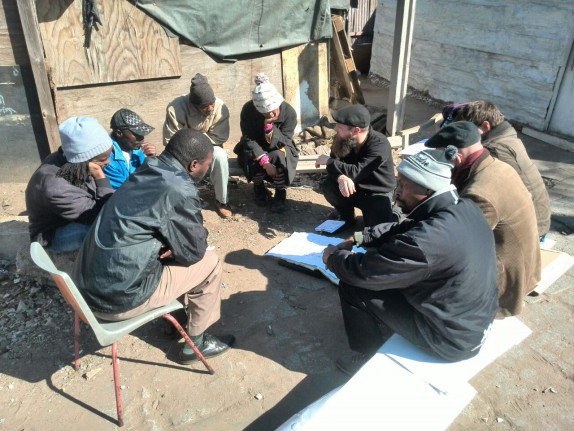
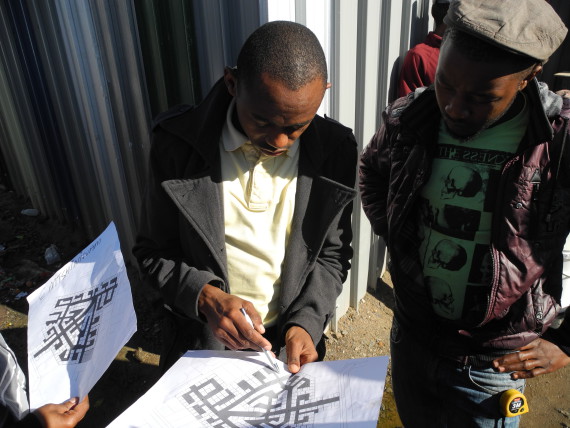
Tambo Square community use back of newly installed toilets for mapping workshop to plan further upgrading initiatives in their settlement.

Tambo Square community use back of newly installed toilets for mapping workshop to plan further upgrading initiatives in their settlement.


Building our partnership with the City

As ISN, we know that the Department of Water & Sanitation has an interest to deliver basic services to communities. The difficulty is that many settlements have little open space for services to be installed. When ISN started mobilising communities and speaking about the value of basic services, community members began thinking about how to create more space in their settlement. In Tambo Square, for example, it looked like there was no space. We suggested that the community remove a large container that stood at the entrance of the settlement. Now there are ten toilets in that space. In this way it was easy to convince Water & Sanitation to partner with us. I think I can say that they see us (ISN) as a solution. We told them,

“We’ve got the space, now you can come and install the toilets. Don’t say there is no space in our community”.

The role of ISN & CORC in partnership building

What is unique about our Alliance is that CORC created a space between ISN and the City. In 2009 there was opposition between communities and the City. Because of that CORC was there to neutralise the relationship. I can say that CORC was a bridge that connected us to the City. The City used to say, “We don’t want to go to meetings with the communities because they will swear at us and toyi-toyi (protest) and do all these things.” But CORC has a belief that communities won’t do that. Through the engagement with CORC we (ISN) understood that we need to go to the table, and not to the street. Then at the end of 2009, the City started saying, “This thing is working”. I think that is why they are happy to work with us.
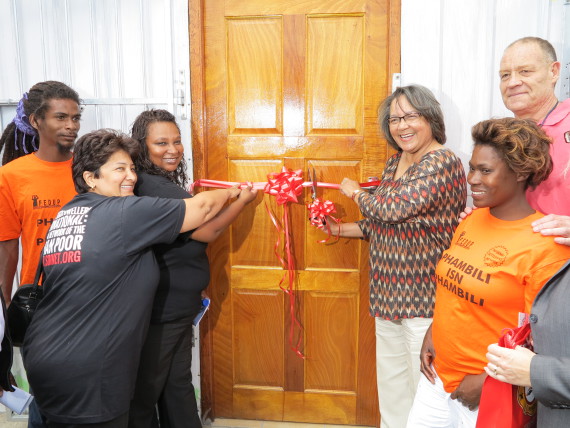
Flamingo Crescent informal settlement community members with ISN facilitator Melanie Manuel, CORC Director Bunita Kohler (left) and City of Cape Town Mayor Patricia de Lille

Flamingo Crescent informal settlement community members with ISN facilitator Melanie Manuel, CORC Director Bunita Kohler (left) and City of Cape Town Mayor Patricia de Lille

Nkokheli Ncambele (second from left) with fellow ISN co-ordinators Mzwanele Zulu and Melanie Manuel (far left and right), CORC technical support, Sizwe Mxobo (centre) and Western Cape MEC for Human Settlements.

Nkokheli Ncambele (second from left) with fellow ISN co-ordinators Mzwanele Zulu and Melanie Manuel (far left and right), CORC technical support, Sizwe Mxobo (centre) and Western Cape MEC for Human Settlements.


The bigger picture: taps, toilets & beyond

We recently met with an Mfuleni councillor and asked what he thought about Mfuleni as a whole. He said he has a bigger picture – that in the next 20 years he doesn’t want to see informal settlements. For that to be possible I see that he needs a movement like ISN that will make sure that his vision is pushed. What is our vision? That all settlements have basic services and that all people who are living in informal settlements have houses. Our vision and his vision are on the same page.

* Compiled by Yolande Hendler (on behalf of CORC)

Newly installed water & sanitation in Strong Yard settlement, Mfuleni

Newly installed water & sanitation in Strong Yard settlement, Mfuleni
 

CORC planner honoured with SAPI Young Planner Award

By CORC, News No Comments
On site in Flamingo Crescent Informal Settlement

On site in Flamingo Crescent Informal Settlement

Sizwe Mxobo, a planner at the Community Organisation Resource Centre (CORC) received  the South African Planning Institute’s (SAPI) Young Planner Award in October 2014. In speaking about his work as a planner with community movements affiliated to the SA SDI Alliance, Sizwe explains,

“An important aspect for me is exploring what public participation means in planning and informal settlement upgrading” (Sizwe Mxobo, CORC Planner).

In early 2014 SAPI released a call for nominations for successful young planners and announced its bi-annual summit in Durban titled “Planning Africa” from 19 – 22 October 2014. Nominations were submitted under various categories, one of which was the Young Planner award – to be made out to a “bright young planner (under the age of 35) for his/ her exemplary achievements and promising for the future in the planning profession as well as his/her contribution to the promotion of the planning profession” (SAPI).

The SAPI Awards

The SAPI National Planning Awards were established in 2008 to recognise and create a strong awareness of the valuable contributions and extraordinary performance in all aspects of the planning profession. The awards are an opportunity to appreciate the efforts and contributions of many planners in shaping the built environment, promoting sustainable development and maintaining the integrity of good planning practice amidst competing development interests and challenging situations.

Sizwe with Langrug commnuity leaders Trevor Masiy and Alfred Ratana

Sizwe with Langrug commnuity leaders Trevor Masiy and Alfred Ratana

Planning in the SA SDI Alliance

Sizwe has been working with CORC since 2011, providing technical support, often in informal settlement upgrading initiatives, ranging from community mobilization, capacity building, assisting settlements with preparing development plans or engaging City officials around service delivery issues.

In 2012, Sizwe project managed the upgrading and re-blocking of Mtshini Wam informal settlement in Cape Town. The project set a precedent for informal settlement upgrading, at local and national level whereby the City of Cape Town used it as a benchmark to deliver a reblocking policy. It was also awarded an Impumelelo Gold Award in 2013. Since then Sizwe has spearheaded 3 other upgrading and re-blocking projects in the City. Sizwe’s work has also focussed on Langrug informal settlement near Franschoek in the Western Cape. Through deep engagement with the community Sizwe assisted CORC and the community in devising a pallette of informal settlement upgrading strategies. The planning of Langrug was awarded the SAPI National Award in the Community Category.

Planning reblcoked Layout in Mtshini Wam informal settlement, Milnerton

Planning reblocked Layout in Mtshini Wam informal settlement, Milnerton

Why Planning?

When tracing his steps as a planner, Sizwe links his interest in participatory, community based planning to his roots.

“I was born and raised in an informal settlement and still live in one. I have always wondered what it would take to transform an informal settlement. When I saw the first housing developments in Samora and Delft I asked myself why people had to move away from their current locations and amenities. Why could changes not happen where people lived?”

Sizwe’s fascination with community development – particularly how informal communities could be transformed to formal settlements – inspired him to study Town and Regional Planning. He remembers that although informality was addressed by the curriculum it largely focussed on how to move from a shack to a house.

“My biggest attraction has always been how planning principles can be used in informal settlements. When I was planning chairperson we took students to Nyanga and explored what in-situ upgrading is about. I learnt that my interest in fighting for people who are generally not considered by planning institutions – landless people in urban areas – is called advocate planning. Others did not always understand my approach to planning. Through working at CORC I found my feet and understood what planning is for me. Winning this award has been a further confirmation. We are no longer talking the language of eradication of informal settlements but of upgrading”

In Nyanga, Cape Town

In Nyanga, Cape Town

In Kuku Town informal settlement with community leader Verona Joseph

In Kuku Town informal settlement with community leader Verona Joseph

A different approach to Planning

“In the ever-changing role of a planner, I think a key element for planners is to ensure the relationship between people and land. Public participation should be more than drawing up plans and asking for a community’s approval. It should be about supporting people to come up with their own development plans for their communities”

(Sizwe Mxobo)

As a profession planning is rapidly transforming. Most urban policies developed in South Africa focus extensively on community participation. Both the National Development Plan (NDP) and Upgrading of Informal Settlements Programme (UISP) talk about community participation as a central tenet for development. However, government has also identified this as a missing link and capacity both within the municipal and private sector. Most recently, the National Upgrading Support Programme (NUSP) has floated tenders in 49 different municipalities to develop community based plans. Clearly, community participation in the planning sector is the need of the hour.

SAPI Award Ceremony in Durban, Oct  2014

SAPI Award Ceremony in Durban, Oct 2014

Discussing Plans with Flamingo Crescent Community Steering Committee

Discussing Plans with Flamingo Crescent Community Steering Committee

With Kuku Town Steering Committee, Kensington

With Kuku Town Steering Committee, Kensington

Moegsien

SA Alliance at National Human Settlements Indaba 2014

By CORC, FEDUP, ISN, News, Press, SDI, uTshani Fund No Comments

By Yolande Hendler (on behalf of CORC)

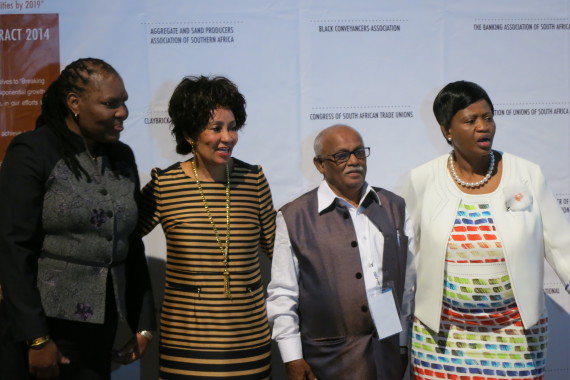
FEDUP members welcome Minister Lindiwe Sisulu and Deputy Minister Zoe Kota-Fredericks at the SDI Exhibition booth

FEDUP members welcome Minister Lindiwe Sisulu and Deputy Minister Zoe Kota-Fredericks at the SDI Exhibition booth

Twenty years after Joe Slovo’s historic Botshabelo Housing Accord, Lindiwe Sisulu, incumbent minister of Human Settlements, invited stakeholders in the human settlements sector to the National Human Settlements Indaba and Exhibition, which was held at the Sandton Convention Centre in Johannesburg from 16-17 October 2014. This included the Federation of the Urban Poor (FEDUP) on behalf of the SA SDI Alliance and Shack/Slum Dwellers International (SDI),

Aims of the Indaba

The Indaba not only marked twenty years of South African democracy but also ten years after the first social contract was signed in 2004 during Sisulu’s first term as Minister of Housing from 2004-2009. The first social contract, similarly, brought together a number of stakeholders in the housing field to discuss and sign an agreement regarding co-operative and collaborative housing practice which would pursue the aims of the then newly launched housing policy: Breaking New Ground (BNG): A framework for Sustainable Housing Development. BNG largely focuses on “promoting the achievement of a non-racial, integrated society through the development of sustainable human settlements and quality housing”. Click here for more on BNG policy. Ten years later, however, the implementation of BNG has been only partially successful.

Against this backdrop, the 2014 Indaba aimed to:

  • Review progress in the implementation of BNG
  • Review the impact of the Social Contract for Rapid Housing signed in 2005
  • Commit stakeholders to a second social contract towards 1.5million housing opportunities by 2019.
Rose Molokoane and SDI delegates from Uganda, Tanzania and Zimbabwe

Rose Molokoane and SDI delegates from Uganda, Tanzania and Zimbabwe

South African and International SDI delegates at Exhibition booth

South African and International SDI delegates at Exhibition booth

Day 1: Pledges towards a second social contract

Amidst actors such as the South African Banking Association, the Chamber of Mines, construction companies and trade union representatives (to mention but a few), SDI and the SA Alliance voiced the interests of the urban poor and advocated for an inclusion of the urban poor in planning, decision-making and implementation.

During the first day’s introductions, Jockin Arputham, SDI President and Nobel Peace Prize Nominee, shared a message of support ahead of the minister’s keynote address which is outlined here. In the afternoon contributors pledged their commitments to the second social contract.

SDI President Jockin Arputham with Minister Lindiwe Sisulu and Deputy Minister Zoe Kota-Fredericks

SDI President Jockin Arputham with Minister Lindiwe Sisulu and Deputy Minister Zoe Kota-Fredericks

Jockin Arputham speaks at Press Briefing

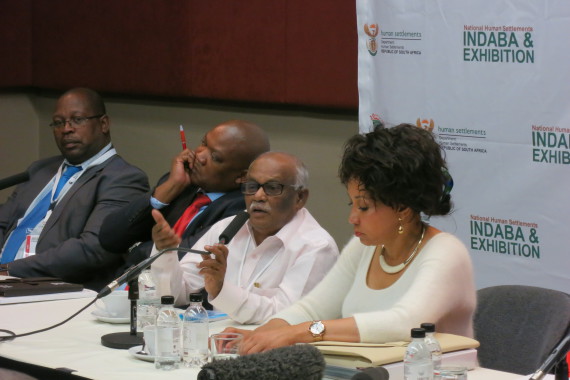
Jockin Arputham speaks at Press Briefing with Minister Sisulu and Director General Zulu

The SA SDI Alliance Pledge

In response to the Department’s larger orientation, Rose Molokoane, national co-ordinator of FEDUP, powerfully shared the pledge of the SA SDI Alliance:

FEDUP pledges to work with national, provincial and local government to deliver 1000 housing actions every month, improving the life of 1000 households. These actions will include

1)   Organising communities through savings

2)   Upgrading services such as water, sanitation, drainage, energy and roads

3)   Building bigger and better houses

4)   Advising the ministry on how to work with communities and organise them to be full stakeholders

We also commit to draw other organisations of the urban poor into the pledge as equal partners. We cannot do this alone. You cannot do this alone. You need our help. “We know the minister is serious about supporting us. What about the MEC’s? What about the local authorities? Are you?

View Rose Molokoane’s speech here:

[vimeo]https://vimeo.com/110123793[/vimeo]

Day 2: Reviewing BNG projects & the second social contract

The second day of the Indaba concluded with presentations by several MECs on the successes and challenges of implementing BNG projects in four provinces, followed by the reading and signing of the second social contract. The specifc commitments of the second social contract are documented here.

Rose & Jockin sign the second social contract on behalf of SA SDI Alliance and SDI

Rose & Jockin sign the second social contract on behalf of SA SDI Alliance and SDI

IMG_0949

Throughout the Indaba the minister repeatedly referred to the value and experience of SDI and the South African Alliance’s work in forming an inclusive atmosphere that engages the urban poor around their own housing development.

Over the last twenty years the SA SDI Alliance has developed an ongoing partnership with the Department which spans from the signing of the Botshabelo accord in 1994, participating in the 2005 national housing accord, the signing of the first social contract in 2005, the 2006 MoU pledge with the Department for subsidies of R285million with which FEDUP has built over 2000 houses to the Department’s most recent pledge of R10million in August 2014.

Throughout FEDUP’s partnership with the Department its core vision has always been: “Nothing for us without Us”. This message is also at the heart of FEDUP’s pledge. As the second social contract is implemented in the next five years, it is the collective vision, experience and practice of the urban poor that is crucial to a truly inclusive implementation not only of housing but also of incremental, in-situ informal settlement upgrading as a vital step towards attaining housing and tenure security.

“We cannot do this alone. You cannot do this alone. You need our help.”

(Rose Molokoane)

Installing Water Taps in Holomisa Gauteng

By CORC, ISN, News, uTshani Fund No Comments

By Blanca Calvo (on behalf of CORC and uTshani)

Holomisa is an informal settlement located in Katlehong (Ekurhuleni, Gauteng). In May 2014, Pumelele Ntanjana, one of the leaders of Holomisa Informal Settlement, contacted the Informal Settlement Network (ISN) to request support for a possible re-location of a portion of his settlement. Today, Holomisa has been profiled and enumerated, new taps have been installed and it has become a learning centre for other ISN communities in Gauteng.

ISN Gauteng co-ordinators with Holomisa residents

ISN Gauteng co-ordinators with Holomisa residents

The Holomisa story tracks back to an ISN leadership meeting that took place in Germiston (Ekurhuleni, Gauteng) in 2008. In that meeting, leaders from all informal settlements in the area had been invited to attend, Holomisa amongst them.

When Holomisa leadership were told by their councillor that a portion of the settlement needed to be re-located because of the enlargement of a neighbouring school, they approached ISN for support. ISN was invited to visit the settlement, where they firstly met with Holomisa leadership and the ward committee members.

The community and ISN profiled the settlement in May 2014 and identified a need for more sources of water (only 2 functioning taps for about 500 households). This was confirmed in a public meeting, where residents requested support for an immediate improvement of their daily lives through implementing more taps, improving sanitation conditions and electrifying the settlement. The settlement’s improved service delivery would also be an additional step to ensuring land tenure.

Existing Water Taps in Holomisa

Existing Water Taps in Holomisa

Three parallel processes started from there. On one side, enumerations started on the ground, identifying 446 households. Since Holomisa had been identified as a learning centre for the region, leaders from 6 neighbouring informal settlements (Emalahleni, Thintwa, Vlakplaas, Mandela, Makalakaleni and Zola) were invited to join the enumeration process, ending up with capacitated leaders to undertake the process in their own settlements. A total of 10 local and 6 external leaders were capacitated. Besides, the figures highlighted again the need for more taps, with a backlog of 8 taps to meet official standards


Holomisa Textbox1

The mobilisation team engaged with the Ward Councillor, who was informed in a partnership meeting of the intention to install more taps in Holomisa with the support of the South African SDI Alliance. The ISN sent a letter to the ward councillor saying,

“We understand that we are poor humble people struggling to make our way in life. Like every South African citizen, what we expect is a fair and reasonable service delivery from Government in return for the taxes we pay”

Finally, the savings team organised community savings to save 10% of the budget for the project. The outstanding 90% of the budget was financed by the Community Upgrading Finance Facility (CUFF) housed in uTshani Fund.
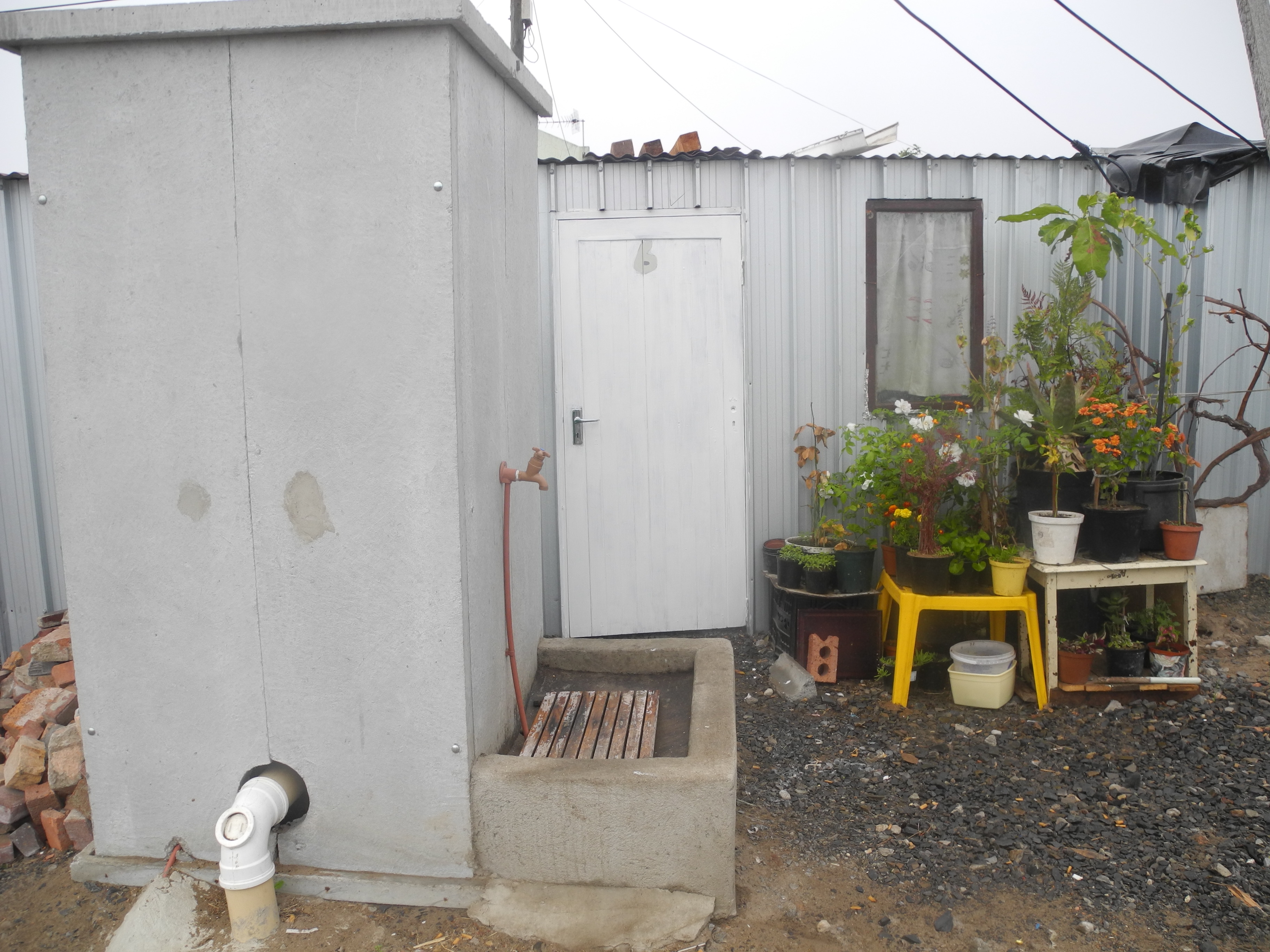
Mandela Day (18 July 2014) was finally the day for the project to start. In the space of 6 days, one tap was fixed and three more taps were installed. 25 local residents volunteered for the project, a technical team of 10 ISN members was on site and 6 leaders from neighbouring informal settlements were invited to participate and learn in the process, thus increasing their skills and building capacity.

New Water Taps in Holomisa

New Water Taps in Holomisa

Holomisa Textbox2

The project was a success for the communities involved, not only because the installation of more taps improved the living conditions of Holomisa residents, but also because some valuable lessons were learnt.

  • Firstly, the will of the people has been proved to be the best tool to work with. The residents identified the need for more taps and lead the project from the first day.
  • Secondly, the power of residents taking ownership of the project. Residents did not wait for external people and institutions for their permissions or to come to the work, they pushed for their needs to be heard and did it themselves.
  • Finally, the learning centre has proved to be a success. 6 leaders from other informal settlements were capacitated using almost the same amount of resources.

However Holomisa’s story does not end here and the process is still on-going. Holomisa residents, are in discussion with their Ward Councillor for the re-location process of a section of the settlement. Continuous engagement with the ISN will ensure that the re-located residents will be allocated a new portion of land, which it is still to be identified.

Holomisa2

Holomisa3

Sharing experiences on building City Funds

By CORC, FEDUP, ISN, News, uTshani Fund No Comments
20140902_103814

By Walter Fieuw (on behalf of CORC)

African cities are characterised by informality, as the rapid urbanisation from rural areas are transforming cities. Within informal settlements, residents are investing incrementally in their households, despite the lack of tenure security in many cases. A large gap exists between household investment and government spending on infrastructure and social support. Government expenditure is often times locked into medium term budgets which might or might not be adjusted on an annual basis, and procurement of goods and services follow time consuming processes. There are also various interests competing for government spending, and low income groups’ influence over the direction of spending is often times weak. Slum dwellers often times do not have access to loans from financial institutions, even considering the popular held belief of an emerging African middle class, which is still highly speculative. Hence new instruments are needed to build on and support the incremental upgrading of informal settlements and support for livelihoods and small income generating loans.

Shack / Slum Dwellers International supports the notion of creating local “city funds” which acts as a mechanism for building city-wide agglomerations and networks of the poor, creates partnerships between organisations of the poor and city governments, and gives voice and power to the urban poor. Following a meeting of country Federations on various experiences in building city funds in January 2014, SDI reported that,

Flexible citywide urban poor funds need to change existing systems of exclusionary finance.  Local government is a change vector that cannot be dismissed and their inclusion in these funds has the potential to create citywide political impact. Organized communities, who can clearly articulate their demands and the rationale for their financial decisions, can negotiate this space ensuring that funds remain relevant to the poor.

Between 1 and 3 September 2014, the Slum Dwellers Federation of Uganda (NSDFU) and support organisation Actogether hosted a meeting on city funds bringing together three African cities: Kampala (Uganda), Lusaka (Zambia) and Cape Town (South Africa). These cities have in common grant funding agreements with British donor Comic Relief, part of the “People Living in Urban Slums Programme”, which is also supported by the DFiD AidMatch initiative. Freetown (Sierra Leone) is forth city in the Comic Relief initiative, but were unable to travel due to the Ebola epidemic.

Comic Relief’s funding strategy of bringing together organisations and communities in city-wide partnerships have been lauded by participating grantees. In this way, according to Triple Line Consulting, who has been supporting Comic Relief in developing responsive city-level Monitoring and Evaluation (M&E) frameworks, the impact of the grants could possible achieve: a) a deeper understanding of the context than it might normally have b) a complementary portfolio of grants across the city c) improved collaboration between the grantees within a city d) a city level monitoring and evaluation framework and e) identified areas of learning across the 4 cities that can be shared with the broader sector.

20140902_101323

Katana Goretti, a Federation leader, demonstrates the construction phases of the eco-san toilet being constructed in Kampala

Reporting on country experiences to date:

Kampala, Uganda

The joint work to which NSDFU and Actogether are a part of is called KASTI, Kampala Slum Transformation Initiative. The Ugandan Federation will be actively engaging local government counterparts in five districts of Kampala, with dedicated settlement forums which feed into municipal forums, and ultimately city forums, to which the guests were exposed to on 3 September (more on this later). Such forums have proved tremendously useful in the past, as this blog article indicates. The Federation’s primary data collection of “settlement profiles”, which are captured on Geographic Information Systems (GIS), will be used to collaborative design a slum upgrading strategy. Comparisons with existing data from Kampala Capital City Authority and the National Water Department has revealed many informal settlements that were not on government’s databases. This is where the city fund becomes important, and seed finances both capital projects, especially innovations in sanitation, and livelihoods projects.

20140903_105337

On 3 September, NSDFU and Actogether hosted the first City Forum with Kampala Capital City Authority, which was lauded as a success

Lusaka, Zambia

In Lusaka there are 30 slums known as Improvement Areas, home to about 70% of the population. In 1996 the Government’s Housing Code allows for participatory approaches to slum upgrading, and the Housing Statutory Bill gives the minister power to declare and upgrade slums. However, there is a policy disjuncture in the sense that the Urban and Regional Planning Act does not have the right policies and instruments to recognise and upgrade slums. Tiyende Pamodzi, which means “working together” in local vanacular Nyanja, is the working title of the Comic Relief funded initiative in Lusaka, of which the Zambian Homeless People’s Federation and support organisation People’s Process on Housing and Poverty in Zambia are a part of. According to PPHPZ, Tiyende Pamodzi’s

main aim of the project is to gather accurate and reliable information of all the slums in Lusaka in order to inform participatory slum upgrading strategies which will see the regularization of slums and improved service delivery. Lusaka City Council (LCC) as the responsible authority for slum upgrading in the city cannot go it alone and as such will bank on the strength of the federation to mobilize their fellow slum dwellers to enumerate and map their settlements and use this as a basis for planning for the upgrading.

The Federation and PPHPZ has a strong working partnership with the University of Zambia, and in the programme will develop GIS courses to improve spatial mapping and profiling data as a basis. The city fund has not yet been defined, and the Federation and PPHPZ with the University as partner is still looking for the appropriate partners to serve on the board and advisory committee.

Cape Town, South Africa

In Cape Town, CORC secured a donor funding arrangement with Comic Relief, with community partners ISN and FEDUP. At the heart of the proposal is the setting up of a city fund, which is currently still being developed and constituted. The initiative is called Khayalethu, and joins the Alliance with Isandla Institute and Violence Prevention through Urban Upgrading (VPUU). At the Kampala meeting, community leaders Thozama, Tamara and Nozuko reflected on the current work in Khayelitsha, where Khayalethu is focused. In the first year, communities have profiled 47 settlements, enumerated 7 settlements, and developed community capacity to plan projects. However, challenges have been experienced in getting project approvals for community-identified settlement upgrading projects from the City of Cape Town. Livelihoods is also a primary focus, and experiences were shared around issuing short term loans for livelihoods development.

The South African delegation to Uganda (left to right): Thozama, Tamara, Walter Fieuw (CORC), Nozuko, Michael Krause (VPUU - Comic Relief partner)

The South African delegation to Uganda (left to right): Thozama Nomnga, Tamara Hela (both FEDUP/ISN), Walter Fieuw (CORC), Nozuko Fulani (FEDUP/ISN), Michael Krause (VPUU – Comic Relief partner)

The common experiences, opportunities and challenges experienced by the three cities in the first year of the Comic Relief funded initiative is instructive in developing locally responsive and appropriate city funds, which can enable and support communities in united networks to design, manage and upgrade their settlements. Moreover, building financial partnerships between city government, organisations of the urban poor and other stakeholders can lead demonstrating that people-centred urban planning and development, based on flexible finance, is vital to the creation of inclusive, pro-poor cities.

Co-producing Ideas: Denver community and University of Johannesburg Studio

By CORC, ISN No Comments

By Motebang Matsela and Yolande Hendler (on behalf of CORC)

Over the years, the SA SDI Alliance has been involved in several architecture and planning studios in which university students and community members co-produce ideas and scenarios around housing and upgrading. The most recent of these studios took place from July to August 2014 in Johannesburg’s Denver informal settlement together with community members, students from the University of Johannesburg’s (UJ) Department of Architecture, the Informal Settlement Network (ISN) and Community Organisation Resource Centre (CORC) who offered technical and social support and facilitation.

UJ students and community members in Denver informal settlement

UJ students and community members in Denver informal settlement

IMG-20140820-WA0007

Motebang Matsela (CORC technical support and CORC studio facilitator) (centre), with community members and students

Denver informal settlement

Denver informal settlement is situated in a light industrial zone that spans the southern section of Johannesburg’s central business district. It was formed in response to Denver hostel, an inner city accommodation, established around 1946 by the government of the time to house rural labour migrants. As the hostel operated for men-only, Denver informal settlement sprang up as an accommodation option for the wives of men living in the hostel. Over the years the settlement has continued to grow along with an increasing demand for housing by its residents.

IMG-20140820-WA0059

Aerial view of Denver

The studio: co-producing training for students and communities

The studio developed out of a longer engagement between UJ’s Department of Architecture, CORC and ISN, who had already collaborated on past studios in Ruimsig (2011) and Marlboro South (2012) informal settlements in Gauteng. The Denver Studio, however, differed from past studios because it introduced the first of a series of project management modules.

For the SA SDI Alliance, studios lay a foundation for productive discussions with local government that voice communities’ views, opinions and requirements. They also introduce students to the necessity and value of planning with communities, which contributes to a focus that shifts away from traditional ‘top down’ product and ‘delivery’ approaches towards ‘responsive’, community-orientated approaches.

While these outcomes are valuable aspects of collaborative work, Gauteng’s ISN leaders highlighted a current gap: community members need to gain tangible skills through the studio and upgrading process, just as the students do. Each module therefore couples practical participation in the studio with project management skills. Upon completion of every module, community residents will receive a certificate of participation. The vision is that these modules will run as an ongoing series throughout future studios and that they will incrementally build on the content of past studios, creating continuity and ongoing engagement between past and future studios.

Community members receive certificates of participation

Community members receive certificates of participation


DSCF9550

The Studio: co-producing ideas

The course engaged eighty 3rd and 5th year students in a site-specific situation that used joint mapping and data to generate community action plans (CAPs). These investigated short, medium and long term planning scenarios that would encourage short-term community initiatives and support further productive discussion with local government around incremental upgrading

The students were divided into ten groups, each of which partnered with two or more residents from Denver settlement who took the lead as designated community planners and explained the community’s various concerns to the students. One of the community leaders, Chief Mbata shared his views on the studio as a platform to commence a dialogue about the urban poor and their conditions of living. He went on to speak about the over crowdedness and the illegal electrical connections that have claimed a lot of shacks and their contents in and around Denver.

“I wish to see these dangerously exposed cables go, and better connections made by the municipality, but when shall that happen?”

(Chief Mbata, Community leader at Denver informal settlement)

Students and community members then investigated the following key themes for ten areas in the settlement:

  • Spatial Justice
  • Humane Environments
  • Scenario Planning
  • Context
  • Spatial / Physical / Social
  • Systems / Networks
  • Interfaces / Thresholds
  • Undercurrents / Threats
  • Aspirations / Perceptions
Students and community members in Denver informal settlement

Students and community members in Denver informal settlement

Final Student Presentations in August 2014

Final Student Presentations in August 2014

While they engaged with these themes, the community, supported by ISN and CORC, also undertook an enumeration of its settlement with the support of iSN – in a combined effort to collect comprehensive information.

As a community member, Daphne Ntombenhle Mabuso used her in-depth knowledge of the community and its history to compile the studio’s data in a collective documentation of Denver that represents the settlement as accurately as possible. Some of the studio’s content includes figure-ground drawings, actual land-use maps and various other maps that identify needs, constraints, observations and possibilities within Denver. This documentation can serve as the basis for continuing discussions between the community of Denver and the City of Johannesburg. (Click here to access the students’ documentation of the studio).

In the last week of August, the students presented their socio-spatial analyses of courtyards, pathways, open spaces,permanent vs. temporary structures and rental vs. owned units to Denver community. These open up a space to begin small-scale projects and a discussion with the local authorities. During this time community members also received their certificates signalling their participation in the studio and the project management skills they acquired. In this way community residents are becoming formally skilled participants and drivers of their own development in a collaborative, co-productive training space.

(Photos: Motebang Matsela, CORC)

DSCF9444


Durban and Port Elizabeth Leaders on Sanitation Exchange

By CORC, iKhayalami, ISN, SDI No Comments

By Stefanie Holzwarth and Yolande Hendler (on behalf of CORC)

Over the past years, the communities of Midrand in Port Elizabeth and Havelock in Durban have been upgrading their settlements, step by step. Last week’s exchange (8-11 July 2014) – in which community leaders visited Cape Town settlements – formed the next step in activating solutions to their specific needs for water and sanitation upgrading.

Site visit in Kuku Town

Site visit in Kuku Town


Midrand and Havelock

Midrand is located on municipal land but is not yet listed on the municipality’s database and therefore experiences great difficulty in accessing services. The community consistently experiences severe flooding. Havelock, on the other hand, is built on privately owned land and has been earmarked for “interim services” by eThekwini Municipality, indicating a willingness to deliver basic services in the short term and habitation in the long term. It is built against a hill with high shack densities that have led to shack fires, flooding and torrents of water flushes in the rainy seasons. Read more background on Havelock and Midrand.

The exchange

During the four-day exchange about ten community leaders visited five settlements in and around Cape Town. The exchange was linked to the SHARE Program (Sanitation and Hygiene Applied Research for Equity) linked to Shack Dwellers International (SDI). Read more about SHARE here. It was facilitated by the Informal Settlement Network (ISN), Community Organisation Resource Centre (CORC) and iKhayalami. It centrally focussed on how communities can use sanitation as a tool for upgrading and mobilisation, particularly in response to ever present and severe flooding.

Midrand community leaders, for example, spent time investigating the most suitable and relevant options for sanitation upgrading in their settlement:

  • Communal toilets and wash facility at the edge of the settlement (ablution blocks) without re-blocking
  • Sanitation and wash facility in the centre of the settlement with partial re-blocking
  • Individual sanitation facilities in courtyard (one-on-one sanitation) with settlement wide re-blocking

These would all require engagement with local government institutions.

Havelock’s central challenge is drainage. The settlement has already engaged with local government about constructing a sanitation unit as well as providing more sanitation units in the centre of the settlement. This would coincide with the communities’ already existing plans to re-block its settlement. Midrand and Havelock’s leaders therefore visited upgrading sites that provided an example of different options available to them.

DSCN7284

Example of sanitation in a community-run Water, Sanitation and Hygiene (WaSH) facility

One-on-One Sanitation in Kuku Town

The visitors spent the first day in Kuku Town where the community recently completed re-blocking with individual sanitation per upgraded structure. They were particularly interested in how Kuku Town managed to re-block without having to relocate people to other areas. Other questions focused on why the community chose individual toilets. Kuku Town’s leaders explained that

“single toilets are manageable because the owner is responsible for their own toilet and because there are no conflicts within the community with regards to hygiene.”

The leaders also reflected on Kuku Town’s successes and challenges throughout planning and implementation. The visitors learned how Kuku Town approached the municipality for support in terms of infrastructure services. Both Midrand and Havelock were impressed by the Council´s successful involvement in providing water and sanitation.

6. After reblocking 3

Sanitation and water services per upgraded structure in Kuku Town

Sanitation facility in Langrug, Stellenbosch & BM Section, Khayelitsha

In Langrug, Franschoek. the visitors saw an example of upgrading that included relocating 16 families, the construction of a second access road and grey-water and drainage channels, and a community designed, multi-purpose Water, Sanitation and Hygiene (WaSH) Facility. The visit offered insight into the WaSH facility, the drainage project and the local playground. The subsequent discussion facilitated an exciting learning environment with questions about the maintenance of the WaSH facility and funding. They also discovered the opportunity of hot water provision via solar heating systems in summer. The afternoon centred on projects in BM section, Khayelitsha. Its similarity (due to an uneven slope) to Havelock made it an ideal site for the exchange and delivered an essential input for its visitors.

DSCN7392

Interior view of Langrug’s WaSH facility


DSCN7455

Courtyard in BM section

Shared Sanitation in Mtshini Wam & ongoing re-blocking in Flamingo

The visit to Mshini Wam provided valuable lessons for the visitors – particularly in the field of funding and engaging the local authority. The visitors took special interest in understanding how Mtshini Wam managed to convince some residents to share toilets on a cluster basis while others had single toilets. The challenges relating to communal toilets were thoroughly discussed.

“The main idea was to have single toilets but due to the number of shacks and the limited space, the plan was diverted in order to accommodate communal toilets. The maintenance and cleaning of the toilets depends on the cluster groups.”

The visitors concluded their site visits in Flamingo Crescent, an ongoing re-blocking project. During a walkabout the visitors observed how shacks were broken down, how ground works were installed and how the new structures were erected.

Site visit in Flamingo during re-blocking

Site visit in Flamingo during re-blocking

Midrand community discusses the way forward

On the last day, Midrand leaders and iKhayalami discussed the sanitation options available to the community and the future steps each would imply. Community leaders agreed that re-blocking with one-on-one services would be the most realistic and feasible option.

“The ablution block won´t work for us because there is lots of friction. No one wants to wait for a long time when using the facility. Community blocks won´t work because some of the people are not responsible. They leave it without taking care.” (Community Leader, Midrand)

Midrand’s leaders agreed to start saving to upgrade their structures instead of solely blocking out. They hoped to convince the municipality to come on board. Re-blocking would be conducted in phases – identifying clusters for incremental re-blocking.

One major challenge in Midrand is the lack of space. Part of the settlement land is still in private hands – which causes major tenure insecurity. Together with iKhayalami the leaders discussed various solutions. While the community leaders resolved their questions, the next step is to share these with the rest of their communities when they return.

The exchange not only offered a learning space but also enabled leaders to grow their ability in community-driven upgrading,

“I have learned a lot by being a community leader and by being part of this exchange. It has built up my confidence and my professional experience. I was a very shy person before – now I can stand up and work for our development goals.” (Midrand community leader)

Midrand Consultation

Andy Bolnick (iKhayalami) discusses sanitation options with Midrand community leaders

Upgrading Flamingo Informal Settlement

By CORC, ISN, News No Comments

By Yolande Hendler (on behalf of CORC)

Tucked between Lansdowne’s industrial warehouses and timber depots lies Flamingo Crescent, an informal settlement situated on a street by the same name. On a walkabout through its smoke and dust-filled pathways, community leaders would tell you that Flamingo is home to about 450 people who reside in 104 structures. The entire settlement makes use of only 2 taps and 14 chemical toilets that are emptied three times a week. You would come across contained fires in tin-drums – because the absence of electricity means that fire is a central source for cooking and warmth.  Most structures – consisting of old cardboard, zinc, timber and plastic pieces – are roughly situated around a broad u-shaped pathway that is intersected by smaller, narrow footpaths.

This picture is about to change as Flamingo community goes about upgrading its settlement. Since its first engagement with the Informal Settlement Network (ISN) in 2012, the community has been preparing for re-blocking and – in partnership with the City of Cape Town – is set to receive one-on-one water, sanitation and electricity services.

1. Overview 2

Aerial view of Flamingo


Fire used for cooking

Fire is used for warmth and cooking

Mobilising the community

The community steering committee recounts how the first people arrived in Flamingo in 1992. Many had previously resided around the M5 motorway in Cape Town. Others had been living under Lansdowne Bridge. During the first meetings with the community, ISN introduced the ideas of informal settlement upgrading and re-blocking. It explained how communities could drive their own development processes through making savings contributions, joint planning and implementation. ISN representative, Terence Johnson, emphasises the importance of the community-led process, particularly in Flamingo, where “people had given up hope”.

“When we met with ISN it was the first time we got a partner to help us change our circumstances. After we linked up with ISN and CORC the community decided to elect a new steering committee so we could get better organised and get a better life for ourselves”

(Mark Solomons and Chirne Arnold, Steering Committee Members)

General Community Meeting in Flamingo

General community meeting in Flamingo

Savings, Exchanges

During a general community meeting the steering committee shared the ideas of upgrading and re-blocking with the community and explained that every community member needed to make a 20% contribution to their own re-blocked and upgraded structure.  The community’s response was initially skeptical because they had expected to receive government-subsidized housing.

“But through going on exchanges the community slowly changed its mind. We saw examples of a re-blocked settlement with upgraded zinc aluminum structures in Sheffield Road and Mtshini Wam as well as the one-on-one services for every upgraded structure in Kuku Town”

(Chirne Arnold, Flamingo Steering Committee Member)

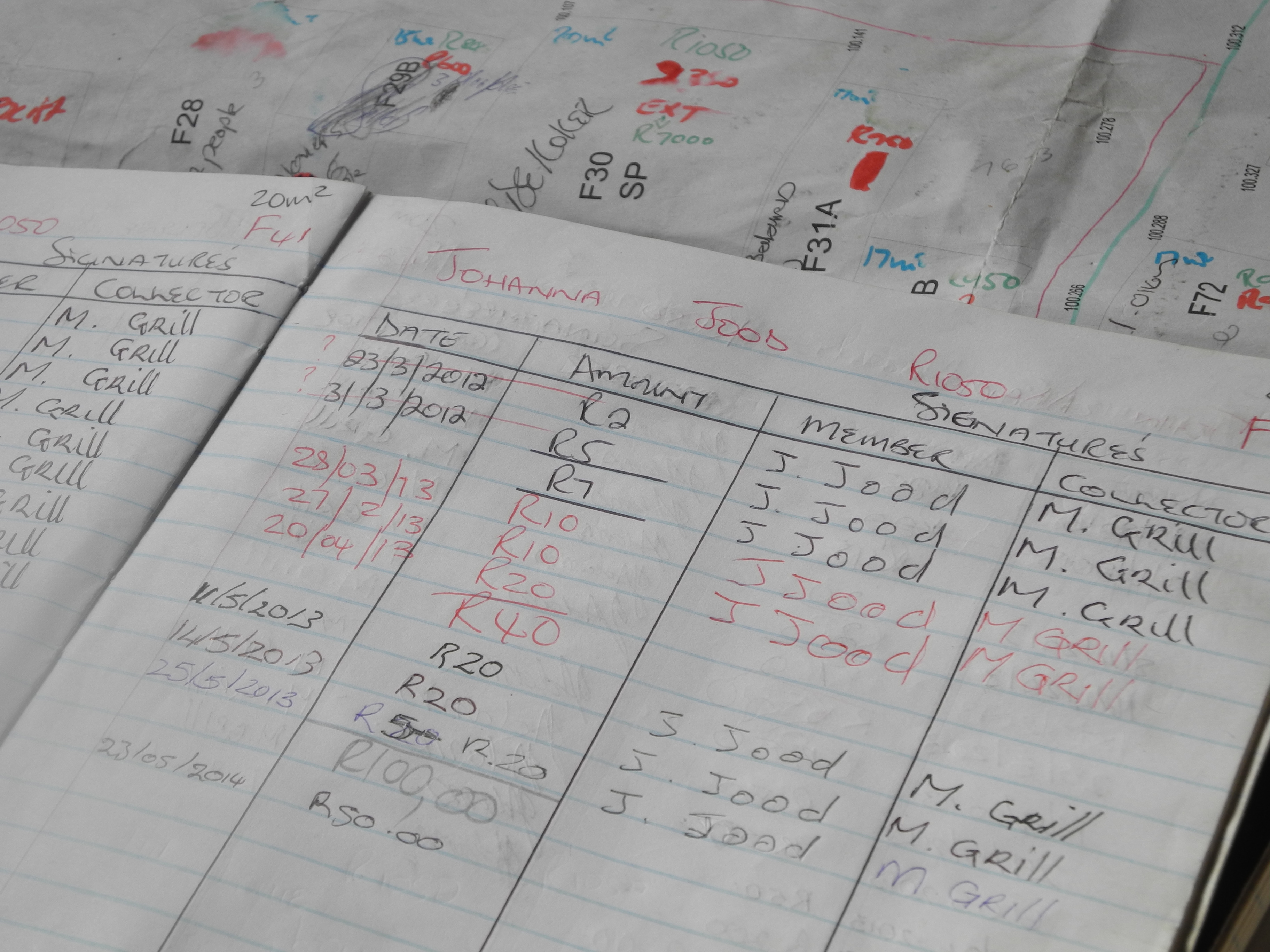
The community began saving in 2012 and to date has saved about R42 000. Each payment was made to the treasurer of the steering committee who recorded each transaction in the community savings book and counter signed the community member’s personal savings book.  As the majority of Flamingo’s population is old and unemployed (50%) the collection of daily savings proved to be a challenge. Nevertheless,

“Some community members like Ouma Sarie have almost managed to save the entire amount. She started with one packet of cigarettes and sold each cigarette one by one. She has saved R860 to date and only has another R200 to go.”

(Elizabeth Rantoetse, Flamingo Steering Committee)

Other community members saved some money through working. Those that were not able to save anything are set to receive short-term employment during the construction process through the City’s Expanded Public Works Programme (EPWP).

DSCN5756

Flamingo Steering Committee and ISN Representatives. From front left to right: Melanie Manuel (ISN), Elizabeth Rantoetse, Jasmine Louw, Lenrika de Koker, Chirne Arnold, Terence Johnson (ISN), Mark Solomons

DSCN7127

Community documented savings

Enumeration, Planning and Partnership

Flamingo’s enumeration took place in April 2012. Over a period of one week, community members, supported by the Alliance, gathered social and demographic data about their settlement. This enabled the community to gather information about Flamingo’s population, the number of structures and the exact extent of water and sanitation amenities. The enumeration also gathered details on the extent and spread of employment as well as the reasons for moving to Flamingo. During a planning studio with students from the Cape Peninsula University of Technology (CPUT) and CORC technical staff in 2013 the community surveyed the site, designed its re-blocked layout and verified its enumeration results. Later that year the community was joined by students from Worcester Polytechnic Institute (USA) who assisted in conceptualising plans for a crèche and a play park.

Flamingo is one of several pilot projects supported by the City as part of a broader commitment the City made in 2012 to support the upgrading of 22 partnership projects. For more background click here. Following the 2012 agreement, the City, Alliance and Flamingo community met in a number of partnership meetings. The enumeration acted as a powerful entry point to negotiating an improved layout and one-on-one service provision. So far, the main sewer lines have been laid and two clusters of structures have been cleared and are ready to be re-blocked. As implementation continues, Flamingo community continues on-site meetings with City officials to discuss details and project developments.

Auntie Marie, Flamingo community leader, reflects on the road thus far:

 “If it wasn’t for ISN, I don’t know where we would be. Through ISN we were introduced to the City and we got a partnership. We started thinking, ‘Now something is going to happen’. Flamingo is going to be re-blocked!”

CORC will continue to document project developments in future posts.

DSCN6554

City of Cape Town site meeting with steering committee

DSCN6124

Ground markings for laying pipes

2014-04-24 10.53.58

Earth works begin

DSCN7079

First clusters are cleared. Preparation for paving central pathways.

DSCN6143

First upgraded structure

DSCN6546

Auntie Marie (Flamingo Community Leader) and Nkokheli Ncambele (ISN Regional Leader)

2014 UCT – Europe Community Studio: Spatial Development Framework

By Academic, CORC, ISN No Comments

By Thandeka Tshabalala (on behalf of CORC)

Over the last four months Europe community members and Masters students of Urban and Regional Planning at the University of Cape Town (UCT) collaborated on a joint planning studio to address some of the community’s most pressing concerns. Together, they began by conducting a site analysis and researching the opportunities and constraints presented in Europe. This research and site analysis led to developing concepts for in-situ, incremental upgrading projects. Read more about the concepts and the first developments of the studio here. The students then split into three groups and used these concepts to produce spatial development frameworks (SDFs), which act as a guiding document on the future development of Europe and surrounds.

Together with Europe residents the students recently presented their proposed SDF’s to their classmates and to City of Cape Town officials.  All three SDF’s had underlining themes, which were

1) Maximising the use of existing infrastructure

2) Developing activity nodes linked to existing major business and transport nodes whilst maintaining the transit character of the main spine (Klipfontein Road)

3) Increasing socio economic opportunities in Europe.

These proposals fittingly introduced the concept of incremental settlement upgrading.

SDF1SDF2

The SDF in summary

1. Creating cultural and ecological nodes

  • The site analysis revealed the presence of several aquifers and wetlands on the site and along Klipfontein Road. In order to protect and enhance Europe’s scenery this natural biodiversity could be joined with pedestrian routes to attract different users to the site.
  • The area around Europe contains several sites of recent South African history that could increase the area’s potential as a cultural node. By connecting to sites such as the Gugulethu Memorial 7 and cemetery and cultural tours to the Cape Flats, residents could increase their access to economic opportunities.

2. Property sales

  • Although residents in Europe do not have tenure security, Europe’s leadership has recorded an enormous amount of property transfer in the settlement due to the high demand for well located affordable housing. During a transaction, the leadership keeps certified identity documents of both parties. These serve as a proof of sale of one’s property. Even in their derelict state most shacks have sold between R10 000 to R15 000.
  • Through their engagement, the students picked up on the importance of location – in terms of one’s own shack and in terms of the settlement location as a whole. They therefore introduced the concept of re-blocking as an incremental approach to housing which would decrease the level of flooding, open spaces for the provision of basic services, communal spaces and spaces of interaction. Moreover, it would improve the quality of life in the whole settlement.
  • Many groups viewed re-blocking as a short-term strategy that could be implemented easily without displacing people. It would also provide residents with the opportunity to access short-term housing structures.

20140528_SDF3

3. Creating activity nodes

  • The Cape Town SDF sets out a hierarchy of different movement routes across the metropolitan area. It focuses on North – South and East – West accessibility. Europe’s location between an urban freeway (N2) and a development route (Klipfontein RD) means that Klipfontein Road presents a greater potential for activity nodes than the impenetrable N2.
  • Heideveld station also provides a critical link between the road and rail network, making this an important node for future development.
  • The analysis uncovered that the Golden Arrow bus route bypasses an important section of Klipfontein Road. This means that the residents of Europe and surrounds, who are already earn a low-income, need to pay for additional taxi transport to reach the closest bus and train station. Some residents also use the local transport ‘Amaphela ‘ due to the area’s high crime levels, which make walking unsafe.
  • As a MyCiti bus station will soon be implemented in Mitchell’s Plain, the intersection between Bocherds Quarry and Klipfontein Roads will in all likelihood grow as a transit node. It therefore has potential to develop into a transport interchange with supporting activities.

Throughout this discussion it was crucial to see Europe as a functional settlement in its own terms and thus limit the distance travelled to access jobs and other socio –economic opportunities.

4. Maximising existing neighbouring corridors

  • Much developmental activity has focussed on improving upcoming North-South corridors such as Parklands and Mitchell’s Plain. There is a need therefore to establish linkages to upcoming opportunities.
  • There is also a need to increase vertical connections to the settlement such as access to Voortrekker Road, which is one of the busiest roads connecting Bellville and Cape Town.

SDF5

5. Short term interventions – livelihoods and food security

  •  After several discussions with the community, the importance of access to employment and food security was clear. Residents felt that they needed to be able to support their households in order for them to start looking at broader issues such as upgrading.
  • After this discussion the community came together and collected their names and livelihood interests on a piece of paper. Those with common interests were then grouped together to begin discussing how they could start livelihoods programs. These included hair dressing, carpentry, gardening etc.  The students put together a pamphlet in isiXhosa with a list of organisations that assist in skills development such as Abalimi Basekhaya and The Carpentry Shop.

In the next phase of the studio the students will develop precinct designs of the settlement and write a short reflection of the studio as a whole. 

National Community Exchange – Durban to Cape Town (Part 2)

By CORC, iKhayalami, ISN No Comments

By Yolande Hendler (on behalf of CORC)

A four-day community exchange was underway from 29 April to 2 May 2014, during which community leaders from Durban visited informal settlements in and around Cape Town.  This blog continues to trace the experiences and reflections collected on the exchange, the first two days of which have been recorded here.

Day 3 in Langrug informal settlement – Sanitation, Drainage and ‘Greening’

View of Langrug informal settlement, Franschoek

View of Langrug informal settlement, Franschoek

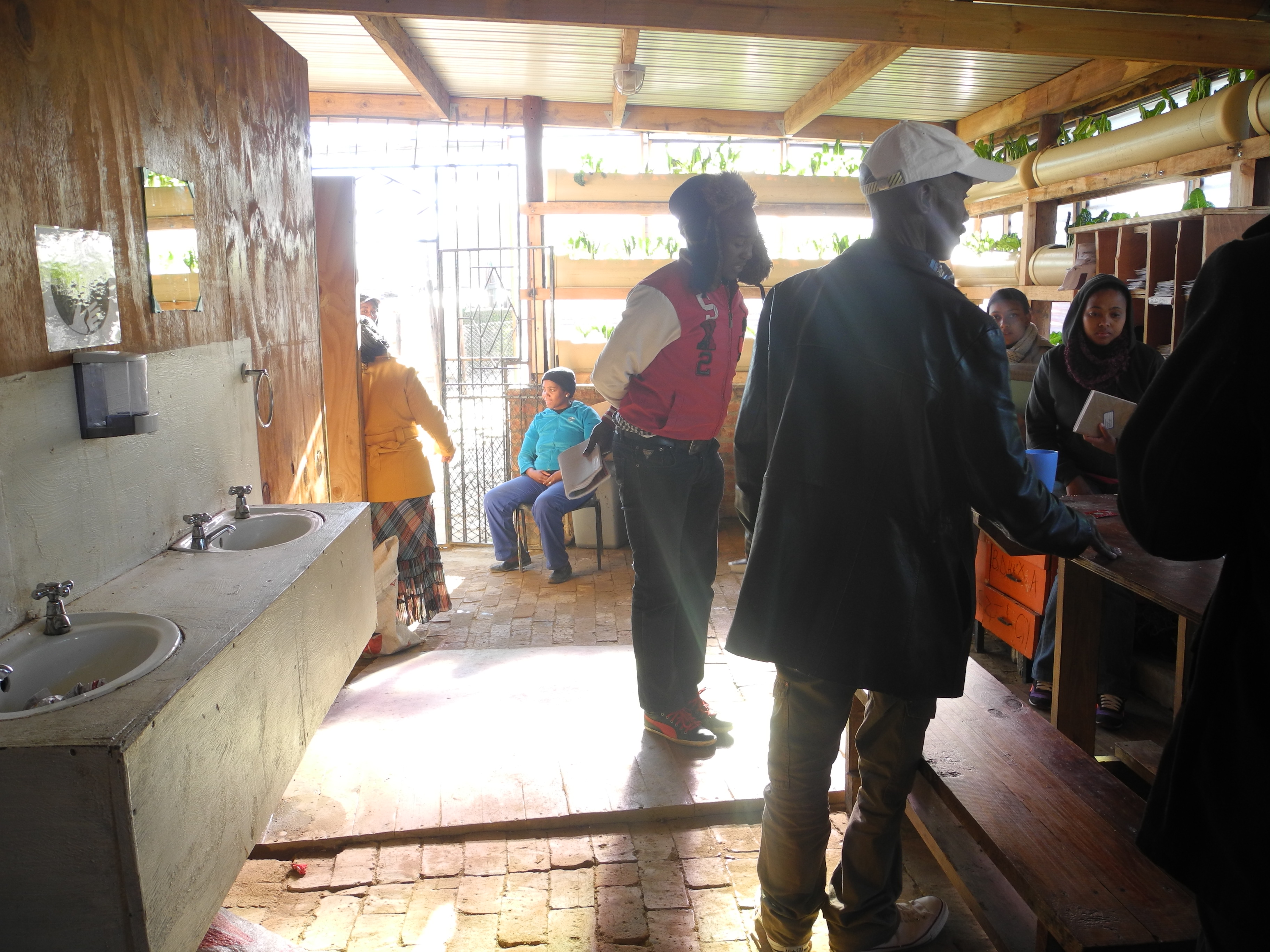
Located in the affluent wine-farming area of Franschoek, Langrug informal settlement, home to about 4500 people, is characterised by extreme poverty, poor housing and sanitation. In the face of these challenges the community signed a precedent-setting Memorandum of Understanding (MoU) with the locally presiding Stellenbosch Municipality that channelled government funds to community-based upgrading initiatives. This translated into relocating 16 families, the construction of a second access road, the construction of grey-water and drainage channels and a community designed, multi-purpose Water, Sanitation and Hygiene (WaSH) Facility. The facility includes a communal homework area for children, a hair salon, benches and laundry basins. Click here for a comprehensive profile of Langrug. Currently, Langrug is involved in the second phase of upgrading: ‘greening’ the existing WaSH facility with vertical vegetable gardens and developing a dry sanitation facility in Zwelitsha, an ‘informal’ section of Langrug without taps and toilets.

Existing WaSH Facility after 'greening'

Existing WaSH Facility after ‘greening’

KZN visitors taste Langrug's spinach

KZN visitors taste Langrug’s spinach

The exchange visitors were introduced to all these aspects on a detailed walk-about. Langrug community member, Alfred Ratana, indicated the differences in depth and purpose of the drainage and grey water channels and explained the processes accompanying relocation. He emphasised the uniqueness of Langrug in that it was a municipality-driven project which was not community financed.

“Langrug shows that municipalities can have a different approach to communities. Our experience shows that municipalities can include us in their plans and construct with us – not for us”

(Alfred Ratana, Langrug community member)

Langrug community member, Alfred Ratana, speaks about Langrug's grey water drainage

Langrug community member, Alfred Ratana, speaks about Langrug’s grey water drainage

DSCN6652

Viewing a community-constructed drainage channel

Langrug community members also explained the breakthrough presented by Zwelitsha’s dry sanitation facility: due to its location on a steep mountain slope it has been impossible to provide water and sanitation services to around 600 families. The dry sanitation facility, however, is a step towards changing this. The vertical vegetable gardens in Langrug’s existing WaSH facility (developed in partnership with Touching the Earth Lightly) showed the visitors how the community secures food and generates income. By selling the spinach it grows, the community intends to generate income to sustain daily running costs of the facility.

The visitors were also impressed by a crèche facility that had been established between external partners and mothers in Langrug who wanted to provide an alternative, more affordable option for their children. The teachers of the crèche explained that,

“getting something started is not about presenting an idea to social services. You just need to start. Once the idea is happening, you can take the outcome to social services and get it registered”.

Once back at the WaSH facility Langrug’s steering committee shared details around the developments in their settlement. The group was also joined by Diana Mitlin and visiting colleagues from Manchester University. Read about their impressions here.

Sharing impressions after the walkabout

Sharing impressions after the walkabout

Langrug's steering committee explains the steps it took in the upgrading process

Langrug’s steering committee explains the steps it took in the upgrading process


Day 4 in Mtshini Wam – Reflections on how to continue

The final visit to Mtshini Wam showed the visitors what a large-scale re-blocking project could look like. During upgrading, the settlement also received one on one services, some in-structure toilets and public water points. More details on Mtshini Wam’s re-blocking are documented here.

Over four days the group had seen much, listened intently, exchanged questions and pondered how to take these impressions back home. Some key points:

  • Visiting Langrug presented a highlight for the visitors from Durban as the topography and accompanying challenges (steep inclines, drainage and flooding) are similar to the conditions in their own settlements.
  • Langrug’s drainage and sanitation facilities therefore presented relevant options for the Durban visitors
  • The visitors were inspired by the initiative and commitment they encountered in their fellow community leaders, something they wanted to take back in responding to circumstances in their own settlements
  • The exchange highlighted the importance of partnerships and the ever-present opportunity to form partnerships as a foundation for wielding large scale change
A street view of Mtshini Wam after re-blocking

A street view of Mtshini Wam after re-blocking

KZN leaders in conversation about securing service provision

KZN leaders in conversation about securing service provision

Durban’s Kenville and Foreman Road settlements will share their experiences of the exchange in mass meetings with their communities this weekend (16-18 May). Their next steps are to enumerate their settlements and establish a relationship with their councillors.

As the visitors embarked on the journey home, ISN community leader, Nkokheli Ncambele, reminded them that

“it is important not to impose everything you have seen on this exchange on your communities at home. Rather take what you have learnt and present it to the community as a suggestion. Then you can decide together what you want and how to make it work in your own settlement”

Exchanges certainly are the most important learning vehicle in the South African Alliance. They facilitate the direct exchange of information, experience and skills, thereby building a horizontal platform for learning between urban poor communities. Through sharing successes and failures in projects, giving and receiving advice on engaging government, sharing in work and life experiences and exchanging tactics and plans communities become central actors.