Tag

Government - Community Partnerships Archives - Page 4 of 6 - SASDI Alliance

Reflections on the Southern African Hub Meeting: Blantyre, Malawi

By SDI No Comments

***Cross-posted from SDI Blog***

By: Mariana Gallo, Knowledge Management Officer CCODE; Nico Keijzer, LME Officer Southern Africa SDI; & Noah Schermbrucker, Projects Officer SDI 

The recent regional hub meeting for Southern Africa took place in Blantyre, Malawi, from 28-31st March 2015. It was the first time that Blanytre or Malawi have hosted a regional hub meeting and provided an opportunity for the Malawian alliance to showcase their work. Participants from South Africa, Namibia, Zambia, Swaziland, and Zimbabwe attended the meeting. Botswana was invited but not able to attend.

Country Reports and Field Visits

The day commenced with each country reporting on their key indicators using the new Learning, Monitoring, and Evaluation (LME) reporting format. All countries concurred that this format assisted them in measuring progress, setting realistic targets, identifying challenges, and more targeted learning to overcome them. For the first time the hub was able to produce accurate totals for Southern Africa – as illustrated in the below table.

Southern African Hub Totals
Baseline Target Achieved Total
Members  161 961,00  8 765,00  7 084,00  169 045,00
Savings Groups 2490 300 217 2707
Daily Savings  4 354 901,00  829 755,00  287 494,00  4 642 395,00
UPF Savings  1 960 417,00  210 099,00  127 794,00  2 088 211,00
         
Settlement Profiles 1553 445 316 1869
City-wide profiles 123 32 3 126
Enumerations 294 50 47 341
Maps – GIS 109 306 207 316
Maps – Hand drawn 15 24 10 25

A variety of field visits also took place. Those who visited Nancholi settlement learnt about the slum upgrading activities that were being undertaken by the federation. Work included the construction of bridges, the development of an agricultural market, the renovation of a local clinic, and the construction of additional blocks for the local secondary school. Other delegates visited a variety of groups who were involved in income generation projects. One group called “Waste for Wealth” produces and sells compost. Another group makes sausages that they package and sell, while a third group makes and sells tie-dye clothes.
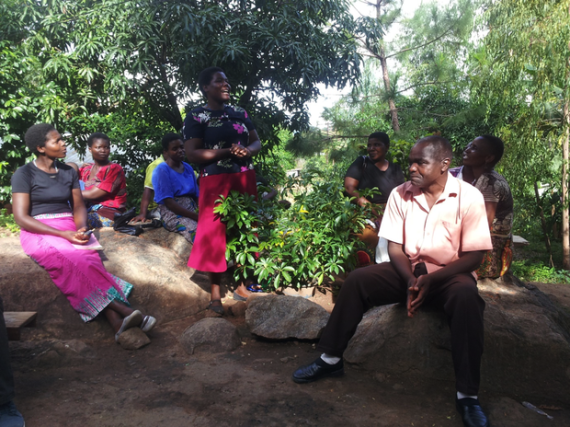
The group producing compost manure in Chilomani, explaining their experience with the enterprise.

The group producing compost manure in Chilomani, explaining their experience with the enterprise.

City Council and Discussions on Country Projects

On the third day, hub delegates visited the Blantyre City Council for a meeting with the Mayor, the Director of Planning and Development for Blantyre, and other officials. While the meeting illustrated the successful partnership between the Malawian Alliance and the Blantyre City Council (BCC) it became clear, through the lively discussions that took place, that these types of partnerships need to be underpinned by material commitments from government (e.g. land, budgetary allocations for slum upgrading). The international delegation pushed the BCC around its previous commitments to establish a citywide slum-upgrading fund. The Malawian federation needs to follow up on the space opened by this discussion.

The meeting attracted media attention, and was reported on the front page of one of the main newspapers on the following day.

Hub participants attending a meeting with the Blantyre City Council.

Hub participants attending a meeting with the Blantyre City Council.

The afternoon’s sessions provided an opportunity for delegates to reflect more deeply on their LME process. Not only in terms of challenges identified but feasible actions to address these issues. Below is an example of this work that the hub collectively committed to implementing over the next period. Outcomes will be reported at the next hub meeting.

Challenges:

1) Unrealistic targets,

2) Understanding of enumerations process or profiling is difficult,

3) Not having a system of reporting,

4) Politics delays the process,

5) Working with other stakeholders is always difficult and can delay the whole process,

6) Changing the mindset of people who expect a lot of money as some organisation does,

7) Slow implementation of projects,

8) Not practicing daily savings.

Possible Solutions:

1)     Setting of realistic targets within a specific period of time,

2)     Drawing of process maps – steps involved in saving, profiling, enumeration etc.,

3)     Mobilizing communities on why they are doing the profiling, enumeration etc.,

4)     Having standard reporting templates/systems,

5)     Signing of MOU’s (exchange visits among municipal/local officials),

6)     Joint working groups that involves stakeholders,

7)     Communities must take ownership and drive the change in the community,

8)     Communities should have one voice in getting resources from local authorities,

9)     Going back to the roots of daily savings.  Take ownership of savings and how the money is managed to build confidence.

Data, Reflections on Donor Funding, Exchanges, and Closing

The final day commenced with a presentation on the data platform from the SDI Secretariat. Federations were able to access, discuss and interact with the online platform that stores their profiling information. This is part of a process to deepen federation ownership of the information collected.

An interesting and important discussion, which is central to the work of all federations and affiliates, then took place.  The crux if this discussion is that while it is recognised that donor funding is needed for activities, the agenda and priorities of donors can sometimes be in conflict with the federation’s core vision (e.g. building unaffordable housing on the periphery of the city).  Broken into country groups delegates discussed criteria for accepting donor funding. Flexibility, equal partnerships, common vision and inclusion of the poorest were amongst the common points of consideration.

The meeting closed with a collective reflection session that gave delegates an opportunity to assess the content and structure of the hub meeting.  More substantive details can be found in the hub report. The next hub meeting was set for September in Zimbabwe.

The Malawi Alliance prepares their data for sharing
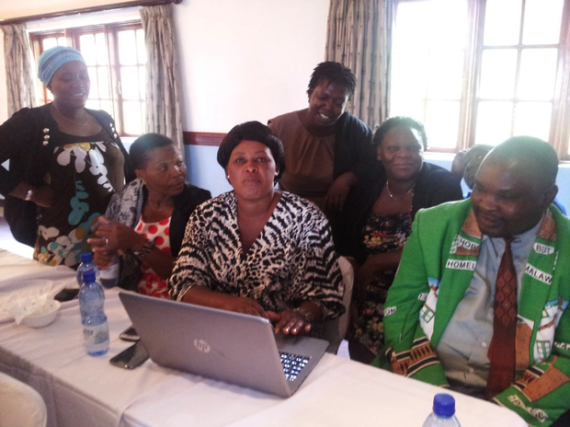
The Malawi Alliance prepares their data for sharing

Malawi Federation members work with the online data platform.

Malawi Federation members work with the online data platform.

Taps, Toilets & Beyond: ISN partners with Water & Sanitation Dept

By CORC, ISN No Comments

By Nkokheli Ncambele (on behalf of ISN)*

Nkokheli Ncambele is the regional co-ordinator of the Alliance’s Informal Settlement Network (ISN) in the Western Cape.

Emseleni Community leader, Nomfundo Lungisa

Emseleni Community leader, Nomfundo Lungisa

In Mfuleni, informal settlements have been without basic services for five years. People had to buy water from surrounding formal houses; at night it was difficult for them to get to a toilet. Last year, ISN started creating a partnership with the City of Cape Town’s Water & Sanitation Department. We kept reporting these problems to the City until we saw that there was a light: the Department came to us saying, “Yes we are going to do something in those communities”.

The City is very important as a partner because when they come on board we see results: in March 2015 they installed a total of 15 standpipes for taps and 57 flush toilets in five settlements (Tambo Square, California, Constantia, Strong Yard and Emseleni) in Mfuleni region which is one of four ISN sub-regions in Cape Town. Every settlement’s leadership sends two or more members to our weekly sub-regional meetings to discuss issues. After we collect all issues we decide where to start. This is how we chose these five settlements for Water & Sanitation installation.

ISN co-ordinators Nkokheli Ncambele and Melanie Manuel with Kuku Town community leader, City of Cape Town councillor and officials

ISN co-ordinators Nkokheli Ncambele and Melanie Manuel with Kuku Town community leader, City of Cape Town councillor and officials


From backyards to informal settlements

You will find that most settlements like Tambo Square, California, Constantia, Strong Yard and Emseleni were established when formal housing was introduced. When there is a big housing improvement project there are always people who move in as backyard dwellers. Why are there so many new settlements like these? Because backyarders are tired of paying rent and being mistreated by homeowners who cut off services without notice. That’s why backyarders move into nearby open spaces.

Constantia informal settlement is in close proximity to formal housing.

Constantia informal settlement is in close proximity to formal housing.

Constantia Steering Committee members, Nolusapho Thandela and Phindiswa Payiti

Constantia Steering Committee members, Nolusapho Thandela and
Phindiswa Payiti


The beginnings of ISN in Mfuleni

Before ISN, we as community leaders used to have a joint leaders forum in Mfuleni. When we heard about ISN, we decided to join because the movement was talking about what we were already doing for a long time.

“We realised that actually we are ISN – anyone who is staying in an informal settlement is ISN. Let’s take this forward”.

New sub regional leaders asked us to explain the ISN process to them. Other community movements, development forums and Councillors also know about us. I can say that 99% of informal settlements in Mfuleni have gone on exchanges to see what other ISN communities are doing. That’s why they want to be part of ISN and why Mfuleni is becoming an ISN base. Look at the people of Tambo Square – they want to be involved in their own project. When the ISN coordinators go to Emseleni, people just come out to greet us. We see that people are hungry to solve their problems.
“Tambo Square started in 2007 when backyarders moved here. We had no toilets or taps and used to get water from the formal houses. We took our problems to ISN who helped us go to the municipality. These changes came to us with ISN – they play a big role for us”.

(Nkosikhona Bangiso, Tambo Square Steering Committee Leader)

Tambo Square community leader, Nkosikhona Bangiso

Tambo Square community use back of newly installed toilets for mapping workshop to plan further upgrading initiatives in their settlement.

Tambo Square community use back of newly installed toilets for mapping workshop to plan further upgrading initiatives in their settlement.


Building our partnership with the City

As ISN, we know that the Department of Water & Sanitation has an interest to deliver basic services to communities. The difficulty is that many settlements have little open space for services to be installed. When ISN started mobilising communities and speaking about the value of basic services, community members began thinking about how to create more space in their settlement. In Tambo Square, for example, it looked like there was no space. We suggested that the community remove a large container that stood at the entrance of the settlement. Now there are ten toilets in that space. In this way it was easy to convince Water & Sanitation to partner with us. I think I can say that they see us (ISN) as a solution. We told them,

“We’ve got the space, now you can come and install the toilets. Don’t say there is no space in our community”.

The role of ISN & CORC in partnership building

What is unique about our Alliance is that CORC created a space between ISN and the City. In 2009 there was opposition between communities and the City. Because of that CORC was there to neutralise the relationship. I can say that CORC was a bridge that connected us to the City. The City used to say, “We don’t want to go to meetings with the communities because they will swear at us and toyi-toyi (protest) and do all these things.” But CORC has a belief that communities won’t do that. Through the engagement with CORC we (ISN) understood that we need to go to the table, and not to the street. Then at the end of 2009, the City started saying, “This thing is working”. I think that is why they are happy to work with us.

Flamingo Crescent informal settlement community members with ISN facilitator Melanie Manuel, CORC Director Bunita Kohler (left) and City of Cape Town Mayor Patricia de Lille

Flamingo Crescent informal settlement community members with ISN facilitator Melanie Manuel, CORC Director Bunita Kohler (left) and City of Cape Town Mayor Patricia de Lille

Nkokheli Ncambele (second from left) with fellow ISN co-ordinators Mzwanele Zulu and Melanie Manuel (far left and right), CORC technical support, Sizwe Mxobo (centre) and Western Cape MEC for Human Settlements.

Nkokheli Ncambele (second from left) with fellow ISN co-ordinators Mzwanele Zulu and Melanie Manuel (far left and right), CORC technical support, Sizwe Mxobo (centre) and Western Cape MEC for Human Settlements.


The bigger picture: taps, toilets & beyond

We recently met with an Mfuleni councillor and asked what he thought about Mfuleni as a whole. He said he has a bigger picture – that in the next 20 years he doesn’t want to see informal settlements. For that to be possible I see that he needs a movement like ISN that will make sure that his vision is pushed. What is our vision? That all settlements have basic services and that all people who are living in informal settlements have houses. Our vision and his vision are on the same page.

* Compiled by Yolande Hendler (on behalf of CORC)

Newly installed water & sanitation in Strong Yard settlement, Mfuleni

Newly installed water & sanitation in Strong Yard settlement, Mfuleni


Alliance at Human Settlements Learning Exchange in Durban

By CORC, FEDUP, ISN No Comments

By Jeff Thomas (on behalf of CORC)

A SA SDI Alliance team comprising FEDUP and ISN community leaders, regional co-ordinators and CORC representatives was invited to attend the International Human Settlements Learning Exchange in eThekwini Municipality from 15-17 April 2015.

The exchange, a first of its kind, was hosted by the Municipal Institute of Learning (MILE) in partnership with eThekwini’s Human Settlements Department and the Affordable Housing Institute (AHI). It included about 200 local, national and provincial government officials, eThekwini Municipality councillors, private sector housing, NGO and academic representatives.  

Screen Shot 2015-05-05 at 11.42.19 AM

It aimed to “share different organisation’s perspectives and experiences within the human settlements sector to improve housing service delivery” (Reference). The exchange focussed on new funding models for affordable housing finance, effective new housing typologies and guidance for establishing socially inclusive and responsive housing settlements.  For the Alliance it was an opportunity to share concrete experiences in community participation that move beyond infrastructural approaches to human settlements development.The event was billed as an international exchange in that the keynote speaker, Professor Jeremy Gorelick, is a globally acclaimed expert in the area of alternative, more-sustainable funding models for housing finance. Among other things, he is the Managing Director of Capital Markets for the USA-based Affordable Housing Institute, a non-profit and tax exempt pro-poor consulting and research firm which operates in 43 countries.
Community-Based Implementation at Alliance's Namibia Stop 8 Housing Project in eThekwini Municipality

Community-Based Implementation at Alliance’s Namibia Stop 8 Housing Project in eThekwini Municipality

Examining Sustainable Funding Models 

His presentation on the first day examined factors relating to the opportunities and challenges of financing housing development in Sub-Saharan Africa, followed by a brief exploration of “Public-Private Partnerships” and “Municipal Development Funds”. The day also involved presentations by KZN MEC for Human Settlements and Public Works, SALGA’s Sustainable Human Settlements Specialist and the Treasury’s DDG who spoke on the South African Model of Human Settlements Finance. Seated around tables in the audience, participants were given the opportunity to discuss the presentations and share feedback on these at a plenary session.

SA SDI Alliance Team at Exchange

SA SDI Alliance Team at Exchange

Visiting Cornubia housing project 

While the first day focused on a sustainable funding model, the second day comprised two key parts: presentations and a field trip.  The presentations related to a series of existing and proposed human settlement projects while the field trip took us to two of them: KwaMashu Centre where a multi-storey 1000-unit social housing development is planned and Cornubia, a 25000-unit housing project and associated social and light industrial precinct to the north of Durban. At both these projects participants were afforded an opportunity to engage in a question and answer session with municipal officials leading the visit.

Cornubia Housing Project,

Cornubia Housing Project, eThekwini Municipality


Cornubia, eThekwini Municipality

Cornubia, eThekwini Municipality

Community-Centred Human Settlement Development

The third day’s focus shifted to issues of community participation in human settlements development discussed by the Project Preparation Trust, the SA SDI Alliance and Habitat for Humanity South Africa. The CEO of Project Preparation Trust examined the meaning of ‘people-centred development’ and its relationship to infrastructural development’. He shared 8 actions that South African cities need to take in order to become more people-centred. Key amongst these were

  • the need to understand local communities and circumstances
  • approaching participation as ‘negotiation’
  • focusing on partnership and trust-building
  • asset not deficit-based thinking
  • understanding informality by working with it not against it
  • and most importantly, focussing on improving livelihoods and quality of life

The SA SDI Alliance team shared its experience in pioneering people-centred development initiatives since 1991. The presentation focussed on the Alliance’s experience in community-driven human settlement upgrading in relation to ‘project preparation’ and ‘project implementation’. While project preparation was explained as comprising community-based savings, data-collection (profiling & enumerations) and planning, implementation looked at upgrading in terms of improved services, re-blocking and housing.

Screen Shot 2015-05-05 at 12.31.08 PM


The emphasis in both regards was on how the Alliance approach provides opportunities for people to participate in and drive their own development, leading to self-pride and greater sense of ownership of the final product. It also emphasised the central role of women in driving the process and the need for partnerships between poor communities and government. A series of quotes about the Alliance process from significant national human settlements ministers concluded the presentation, clearly communicating that,

“It’s only a fool who cannot support this process”

(Derek Hanekom, SA Human Settlements Minister, 1999)

Habitat for Humanity SA’s final presentation shared its new strategic direction since 2012 and its use of the 4P model: People-Public-Private Partnerships. Habitat shared its approach to leadership capacity-building workshops, the role of asset-mapping and sustainable livelihoods analysis, the artisan audit towards providing appropriate skills training which is part of a social scoping exercise run in communities that participate in their own development programs.

Outlook

Discussions aimed to broaden thinking and practice by municipal officials and sector practitioners alike. As a result of the presentations and discussion on community-centred participation on Day 3, the concept of ‘Public-Private Partnerships’ introduced on the first day had been broadened out to include People-Public-Private Partnerships, in which communities become central role-players in project preparation (community driven savings, data collection and planning) as well as implementation. As the Alliance continues to seek out a partnership the municipality, the exchange indicated a growing awareness concerning the significance of community-driven process and collaborative partnership between stakeholder sectors.

Spotlight on Mpumalanga: “Through FEDUP we support each other”

By FEDUP, uTshani Fund One Comment

By Yolande Hendler (on behalf of CORC)

“At Ellerines in Standerton, we need to collect Dolly, then its not far: continue straight over the crossing and turn left to get to Extension 6. We want to share what we are doing in our savings scheme. Some of us have houses, and some of us are starting small businesses”

(Togo Simelane, FEDUP member, Mpumalanga)

IMG_3041

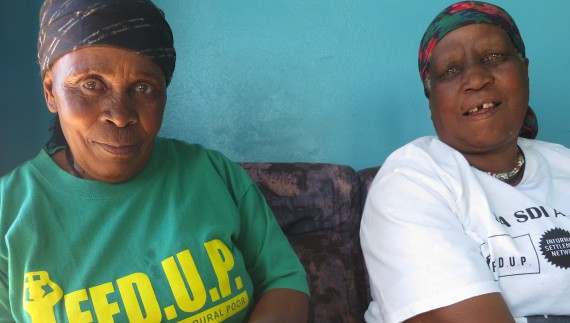
Emelina Hlabati and Beauty Nkosi, long standing members of FEDUP’s Masakane savings scheme in Standerton

As Mama Dolly Moleme and Togo Simelane arrive at their home in Extension 6 in Standerton, they lead the way to Gogo Emelina Hlabati’s home. Together with Beauty Nkosi, the three ladies make up the steering committee of FEDUP’s PHP housing projects in Standerton. Apart from acting as FEDUP’s regional financial signatories, the group is involved in negotiating with the municipality and provincial government for direct access to housing subsidies through the People’s Housing Process (PHP). Read more about FEDUP’s engagement with PHP here.

Togo Simelane (front), Beauty Nkosi (left), Emelina Hlabati (right), Dolly Moleme (back)

Togo Simelane (front), Beauty Nkosi (left), Emelina Hlabati (right), Dolly Moleme (back)

Building first houses in Extension 6

FEDUP has been active in Extension 6 since 2001, with five savings schemes (Masakane, Lethukhanya, Vukuzenzele, Masihambisane and one income generation / loan group).

Dolly explains,

“We started building all the FEDUP houses in Extension 6 in 2005. uTshani Fund supported us with pre-financing the houses. We managed the construction of the houses through our Community Construction Management Teams (CCMTs). Houses should take one week to build but we waited for one month for the materials to deliver. The role of the government is to provide an inspector to check that the houses we build meet the appropriate standards.”

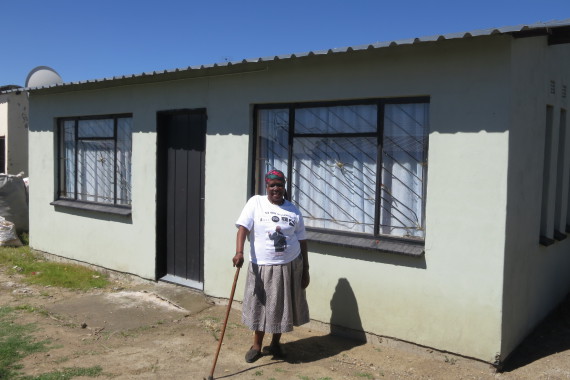
Beauty Nkosi infront of her Federation house

Beauty Nkosi infront of her Federation house

FEDUP self-financed its first three houses as “show houses” to negotiate for direct access to subsidy funds in 2001 and 2002. This enabled members to build houses with bigger dimensions than RDP houses. For the group of ladies it was clear,

“We’re not looking for municipality houses – we want Federation houses because they are much bigger and more beautiful”

Between 2005 and 2006 FEDUP has built 36 houses. Other members in the community are approved to receive a subsidy but Dolly explains that there has been little movement from the municipality. The group therefore contacts the municipality on a weekly basis to find out about proposed plans for the next subsidy houses. The likelihood of receiving subsidies in the near future, however, is small. This reflects the inability of South Africa’s provincial Departments of Human Settlements to adequately meet the country’s housing backlog. The backlog in Mpumalanga alone is close to 200 000.

IMG_3053

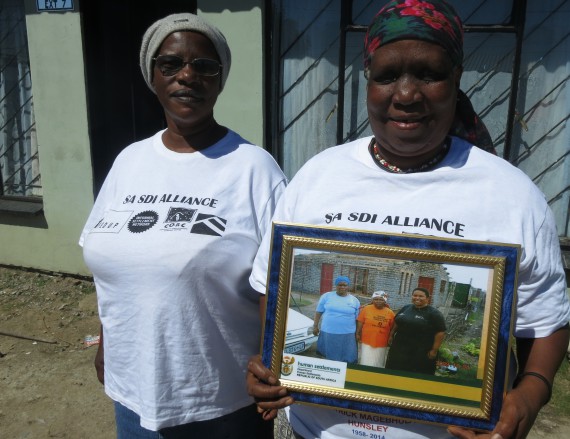
Beauty Nkosi with human settlements accredited photograph with Emelina Hlabati and Nomvula Mahlangu

FEDUP houses in Extension 6

FEDUP houses


Building Savings, Building Support

Through daily savings, however, FEDUP, has nurtured strong savings schemes and spaces in which members can support each other, regardless of the extent of municipal commitment and support.

Dolly explains,

“The Federation helped Gogo Emelina to such an extent that when she was born she was living in a shack. She started daily savings and luckily with the support of the Federation she was able to bury her husband in a dignified manner. When her husband passed away, the house was completed. Today she has a house and a chicken business. Otherwise she would be out in the open”

Dolly, Emelina and Beauty speak about their savings scheme:

“We are all part of Masakane savings scheme. Now we are about 30 members. Many of us received houses. Together we have a chicken project. We buy small chickens, we grow them and then we sell them when they have grown big. When we heard about the FEDUP loan group we decided to sell chickens because many people like to eat chickens.”

Read about FEDUP’s Income Generation Programme here.

Dolly Moleme and Emelina Hlabatis Chicken business

Dolly Moleme and Emelina Hlabatis Chicken business

Masakane savings scheme is also involved in other forms of saving such as saving towards groceries for the year-end. At the end of the year 60 members use the savings to buy a big load of groceries and one sheep each.

“Many people who live here live in shacks often don’t want to save. But when they see us building our houses they come running to us and ask how they can do this too. I like the Federation a lot! Even though I already have a house I would never dream of leaving the Federation. Many people are struggling. Through FEDUP we support each other even if the municipality doesn’t seem to want to help us”

(Dolly Moleme, FEDUP member, Standerton)

Togo Simelane in FEDUP office in Extension 6

Togo Simelane in FEDUP office in Extension 6

Minister Sisulu appoints Rose Molokoane to Council of Social Housing Regulatory Authority

By CORC, FEDUP, News, SDI, uTshani Fund No Comments

The South African SDI Alliance, together with SDI, is excited to announce that last week national minister of Human Settlements, Lindiwe Sisulu appointed Rose Molokoane to the Council of the South African Social Housing Regulatory Authority (SHRA). Molokoane is founding member and national co-ordinator of the SA Alliance, the Federation of the Urban and Rural Poor (FEDUP) and Deputy President of SDI.

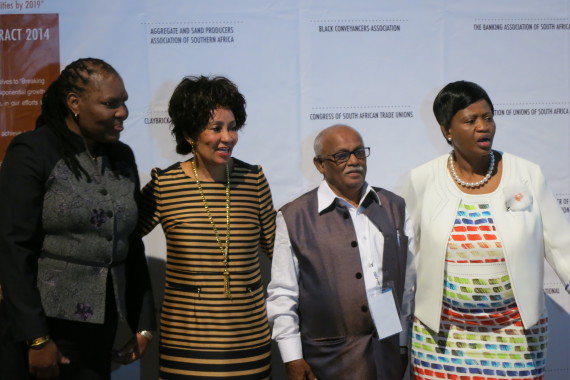
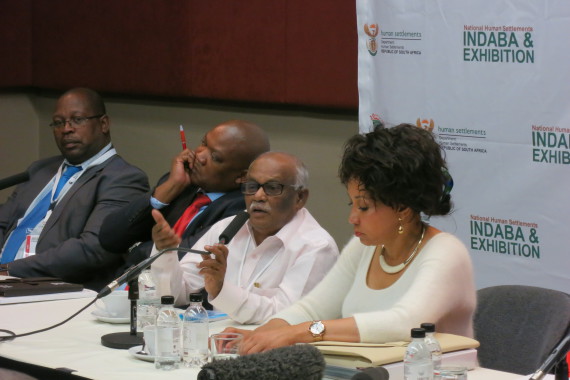
Minister Lindiwe Sisulu (left), with Jockin Arputham (SDI president), Zoe Kota-Fredericks (Deputy MInister) and Rose Molokoane (right) at National Human Settlements Indaba 2014

Minister Lindiwe Sisulu (left), with Jockin Arputham (SDI president), Zoe Kota-Fredericks (Deputy MInister) and Rose Molokoane (right) at National Human Settlements Indaba 2014

Rose Molokoane

Rose Molokoane

In her appointment letter Minister Sisulu writes,

“Your appointment to the Council of the Social Housing Regulatory Authority is in recognition of your unique set of skills and expertise, and I am confident that your contribution will be meaningful.”

The SHRA works together with the Department of Human Settlements at all tiers, the National Housing Finance Corporation and international actors to develop the social rental housing sector for the delivery of rental housing accommodation to low and middle income earners.

The SHRA’s vision is to regulate and invest in the development of affordable rental homes in integrated urban environments through sustainable institutions. Some of the functions of the SHRA include:

  • Promote the development and awareness of social housing by providing an enabling environment for the growth and development of the social housing sector.
  • Provide advice and support to the Department of Human Settlements in its development of policy for the social housing sector and facilitate national social housing programmes
  • Provide best practice information and research on the status of the social housing sector
  • Support provincial governments with the approval of project applications by social housing institutions
  • Provide assistance, when requested, with the process of the designation of restructuring zones
  • Enter into agreements with provincial governments and the National Housing Finance Corporation to ensure the co-ordinated exercise of powers
Rose Molokoane facilitates daily savings workshop for FEDUP treasurers and collectors in Limpopo

Rose Molokoane facilitates daily savings workshop for FEDUP treasurers and collectors in Limpopo

Molokoane is a resident of Oukasie township near Brits in North West Province, and a member of Oukasie savings scheme. A veteran of the anti-apartheid struggle, she is one of the most internationally recognised grassroots activists involved in land tenure and housing issues. FEDUP has supported more than 150,000 shack dwellers, the vast majority of whom are women, to pool their savings. This has won them sufficient standing to negotiate with government for a progressive housing policy (People’s Housing Process) that has produced over 15,000 new homes and secured more than 1,000 hectares of government land for development.

Molokoane has initiated federations of savings schemes throughout Africa, Asia, and Latin America. She was awarded the UN-Habitat Scroll of Honor in 2005 for her struggle to bring land and homes to the poor.

Rose Molokoane with members fellow members of SDI board and council from Uganda and Tanzania.

Rose Molokoane with fellow members of SDI board and council from Uganda and Tanzania.

Rose Molokoane with FEDUP Western Cape members

Rose Molokoane with FEDUP Western Cape members


Tinasonke Community: Our show houses help us negotiate with Gauteng Province

By FEDUP, uTshani Fund No Comments

By Cynthia Ntombekhaya Yalezo and Philda Mmole * (on behalf of FEDUP)

This piece of land – where we now live – was not always called Tinasonke**. When we still stayed across the road – there in Tokoza township – as backyarders, it was called Caravan Park. There were only labour tenants living on this land because it was used to farm apple and apricot trees and mielies (maize).

**(Tinasonke township is located in Ekurhuleni Metropolitan Municipality, near Alberton in Gauteng. It was formally established in 2009).

IMG_2759

Tinasonke community leaders, Philda Mmole and Cynthia Ntombekhaya Yalezo

Walking through Tinasonke

View of Tinasonke

From Tokoza to Tinasonke

When we lived in Tokoza, about 1500 of us backyarders came together in 1997 to form the Zenzeleni Housing Savings Scheme as part of what we now call the Federation of the Urban and Rural Poor (FEDUP). We wanted to improve our conditions by living on our own land and in our own houses. This is when we identified Caravan Park and negotiated with the owner of the land, who sold it to uTshani Fund on behalf of FEDUP in 1998 for R1.2 million. As a savings scheme we contributed R 260 000 of the cost which we used as a deposit for the land.

Each member of our savings scheme had to contribute R600 to cover the cost of the deposit. Some of us were working, others not. But we tried to help people. We lent money to Mama Msani to buy and resell bananas to earn the R600. There was a split and not everyone contributed to the cost of the deposit but we all moved away from Tokoza in 2003.

Philda and Cynthia outside FEDUP office in Tinasonke

Philda and Cynthia outside FEDUP office in Tinasonke

The beginning: our plans for houses

At this time we submitted our housing subsidy applications to the provincial government. Once they were approved we planned the site layout with the support of consultants who drew the layout professionally and submitted it for approval. We are now about 1200 people in Tinasonke, living on 514 sites. When we drew the layout plan – the municipality asked us to name our land.

We chose “Tinasonke” which means “all together”. We want everyone in FEDUP to get access to land together.

Since we moved here our savings group separated. Some members wanted RDP houses while the rest of us wanted FEDUP houses (Through the People’s Housing Process FEDUP members can directly access housing subsidies and construct larger houses through Community Construction Management Teams. FEDUP houses are generally 50m2 or larger, depending on the extent of additional savings. RDP houses are 40m2 in size.)

RDP house (left) , FEDUP show house (right)

RDP house (left) , FEDUP show house (right)

Far left: Lucky Khwidzili (uTshani Fund), Elias Matodzi (Owner of show house) Far Right: Philda Mmole, Cynthia Yalezo, Emily Mfundisi Mofokeng (Tinasonke Steering Committee members)

Far left: Lucky Khwidzili (uTshani Fund), Elias Matodzi (Owner of show house)
Far Right: Philda Mmole, Cynthia Yalezo, Emily Mfundisi Mofokeng (Tinasonke Steering Committee members)

Plan of Action: Building our show houses

Some community members have RDP houses. As FEDUP members our subsidies have been approved but we haven’t received them yet. We don’t want to fold our arms and wait for government to deliver houses. We want to do something ourselves – because when you wait for government you can wait 100 years. We try practice freedom, democracy.

We decided to build two show houses in Tinasonke to show government that we can do it ourselves. We used our own savings money from our Urban Poor Fund to pre-finance the two houses. In Tinasonke we have three savings schemes that meet every Saturday. Two are made up of FEDUP members in Tinasonke, and one is a savings scheme of landless people.

For the show houses we selected FEDUP members according to their age and participation. One of the show houses belongs to Nthathe Elias Matodzi. He has been a member of FEDUP since we moved to Tinasonke. FEDUP is in his blood. We like FEDUP because being part of this organisation gives us knowledge.

We want to negotiate with our show houses. We want government to see that we are doing things for our selves. We want government to match us with money so it can meet us half way and give our subsidies to us. Even now the rest of the community want FEDUP houses because they have seen our show houses. We want provincial government to see that we can do it for ourselves.

* Compiled by Yolande Hendler (on behalf of CORC) 

Elias Matodzi's 'two' homes, (showhouse on right)

Elias Matodzi’s ‘two’ homes, (showhouse on right)

Elias in his soon-to-be-completed house.

Elias in his soon-to-be-completed house.

Roof tiles delivered to Elias' showhouse.

Roof tiles delivered to Elias’ showhouse.

Urban Livelihoods in Cape Town

By CORC, ISN, SDI, Youth No Comments

By Ariana K. MacPherson (cross posted from SDI blog)

A different approach to livelihoods 

A national industry which offers public-sector employment to 50,000 economically disadvantaged beneficiaries should have a profound impact on the livelihoods of poor informal settlement dwellers. The Department of Environmental Affairs Working for Water Program (WfW) is therefore a primary target for Community Organisation Resource Centre’s (CORC) engagement of the state. In 2002, CORC managed 25 teams in all nine provinces to work at a staffing model which sustainably supports employees. However, due to the under-budgeted nature of the program, the majority of these teams disintegrated. The only remaining teams were privately led rather than collective in structure, with profits directed primarily to the supervisory contractor, rather than the labourers. Currently, most WfW teams operate under this model, under which the vast majority of beneficiaries earn minimal wages and secondary benefits of social development and training opportunities.

Nandipha & Noziphiwo team up to expand the community garden at the Masiphumelele Soup Kitchen

Nandipha & Noziphiwo team up to expand the community garden at the Masiphumelele Soup Kitchen

This year, CORC assembled a new team in the Western Cape based on an ambitious project: to clear neglected private areas on demanding terrain bordering the Province’s most-visited nature reserve. This effort in collaboration with nearby private landowners attracted the attention of WfW once more. Affected communities near the reserve have limited employment opportunities due to their isolation and have minimal collaboration with the Informal Settlement Network (ISN) and Federation of the Urban Poor (FEDUP).

With the help of existing contacts at Non-Profit organisations in the settlements of Masiphumelele, team leaders were drawn from youth SDI-employees from Phillipi. Young women from Masiphumelele in the South Cape Peninsula were hired as general workers with the potential for promotion conditional with training. This report follows their story.

Meet the team: youth from Masiphumelele and Philippi 

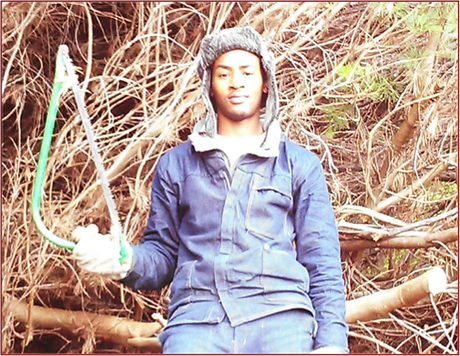
Ayanda The seeds of this project started when Ayanda Magqaza was a sprightly fifteen-year-old. He would leave his home in Phillipi to stay and work in the South Peninsula for the weekend. Agile and flexible, Ayanda quickly learned to clamber over the boulders and climb the gum trees at Castle Rock. Local landowners would hire him, first to help in the garden, and eventually to man a chainsaw alone in the depths of the forest all day long. As a CORC employee, Ayanda was the first person the project leaders called to begin working on the mountain, with the hopes that he would soon be able to lead an entire team to assist him. Within a few months the imagined team materialized, largely due to his illustrative, personal and persuasive communication abilities. When project management was absent for two months in mid-winter, Ayanda took the helm and continued to recruit new team members, coordinate logistics for certified training sessions, and lead the team to clear vegetation on the mountain slopes.

Anela All roads in Masiphumelele lead past the Pink House, a community services center managed by Catholic Welfare Development (CWD). While CORC was recruiting for the team, CWD opened their doors and provided a number of applicants. Most were men, with some construction experience; the women seemed to be looking for a desk or service job, something with a roof. But Anela Dlulane stood out, highly recommended by CWD as a lead volunteer there. During the first trial on the mountain, when the slackers stayed back to chat and move slowly, Anela kept pace with the young guys as they stacked body-length branches along the hillside. It was hard work compared to her previous job as a typist at the Department of Transport, but Anela stuck with it, with the hopes of one day fulfilling an administrative role for the CORC team.

Anela was an unpaid volunteer at the Masiphumelele Pink House when she started with CORC in June. Now she earns a wage on the CORC team, partly to help restore the Pink House community garden.

Anela was an unpaid volunteer at the Masiphumelele Pink House when she started with CORC in June. Now she earns a wage on the CORC team, partly to help restore the Pink House community garden.


Roger Prior to joining the team, most of Roger Janse’s days were indoors at the Slum Dweller International (SDI) offices. The office valued his polyglot fluency in Cape Town’s three main languages, but his studies were at a standstill and he was not sure how to advance his career. He aspired to obtain his Driver’s License and begin work as a driver for SDI, but despite repeated courses, he did not pass the test. Roger had helped Ayanda in the South Peninsula before and decided to try it again. The mountain revealed itself to be an exciting place, satisfying his interest in wildlife like puff adders and cape cobras. Roger began work as a stacker, but by the end of winter had attained his Chainaw Operator’s certificate, and qualified for three other courses. Just two months later he held his long-awaited Driver’s License in his hands, then doggedly pursued an additional commercial license. Due to his determination, the team now depends on Roger in his role of back-up driver to transport them and their equipment from home to work.

Determined to expand his skill set, Roger exceeded available WfW courses and attained his commercial Driving License

Determined to expand his skill set, Roger exceeded available WfW courses and attained his commercial Driving License

Sinjuvo She came prepared. She brought with her a record of several years of herbicide applicator experience, a list of contacts from her old team, and even wore here official yellow WfW shirt to work. At some point she had left her previous WfW team and her skills and training were left idle until she crossed paths with the SA SDI Alliance in Masiphumelele. Gudiswa Mathu may be older than the average worker, but her experience helps her know how best to contribute. When the team was still in its early stages, struggling to find women who were prepared to do labour-intensive tasks day in and day out, Gudiswa knew who to call. Within two weeks, the team ratio was balanced in favor of the better gender, 7 to 4, surpassing WfW national standards for female-to-male hiring ratios.

Sakhe With only his secondary school certificate in hand, he set out for Cape Town from the Eastern Cape. After growing up there and doing his schooling there, Sakhekile Nkohli contacted the few family members and friends he had in Cape Town and moved into Masiphumelele. He found infrequent work, mostly occasional construction jobs. But as a young worker his resume and contacts were not competitive. When given the chance on the mountain, Sakhe demonstrated what made him stand out. His fearlessness and drive earned him the position as the only team member without a previous relationship with SDI to receive and qualify for chainsaw training. With Siya or Ayanda present, Sakhe is a dependable assistant and when a more experienced manager is unavailable, he takes the helm.

Bracing himself on the steep slopes, Sakhe clears an area for the Chainsaw Operator to work, a role for which he now is also qualified as a result of training on the team

Bracing himself on the steep slopes, Sakhe clears an area for the Chainsaw Operator to work, a role for which he now is also qualified as a result of training on the team

Liso She may have the smallest shoe size, but in many ways she makes the biggest contribution. After 6 years of working on alien clearing teams, Liso Jentile offers the most insight and thoughtfulness of any team member. Her years of experience include training as chainsaw operator, which offsets the gender balance of mostly men leading with chainsaws and women following while stacking branches. Most of the time, she is quiet, and does not participate in the teatime chatter. But when the team reaches a new situation and is uncertain how to proceed, people turn to Liso for well-seasoned advice. Her thinking abilities make her a role model for other women on the team and a prime candidate for promotion to a leadership role.

Siya Initially, he was busy in the office and didn’t take the offer. Afterall, his family was in Philippi, including his newborn son. Weekdays in isolated Castle Rock sounded lonesome. And after more than a decade of chainsaw work without any career prospects, the idea of working on the mountain did not excite him. But when the opportunity to join Ayanda at a chainsaw operator training arose, Siyasanga Hermanus got involved. Within three weeks he had a team working to help him stack – a luxury after the years of working on the mountain alone. With his firm manner and steadfast approach, Siya earned his team’s trust. Now he, like Ayanda, is building up skills to eventually contract his own team. But while most WfW contractors supervise from the sidelines, Siya will remain right where he is. The only way to make sure the work gets done, he says, is to be part of the team. He won’t be letting go of his chainsaw anytime soon.

Workers are tasked with removing dense alien forest from steep mountain slopes

Workers are tasked with removing dense alien forest from steep mountain slopes

Outlook: Transitioning from labourers to leaders 

It is a fragile system, but it holds together – a web of life that benefits from its interdependent nature as much as it is defrayed by internal competition. Like the risk of wildfire on the mountain, our team confronts challenges to their health and safety every day. Competition is no stranger, and they confront one another when they disagree on an approach to an issue. Like the heat of summer, they feel it on their table at home when funding dries up and bonuses are no longer available. And when in need of assistance, if it is not offered with personal consideration, some team members may be flooded with advantages while others fail to gain ground.

Despite these challenges, the team is resilient. They depend on one another because they know that they can fell more trees working together than alone. A communicator like Ayanda can help advocate for more contracts together than the others could do alone. A veteran like Liso can help plan savings for their future together better than the others could do alone. And with perseverance, they can build a collective company with the full contribution of each team member.

While one person cleans a chainsaw, another takes inventory of the day’s supplies. A Health and Safety Officer takes note of the appearance of the deforested slopes after a day’s work while a First Aid Officer records that day’s participation of each individual. One person measures herbicide concentrations, while another speaks publicly about the value to biodiversity of their work. Each worker has their role and is valued as an essential member of the team. 

Over 35,000 South Africans are funded by the Department of Environmental Affairs to clear invasive alien vegetation in South Africa. The vast majority of them work under a private contractor. While project funds should be directed to workers, this system incentivizes the contractor to increase staff productivity to their own benefit. CORC’s team structure provides a new model, one that serves the poor populations that it is meant to support. Through this program, CORC has the opportunity to affect livelihoods across the country. It begins with the collective.

This collective has a new opportunity. In the South Cape Peninsula, a few mountain slopes dipping into the sea appear too difficult, too costly to clear. Without professional training for mountain slopes, this team has confronted Castle Rock. In doing so, they have proven their worth as recipients of intermediate training required to clear such lands safely. As an intermediate team in high demand, they may prove financially sustainable while maintaining the collective structure that can help negotiate the team members into more established careers. As a self-sustaining collective they may be able to operate independently throughout the Western Cape, and can train other teams in other provinces. A handful of youth from the South Peninsula has the chance to transition from labourers to leaders, not only in their industry, but in their communities.

FEM

SA Alliance supports Swaziland to engage Government Around Upgrading Policy

By CORC, FEDUP, SDI No Comments

By Kwanele Sibanda (on behalf of CORC)

From 29 October – 2 November 2014 the South African Alliance travelled to Swaziland to support communities in their work with government around a national upgrading policy currently under review. The exchange aimed at looking into Swaziland’s draft policy on land allocations and procedure that is likely to cause evictions. The engagements were between municipality officials, Zone leaders and the local federation.

Group photo of Mayors, Councillors, SLIPO & FEDUP members

Group photo of Mayors, Councillors, SLIPO & FEDUP members

The Kingdom of Swaziland

The Kingdom of Swaziland is located in Southern Africa and is land locked . The Swazi Nation Land, which is communal, is held in trust by the King and parts of it are allocated by Chiefs to individual Swazi families for their use. Swaziland has four administrative regions which are further divided into 55 Tinkhundla Centres (Local Administration) these form the basic unit of political administration. Political parties were banned from the constitution promulgated on 13 October 1978.

The local federation

The federation of Swaziland is known as SLIPO (Swaziland Low Income People’s Organization). No local support NGO has been established as yet.The federation activities are currently being anchored by John Dlamini who has supported the federation from its revival in 2011.In 2008 an exchange was held to Zambia and it was attended by municipal officials and zone leaders. Upon their return, they established the federation with a lot of support from the municipality.An MOU was submitted to the national government in 2012; however no formal feedback was given back to the federation.Out of Swaziland’s total of four regions, the federation is in two regions namely: Manzini and Hhohho.The other two regions that have not yet been mobilized are Lubombo and Shiselweni.SLIPO’s membership is currently at 429 and they have R498 333.00 in savings.The federation is currently in the process of building a federation office that is being funded by SDI.

SLIPO Federation Office Near Completion

SLIPO Federation Office Near Completion

Challenges posed by Swaziland’s draft policy on upgrading

In 2008, residents of Mbabane were informed that the government is working on a policy around upgrading; however it is asserted that no further consultation was held with the respective communities. Without much knowledge about the implications of the policy; the communities remained relaxed. As SLIPO intensified its engagements with the state in 2014, it came to light that the policy had reached an advanced stage and if it is not attended; its implementation may come with more harm than good for the poor communities. To start off the process, the policy shall be implemented with an intention of upgrading 9 areas around Mbabane and that will affect Ward 1, 2, 3, part of 7, 11 and 12. Each Ward is divided into Zones.The Land Allocations Policy and Procedure went through council and passed. It was recommended that it be forwarded to the Minister and it is currently with him for approval before it is forwarded to cabinet. The first and direct negative implication of the policy especially to the poor is that; he who cannot afford a site estimated at R42 000 shall be required to seek a new place of residence (in a form that can be described as eviction). According to the state, the aim of selling the sites is that of raising funds for service installation. As SLIPO grows to another stage within the SDI alliance; it encountered a challenge that requested support; hence the request for the South African alliance to go and support. .

Day 1: Preparatory Meeting 

As SLIPO and South African delegates met in preparation for the meeting with the Mayor, they explained the background,origins and implications of the problematic draft policy to the South African visitors and requested them to focus their presentation on how the Federation of the Urban Poor (FEDUP) partnered with government and what they have achieved. SLIPO further explained that:

  • mobilizes and organises members in informal and formal wards because there is a great percentage that is struggling to pay rates and taxes and run at a risk of having their properties seized.
  • SLIPO would like to mobilise and organize communities, use SDI tools and be able to influence policies and the manner in which they are drafted
  • its challenge within the Municipality is a lack of proper handover of information

Meeting the Mayors and the councillors

Four councillors, seven SLIPO representatives and four SASDI alliance delegates attended the meeting. These included the Mayor of Mbabane, the Mayor of Manzini, the Representing Mayor of Ngwenya and the Mayor of Piggs Peak. SLIPO first presented its background, aims and objectives, member, savings UPF, loans, projects as well as areas covered. The SASDI alliance’s presentation gave an overview of SDI, tools, S.A partnerships with the state and other formal institutions as well as achievements. The various representatives explained how working closely with saving and organized communities results in meaningful development.

In his response, the Mayor indicated that he is impressed with the presentations and approach taken.He enlightened delegates about the differences between S.A and Swaziland: While South Africa has three spheres of government (national, provincial and local), Swaziland only has national and local. In addition to the above, the local municipalities rely on rates and taxes payment as funds for development; hence the need to sell plots and install infrastructure. The municipalities have a serious budget constraint because they do not get a budget allocation from national for service installation and maintenance. Funds received from national are for subsidizing service provision that is made to areas that do not pay rates and taxes.The Mayor furthermore emphasized that if there are such communities that are taking a stand in development; the state and SLIPO have to jointly have a model that clearly states how the process is going to be undertaken. Lastly, it was indicated that for SLIPO to be recognized as a national structure, it has to cover all the four regions of Swaziland.

Patrick Matsemela from North West FEDUP presenting to Zone leaders

Patrick Matsemela from North West FEDUP presenting to Zone leaders

Day 2: Meeting with Zone Leaders 

On day two of the exchange, a meeting was held between SLIPO saving scheme leaders, Zone leaders and the SASDI delegates. Zone leaders are equivalent to community leaders in the South African context. The aim of meeting them was that of: sharing the SDI concept with them, reporting on what SLIPO has been doing in form of saving schemes, share report back from meeting with the Mayors and Councillors and also requesting their support in establishing more saving schemes in their respective Zones.

The zone leaders were informed about the upgrading policy and also reminded that it is everyone’s challenge therefore a joint effort is required in finding a better solution. The estimated cost of each plot is around R42 000 and that will require at least a R600 contribution per member per month for at least five years. It was mentioned that the majority of residents are unemployed and for those that are employed they hardly earn R3 000 per month.

The leaders basically denounced the displacement of residents in the name of development and furthermore pledged to support SLIPO in mobilizing communities and engaging the government in a workable solution to the challenge.

Day 3: Meeting with Saving Scheme Leaders 

On day three the saving scheme leaders met to report back the previous days’ engagements, share savings reports, discuss mobilization and establish more saving schemes. Some of the outcomes were:

  • SLIPO would request monthly joint meetings to share its work and request participation from relevant officials
  • SLIPO saving scheme leaders to discuss and agree on a reasonable affordable amount of savings contributions
  • Leaders have a task of drafting an MOU directed to the Municipality of Mbabane as recommended

Some Lessons Learnt 

  • Swaziland has a different governing system (only national and local government)
  • SLIPO’s savings figures with limited support from the state and other institutions reflect a great commitment level
  • The lesson on the importance of savings as practiced in Swaziland can be of great use if taken seriously in South Africa. In Swaziland Saving scheme with as few members as 15 have more than 25 000 in savings and these are savings that started in 2011. The statistics show a great level of commitment.
  • SLIPO is a fairly new federation without much of projects or formal partnerships established, but the unity amongst members and moral is a great starting point for success.
Leaders of different saving schemes gather after meeting with  SASDI delegates

Leaders of different saving schemes gather after meeting with SASDI delegates

Moegsien

SA Alliance at National Human Settlements Indaba 2014

By CORC, FEDUP, ISN, News, Press, SDI, uTshani Fund No Comments

By Yolande Hendler (on behalf of CORC)

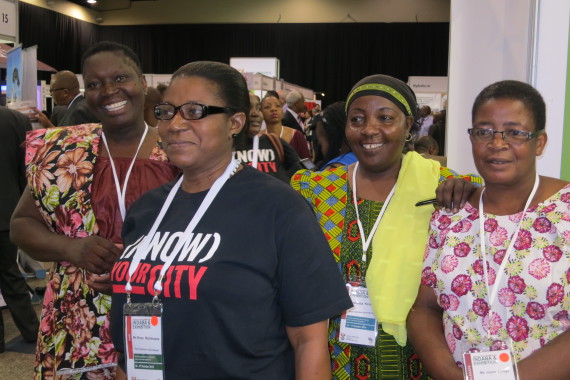
FEDUP members welcome Minister Lindiwe Sisulu and Deputy Minister Zoe Kota-Fredericks at the SDI Exhibition booth

FEDUP members welcome Minister Lindiwe Sisulu and Deputy Minister Zoe Kota-Fredericks at the SDI Exhibition booth

Twenty years after Joe Slovo’s historic Botshabelo Housing Accord, Lindiwe Sisulu, incumbent minister of Human Settlements, invited stakeholders in the human settlements sector to the National Human Settlements Indaba and Exhibition, which was held at the Sandton Convention Centre in Johannesburg from 16-17 October 2014. This included the Federation of the Urban Poor (FEDUP) on behalf of the SA SDI Alliance and Shack/Slum Dwellers International (SDI),

Aims of the Indaba

The Indaba not only marked twenty years of South African democracy but also ten years after the first social contract was signed in 2004 during Sisulu’s first term as Minister of Housing from 2004-2009. The first social contract, similarly, brought together a number of stakeholders in the housing field to discuss and sign an agreement regarding co-operative and collaborative housing practice which would pursue the aims of the then newly launched housing policy: Breaking New Ground (BNG): A framework for Sustainable Housing Development. BNG largely focuses on “promoting the achievement of a non-racial, integrated society through the development of sustainable human settlements and quality housing”. Click here for more on BNG policy. Ten years later, however, the implementation of BNG has been only partially successful.

Against this backdrop, the 2014 Indaba aimed to:

  • Review progress in the implementation of BNG
  • Review the impact of the Social Contract for Rapid Housing signed in 2005
  • Commit stakeholders to a second social contract towards 1.5million housing opportunities by 2019.
Rose Molokoane and SDI delegates from Uganda, Tanzania and Zimbabwe

Rose Molokoane and SDI delegates from Uganda, Tanzania and Zimbabwe

South African and International SDI delegates at Exhibition booth

South African and International SDI delegates at Exhibition booth

Day 1: Pledges towards a second social contract

Amidst actors such as the South African Banking Association, the Chamber of Mines, construction companies and trade union representatives (to mention but a few), SDI and the SA Alliance voiced the interests of the urban poor and advocated for an inclusion of the urban poor in planning, decision-making and implementation.

During the first day’s introductions, Jockin Arputham, SDI President and Nobel Peace Prize Nominee, shared a message of support ahead of the minister’s keynote address which is outlined here. In the afternoon contributors pledged their commitments to the second social contract.

SDI President Jockin Arputham with Minister Lindiwe Sisulu and Deputy Minister Zoe Kota-Fredericks

SDI President Jockin Arputham with Minister Lindiwe Sisulu and Deputy Minister Zoe Kota-Fredericks

Jockin Arputham speaks at Press Briefing

Jockin Arputham speaks at Press Briefing with Minister Sisulu and Director General Zulu

The SA SDI Alliance Pledge

In response to the Department’s larger orientation, Rose Molokoane, national co-ordinator of FEDUP, powerfully shared the pledge of the SA SDI Alliance:

FEDUP pledges to work with national, provincial and local government to deliver 1000 housing actions every month, improving the life of 1000 households. These actions will include

1)   Organising communities through savings

2)   Upgrading services such as water, sanitation, drainage, energy and roads

3)   Building bigger and better houses

4)   Advising the ministry on how to work with communities and organise them to be full stakeholders

We also commit to draw other organisations of the urban poor into the pledge as equal partners. We cannot do this alone. You cannot do this alone. You need our help. “We know the minister is serious about supporting us. What about the MEC’s? What about the local authorities? Are you?

View Rose Molokoane’s speech here:

[vimeo]https://vimeo.com/110123793[/vimeo]

Day 2: Reviewing BNG projects & the second social contract

The second day of the Indaba concluded with presentations by several MECs on the successes and challenges of implementing BNG projects in four provinces, followed by the reading and signing of the second social contract. The specifc commitments of the second social contract are documented here.

Rose & Jockin sign the second social contract on behalf of SA SDI Alliance and SDI

Rose & Jockin sign the second social contract on behalf of SA SDI Alliance and SDI

IMG_0949

Throughout the Indaba the minister repeatedly referred to the value and experience of SDI and the South African Alliance’s work in forming an inclusive atmosphere that engages the urban poor around their own housing development.

Over the last twenty years the SA SDI Alliance has developed an ongoing partnership with the Department which spans from the signing of the Botshabelo accord in 1994, participating in the 2005 national housing accord, the signing of the first social contract in 2005, the 2006 MoU pledge with the Department for subsidies of R285million with which FEDUP has built over 2000 houses to the Department’s most recent pledge of R10million in August 2014.

Throughout FEDUP’s partnership with the Department its core vision has always been: “Nothing for us without Us”. This message is also at the heart of FEDUP’s pledge. As the second social contract is implemented in the next five years, it is the collective vision, experience and practice of the urban poor that is crucial to a truly inclusive implementation not only of housing but also of incremental, in-situ informal settlement upgrading as a vital step towards attaining housing and tenure security.

“We cannot do this alone. You cannot do this alone. You need our help.”

(Rose Molokoane)

Installing Water Taps in Holomisa Gauteng

By CORC, ISN, News, uTshani Fund No Comments

By Blanca Calvo (on behalf of CORC and uTshani)

Holomisa is an informal settlement located in Katlehong (Ekurhuleni, Gauteng). In May 2014, Pumelele Ntanjana, one of the leaders of Holomisa Informal Settlement, contacted the Informal Settlement Network (ISN) to request support for a possible re-location of a portion of his settlement. Today, Holomisa has been profiled and enumerated, new taps have been installed and it has become a learning centre for other ISN communities in Gauteng.

ISN Gauteng co-ordinators with Holomisa residents

ISN Gauteng co-ordinators with Holomisa residents

The Holomisa story tracks back to an ISN leadership meeting that took place in Germiston (Ekurhuleni, Gauteng) in 2008. In that meeting, leaders from all informal settlements in the area had been invited to attend, Holomisa amongst them.

When Holomisa leadership were told by their councillor that a portion of the settlement needed to be re-located because of the enlargement of a neighbouring school, they approached ISN for support. ISN was invited to visit the settlement, where they firstly met with Holomisa leadership and the ward committee members.

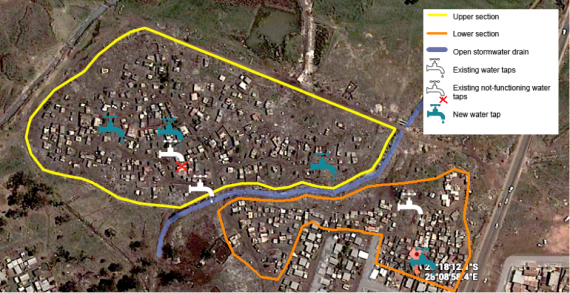
The community and ISN profiled the settlement in May 2014 and identified a need for more sources of water (only 2 functioning taps for about 500 households). This was confirmed in a public meeting, where residents requested support for an immediate improvement of their daily lives through implementing more taps, improving sanitation conditions and electrifying the settlement. The settlement’s improved service delivery would also be an additional step to ensuring land tenure.

Existing Water Taps in Holomisa

Existing Water Taps in Holomisa

Three parallel processes started from there. On one side, enumerations started on the ground, identifying 446 households. Since Holomisa had been identified as a learning centre for the region, leaders from 6 neighbouring informal settlements (Emalahleni, Thintwa, Vlakplaas, Mandela, Makalakaleni and Zola) were invited to join the enumeration process, ending up with capacitated leaders to undertake the process in their own settlements. A total of 10 local and 6 external leaders were capacitated. Besides, the figures highlighted again the need for more taps, with a backlog of 8 taps to meet official standards


Holomisa Textbox1

The mobilisation team engaged with the Ward Councillor, who was informed in a partnership meeting of the intention to install more taps in Holomisa with the support of the South African SDI Alliance. The ISN sent a letter to the ward councillor saying,

“We understand that we are poor humble people struggling to make our way in life. Like every South African citizen, what we expect is a fair and reasonable service delivery from Government in return for the taxes we pay”

Finally, the savings team organised community savings to save 10% of the budget for the project. The outstanding 90% of the budget was financed by the Community Upgrading Finance Facility (CUFF) housed in uTshani Fund.

Mandela Day (18 July 2014) was finally the day for the project to start. In the space of 6 days, one tap was fixed and three more taps were installed. 25 local residents volunteered for the project, a technical team of 10 ISN members was on site and 6 leaders from neighbouring informal settlements were invited to participate and learn in the process, thus increasing their skills and building capacity.

New Water Taps in Holomisa

New Water Taps in Holomisa

Holomisa Textbox2

The project was a success for the communities involved, not only because the installation of more taps improved the living conditions of Holomisa residents, but also because some valuable lessons were learnt.

  • Firstly, the will of the people has been proved to be the best tool to work with. The residents identified the need for more taps and lead the project from the first day.
  • Secondly, the power of residents taking ownership of the project. Residents did not wait for external people and institutions for their permissions or to come to the work, they pushed for their needs to be heard and did it themselves.
  • Finally, the learning centre has proved to be a success. 6 leaders from other informal settlements were capacitated using almost the same amount of resources.

However Holomisa’s story does not end here and the process is still on-going. Holomisa residents, are in discussion with their Ward Councillor for the re-location process of a section of the settlement. Continuous engagement with the ISN will ensure that the re-located residents will be allocated a new portion of land, which it is still to be identified.

Holomisa2

Holomisa3