Tag

Department of Human Settlements Archives - Page 2 of 2 - SASDI Alliance

Alliance at Human Settlements Learning Exchange in Durban

By CORC, FEDUP, ISN No Comments

By Jeff Thomas (on behalf of CORC)

A SA SDI Alliance team comprising FEDUP and ISN community leaders, regional co-ordinators and CORC representatives was invited to attend the International Human Settlements Learning Exchange in eThekwini Municipality from 15-17 April 2015.

The exchange, a first of its kind, was hosted by the Municipal Institute of Learning (MILE) in partnership with eThekwini’s Human Settlements Department and the Affordable Housing Institute (AHI). It included about 200 local, national and provincial government officials, eThekwini Municipality councillors, private sector housing, NGO and academic representatives.  

Screen Shot 2015-05-05 at 11.42.19 AM

It aimed to “share different organisation’s perspectives and experiences within the human settlements sector to improve housing service delivery” (Reference). The exchange focussed on new funding models for affordable housing finance, effective new housing typologies and guidance for establishing socially inclusive and responsive housing settlements.  For the Alliance it was an opportunity to share concrete experiences in community participation that move beyond infrastructural approaches to human settlements development.The event was billed as an international exchange in that the keynote speaker, Professor Jeremy Gorelick, is a globally acclaimed expert in the area of alternative, more-sustainable funding models for housing finance. Among other things, he is the Managing Director of Capital Markets for the USA-based Affordable Housing Institute, a non-profit and tax exempt pro-poor consulting and research firm which operates in 43 countries.
Community-Based Implementation at Alliance's Namibia Stop 8 Housing Project in eThekwini Municipality

Community-Based Implementation at Alliance’s Namibia Stop 8 Housing Project in eThekwini Municipality

Examining Sustainable Funding Models 

His presentation on the first day examined factors relating to the opportunities and challenges of financing housing development in Sub-Saharan Africa, followed by a brief exploration of “Public-Private Partnerships” and “Municipal Development Funds”. The day also involved presentations by KZN MEC for Human Settlements and Public Works, SALGA’s Sustainable Human Settlements Specialist and the Treasury’s DDG who spoke on the South African Model of Human Settlements Finance. Seated around tables in the audience, participants were given the opportunity to discuss the presentations and share feedback on these at a plenary session.
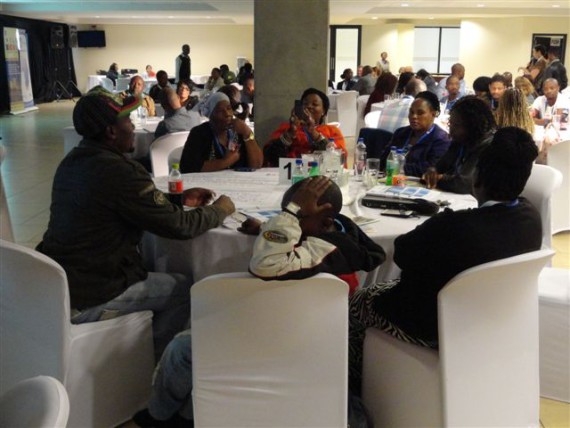
SA SDI Alliance Team at Exchange

SA SDI Alliance Team at Exchange

Visiting Cornubia housing project 

While the first day focused on a sustainable funding model, the second day comprised two key parts: presentations and a field trip.  The presentations related to a series of existing and proposed human settlement projects while the field trip took us to two of them: KwaMashu Centre where a multi-storey 1000-unit social housing development is planned and Cornubia, a 25000-unit housing project and associated social and light industrial precinct to the north of Durban. At both these projects participants were afforded an opportunity to engage in a question and answer session with municipal officials leading the visit.

Cornubia Housing Project,

Cornubia Housing Project, eThekwini Municipality
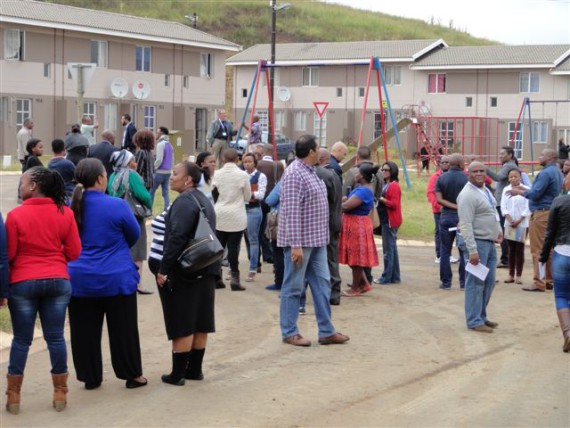
 

Cornubia, eThekwini Municipality

Cornubia, eThekwini Municipality

Community-Centred Human Settlement Development

The third day’s focus shifted to issues of community participation in human settlements development discussed by the Project Preparation Trust, the SA SDI Alliance and Habitat for Humanity South Africa. The CEO of Project Preparation Trust examined the meaning of ‘people-centred development’ and its relationship to infrastructural development’. He shared 8 actions that South African cities need to take in order to become more people-centred. Key amongst these were

  • the need to understand local communities and circumstances
  • approaching participation as ‘negotiation’
  • focusing on partnership and trust-building
  • asset not deficit-based thinking
  • understanding informality by working with it not against it
  • and most importantly, focussing on improving livelihoods and quality of life

The SA SDI Alliance team shared its experience in pioneering people-centred development initiatives since 1991. The presentation focussed on the Alliance’s experience in community-driven human settlement upgrading in relation to ‘project preparation’ and ‘project implementation’. While project preparation was explained as comprising community-based savings, data-collection (profiling & enumerations) and planning, implementation looked at upgrading in terms of improved services, re-blocking and housing.

Screen Shot 2015-05-05 at 12.31.08 PM


The emphasis in both regards was on how the Alliance approach provides opportunities for people to participate in and drive their own development, leading to self-pride and greater sense of ownership of the final product. It also emphasised the central role of women in driving the process and the need for partnerships between poor communities and government. A series of quotes about the Alliance process from significant national human settlements ministers concluded the presentation, clearly communicating that,

“It’s only a fool who cannot support this process”

(Derek Hanekom, SA Human Settlements Minister, 1999)

Habitat for Humanity SA’s final presentation shared its new strategic direction since 2012 and its use of the 4P model: People-Public-Private Partnerships. Habitat shared its approach to leadership capacity-building workshops, the role of asset-mapping and sustainable livelihoods analysis, the artisan audit towards providing appropriate skills training which is part of a social scoping exercise run in communities that participate in their own development programs.

Outlook

Discussions aimed to broaden thinking and practice by municipal officials and sector practitioners alike. As a result of the presentations and discussion on community-centred participation on Day 3, the concept of ‘Public-Private Partnerships’ introduced on the first day had been broadened out to include People-Public-Private Partnerships, in which communities become central role-players in project preparation (community driven savings, data collection and planning) as well as implementation. As the Alliance continues to seek out a partnership the municipality, the exchange indicated a growing awareness concerning the significance of community-driven process and collaborative partnership between stakeholder sectors.
Spotlight on Mpumalanga: “Through FEDUP we support each other”

By FEDUP, uTshani Fund One Comment

By Yolande Hendler (on behalf of CORC)

“At Ellerines in Standerton, we need to collect Dolly, then its not far: continue straight over the crossing and turn left to get to Extension 6. We want to share what we are doing in our savings scheme. Some of us have houses, and some of us are starting small businesses”

(Togo Simelane, FEDUP member, Mpumalanga)

IMG_3041

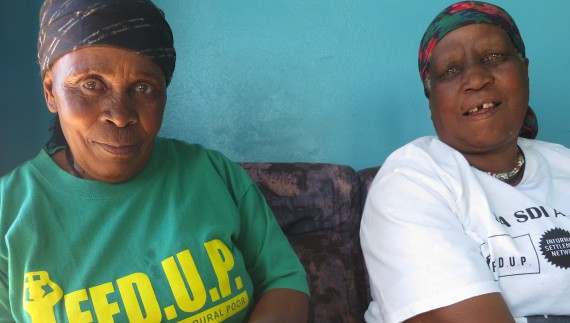
Emelina Hlabati and Beauty Nkosi, long standing members of FEDUP’s Masakane savings scheme in Standerton

As Mama Dolly Moleme and Togo Simelane arrive at their home in Extension 6 in Standerton, they lead the way to Gogo Emelina Hlabati’s home. Together with Beauty Nkosi, the three ladies make up the steering committee of FEDUP’s PHP housing projects in Standerton. Apart from acting as FEDUP’s regional financial signatories, the group is involved in negotiating with the municipality and provincial government for direct access to housing subsidies through the People’s Housing Process (PHP). Read more about FEDUP’s engagement with PHP here.

Togo Simelane (front), Beauty Nkosi (left), Emelina Hlabati (right), Dolly Moleme (back)

Togo Simelane (front), Beauty Nkosi (left), Emelina Hlabati (right), Dolly Moleme (back)

Building first houses in Extension 6

FEDUP has been active in Extension 6 since 2001, with five savings schemes (Masakane, Lethukhanya, Vukuzenzele, Masihambisane and one income generation / loan group).

Dolly explains,

“We started building all the FEDUP houses in Extension 6 in 2005. uTshani Fund supported us with pre-financing the houses. We managed the construction of the houses through our Community Construction Management Teams (CCMTs). Houses should take one week to build but we waited for one month for the materials to deliver. The role of the government is to provide an inspector to check that the houses we build meet the appropriate standards.”

Beauty Nkosi infront of her Federation house

Beauty Nkosi infront of her Federation house

FEDUP self-financed its first three houses as “show houses” to negotiate for direct access to subsidy funds in 2001 and 2002. This enabled members to build houses with bigger dimensions than RDP houses. For the group of ladies it was clear,

“We’re not looking for municipality houses – we want Federation houses because they are much bigger and more beautiful”

Between 2005 and 2006 FEDUP has built 36 houses. Other members in the community are approved to receive a subsidy but Dolly explains that there has been little movement from the municipality. The group therefore contacts the municipality on a weekly basis to find out about proposed plans for the next subsidy houses. The likelihood of receiving subsidies in the near future, however, is small. This reflects the inability of South Africa’s provincial Departments of Human Settlements to adequately meet the country’s housing backlog. The backlog in Mpumalanga alone is close to 200 000.

IMG_3053

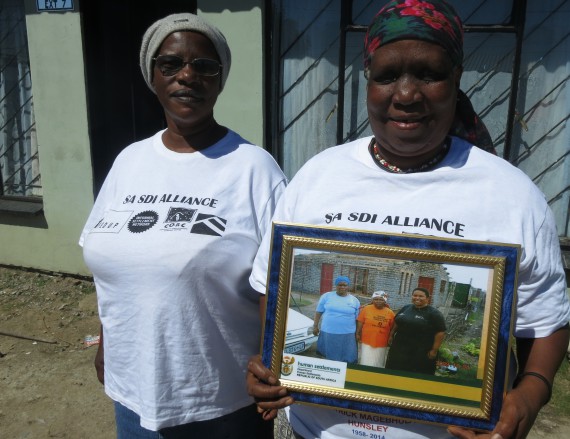
Beauty Nkosi with human settlements accredited photograph with Emelina Hlabati and Nomvula Mahlangu

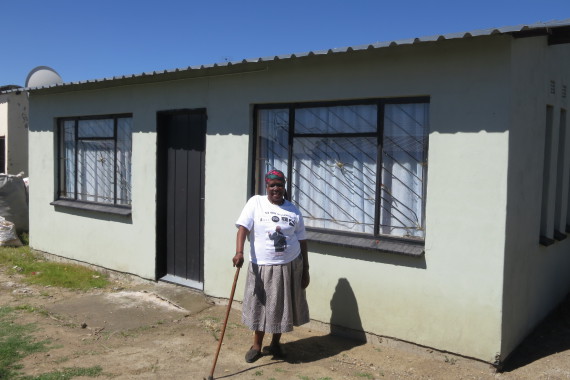
FEDUP houses in Extension 6

FEDUP houses


Building Savings, Building Support

Through daily savings, however, FEDUP, has nurtured strong savings schemes and spaces in which members can support each other, regardless of the extent of municipal commitment and support.

Dolly explains,

“The Federation helped Gogo Emelina to such an extent that when she was born she was living in a shack. She started daily savings and luckily with the support of the Federation she was able to bury her husband in a dignified manner. When her husband passed away, the house was completed. Today she has a house and a chicken business. Otherwise she would be out in the open”

Dolly, Emelina and Beauty speak about their savings scheme:

“We are all part of Masakane savings scheme. Now we are about 30 members. Many of us received houses. Together we have a chicken project. We buy small chickens, we grow them and then we sell them when they have grown big. When we heard about the FEDUP loan group we decided to sell chickens because many people like to eat chickens.”

Read about FEDUP’s Income Generation Programme here.

Dolly Moleme and Emelina Hlabatis Chicken business

Dolly Moleme and Emelina Hlabatis Chicken business

Masakane savings scheme is also involved in other forms of saving such as saving towards groceries for the year-end. At the end of the year 60 members use the savings to buy a big load of groceries and one sheep each.

“Many people who live here live in shacks often don’t want to save. But when they see us building our houses they come running to us and ask how they can do this too. I like the Federation a lot! Even though I already have a house I would never dream of leaving the Federation. Many people are struggling. Through FEDUP we support each other even if the municipality doesn’t seem to want to help us”

(Dolly Moleme, FEDUP member, Standerton)

Togo Simelane in FEDUP office in Extension 6

Togo Simelane in FEDUP office in Extension 6

Moegsien

SA Alliance at National Human Settlements Indaba 2014

By CORC, FEDUP, ISN, News, Press, SDI, uTshani Fund No Comments

By Yolande Hendler (on behalf of CORC)

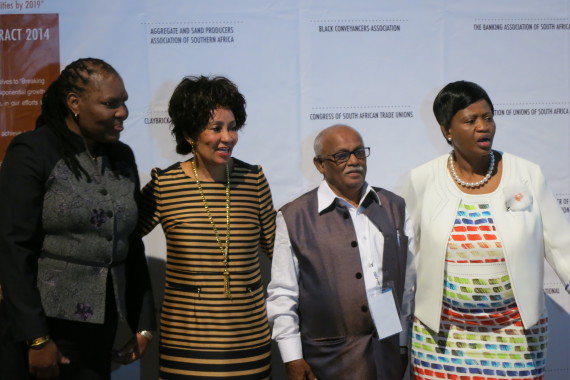
FEDUP members welcome Minister Lindiwe Sisulu and Deputy Minister Zoe Kota-Fredericks at the SDI Exhibition booth

FEDUP members welcome Minister Lindiwe Sisulu and Deputy Minister Zoe Kota-Fredericks at the SDI Exhibition booth

Twenty years after Joe Slovo’s historic Botshabelo Housing Accord, Lindiwe Sisulu, incumbent minister of Human Settlements, invited stakeholders in the human settlements sector to the National Human Settlements Indaba and Exhibition, which was held at the Sandton Convention Centre in Johannesburg from 16-17 October 2014. This included the Federation of the Urban Poor (FEDUP) on behalf of the SA SDI Alliance and Shack/Slum Dwellers International (SDI),

Aims of the Indaba

The Indaba not only marked twenty years of South African democracy but also ten years after the first social contract was signed in 2004 during Sisulu’s first term as Minister of Housing from 2004-2009. The first social contract, similarly, brought together a number of stakeholders in the housing field to discuss and sign an agreement regarding co-operative and collaborative housing practice which would pursue the aims of the then newly launched housing policy: Breaking New Ground (BNG): A framework for Sustainable Housing Development. BNG largely focuses on “promoting the achievement of a non-racial, integrated society through the development of sustainable human settlements and quality housing”. Click here for more on BNG policy. Ten years later, however, the implementation of BNG has been only partially successful.

Against this backdrop, the 2014 Indaba aimed to:

  • Review progress in the implementation of BNG
  • Review the impact of the Social Contract for Rapid Housing signed in 2005
  • Commit stakeholders to a second social contract towards 1.5million housing opportunities by 2019.
Rose Molokoane and SDI delegates from Uganda, Tanzania and Zimbabwe

Rose Molokoane and SDI delegates from Uganda, Tanzania and Zimbabwe

South African and International SDI delegates at Exhibition booth

South African and International SDI delegates at Exhibition booth

Day 1: Pledges towards a second social contract

Amidst actors such as the South African Banking Association, the Chamber of Mines, construction companies and trade union representatives (to mention but a few), SDI and the SA Alliance voiced the interests of the urban poor and advocated for an inclusion of the urban poor in planning, decision-making and implementation.

During the first day’s introductions, Jockin Arputham, SDI President and Nobel Peace Prize Nominee, shared a message of support ahead of the minister’s keynote address which is outlined here. In the afternoon contributors pledged their commitments to the second social contract.

SDI President Jockin Arputham with Minister Lindiwe Sisulu and Deputy Minister Zoe Kota-Fredericks

SDI President Jockin Arputham with Minister Lindiwe Sisulu and Deputy Minister Zoe Kota-Fredericks

Jockin Arputham speaks at Press Briefing

Jockin Arputham speaks at Press Briefing with Minister Sisulu and Director General Zulu

The SA SDI Alliance Pledge

In response to the Department’s larger orientation, Rose Molokoane, national co-ordinator of FEDUP, powerfully shared the pledge of the SA SDI Alliance:

FEDUP pledges to work with national, provincial and local government to deliver 1000 housing actions every month, improving the life of 1000 households. These actions will include

1)   Organising communities through savings

2)   Upgrading services such as water, sanitation, drainage, energy and roads

3)   Building bigger and better houses

4)   Advising the ministry on how to work with communities and organise them to be full stakeholders

We also commit to draw other organisations of the urban poor into the pledge as equal partners. We cannot do this alone. You cannot do this alone. You need our help. “We know the minister is serious about supporting us. What about the MEC’s? What about the local authorities? Are you?

View Rose Molokoane’s speech here:

[vimeo]https://vimeo.com/110123793[/vimeo]

Day 2: Reviewing BNG projects & the second social contract

The second day of the Indaba concluded with presentations by several MECs on the successes and challenges of implementing BNG projects in four provinces, followed by the reading and signing of the second social contract. The specifc commitments of the second social contract are documented here.

Rose & Jockin sign the second social contract on behalf of SA SDI Alliance and SDI

Rose & Jockin sign the second social contract on behalf of SA SDI Alliance and SDI

IMG_0949

Throughout the Indaba the minister repeatedly referred to the value and experience of SDI and the South African Alliance’s work in forming an inclusive atmosphere that engages the urban poor around their own housing development.

Over the last twenty years the SA SDI Alliance has developed an ongoing partnership with the Department which spans from the signing of the Botshabelo accord in 1994, participating in the 2005 national housing accord, the signing of the first social contract in 2005, the 2006 MoU pledge with the Department for subsidies of R285million with which FEDUP has built over 2000 houses to the Department’s most recent pledge of R10million in August 2014.

Throughout FEDUP’s partnership with the Department its core vision has always been: “Nothing for us without Us”. This message is also at the heart of FEDUP’s pledge. As the second social contract is implemented in the next five years, it is the collective vision, experience and practice of the urban poor that is crucial to a truly inclusive implementation not only of housing but also of incremental, in-situ informal settlement upgrading as a vital step towards attaining housing and tenure security.

“We cannot do this alone. You cannot do this alone. You need our help.”

(Rose Molokoane)

Minister Sisulu speaks about Partnership with SA Alliance

By Archive, FEDUP, Resources, uTshani Fund No Comments
DSC03915

2006 Pledge Conference with Minister Lindiwe Sisulu

In anticipation of The National Human Settlements Indaba and Exhibition (16-17 October 2014) we share a speech made by Lindiwe Sisulu, Minister of Human Settlements in 2006 about the Department’s partnership with Shack/Slum Dwellers International (SDI) and the Federation of the Urban Poor (FEDUP).

During this event the minister recognised the inherent value of partnership with the Alliance and of promoting community-led development processes:  she signed an MoU binding Provincial MECs to pledging 1,000 subsidies per Province per annum to FEDUP.  Since 1994 the Alliance has partnered with national, provincial and local government, pioneering new methodologies of community organisation. This year’s Indaba will be held in Johannesburg and focuses on the theme of “Building partnerships for accelerated delivery of human settlements”.  Both SDI and the South African Alliance have been invited as partners who reflect and voice the interest of the urban poor.

KEYNOTE ADDRESS BY LN SISULU MINISTER OF HOUSING AT THE CONFERENCE OF SHACK/ SLUM DWELLERS INTERNATIONAL AND THE FEDERATION OF THE URBAN POOR 

19 May 2006 
International Convention Centre
 , Cape Town 

Chairperson;

President of the Slum Dwellers International,

President of the Federation of the Urban Poor,

Representatives of other different community based organisations present here
,

Comrades
,

Invited Guests,

Ladies and Gentlemen:

I accepted the honour to open this Conference with a great deal of humility. Humility because I, who represents those who are seen to have plenty, have to stand here in front of you who represent the poorest of the poor and pretend that I have some words of wisdom to impart to you. But I stand here with pride, and I am proud too, because you have chosen my government as a partner in a cause that goes right to the heart of what we are and what we fought for all those years. For me this can only mean an endorsement of your confidence in us, that with us, through us, your ideals can be achieved.

I welcome your confidence in us for we, in turn, will use it to spur ourselves on to ensure that our common goals are realised. It is an honour for us to be counted as one of the champions of the poorest of the poor.

The great revolutions of modern times have, apart from the influences of technological advances and progress, been the result often of the kind of progressive action that had found its source from the grassroots. Such has been the influence and the power of the grassroots in the present time that none who held political power could on their own define and occupy the political space that is critical to issues of sustainable development.

We are all one human force, inexorably drawn to the ideal that until all are free, free from the shackles of poverty, none of us is free. Because by some strange reason we are bound to this universe together. There is some logic in this contradiction. If we are to move forward – progress, our collective pace will be determined by the slowest, in this case the lowest. The great irony of our time! The future of our civilisation rests on how we determine our way forward. We shall not be identified as the civilisation of great poverty, that cannot defines us, we who are proud inventors of everything that has culminated into our launching into space to seek answers about what lies beyond. Perhaps, this is a justifiable deflection as we remain unable to solve problems that lie at our feet. Intellectually, one of the best periods of recorded history, but morally very wanting. The consciousness of the rich closed to the poverty that surrounds them.

In convening this Conference, the Slum Dwellers International and the Federation of the Urban Poor, give us reason to have greater confidence that the common struggle we share against homelessness will indeed achieve its greater results during our own lifetime. No moment in the history of human society has landed itself to this possibility other than ours.

Minister Lindiwe Sisulu, with Jockin Arputham (President of SDI) and Rose Molokoane, National Co-ordinator of FEDUP, 2006

Minister Lindiwe Sisulu, with Jockin Arputham (President of SDI) and Rose Molokoane, National Co-ordinator of FEDUP, 2006

I have just retuned from a trip to India – a most valuable learning experience it was. I did not get to see the Taj Mahal but what I experienced was more valuable than the Taj. I went out to see the pavement dwellers of Mumbai living in the most shocking conditions on the edge of society – having lived that way for all their lives. But a people with hope. An entrepreneurial people taught me the value of saving and the spirit that drives them to ensure that they do provide a house for their families. A people determined that they will do their bit to restore their dignity.

I yearn for that spirit here. A spirit that says this is our government – how can we help it in this huge challenge to provide housing? What can I – sitting in a shack house – do to help ensure that I too have a house? We need to infuse this in our people. We were once a proud people that moved heaven and earth and did do the impossible. The present challenge is within our power to resolve.

In India, I also had a tour of projects that had been undertaken by slum dwellers, projects that demonstrated resourcefulness, originality and innovation. They vindicated the belief I had always had that if government was to accelerate the delivery of housing then the complete involvement of the poor needed to receive full support.

I then began to reflect on the 2005 World Summit Outcome that committed governments to specific actions in relation to slum prevention and slum upgrading. Key among the resolutions was the commitment to increase resources for housing and the related infrastructure.

Ghandi believed that there was an innate goodness in human nature which at all times is able to perceive the truth as though by instinct.

We are a people with a very proud history, proud of what we can do for ourselves. My worry right now is that this proud heritage is dissipating now that we have our own government, the government of the poorest of the poor, the disadvantaged. And we have ourselves to believe that the government will provide.

I have been very attracted by the founding ethos of Shack Dwellers International: that no matter how disadvantaged, we can still do it ourselves, that in fact it is nobler if we do it ourselves. Help me plant this into the heart of every disadvantaged South African. Help me inspire them to stand up.

At the Special Ministerial Conference of the African Ministerial Conference on Housing and Urban Development (AMCHUD), that we held a month ago, in Nairobi, resolutions had been passed to effect these outcomes of the World Summit by focusing governments on the resourcefulness of the poor.

Having ourselves placed the issue of slum prevention and slum upgrading at the top of the international agenda we resolved not only to prevent new slum formations but to also look into the existing policies, legal, institutional and regulatory frameworks that hinder our abilities to deal with slum formation in ways that affirmed and strengthened our relationship with the poor.  We therefore resolved to review the frameworks that exist to enable an environment where the full capacities of community organisations and non-governmental organisations were utilised. In practice, amongst other things, this will mean the promotion of community-led development processes in slum prevention and slum upgrading and the identification of ways to assist initiatives relating to savings.  

I am gratified that the relation we have cultivated with yourselves has enabled us to implement some of these resolutions already. The Homeless People’s Federation, that we had interactions with in 2004, enabled us to make this start.

The Conference cements the relationship by now enabling us to act together at the international level. It is my hope that such collaboration will help encourage a fundamental rethinking of issues connected with sustainable development and the achievement, specifically, of the Millennium Development Goals. It is a great contradiction of our times, in my view, that whilst on the one hand we correctly extol the virtues of economic progress and political stability, on the other hand, we remain unable to expend and invest sufficient resources to achieve those outcomes.

I have had occasion to look back and assess the damage done to all of us in this country by the policies of inequality. It has cost us dearly. If eighty years ago we had all progressed along the same path, I leave you to imagine where this country would be today. We held back on the development of a segment of our society and we live with those consequences.

The steps that we have taken to support and assist initiatives from the Slum Dwellers International and Federation of the Urban Poor recognizes this singular truth. As government we recognize that apart from the market mechanism other initiatives and ways that have their origins in the people who make up our cities and towns, exist.

Minister Lindiwe Sisulu and President of SDI, Jockin Arputham

Minister Lindiwe Sisulu and President of SDI, Jockin Arputham

This is the experience that yet again I was exposed to when again I visited Thailand last year. I was exposed to a unique programs that forms partnerships between communities, government, and other stakeholders in identifying and developing suitable land for housing. This was a partnership to ensure that communities were located in the most opportune locations where their actual needs could be addressed in a sustainable manner.

We are thus committed to learn through practical experience and to enhance our programs to ensure that community needs are achieved. And I thus welcome the proposed structured cooperation arrangement that will be established during the Conference for the implementation of projects linked to policy and strategy enhancement.

The Conference is a unique opportunity for all of us to learn how partnerships with civil society are formed and should operate.

I would like to congratulate all of you for the achievements that both individually and collectively you have made in advancing the cause of slum dwellers.

Finally, Jockin, I do not know what to say to you. You remind me so much of my own father. You are beautiful in every single way!

I thank you most sincerely.

The Dept. of Human Settlements honours Patrick Hunsley & pledges R10 million to FEDUP

By CORC, FEDUP, ISN, SDI, uTshani Fund No Comments

Patrick Magebhula Hunsley, founding member and stalwart of the South African Alliance and Shack Dwellers International (SDI), was awarded the Lifetime Achievement Award by Lindiwe Sisulu, Minister of Human Settlements on behalf of the Department of Human Settlements on Thursday 14 August 2014 at the annual Govan Mbeki Human Settlements Awards ceremony held in Johannesburg.

Patrick Magebhula Hunsley

Patrick Magebhula Hunsley

Patrick's son, Charles Hunsley, receives the Lifetime Achievement Award on behalf of his father from Minister of Human Settlements, Lindiwe Sisulu

Patrick’s son, Charles Hunsley, receives the Lifetime Achievement Award on behalf of his father from Minister of Human Settlements, Lindiwe Sisulu

This prestigious award ceremony (established in 2006) aims “to promote and inculcate a culture of excellence within the human settlement sector in the delivery of quality human settlements and dignity to South Africans” (Reference). The awards acknowledge excellent achievements on a Provincial and National level, in order to showcase and demonstrate the work done by the department at both tiers and to promote best practices in meeting the delivery mandate of the Presidency’s Outcome 8, which is aligned with the vision of building sustainable human settlements and meeting the Millennium Development Goals.

This year, however, the minister included an additional category of awards – the Lifetime Achievement Award – that was given to only two people in honour of excellent and noteworthy contributions. When attending Patrick’s funeral in Durban on 16 August at the KwaMashu Christian Centre in Durban, the minister shared

“For the first time this year, we honoured people with outstanding qualities and recognized them as life time achievers in this area. Of all the people who have been active in this field we chose two people. The first was Joe Slovo, the first minister of housing and the second was Patrick Magebhula”.

Lindiwe Sisulu, Minister of Human Settlements and Rose Molokoane, National Coordinator of FEDUP at Patrick Hunsley's funeral on 16 August 2014.

Lindiwe Sisulu, Minister of Human Settlements and Rose Molokoane, National Coordinator of FEDUP at Patrick Hunsley’s funeral on 16 August 2014.

Lindiwe Sisulu, Minister of Human Settlements pledges R10 000 000 to the Federation of the Urban Poor at Patrick's funeral

Lindiwe Sisulu, Minister of Human Settlements speaks at Patrick’s funeral

The Federation of the Urban Poor (FEDUP) has had a long-standing relationship with government. In the lead up to the 1994 elections, the federation of women’s savings collectives lobbied for an alternative approach to housing that focused on people-centred and controlled development – this model was appropriated by government in 1998 in the form of the People’s Housing Process (PHP). Read more here. Patrick was instrumental in these processes, negotiating with government and ‘un-blocking’ strategic regions in the country. In 2006 FEDUP secured a long term ‘subsidy pledge’ with the department of human settlements which was signed by FEDUP, uTshani Fund and then national minister of housing, Lindiwe Sisulu for 1000 housing subsidies per province in South Africa. In 2010 Patrick served as special advisor to then minister of human settlements, Tokyo Sexwale, on human settlements policy and practice. In 2011 Patrick was asked to serve on a Ministerial Task Team on Water and Sanitation, headed by Ms. Winnie Madikizela-Mandela, tasked with addressing the issues of open-air, incomplete and dilapidated toilets in poor communities across South Africa.

Having worked together closely with Patrick, current Minister of Human Settlements, Lindiwe Sisulu, recognised him at the award ceremony as

 “an outstanding, humble man who helped us shape our policies and understand how people who live in slum conditions are not victims, that they have the power, together with our support, to take themselves out of their poverty. His name is Patrick Magebhula and he passed away on Monday 4 August 2014. It is a sad loss for us. We will bury him on Saturday with all the dignity that he deserves. Today we honour him as an internationally recognised champion and pioneer of the empowerment of the poor and acknowledge his outstanding contribution. We and his broader family of the Federation of the Urban Poor and SDI will have to double our collective effort to further his work to ensure that his life passion was not in vain.” (Reference)

At Patrick’s funeral, which was attended by family, hundreds of fellow activists, friends and comrades the minister remembered how she and Patrick had first met in Barcelona (Cape Town) when she was a new minister together with FEDUP and Rose. As she got up to speak at one of the occasions she explained that Patrick had humorously asked her to explain who she was, who had sent her, who she was representing and what her promise would be to the Federation. After the minister had shared this anecdote, she pledged R 10 000 000 in housing subsidies to FEDUP. Kwa Mashu’s church – packed to the brim – erupted in song, cheers and ululations.

 “My only regret is that Patrick is not here today to hear me but I want him to know that the promise I made to him, today, I kept in his honour. The federation will not be in want while I am around, the federation will not want for anything while the DG, the deputy minister and the department is there. The partnership we have will live in honour of this man whose humility is amazing. As the Department of Human Settlements we count ourselves as the broader family of Patrick.”

She also honoured the work of Shack Dwellers International (SDI) and its nomination for the Nobel Peace Prize, which South Africa has decided to second.

“We as South Africa have pledged to second SDI’s nomination and lobby all African countries who are part of us to second the nomination so that we can celebrate with Patrick should we win the peace prize”.

The Minister then led the gathering in the song: “Lihambile iQhawe”, a famous freedom song that was also sung as Mandela was buried in December last year. The refrain goes: “Lihambile iQhawe lamaQhawa” – The Bravest of the Brave has departed.