Tag

CORC Archives - Page 5 of 5 - SASDI Alliance

2014 UCT – Europe Community Studio: Spatial Development Framework

By Academic, CORC, ISN No Comments

By Thandeka Tshabalala (on behalf of CORC)

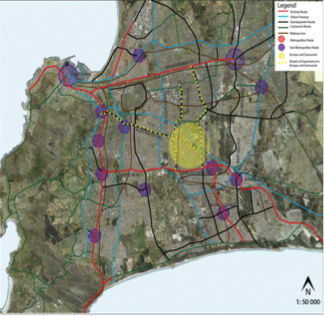
Over the last four months Europe community members and Masters students of Urban and Regional Planning at the University of Cape Town (UCT) collaborated on a joint planning studio to address some of the community’s most pressing concerns. Together, they began by conducting a site analysis and researching the opportunities and constraints presented in Europe. This research and site analysis led to developing concepts for in-situ, incremental upgrading projects. Read more about the concepts and the first developments of the studio here. The students then split into three groups and used these concepts to produce spatial development frameworks (SDFs), which act as a guiding document on the future development of Europe and surrounds.

Together with Europe residents the students recently presented their proposed SDF’s to their classmates and to City of Cape Town officials.  All three SDF’s had underlining themes, which were

1) Maximising the use of existing infrastructure

2) Developing activity nodes linked to existing major business and transport nodes whilst maintaining the transit character of the main spine (Klipfontein Road)

3) Increasing socio economic opportunities in Europe.

These proposals fittingly introduced the concept of incremental settlement upgrading.
SDF1SDF2

The SDF in summary

1. Creating cultural and ecological nodes

  • The site analysis revealed the presence of several aquifers and wetlands on the site and along Klipfontein Road. In order to protect and enhance Europe’s scenery this natural biodiversity could be joined with pedestrian routes to attract different users to the site.
  • The area around Europe contains several sites of recent South African history that could increase the area’s potential as a cultural node. By connecting to sites such as the Gugulethu Memorial 7 and cemetery and cultural tours to the Cape Flats, residents could increase their access to economic opportunities.

2. Property sales

  • Although residents in Europe do not have tenure security, Europe’s leadership has recorded an enormous amount of property transfer in the settlement due to the high demand for well located affordable housing. During a transaction, the leadership keeps certified identity documents of both parties. These serve as a proof of sale of one’s property. Even in their derelict state most shacks have sold between R10 000 to R15 000.
  • Through their engagement, the students picked up on the importance of location – in terms of one’s own shack and in terms of the settlement location as a whole. They therefore introduced the concept of re-blocking as an incremental approach to housing which would decrease the level of flooding, open spaces for the provision of basic services, communal spaces and spaces of interaction. Moreover, it would improve the quality of life in the whole settlement.
  • Many groups viewed re-blocking as a short-term strategy that could be implemented easily without displacing people. It would also provide residents with the opportunity to access short-term housing structures.

20140528_SDF3

3. Creating activity nodes

  • The Cape Town SDF sets out a hierarchy of different movement routes across the metropolitan area. It focuses on North – South and East – West accessibility. Europe’s location between an urban freeway (N2) and a development route (Klipfontein RD) means that Klipfontein Road presents a greater potential for activity nodes than the impenetrable N2.
  • Heideveld station also provides a critical link between the road and rail network, making this an important node for future development.
  • The analysis uncovered that the Golden Arrow bus route bypasses an important section of Klipfontein Road. This means that the residents of Europe and surrounds, who are already earn a low-income, need to pay for additional taxi transport to reach the closest bus and train station. Some residents also use the local transport ‘Amaphela ‘ due to the area’s high crime levels, which make walking unsafe.
  • As a MyCiti bus station will soon be implemented in Mitchell’s Plain, the intersection between Bocherds Quarry and Klipfontein Roads will in all likelihood grow as a transit node. It therefore has potential to develop into a transport interchange with supporting activities.

Throughout this discussion it was crucial to see Europe as a functional settlement in its own terms and thus limit the distance travelled to access jobs and other socio –economic opportunities.

4. Maximising existing neighbouring corridors

  • Much developmental activity has focussed on improving upcoming North-South corridors such as Parklands and Mitchell’s Plain. There is a need therefore to establish linkages to upcoming opportunities.
  • There is also a need to increase vertical connections to the settlement such as access to Voortrekker Road, which is one of the busiest roads connecting Bellville and Cape Town.

SDF5

5. Short term interventions – livelihoods and food security

  •  After several discussions with the community, the importance of access to employment and food security was clear. Residents felt that they needed to be able to support their households in order for them to start looking at broader issues such as upgrading.
  • After this discussion the community came together and collected their names and livelihood interests on a piece of paper. Those with common interests were then grouped together to begin discussing how they could start livelihoods programs. These included hair dressing, carpentry, gardening etc.  The students put together a pamphlet in isiXhosa with a list of organisations that assist in skills development such as Abalimi Basekhaya and The Carpentry Shop.

In the next phase of the studio the students will develop precinct designs of the settlement and write a short reflection of the studio as a whole. 

Designing with Communities: CPUT – Manenberg Studio 2014

By CORC, ISN, News No Comments

By Yolande Hendler (on behalf of CORC)

Manenberg community leaders and architectural students from the Cape Peninsula University of Technology (CPUT) recently collaborated on a six-week long planning studio in Cape Town (March-May 2014). The studio aimed to generate ideas around alternative housing design and delivery options that would address the needs of Manenberg residents within their existing challenges and ‘urban’ conditions.

DSCN6957

CPUT students with Manenberg community leaders Terence Johnson, Melanie Manuel, Na-eema Schwartz & Errol Snippers (left to right)

Manenberg

Manenberg was established in 1966, during a time of forced removals when the apartheid government relocated low-income coloured families from District Six and other parts of the city to an area known as the Cape Flats, 20km away from Cape Town city centre.  During Manenberg’s construction phase in the late 1960s it was classified as a ‘sub-economic housing development area’. Although the design and structures of these semi-detached houses and project-like flats differed, this term indicates that most did not have ceilings, inside water or doors to their rooms (Reference). As construction continued into the mid 1980s, other buildings and social amenities sprang up. Many people currently live in backyard dwellings. Along with experiencing overcrowded living conditions Manenberg’s communities are continuously exposed to high crime and gangsterism.

Screen Shot 2014-05-20 at 4.20.36 PM

The studio brought together about 40 students from CPUT’s Department of Architectural Technology and Manenberg community leaders who represented the Manenberg Slum Dwellers, the Movement for Change, the Backyarders Network, the Federation of the Urban Poor (FEDUP) and the Informal Settlement Network (ISN). The studio was facilitated by ISN and supported by the technical team of the Community Organisation Resource Centre (CORC).  For more background on ISN-affiliated communities in Manenberg and backyard dwellings click here.

ISN representative and Manenberg community leader, Melanie Manuel, explained that the studio offered an opportunity for Manenberg residents to come up with a better proposal to address overcrowded conditions and inadequate basic services. For the students the studio offered valuable exposure to inclusive planning practice. They were tasked to assist the community in the design and planning of housing and the related community ‘place’ layout.  This required students to work closely alongside community leaders to explore innovative and relevant concepts that would generate flexible solutions. Mizan Rambhoros, Senior Lecturer at CPUT, explained that

“Traditionally, architectural students work on hypothetical projects. This makes working with a community in a studio and involving a community in the design process a completely different scenario. In a ‘live’ project it’s not possible to follow a rigid process – this really opened the student’s eyes.”

IMG-20140520-WA0012

Sharing planning concepts with community leaders

The studio began with a site visit to Manenberg in which community leaders highlighted their primary concerns to the students – recurring floods, fires and security issues. Together, they identified the site they would engage with – the block between Red River Street and Red River Walk that experiences a high prevalence of crime and overcrowding. Students continued to meet with community leaders on a weekly basis, altering and adjusting their housing design and concepts according to the communities’ feedback.

“By working together with the students we could share our experiences and give them more in-depth input on what would work and what wouldn’t – especially because they were honest and open to criticism”

(Melanie Manuel, Manenberg community leader and ISN representative)

‘Incremental Growth’ and Final Presentations

On 9 May, the students presented their final design and concepts. Each group presented their understanding of the contextual and conceptual issues they encountered, designs of a detailed layout and a model of proposed housing units.  The idea of ‘incremental growth’ presented a common strand through all presentations. Several groups highlighted how external circumstances influence mind-sets and subsequently how people interact with each other. This caused them to ask: how can space facilitate a change in mind-set and interaction with people?”

DSCN6931

In responding to the presentations, Na-eema Schwartz from the Manenberg Backyarders Network, commended the students for addressing aspects that were highly relevant to community members – such as idle time and space, fire, flooding and security. In reflecting on the studio, Errol Snippers (Manenberg’s Movement for Change) shared his experience:

“These youngsters have opened my eyes to the way I look at buildings and safety features. Maybe they’ve learnt from us, but I’ve learnt from them too. In this short time we’ve gotten to know each other. I love their passion and drive and would love the kids in Manenberg to have the same passion”

DSCN6942

Errol Snippers (Manenberg Movement for Change)

By the end of the studio it was evident that ‘incremental growth’ was not only reflected in architectural concepts and designs. Even more so it was reflected in both community leaders’ and students’ reflections.

“The studio presented our first opportunity to work on a ‘live’ project in which we needed to feed back our ideas to the community and think about what would be relevant to them.  At the beginning, some of us had quite a stereotyped mind-set. Working together with community leaders in the studio was a learning curve for us all. We now design and accommodate for people’s social situations because we understand them.  How do you design with communities? You have to become ‘part’ them”

(Nomfundo Dlamini, CPUT student)

The next step will see community leaders share the students’ work with the rest of their communities and establish how to use and implement the concepts and design. Such community-based, participatory planning practices contribute to harnessing local knowledge and packaging it into an action plan. In this way communities become key agents in their own development plans.

National Community Exchange – Durban to Cape Town (Part 2)

By CORC, iKhayalami, ISN No Comments

By Yolande Hendler (on behalf of CORC)

A four-day community exchange was underway from 29 April to 2 May 2014, during which community leaders from Durban visited informal settlements in and around Cape Town.  This blog continues to trace the experiences and reflections collected on the exchange, the first two days of which have been recorded here.

Day 3 in Langrug informal settlement – Sanitation, Drainage and ‘Greening’

View of Langrug informal settlement, Franschoek

View of Langrug informal settlement, Franschoek

Located in the affluent wine-farming area of Franschoek, Langrug informal settlement, home to about 4500 people, is characterised by extreme poverty, poor housing and sanitation. In the face of these challenges the community signed a precedent-setting Memorandum of Understanding (MoU) with the locally presiding Stellenbosch Municipality that channelled government funds to community-based upgrading initiatives. This translated into relocating 16 families, the construction of a second access road, the construction of grey-water and drainage channels and a community designed, multi-purpose Water, Sanitation and Hygiene (WaSH) Facility. The facility includes a communal homework area for children, a hair salon, benches and laundry basins. Click here for a comprehensive profile of Langrug. Currently, Langrug is involved in the second phase of upgrading: ‘greening’ the existing WaSH facility with vertical vegetable gardens and developing a dry sanitation facility in Zwelitsha, an ‘informal’ section of Langrug without taps and toilets.

Existing WaSH Facility after 'greening'

Existing WaSH Facility after ‘greening’

KZN visitors taste Langrug's spinach

KZN visitors taste Langrug’s spinach

The exchange visitors were introduced to all these aspects on a detailed walk-about. Langrug community member, Alfred Ratana, indicated the differences in depth and purpose of the drainage and grey water channels and explained the processes accompanying relocation. He emphasised the uniqueness of Langrug in that it was a municipality-driven project which was not community financed.

“Langrug shows that municipalities can have a different approach to communities. Our experience shows that municipalities can include us in their plans and construct with us – not for us”

(Alfred Ratana, Langrug community member)

Langrug community member, Alfred Ratana, speaks about Langrug's grey water drainage

Langrug community member, Alfred Ratana, speaks about Langrug’s grey water drainage

DSCN6652

Viewing a community-constructed drainage channel

Langrug community members also explained the breakthrough presented by Zwelitsha’s dry sanitation facility: due to its location on a steep mountain slope it has been impossible to provide water and sanitation services to around 600 families. The dry sanitation facility, however, is a step towards changing this. The vertical vegetable gardens in Langrug’s existing WaSH facility (developed in partnership with Touching the Earth Lightly) showed the visitors how the community secures food and generates income. By selling the spinach it grows, the community intends to generate income to sustain daily running costs of the facility.

The visitors were also impressed by a crèche facility that had been established between external partners and mothers in Langrug who wanted to provide an alternative, more affordable option for their children. The teachers of the crèche explained that,

“getting something started is not about presenting an idea to social services. You just need to start. Once the idea is happening, you can take the outcome to social services and get it registered”.

Once back at the WaSH facility Langrug’s steering committee shared details around the developments in their settlement. The group was also joined by Diana Mitlin and visiting colleagues from Manchester University. Read about their impressions here.

Sharing impressions after the walkabout

Sharing impressions after the walkabout

Langrug's steering committee explains the steps it took in the upgrading process

Langrug’s steering committee explains the steps it took in the upgrading process


Day 4 in Mtshini Wam – Reflections on how to continue

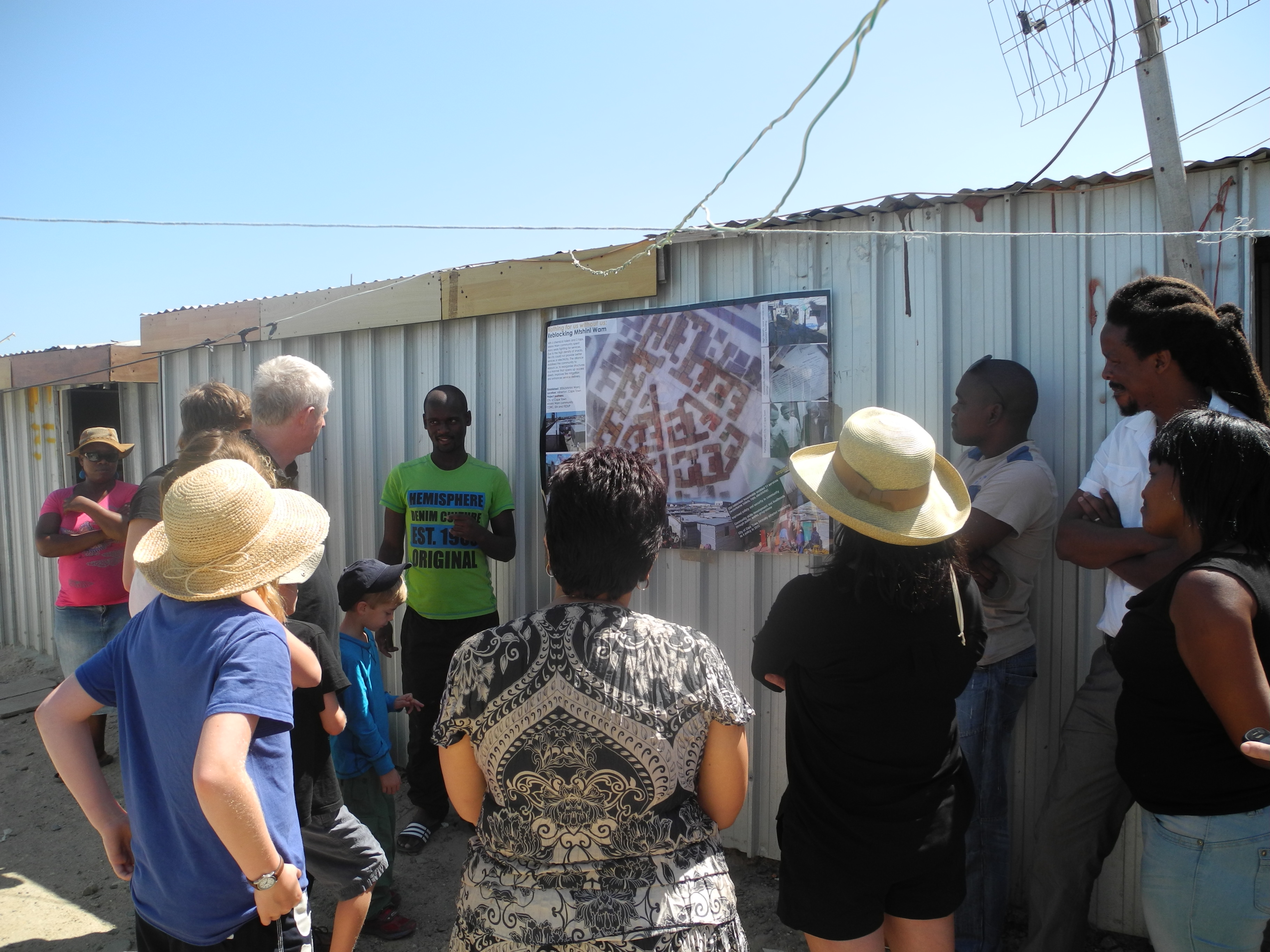
The final visit to Mtshini Wam showed the visitors what a large-scale re-blocking project could look like. During upgrading, the settlement also received one on one services, some in-structure toilets and public water points. More details on Mtshini Wam’s re-blocking are documented here.

Over four days the group had seen much, listened intently, exchanged questions and pondered how to take these impressions back home. Some key points:

  • Visiting Langrug presented a highlight for the visitors from Durban as the topography and accompanying challenges (steep inclines, drainage and flooding) are similar to the conditions in their own settlements.
  • Langrug’s drainage and sanitation facilities therefore presented relevant options for the Durban visitors
  • The visitors were inspired by the initiative and commitment they encountered in their fellow community leaders, something they wanted to take back in responding to circumstances in their own settlements
  • The exchange highlighted the importance of partnerships and the ever-present opportunity to form partnerships as a foundation for wielding large scale change
A street view of Mtshini Wam after re-blocking

A street view of Mtshini Wam after re-blocking

KZN leaders in conversation about securing service provision

KZN leaders in conversation about securing service provision

Durban’s Kenville and Foreman Road settlements will share their experiences of the exchange in mass meetings with their communities this weekend (16-18 May). Their next steps are to enumerate their settlements and establish a relationship with their councillors.

As the visitors embarked on the journey home, ISN community leader, Nkokheli Ncambele, reminded them that

“it is important not to impose everything you have seen on this exchange on your communities at home. Rather take what you have learnt and present it to the community as a suggestion. Then you can decide together what you want and how to make it work in your own settlement”

Exchanges certainly are the most important learning vehicle in the South African Alliance. They facilitate the direct exchange of information, experience and skills, thereby building a horizontal platform for learning between urban poor communities. Through sharing successes and failures in projects, giving and receiving advice on engaging government, sharing in work and life experiences and exchanging tactics and plans communities become central actors.

National Community Exchange – Durban to Cape Town (Part 1)

By CORC, iKhayalami, ISN No Comments

By Yolande Hendler (on behalf of CORC)

Informal settlement leaders from Kenville and Foreman Road in Durban are mobilising their communities to upgrade their settlements with better services and improved spatial layouts. Last week’s exchange to Cape Town (29 April – 2 May 2014) therefore presented a first-hand opportunity for them to draw insights from fellow community leaders.

DSCN6359

Group picture in Kuku Town: Durban and Cape Town communities on exchange

Over the week the Durban visitors were hosted by Kuku Town, Flamingo Crescent, Langrug & Mtshini Wam communities in and around Cape Town. Each day was dedicated to an in-depth visit of each settlement. This included a detailed site visit, discussions on  collecting savings, enumerating and profiling settlements and contributing to planning and mapping. Besides bringing leaders together on a national level, the exchange also connected communities locally: for leaders from Kuku Town, Flamingo and Langrug the exchange comprised a first time visit to the other settlements. Exchanges are thus the most important learning vehicle in the South African Alliance, facilitating the direct exchange of information, experience and skills between urban poor communities.

DSCN6297

Introductions and briefing on the week ahead at CORC office in Mowbray

Day one in Kuku Town: Upgrading & Savings 

Community leaders met in Kuku Town, a small settlement that recently completed re-blocking and in the process secured one-on-one water and sanitation services from the City of Cape Town. Read more about Kuku Town and re-blocking here. In the discussion community leaders took the visitors through a step-by-step picture of Kuku Town’s experiences. ISN representative, Melanie Manuel, explained that

“What we do in ISN is not only to beautify our settlements but to actually change the way we live. Savings and partnerships – like we had with Habitat for Humanity and the municipality – are an important part of this.”

DSCN6325

Community leaders share their experiences around organising and upgrading in Kuku Town community hall

Yet, before partnerships can be formed, a community needs to know its settlement in terms of the number of (un)emloyed people, the number of structures and families and details on service provision (electricity, sanitation and water). This information is collected in enumerations. Kuku Town community used its enumeration data to plan its re-blocked layout and to negotiate the provision of one-on-one services and short-term employment opportunities through the City’s Expanded Public Works Programme (EPWP).  Community leaders explained that they organised themselves in clusters to be able to navigate the logistics around communication and construction during re-blocking.

Among a variety of questions, the visitors took special interest in understanding the connection between savings and upgrading, especially the role of community contributions. Melanie explained that

“Savings contributions enable us as communities to take ownership and responsibility of the changes and upgrading in our settlements. We want to move away from a ‘free for all mindset’ and restore dignity and pride to our communities”

Melanie Manuel, ISN representative

Melanie Manuel, ISN representative

But collecting savings poses a continuous challenge. How to go about motivating communities and responding to accusations? Flamingo Crescent’s community leader, Auntie Marie, shared her experience:

“Getting the community’s commitment for daily savings is difficult. People only want to act when they see that things are happening. You’ve got to be tough. If you’re not tough you won’t get anything right”

For Kuku Town community leader, Verona Joseph, the partnership with the City and its support in this regard, was crucial.  This became evident at Kuku Town’s official handover that afternoon which was attended by the ward councillor and City officials.  The handover and a site visit completed the first day of the exchange, demonstrating what a tangible community-government partnership can look like.

DSCN6393

Exchange communities join Kuku Town handover ceremony

Inspecting the water and sanitation services provided by the City

Kuku Town site visit: inspecting water and sanitation services provided by the City

Day two in Flamingo Crescent: Re-blocking and Partnerships

Flamingo Crescent is about to begin re-blocking and – in partnership with the City of Cape Town – is set to receive one-on-one services. On a walkabout through the smoke and dust-filled pathways community leaders received a thorough impression of the settlement’s layout. Most structures – consisting of old cardboard, zinc, timber and plastic pieces – are situated around a broad, u-shaped pathway that is intersected by smaller, narrow footpaths. Flamingo’s population of about 450 people resides in 104 structures. The entire settlement makes use of only 2 taps and 14 chemical toilets that are emptied three times a week. The absence of electricity means that fire is used as a central source for cooking and warmth.

1. Overview 2

Flamingo – view from above

Site visit in Flamingo

Site visit in Flamingo

In a nearby community hall, Flamingo’s steering committee explained its relationship with ISN and the challenge of collecting savings contributions due to its high unemployment rate (50%). Flamingo’s enumeration acted as a powerful entry point to negotiating an improved layout and service provision with the City of Cape Town. Together with students from the Cape Peninsula University of Technology and Worcester Polytechnic Institute (USA) the community designed the re-blocked layout and conceptualised plans for a crèche and a play park.  Later, the visitors joined the steering committee’s meeting with a Cape Town City official who provided an update on the City’s contribution to upgrading.  For the visitors this was of particular value as it emphasised the crucial role of partnerships and the number of actors involved in a given project. The question at the forefront of many minds was: how can we do this in our communities at home?

For Auntie Marie, Flamingo community leader, it is evident that

“If it wasn’t for ISN, I don’t know where we would be. Through ISN we were introduced to the City and we got a partnership. We started thinking, ‘Now something is going to happen’. Flamingo is going to be re-blocked!”

Continue reading Part 2 of the exchange here.

(Flamingo steering committee presents its partnerships

Flamingo steering committee presents its partnerships

Auntie Marie, Leader of Flamingo Community and Steering Committee

Auntie Marie, Leader of Flamingo Community and Steering Committee

Report back to Flamingo Community

Report back to Flamingo Community


Official Handover of Kuku Town Re-blocking

By CORC, ISN, News, uTshani Fund No Comments

By Walter Fieuw and Yolande Hendler (on behalf of CORC)

Kuku Town before re-blocking

Kuku Town before re-blocking

Kuku Town after re-blocking

Kuku Town after re-blocking

There is a growing recognition that services need to be delivered to informal settlements in new ways. Such new approaches should aim at building community capacity through participatory planning, design and service implementation. Informal settlements are characterised by very different shapes and sizes, ranging from smaller inner city settlements located in residential neighborhoods to large sprawling settlements on the periphery of cities. Different approaches are needed to effectively transform these settlements into more dignified living spaces.  Working with communities is paramount to succeeding in upgrading initiatives. The re-blocking of Kuku Town is an example of an alternative approach to thinking through aspects of place, safety and security through improved settlement layouts, and better located services.

The South African Alliance and Kuku Town community celebrated the official completion of re-blocking on 29 April 2014. Community leaders welcomed delegates from ISN and FEDUP, NGOs such as CORC, iKhayalami and Habitat for Humanity South Africa (HFHSA), City of Cape Town officials from the Department of Human Settlements and the Councillor of Ward 32, Cllr. Derrick America to the hand over last Tuesday.

DSCN6393

ISN & FEDUP co-ordinators speak at handover

Verona Joseph, Kuku Town community leader, opened the ceremony by welcoming guests and sharing some of Kuku Town’s history and the process of community mobilisation. Diverse partners involved in the upgrading process held a variety of speeches that gave thanks, recognised and acknowledged the community’s achievement after three years of negotiations and preparations. ISN and FEDUP community representatives, Mzwanele Zulu & Thozama Nomnga, voiced the importance of continuing the relationships and partnerships, beyond the completion of re-blocking.  Cllr America echoed this sentiment and emphasised that upgrading a settlement is about restoring dignity. Every community member received a personalised ID card containing demographic information  – a symbol of having taken one step closer to reaching security of tenure. The ceremony therefore marked an important milestone for the community, who founded the settlement in 1985.

Cllr Derrick America (right) hands over ID card to community leader Verona Joseph (centre) with Salisha Lauton (left, Habitat for Humanity SA)

Cllr Derrick America (right) hands over ID card to community leader Verona Joseph (centre) with Salisha Lauton (left, Habitat for Humanity SA)

In the meantime, the City of Cape Town has formally adopted re-blocking as an informal settlement upgrading strategy. It is included in the City’s IDP and Urban Settlement Development Grant (USDG) budgets for the next five years. The strength of re-blocking stems from the central participation of community members in the planning, design and implementation of their settlement upgrade. Unless community members are seen as central participants in the design of their settlement, the exercise remains futile, and not responsive to local conditions. 

Invalid Displayed Gallery

2014 UCT – Europe Community Studio “The Beginning”

By CORC, ISN No Comments

By Thandeka Tshabalala and Yolande Hendler (on behalf of CORC)

Community members and students locate structures and amenities in Europe informal settlement.

Community members and students locate structures and amenities in Europe informal settlement.

On 19 February 2014, Europe community members welcomed about thirty masters students of Urban and Regional Planning from the University of Cape Town (UCT) to their informal settlement, which is located in Gugulethu, Cape Town. This first gathering kicked off a four month long ‘planning studio’ in which community members and students will work together to address some of the community’s most pressing concerns. The studio also aims to expose students to alternative planning approaches to urban informality. The Informal Settlement Network (ISN) facilitates and supports the community leadership while CORC offers technical support as the community and students develop plans for upgrading. Read more on the background leading up to the 2014 studio.

First meeting in Europe

Community members and students gathered in Europe’s community hall where ISN and CORC shared opening insights on the importance of community participation, mobilization and capacitation. Such an approach forms a solid foundation for planning community-relevant issues such as access to basic services and housing. Situated close to employment opportunities at the Airport Industria and the N2 corridor, Europe’s location is ideal for its residents. For this reason students and community members decided that it would be ideal to look at in-situ, incremental upgrading projects. In order to give students a more concrete idea of ‘life in Europe’ community members showed them around their settlement. This opened up a platform for both community members and students to reflect and share their expectations for the studio ahead.

Students' first visit to Europe.

Students’ first visit to Europe.

The purpose of the studio is two-fold: For the community, technical support around housing and upgrading are advantageous for engaging government. For the students it is advantageous to gain valuable experience in working in a highly collaborative and participatory environment around some of the most pressing issues in the city.

After the visit, CORC’s technical team joined the students at UCT in order to reflect before the next joint planning session with community members. Based on the students many impressions – for some it was the first visit to an informal settlement – a variety of ideas, concerns and suggestions arose. Some students related Europe to studies of urban informality in the global South, others explored how the meaning of boundaries in communities impacts opportunities and community interaction.  Some concerns related to the lack of public interaction spaces, lack of socio-economic activity and the need to value recycling as a source of income. Other students emphasized the importance of collaborative and participatory planning methods.  Towards the end, one of the students seemed to capture the general sentiment that

“We need to develop new sets of eyes to understand the logic systems, local assets and already present ways of doing things in Europe. We need to identify local systems. The community needs to identify its own opportunities”

Joint planning for action

The next session was an interactive one with a printed map of Europe. It was marked with some reference points, landmarks and amenities that would serve as a collaborative working document to gather information about the settlement from community members.  This meeting focused on sharing expectations and establishing specific issues the community wanted to address. Furthermore, it established where students’ interests and abilities aligned with community priorities.  With great excitement, students and community members located their homes on the map, marked off the boundaries of Europe and identified central spaces. Community members also expressed that they would like the studio’s incremental projects to support their long-term vision of attaining housing. This focus is linked to the question: “how permanent is our temporary?” As communities wait for permanent housing, there is a need of assisting well located settlements such as Europe to upgrade, but not lose sight of the long term vision.

DSCN5652

Interactive mapping at UCT

After several visits to Europe, students expressed the significance they perceived in planners moving away from physical planning to focus on the people they are planning with, i.e. understanding their background and socio-economic context within the larger context and potential of the city. The students thus based their analysis of Europe community on reinforcing socio-economic opportunities.

Through engaging with residents’ already present coping mechanisms students researched opportunities, constraints and concepts for future action. The opportunities they presented included access to employment, recreational spaces, spaces of interaction, education and small businesses. The identified constraints comprised flooding, crime, physical and social barriers, pollution and poor soil quality affecting food production. Together, community members and students developed working groups that respectively looked at socio-economic issues, transport, housing / land / tenure issues and water, sanitation and storm water services.

Working Groups 2

A working group in Europe

The working groups then identified more concrete concepts:

  • Socio-economic opportunities around Klipfontein Road

Klipfontein Road was presented as a main artery of opportunity as Europe’s main entry point and connecting point to other neighbourhoods. The industrial area at the airport was presented as a potential source of employment. A further point related to taking advantage of existing business that represent high activity nodes.

  • Easing access to public transport routes

This was particularly relevant due to the community’s reliance on pubic transport.

  • Potential upgrading and re-blocking
  • Strengthening food production

The focus would lie in increasing food security whilst decreasing poverty levels.

  • Overcoming barriers to neighboring communities

This would facilitate greater interaction between communities.

During the presentation students emphasized the knowledge they had gained from the community in developing these concepts,

“ We regard the community as experts, they have all along been able to use their human architecture to deal with the physical constraints of the space they live in.”

The next phase of the studio will comprise developing a spatial development framework. CORC and ISN will continue to share the studio’s upcoming developments.


Building Partnerships: Comic Relief vice chair and film director Richard Curtis visits SA Alliance

By CORC, News No Comments

By Yolande Hendler (on behalf of CORC)

DSCN5524 - Kopie

Richard Curtis, Melanie Manuel (ISN), Emma Freud, Bunita Kohler (Director of CORC), Marlene Don (FEDUP) and Bukiwe Marawu (CORC)

Last week, the South African Shack Dwellers Alliance welcomed Comic Relief vice-chair and film director/producer/writer Richard Curtis with his wife, Emma Freud, and family at the Cape Town office. Before arriving he told his children,

“Today I’m meeting the people I work for”.

As a renowned film-maker, Curtis is also co-founder of the UK based charity Comic Relief which has been one of the alliance’s principal development partners since 2011. Together, they spent a morning meeting the alliance partners, visiting Mtshini Wam informal settlement where community members explained the process of re-blocking and showed Curtis and his family what a re-blocked settlement can look like. They also visited the Solid Waste Network, one of the alliance’s income generation initiatives.

DSCN5533

Mthsini Wam community members explain reblockingDSCN5542

Building Partnerships

To achieve the vision of more inclusive and pro poor cities it is critical to build partnerships with urban development actors who support this vision. The alliance’s association with Comic Relief as a development partner is a platform for organised communities to be at the core of building such cities. Communities are best positioned to contribute to design and to plan development solutions that have greater impact and sustainability than external development interventions. The alliance’s partnerships not only include the network of SDI affiliated countries or partnerships with government but also focus on partnerships with international aid agencies and donors, such as Comic Relief.

Founded in 1985, Comic Relief’s vision is of a “just world, free from poverty” (Reference). By raising funds through campaigns such as Red Nose Day and Sport Relief, Comic Relief spends these on projects that tackle the “root causes of poverty and social injustice in the UK and across the world” (Ibid). In particular Comic Relief supports projects “on the ground”, giving people a “leg up, not a hand out” (Ibid). Comic Relief displays a long term view of achieving this vision and therefore forms lasting partnerships with local organisations. Some projects are supported for up to six years whereby the progress of projects is tracked and funds are paid in phases.

Comic Relief and the South African Alliance

Comic Relief has been a core funding partner of the Alliance’s work since 2011 when uTshani Fund secured a grant for supporting the core activities of FEDUP housing development process. The grant is in its second year of operations and aims to support community lead projects in housing development and informal settlement upgrading (via the uTshani Fund housed funding facility Community Upgrading Finance Facility). uTshani Fund and CORC have formed a close working relationship in addressing the challenges of homelessness, landlessness and urban poverty.

The Community Organisation Resource Centre (CORC) has also been successful in applying to Comic Relief for grant funding. As part of its UK Aid Match scheme, Comic Relief formed a partnership with the Department for International Development (DFID). In December 2011 DFID agreed to provide a further £10m of funding for Comic Relief’s Urban Slums work. This sum would be matched by Comic Relief through funds raised during Sport Relief 2012, thereby totaling £20m. This new fund is intended to transform the lives of a million slum dwellers in a limited number of African cities through the strategic collaboration of agencies. The funding spans five years in total.

CORC and the South African alliance partners responded to the call for proposals and were successful in their application. The core of the funding proposal focussed on setting up a local city fund which will deliver informal settlement upgrading projects in the area of Khayelitsha in the City of Cape Town. The city fund is a responsive mechanism that aims to achieve a long term sustainable fund which could be replicated and/or recapitalised by City and Provincial government.

The beginning of Comic Relief funded projects in Khayelitsha

DSCN5045

Community leaders plan and design in KhayelitshaDSCN5063

As part of the Comic Relief grant, the alliance has been engaging with several neighbouring communities in Khayelitsha that live in UT, TT and BT sections, Litha Park and UT Gardens. Since mid 2012 these communities have been forming a horizontal relationship with ISN structures. After community members living in UT Gardens profiled and enumerated their section, they expressed the need for a crèche / multi-purpose centre for the community on a nearby open field.  Since the start of 2014 community leaders have continuously met with each other and CORC’s technical support team.

The meetings have had two aspects: On the one hand the community leaders expressed some key issues to address such as drainage and managing waste disposal. On the other, they co-designed and co-conceptualised the first drafts of the crèche / multi-purpose centre and identified existing footpaths and transit spaces. As the discussions continue, community leaders are eager to see this project lift off the ground.

This, then, is one of the projects that the Comic Relief grant supports. On the surface, it looks entirely different from Mtshini Wam or the Solid Waste Network which Curtis and his family visited. Yet the similarity lies in the tools that each community uses to organise itself. It lies in communities who lead their own design and planning. The SA SDI Alliance values long term funding agreements with international development partners such as Comic Relief (and its associations and members) that recognise the imperatives of informal settlement upgrading, housing and land, and livelihoods development.


2012 / 2013 CORC Annual Report

By CORC, FEDUP, ISN, Publications, uTshani Fund No Comments

Cover

With great pleasure CORC ‘s annual report looks back on an event-filled 2012-2013 which set the scene for community mobilisations, beginning and continuing partnerships with government, valuable developments on urban sustainability and our documentation strategies. However, the past year was also marked by the effects of the global financial crisis which were acutely felt by urban poor communities in the form of rapid urbanisation and a continuing lack of government service delivery.  By supporting urban poor informal settlements CORC supports communities in building a “platform of the urban poor”.

In this report outlines an overview of CORC’s general activities and supportive role to its alliance partners, the Informal Settlement Network (ISN) and the Federation of the Urban Poor (FEDUP) both of which are social movements involved in community-led upgrading processes. You will get an impression of dynamics around community savings, community mobilisations, enumerations, international events and exchanges. Please note that detailed project reports can be found in the separate publication, Masikhase: Community Upgrading Finance Facility (CUFF).

In addition to comments from our regional offices and a financial overview, the report also contains updated developments on our existing partnerships and new working relationships with government. Partnerships with local governments include the City of Cape Town, Stellenbosch Municipality (mature partnerships), City of Joburg Ekurhuleni Metropolitan Municipality, eThekwini Metropolitan Municipality, Nelson Mandela Bay Municipality, Midvaal Municipality (partnerships in progress), Breedevalley and Drakenstein Municipalities (signs of potential working relationships).

“We know that when the poor are not involved in development decisions they will care less about their surroundings or even use their initiative to resist paying for their services. our new approach means we will build partnerships with communities, and to give them ‘voice and choice’ in the design and construction of settlements that build sustainable livelihoods and can fulfil their needs” Deputy minister of Human Settlements, Ms. Zoe Kota-Fredericks”

As CORC supports communities making meaningful alternatives to change the structural causes of informality we aim to shift the focus of service delivery from government to partnerships and collaborative relationships.  This year, our work with organised communities, academic and non-governmental partners therefore centred on realising issues of urban sustainability. Some of these include the Solid Waste Network, partnering with Habitat for Humanity South Africa in establishing a city fund or introducing solar electrification in informal settlements.

The report outlines some of the successes and challenges of building coalitions of the urban poor in the contexts of landlessness, homelessness and urban poverty. We wish to congratulate our community partners for the number of awards and nominations for projects delivered, the hard work of collecting data and the patience of building partnerships.

CORC wishes to thank international donor organisations for believing in the vision and supporting the work of the SA SDI Alliance. These donors include:

  • Bill and Melinda Gates Foundation: (“Aligning communities and government”)
  • Ford Foundation (“Promoting Transparent Effective and Accountable Government”)
  • Charles Steward Mott Foundation (“General Purposes” and “Learning through Practice”)
  • Comic Relief (Ikhayalethu grant)
  • Misereor (“Building partnerships between communities and local authorities”)

National leaders of the Alliance congregate in Cape Town

By CORC, FEDUP, ISN, News, uTshani Fund No Comments

By  Walter Fieuw, CORC

Leaders of the South African SDI Alliance congregated between 16 – 18 January 2012 at the Lutheran Youth Centre in Athlone to follow up on progress made since the strategic meeting held at Kolping House in January 2011. At last year’s meeting, the Alliance agreed to a shift of focus towards upgrading of informal settlements. Despite one of the world’s largest housing delivery programmes, the South African government has failed to curb the demand for housing and the improvement of basic living conditions for milllions of poor people. The Alliance has pledged ‘to strengthen the voice of the urban and rural poor in order to improve quality of life in informal settlements and backyard dwellings’. This we will accomplish by supporting communities who are willing and able to help themselves.

At Kolping House strategic meeting, the following four broad strategies would define the work of the network:

1. Building communities through FEDUP and ISN using SDI social tools;

2. Building partnerships with government at all tiers;

3. Implementing partnerships through projects; and

4. Keeping record of learning, monitoring and evaluation.

Upgrading informal settlements is an inherently complex endeavour considering the various socio-political realities connect to harsh living conditions and illegality. However, across South Africa the urban poor are mobilising and building institutional capacity to engage local governments around community-initiated upgrading agendas. As the Alliance’s saying goes, “Nothing for us without us”. Dialogues and outcomes of this year’s strategic meeting focused on meeting the development indicators which the Alliance set for itself at Kolping House. This year will see a renewed focus on the following:

  • Capacitating regional leadership structures, and the creation of a national ISN coordinating team
  • Recommitment to the spirit of daily savings, daily mobilisation and daily exchanges of learning
  • Deepening the quality of selected settlement upgrading, while growing the ISN network
  • Developing relevant and sensitive indicators, guidelines and protocols for the Alliance’s core activities to spur self-monitoring and evaluation.
  • Resourcing the Alliance through effective partnerships with local governments, universities and other development agencies such as the National Upgrading Support Programme (NUSP, Dept of Human Settlements) and the promotion of establishing Urban Poor Funds, similar to the Stellenbosch experience (hyperlink: http://www.sasdialliance.org.za/blog/Memorandum/)

Building coalitions of the urban poor able to capture the imaginations of city builders, both from the top-down and the bottom-up, is not often highly regarded or understood when upgrading strategies are devised. The Alliance is committed to strengthening the voices of the urban poor through building effective, pro-poor partnerships and platforms with local government, and implementing these partnerships at project level. As the process to understand the discrepancies and commonalities between the agendas of communities and the municipality gets underway, work must begin. Communities and the municipality develop, in partnership, a mix of “quick wins” that can build trust and show real change for communities. At the same time, the Alliance is also geared towards challenging many of the assumptions that lie behind planning for the urban poor throughout cities in South Africa. Other projects that get chosen for implementation are difficult cases designed to influence the way the municipality operates so that its methods come closer to the planning priorities of communities. All the project types also influence communities. At these interfaces of bottom-up agency and top-down city management, new ways of seeing, grappling with and finding solutions for informality emerge, and shack dwellers are no longer passive by-standers to the development enterprise, but active partners and innovators of finding workable, affordable and scalable solutions to urban poverty.