Tag

CORC Archives - Page 3 of 5 - SASDI Alliance

From Re-blocking to Housing: Lwazi Park – CPUT Studio 2015

By CORC, ISN No Comments

By Yolande Hendler & Andiswa Meke (on behalf of CORC)

In April 2015, the community of Lwazi Park embarked on a four-week design studio that investigated affordable solutions for incrementally improving dwelling structures in the settlement. Through its affiliation to the Informal Settlement Network (ISN) and Community Organisation Resource Centre (CORC), the community partnered with fourth year students of Architectural Technology from the Cape Peninsula University of Technology (CPUT) as well as a visiting group of students from the Reunion Island arm of the Ecolé National Superier d’Architecture Montpellier (ENSAM).
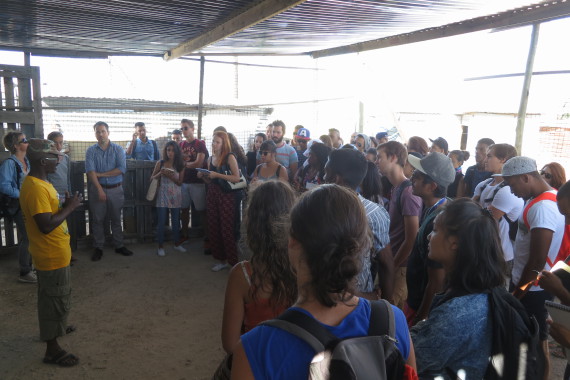
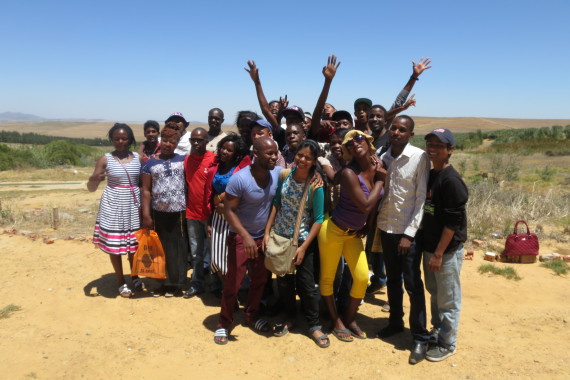
CPUT & Reunion Students visit Lwazi Park.

CPUT & Reunion Students visit Lwazi Park.

Lwazi Park Informal Settlement

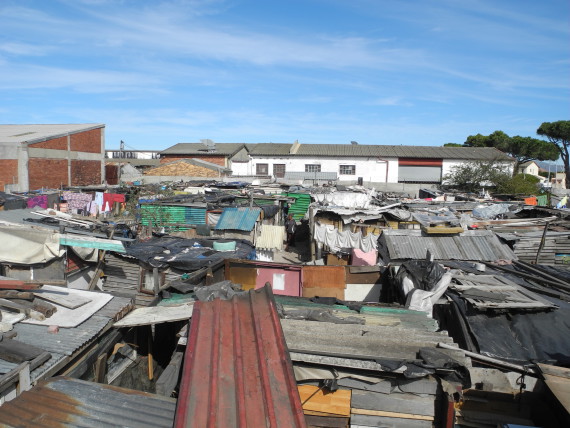
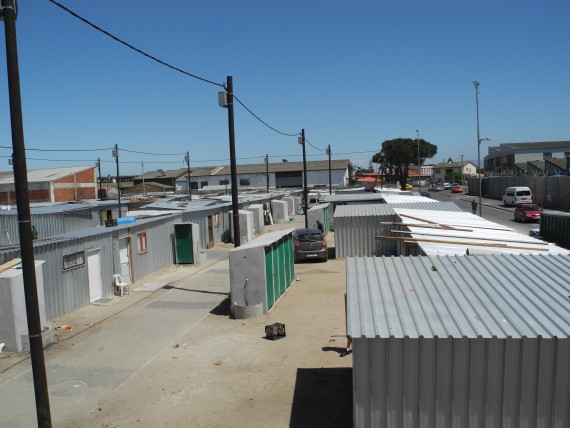
Lwazi Park is situated in Gugulethu, near the N2 freeway in Cape Town. The settlement is now home to thirty-eight households and a primary school adjacent to the area. Its first inhabitants are alleged to have occupied the space in the mid- 1990s, when they built informal dwellings near the Lotus River. In 2001 the informal settlement stretched from Klipfontein Road up to the Eastern edge of Gugulethu. Lwazi Park is characterized by canals that were built fifty years ago, with the purpose of draining the flood plains for communities who were forcibly removed from the city centre during the apartheid era. Today, these canals are polluted and flood every rainy season.

View of Lwazi Park canal

View of Lwazi Park canal

Past Studios Paving the Way for Lwazi Park

The relationship between Lwazi Park community and the SA SDI Alliance dates to 2011, when the community, Alliance and City of Cape Town began to address a pending relocation of the informal settlement. Click here for more background. CPUT’s architectural technology students first participated in joint design studios with ISN & CORC in 2011 working on subsequent collaborative design in Vygieskraal and Manenberg.

The 2015 Lwazi Park studio was convened as a response to the community’s desire to explore options for further in situ upgrading after re-blocking in 2011. This is one of the first Alliance studios focused on incremental housing typologies for a settlement that has already undergone re-blocking. The studio thus reflects the incremental and cumulative nature of informal settlement upgrading. Perhaps even more significantly it speaks to a context-specific and community-centred approach.

Lwazi Park after reblocking in 2011

Lwazi Park after reblocking in 2011

Within the Alliance, studios play a significant role. On the one hand they support community negotiations with local authorities: through a collaborative approach studios bring about community-informed design typologies. On the other, they challenge and extend existing disciplinary norms in architectural thought and practice. CPUT Lecturer, Rudolf Perold, explains that such approaches are anomalies in

“the field of architecture, which often does not make provision for design in informal areas let alone consider the community’s lived context as informing appropriate and relevant design solutions*.”

In this sense collaborative design studios generate ideas and debate on alternative housing design and delivery options that address residential environments within existing and challenging urban conditions.

Lwazi Park Studio Content: incremental housing typologies

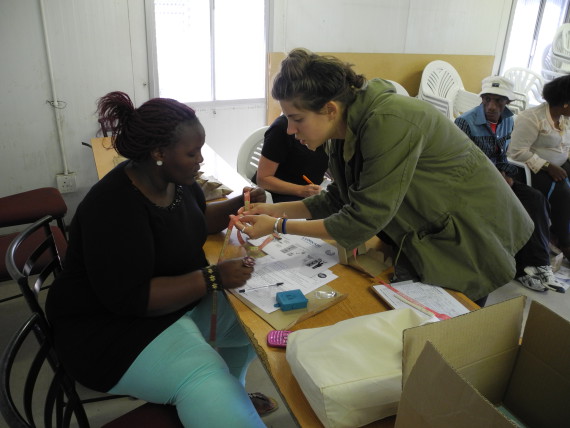
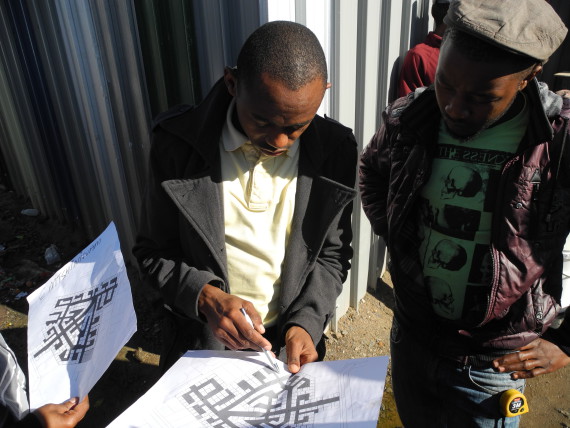
In practice, the studio comprised a site visit to Lwazi Park and two collaborative design instances between community representatives, students and Alliance representatives (ISN & CORC) who provided social support and facilitation. The students were tasked to develop a spatial development/master plan for the settlement’s in-situ upgrading to two to three story residential buildings as well as housing typologies that would respond to the social needs and spatial context of Lwazi Park community.

Lwazi Park community leader engages students around their questions.

Lwazi Park community leader engages students around their questions.

During the site visit community members introduced students to the physical layout and context of their settlement, lived realities, daily challenges and needs. These include the lack of a multipurpose / community hall or a nearby school. A central concern was the lack of funding provided by the city to help improve the standard of living. The community also expressed a desire for a safe place for their children to play in. A further concern related to drug abuse by the youth and the unsettling rate of crime.

Once the site visit had been completed and some preliminary insight gathered from community members, the design process began. CPUT lecturer Rudolf Perold explains,

“Their [the students’] point of departure was the community representatives’ assertion that they were set on obtaining tenure security and upgrading their settlement. Having had to adjust their approach based on the input received (albeit not representative of the entire community’s wishes) the complexity of balancing the community’s needs with your own design intent became clear”.

Challenges and Learning Points

In reflecting on the studio, CPUT lecturer Rudolf Perold highlights learning points for the students

  • The relationship between designer and occupant was crucial to the design process and triggered an empathy which contributed to the success of the design outcomes
  • The situated knowledge of community representatives and the Alliance proved integral to the development of the site layout and housing typologies
  • Students were sensitized to lived realities in informal settlements
  • “These experiences show that designers require a broadened skill set if they are to prove themselves useful in a context of mediation between poor urban communities and local government…- acting, as Stephen Lamb of Design-Change says, as interpreter of community needs rather than the holder of professional knowledge”
  • CPUT-based studio with input by community representatives, ISN & CORC.

CPUT-based studio with input by community representatives, ISN & CORC.

In addition a CPUT student added,

“Realising how people adapted to their living conditions in Lwazi Park and how these conditions push people to learn to survive, was a learning curve for me.”

For both the students and the Alliance a core challenge was experienced by the lacking attendance of enough community representatives in campus-based contact sessions. The students gained some community input during the site visit, which helped to contextualize and ground their work. The lack of community representation, however, speaks to a need for more social facilitation between the different actors involved so that the jointly designed plans can indeed be presented to the municipality.

  • CPUT quotations taken from “Perold.R., Devish, O., Verbeeck, G. 2015. Informal Capacities: Broadening Design Practice to Support Community –Driven Transitions to Sustainable Urbanism. Working Paper.
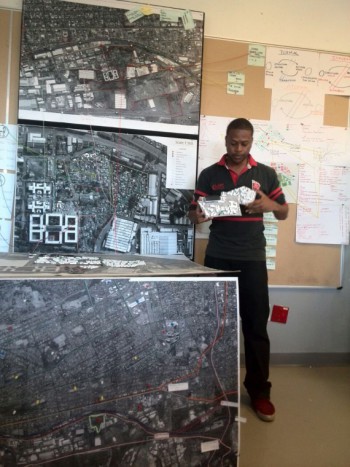
Presentations of master plans and housing typologies
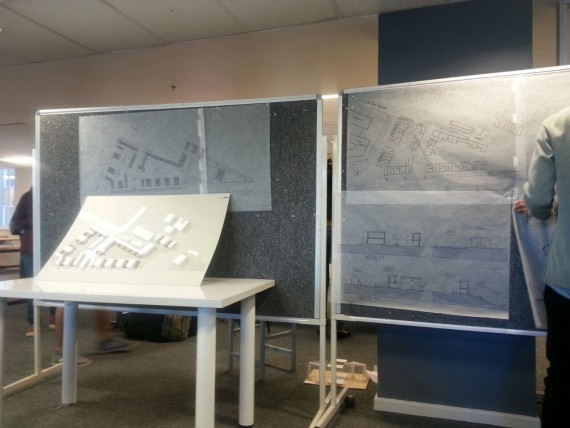
Presentations of master plans and housing typologies

Final Student Presentations

Final Student Presentations

Building Continuity: Denver Community and University of Johannesburg Studio 2015

By CORC, FEDUP, ISN No Comments

By Motebang Matsela (on behalf of CORC)

From 27 April to 22 May 2015, the community of Denver informal settlement in Johannesburg partnered with students from the University of Johannesburg’s (UJs) Department of Architecture in a collaborative design studio. Such studios focus on co-producing ideas, scenarios, plans and typologies on informal settlement upgrading and housing. Denver’s first collaborative studio took place in 2014. It was the first of consecutive, annual studios that would build on previous work and span a period of 3-5 years. The 2015 studio therefore started where the last studio ended, focusing on establishing tangible outputs such as a collaborative design handbook and a catalogue of dwelling typologies.

20150605072345

Co-producing Ideas: Denver Studio 2014

In 2014 the studio catalysed the generation of co-produced mapping and socio-demographic data on the settlement. The aim was to formulate community action plans (CAPs) for Denver Settlement in an effort to encourage short-term community initiatives and to support further productive discussion with local government agencies and other stakeholders regarding incremental upgrading in informal settlements. It also introduced students to the necessity and value of planning with communities, shifting the focus from traditional ‘top down’ delivery towards ‘responsive’, community-orientated approaches. For more background on the settlement and the 2014 studio click here.

Aerial view of Denver informal settlements

Aerial view of Denver informal settlements

A growing partnership

The idea of co-production suggests the involvement of different stakeholders. For this studio, therefore, the role players included Denver community members and leadership, the Ward Councillor and community representative, a collective of community volunteers assembled at various stages of the long-term studio, Aformal Terrain in partnership with the Department of Architecture at UJ and its students and the Alliance’s ISN, FEDUP and CORC who offered technical and social support and facilitation.

Unlike previous studios that customarily take place in informal settlements, the Denver studio had to change venue when xenophobic violence broke out in Johannesburg. The socio-political atmosphere of the violence and hostel raiding was deemed an unsafe environment to operate under.

20150605070039

As indicated, the collaborative outcomes are valuable aspects of the studio’s work. Based on the experience of last year’s studio, Gauteng’s ISN leaders highlighted the need for community members to gain tangible skills throughout the studio and upgrading process just as the students do. Each stage (module) of the studio therefore couples a community member’s practical participation in the studio with project management skills. In this year’s studio, more emphasis was placed on community participation and benefit.

This led to a revision of the 2014 Memorandum of Understanding (MoU) formalising the partnership between the SA SDI Alliance and UJ’s Architecture Department.

Some of the changes were highlighted in terms of:

  • The precedence of the relationship between Denver community and SA SDI Alliance
  • Denver community decisions will be respected and take priority within this project
  • Any data generated by the community residents will remain the property of the residents. Copies of any formal information packages generated from the studio engagement will be made available to community leadership.
  • All parties agree to inform each other in writing around documentation, marketing or exhibiting of the Denver project. The documentation will sufficiently acknowledge the role of each party and most importantly the residents’

Building Continuity: Denver Studio 2015

The objective of this studio was to incrementally build on the content of the 2014 studio, creating continuity and ongoing engagement between past and future studios. It also aimed to develop a collaborative design ‘handbook’; a catalogue of typologies of dwellings in informal settlements with related strategies for improvement through self-build, co-ops, CBOs, local government assistance, infrastructure etc.

This investigation focused on three main issues;

  • site (the physical)
  • planning (spatial and developmental)
  • policy (strategies from governmental level)

20150605070105

The intention was that these three focal areas would form a broad scale critical inquiry into current upper strategies for informal settlement upgrading and as a starting point suggested possible linkages with existing bottom-up initiatives.

It is envisioned that the outcomes will come to fulfilment in various forms through the studio process over the next 3-5 years in the form of awareness and knowledge packs about the settlement, site handbooks and guides on in-situ upgrading at various scales (shelter, site, policy, planning etc.), design studies for future densification and longer term formal development. A number of other valuable outputs not limited to this list will be determined through the studio process.

These potential outputs aim to bridge the gap between current bottom-up and top-down strategies already active in Denver – aiming to ‘connect’ community initiatives and local government intentions in more productive conversations toward improvement.

20150605070125

The studios final presentations tabled prototype-scenarios generated in response to a three-week focused research exercise focusing on 3 scales;

  • Dwelling-and-Neighbourhood,
  • Planning
  • Policy

In this final week (loosely termed ‘rapid design prototyping’) students worked in mixed groups, integrating information from the 3 earlier foci with the aim of generating scenarios for the potential improvement of Denver Informal Settlement. It is intended that these scenarios become useful tools for engagement with the residents of Denver in focused workshops and engagements during the course of this year.

Reflections on the Southern African Hub Meeting: Blantyre, Malawi

By SDI No Comments

***Cross-posted from SDI Blog***

By: Mariana Gallo, Knowledge Management Officer CCODE; Nico Keijzer, LME Officer Southern Africa SDI; & Noah Schermbrucker, Projects Officer SDI 

The recent regional hub meeting for Southern Africa took place in Blantyre, Malawi, from 28-31st March 2015. It was the first time that Blanytre or Malawi have hosted a regional hub meeting and provided an opportunity for the Malawian alliance to showcase their work. Participants from South Africa, Namibia, Zambia, Swaziland, and Zimbabwe attended the meeting. Botswana was invited but not able to attend.

Country Reports and Field Visits

The day commenced with each country reporting on their key indicators using the new Learning, Monitoring, and Evaluation (LME) reporting format. All countries concurred that this format assisted them in measuring progress, setting realistic targets, identifying challenges, and more targeted learning to overcome them. For the first time the hub was able to produce accurate totals for Southern Africa – as illustrated in the below table.

Southern African Hub Totals
Baseline Target Achieved Total
Members  161 961,00  8 765,00  7 084,00  169 045,00
Savings Groups 2490 300 217 2707
Daily Savings  4 354 901,00  829 755,00  287 494,00  4 642 395,00
UPF Savings  1 960 417,00  210 099,00  127 794,00  2 088 211,00
         
Settlement Profiles 1553 445 316 1869
City-wide profiles 123 32 3 126
Enumerations 294 50 47 341
Maps – GIS 109 306 207 316
Maps – Hand drawn 15 24 10 25

A variety of field visits also took place. Those who visited Nancholi settlement learnt about the slum upgrading activities that were being undertaken by the federation. Work included the construction of bridges, the development of an agricultural market, the renovation of a local clinic, and the construction of additional blocks for the local secondary school. Other delegates visited a variety of groups who were involved in income generation projects. One group called “Waste for Wealth” produces and sells compost. Another group makes sausages that they package and sell, while a third group makes and sells tie-dye clothes.

The group producing compost manure in Chilomani, explaining their experience with the enterprise.

The group producing compost manure in Chilomani, explaining their experience with the enterprise.

City Council and Discussions on Country Projects

On the third day, hub delegates visited the Blantyre City Council for a meeting with the Mayor, the Director of Planning and Development for Blantyre, and other officials. While the meeting illustrated the successful partnership between the Malawian Alliance and the Blantyre City Council (BCC) it became clear, through the lively discussions that took place, that these types of partnerships need to be underpinned by material commitments from government (e.g. land, budgetary allocations for slum upgrading). The international delegation pushed the BCC around its previous commitments to establish a citywide slum-upgrading fund. The Malawian federation needs to follow up on the space opened by this discussion.

The meeting attracted media attention, and was reported on the front page of one of the main newspapers on the following day.

Hub participants attending a meeting with the Blantyre City Council.

Hub participants attending a meeting with the Blantyre City Council.

The afternoon’s sessions provided an opportunity for delegates to reflect more deeply on their LME process. Not only in terms of challenges identified but feasible actions to address these issues. Below is an example of this work that the hub collectively committed to implementing over the next period. Outcomes will be reported at the next hub meeting.
Challenges:

1) Unrealistic targets,

2) Understanding of enumerations process or profiling is difficult,

3) Not having a system of reporting,

4) Politics delays the process,

5) Working with other stakeholders is always difficult and can delay the whole process,

6) Changing the mindset of people who expect a lot of money as some organisation does,

7) Slow implementation of projects,

8) Not practicing daily savings.

Possible Solutions:

1)     Setting of realistic targets within a specific period of time,

2)     Drawing of process maps – steps involved in saving, profiling, enumeration etc.,

3)     Mobilizing communities on why they are doing the profiling, enumeration etc.,

4)     Having standard reporting templates/systems,

5)     Signing of MOU’s (exchange visits among municipal/local officials),

6)     Joint working groups that involves stakeholders,

7)     Communities must take ownership and drive the change in the community,

8)     Communities should have one voice in getting resources from local authorities,

9)     Going back to the roots of daily savings.  Take ownership of savings and how the money is managed to build confidence.

Data, Reflections on Donor Funding, Exchanges, and Closing

The final day commenced with a presentation on the data platform from the SDI Secretariat. Federations were able to access, discuss and interact with the online platform that stores their profiling information. This is part of a process to deepen federation ownership of the information collected.

An interesting and important discussion, which is central to the work of all federations and affiliates, then took place.  The crux if this discussion is that while it is recognised that donor funding is needed for activities, the agenda and priorities of donors can sometimes be in conflict with the federation’s core vision (e.g. building unaffordable housing on the periphery of the city).  Broken into country groups delegates discussed criteria for accepting donor funding. Flexibility, equal partnerships, common vision and inclusion of the poorest were amongst the common points of consideration.

The meeting closed with a collective reflection session that gave delegates an opportunity to assess the content and structure of the hub meeting.  More substantive details can be found in the hub report. The next hub meeting was set for September in Zimbabwe.

The Malawi Alliance prepares their data for sharing

The Malawi Alliance prepares their data for sharing

Malawi Federation members work with the online data platform.

Malawi Federation members work with the online data platform.

Taps, Toilets & Beyond: ISN partners with Water & Sanitation Dept

By CORC, ISN No Comments

By Nkokheli Ncambele (on behalf of ISN)*

Nkokheli Ncambele is the regional co-ordinator of the Alliance’s Informal Settlement Network (ISN) in the Western Cape.

Emseleni Community leader, Nomfundo Lungisa

Emseleni Community leader, Nomfundo Lungisa

In Mfuleni, informal settlements have been without basic services for five years. People had to buy water from surrounding formal houses; at night it was difficult for them to get to a toilet. Last year, ISN started creating a partnership with the City of Cape Town’s Water & Sanitation Department. We kept reporting these problems to the City until we saw that there was a light: the Department came to us saying, “Yes we are going to do something in those communities”.

The City is very important as a partner because when they come on board we see results: in March 2015 they installed a total of 15 standpipes for taps and 57 flush toilets in five settlements (Tambo Square, California, Constantia, Strong Yard and Emseleni) in Mfuleni region which is one of four ISN sub-regions in Cape Town. Every settlement’s leadership sends two or more members to our weekly sub-regional meetings to discuss issues. After we collect all issues we decide where to start. This is how we chose these five settlements for Water & Sanitation installation.

ISN co-ordinators Nkokheli Ncambele and Melanie Manuel with Kuku Town community leader, City of Cape Town councillor and officials

ISN co-ordinators Nkokheli Ncambele and Melanie Manuel with Kuku Town community leader, City of Cape Town councillor and officials


From backyards to informal settlements

You will find that most settlements like Tambo Square, California, Constantia, Strong Yard and Emseleni were established when formal housing was introduced. When there is a big housing improvement project there are always people who move in as backyard dwellers. Why are there so many new settlements like these? Because backyarders are tired of paying rent and being mistreated by homeowners who cut off services without notice. That’s why backyarders move into nearby open spaces.

Constantia informal settlement is in close proximity to formal housing.

Constantia informal settlement is in close proximity to formal housing.

Constantia Steering Committee members, Nolusapho Thandela and Phindiswa Payiti

Constantia Steering Committee members, Nolusapho Thandela and
Phindiswa Payiti


The beginnings of ISN in Mfuleni

Before ISN, we as community leaders used to have a joint leaders forum in Mfuleni. When we heard about ISN, we decided to join because the movement was talking about what we were already doing for a long time.

“We realised that actually we are ISN – anyone who is staying in an informal settlement is ISN. Let’s take this forward”.

New sub regional leaders asked us to explain the ISN process to them. Other community movements, development forums and Councillors also know about us. I can say that 99% of informal settlements in Mfuleni have gone on exchanges to see what other ISN communities are doing. That’s why they want to be part of ISN and why Mfuleni is becoming an ISN base. Look at the people of Tambo Square – they want to be involved in their own project. When the ISN coordinators go to Emseleni, people just come out to greet us. We see that people are hungry to solve their problems.

“Tambo Square started in 2007 when backyarders moved here. We had no toilets or taps and used to get water from the formal houses. We took our problems to ISN who helped us go to the municipality. These changes came to us with ISN – they play a big role for us”.

(Nkosikhona Bangiso, Tambo Square Steering Committee Leader)

Tambo Square community leader, Nkosikhona Bangiso

Tambo Square community use back of newly installed toilets for mapping workshop to plan further upgrading initiatives in their settlement.

Tambo Square community use back of newly installed toilets for mapping workshop to plan further upgrading initiatives in their settlement.


Building our partnership with the City

As ISN, we know that the Department of Water & Sanitation has an interest to deliver basic services to communities. The difficulty is that many settlements have little open space for services to be installed. When ISN started mobilising communities and speaking about the value of basic services, community members began thinking about how to create more space in their settlement. In Tambo Square, for example, it looked like there was no space. We suggested that the community remove a large container that stood at the entrance of the settlement. Now there are ten toilets in that space. In this way it was easy to convince Water & Sanitation to partner with us. I think I can say that they see us (ISN) as a solution. We told them,

“We’ve got the space, now you can come and install the toilets. Don’t say there is no space in our community”.

The role of ISN & CORC in partnership building

What is unique about our Alliance is that CORC created a space between ISN and the City. In 2009 there was opposition between communities and the City. Because of that CORC was there to neutralise the relationship. I can say that CORC was a bridge that connected us to the City. The City used to say, “We don’t want to go to meetings with the communities because they will swear at us and toyi-toyi (protest) and do all these things.” But CORC has a belief that communities won’t do that. Through the engagement with CORC we (ISN) understood that we need to go to the table, and not to the street. Then at the end of 2009, the City started saying, “This thing is working”. I think that is why they are happy to work with us.

Flamingo Crescent informal settlement community members with ISN facilitator Melanie Manuel, CORC Director Bunita Kohler (left) and City of Cape Town Mayor Patricia de Lille

Flamingo Crescent informal settlement community members with ISN facilitator Melanie Manuel, CORC Director Bunita Kohler (left) and City of Cape Town Mayor Patricia de Lille

Nkokheli Ncambele (second from left) with fellow ISN co-ordinators Mzwanele Zulu and Melanie Manuel (far left and right), CORC technical support, Sizwe Mxobo (centre) and Western Cape MEC for Human Settlements.

Nkokheli Ncambele (second from left) with fellow ISN co-ordinators Mzwanele Zulu and Melanie Manuel (far left and right), CORC technical support, Sizwe Mxobo (centre) and Western Cape MEC for Human Settlements.


The bigger picture: taps, toilets & beyond

We recently met with an Mfuleni councillor and asked what he thought about Mfuleni as a whole. He said he has a bigger picture – that in the next 20 years he doesn’t want to see informal settlements. For that to be possible I see that he needs a movement like ISN that will make sure that his vision is pushed. What is our vision? That all settlements have basic services and that all people who are living in informal settlements have houses. Our vision and his vision are on the same page.

* Compiled by Yolande Hendler (on behalf of CORC)

Newly installed water & sanitation in Strong Yard settlement, Mfuleni

Newly installed water & sanitation in Strong Yard settlement, Mfuleni


Rolling out Lumkani Fire Device: Preventing Fires, Upgrading Communities

By CORC, FEDUP, ISN, News No Comments

By Yolande Hendler (on behalf of CORC)

The last two months bear witness to the devastation fires can cause. At the height of South Africa’s hottest months, fires pose a continuous threat, often breaking out in informal areas, wiping out entire segments of informal settlements, despite the response of fire departments.

Fire in Langrug, Stellenbosch Municipality, February 2014

Fire in Langrug, Stellenbosch Municipality, February 2014

A proactive response to fire?

In January and February 2015, the Alliance was alerted to two fires in ISN/FEDUP settlements alone, with several more breaking out in the City of Cape Town and Stellenbosch Municipality such as in Langrug informal settlement where an estimated 70 structures were razed to the ground. In 2014 the City of Cape Town’s Human Settlements directorate spent R6.5 million on fire aid by issuing 1 186 enhanced emergency kits to victims of 254 separate fires in a period of two months.

How can the response to informal settlement fires become less reactive and more proactive and preventative? Since early 2014 the SA SDI Alliance has partnered with Lumkani, a social enterprise that has designed and co-developed an early warning fire detection device with ISN and FEDUP affiliated communities in Cape Town.

UT Gardens leadership with Lumkani with installed device on wall

UT Gardens leadership with Lumkani with installed device on wall

2014-11-24 11.50.54

Co-developing the Lumkani device

The Lumkani device uses heat detection technology to sense for fires. It accurately measures the incidence of harmful fires alerting the family inside a shack of the danger. Each device is networked to surrounding devices within a 100m radius. In the event of a fire the detecting device sends a signal to surrounding devices within this range. A solid beep means that the device has detected a fire in your own home while a broken beep indicates that the fire is in the nearby surrounding. A wave of sound creates a community-wide alert and response to danger. This buys time for the community to become proactive in rapidly spreading fire risk situations. Through deep engagement with UT Gardens community leadership, the Lumkani team co-developed the device to optimally suit the informal settlement context. Read more about the device and the co-design process here.

The Lumkani device

The Lumkani device

DSCN7918

Co-developing the device – workshop in UT Gardens ahead of rollout and installation.

DSCN7901

Co-developing the device – workshop in UT Gardens ahead of rollout and installation.

Roll-out and Community Contributions: “We are proud of our device”

In November and December 2015 the first Lumkani devices were rolled out in UT Gardens and Siyahlala’s D-section. Currently ISN and FEDUP community leaders have rolled out 650 devices.

On the first day of distribution and roll-out, community leaders and members of the Lumkani team installed about 20 manufactured devices in the homes of community leaders and general community members. The devices need to be installed 1m away from the cooking area, to avoid triggering a false alarm in the event of close proximity to a heat source. The device is therefore positioned as high as possible while still in reachable distance in order to test or silence the alarm.

As the first batch was installed the community leadership collected a 20% contribution of the overall cost of the devices from community members through door-to-door visits. Contributions are an integral part of the Alliance approach of “Vuku’zenzele” – “Wake up and do it for yourself”.

Nokokheli Ncambele, Western Cape ISN co-ordinator explains,

“[Contributions are important because we want] communities to find solutions to their own problems. If a community contributes, they show that they are interested. With our contributions, we leverage more funds”

Communities that expressed interest in the device during initial mobilisation could apply to the Alliance’s Community Upgrading Finance Facility (CUFF) for co-funding, whereby CUFF covered 80% and community members contributed 20% (i.e R20) of the total cost.

Emily Vining, who facilitates Lumkani’s community interaction, reflects on the significance of community contributions,

“It is our hope that the act of purchasing the device is an exercise of freedom whereby people can increase their own safety and security and that of their community through their own agency and choice. Communities don’t have to wait for external actors to bring about change. They can do it for themselves”

2014-11-24 11.33.33

UT Gardens community leader, Vuyani Ntontela and Lumkani engineer Frank Petousis install device

Lumkani with Nozuko

Siyahlala’s FEDUP co-ordinator, Nozuko Fulani, with Lumkani’s Emily Vining & Frank Petousis

Fire prevention record so far

So far the system has prevented the spread of two fires in UT Gardens. The first (9 Dec 2014) occurred in the late morning when a light breeze blew some embers from a cooking fire into the neighbouring home. Although the homeowner was away, the Lumkani device she had installed triggered her neighbours devices who ran outside their homes to see where the danger had come from. The community managed to keep the fire contained with buckets while one community member used the toll-free emergency number 112 to call the fire department. The fire had burnt the community member’s home to the ground but no other structures where affected. The community attributed this to the early alert the Lumkani system provided.

The second incident occurred in the early morning hours of 22 Dec 2014 when UT and Lumkani leadership were alerted by SMS text messages that the system had triggered. Later that day it emerged that some men had left their pot unattended while making food. Their Lumkani device rang when the pot caught fire alerting them to the danger. They quickly put out the fire and shared the story with UT Gardens community leader, Thamara Hela, as they were very impressed with the functionality of the device.

DSCN7907

UT Gardens community leader, Thamara Hela, with Emily Vining

A broader approach to Upgrading

The Alliance’s partnership with Lumkani is an example of what a proactive community intervention can look like. Its significance lies in the co-design and co-development of the Lumkani device – between community members and Lumkani’s technical team. What sets the Lumkani device apart is the community’s involvement in developing its own technical intervention. Through negotiating additional funds through their own contributions the community expressed its interest in taking the device on as its own – “Vuku’zenzele”.

The partnership is also an example of a broader approach to upgrading, one that reaches beyond housing and basic services. When upgrading includes co-design and relevant co-intervention, communities move from being receptors to actors, taking more control of the development process itself. 

CORC planner honoured with SAPI Young Planner Award

By CORC, News No Comments
On site in Flamingo Crescent Informal Settlement

On site in Flamingo Crescent Informal Settlement

Sizwe Mxobo, a planner at the Community Organisation Resource Centre (CORC) received  the South African Planning Institute’s (SAPI) Young Planner Award in October 2014. In speaking about his work as a planner with community movements affiliated to the SA SDI Alliance, Sizwe explains,

“An important aspect for me is exploring what public participation means in planning and informal settlement upgrading” (Sizwe Mxobo, CORC Planner).

In early 2014 SAPI released a call for nominations for successful young planners and announced its bi-annual summit in Durban titled “Planning Africa” from 19 – 22 October 2014. Nominations were submitted under various categories, one of which was the Young Planner award – to be made out to a “bright young planner (under the age of 35) for his/ her exemplary achievements and promising for the future in the planning profession as well as his/her contribution to the promotion of the planning profession” (SAPI).

The SAPI Awards

The SAPI National Planning Awards were established in 2008 to recognise and create a strong awareness of the valuable contributions and extraordinary performance in all aspects of the planning profession. The awards are an opportunity to appreciate the efforts and contributions of many planners in shaping the built environment, promoting sustainable development and maintaining the integrity of good planning practice amidst competing development interests and challenging situations.

Sizwe with Langrug commnuity leaders Trevor Masiy and Alfred Ratana

Sizwe with Langrug commnuity leaders Trevor Masiy and Alfred Ratana

Planning in the SA SDI Alliance

Sizwe has been working with CORC since 2011, providing technical support, often in informal settlement upgrading initiatives, ranging from community mobilization, capacity building, assisting settlements with preparing development plans or engaging City officials around service delivery issues.

In 2012, Sizwe project managed the upgrading and re-blocking of Mtshini Wam informal settlement in Cape Town. The project set a precedent for informal settlement upgrading, at local and national level whereby the City of Cape Town used it as a benchmark to deliver a reblocking policy. It was also awarded an Impumelelo Gold Award in 2013. Since then Sizwe has spearheaded 3 other upgrading and re-blocking projects in the City. Sizwe’s work has also focussed on Langrug informal settlement near Franschoek in the Western Cape. Through deep engagement with the community Sizwe assisted CORC and the community in devising a pallette of informal settlement upgrading strategies. The planning of Langrug was awarded the SAPI National Award in the Community Category.

Planning reblcoked Layout in Mtshini Wam informal settlement, Milnerton

Planning reblocked Layout in Mtshini Wam informal settlement, Milnerton

Why Planning?

When tracing his steps as a planner, Sizwe links his interest in participatory, community based planning to his roots.

“I was born and raised in an informal settlement and still live in one. I have always wondered what it would take to transform an informal settlement. When I saw the first housing developments in Samora and Delft I asked myself why people had to move away from their current locations and amenities. Why could changes not happen where people lived?”

Sizwe’s fascination with community development – particularly how informal communities could be transformed to formal settlements – inspired him to study Town and Regional Planning. He remembers that although informality was addressed by the curriculum it largely focussed on how to move from a shack to a house.

“My biggest attraction has always been how planning principles can be used in informal settlements. When I was planning chairperson we took students to Nyanga and explored what in-situ upgrading is about. I learnt that my interest in fighting for people who are generally not considered by planning institutions – landless people in urban areas – is called advocate planning. Others did not always understand my approach to planning. Through working at CORC I found my feet and understood what planning is for me. Winning this award has been a further confirmation. We are no longer talking the language of eradication of informal settlements but of upgrading”

In Nyanga, Cape Town

In Nyanga, Cape Town

In Kuku Town informal settlement with community leader Verona Joseph

In Kuku Town informal settlement with community leader Verona Joseph

A different approach to Planning

“In the ever-changing role of a planner, I think a key element for planners is to ensure the relationship between people and land. Public participation should be more than drawing up plans and asking for a community’s approval. It should be about supporting people to come up with their own development plans for their communities”

(Sizwe Mxobo)

As a profession planning is rapidly transforming. Most urban policies developed in South Africa focus extensively on community participation. Both the National Development Plan (NDP) and Upgrading of Informal Settlements Programme (UISP) talk about community participation as a central tenet for development. However, government has also identified this as a missing link and capacity both within the municipal and private sector. Most recently, the National Upgrading Support Programme (NUSP) has floated tenders in 49 different municipalities to develop community based plans. Clearly, community participation in the planning sector is the need of the hour.

SAPI Award Ceremony in Durban, Oct  2014

SAPI Award Ceremony in Durban, Oct 2014

Discussing Plans with Flamingo Crescent Community Steering Committee

Discussing Plans with Flamingo Crescent Community Steering Committee

With Kuku Town Steering Committee, Kensington

With Kuku Town Steering Committee, Kensington

Launch of Upgrading at Flamingo Crescent with Cape Town Mayor Patricia de Lille

By CORC, FEDUP, iKhayalami, ISN, Press No Comments

Authored by CORC

“People said Flamingo Crescent [Upgrading] will never happen. But today is here and this is the proof that it has happened – one cannot do it alone we need to work as a collective!”

Melanie Manuel, Informal Settlement Network (ISN) Co-ordinator

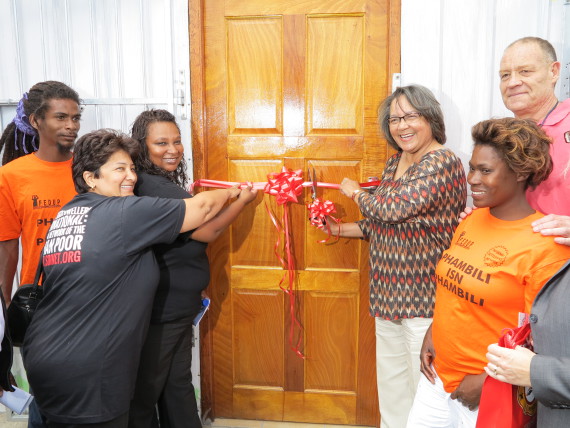
Mayor of Cape Town, Patricia de Lille, with Flamingo Crescent Community Members, SA SDI Alliance, PFO's and City Officials

Mayor of Cape Town, Patricia de Lille, with Flamingo Crescent Community Members, SA SDI Alliance, PFO’s and City Officials

Last week’s upgrading launch at Flamingo Crescent informal settlement celebrated the completion of re-blocking, installation of water, sanitation and electricity services for each of Flamingo’s 104 households, the unveiling of Flamingo’s first formal street names and opening of the settlement’s own crèche, Little Paradise. Moreover it marked a milestone in an ongoing upgrading process, showcasing what is possible when communities, intermediaries, governments and stakeholders form partnerships.

Delegates from community organisations and networks, the Mayor of the City of Cape Town, delegates from various government departments, ward and sub-council politicians, NGOs and support organisations gathered in the Lansdowne Civic Centre from 11:00 on Monday 10 February.

The re-blocking project is lauded as a successful demonstration of community-led, participatory planning, collaborative implementation and improvement of informal settlements. The uniqueness of the project was that despite the settlement’s density no one was displaced and grossly inconvenienced during the implementation of upgrading 104 structures.

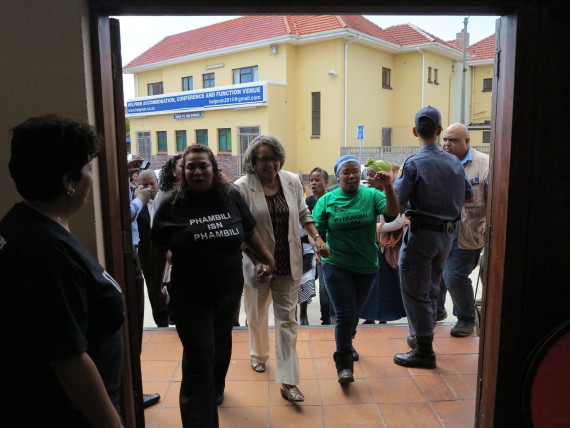
ISN & FEDUP welcome the Mayor to the launch at Lansdowne Civic Centre

ISN & FEDUP welcome the Mayor to the launch at Lansdowne Civic Centre

First engagements around Flamingo Crescent 

First engagements began in 2012 after the City of Cape Town signed a Memorandum of Understanding with the SA SDI Alliance around joint community-led upgrading of 22 informal settlements, of which Flamingo Crescent is the third, having built on the experiences of Mtshini Wam and Kuku Town. It differs from the previous two in the severity of its socio-economic challenges – high levels of crime, unemployment, violence and poverty. Given these circumstances the Alliance’s Informal Settlement Network (ISN) facilitated implementation and engagement between the City and the community.

Melanie Manuel (Flamingo Crescent ISN facilitator) shared,

“When we started the partnership with the City of Cape Town in 2011 in Vygieskraal it was a day of celebration and no one knew the hardships that would lie ahead. As time went on we realised we fundamentally believe in community participation, a bottom up approach because we know communities understand their settlements best.”

Read more background here.

Flamingo Before Upgrading

Flamingo Before Upgrading

The Launch: Messages on Upgrading and Inclusion in Services

At the launch, the first speaker, Councillor Anthea Green shared,

“Since 2012 I have said that we need to upgrade Flamingo Crescent, despite resistance from the rate payers and residents’ groups. We were committed to work with the community, and now this is a transformed settlement”.

Informal settlements not only face substandard basic services like water, sanitation and electricity but are also cut off from functions of city administration such as receiving a residential address. The re-blocking project allowed the City and the Post Office to give Flamingo Crescent street names and addresses, after the community made this requirement upfront in their development plan.

Gerald Blankenberg, regional director of the Post Office, said that the Post Office Act and other regulations require the post office to expand addresses to underserviced communities.

“Informal communities are often times socially and economically disconnected from basic administrative functions, and therefore a residential address will give the Post Office an opportunity to serve the community with dignity”, he said.

In the keynote address, Mayor Patricia de Lille emphasised the significant role of Flamingo community’s steering committee, the Alliance’s ISN and Community Organisation Resource Centre (CORC) in the success of the project. She, however, expressed concern about the slow pace of project implementation, emphasizing the need to boost municipal and community capacity to ensure the roll out of more projects in the City’s 200 informal settlements.

“The aim of re-blocking is the improvement of informal settlements while people wait for a housing opportunity”, she observed.

In closing of the ceremony, the Mayor handed over certificates of tenure to community members, ensuring formal recognition of residence and tenure security.

Mayor, Patricia de Lille with Flamingo Community Leader, Maria Matthews

Mayor, Patricia de Lille with Flamingo Community Leader, Maria Matthews

The Impact of Upgrading : Before and After

Before re-blocking, the community of 405 residents had access to only 14 chemical toilets (of which 7 were serviced) and 2 water taps. There was no electricity so that contained fires in tin drums dotted the settlement’s dusty pathways. The community was especially concerned about the safety of its children playing in the busy street.

Re-blocking restructured space in the settlement, opening courtyard areas and clearly designated access roads, enabling the City of Cape Town to install individual water, sanitation and electricity services per household. What sets Flamingo apart from previous projects are its paved pathways, with official road names as well as the construction of a crèche.

The community contributed 20% to the cost of its structures through community-based daily savings. During the implementation phase, 20 jobs were created through the Expanded Public Works Programme.

Before upgrading

Before upgrading

After upgrading

After upgrading

Into the Future: Community voices on Partnership and City Fund

“Since 2010 we have been thinking about improvements in our settlement. This is when we got in touch with ISN, who introduced us to CORC, and we then made a partnership with the City [of Cape Town] We explained what we wanted from the city – our own taps, toilets and electricity. But we needed to come together and draft our own plans”.

(Maria Matthews, Flamingo Community Leader)

Through the SA SDI Alliance the community additionally partnered with several organisations. iKhayalami supported the community, ISN/FEDUP and CORC around training community members and top structure construction. The community established the re-blocked layout and community-based maps in partnership with students from Cape Peninsula University of Technology and support staff from CORC. With the support of Worcester Polytechnic Institute (WPI, USA) the community drew up plans for the crèche. Habitat for Humanity South Africa contributed to construction by supplying the roof sheets and windows. The Centre for Early Childhood Development (CECD) donated funds to build the crèche. CECD will also support around the training and registration of the crèche.

From Melanie’s speech it was clear,

“This project is successful because of the methodologies we use. We allow communities to do their own designs. The community also made a [financial] contribution [in a settlement] where 95% of community members were unemployed. How do we change the mind-sets of people who are still waiting for adequate housing? Let’s change the way we are living now while we are waiting for housing to come.”

(Melanie Manuel, ISN Facilitator)

Melanie Manuel, ISN Co-ordinator in Flamingo

Melanie Manuel, ISN Co-ordinator in Flamingo

As important as settlement improvement is in itself, the methodology is just as significant. Moreover, Flamingo Crescent serves as a precedent for informal settlement upgrading on a larger scale. The day ended with the community leading the Mayor through their settlement, unveiling Flamingo’s new street names and officially opening the Little Paradise crèche together. It is Melanie Manuel’s closing words that speak of the future:

 “We need to look at a holistic plan for the metro. Let’s look at how we can reach basic services much quicker and how we can scale up. The Alliance projects do not only focus on reblocking but on basic services in every form. The Alliance has designed a City Fund with which communities can directly access money for upgrading in Cape Town. In Flamingo the Aliance’s Community Upgrading Finance Facility (CUFF) helped us match the 20% that each community member contributed to their structure. This kind of facility on a city-level will go a long way – we challenge the City to continue partnering with us and match our contributions in the City Fund!”


YOUTH: Young. Organised. United. Talented. Hardworking.

By News 2 Comments

By Skye Dobson [Cross posted from SDI Secretariat]

beach3_big

“Poor people have me. Rich people don’t need me. If you eat me you’ll die. I am worse than a demon. Who am I?” 

This was the riddle Rogers, a youth member of the South African SDI Alliance posed to youth from across South Africa, Uganda, Kenya and India at the opening of a peer-to-peer exchange held in Cape Town, South Africa for youth activists last week. He put his phone on the table and said that whoever solved the riddle in 3 minutes would get the phone. To honor the riddle, I will tell you the answer at the end of the blog. 

Unfortunately the phone deal has expired.

“As a girl, I’m always told things happen because of fate. But it’s the things I do, not luck, that determine my fate. So we must forget about fate, and move forward.”

Shikha, India

prayasam_big

The exchange was inspired by the youth activism of Prayasam, an Indian organization founded in 1999 to enable children to participate in the decisions that affect their lives. When Shack/Slum Dwellers International (SDI), an international network of slum dweller federations in 33 countries, learned of Prayasam’s work and the shared strategies used to organize communities to profile and map their settlements as a starting point for negotiations with authorities, it was agreed that the two organizations would do well to promote peer-to-peer learning between youth members and other youth groups trying to make change in their settlements. With support from Sundance Films, SDI, Prayasam, The Community Organization Resource Centre (COURC), and SDI hosted a 6-day learning exchange for youth from informal settlements in Uganda, Kenya, South Africa, and India.

“I taught myself how to share and how to love. The River of Life showed me you can solve your problems as a group.”

Lucky, South Africa

riveroflife_big

A River of Life exercise on the first day – led by the Prayasam youth – kicked off the exchange and supported reflection by the youth on the highs and lows of their lives and their goals for the next three years. The youth drew and presented their personal rivers to the group. The stories were touching, referencing hardships such as the death of family and friends, early pregnancies, gang membership, and lost opportunities owing to a lack of financial resources. On the high points of their rivers, however, they explained the pride experienced when they got into or performed well at school, found spiritual direction, became members of youth groups, and took part in exchanges with other youth both locally and abroad. While their highs and lows were described in individual terms, it was fascinating to note that their aspirations for the future were almost entirely group-centered. The youth spoke of wishing to bring their communities together, of wanting to empower their peers, about increasing the membership and impact of their youth groups, of setting a good example to children, and of advocating for the rights of the young and the disadvantaged. This exercise set the stage for the youth to engage each other more openly. Instead of the standard introductions of formally structured peer-to-peer learning, these introductions stripped the process down to authentic fundamentals: Who am I? Why am I here? How did I get here? It was clear that the process was as much about answering these questions for oneself as it was about sharing it with others.

“The film showed that you’re never too young to make change.”

Sefiso, South Africa

A key inspiration for the youth exchange was a film called The Revolutionary Optimists, which follows Amlan (founder and Director of Prayasam) and three of the children he works with, as they become agents of change in their communities. The film not only captures the incredible work of Prayasm’s children, but the realities of life in Indian slums. On the second day the youth were able to see the film at a community center in Langa as well another from Uganda, The Boda Boda Thieves, which captures some of the realities of life in Uganda’s slums. The feedback from the youth was thoughtful and insightful. They were quick with their praise for the Indian youth and concluded that one is never to young to make change in his/her community. They expressed the similarities they saw between conditions in India and their own countries – particularly related to poor sanitation, teenage pregnancy, and child labor. They joked of the celebrities in their midst! From The Boda Boda Thieves film they concluded youth must be very careful when it comes to peer pressure and a desire to get money quickly. They all had stories about youth who had succumbed to peer pressure and “gangsterism” and they made references to the contributing factors. They discussed the importance of reaching out to parents so that they can support their children to join youth groups and take part in productive afterschool activities as an alternative.

“Statistics might be different from experiences.”

Sibo, South Africa (Sizakuyenza)

IMG_2104

IMG_2106

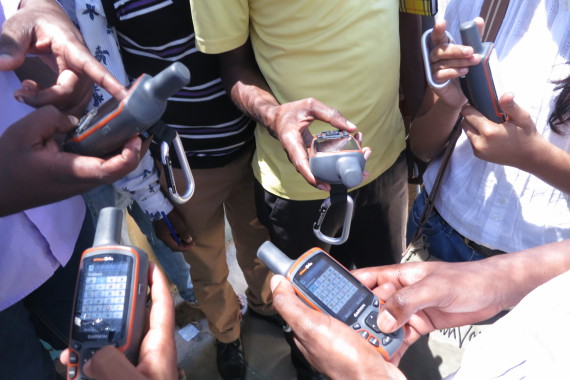
A unifying strategy across many of the groups is the collection of data by youth in order to plan for change and negotiate with other actors – often the State – to implement solutions. Both Prayasam and SDI affiliates profile slum settlements, but their approaches are slightly different and the youth were able to share and reflect on each others strategies, achievements, and challenges. In the spirit of Learning-by-Doing, the youth went to a settlement in Nginalendlovu in Khayelitsha anda settlement profiling exercise which was facilitated by community members and supporting professionals in the South African SDI Alliance. Half the group used GPS devices to map the boundary of the settlement, while the other half conducted the socio-economic profile with the local community, while trying to squeeze into all available shade under the awnings of shacks. Rogers, a youth member from Kwazulu Natal administered the questionnaire with infectious enthusiasm and finesse.

Community members were guided to discuss and generate information on their settlement, from the origin of its name, to issues of tenure security and services, to the biggest challenges facing the community. They expressed major concerns with water supply, flooding, and crime, but they were unanimous that the biggest threat to their community at present comes from rats. One gentleman explained that his cat was eaten by a rat and that children are attacked and one child’s hand was bitten off. It is important to note that a problem with rats was not amongst the check boxes on the questionnaire. This highlighted Rogers’ skill as a profiler and the need to allow sufficient time for communities to make less structured contributions throughout the profiling process. The community was eager for the compiled information to be returned to them and the discussion about their issues to continue so that they can begin to generate solutions.

“…everything in nature has its own reason.”

Rogers, South Africa

IMG_2271

IMG_2248

The reflections from one of the youth on his visit to Path Out of Poverty (POP) on Goedgedacht Farm visit were so poignant. Through a long term, holistic, programme, POP builds confidence and skills in rural youth and offers opportunities for self advancement and for making a real contribution to their own communities. Rogers said he was “blown away by POP” and that he learned “everything in nature has its own reason. You can learn from nature if you’re patient. If you watch it, it will teach you.” One could argue the same is true for these youth, who clearly have so much to teach the world about their realities and how they believe change is possible. Within them, like nature, the solutions can be found for many of the world’s ills. Salim, one of the Indian youth, said the way poems and song are used to “manage the kids” at the Goedgedacht Farm will really help him to strengthen his leadership at the preschool in his community, while Kamalika from Saldanha was inspired to go back to her community and work with small children.

“They come in wrecked and leave as a piece of art”

Sibo, South Africa

img_0256_big

On Wednesday the youth visited Sizakuyenza to see youth projects, including a recycling project, health services, and a women’s home called House of Smiles. The local federation designed Sizakuyenza to serve as a basket of services for the federation saving groups and their wider communities. The recycling initiative (Solid Waste Network) provides employment for youth and supports the municipality to keep the area clean. Many of the youth from South Africa and the youth from India were particularly interested in the waste project, as they have plans to operate waste management businesses of their own.

At House of Smiles the youth asked many questions about the women who live in the shelter and whether they were safe from their husbands once inside. They were interested to hear about the close relationship the center maintains with the police and the confidence they place in them. Many of the youth harbor suspicions about police, but the House of Smiles team has developed a close working relationship with them, which makes their premises and inhabitants feel secure.

IMG_2377

In the afternoon a youth choir by Ubuhle Bendalo, a youth group of about 90 members based in Makhaza, Khayelitsha. The group meets most days after school and uses the performing arts to develop each other’s artistic skills and address challenges in their community. The song, dance, and poetry were moving and had a number in the audience trying to blink away tears. The youth in Makhaza work hand-in-hand with the local police to fight crime and youth participation in gangs. A police officer gave testimony that the settlement has been transformed by the presence of the group. For Shikha, from Prayasam, the afternoon with Ubuhle Bendalo was the highlight of the week – she was infected by the group’s vibrancy and wanted to take that energy and vibrancy back home.

“At first I was not about to swim. I don’t know how to. But when I heard those guys explaining, I decided to try.”

Allan, Uganda

Thursday was a day of physical exertion! The day began with some training at the Future Champs Boxing Gym in Philippi and ended with surfing in Muizenberg. The two events highlighted the powerful role sports can play in the process of team and community building, the humbling and unifying effects of learning something new, and the power of fun in managing some of the stresses of daily life. Manish, from Prayasam, was inspired to take some of the tools of the Future Champs (boxing) and Waves of Change (surfing) programs back to the Sports Academy he is part of in India. Many of the youth had not seen the ocean before. Many could not swim. Yet, they surfed! They laughed in the “salty water” with their faces plastered with white sunscreen and fearlessly took on the challenge.

IMG_2458

IMG_2513


“And to those who sent me here: I will make you proud.”

Sifiso, South Africa

On the final day of the exchange the youth had a reflection on the week and all agreed they had become family. With sincerity they told each other how much they would miss being together and pledged to stay in touch and provide continuous support via social media as much as they can.

And the answer to the riddle? It’s “nothing”. Poor people have me. Rich people don’t need me. If you eat me you’ll die. I am worse than a demon. Nothing.

Though the riddle was a whole lot of fun, the week’s exchange made it very clear that poor people don’t have “nothing” at all. Though poor, the youth showed they have authenticity, compassion, innovation, and commitment to improving their own lives and those of their communities. Exchanges such as these will inspire changes within individuals and communities in ways we cannot possibly predict. But, this is the exact strategy (as much as it sits at odds with increasingly logframe and indicator obsessed NGOs): Bring the people together and let them create new knowledge, develop their own insights, reaffirm their own value, develop new strategies, and then figure out how to implement.

“I am not the same person I was before I came here.”

Patrick, Kenya

Urban Livelihoods in Cape Town

By CORC, ISN, SDI, Youth No Comments

By Ariana K. MacPherson (cross posted from SDI blog)

A different approach to livelihoods 

A national industry which offers public-sector employment to 50,000 economically disadvantaged beneficiaries should have a profound impact on the livelihoods of poor informal settlement dwellers. The Department of Environmental Affairs Working for Water Program (WfW) is therefore a primary target for Community Organisation Resource Centre’s (CORC) engagement of the state. In 2002, CORC managed 25 teams in all nine provinces to work at a staffing model which sustainably supports employees. However, due to the under-budgeted nature of the program, the majority of these teams disintegrated. The only remaining teams were privately led rather than collective in structure, with profits directed primarily to the supervisory contractor, rather than the labourers. Currently, most WfW teams operate under this model, under which the vast majority of beneficiaries earn minimal wages and secondary benefits of social development and training opportunities.

Nandipha & Noziphiwo team up to expand the community garden at the Masiphumelele Soup Kitchen

Nandipha & Noziphiwo team up to expand the community garden at the Masiphumelele Soup Kitchen

This year, CORC assembled a new team in the Western Cape based on an ambitious project: to clear neglected private areas on demanding terrain bordering the Province’s most-visited nature reserve. This effort in collaboration with nearby private landowners attracted the attention of WfW once more. Affected communities near the reserve have limited employment opportunities due to their isolation and have minimal collaboration with the Informal Settlement Network (ISN) and Federation of the Urban Poor (FEDUP).

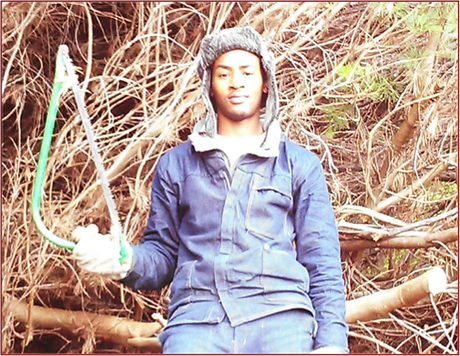
With the help of existing contacts at Non-Profit organisations in the settlements of Masiphumelele, team leaders were drawn from youth SDI-employees from Phillipi. Young women from Masiphumelele in the South Cape Peninsula were hired as general workers with the potential for promotion conditional with training. This report follows their story.

Meet the team: youth from Masiphumelele and Philippi 

Ayanda The seeds of this project started when Ayanda Magqaza was a sprightly fifteen-year-old. He would leave his home in Phillipi to stay and work in the South Peninsula for the weekend. Agile and flexible, Ayanda quickly learned to clamber over the boulders and climb the gum trees at Castle Rock. Local landowners would hire him, first to help in the garden, and eventually to man a chainsaw alone in the depths of the forest all day long. As a CORC employee, Ayanda was the first person the project leaders called to begin working on the mountain, with the hopes that he would soon be able to lead an entire team to assist him. Within a few months the imagined team materialized, largely due to his illustrative, personal and persuasive communication abilities. When project management was absent for two months in mid-winter, Ayanda took the helm and continued to recruit new team members, coordinate logistics for certified training sessions, and lead the team to clear vegetation on the mountain slopes.

Anela All roads in Masiphumelele lead past the Pink House, a community services center managed by Catholic Welfare Development (CWD). While CORC was recruiting for the team, CWD opened their doors and provided a number of applicants. Most were men, with some construction experience; the women seemed to be looking for a desk or service job, something with a roof. But Anela Dlulane stood out, highly recommended by CWD as a lead volunteer there. During the first trial on the mountain, when the slackers stayed back to chat and move slowly, Anela kept pace with the young guys as they stacked body-length branches along the hillside. It was hard work compared to her previous job as a typist at the Department of Transport, but Anela stuck with it, with the hopes of one day fulfilling an administrative role for the CORC team.

Anela was an unpaid volunteer at the Masiphumelele Pink House when she started with CORC in June. Now she earns a wage on the CORC team, partly to help restore the Pink House community garden.

Anela was an unpaid volunteer at the Masiphumelele Pink House when she started with CORC in June. Now she earns a wage on the CORC team, partly to help restore the Pink House community garden.


Roger Prior to joining the team, most of Roger Janse’s days were indoors at the Slum Dweller International (SDI) offices. The office valued his polyglot fluency in Cape Town’s three main languages, but his studies were at a standstill and he was not sure how to advance his career. He aspired to obtain his Driver’s License and begin work as a driver for SDI, but despite repeated courses, he did not pass the test. Roger had helped Ayanda in the South Peninsula before and decided to try it again. The mountain revealed itself to be an exciting place, satisfying his interest in wildlife like puff adders and cape cobras. Roger began work as a stacker, but by the end of winter had attained his Chainaw Operator’s certificate, and qualified for three other courses. Just two months later he held his long-awaited Driver’s License in his hands, then doggedly pursued an additional commercial license. Due to his determination, the team now depends on Roger in his role of back-up driver to transport them and their equipment from home to work.

Determined to expand his skill set, Roger exceeded available WfW courses and attained his commercial Driving License

Determined to expand his skill set, Roger exceeded available WfW courses and attained his commercial Driving License

Sinjuvo She came prepared. She brought with her a record of several years of herbicide applicator experience, a list of contacts from her old team, and even wore here official yellow WfW shirt to work. At some point she had left her previous WfW team and her skills and training were left idle until she crossed paths with the SA SDI Alliance in Masiphumelele. Gudiswa Mathu may be older than the average worker, but her experience helps her know how best to contribute. When the team was still in its early stages, struggling to find women who were prepared to do labour-intensive tasks day in and day out, Gudiswa knew who to call. Within two weeks, the team ratio was balanced in favor of the better gender, 7 to 4, surpassing WfW national standards for female-to-male hiring ratios.

Sakhe With only his secondary school certificate in hand, he set out for Cape Town from the Eastern Cape. After growing up there and doing his schooling there, Sakhekile Nkohli contacted the few family members and friends he had in Cape Town and moved into Masiphumelele. He found infrequent work, mostly occasional construction jobs. But as a young worker his resume and contacts were not competitive. When given the chance on the mountain, Sakhe demonstrated what made him stand out. His fearlessness and drive earned him the position as the only team member without a previous relationship with SDI to receive and qualify for chainsaw training. With Siya or Ayanda present, Sakhe is a dependable assistant and when a more experienced manager is unavailable, he takes the helm.

Bracing himself on the steep slopes, Sakhe clears an area for the Chainsaw Operator to work, a role for which he now is also qualified as a result of training on the team

Bracing himself on the steep slopes, Sakhe clears an area for the Chainsaw Operator to work, a role for which he now is also qualified as a result of training on the team

Liso She may have the smallest shoe size, but in many ways she makes the biggest contribution. After 6 years of working on alien clearing teams, Liso Jentile offers the most insight and thoughtfulness of any team member. Her years of experience include training as chainsaw operator, which offsets the gender balance of mostly men leading with chainsaws and women following while stacking branches. Most of the time, she is quiet, and does not participate in the teatime chatter. But when the team reaches a new situation and is uncertain how to proceed, people turn to Liso for well-seasoned advice. Her thinking abilities make her a role model for other women on the team and a prime candidate for promotion to a leadership role.

Siya Initially, he was busy in the office and didn’t take the offer. Afterall, his family was in Philippi, including his newborn son. Weekdays in isolated Castle Rock sounded lonesome. And after more than a decade of chainsaw work without any career prospects, the idea of working on the mountain did not excite him. But when the opportunity to join Ayanda at a chainsaw operator training arose, Siyasanga Hermanus got involved. Within three weeks he had a team working to help him stack – a luxury after the years of working on the mountain alone. With his firm manner and steadfast approach, Siya earned his team’s trust. Now he, like Ayanda, is building up skills to eventually contract his own team. But while most WfW contractors supervise from the sidelines, Siya will remain right where he is. The only way to make sure the work gets done, he says, is to be part of the team. He won’t be letting go of his chainsaw anytime soon.

Workers are tasked with removing dense alien forest from steep mountain slopes

Workers are tasked with removing dense alien forest from steep mountain slopes

Outlook: Transitioning from labourers to leaders 

It is a fragile system, but it holds together – a web of life that benefits from its interdependent nature as much as it is defrayed by internal competition. Like the risk of wildfire on the mountain, our team confronts challenges to their health and safety every day. Competition is no stranger, and they confront one another when they disagree on an approach to an issue. Like the heat of summer, they feel it on their table at home when funding dries up and bonuses are no longer available. And when in need of assistance, if it is not offered with personal consideration, some team members may be flooded with advantages while others fail to gain ground.

Despite these challenges, the team is resilient. They depend on one another because they know that they can fell more trees working together than alone. A communicator like Ayanda can help advocate for more contracts together than the others could do alone. A veteran like Liso can help plan savings for their future together better than the others could do alone. And with perseverance, they can build a collective company with the full contribution of each team member.

While one person cleans a chainsaw, another takes inventory of the day’s supplies. A Health and Safety Officer takes note of the appearance of the deforested slopes after a day’s work while a First Aid Officer records that day’s participation of each individual. One person measures herbicide concentrations, while another speaks publicly about the value to biodiversity of their work. Each worker has their role and is valued as an essential member of the team. 

Over 35,000 South Africans are funded by the Department of Environmental Affairs to clear invasive alien vegetation in South Africa. The vast majority of them work under a private contractor. While project funds should be directed to workers, this system incentivizes the contractor to increase staff productivity to their own benefit. CORC’s team structure provides a new model, one that serves the poor populations that it is meant to support. Through this program, CORC has the opportunity to affect livelihoods across the country. It begins with the collective.

This collective has a new opportunity. In the South Cape Peninsula, a few mountain slopes dipping into the sea appear too difficult, too costly to clear. Without professional training for mountain slopes, this team has confronted Castle Rock. In doing so, they have proven their worth as recipients of intermediate training required to clear such lands safely. As an intermediate team in high demand, they may prove financially sustainable while maintaining the collective structure that can help negotiate the team members into more established careers. As a self-sustaining collective they may be able to operate independently throughout the Western Cape, and can train other teams in other provinces. A handful of youth from the South Peninsula has the chance to transition from labourers to leaders, not only in their industry, but in their communities.

FEDUP launches livelihood programs: solar lights, funeral scheme & income generation

By FEDUP, uTshani Fund No Comments

By Walter Monyela and Yolande Hendler (on behalf of CORC)

IMG_1230

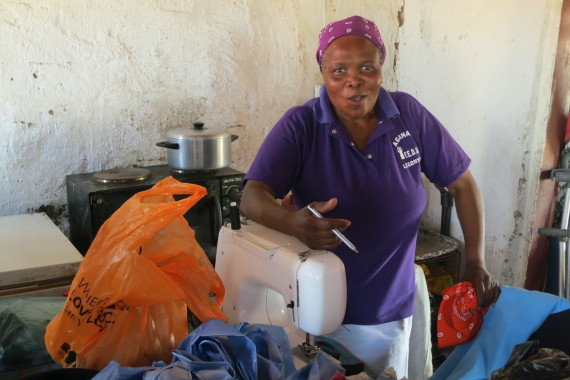
Sarah Makgopela of Aganang savings scheme in Legonyane (North West province) has started a small business selling hats, water boilers, sweets and other small goods through the income generation program


If about 25% of South Africans are unemployed, this percentage is even higher for communities living in informal settlements – a reality that is no different for the members of the South African Federation of the Urban and Rural Poor (FEDUP). Since the early 1990s, FEDUP members have identified their own development needs especially around accessing well-located land, security of tenure, improved shelter, housing and basic services. Through the practice of daily savings and other community organisation tools, FEDUP has built partnerships with government on all tiers and has negotiated access to many of these needs. Yet the lack of income generation has posed continuous instability and hardship on a day-to-day basis.

Over the last years, therefore, FEDUP has identified the need to strengthen the income generation opportunities of its members and in 2014 launched several livelihood programs. While these programs assist members to start their own small businesses and the movement as a whole to generate its own income and build its own assets, they are at the same time initiatives that reinforce the importance of the rituals of Shack/ Slum Dwellers International, such as daily savings.

The livelihoods programs underway are

  • Total Solar Lamps by Awango
  • Funeral Policy known as South African FEDUP Funeral Scheme (SAFFS)
  • Loan Program known as the Federation Income Generation Program (FIGP)

Total Solar Lamps by Awango

IMG_1158

A member of Aganang savings scheme in Legonyane (North West) reselling Awango solar lights by Total South Africa

Total South Africa (TSL) introduced solar lamps by Awango and entered a contractual partnership with uTshani Fund to provide FEDUP members with economic opportunities of buying Awango solar lights from uTshani Fund and selling them to potential buyers e.g informal settlement communities and businesses. Although the emphasis is on FEDUP members this opportunity is also open to non-FEDUP members who are keen to do sales. This year a total of 314 people (307 FEDUP members) in seven provinces were trained as resellers.

Training includes a presentation on the available products, how they operate, durability and logistical aspects of the business. After training each reseller ideally buys at least one of each type of solar light (3 in total). The solar lights business is aimed at members who already run an income generation initiative and are seeking to diversify their products – this would provide the financial platform for securing the first stock.

Amidst successes, the program experienced challenges in terms of sellers lacking sufficient start-up capital as well as insufficient sales experience. In response FEDUP members are devising strategies to support the growth of businesses and sellers’ capacities such as exposing sellers to more in-depth training in sales skills and exploring the potential of connecting with the Small Enterprise Finance Agency (SEFA) around increased support for start-up loans.

Funeral Policy (SAFFS)

The South African FEDUP Funeral Scheme (SAFFS) grew out of a desire expressed by FEDUP to bury its members with dignity and honour. SAFFS started its full operations in March 2014 and operates as an understudy to Imbalenhle Burial Society (IBS). It is underwritten by TransAfrica Life Funeral Policies, who are registered with the Financial Services Board of South Africa (FSB).SAFFS currently works in association with IBS to learn how to administer a funeral scheme with the intention of going solo. FEDUP members sell the funeral scheme to own members as well as the public and have sold an estimated 600 schemes to date. Sellers are compensated per policy sold.

Loan Program (Federation Income Generation Program – FIGP)

IMG_1268

“I have used the Federation Income Generation Program to sew graduation gowns as a business. This helps me support my family”


The loan program is a formalisation of the loans that FEDUP members access at individual savings scheme level. While this practice will continue, the FIGP is an initiative to expand the scope of these loans to support FEDUP members in income generation activities of their choice.

FEDUP has therefore registered with the relevant financial bodies (via uTshani Fund) and has started up a legal and formalised microfinance institution through which members can access group loans from their own Urban Poor Fund, instead of external financial institutions.The criteria for accessing a loan is:

  • Formal FEDUP membership (complete UPF payment)
  • Active member of a FEDUP savings scheme
  • Experience as small business entrepreneur for at least 6 months
  • Be part of a group of 5 to access a loan

These criteria ensure that members continue saving and support one another in the development of their respective businesses because individuals can only receive loans when they are in a group of five. The whole group must also make repayments as one overall sum. Therefore individual success depends on group success.

In this way FEDUP broadens the scope of its livelihood programs, strengthens its membership base and positions itself toward financial sustainability within the next five years. The year 2015 will definitely mark FEDUP as another recognised, fully registered and compliant microfinance in South Africa. Through this initiative FEDUP will also be able to approach funders and private organisations to leverage further resources.

IMG_1379

” I have used the FIGP to buy shwe shwe material and sew dresses” – Elizabeth Motaung, FEDUP members in Orange Farm Gauteng

At the heart of the matter

What lies behind these varying income generation initiatives? On the one hand, FEDUP’s step towards financial sustainability to ensure continued existence in the case of decreased donor-funding. On the other hand, and at the heart of the matter, lies savings, the engine of FEDUP that enables poor women to come together, share their experiences – struggles and triumphs – and find solutions.

Sarah Mulaudzi, North West co-ordinator for FEDUP recently shared that

“In our savings groups we have R300 000 worth of savings from our members who are doing income generation programs. Through the income generation program our savings are really growing!”

As the income generation programs require savings and start up capital they strengthen FEDUP’s savings practices. Strong savings in turn build a strong group and a strong community, which widens opportunities within the income generation programs themselves.

The small business of Sarah Makgopela and Elizabeth Moletese of Aganang savings scheme in Legonyane, North West province.

The small business of Sarah Makgopela and Elizabeth Moletese of Aganang savings scheme in Legonyane, North West province.