Category

FEDUP

Re-designing the city one shack cluster at a time

By CORC, FEDUP, ISN, News, uTshani Fund No Comments

By Andy Bolnick (CORC/iKhayalami) and Benjamin Bradlow

The roller coasters and carnival games at Ratanga Junction Park in the Milnerton area of Cape Town may appear as a middle class child’s idyll, even amidst the winter cold and rain. But only a kilometer away, shack dwelling mothers, fathers, sisters and brothers, daughters and sons, in an informal settlement called Mshini Wam in Joe Slovo Park are coming together to build a better life for their children. Collectively, they are influencing city government in a way that is, step-by-step, producing lessons for a future in which all children grow up in safe, vibrant, and nurturing neighborhoods.

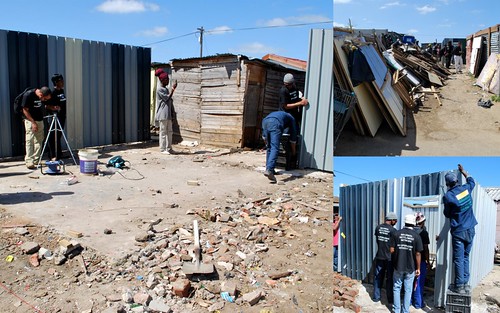
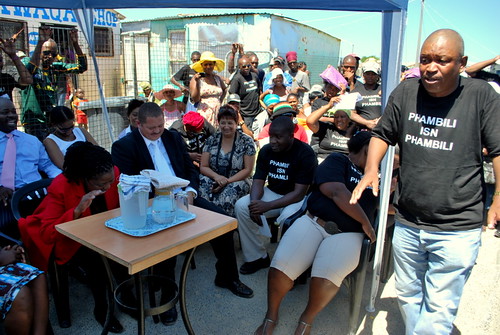
The settlement of 250 families, is becoming a learning center for improving informal settlements throughout Cape Town. Yesterday, the community, which links with informal settlement leadership throughout the city through the Informal Settlement Network (ISN), invited city officials from the Informal Settlements Management Unit, Extended Public Works Programme, and city council, to celebrate what they have achieved. In less than one week, residents of Mshini Wam have begun transforming the physical layout of their neighborhood, through a partnership with the city government, ISN, and a supporting NGO called the Community Organisation Resource Centre (CORC). The ceremony celebrated the community’s work in “re-blocking” the dense, flood and fire-prone settlement, into organized clusters of 8-10 shacks.

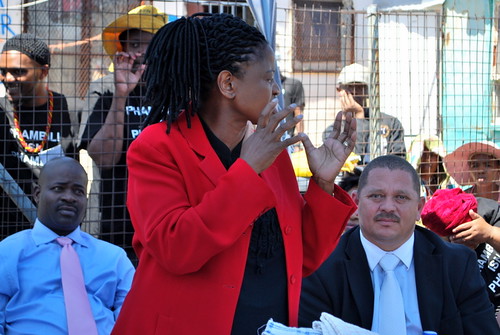
The first cluster was completed on 23 February to demonstrate blocking-out to the community and to the Deputy Minister of Human Settlements, Ms Zou Kota Federicks who had come to Mshini Wam to attend the community led enumeration (household socio-economic survey and neighborhood map) launch. With three clusters done, the project is due to be completed in the next 3 months. In addition to the re-blocking, many of the shacks were improved with fire-proof, environmentally friendly materials.

The residents of Mshini Wam have, from the outset, claimed and owned this project. A community design team led the cluster-based redesign, with technical assistance from an architect at CORC. Luthando Klaas, when introduced to a reporter from the local Cape Times as a community leader, interrupted the reporter’s question. “No, no, no. I’m a community designer.”

This kind of assurance was behind the words of Nokhwezi Klaas when she spoke at a short ceremony with the invited parties. As she stood fighting back a mild cough, she spoke of the effect of the project on the community that she leads, and her own personal life: “As you can see, I am sick all the time because my shack is constantly damp from flooding.”

She then pointed to the “re-blocked” shacks and described how they were organized in a way that not only protected residents from flooding, but also created the space for the city to pave emergency access roads, and install electricity, and water and sanitation piping. Further, the community has been able to open up savings schemes that breed financial accountability and management skills amongst residents, who have then been able to contribute to voluntary shack improvements, in addition to the re-blocking effort. Community savings currently total R29,200.

As ISN leader Vuyani Mnyango noted, the upgrading effort is of dire importance in a settlement that not only suffers from frequent flooding, but has only 16 chemical toilets and 3 water taps for 250 households.

At the end of last year, the city authorities, ISN, and CORC agreed that, in order to do the required infrastructural improvements in Mshini Wam, it would be necessary to relocate between 20 to 50 households to an area nearby. The plan was for the city to come in and do the necessary earthworks and service provision and then the families were to move back. However, it became very difficult for the city to approve land that the community had identified for this purpose. No progress was made from March until last week.

The community wanted to begin and were getting very frustrated at the delays. The community leadership and ISN realized together that the best way to harness the community’s energy was to start blocking-out in an entirely in situ manner with no temporary relocations. Early last week, the city came on board in terms of supplying resources such as materials for the roofs of households (part of emergency starter kits), sand filling, crusher stone and compacting machinery.

The level of activity and community participation is palpable. Women are particularly active — clearing the site, collecting debris, loading wheelbarrows, carrying wheelbarrows, learning how to make the upgraded panels and then making them.

Yesterday, Mshini Wam’s Nokhwezi Klaas, along with ISN leaders, urged a representative from the city’s Extended Public Works Programme (EPWP) to join in this partnership. This would ensure that community members who work on such upgrading work are not only compensated, but also gain recognition for the skills development that occurs in a project like the re-blocking of Mshini Wam.

But this is not a project that is just affecting one community. Most significantly, Mshini Wam is a proving ground for a city-wide partnership for informal settlement upgrading between networked communities across the cities and the Cape Town municipal authorities. This alliance was consecrated in a memorandum of understanding signed with Mayor Patricia de Lille earlier this year. The re-blocking strategy, which re-arranges shacks in densely-packed settlements to open up common public space, access roads, and basic service infrastructure installation, is currently being rolled out in four settlements throughout the city this year, which is then set to expand to at least 18 more settlements. Through partnership between ISN, CORC, and Cape Town local authorities, the city is also able to explore other appropriate informal settlement upgrading strategies in a deliberate and collective manner. Overall, the city has committed R6 million for infrastructure, and is supporting community-led enumerations in all the identified settlements.

While policy-makers, academics and professional organizations struggle to gain even the smallest bit of traction on the ground to begin improving the lives of shack dwellers throughout the country, an alternative paradigm is emerging into focus. Little of this appears in the textbooks and policy codes. Rather, it is through practice that we can make out this new approach. When shack dwelling communities come together, and pool their own knowledge and resources, they are able to partner with local authorities and catalyze city-wide processes. As informal settlement-based learning centres spring up throughout Cape Town, communities are gaining influence, access to resources, and improved settlements and lives.

Mshini Wam cluster 2 reblocking now in progress

By CORC, FEDUP, ISN, News, uTshani Fund No Comments


no images were found

The reblocking of Cluster 2 in Mshini Wam has begun!

ISN leaders have been engaging with City of Cape Town officials and principle field officers for more than 6 months, and now cluster two is in progress. The process of the reblocking process requires full participation of the community in the in-situ upgrading of their settlement. Yesterday, 5th July, 8 shacks were pulled down. The affected households stored their goods with neighbors, and the site was prepared through intensive manual labor. The community leveled the ground, supplemented by G5 filling material capable of holding the cluster’s weight.

Today, 6th July, 8 shacks will be erected. This new Interlocker material is of much better quality that the pervious shelters, and does not burn as quickly.

The reblocking process therefore requires full participation, and the disruption to people’s lives are minimal. The new cluster will be designed in a way that ensured no one is required to be relocated, and that neighborhood watch is promoted. The full delivery of services, such as an access road, is the long term plan, but for now, the space create ensures that toilets and water taps can be installed in a way that promotes community ownership.

Follow the ISN on twitter and facebook for up to date information.

SA Alliance secures follow-up engagements with Manguang Metro

By FEDUP, ISN, News No Comments

By Kwanele Sibanda, CORC


ISN attempted to make a presentation to the Mangaung Metro in March. This was delayed because the speaker of the Chief of Staff felt that the presentation was too important for his ears alone and requested the meeting to be postponed until other officials and project managers were available. After consistent follow-ups, it was agreed that the presentation would occur on the 8th of June, but the Mayor was not available due to other commitments.

Present in the meeting from the Metro was the Chief of Staff, Head of Planning (Mr. Gabagamba) and the Head of Human Settlements (Mr. Mokgwena). Representing ISN were five leaders from various settlements of Mangaung and they were supported by Emily (FEDUP Free State regional leader), Vuyani (ISN Western Cape), Kwanele (CORC, Joburg) and Gershwin (CORC, Cape Town).

Emily led the ISN presentation and she spotlighted the successes of the Federation in engaging government and building communities through a focus on savings groups in line with self-sustenance, livelihoods initiatives, women driven processes and the People’s Housing Process. She also talked about the signing of a MOU between FEDUP, uTshani Fund and the National Department of Housing which resulted in a commitment made by Minister Sisulu in 2006 to pledge 1,000 subsidies per province. In the Free State, the government-Federation relationship has been very strong and the department of Human Settlements have paid subsidies to FEDUP savings schemes upfront.

Emily also explained the emergence of the Informal Settlement Network (ISN), and what the network aims to achieve by building issue-based agendas at the city-wide scale. She emphasized that ISN is a non-political movement of the poor, and aims to influence decision-making powers through pilot projects in the five large metros in South Africa. Vuyani from ISN Western Cape reiterated these words when he spoke about the partnership with the City of Cape Town where 11 projects were identified in 2009, which led to broad-based mobilization of the poor throughout the City. Similarly the successes of the Stellenbosch partnership have been equally instructive. Kwanele and Gershwin from CORC drew in examples from the SDI network, and the emerging synergies between professionals and communities. CORC’s interventions are designed around the innovations of local communities, and working in partnership with municipalities has delivered precedent setting upgrading projects.

Officials from Manguang set out the challenges facing the medium sized city of Bloemfontein and surrounding townships and rural areas. Mr. Mokgwena, Head  of Human Settlements,  explained that they are aware of 28 informal settlements ranging in size. The Housing Development Agency (HDA) is currently drafting a program before their enumeration process begins. Their sub-regions are Bloemfontein, Botshabelo and Thabanchu. Mr. Gabagamba, the Head of Planning, outlined eight key issues that will have to be addressed in preparing for a formalized working relationship:

  1. Establishment of a committee that agglomerates the two parties (South African SDI Alliance and Mangaung Metro);
  2. How the arrangement will be structured;
  3. Articles of association;
  4. Areas of performance;
  5. Membership profile;
  6. Resource base;
  7. Targeted communities; and
  8. Governance system

In response to the presentation, and the proposal to set up a steering committee, the Chief of Staff nominated two officials (Head of Planning and Head of Human Settlements) as well as two politicians that he still to name.

It was agreed upon that the next meeting is going to be held on the 22nd of June 2012. The purpose of the meeting shall be that of presenting the eight key points listed above on the side of SDI as well as the presentation of settlements that fall under the IDP and a discussion on how each party will play its role.

The art of ark building in Langrug, Stellenbosch

By CORC, FEDUP, ISN, News No Comments

By Walter Fieuw, CORC

The dystopia of the urbanisation of poverty is a confounding reality, to say the least. People eek out a living in the harshest environment, are subject to environmental torture, and have little prospect of escaping the vices of modern life. Under imperial and apartheid South Africa, the right of non-Europeans/ non-whites to urban life was continuously supressed, if not denied fully. In fact, the very existence of the racist regime was premised on segregated urban spaces. This is why, argues philosopher Achile Mbembe of Stellenbosch University, “most social struggle of the post apartheid era can be read as attempts to re-conquer the right to be urban.”

This confounding reality is often worsened and aggravated by government policies that do not recognize the urban crisis. For many years, governments have shied away from devising comprehensive policies that tackle the challenges of urban poverty, and that harness the potentials for innovative development, which have historically been associated with urbanization. In the global South, the import of modernist planning norms and standards from the global North has perpetuated the existence and recurrence of peripheral urban slums by creating sanitized spaces for the elite.

What are the real prospects for social and political change in this new democratic dispensation? The high waves of market forces, income inequality, and worsening human development indices rock the tattered and bruised vessels of the urban poor. For some miracle of resilience and agency, the poor continue to press forward. In many cases, the hope of a more equal and fair society has found expression in the agency of the underclass, of the excluded, of the marginalized. These societies have depended on a forgotten art: the art of ark building.

Despite the introduction of potentially more progressive, transformative and situational responsive policies contained in the “second generation” of human settlement legislative frameworks (the first ten years being a dismal failure), local governments have struggled to come to grips with the extensive community engagement and difficult engineering and geotechnical interventions implicit in the upgrading of informal settlements. Organised communities are filling the voids created by lack of political will, social facilitation, and technical expertise by generating a resource base they own: knowledge about their settlement.
Screen Shot 2012-05-18 at 4.04.10 PM[1]

For this reason, Premier of the Western Cape, Ms. Helen Zille, paid a visit to Franschhoek on the 8th of May. She wanted to witness the progress made by the Langrug community in partnership with the Stellenbosch Municipality. Langrug is a large informal settlement on the slopes of Mont Rochelle Nature Reserve on the outskirts of Franschhoek. Seasonal laborers working on the wine farms and a large dam construction project established the settlement in the early 1990s. This settlement construed a forgotten people for many years, until the municipality was forced to action when the neighboring farm owner obtained a court interdict against the Municipality for the settlement’s greywater runoff into his irrigation dam. The municipality was forced to start negotiating with the settlement, because 14 families were to be relocated in the reserve earmarked for an access road construction. ISN was introduced to the settlement after the municipality engaged the network, opening a year-long relationship building window. Ever since, a full scale in-situ upgrade project has been launched; providing better service with minimal disruption to residents’ lives.
Premier Zille visits Ruimsig settlement[1]
Premier Zille opened her address by saying that there is no more difficult policy environment than housing. The question of the spread of resources – either a serviced house for a few or better services and incremental tenure security for many – has continually shaped the South African housing policy debate. During the visit, Zille commented, “the important point about this informal settlement is that it is one of the first where we have a viable partnership with the community. And now, working with the community, we are installing stormwater, greywater systems, toilets, washing facilities, road and upgrading the place generally … but the existing thing about this project is that we are upgrading shacks where they are instead of moving people out and starting from the beginning”. Western Cape MEC for Housing Bonginkosi Madikizela said: “It is a fantastic model. The message to the rest of the country is that any development is a partnership between government and communities. They become partners rather than passive recipients”.

Much attention was called to the “model” of community participation espoused by Informal Settlement Network (ISN). Zille argued that this new “model” could be better articulated by having a single window policy approach to refining the government’s ability to navigate complex (and fragmented) policy frameworks. Although such an approach could be instructive, a model without agency has no value. Organised communities have an agency to transform urban landscapes by transforming their settlements. One of the failures of the government-driven and top-down implementation of housing developments in post-apartheid era was exactly this: the entrenchment of the forgotten apartheid ghettos. But informal residents are taking the lead in integrating their development with the greater evolution of their surrounding urban spaces. The ark communities are building is an inclusive one; one that has the capacity to deliver social and political change. This ark does not look or function like any of the government’s planning apparatuses, which are often founded on principles that entrench existing spatial inequalities. No, this ark is different. It is different because the ones designing the ark are different. Communities and government can only revive the lost art of ark building when they partner around deliverables such as improved living conditions. In this way, power is shared, and solutions are co-produced.

Other media coverage:

FEDUP scoops up two provincial Govan Mbeki awards for outstanding housing developments

By FEDUP, uTshani Fund No Comments

By Walter Fieuw, CORC

In the lead up to the 1994 elections, the federation of woman’s savings collectives lobbied the Government of National Unity to institute an alternative to the dominating approach of project-linked capital subsidy scheme system. The federation demonstrated that people-centred and controlled development outperformed developer-built subsidised housing in size, cost and quality; empowered communities; generated employment and construction skills; and gave a voice to the most marginalised.

In 1998 the government appropriated the model and mainstreamed its fundamentals. The result was the People’s Housing Process (PHP), a special housing subsidy that allowed for much greater involvement of communities in the construction of their houses. The challenge of the social movement was always going to be a way of shifting the control of resources and the devolution of power into the hands of communities. Since that time, the PHP has come under much scrutiny – both from implementing communities and professional policy-orientated urban sector NGOs – for reducing a potentially transformative instrument to sweat equity in contractor-driven developments, undermining the fundamental tenants of this approach.

Driven by the agenda people-driven development with all the associated economic, social and political reforms implicit, the Federation of the Urban Poor (FEDUP) has pioneered innovative solutions where formal and informal systems overlap. Government has acknowledged the constraints and regressive nature of the PHP in its previous incarnation, and made deliberate steps to widen the space for communities and their supportive NGOs to influence resource distribution. This led to the enhanced PHP, which aims to  “enable/encourage communities to actively contribute and participate in the housing development process so that communities take ownership of the process and not just act as passive recipients of housing…. ePHP recognizes that the community is the initiator and driver of the process” (ePHP policy framework).

The Govan Mbeki Human Settlements awards

The Govan Mbeki Human Settlements awards are a prestigious ceremony hosted by the National Department of Human Settlements in two stages: the Provincial and the National. The award ceremony aims to showcase and demonstrate the work done by the department at both tiers and promotes best practices in meeting the delivery mandate of the Presidency’s Outcome 8, which is aligned with the vision of building sustainable human settlements and meeting the Millennium Development Goals. The MEC of Human Settlements at the Provincial tier nominates projects in the five specified categories which displays exceptional quality, promotes best practice, brings together stakeholders, and most importantly, improving the quality of life for the beneficiary-partners.
Human Settlements - Govan Mbeki banner
In the category Best Enhanced People’s Housing Process (ePHP) project, two FEDUP housing developments took the Provincial centre stage in the North-West (for the Lethabong project) and in Kwa-Zulu Natal (for the Namibia Stop 8 project). These projects now qualify for the national award ceremony to be held in May in the Free State.

The Lethabong project, North West Province (96 houses)

The Lethabong project is located in Hartebeesfontein, Rustenburg Bojanala district. FEDUP members distinguished this project from other ePHP projects when they said that, “The project has been solely run by members of the beneficiary community. The different project tasks were divided amongst team members elected from the community. The teams carried out the project tasks ranging from subsidy administration, project planning and programming, material procurement and construction supervision. This is a project where ordinary women successfully planned and implemented the project.”

The sizes of the 96 houses were also much larger than normal RDP houses; average FEDUP house is 54m2 which is much larger than the 36m2 to 40mhouses built under traditional RDP contractor-driven housing developments. These houses are also plastered on the inside and outside and are adorned with specially decorated window sills and doors. Community members were trained in bricklaying, carpentry, and plastering. Two additional savings schemes were started and income generating opportunities were identified.

At the event ceremony held on the 26th of April, the MEC Mohono congratulated FEDUP members and wished them luck at the national awards.
IMG-20120316-00040
A Lethabong FEDUP showhouse. Picture by Patrick Matsemale

The Namibia / Stop 8 project, Kwa-Zulu Natal Province (89 houses)

In the Namibia / Stop 8 project, the role of the Community Construction Management Team (CCMT) was paramount to the successful implementation. This site-and-serviced site is located on Haffajee’s land in northern eThekwini (Durban) where FEDUP members were allocated 90 hectares to construct 96 units. This forms part of the pledged commitment of the then-minister of Housing Lindiwe Sisulu that would see each province commit 1,000 subsidies to FEDUP members. In the 1960s migrating labourers invaded these lands hoping to find better access to services and job opportunities. When the area was formalised in 2005, some families had to be relocated.

The Federation’s project brought together divergent groups of people around a single vision of constructing good quality houses. The coordinating and management role of the CCMT was sensitive to the finely granulated complexities of newly settled relocated families. In this sense, not only the houses speak of the success, but also a cohesive society.

Namibia / Stop 8 has received international admiration and the Department of Human Settlements regularly quotes it in discussions on ePHP. The Premier of KZN and his MEC for Housing officially opened the first 30 houses constructed in 2010 which was followed by visits of the Premier of the Free State, the Secretary of State for Sweden, and other delegates and associates of the Shack / Slum Dwellers International community. It stands out as an example of the quality that can be delivered through a community-based approach to housing supply together with formal partnerships with national, provincial and local government.
DSC00849
Mam Benekane receiving the Govan Mbeki award

FEDUP celebrates two decades with a house opening in Orange Farm

By FEDUP, News, uTshani Fund No Comments

By FEDUP and uTshani Fund

The Federation of the Urban Poor (FEDUP) and the uTshani Fund are two organisations working in alliance to bring the urban poor in South Africa together and bring their huge collective resourcefulness, creativity, energy and social force to the task of delivering secure, affordable housing to everyone. The FEDUP / uTshani Fund alliance has initiated housing projects in urban and peri-urban communities across all nine provinces, improving the lives of some 17,000 households so far.

FEDUP’s primary vision has been to ensure that the urban poor – and particularly poor women – gain full citizenship rights and become key actors in determining the development priorities and policies of cities. The Federation has worked to move both urban policy and poor communities away from crisis-led reactive interventions to gendered long-term partnerships in which the urban poor themselves play a key role as visionaries and partners in generating “win-win” solutions that create revised models of development.

FEDUP celebrates two decades with a house opening in Orange Farm

Photo: Gauteng Province Department Local Government and Housing

At a mass gathering on March 1st, attended by local, national and international shack dwellers, city officials and NGO staff, FEDUP reasserted its vision to build inclusive and pro-poor cities by positioning the poor as central actors in urban development. They were gathered at Stretford Park in Extension 6 of Orange Farm, where joyous singing and chanting resounded throughout the park, overlaid with the DJ’s big dubstep beats.

While the gathering buzzed and hummed, the deputy minister of Human Settlements Ms. Zoe Kota-Fredericks, and Gauteng Members of Executive Council met in a private meeting to discuss the unlocking of People’s Housing Processes in the province. Patrick Magebula, national FEDUP leader and advisor to the minister of Human Settlements Mr. Tokyo Sexwale, mentioned that the processes in Orange Farm are unfolding across the country, and poor people’s groups across the country are actively contributing to changing the way government engages poor residents. Since March 1992, when women across the country mobilised around savings collectives, the Federation has engaged with formal banking institutions and all three tiers of government, helped setup Shack / Slum Dwellers International (SDI) by participating in and leading international exchanges, and most importantly, ensured the material improvement and tenure security in the lives of thousands of poor people. The FEDUP has shared their successes (and failures) and supported new savings initiatives in encouraged and supported savings groups in Angola, Brazil, Ghana, Kenya, Madagascar, Malawi, Namibia, Uganda, Swaziland, Zambia, and Zimbabwe.

On Ms. Kota-Fredericks’ arrival, she addressed the crowd and said, “We are encouraged that people take their own initiatives rather than waiting for the government to come to them. Through your savings you were able to build yourselves better houses, much better than the RDP houses that the government provides. The government needs this kind of commitment from the community so that we can be able to provide services faster and more efficiently”.

Houses built by the Federation through the People’s Housing Process have been of significantly higher quality than those built through privately contracted government delivered starter houses. The current houses being completed with the subsidy pledge are all larger than 50 m2 in size with a fully fitted bathroom, a kitchen with a sink as well as three to four spacious bedrooms. The houses are fully electrified. The finishing includes plaster inside and outside, and is also painted inside and outside. These are achievable through the savings and contributions of the beneficiaries.

The beneficiaries on the projects are mainly elderly women. Young men and women help the beneficiary to construct the houses. Subsidy forms are completed among the members and submitted to the provincial housing Department for approval before building can commence for any beneficiary.

Said Mrs. Manthoka and Mr. Mangena of Orange Farm about a poor people’s movement, “It was a good experience to work with the Federation. It brought us happiness! It was so unfortunate that the whole thing came to a standstill now… There was a problem with the interpretation of the subsidies. People thought that government would be paying the subsidies upfront”.

Poor people have always been in charge of their own developments, building very innovative, very large, and very effective shelters that meet their needs. These creative, colorful, and appropriate homes tend to constitute the vast majority of the architecture of the Global South. It is thus imperative that shack dwellers themselves be involved in the struggle to house the urban poor. They have the appropriate skills and vision to develop their own, comfortable settlements, with a small amount of professional and financial support from the experts and politicians.

Ms. Kota-Fredericks mentioned the long standing relationship between the FEDUP and the national department of Human Settlements. It started with the pledge from Minister Joe Slovo in 1994, which was followed up by Sankie Mthembu-Mahanyelele. Minister Sisulu also pledged subsidies to FEDUP and uTshani Funds in 2004, but provinces have been slow to release these funds for a number of reasons. Rose Molokoane, national coordinator of the FEDUP, commented that a lot of work still remains, as many people still live in harsh conditions. Said Molokoane, “The majority of our people are still poor and can’t afford proper houses. They are living in appalling conditions in informal settlements. But we are confident that our partnership with the government will grow stronger and will achieve more. When we started banks could not loan us money as we were regarded as high risk customers. But we have never lost hope, we decided to do it on our own and it worked”.

Some quotations borrowed from the following online articles:

Community organisations engaging Mangaung Metropolitan Municipality

By FEDUP, ISN, News One Comment

By Kwanele Sibanda, CORC
Representative of Freedom Square West seeks clarity after the presentation

An ISN leadership meeting was held in Bloemfontein on the 8th of March 2012 where 76 leaders represented 14 informal settlements falling under the Mangaung Metro Municipality. This was the first ISN leadership meeting that brought together all the Bloemfontein informal settlement leaders. The main objective of the meeting was to ensure that community leaders were familiar with the core activities and principles of the ISN. More importantly, the meeting was used as a platform for the leaders to identify the first pilot settlement where an enumeration will be conducted and to elect a coordinating team for the Mangaung region. The pilot project suggested was Pieter Swaart informal settlement because of its dire need for water provision (residents are forced to buy water from nearby formal houses at premium rates).

At the meeting, leaders were afforded the opportunity to ask questions relating to ISN. This discussion triggered many responses about the nature of community mobilisation and engagement with local government, and briefly presented the common challenges amongst the settlements that are potential ISN pilot projects. These challenges related to sanitation and water provision, access routes for emergency services and community halls. Other bigger challenges noted included the need for schools, electricity, churches and police stations. Unlike numerous informal settlements of Gauteng and Cape Town, most of Mangaung informal settlements are situated on municipal land and shacks are widely spaced.

On Wednesday 13 March, the newly elected regional ISN delegation met with the Mangaung Metro officials. Ten informal settlements were represented. The official was impressed with ISN’s approach to upgrading and further more requested the team to make a presentation to the Mayor, town planners and other relevant departments that he is going to invite. After the meeting with the Metro officials, a large gathering in Pieter Swaart settlement was organized, and more than 170 community members attended the meeting. Once again, the regional ISN coordinating team was introduced to the wider community and the core activities of the ISN, especially that of enumeration, were introduced to the gathering.

The groups also expressed solidarity and a commitment to working together. This was concretised when the coordination team tracked a number of households who were evicted from a settlement close to Bloemfontein’s CBD. The households have been sheltering in a hostel building. Following up on evicted families will be a defining characteristic of the regional coordinating team’s programme of action for future negotiations.

MORE FIRE! Deputy Minister visits Mshini Wam and Siyahlala settlements in Joe Slovo Park

By CORC, FEDUP, ISN, News No Comments

By Walter Fieuw, CORC

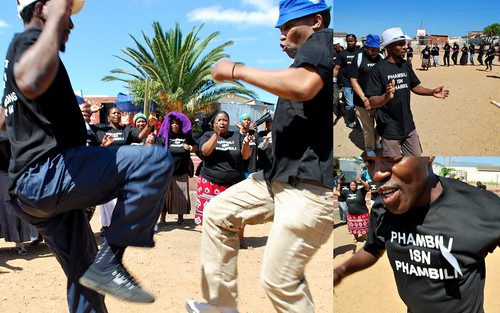
On Thursday 23 February 2012, while South Africa were debating the implications of Finance Minister Pravin Gordhan’s budget speech, another group was preparing to put action to words. Community leaders from across the country and associated with the Informal Settlement Network (ISN) were gathering in a community hall in Joe Slovo Park, Milnerton, Cape Town. This group attended a workshop during the week on enumerations, mapping and blocking out of their settlements. The energy was bouncing off the walls, and detonated into a joyous singing-dancing affair along Freedom Way.
DSC_0014-1
The group danced and sang their way to the next stop: an open field in Mshini Wam settlement where a gazebo was set up to receive the Deputy Minister of Human Settlements, Ms. Zou Kota-Fredericks. The group sang affectionate songs to the on-lookers, urging them to unite and prepare their communities for improving their living conditions.

Ndikunile isandla [I give my hand]

Ndakunika ingalo [I give my arm]

Ndakunika amabele [I give you my chest / breasts]

Andiyazi byifunayo [I don’t know what else you want]

Yona soze uyifumane [and you wont get it!] Deputy Minister visits Mshini Wam
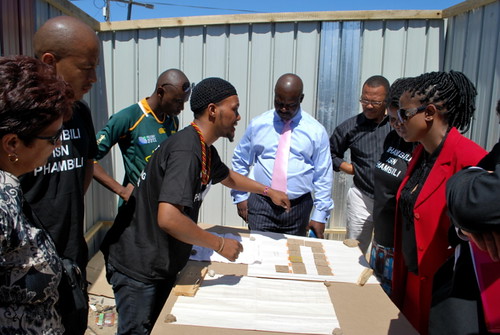
Blocking-out is a term the South African SDI Alliance uses to refer to the community based planning and design processes that lead to the re-organisation of shacks to utilise space much better. The need for blocking out could be anything from opening space to ensure better penetration of emergency services, finding solutions to flooding and fire, security and safety of children in court yards under neighborhood supervision, or better located water and sanitation services. In the case of Mshini Wam – a settlement that has been plagued with fires that not only destroy their belongings, but also have claimed residents’ lives – the community intends to open space to develop roads for emergency services, amongst others. Ms. Kota-Fredericks was led through a narrow alley way littered with the debris of shacks pulled down. However, in the place of the old: the new! Ngcambo, a leader from Mshini Wam, introduced the community designs to the minister in a practical way. He presented the previous layout of shacks with cardboard cut-outs, and rearranged them to show her what the new layout will look like. The iKhayalami team was supporting the affected households on that very same stage, and the minister could see the new synergy of professional builders working alongside unskilled communities. The skills transfer that occurs in this space is notable.
Deputy Minister visits Mshini Wam1
DSC_0095-1

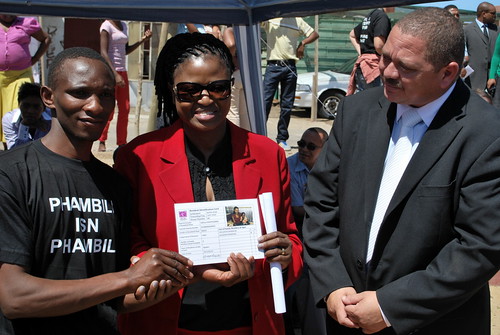
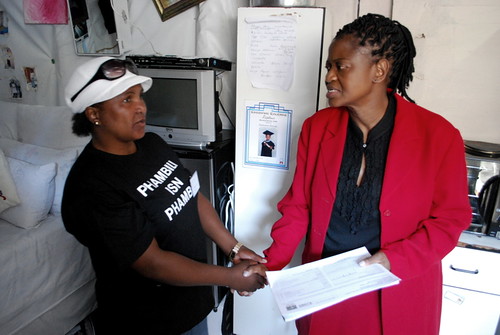
The delegation moved on to another aspect of the enumeration process that is linked to securing people’s tenure and creates a sense of belonging. This time, the minister handed over identity cards to Mshini Wam residents. The identity card contains the following household information:

  • Name and national ID number of household head, with a picture of him / her next to his / her numbered shack
  • Names and identity numbers of household dependents
  • Shack and block / cluster number
  • Number of years lived in the shack

This small gesture goes a long way. When the City’s anti-land invasion unit peruses settlements, and allegedly threatens with eviction, residents in enumerated settlements can easily produce tangible evidence to the contrary.
DSC_0118-1
The party then moved on the next venue: Siyahlala settlement across the road from Mshini Wam. “It’s an honor to again have you here amongst the shacks, Minister” said Patrick Magebhula, chair of ISN and advisor to Tokyo Sexwale. “This is where it really matters”. Turning to the buzzing crowd he said, “You need to be a leader with a purpose. A leader that represents solutions to real problems. A leader of the elderly, of the unemployed, of the disabled, of the children. And you will only know your people and your settlement if you have enumerated and discussed the data”. Magebhula also ensured the Minister and officials from the City of Cape Town that ISN, with support of CORC, are preparing a master database of data collected in settlements over the past years.

Member of Mayoral Committee for Human Settlements, Councilor Sonnenberg, also affirmed the City of Cape Town’s commitment to working alongside communities associated with the Informal Settlement Network – in particular the communities of Mshini Wam, BT Section, Burundi, and Vygieskraal. Six objectives in the partnership between the ISN and City of Cape Town were also presented:

  1. Create a shared community vision of the future, especially with regard to informal settlements upgrading and backyard rehabilitation;
  2. Identify and prioritise key issues, thereby facilitating immediate measures to alleviate urgent problems;
  3. Support community-based analysis of local issues, including the comprehensive review of long-term, systemic problems that confront particular service systems and the need to integrate different service strategies so that they are mutually supportive;
  4. Develop action plans for addressing key issues, drawing from the experiences and innovations of diverse local groups;
  5. Mobilise community-wide resources to meet service needs, including the joint implementation of sustainable development projects; and
  6. Increase public support for municipal activities and local understanding of municipal development needs and constraints.

DSC_0132-1

DSC_0141-1

Minister Kota-Fredericks reminded the delegation of minister, councillors and officials that these are the people we serve. She further remarked that the Department is in the process of finalising its budget and at the budget speech, she will report back on the collaborative upgrading initiatives she witnessed in Cape Town.

In closing, minister Kota-Fredericks talked about the “multiplier effect” that small City-wide projects have on national policy deliberations. This starts through organised communities taking the initiative to build horizontal networks of accountability and transparency. Only by building partnerships with all tiers of government, starting at the local level, meaningful engagement will be achieved. The minister walked the talk, and conducted a household level enumeration by completing the CORC questionnaire with a local resident. And in doing so, she also launched the enumeration of Siyahlala settlement.
DSC_0159-1

Ulwazi ngamandla! People’s power in the age of the informal

By FEDUP, ISN, News No Comments

By Walter Fieuw, CORC

Zeziphi ezona ngxaki ninazo e Joe Slovo? Xa unofumana ithuba lokulungisa yeyiphi eyona onoqala ngayo?

On a hot Cape Town morning, across the road from where Democracy Mini Market in Joe Slovo Park is located, a group of young men talk through the problems they face in their settlements, and what they could possibly do to remedy their harsh living conditions. Where will the money come from, and who do we speak to? A lady enters the conversation and says that her main concern for Msuluzi Village in Mpumalanga is tenure security as they face regular threats of evictions.
DSC_0094-1

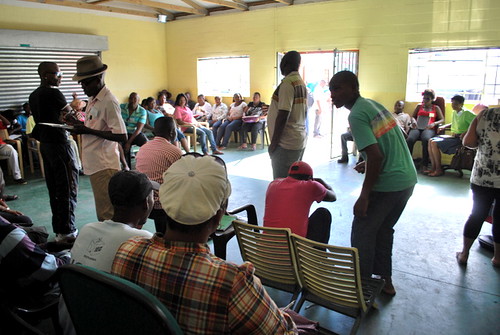
Between Monday and Friday, 20 to 24 February, community leaders associated with the Informal Settlement Network (ISN) from across the country meet in Joe Slovo Park, Milnerton, Cape Town and participate in a national workshop on enumerations. The focus of the workshop is to start a conversation about finding solutions through the information communities gather through enumeration. Enumeration is a social organising tool the ISN utilises by which the community does a survey and assessment of socio-economic and demographic profile, basic services and development aspirations. Communities use this information to build local capacity and develop spatial plans for the upgrading of their settlement.

This information is very valuable. City councils allocate funds to budgets that are aligned to 5-year-development plans – also called the Integrated Development Plan (IDP). The IDP document influences the way the City council prioritises and upgrades informal settlements. City councils need information to do this type of planning, and private consultants are often employed to do surveys and research on the development needs. Yet private consultants rarely drill down into community structures to ascertain a comprehensive vision of a preferred future. Strong organised communities therefore need to build local capacity to influence and interject the imaginations of city builders. This happens when they have self-knowledge, which become power negotiation tools. In this way, communities offer an alternative to top-down development, and offer opportunities to deepen democratic engagement and create an inclusive governance culture, which are the obligations of “developmental local government”.

At the same time, enumerations in different regions in Cape Town and other South African cities have been conducted which did not necessarily lead to stronger communities and development plans. The workshop also seeks to address how enumeration should be a mobilisation tool whereby the entire community is prepared and agrees to the development vision. This requires an in-depth mobilisation of the community. Enumerators need to be able to articulate the enumeration programme, and be able to address the community at large about what this entails and why this is important. This underscores the importance of knowing your neighbor. The congregation agreed that we are not in the business of building individuals, but communities.

The full participation of communities is the only way to have a successful enumeration. We have seen enumerations that were led by a few individuals in the communities and nothing happened there. Therefore, by sensitising the community to the process and the outcomes, you create a focus on projects that builds on community solidarity. It is the leadership committee’s responsibility to involve wide participation in the enumeration process; from the way that questions are framed, to the way data is captured and presented to the community.  A number of stories were also heard.

Siyahliwe, Johannesburg: At first, ISN members visited the councillor and the municipality and the organised structures in the community. They went back to their community, and called a general meeting, which was attended by all these parties. They introduced the enumeration programme, and identified the problems in their settlement. Once the community, councilor and municipality were on board, the leaders drew up a map of the settlement, designated blocks, and the enumeration was started.
Mshini Wam, Cape Town: Started in 2010 at the time when they started engaging the regional ISN leaders. For a long time, they were depending on water and services from the formal RDP houses in the settlement. Therefore, they should be seen as backyarders and not an informal settlement per se. They were paying up to R50 per month for water. At the regional ISN forums, they learned a lot from other settlements in their region. The City of Cape Town said they could not install services because of the density and no access roads. After a long engagement, they ensured taps were installed. The idea of enumeration was seen as a way to open space and understand the demographics and spatial relationships of the settlement. They identified the open spaces in their settlement, and have completed the initial plan for the first cluster. In this way they are opening space to construct
Manenberg, Cape Town: We approached the local housing office and asked them how many people do they estimate live in backyarder shacks in Manenberg. The office estimated about 420 people. The enumeration showed the true number to be more than 4,000 people. This revelation had major impact in the way the city saw the Manenberg backyarders; a community that was uncovered through the enumeration process.

The workshop culminates on Thursday with a visit from the Deputy Minister of Human Settlements Ms Zoe Kota-Fredericks where the community of Mshini Wam will demonstrate their validated enumeration results and draft spatial plans, and the community of Siyahlala where Ms. Kota-Fredericks will launch the enumeration at a mass meeting.


National leaders of the Alliance congregate in Cape Town

By CORC, FEDUP, ISN, News, uTshani Fund No Comments

By  Walter Fieuw, CORC

Leaders of the South African SDI Alliance congregated between 16 – 18 January 2012 at the Lutheran Youth Centre in Athlone to follow up on progress made since the strategic meeting held at Kolping House in January 2011. At last year’s meeting, the Alliance agreed to a shift of focus towards upgrading of informal settlements. Despite one of the world’s largest housing delivery programmes, the South African government has failed to curb the demand for housing and the improvement of basic living conditions for milllions of poor people. The Alliance has pledged ‘to strengthen the voice of the urban and rural poor in order to improve quality of life in informal settlements and backyard dwellings’. This we will accomplish by supporting communities who are willing and able to help themselves.

At Kolping House strategic meeting, the following four broad strategies would define the work of the network:

1. Building communities through FEDUP and ISN using SDI social tools;

2. Building partnerships with government at all tiers;

3. Implementing partnerships through projects; and

4. Keeping record of learning, monitoring and evaluation.

Upgrading informal settlements is an inherently complex endeavour considering the various socio-political realities connect to harsh living conditions and illegality. However, across South Africa the urban poor are mobilising and building institutional capacity to engage local governments around community-initiated upgrading agendas. As the Alliance’s saying goes, “Nothing for us without us”. Dialogues and outcomes of this year’s strategic meeting focused on meeting the development indicators which the Alliance set for itself at Kolping House. This year will see a renewed focus on the following:

  • Capacitating regional leadership structures, and the creation of a national ISN coordinating team
  • Recommitment to the spirit of daily savings, daily mobilisation and daily exchanges of learning
  • Deepening the quality of selected settlement upgrading, while growing the ISN network
  • Developing relevant and sensitive indicators, guidelines and protocols for the Alliance’s core activities to spur self-monitoring and evaluation.
  • Resourcing the Alliance through effective partnerships with local governments, universities and other development agencies such as the National Upgrading Support Programme (NUSP, Dept of Human Settlements) and the promotion of establishing Urban Poor Funds, similar to the Stellenbosch experience (hyperlink: http://www.sasdialliance.org.za/blog/Memorandum/)

Building coalitions of the urban poor able to capture the imaginations of city builders, both from the top-down and the bottom-up, is not often highly regarded or understood when upgrading strategies are devised. The Alliance is committed to strengthening the voices of the urban poor through building effective, pro-poor partnerships and platforms with local government, and implementing these partnerships at project level. As the process to understand the discrepancies and commonalities between the agendas of communities and the municipality gets underway, work must begin. Communities and the municipality develop, in partnership, a mix of “quick wins” that can build trust and show real change for communities. At the same time, the Alliance is also geared towards challenging many of the assumptions that lie behind planning for the urban poor throughout cities in South Africa. Other projects that get chosen for implementation are difficult cases designed to influence the way the municipality operates so that its methods come closer to the planning priorities of communities. All the project types also influence communities. At these interfaces of bottom-up agency and top-down city management, new ways of seeing, grappling with and finding solutions for informality emerge, and shack dwellers are no longer passive by-standers to the development enterprise, but active partners and innovators of finding workable, affordable and scalable solutions to urban poverty.