Tag

partnerships Archives - Page 5 of 5 - SASDI Alliance

Reflections on the Southern African HUB Meeting: Lusaka, Zambia

By CORC, FEDUP, ISN, SDI No Comments

**Cross-posted from the SDI blog**

By Noah Schermbrucker (on behalf of SDI Secretariat)

SDI Southern African Hub Countries

SDI Southern African Hub Countries

HUB meetings are gatherings that bring affiliates together to collectively set the agenda for the region. They are used as a mechanism to share collective learning, devise targeted support strategies (e.g. exchanges) for individual countries and concretize planning, on a regional scale, for the next period. The Southern African HUB recently took place in Lusaka, Zambia from 12-14 September 2014. Delegations from South Africa, Namibia, Zimbabwe, Swaziland, Botswana and Malawi attended the 3-day meeting. A team from Uganda, who had recently hosted the East African HUB, participated in order to promote continuity. Ghana was also invited as the West African HUB has been indefinitely postponed due to the Ebola outbreak.

Below find my reflections on the meeting. I hope that they provide some insights not only into SDI processes at a regional level but also the “nuts and bolts” of which this process is comprised. This is hence not an exhaustive description of the meeting but aims to give the reader a “practical flavor” of SDI’s work as it plays out in the interactions between slum dwellers, support professionals and government.

Day 1: Engagement with Ministry of Local Government, field visit to Garden Park community under threat of eviction (only some delegates) and meeting at Lusaka City Council (LCC).

The Zambians were clear that the first day’s agenda was about taking their process forward, especially in terms of achieving tangible outputs from government. South Africa, Namibia, Zimbabwe, Uganda, Malawi and Ghana all stressed the actual outputs of their relationship with government to both the Ministry of Local Government and LCC. As was noted, “ An M.o.U with government is just a piece of paper unless it has actual tangible outputs attached”.

Making the first day about taking the Zambian process really orientated us within local challenges and used the HUB as an instrument to open space with government for the Zambians (which they are now following up on). The Southern African HUB has previously been very “talk” orientated and not substantively relevant to the local process so this shift was refreshing to see. A trick that we missed out on was not inviting government officials from the countries attending as the Zambians felt that this would have deepened the impact in these engagements with government. As a federation member noted “governments like to talk to other governments”.

Through the site visit to Garden Park, evictions were placed on the table as a key issue with the HUB committing (on the final day) that each federation will draft guidelines on evictions sharing their experiences and strategies used (this emerged out of a separate federation only session)

Women from Garden Park meet to discuss eviction threat

Women from Garden Park meet to discuss eviction threat

Day 2: New Secretariat systems (L,M&E, New Secretariat structures)

Day 2 was spent at the Zambian federation’s resource center in George compound with significant participation from the Zambian federation. Mara (from the SDI Secretariat) and Muturi (from the Core Team) did a fantastic job in taking everyone through some of the new systems developed by The Secretariat including the L, M &E worksheet and call for support. There was a vibrant discussion about these new systems and some very important suggestions made as to how they could be refined (e.g. definitions of certain terms such as “secure tenure” need to be clarified). These issues were noted and will be shared with the secretariat team.

A very critical issue was raised around the learning center and its role within the HUB, a number of people felt that the HUB itself was serving as the learning center. We need to think carefully about how the learning center fits into the HUB-especially in the case of Southern Africa were conditions and experiences in Cape Town are quite different to the rest of the countries. People felt strongly that different countries had different strengths (e.g. Namibia and Zimbabwe around collection of their savings number & indicators).

"Carrying" water home in Chazanga, Lusaka

“Carrying” water home in Chazanga, Lusaka

Day 3: HUB Business

The day was focused on collecting country reports that were compiled previously by each country. These will be used to aggregate a set of Southern African HUB figures that can be taken to the Board & Council (B&C) meeting. Each country handed in their reports but then spoke about the “burning issues” and what support was needed. This led to suggestions for further exchanges that have been noted. The HUB also discussed progress made on exchanges decided at the B&C. In general this approach was well received as countries did not use up time providing long lists of figures but rather focused on the key issues that they wished to raise. The exact role and nature of the CORE team was also explained at length.

Throughout the meeting the participation of members from Kenya, Uganda and Ghana was extremely helpful. Their insights were valuable and contributed to the discussions with government. The continuity between the East African HUB and this HUB was definitely beneficial and something that we could take forward.

An issue that emerged from some was how we can include more “voices” in the HUB and encourage everyone to participate and speak more fully. It seemed that when we broke into country teams it allowed for more even discussion and participation as opposed to just a few people speaking in the bigger forum.

A HUB report is currently being drafted by Zambia and will be shared shortly.

Co-producing Ideas: Denver community and University of Johannesburg Studio

By CORC, ISN No Comments

By Motebang Matsela and Yolande Hendler (on behalf of CORC)

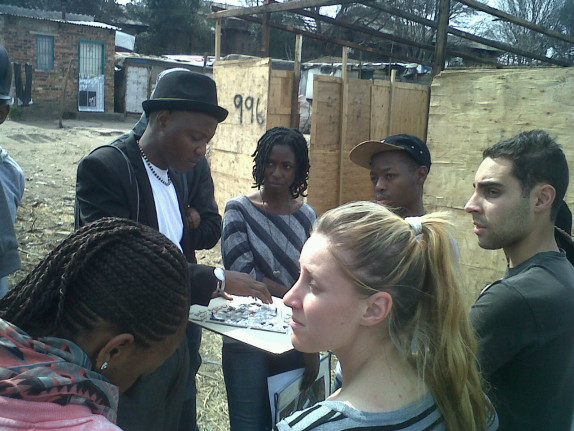
Over the years, the SA SDI Alliance has been involved in several architecture and planning studios in which university students and community members co-produce ideas and scenarios around housing and upgrading. The most recent of these studios took place from July to August 2014 in Johannesburg’s Denver informal settlement together with community members, students from the University of Johannesburg’s (UJ) Department of Architecture, the Informal Settlement Network (ISN) and Community Organisation Resource Centre (CORC) who offered technical and social support and facilitation.

UJ students and community members in Denver informal settlement

UJ students and community members in Denver informal settlement

IMG-20140820-WA0007

Motebang Matsela (CORC technical support and CORC studio facilitator) (centre), with community members and students

Denver informal settlement

Denver informal settlement is situated in a light industrial zone that spans the southern section of Johannesburg’s central business district. It was formed in response to Denver hostel, an inner city accommodation, established around 1946 by the government of the time to house rural labour migrants. As the hostel operated for men-only, Denver informal settlement sprang up as an accommodation option for the wives of men living in the hostel. Over the years the settlement has continued to grow along with an increasing demand for housing by its residents.

IMG-20140820-WA0059

Aerial view of Denver

The studio: co-producing training for students and communities

The studio developed out of a longer engagement between UJ’s Department of Architecture, CORC and ISN, who had already collaborated on past studios in Ruimsig (2011) and Marlboro South (2012) informal settlements in Gauteng. The Denver Studio, however, differed from past studios because it introduced the first of a series of project management modules.

For the SA SDI Alliance, studios lay a foundation for productive discussions with local government that voice communities’ views, opinions and requirements. They also introduce students to the necessity and value of planning with communities, which contributes to a focus that shifts away from traditional ‘top down’ product and ‘delivery’ approaches towards ‘responsive’, community-orientated approaches.

While these outcomes are valuable aspects of collaborative work, Gauteng’s ISN leaders highlighted a current gap: community members need to gain tangible skills through the studio and upgrading process, just as the students do. Each module therefore couples practical participation in the studio with project management skills. Upon completion of every module, community residents will receive a certificate of participation. The vision is that these modules will run as an ongoing series throughout future studios and that they will incrementally build on the content of past studios, creating continuity and ongoing engagement between past and future studios.

Community members receive certificates of participation

Community members receive certificates of participation


DSCF9550

The Studio: co-producing ideas

The course engaged eighty 3rd and 5th year students in a site-specific situation that used joint mapping and data to generate community action plans (CAPs). These investigated short, medium and long term planning scenarios that would encourage short-term community initiatives and support further productive discussion with local government around incremental upgrading

The students were divided into ten groups, each of which partnered with two or more residents from Denver settlement who took the lead as designated community planners and explained the community’s various concerns to the students. One of the community leaders, Chief Mbata shared his views on the studio as a platform to commence a dialogue about the urban poor and their conditions of living. He went on to speak about the over crowdedness and the illegal electrical connections that have claimed a lot of shacks and their contents in and around Denver.

“I wish to see these dangerously exposed cables go, and better connections made by the municipality, but when shall that happen?”

(Chief Mbata, Community leader at Denver informal settlement)

Students and community members then investigated the following key themes for ten areas in the settlement:

  • Spatial Justice
  • Humane Environments
  • Scenario Planning
  • Context
  • Spatial / Physical / Social
  • Systems / Networks
  • Interfaces / Thresholds
  • Undercurrents / Threats
  • Aspirations / Perceptions
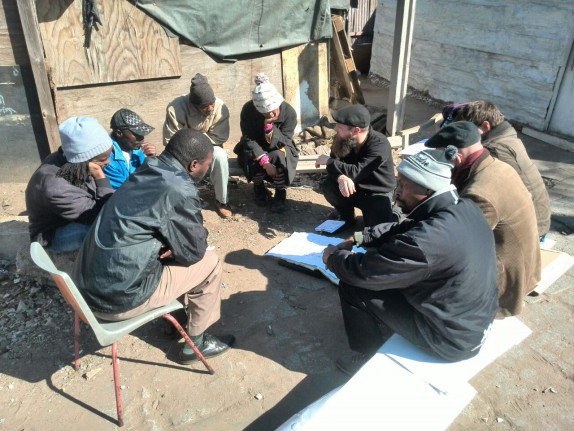
Students and community members in Denver informal settlement

Students and community members in Denver informal settlement

Final Student Presentations in August 2014

Final Student Presentations in August 2014

While they engaged with these themes, the community, supported by ISN and CORC, also undertook an enumeration of its settlement with the support of iSN – in a combined effort to collect comprehensive information.

As a community member, Daphne Ntombenhle Mabuso used her in-depth knowledge of the community and its history to compile the studio’s data in a collective documentation of Denver that represents the settlement as accurately as possible. Some of the studio’s content includes figure-ground drawings, actual land-use maps and various other maps that identify needs, constraints, observations and possibilities within Denver. This documentation can serve as the basis for continuing discussions between the community of Denver and the City of Johannesburg. (Click here to access the students’ documentation of the studio).

In the last week of August, the students presented their socio-spatial analyses of courtyards, pathways, open spaces,permanent vs. temporary structures and rental vs. owned units to Denver community. These open up a space to begin small-scale projects and a discussion with the local authorities. During this time community members also received their certificates signalling their participation in the studio and the project management skills they acquired. In this way community residents are becoming formally skilled participants and drivers of their own development in a collaborative, co-productive training space.

(Photos: Motebang Matsela, CORC)

DSCF9444


Building the Siphumelele WaSH facility / Innovation Centre in Langrug, Stellenbosch

By CORC, FEDUP, ISN No Comments

By Aditya Kumar and Yolande Hendler (on behalf of CORC)

Zwelitsha is a section of Langrug informal settlement, located on the rocky ground of a mountain slope that overlooks the lush valleys and nearby town of Franschoek in Stellenbosch Municipality. Zwelitsha’s residents make up 604 people who reside in 318 structures. Langrug as a whole is home to 4700 people who live in 2118 structures. While Langrug’s other sections have access to water and sanitation facilities – including the Langrug Water Sanitation and Hygiene (WaSH) facility – Zwelitsha’s steep incline and rocky terrain have made it extremely difficult to build water and sanitation points. To this end, Zwelitsha currently has only one tap and no toilets.

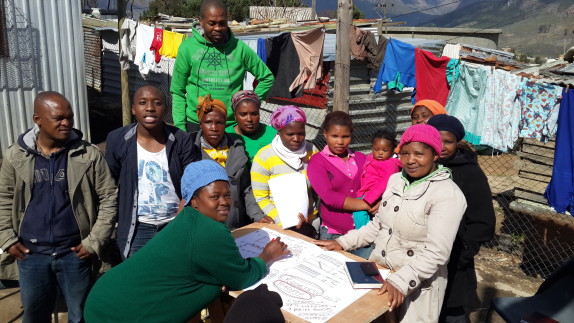
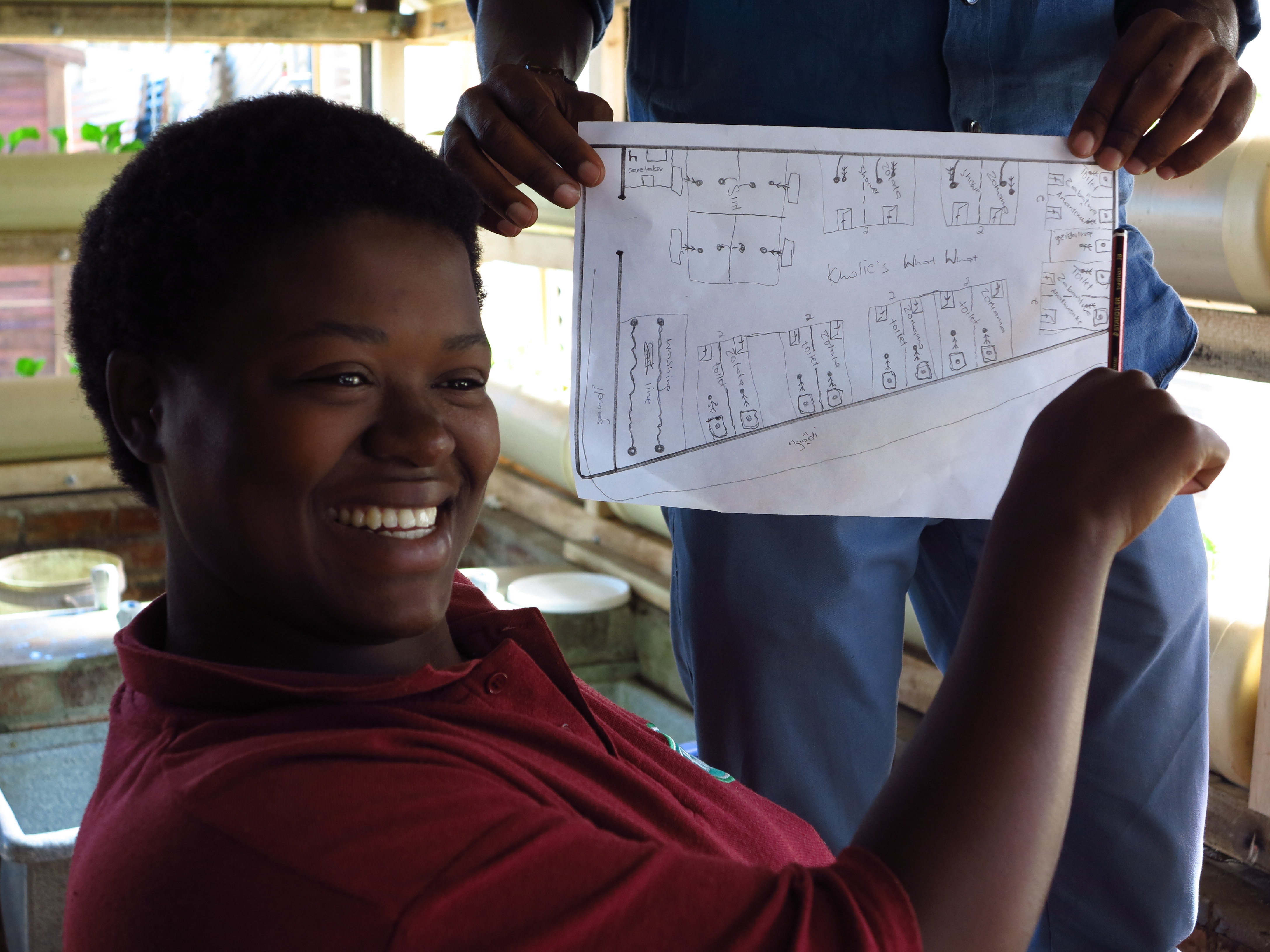
Zwelitsha community members developing plans for the Siphumelele WaSH facility

Zwelitsha community members developing plans for the Siphumelele WaSH facility

Yet this situation is about to change, as community members began work on the foundations of the Siphumelele WaSH Facility and Innovation Centre last week in partnership with the Informal Settlement Network (ISN), Federation of the Urban Poor (FEDUP), Community Organisation Resource Centre (CORC), Touching the Earth Lightly (TEL), Sculpt the Future Foundation, Stellenbosch Municipality, Worcester Polytechnic Institute (WPI) and Enviro Loo (a waterless sanitation provider).

Site of Siphumelele WaSH facility in Zwelitsha section of Langrug informal settlement

Site of Siphumelele WaSH facility in Zwelitsha section of Langrug informal settlement

Building on Experience: Learning from the Langrug WaSH facility

Based on the monitoring, evaluation and learning around the existing WaSH facility (read more here) in Langrug, Zwelitsha’s residents initiated a discussion about the possibility of a second WaSH facility. They approached ISN and CORC, WPI and Stellenbosch Municipality, all of whom had partnered with the community in building the existing WaSH facility in 2011.

Learning from the existing WaSH facility in Langrug

Learning from the existing WaSH facility in Langrug

The discussion related to the outcomes of a sample survey that was conducted over 12 days in July and August 2013. This survey looked at the benefits of data collection, the various uses of the existing WaSH facility (economic and small enterprise, health and food security, educational, organisational meeting point) and its upkeep and maintenance.

More specifically the outcomes of the survey of the Langrug WaSH facility included:

  • The collection of inception data for Siphumelele WaSH facility
  • Current data collection for usage at both WaSH facilities from July 2014
  • Increased use of the Langrug facility by crèches in Langrug. (An estimated 40 children served per day at the facility around issues related to basic hygiene)
  • A fully functioning post-office hosted in the Langrug WaSH facility, based on previously collected enumeration (socio-demographic) data
  • Support for HIV / AIDS awareness in Langrug WaSH facility
  • Potential for small businesses selling health and hygiene products in Langrug facility
  • Increased food security through the greening of the existing facility in partnership with Touching the Earth Lightly
  • Langrug WaSH facility as a space for youth education, workshops and meetings
  • Dramatic increase in usage of Langrug facility due to consistent cleanliness and ancillary functions within the facility
  • Comparatively low maintenance and upkeep of Langrug facility
  • Success in preventing vandalism
  • Significantly, the community expressed a higher degree of ownership in relation to the Langrug WaSH facility as it was community designed, built and maintained

The challenges that emerged around the facility enhanced the monitoring, evaluation and learning around the delivery and maintenance of services, and assisted in conceptualising the Siphumelele WaSH facility.

Some of these challenges and learning points related to:

  • The low usage of communal showers
  • The slow inception of the hair salon

Building the Concept: Co-Designing the Siphumelele WaSH facility

Given the cost of maintenance and operations, the community and partners involved explored the idea of a livelihood-linked wash facility where a portion of the facility would generate revenue (through a kiosk, crèche, health and educational programme) to reduce the burden on municipal funds for maintenance. Given the community’s experience of struggling for a space of safety and dignity, the Zwelitsha design and construction team named the wash facility “Siphumelele” – “We have achieved it”.

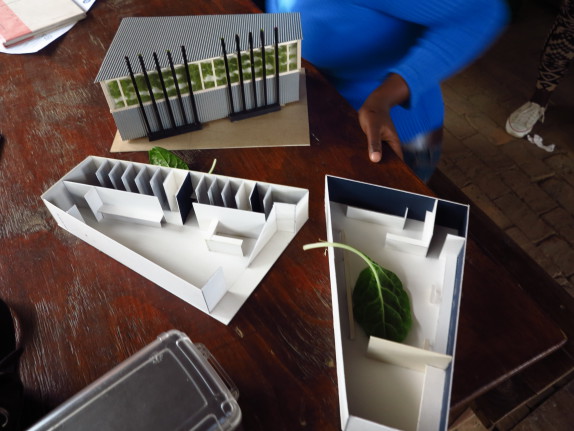
From March to April 2014 the community, together with TEL, began co-designing the facility. The designs include toilets for men and women, a wash area and a kiosk on the ground floor. The second floor will contain a crèche and soup kitchen that will be managed by the community. After conducting a survey with Zwelitsha’s families about amenities to be included in the facility, community leaders chose to exclude showers due to their infrequent use in the Langrug WaSH facility. The community also chose to make use of Enviro Loo toilets after they visited Enviro Loo in November 2013 and received detailed explanations on how the toilets are maintained and operated. The Enviro Loo is a waterless toilet system that provides a safe, non-polluting, cost-effective solution to sanitation.

Co-designing with Touching the Earth Lightly

Co-designing with Touching the Earth Lightly

IMG_6272

Co-designing the WaSH facility

Model of Siphumelele WaSH facility

Model of Siphumelele WaSH facility

Building the Team: Community-led Implementation

Apart from the partners already mentioned, the community has put together different teams to lead the implementation process. These include a leadership committee, a savings group and an Informal Settlement Upgrading Team (ISUT). This team is led by 8 women and includes a Community Liaison Officer, a storekeeper and a project manager who spearhead the construction process. After an exchange to a savings scheme linked to the Federation of the Urban Poor (FEDUP), the community set up their own savings group in July 2014 so as to manage finances to maintain and operate Siphumelele WaSH facility.

Building a voice of the urban poor in Langrug

The foundations for both WaSH facilities were laid when Stellenbosch Municipality signed a Memorandum of Understanding (MoU) with the community and ISN / CORC in 2011. Since this date Langrug’s community leaders have been developing a formal relationship with the Municipality and are making a strong case for how urban poor communities successfully organise themselves to lead their own upgrading processes, and how co-design and co-planning is a step towards a more tangible ‘inclusive city’.

(Photographs: Stephen Lamb, TEL)

Phase 1 of construction

Phase 1 of construction

The construction team

The construction team

Preventing Shack Fires in UT Gardens with Lumkani Fire Detector

By CORC, ISN No Comments

By Yolande Hendler (on behalf of CORC)

Vuyani Ntontela and Thamara Hela are community leaders in UT Gardens, an informal settlement of about 400 structures in Khayelitsha, Cape Town. UT Gardens forms part of UT section in Khayelitsha’s Site B. Since the community was introduced to the Informal Settlement Network (ISN) in 2013, Thamara explains that UT Gardens has been organising itself for upgrading. Yet she also speaks of one of the biggest challenges the community faces: on-going fires that ravage homes and livelihoods, the most recent of which occurred last month.

UT Gardens Community leaders with Lumkani. From left to right: Phatiswa Nzima, Thamara Hela, Emily Vining, Ntombentle Qinga

UT Gardens Community leaders with Lumkani. From left to right: Phatiswa Nzima, Thamara Hela, Emily Vining, Ntombentle Qinga

Since March 2014 Vuyani (chairperson of UT Gardens), Thamara and the rest of UT Gardens’ leadership committee (15 in total) have been building a relationship with ‘Lumkani’, a social enterprise that is focussed on overcoming the challenge of shack fires in urban informal settlements. Lumkani has been developing a device that acts as an early-warning alert against shack fires.

The Lumkani device

The Lumkani device uses heat detection technology instead of smoke detection (not suited for the shack environment given the heating, lighting and cooking methods that take place in homes) to sense for fires. As a heat detector it accurately measures the incidence of harmful fires, alerting the family inside the shack of the danger. Each device is networked to surrounding devices within a 100m radius. In the event of a fire, the detecting device will send a signal to surrounding devices within this range. A solid beep means that the device has detected a fire in your own home whereas a broken beep indicates that the fire is in the nearby surrounding. A wave of sound creates a community-wide alert and response to danger. This buys time for the community to become proactive in rapidly spreading fire risk situations. Emily Vining, who facilitates Lumkani’s community interaction, explains that

“The networked functionality of the device is a way to confront the challenge of density and the rapid spread of fire. The devices are networked because it is not enough for one person to be alerted – everyone needs to be alerted. As a device Lumkani intends to stop the spread of fire through a community-wide response. It is most effective in communities with a strong leadership who can create strategies to respond to fire”

The Lumkani device

The Lumkani device

Building the relationship between UT Gardens and Lumkani

Thamara remembers how UT Gardens first heard about Lumkani through ISN and the Community Organisation Resource Centre (CORC).

 “When I heard about Lumkani I liked it. Because I am a mobiliser I proposed it to the other leaders. When we first met with Lumkani, they explained the fire detection device to us and asked if the community wants to be one of their pilot communities. As leaders we also liked the project. But we first called a general meeting to check with the community. They accepted the idea because we have a problem with fires. We meet with Lumkani every week to share our plans with each other. ”

(Thamara Hela, UT Gardens community leader)

Emily explains how Lumkani first met Thamara and the UT Gardens leadership in December 2013. From February/ March 2014 Lumkani met with UT Gardens leadership weekly to grow a relationship. David Gluckman, Lumkani’s financial director, explains that

“from the earliest phase of the project we met with community leaders and sought out their input – which had direct implications on the design of the device and its functionality – after all nobody knows the fire situation in informal settlements better than the people living there”

Emily elaborates that Lumkani was interested in developing the device through a deep-participatory approach that values horizontal learning. This means: inclusive design solutions and continuous innovation driven by testing and feedback. Both Emily and David emphasise how the community’s guidance was key, especially during on-site meetings with Max Basler, Lumkani’s industrial designer and Samuel Ginsberg, Lumkani’s technical director. It was during the first meetings with the community that the Lumkani team became aware of the need for a community wide and –networked device that could share information as fast as possible. Apart from on-site meetings, Lumkani formalised its community research in a short 12 question survey distributed to about 70 households in order to better understand how the community is affected by and responds to shack fires.

IMG_1610

Making plans to install 10 test devices last week

IMG_1616

Measuring out the distance between structures for installing the test devices

Looking forward

At the moment the device is in a general testing phase – which includes technology tests and a sound test that took place last week, for which the first ten devices were installed. The pilot is set to begin in October 2014 and will seek to test 2000 devices in four high fire risk communities in Cape Town, one of which is UT Gardens.

Thinking back of the past months of working together with Lumkani, Thamara shares,

“Since we started our relationship with Lumkani I would like to say that they are doing a good job. What I like about Lumkani is that after we have a meeting, we see things happening on the ground. Even when people from other settlements in Site B visit me and see the fire detector they like what Lumkani is doing”

(Thamara Hela, UT Gardens community leader)

Gauteng settlements install ‘Litres of Light’

By CORC, ISN No Comments

By Motebang Matsela and Yolande Hendler (on behalf of CORC)

DSCF2366

Naledi informal settlement in Soweto, Johannesburg

Many informal settlement dwellers have no access to electricity and are forced to rely on open fires, gas and paraffin appliances or candles as sources of light, warmth and energy.  The resulting frequency of fires that ravage informal settlement homes throughout South Africa is well known.  Gauteng’s Informal Settlement Network (ISN) introduced an alternative lighting option to community members in Gauteng settlements together with a team from ‘Litre of Light‘ Switzerland, who visited Johannesburg from 5-12 April 2014.

‘Litre of Light’ offers an alternative source of light through installing a 2litre PET bottle – that is filled with purified water and bleach – onto the roof of a structure. The water inside the bottle refracts the sunlight during the day and creates the same light intensity as a 55-Watt light bulb. With the correct installation and materials a solar bottle can last up to 5 years. The ‘Litre of Light’ is assembled by using cheap, durable and readily available materials. This enables urban poor households to access an affordable, environmentally friendly, long-term alternative to electric light during the day.

Demonstrations on how to assemble the 'Litre of Light' bottle

A ‘Litre of Light’ team member demonstrates how to assemble the light

ISN representatives introduced the team from Liter of Light to community members in four Gauteng settlements: Kliptown and Naledi in Soweto (South West Johannesburg), Innesfree informal settlement in Sandton (North Johannesburg) and Holomisa informal settlement (East of Johannesburg).  They had chosen these settlements because of the poor light conditions – many shacks do not have windows and those that do, only receive limited light due to the high density of structures in the settlement.

Over the week, the ‘Litre of Light’ team visited each settlement and workshopped community members on how to assemble the lights: a two litre plastic bottle is pushed through a steel sheet that serves as a metal lock to prevent the bottle from slipping. It is then embedded into a corrugated iron roof. A small part of the bottle is left outside while the rest of it protrudes into the room. After the initial demonstration community members proceeded to assemble their own lights. Each community installed a light in two structures. ISN community leaders are establishing the interest that was generated after this initial exchange – with a view to establishing how to move towards a broader vision of “candle-less settlements”.

The readily available materials and straightforward assembly process means that a majority of informal settlement households can install the light themselves.  This also brings about a potential income-generation opportunity in the long term. Both ISN and the Litre of Light team hope to spread this alternative source of light, as a manner of improving livelihood opportunities for shack dwellers and minimising the risk of day-time shack fires.

A community member in Innesfree, Johannesburg assembles a 'Litre of Light' bottle

A community member in Innesfree, Johannesburg assembles a ‘Litre of Light’ bottle

National Community Exchange – Durban to Cape Town (Part 2)

By CORC, iKhayalami, ISN No Comments

By Yolande Hendler (on behalf of CORC)

A four-day community exchange was underway from 29 April to 2 May 2014, during which community leaders from Durban visited informal settlements in and around Cape Town.  This blog continues to trace the experiences and reflections collected on the exchange, the first two days of which have been recorded here.

Day 3 in Langrug informal settlement – Sanitation, Drainage and ‘Greening’

View of Langrug informal settlement, Franschoek

View of Langrug informal settlement, Franschoek

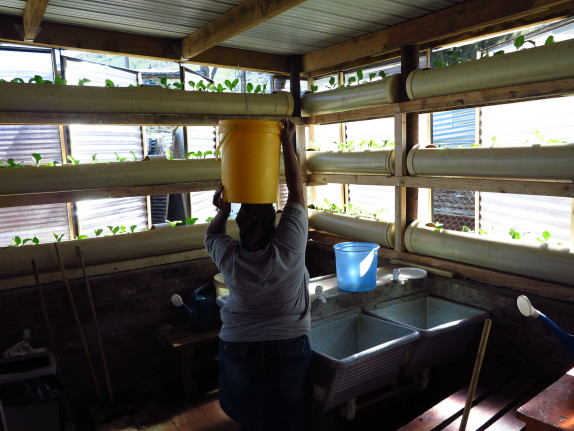
Located in the affluent wine-farming area of Franschoek, Langrug informal settlement, home to about 4500 people, is characterised by extreme poverty, poor housing and sanitation. In the face of these challenges the community signed a precedent-setting Memorandum of Understanding (MoU) with the locally presiding Stellenbosch Municipality that channelled government funds to community-based upgrading initiatives. This translated into relocating 16 families, the construction of a second access road, the construction of grey-water and drainage channels and a community designed, multi-purpose Water, Sanitation and Hygiene (WaSH) Facility. The facility includes a communal homework area for children, a hair salon, benches and laundry basins. Click here for a comprehensive profile of Langrug. Currently, Langrug is involved in the second phase of upgrading: ‘greening’ the existing WaSH facility with vertical vegetable gardens and developing a dry sanitation facility in Zwelitsha, an ‘informal’ section of Langrug without taps and toilets.

Existing WaSH Facility after 'greening'

Existing WaSH Facility after ‘greening’

KZN visitors taste Langrug's spinach

KZN visitors taste Langrug’s spinach

The exchange visitors were introduced to all these aspects on a detailed walk-about. Langrug community member, Alfred Ratana, indicated the differences in depth and purpose of the drainage and grey water channels and explained the processes accompanying relocation. He emphasised the uniqueness of Langrug in that it was a municipality-driven project which was not community financed.

“Langrug shows that municipalities can have a different approach to communities. Our experience shows that municipalities can include us in their plans and construct with us – not for us”

(Alfred Ratana, Langrug community member)

Langrug community member, Alfred Ratana, speaks about Langrug's grey water drainage

Langrug community member, Alfred Ratana, speaks about Langrug’s grey water drainage

DSCN6652

Viewing a community-constructed drainage channel

Langrug community members also explained the breakthrough presented by Zwelitsha’s dry sanitation facility: due to its location on a steep mountain slope it has been impossible to provide water and sanitation services to around 600 families. The dry sanitation facility, however, is a step towards changing this. The vertical vegetable gardens in Langrug’s existing WaSH facility (developed in partnership with Touching the Earth Lightly) showed the visitors how the community secures food and generates income. By selling the spinach it grows, the community intends to generate income to sustain daily running costs of the facility.

The visitors were also impressed by a crèche facility that had been established between external partners and mothers in Langrug who wanted to provide an alternative, more affordable option for their children. The teachers of the crèche explained that,

“getting something started is not about presenting an idea to social services. You just need to start. Once the idea is happening, you can take the outcome to social services and get it registered”.

Once back at the WaSH facility Langrug’s steering committee shared details around the developments in their settlement. The group was also joined by Diana Mitlin and visiting colleagues from Manchester University. Read about their impressions here.

Sharing impressions after the walkabout

Sharing impressions after the walkabout

Langrug's steering committee explains the steps it took in the upgrading process

Langrug’s steering committee explains the steps it took in the upgrading process


Day 4 in Mtshini Wam – Reflections on how to continue

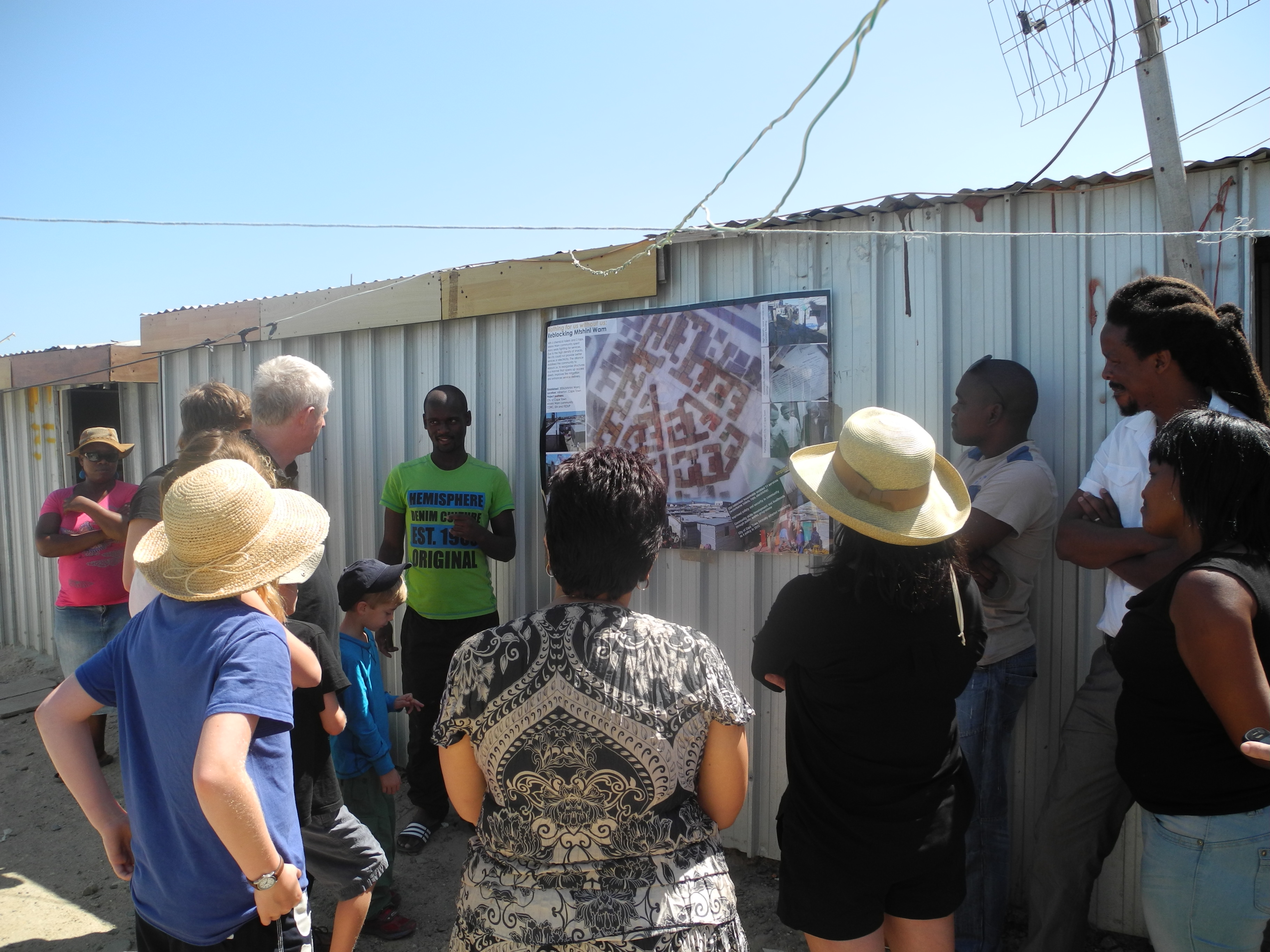
The final visit to Mtshini Wam showed the visitors what a large-scale re-blocking project could look like. During upgrading, the settlement also received one on one services, some in-structure toilets and public water points. More details on Mtshini Wam’s re-blocking are documented here.

Over four days the group had seen much, listened intently, exchanged questions and pondered how to take these impressions back home. Some key points:

  • Visiting Langrug presented a highlight for the visitors from Durban as the topography and accompanying challenges (steep inclines, drainage and flooding) are similar to the conditions in their own settlements.
  • Langrug’s drainage and sanitation facilities therefore presented relevant options for the Durban visitors
  • The visitors were inspired by the initiative and commitment they encountered in their fellow community leaders, something they wanted to take back in responding to circumstances in their own settlements
  • The exchange highlighted the importance of partnerships and the ever-present opportunity to form partnerships as a foundation for wielding large scale change
A street view of Mtshini Wam after re-blocking

A street view of Mtshini Wam after re-blocking

KZN leaders in conversation about securing service provision

KZN leaders in conversation about securing service provision

Durban’s Kenville and Foreman Road settlements will share their experiences of the exchange in mass meetings with their communities this weekend (16-18 May). Their next steps are to enumerate their settlements and establish a relationship with their councillors.

As the visitors embarked on the journey home, ISN community leader, Nkokheli Ncambele, reminded them that

“it is important not to impose everything you have seen on this exchange on your communities at home. Rather take what you have learnt and present it to the community as a suggestion. Then you can decide together what you want and how to make it work in your own settlement”

Exchanges certainly are the most important learning vehicle in the South African Alliance. They facilitate the direct exchange of information, experience and skills, thereby building a horizontal platform for learning between urban poor communities. Through sharing successes and failures in projects, giving and receiving advice on engaging government, sharing in work and life experiences and exchanging tactics and plans communities become central actors.

National Community Exchange – Durban to Cape Town (Part 1)

By CORC, iKhayalami, ISN No Comments

By Yolande Hendler (on behalf of CORC)

Informal settlement leaders from Kenville and Foreman Road in Durban are mobilising their communities to upgrade their settlements with better services and improved spatial layouts. Last week’s exchange to Cape Town (29 April – 2 May 2014) therefore presented a first-hand opportunity for them to draw insights from fellow community leaders.

DSCN6359

Group picture in Kuku Town: Durban and Cape Town communities on exchange

Over the week the Durban visitors were hosted by Kuku Town, Flamingo Crescent, Langrug & Mtshini Wam communities in and around Cape Town. Each day was dedicated to an in-depth visit of each settlement. This included a detailed site visit, discussions on  collecting savings, enumerating and profiling settlements and contributing to planning and mapping. Besides bringing leaders together on a national level, the exchange also connected communities locally: for leaders from Kuku Town, Flamingo and Langrug the exchange comprised a first time visit to the other settlements. Exchanges are thus the most important learning vehicle in the South African Alliance, facilitating the direct exchange of information, experience and skills between urban poor communities.

DSCN6297

Introductions and briefing on the week ahead at CORC office in Mowbray

Day one in Kuku Town: Upgrading & Savings 

Community leaders met in Kuku Town, a small settlement that recently completed re-blocking and in the process secured one-on-one water and sanitation services from the City of Cape Town. Read more about Kuku Town and re-blocking here. In the discussion community leaders took the visitors through a step-by-step picture of Kuku Town’s experiences. ISN representative, Melanie Manuel, explained that

“What we do in ISN is not only to beautify our settlements but to actually change the way we live. Savings and partnerships – like we had with Habitat for Humanity and the municipality – are an important part of this.”

DSCN6325

Community leaders share their experiences around organising and upgrading in Kuku Town community hall

Yet, before partnerships can be formed, a community needs to know its settlement in terms of the number of (un)emloyed people, the number of structures and families and details on service provision (electricity, sanitation and water). This information is collected in enumerations. Kuku Town community used its enumeration data to plan its re-blocked layout and to negotiate the provision of one-on-one services and short-term employment opportunities through the City’s Expanded Public Works Programme (EPWP).  Community leaders explained that they organised themselves in clusters to be able to navigate the logistics around communication and construction during re-blocking.

Among a variety of questions, the visitors took special interest in understanding the connection between savings and upgrading, especially the role of community contributions. Melanie explained that

“Savings contributions enable us as communities to take ownership and responsibility of the changes and upgrading in our settlements. We want to move away from a ‘free for all mindset’ and restore dignity and pride to our communities”

Melanie Manuel, ISN representative

Melanie Manuel, ISN representative

But collecting savings poses a continuous challenge. How to go about motivating communities and responding to accusations? Flamingo Crescent’s community leader, Auntie Marie, shared her experience:

“Getting the community’s commitment for daily savings is difficult. People only want to act when they see that things are happening. You’ve got to be tough. If you’re not tough you won’t get anything right”

For Kuku Town community leader, Verona Joseph, the partnership with the City and its support in this regard, was crucial.  This became evident at Kuku Town’s official handover that afternoon which was attended by the ward councillor and City officials.  The handover and a site visit completed the first day of the exchange, demonstrating what a tangible community-government partnership can look like.

DSCN6393

Exchange communities join Kuku Town handover ceremony

Inspecting the water and sanitation services provided by the City

Kuku Town site visit: inspecting water and sanitation services provided by the City

Day two in Flamingo Crescent: Re-blocking and Partnerships

Flamingo Crescent is about to begin re-blocking and – in partnership with the City of Cape Town – is set to receive one-on-one services. On a walkabout through the smoke and dust-filled pathways community leaders received a thorough impression of the settlement’s layout. Most structures – consisting of old cardboard, zinc, timber and plastic pieces – are situated around a broad, u-shaped pathway that is intersected by smaller, narrow footpaths. Flamingo’s population of about 450 people resides in 104 structures. The entire settlement makes use of only 2 taps and 14 chemical toilets that are emptied three times a week. The absence of electricity means that fire is used as a central source for cooking and warmth.

1. Overview 2

Flamingo – view from above

Site visit in Flamingo

Site visit in Flamingo

In a nearby community hall, Flamingo’s steering committee explained its relationship with ISN and the challenge of collecting savings contributions due to its high unemployment rate (50%). Flamingo’s enumeration acted as a powerful entry point to negotiating an improved layout and service provision with the City of Cape Town. Together with students from the Cape Peninsula University of Technology and Worcester Polytechnic Institute (USA) the community designed the re-blocked layout and conceptualised plans for a crèche and a play park.  Later, the visitors joined the steering committee’s meeting with a Cape Town City official who provided an update on the City’s contribution to upgrading.  For the visitors this was of particular value as it emphasised the crucial role of partnerships and the number of actors involved in a given project. The question at the forefront of many minds was: how can we do this in our communities at home?

For Auntie Marie, Flamingo community leader, it is evident that

“If it wasn’t for ISN, I don’t know where we would be. Through ISN we were introduced to the City and we got a partnership. We started thinking, ‘Now something is going to happen’. Flamingo is going to be re-blocked!”

Continue reading Part 2 of the exchange here.

(Flamingo steering committee presents its partnerships

Flamingo steering committee presents its partnerships

Auntie Marie, Leader of Flamingo Community and Steering Committee

Auntie Marie, Leader of Flamingo Community and Steering Committee

Report back to Flamingo Community

Report back to Flamingo Community


Building Partnerships: Comic Relief vice chair and film director Richard Curtis visits SA Alliance

By CORC, News No Comments

By Yolande Hendler (on behalf of CORC)

DSCN5524 - Kopie

Richard Curtis, Melanie Manuel (ISN), Emma Freud, Bunita Kohler (Director of CORC), Marlene Don (FEDUP) and Bukiwe Marawu (CORC)

Last week, the South African Shack Dwellers Alliance welcomed Comic Relief vice-chair and film director/producer/writer Richard Curtis with his wife, Emma Freud, and family at the Cape Town office. Before arriving he told his children,

“Today I’m meeting the people I work for”.

As a renowned film-maker, Curtis is also co-founder of the UK based charity Comic Relief which has been one of the alliance’s principal development partners since 2011. Together, they spent a morning meeting the alliance partners, visiting Mtshini Wam informal settlement where community members explained the process of re-blocking and showed Curtis and his family what a re-blocked settlement can look like. They also visited the Solid Waste Network, one of the alliance’s income generation initiatives.

DSCN5533

Mthsini Wam community members explain reblockingDSCN5542

Building Partnerships

To achieve the vision of more inclusive and pro poor cities it is critical to build partnerships with urban development actors who support this vision. The alliance’s association with Comic Relief as a development partner is a platform for organised communities to be at the core of building such cities. Communities are best positioned to contribute to design and to plan development solutions that have greater impact and sustainability than external development interventions. The alliance’s partnerships not only include the network of SDI affiliated countries or partnerships with government but also focus on partnerships with international aid agencies and donors, such as Comic Relief.

Founded in 1985, Comic Relief’s vision is of a “just world, free from poverty” (Reference). By raising funds through campaigns such as Red Nose Day and Sport Relief, Comic Relief spends these on projects that tackle the “root causes of poverty and social injustice in the UK and across the world” (Ibid). In particular Comic Relief supports projects “on the ground”, giving people a “leg up, not a hand out” (Ibid). Comic Relief displays a long term view of achieving this vision and therefore forms lasting partnerships with local organisations. Some projects are supported for up to six years whereby the progress of projects is tracked and funds are paid in phases.

Comic Relief and the South African Alliance

Comic Relief has been a core funding partner of the Alliance’s work since 2011 when uTshani Fund secured a grant for supporting the core activities of FEDUP housing development process. The grant is in its second year of operations and aims to support community lead projects in housing development and informal settlement upgrading (via the uTshani Fund housed funding facility Community Upgrading Finance Facility). uTshani Fund and CORC have formed a close working relationship in addressing the challenges of homelessness, landlessness and urban poverty.

The Community Organisation Resource Centre (CORC) has also been successful in applying to Comic Relief for grant funding. As part of its UK Aid Match scheme, Comic Relief formed a partnership with the Department for International Development (DFID). In December 2011 DFID agreed to provide a further £10m of funding for Comic Relief’s Urban Slums work. This sum would be matched by Comic Relief through funds raised during Sport Relief 2012, thereby totaling £20m. This new fund is intended to transform the lives of a million slum dwellers in a limited number of African cities through the strategic collaboration of agencies. The funding spans five years in total.

CORC and the South African alliance partners responded to the call for proposals and were successful in their application. The core of the funding proposal focussed on setting up a local city fund which will deliver informal settlement upgrading projects in the area of Khayelitsha in the City of Cape Town. The city fund is a responsive mechanism that aims to achieve a long term sustainable fund which could be replicated and/or recapitalised by City and Provincial government.

The beginning of Comic Relief funded projects in Khayelitsha

DSCN5045

Community leaders plan and design in KhayelitshaDSCN5063

As part of the Comic Relief grant, the alliance has been engaging with several neighbouring communities in Khayelitsha that live in UT, TT and BT sections, Litha Park and UT Gardens. Since mid 2012 these communities have been forming a horizontal relationship with ISN structures. After community members living in UT Gardens profiled and enumerated their section, they expressed the need for a crèche / multi-purpose centre for the community on a nearby open field.  Since the start of 2014 community leaders have continuously met with each other and CORC’s technical support team.

The meetings have had two aspects: On the one hand the community leaders expressed some key issues to address such as drainage and managing waste disposal. On the other, they co-designed and co-conceptualised the first drafts of the crèche / multi-purpose centre and identified existing footpaths and transit spaces. As the discussions continue, community leaders are eager to see this project lift off the ground.

This, then, is one of the projects that the Comic Relief grant supports. On the surface, it looks entirely different from Mtshini Wam or the Solid Waste Network which Curtis and his family visited. Yet the similarity lies in the tools that each community uses to organise itself. It lies in communities who lead their own design and planning. The SA SDI Alliance values long term funding agreements with international development partners such as Comic Relief (and its associations and members) that recognise the imperatives of informal settlement upgrading, housing and land, and livelihoods development.


FEDUP’s Gogo Mohale saved up for “the house of her dreams”

By FEDUP, uTshani Fund No Comments

By Patrick Matsemela (on behalf of FEDUP)

2013 was a special year for Gogo Mmapule Mohale.  After she saved for 14 years, we began building her house in Maboloka in North West Province. She started saving with the Federation of the Urban Poor (FEDUP)  in 1999. FEDUP is a women-led social movement that empowers communities to start community saving schemes. It is also one of two social movements that forms the South African Shack Dwellers Alliance. At meetings Gogo Mmapule Mohale would always tell other members,

“I am not in a hurry. I know that I will have the house of my dreams. What needs to happen is that we must negotiate with government for more support”

Now, Gogo Mohale is 87 years old and received her house.

07032013006-002

Gogo Mohale in front of her old house


16082013038-001

Gogo Mohale’s new house


FEDUP – North West Network

In the North West, the FEDUP network is formed by four to six savings groups. We have six local facilitators and one regional facilitator. Federation network members meet once a month, where they bring different reports from different savings groups. They also share information on their different groups and compile a report for the regional meeting. The report also requests support on issues raised in network meetings.

Through FEDUP saving schemes, communities can develop their own knowledge and capacities, build houses and acquire land. In South Africa FEDUP has about 1500 savings and credit groups which range from a minimum of 15 to a maximum 500 members. If communities save small amounts of money, collect information and use this to negotiate with government they have a better chance of securing entitlements, strengthening themselves and leading their own development plans. FEDUP has used its collective power to lobby government and access the housing subsidy programme. In this way it strongly influenced the governments’s low-income housing policy, the People’s Housing Process (PHP) and later, the enhanced People’s Housing Process (ePHP). uTshani Fund is FEDUPs own housing finance facility and account administrator.

A FEDUP member calculates our her savings at our network meeting in Mafikeng (North West Province)


The North West / FEDUP Pledge

Gogo’s house was one of 200 hundred houses that were pledged to be built in Maboloka. The Maboloka project was part of several housing projects in Mafikeng Municipality in North West Province which was part of a national housing pledge signed in 2006 between uTshani Fund and the National Department of Housing and then minister, Lindiwe Sisulu. The pledge was for 1000 subsidies with which to build houses throughout South Africa. The other projects in North West Province were in Lethabong, Jericho&Legonyane, Oukasie Lethabile, Mafikeng and Madinyane.

Lethabong, for example, would receive 96 subsidy houses. As FEDUP we managed to build 89 houses. For this we won the runner up to the North West award for best enhanced People’s Housing Process (ePHP).  For us as FEDUP the PHP needs to be focused on the community. The most important thing about this project was that it was led by the community. We want them to lead the construction, administration and project management. This happens through the Community Construction Management Team (CCMT) which is formed by community members who hold the positions of project manager, procurement officer, bookkeeper, administrator and community liaison officer.  The houses that FEDUP members receive are bigger (54m²) than RDP houses (36m² or 40m²).

We are happy that after so many years of saving together, Gogo Mohale now has her own house. For other FEDUP savings groups to achieve what Gogo Mohale did, we still need more support from government.


07032013004

The CCMT team manages construction


National leaders of the Alliance congregate in Cape Town

By CORC, FEDUP, ISN, News, uTshani Fund No Comments

By  Walter Fieuw, CORC

Leaders of the South African SDI Alliance congregated between 16 – 18 January 2012 at the Lutheran Youth Centre in Athlone to follow up on progress made since the strategic meeting held at Kolping House in January 2011. At last year’s meeting, the Alliance agreed to a shift of focus towards upgrading of informal settlements. Despite one of the world’s largest housing delivery programmes, the South African government has failed to curb the demand for housing and the improvement of basic living conditions for milllions of poor people. The Alliance has pledged ‘to strengthen the voice of the urban and rural poor in order to improve quality of life in informal settlements and backyard dwellings’. This we will accomplish by supporting communities who are willing and able to help themselves.

At Kolping House strategic meeting, the following four broad strategies would define the work of the network:

1. Building communities through FEDUP and ISN using SDI social tools;

2. Building partnerships with government at all tiers;

3. Implementing partnerships through projects; and

4. Keeping record of learning, monitoring and evaluation.

Upgrading informal settlements is an inherently complex endeavour considering the various socio-political realities connect to harsh living conditions and illegality. However, across South Africa the urban poor are mobilising and building institutional capacity to engage local governments around community-initiated upgrading agendas. As the Alliance’s saying goes, “Nothing for us without us”. Dialogues and outcomes of this year’s strategic meeting focused on meeting the development indicators which the Alliance set for itself at Kolping House. This year will see a renewed focus on the following:

  • Capacitating regional leadership structures, and the creation of a national ISN coordinating team
  • Recommitment to the spirit of daily savings, daily mobilisation and daily exchanges of learning
  • Deepening the quality of selected settlement upgrading, while growing the ISN network
  • Developing relevant and sensitive indicators, guidelines and protocols for the Alliance’s core activities to spur self-monitoring and evaluation.
  • Resourcing the Alliance through effective partnerships with local governments, universities and other development agencies such as the National Upgrading Support Programme (NUSP, Dept of Human Settlements) and the promotion of establishing Urban Poor Funds, similar to the Stellenbosch experience (hyperlink: http://www.sasdialliance.org.za/blog/Memorandum/)

Building coalitions of the urban poor able to capture the imaginations of city builders, both from the top-down and the bottom-up, is not often highly regarded or understood when upgrading strategies are devised. The Alliance is committed to strengthening the voices of the urban poor through building effective, pro-poor partnerships and platforms with local government, and implementing these partnerships at project level. As the process to understand the discrepancies and commonalities between the agendas of communities and the municipality gets underway, work must begin. Communities and the municipality develop, in partnership, a mix of “quick wins” that can build trust and show real change for communities. At the same time, the Alliance is also geared towards challenging many of the assumptions that lie behind planning for the urban poor throughout cities in South Africa. Other projects that get chosen for implementation are difficult cases designed to influence the way the municipality operates so that its methods come closer to the planning priorities of communities. All the project types also influence communities. At these interfaces of bottom-up agency and top-down city management, new ways of seeing, grappling with and finding solutions for informality emerge, and shack dwellers are no longer passive by-standers to the development enterprise, but active partners and innovators of finding workable, affordable and scalable solutions to urban poverty.