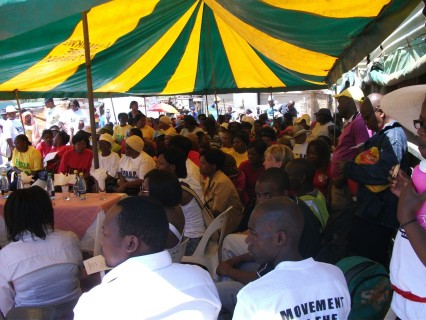
Tag

ISN Archives - Page 5 of 5 - SASDI Alliance

SDI President Jockin Arputham in Cape Town

By FEDUP, ISN, News, SDI No Comments

Jockin Arputham, president of Shack / Slum Dwellers International (SDI) received a warm welcome from the South African Alliance in Cape Town yesterday on the last of his four-day visit. As a long-standing, much-valued friend of the Alliance he spent the day with community leaders in Khayelitsha and with representatives of the City of Cape Town and Western Cape Province.  Jockin spoke about the power of savings and the Indian Alliance’s partnership with the Municipality of Greater Mumbai. In this context, Jockin was accompanied by Rajiv Jalota, the Additional Municipal Commissioner for Projects in Greater Mumbai Municipality.

SDI President Jockin Arputham (Right) & Rajiv Jalota (Additional Municipal Commissioner for Greater Mumbai Municipality)

SDI President Jockin Arputham (Right) & Rajiv Jalota (Additional Municipal Commissioner for Greater Mumbai Municipality)

The Informal Settlement Network (ISN) has mobilised and profiled several settlements in Khayelitsha that are set to proceed on water, sanitation, drainage, re-blocking and community facility projects.  Jockin’s visit linked Khayelitsha’s community leaders – many of whom are fairly new to ISN and SDI processes – to the broader context of the South African Alliance and SDI as a global network.

Community Leaders greet Jockin

Community leaders welcome Jockin

Word of welcome by Tamara Hela, Community Leader from UT Gardens Khayelitsha

An official word of welcome by Tamara Hela, Community Leader from UT Gardens Khayelitsha

National coordinators of the South African Alliance’s two social movements, Patrick Maghebhula (ISN) and Rose Molokoane (FEDUP) welcomed Jockin by speaking about the Alliance’s history with the Indian Alliance. They referred to the South African slogan – Amandla Imali Nolwazi: Power is Money and Knowledge – and its roots in the relationship with India.

“This slogan started influencing me after we went to India (in 1991). We shared ideas around democracy with the Indians. We saw that after 40 years of democracy millions of people in India were extremely poor. We realized that if you sit around and wait for democracy it will come…but it will come with its own laws that might not cater for you. We need to do something to translate these laws to our own life. And so we learnt the experience of self-reliance from the Indians. We need to drive our own lives – and we do that with savings. This is how relationships with government were formed in India. Our savings and our information give us power to influence laws. We know, that yes, we may be poor, but we are not hopeless“

(Rose Molokoane, National FEDUP co-ordinator)

Rose Molokoane (National FEDUP co-ordinator)

Rose Molokoane (National FEDUP co-ordinator)


In the keynote address, Jockin emphasised that

“Savings are a life line. We talk about savings the whole time because money is what speaks.  But when you collect money – door to door – you also collect information. When you have information you can plan action and if you act, something will happen. This is why money and information guarantee us power.  We need to think about how to support ourselves”

As 40 – 50 % of Mumbai’s population – 19 million people – lives in slums, many millions do not have access to toilets. In fact, the ratio translates to about 1 toilet for every 800 people.  The NSDF has therefore been working together with Mr Jalota and the Municipality to construct community planned and -owned toilet facilities. This experience, Mr Jalota explained, would help to develop more policies for Greater Mumbai.

Jockin founded the National Slum Dwellers Federation of India (NSDF) in the 1970s. Often referred to as the “grandfather” of the global slum dwellers movement, Jockin was educated by the slums, living on the streets for much of his childhood with no formal education. For more than 30 years, Jockin has worked in slums and shantytowns throughout India and around the world. After working as a carpenter in Mumbai, he became involved in organising the community where he lived and worked (Reference). He helped found SDI and has been awarded many prestigious global awards, most recently the Skoll Foundation award for social entrepreneurship. On behalf of SDI Jockin has also been nominated for the Nobel Peace Prize.

Jockin Arputham, SDI President

Jockin Arputham, SDI President

National Community Exchange – Durban to Cape Town (Part 1)

By CORC, iKhayalami, ISN No Comments

By Yolande Hendler (on behalf of CORC)

Informal settlement leaders from Kenville and Foreman Road in Durban are mobilising their communities to upgrade their settlements with better services and improved spatial layouts. Last week’s exchange to Cape Town (29 April – 2 May 2014) therefore presented a first-hand opportunity for them to draw insights from fellow community leaders.

DSCN6359

Group picture in Kuku Town: Durban and Cape Town communities on exchange

Over the week the Durban visitors were hosted by Kuku Town, Flamingo Crescent, Langrug & Mtshini Wam communities in and around Cape Town. Each day was dedicated to an in-depth visit of each settlement. This included a detailed site visit, discussions on  collecting savings, enumerating and profiling settlements and contributing to planning and mapping. Besides bringing leaders together on a national level, the exchange also connected communities locally: for leaders from Kuku Town, Flamingo and Langrug the exchange comprised a first time visit to the other settlements. Exchanges are thus the most important learning vehicle in the South African Alliance, facilitating the direct exchange of information, experience and skills between urban poor communities.

DSCN6297

Introductions and briefing on the week ahead at CORC office in Mowbray

Day one in Kuku Town: Upgrading & Savings 

Community leaders met in Kuku Town, a small settlement that recently completed re-blocking and in the process secured one-on-one water and sanitation services from the City of Cape Town. Read more about Kuku Town and re-blocking here. In the discussion community leaders took the visitors through a step-by-step picture of Kuku Town’s experiences. ISN representative, Melanie Manuel, explained that

“What we do in ISN is not only to beautify our settlements but to actually change the way we live. Savings and partnerships – like we had with Habitat for Humanity and the municipality – are an important part of this.”

DSCN6325

Community leaders share their experiences around organising and upgrading in Kuku Town community hall

Yet, before partnerships can be formed, a community needs to know its settlement in terms of the number of (un)emloyed people, the number of structures and families and details on service provision (electricity, sanitation and water). This information is collected in enumerations. Kuku Town community used its enumeration data to plan its re-blocked layout and to negotiate the provision of one-on-one services and short-term employment opportunities through the City’s Expanded Public Works Programme (EPWP).  Community leaders explained that they organised themselves in clusters to be able to navigate the logistics around communication and construction during re-blocking.

Among a variety of questions, the visitors took special interest in understanding the connection between savings and upgrading, especially the role of community contributions. Melanie explained that

“Savings contributions enable us as communities to take ownership and responsibility of the changes and upgrading in our settlements. We want to move away from a ‘free for all mindset’ and restore dignity and pride to our communities”

Melanie Manuel, ISN representative

Melanie Manuel, ISN representative

But collecting savings poses a continuous challenge. How to go about motivating communities and responding to accusations? Flamingo Crescent’s community leader, Auntie Marie, shared her experience:

“Getting the community’s commitment for daily savings is difficult. People only want to act when they see that things are happening. You’ve got to be tough. If you’re not tough you won’t get anything right”

For Kuku Town community leader, Verona Joseph, the partnership with the City and its support in this regard, was crucial.  This became evident at Kuku Town’s official handover that afternoon which was attended by the ward councillor and City officials.  The handover and a site visit completed the first day of the exchange, demonstrating what a tangible community-government partnership can look like.

DSCN6393

Exchange communities join Kuku Town handover ceremony

Inspecting the water and sanitation services provided by the City

Kuku Town site visit: inspecting water and sanitation services provided by the City

Day two in Flamingo Crescent: Re-blocking and Partnerships

Flamingo Crescent is about to begin re-blocking and – in partnership with the City of Cape Town – is set to receive one-on-one services. On a walkabout through the smoke and dust-filled pathways community leaders received a thorough impression of the settlement’s layout. Most structures – consisting of old cardboard, zinc, timber and plastic pieces – are situated around a broad, u-shaped pathway that is intersected by smaller, narrow footpaths. Flamingo’s population of about 450 people resides in 104 structures. The entire settlement makes use of only 2 taps and 14 chemical toilets that are emptied three times a week. The absence of electricity means that fire is used as a central source for cooking and warmth.

1. Overview 2

Flamingo – view from above

Site visit in Flamingo

Site visit in Flamingo

In a nearby community hall, Flamingo’s steering committee explained its relationship with ISN and the challenge of collecting savings contributions due to its high unemployment rate (50%). Flamingo’s enumeration acted as a powerful entry point to negotiating an improved layout and service provision with the City of Cape Town. Together with students from the Cape Peninsula University of Technology and Worcester Polytechnic Institute (USA) the community designed the re-blocked layout and conceptualised plans for a crèche and a play park.  Later, the visitors joined the steering committee’s meeting with a Cape Town City official who provided an update on the City’s contribution to upgrading.  For the visitors this was of particular value as it emphasised the crucial role of partnerships and the number of actors involved in a given project. The question at the forefront of many minds was: how can we do this in our communities at home?

For Auntie Marie, Flamingo community leader, it is evident that

“If it wasn’t for ISN, I don’t know where we would be. Through ISN we were introduced to the City and we got a partnership. We started thinking, ‘Now something is going to happen’. Flamingo is going to be re-blocked!”

Continue reading Part 2 of the exchange here.

(Flamingo steering committee presents its partnerships

Flamingo steering committee presents its partnerships

Auntie Marie, Leader of Flamingo Community and Steering Committee

Auntie Marie, Leader of Flamingo Community and Steering Committee

Report back to Flamingo Community

Report back to Flamingo Community


Official Handover of Kuku Town Re-blocking

By CORC, ISN, News, uTshani Fund No Comments

By Walter Fieuw and Yolande Hendler (on behalf of CORC)

Kuku Town before re-blocking

Kuku Town before re-blocking

Kuku Town after re-blocking

Kuku Town after re-blocking

There is a growing recognition that services need to be delivered to informal settlements in new ways. Such new approaches should aim at building community capacity through participatory planning, design and service implementation. Informal settlements are characterised by very different shapes and sizes, ranging from smaller inner city settlements located in residential neighborhoods to large sprawling settlements on the periphery of cities. Different approaches are needed to effectively transform these settlements into more dignified living spaces.  Working with communities is paramount to succeeding in upgrading initiatives. The re-blocking of Kuku Town is an example of an alternative approach to thinking through aspects of place, safety and security through improved settlement layouts, and better located services.

The South African Alliance and Kuku Town community celebrated the official completion of re-blocking on 29 April 2014. Community leaders welcomed delegates from ISN and FEDUP, NGOs such as CORC, iKhayalami and Habitat for Humanity South Africa (HFHSA), City of Cape Town officials from the Department of Human Settlements and the Councillor of Ward 32, Cllr. Derrick America to the hand over last Tuesday.

DSCN6393

ISN & FEDUP co-ordinators speak at handover

Verona Joseph, Kuku Town community leader, opened the ceremony by welcoming guests and sharing some of Kuku Town’s history and the process of community mobilisation. Diverse partners involved in the upgrading process held a variety of speeches that gave thanks, recognised and acknowledged the community’s achievement after three years of negotiations and preparations. ISN and FEDUP community representatives, Mzwanele Zulu & Thozama Nomnga, voiced the importance of continuing the relationships and partnerships, beyond the completion of re-blocking.  Cllr America echoed this sentiment and emphasised that upgrading a settlement is about restoring dignity. Every community member received a personalised ID card containing demographic information  – a symbol of having taken one step closer to reaching security of tenure. The ceremony therefore marked an important milestone for the community, who founded the settlement in 1985.

Cllr Derrick America (right) hands over ID card to community leader Verona Joseph (centre) with Salisha Lauton (left, Habitat for Humanity SA)

Cllr Derrick America (right) hands over ID card to community leader Verona Joseph (centre) with Salisha Lauton (left, Habitat for Humanity SA)

In the meantime, the City of Cape Town has formally adopted re-blocking as an informal settlement upgrading strategy. It is included in the City’s IDP and Urban Settlement Development Grant (USDG) budgets for the next five years. The strength of re-blocking stems from the central participation of community members in the planning, design and implementation of their settlement upgrade. Unless community members are seen as central participants in the design of their settlement, the exercise remains futile, and not responsive to local conditions. 

Invalid Displayed Gallery

Kliptown communities in Gauteng relocate after heavy flooding

By ISN No Comments

As a heavy down pour of rain struck Gauteng in the first week of March, the banks of the Kliprivier broke and severely flooded Kliptown, one of the largest areas in Johannesburg comprising 14 informal settlements. The floods of 5 March affected 401 households, completely destroying the shelters and belongings of more than 15 families who were moved to the Kliptown Community Centre. They stayed there for about two weeks as they received emergency relief, food parcels and blankets.  Many children were unable to go to school as they had lost their uniforms and school books in the floods. Elderly residents and those living with TB, diabetes and HIV were in dire need of medical attention as they had lost their medication, missing out on daily treatment.

“One old lady was swept away by the floods and her leg was caught in razor wire. She couldn’t go to hospital until we took her. Things like this make the community angry because this is not the first flood. It’s been happening for the past five years” Dumisane Mathebula, ISN community leader

The Informal Settlement Network in Kliptown

As displaced people kept arriving at the community centre, community leaders affiliated to the Informal Settlement Network (ISN) called a stakeholders meeting in which the leaders of Kliptown’s 14 informal settlements met with representatives from the Department of Housing, respective ward councilors, representatives from the police, churches, crèches and NGOs to identify specific responses and tasks towards relocation.

DSCF2206

Existing materials are offloaded as relocation begins in Kliptown

ISN community leaders were tasked with sourcing support for flood victims. They wrote numerous letters to local businesses and hardware stores, sourcing support and building materials (timber, cement and nails) as well as blankets and food to support families who had lost everything. They also entered into negotiations with Region D Municipality about securing land for community residents who could not reconstruct their dwellings on the previous site due to the threat of continuous rainfall. After five years of repeated flooding, community leaders emphasized the urgency of relocation to municipal officials who agreed to using one of three suitable sites (earmarked for housing and serviced with infrastructure) for relocation.

“Before the floods we had a gap in our relationship with the city. The floods are an opportunity to be closer to the people and show the city who we are and that we are organised” Dumisane Mathebula

DSCF2227

The City of Johannesburg

The city was tasked with coordinating the relocation and layout, hiring a contractor and leveling the site according to the standards of the Emergency Housing Programme (EHP). This included providing one chemical toilet per seven households and taps in accordance with minimum EHP standards. During the relocation existing structures were demolished and reconstructed on the new site, using old materials wherever possible. As a number of structures were made of cardboard and tin, much material could not be re-used which has resulted in smaller and overcrowded shelters for many households. Since 17 March about 30 households have been relocated, including all displaced families staying in Kliptown Community Centre. Relocated residents are only staying in the structures temporarily as some are listed to receive subsidy housing on that land.

For Kliptown community resident and ISN leader, Jeff Mokoena, the heart of the problem is that the municipality did not address the problem of flooding in the past or relocate community members after the 2013 floods. He explains how the floods have been a recurring issue because people’s shelters are located within wetlands and flood lines.

“My concern is that the city is not managing informal settlements or making sure that people are safe. There is a lack of educating communities about the dangers of settling in flood line areas. We need to be informed by government around these issues so that we can participate in decision-making processes, as it says in the government’s National Upgrading Support Programme (NUSP). Kliptown is over 100 years old and we ask ourselves why it is not being prioritized. We have analysed the Freedom Charter but it is not being implemented here. When our sadness, frustration and anger comes together it becomes so big that you cannot  swallow it….”

“But I think since 2012 we have a breakthrough with the regional office of the city.  The relocation we are now doing is professional. We have requested a formal letter giving us a clear indication who will relocate where. Today I am a happy man because we are leading the relocation process and building a new face of Kliptown”

DSCF2282


Amandla Imali Nolwazi! Alliance marches to eThekwini Municipality

By CORC, FEDUP, ISN, uTshani Fund No Comments

After weeks of preparation and community mobilization, thousands of shack dwellers gathered on Durban’s Dinuzulu Square early on Monday morning, 24 March 2014. As people arrived by foot, mini-bus taxi and on numerous busses, they were met by songs of protest sounding from an ever-growing crowd of shack dwellers affiliated to the Federation of the Urban Poor (FEDUP) and the Informal Settlement Network (ISN).  The mass of black and white t-shirts, placards, banners and cardboard signs bore powerful messages

“Did you know the majority of people in eThekwini are still without title deeds?”

“Phambili nge community participation – Forward with community participation!”

“No Upgrading without Us!”

These messages pointed to the purpose of the march: to hand over an agreement of co-operation to eThekwini Municipality which outlined a more inclusive, implementable and participatory partnership between the municipality and organized groups of shack dwellers affiliated to FEDUP and ISN.

First marchers gather at Dinuzulu Square

First marchers gather at Dinuzulu Square


From Dinuzulu Square to the City Hall

The date of the march coincided with national celebrations around Human Rights Day. Most shack dwellers in eThekwini municipality and the country, however, do not benefit tangibly from the achievement of human rights in South Africa. Land acquisition, housing, water and sanitation, refuse removal, access to electricity and informal settlement upgrading are urgent and daily recurring concerns. For shack dwellers in eThekwini municipality these issues are particularly expressed in the lack of a meaningful engagement between themselves and the municipality.  The march, therefore, aimed to set the scene for an inclusive and participatory working relationship.


IMG_1387

A crowd of about 2500 marchers set off from Dinuzulu Square at 11h00, marching in peaceful and powerful protest, singing and loud hailing slogans that express the hardships of life in informal settlements and the power of organised communities. In the mid-day heat of a bright summer’s day, the streets of Durban CBD came to a standstill as shopkeepers, pedestrians and on-lookers absorbed the lively and determined atmosphere. The slogan was clear:

“Amandla, Imali Nolwazi, eish! Ayilumi Mayihlafuna” – Power is Money and Knowledge! Eish! You can’t bite while you are chewing!

IMG_1439IMG_1426

The alliance slogan directly speaks to the low response many urban poor communities receive from local municipalities.  ISN community leader Sifiso Nobani, explains that

“We chose to march because this is the only language that the municipality understands. Roads will be closed and people and businesses will take notice of us”

After 2km, the marchers, representing numerous informal settlement communities in eThekwini gathered in front of the City Hall to hand over the Agreement of Co-operation.

Towards an Agreement of Co-operation

The agreement was drafted as a response to some of the most pressing challenges faced by the urban poor in eThekwini. Sithembile Doncabe, FEDUP savings scheme leader, explains that

“ We are sick and tired of living in informal settlements. We are losing our dignity. We want to raise our dignity. We are citizens. We want houses. But they are not listening to us”

Ma Mkhabela, provincial FEDUP coordinator adds,

“There is some commitment from the municipality but they keep pulling back. When we meet in joint working groups once a month, municipality members are often missing. The provincial and national response is better. The problem is that our ‘partnership’ with the municipality is not a written one”

“We don’t know anything about the municipality’s plans for upgrading our settlements. We need to be informed about time lines and planning. We want to be independent communities. We have rituals that help us, like enumerations that show that one shack does not equal one family. If we have a chance to submit this information to the municipality we can develop our country nicely, like the constitution says!”

At Durban City Hall

At Durban City Hall

The co-operation agreement outlined these concerns in more detail. They relate to: a lack of updated facts and figures concerning the urban poor, a slow approach to land acquisition and assembly for informal settlements, inadequate delivery of basic services and disaster management, inadequate inclusion of the urban poor in municipal budgeting and planning processes, lack of municipal commitment to Joint Working Group structures to deal with uTshani Fund old debt and Pledge Housing implementation, limited social development, poverty alleviation, livelihood generation and nutritional programs as well as inadequate access to finance in funding community based upgrading projects. The agreement of co-operation also outlines the purpose and joint activities for future collaboration, emphasizing practical and implementable suggestions.

Several provincial alliance members shared their experiences around lobbying and mobilization with the marchers. Joe Nene, advisor to the Mayor, then joined national coordinators Rose Molokoane (FEDUP), Mzwanele Zulu and Patrick Magebhula (ISN) as the agreement was read out and handed over.

Mr. Nene received the agreement, emphasizing that he could not promise a signature but that it would be passed on to the mayoral office, which would respond within seven days.

As communities wait for a response from the municipality, Ma Mkhabela is clear,

“We want to plan together with the municipality so that they know our priorities. They need to talk to us. There’s nothing for us without us. We want to know that we have agreed together”.

Joe Nene (Advisor to the Mayor), Patrick Magebhula and Mzwanele Zulu (ISN national coordinators)

Joe Nene (Advisor to the Mayor), Patrick Magebhula and Mzwanele Zulu (ISN national coordinators)

2012 / 2013 CORC Annual Report

By CORC, FEDUP, ISN, Publications, uTshani Fund No Comments

Cover

With great pleasure CORC ‘s annual report looks back on an event-filled 2012-2013 which set the scene for community mobilisations, beginning and continuing partnerships with government, valuable developments on urban sustainability and our documentation strategies. However, the past year was also marked by the effects of the global financial crisis which were acutely felt by urban poor communities in the form of rapid urbanisation and a continuing lack of government service delivery.  By supporting urban poor informal settlements CORC supports communities in building a “platform of the urban poor”.

In this report outlines an overview of CORC’s general activities and supportive role to its alliance partners, the Informal Settlement Network (ISN) and the Federation of the Urban Poor (FEDUP) both of which are social movements involved in community-led upgrading processes. You will get an impression of dynamics around community savings, community mobilisations, enumerations, international events and exchanges. Please note that detailed project reports can be found in the separate publication, Masikhase: Community Upgrading Finance Facility (CUFF).

In addition to comments from our regional offices and a financial overview, the report also contains updated developments on our existing partnerships and new working relationships with government. Partnerships with local governments include the City of Cape Town, Stellenbosch Municipality (mature partnerships), City of Joburg Ekurhuleni Metropolitan Municipality, eThekwini Metropolitan Municipality, Nelson Mandela Bay Municipality, Midvaal Municipality (partnerships in progress), Breedevalley and Drakenstein Municipalities (signs of potential working relationships).

“We know that when the poor are not involved in development decisions they will care less about their surroundings or even use their initiative to resist paying for their services. our new approach means we will build partnerships with communities, and to give them ‘voice and choice’ in the design and construction of settlements that build sustainable livelihoods and can fulfil their needs” Deputy minister of Human Settlements, Ms. Zoe Kota-Fredericks”

As CORC supports communities making meaningful alternatives to change the structural causes of informality we aim to shift the focus of service delivery from government to partnerships and collaborative relationships.  This year, our work with organised communities, academic and non-governmental partners therefore centred on realising issues of urban sustainability. Some of these include the Solid Waste Network, partnering with Habitat for Humanity South Africa in establishing a city fund or introducing solar electrification in informal settlements.

The report outlines some of the successes and challenges of building coalitions of the urban poor in the contexts of landlessness, homelessness and urban poverty. We wish to congratulate our community partners for the number of awards and nominations for projects delivered, the hard work of collecting data and the patience of building partnerships.

CORC wishes to thank international donor organisations for believing in the vision and supporting the work of the SA SDI Alliance. These donors include:

  • Bill and Melinda Gates Foundation: (“Aligning communities and government”)
  • Ford Foundation (“Promoting Transparent Effective and Accountable Government”)
  • Charles Steward Mott Foundation (“General Purposes” and “Learning through Practice”)
  • Comic Relief (Ikhayalethu grant)
  • Misereor (“Building partnerships between communities and local authorities”)

SA SDI Alliance 2013 in Review

By CORC, FEDUP, ISN, News, uTshani Fund No Comments

Ayanda 20120209 212

Its that time of the year when we, the SA SDI Alliance, reflect on our achievements and work in progress. 2013 was a year of growth, maturation, and sharing knowledge and experiences. On the housing front, FEDUP was awarded with the Gauteng Provincial Goven Mbeki awards (runner up in North West), when the re-blocking of Mtshini Wam earned ISN and the community a Gold Impumelelo social innovation award.

The City of Cape Town’s adoption of the re-blocking policy has surpassed recognition and honor of the alliances work to realizing one of its main goals, which is creating precedent setting projects that have the ability to change policy and influence resource flows. Although the importance of upgrading of informal settlements has been recognised in the National Development Plan and actioned by the National Upgrading Support Programme (Department of Human Settlements), more needs to be done to promote community participation.

Creating partnerships with Government is one of the alliance’s aims of increasing the reach and impact of participatory development, and in this year we have spread our wings through sharing of knowledge and experiences by partnering with a number of stakeholders. These include the Santa Fe Institute, Habitat for Humanity, Touching the Earth Lightly and local and international universities (Worcester Polytechnic Institute, University of Cape Town and the University of Melbourne).

This year also marked a much closer working relationship between FEDUP and ISN, resulting in the signing of a joint charter. Such a review happens once in four years, and this year at the national forum the ISN/FEDUP charter was launched to strengthen and clarify the roles of each network. In 2014 we are looking forward to showcasing four of the Alliances projects that have been acknowledged by the World Design Capital 2014 committee and we will continue working with different stakeholders to make the voices of the poor heard.

We look back on the year past, and in anticipation, look forward to the coming year.

1: Policy transformation at the local government level

On the 5th of November 2013, Thandeka Gqada, Mayoral Committee Member for Human Settlements, City of Cape Town announced the adoption of the reblocking policy by The City of Cape Town. This policy has been influenced by the Mtshini Wam reblocking project, which is one of 22 pilot projects scheduled for re-blocking in the 2014.

Mtshini Wam before and after

Blocking-out” and “re-blocking” are interchangeable terms the South African SDI Alliance uses to refer to the reconfiguration and repositioning of shacks in very dense informal settlements in accordance to a community-drafted spatial framework. The aim is to better utilize the spaces in informal settlements to allow for better service provision. Moreover, re-blocking is done in “clusters” identified by the community, and after implementation, “courtyard” are created to ensure a safer environment for woman and children via neighborhood watches (all shacks face the courtyard), productive places (such as washing lines, food gardens), and generally provides space for local government to install better services. Read more on the City of Cape Town Adopts Reblocking policy.

2: Innovative projects nationally recognised

Dududza Project Wins Govan Mbeki award

On the 11th of April, FEDUP was nominated in the Gauteng Provincial Govan Mbeki awards. The award ceremony aims to showcase and demonstrate the partnerships with the department at both tiers and promotes best practices in meeting the delivery mandate of the Presidency’s Outcome 8, which is aligned with the vision of building sustainable human settlements and meeting the Millennium Development Goals. The Federation of the Urban and Rural Poor (FEDUP) has been transforming the housing policy from the bottom up for the past two decades. Premised on the notions of social and political change through community savings. The Federation has built more than 12,000 houses since 1994, and continues to set a precedent in women’s led leadership and collaboration with government. The MEC of Human Settlements at the Provincial tier nominated projects in four specified categories 1) which displays exceptional quality 2) promotes best practice 3) collaboration of stakeholders 4) improving the quality of life for the beneficiary-partners. Read more: Duduza Wins Gauteng Govan Mbeki Award for ePHP and Mafikeng in the North West with the runner up prize

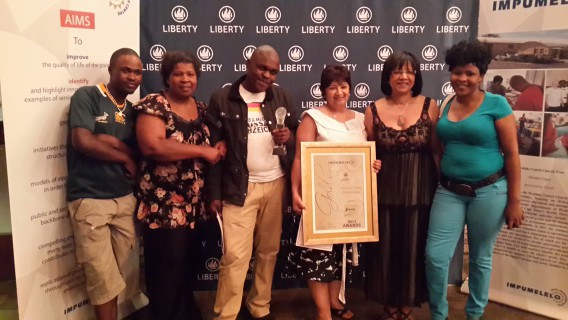
Mtshini Wam Reblocking Project Wins Impumelelo Award

Mtshni Wam was one of the 33 finalists that have been selected out of the 80 shortlisted projects. The finalist are from all over South Africa in a wide range of sectors such as Health, HIV/AIDS, ECD, Education, Skills Training, Environment, Agriculture, Infrastructure, Social Welfare, Community Development, Food Security, Job Creation, and Animal Welfare.  This project showcases community led planning and design, the use of innovative material and layout design to decrease the level of disasters such as fires, flooding and food security, and the collaboration of stakeholders.  Read more  on Mtshini Wam Reblocking Project wins a Gold Impumelelo award.
20131201_205542_LLS_resized

3:  Collaboration and Partnerships

SDI- Santa Fe Institute Partnership

SDI has collaboratively partnered with the Santa Fe Institute in testing new techniques in profiling informal settlements with the quest of improving data capture processes. The importance of this collaboration is to develop theoretical insights about cities that can inform quantitative analyses of their long-term sustainability in terms of the interplay between innovation and resource appropriation. At the grassroots level, the data helps communities understand their settlements better and use it as an engagement tool with government. Read more on the profiling of UT Section, Khayelitsha, Cape Town

Habitat for Humanity South Africa

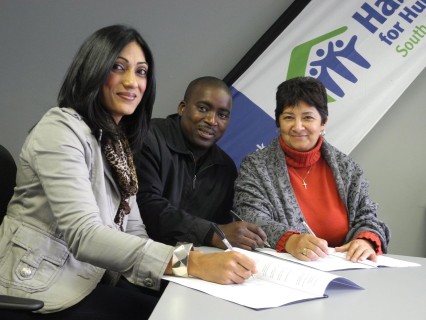
The partnership between CORC/ISN and Habitat for Humanity South Africa centrally recognises that if a vision of change is not community centred, it will most likely yield less impact. Moreover, development, which is conceptualised and implemented by an external agency, will most likely not be able to scale up and reach a citywide impact. For this reason, the Alliance signed a partnership agreement with Habitat for Humanity South Africa around two key around: 1) collaboration around a to-be-determined schedule of projects, and 2) setting up a city-fund. Read more about this collaboration on: Alliance Signs MOU with Habitat for Humanity.
DSCN4071Touching the Earth Lightly

The partnership with Stephen Lamb and Andrew Lord of Touching the Earth Lightly resulted in a first pilot of the Green Shack, which drew a lot of attention at Design Indaba 2o13. This showcase of innovative and cost effective solutions for shack upgrading addressing the problems of fire, flooding and food security was well received.

The aim of growing food vertically is to use the limited spaces that communities have to decrease poverty and hunger in informal settlements. Due to the shift of poverty from rural areas to urban areas, food gardening is an alternative to providing food security in informal settlements, with the high unemployment rate in informal settlements it is difficult for households to provide nutritious meals for their families because food security in urban areas is tied to purchasing power.

The initiative to start a food gardening projects in communities in realizing food provision at a cheaper price in order to decrease household spending on food, increasing food security for poor households and creating livelihood opportunities. The broader idea is to have most of the community members growing gardens either for consumption at a household level or selling to the community to increase the household’s income. Touching the Earth lightly provides innovative ways of growing food in limited spaces such as the creation of vertical gardens, using crates and tyres.

4. SA SDI collaboration with Universities

University of Cape Town (Europe Community Studio)

Tanja Winkler, senior lecturer in Urban and Regional Planning, University of Cape Town, joined CORC staff and the Europe informal settlement leadership on a planning session at Europe, an informal settlement located in Gugulethu, just of the N2 national highway in Cape Town.  The purpose of the planning meeting was to align the 2014 UCT Urban Planning practical learnership with that of the Europe community leaderships’s agendas in a “planning studio”. This studio will form part of the Master Students in Urban and Regional Planning curriculum, and have direct interactions with the community.  The aim of the studio is to expose the students to alternative planning approaches when considering one of the most pressing challenges of our post-apartheid cities: urban informality in its various expressions. Moreover, the nature of the studio also means that technical support is given to the community’s plans for upgrading the settlements, and hence a two-way beneficial relationship is established from where new tools of engagement with the state can be created.  Read more on Community Studio|2014 UCT-Europe Studio’The Planning Session’ . 

IMG00285-20131129-1144

Worcester Polytechnic Institute, USA (Langrug WASH facility)

The construction of the WASH facility is a precedent setting partnership outlining that the provision of water and sanitation services in communities should be executed in a manner that does not simply add-up to the statistics of facilities, or a mere provision of basic utility services as a basic constitutional right. The government is currently the primary entity responsible for sanitation facilities provision in South Africa. However, too often, its top-down and subsidized approach has not been successful in meeting the imperatives of socio-economic sustainability. The facilities are typically undignified and mostly located in the peripherals where residents often find inconvenient to access and more so the facilities are poorly maintained. In addition, residents regularly vandalize them. The dilemma of how, where and which type of service level to provide in informal settlements is far off a challenge too great for the government to solve alone. In that regard, multi stakeholder approaches, with urban poor communities at the core, are needed. This is to enhance dignity-associated with the use of a communal toilet, contribute towards place making in communities, and create job opportunities in asset management, as well as impact policy and practice towards meaningful participatory urban development.

This innovative design, implementation and management of the WASH facility in Langrug is a ‘precedent’ setting for a multi-stakeholder co-production of infrastructure services, which triggered meaningful community engagement and consequently creating a sense of entitlement and redefining government-community relations. Read More on  The Langrug Wash Facility A new Common Space for the Community.

University of Melbourne (Planning studios in Mtshini Wam, Shuku Shukuma and Ruo Emoh)

In February a planning studio was organised between the communities of Mtshini Wam, Shuku Shukuma and Ruo Emoh and architecture and planning students from the University of Melbourne to investigate new solutions for informal settlement upgrading and housing development. In Shuku Shukuma, 80sqm plot size placeholders were cut to scale and laid out on an aerial photograph. The location of visible infrastrcuture was mapped, such as electricity poles, toilet blocks and water taps. The Mtshini Wam group looked at alternative typologies for densification and formalisation after re-blocking projects. A visual fly through model was created, building on the new layout of re-blocked settlement.

We also hosted Tim Budge, a PhD student at Deakin University in Melbourne, Australia. The PhD is focused on the topic of “The Legacy of Paulo Freire and Saul Alinsky for communities seeking change in sub-Saharan Africa”. As part of his studies, he is doing field research in Zambia and South Africa. The research is deliberatively focused on case studies, narratives of change and an appreciation of local context and of the way local people learn and act in their own worlds. In August he gave three communities (Siyahlala, Busasa and Langrug) cameras and diaries where they can record community stories /activities that relate to change.

5: Projects

CORC and Alliance partners was proud to present the publication Masikhase: The Community Upgrading Finance Facility. This publication articulates the spaces created by communities and local government to make decisions and work together towards the incremental improvement of informal settlements.  These new participatory spaces often create conditions for informal settlement upgrading to be more effective and sustainable. The Community Upgrading Finance Facility (CUFF) aims to enhance the agencies and practices of the organized poor by providing a platform and institutional support for communities to engage government more effectively around collaborative upgrading and livelihood projects. Please download the booklet here: CUFF Booklet.

6: World Capital Design Projects

World Design Capital Yellow Logo

The prestigious accolade of World Design Capital is awarded by the International Council of Societies of Industrial Design every two years. It recognises that “the future success of each city is therefore largely reliant on those who plan, design and manage the shared spaces and functions of their city”.

The Alliance of community organisations and social networks Informal Settlement Network (ISN) andFederation of the Urban and Rural Poor (FEDUP) and support organisations CORC, uTshani Fund and iKhayalami saw this as an opportunity to display, on a global stage, how communities go about designing, inhabiting and reproducing spaces that increase accessibility and productivity of poor people in the city. The WCD committee selected four of the Alliances projects namely Mtshini wam reblocking project, Langrug informal settlement upgrading project, Solid Waste management and Community led spatial design and reconfiguration of informal settlements both pre and post disaster. Read More on: Four Alliance Projects Recognised by World Design Capital 2014 Committee.

7: SA SDI Alliance national forum

This year national forum started from the 11th-14th November 2013, more than 200 members of the ISN and FEDUP regional facilitators from all the provinces of South Africa were present. They discussed and shared experiences on income generation programs, savings, enumeration, profiling, informal settlement upgrading, land ownership and partnerships.   The forum is an event where the alliance reports on its past achievements and challenges while the supporting NGO CORC (Community Organization Resource Center) uses this platform to understand the challenges faced by all regions on the ground.  The event also included the launch of the ISN/FEDUP charter. Read More on SA SDI National Forum and Charter Launch. 

IMG_6034

Conclusion:
2013 was a year marked by local and national recognition of the power and possibilities of collaboratively partnering with communities organisations. By building local community capacity, communities have built a bridge to local government officials. Partnerships are pending with the Nelson Mandela Bay Metropolitan Municipality after the profiling and mapping of Midrand informal settlement and also in Moeggesukkel informal settlement. The power of exchanges were visible, considering the role of Gauteng ISN played in strenthening the emerging Eastern Cape ISN . In Midrand municipality, the community of Sicelo showcased alternative options when they demonstrated the effectiveness of community based enumeration. There are also a pending partnership in this local government.

These loose threads will be pursued next year, while implementation in the mature partnerships with City of Cape Town and Stellenbosch Municipality will be stepped up. We want to thank our partners, especially international donors Bill and Melinda Gates Foundation, Comic Relief, Ford Foundation, Charles Stewart Mott Foundation, and Misereor for funding these operations. Early next year our 2013/14 annual report will be ready, expounding on these experiences.

National leaders of the Alliance congregate in Cape Town

By CORC, FEDUP, ISN, News, uTshani Fund No Comments

By  Walter Fieuw, CORC

Leaders of the South African SDI Alliance congregated between 16 – 18 January 2012 at the Lutheran Youth Centre in Athlone to follow up on progress made since the strategic meeting held at Kolping House in January 2011. At last year’s meeting, the Alliance agreed to a shift of focus towards upgrading of informal settlements. Despite one of the world’s largest housing delivery programmes, the South African government has failed to curb the demand for housing and the improvement of basic living conditions for milllions of poor people. The Alliance has pledged ‘to strengthen the voice of the urban and rural poor in order to improve quality of life in informal settlements and backyard dwellings’. This we will accomplish by supporting communities who are willing and able to help themselves.

At Kolping House strategic meeting, the following four broad strategies would define the work of the network:

1. Building communities through FEDUP and ISN using SDI social tools;

2. Building partnerships with government at all tiers;

3. Implementing partnerships through projects; and

4. Keeping record of learning, monitoring and evaluation.

Upgrading informal settlements is an inherently complex endeavour considering the various socio-political realities connect to harsh living conditions and illegality. However, across South Africa the urban poor are mobilising and building institutional capacity to engage local governments around community-initiated upgrading agendas. As the Alliance’s saying goes, “Nothing for us without us”. Dialogues and outcomes of this year’s strategic meeting focused on meeting the development indicators which the Alliance set for itself at Kolping House. This year will see a renewed focus on the following:

  • Capacitating regional leadership structures, and the creation of a national ISN coordinating team
  • Recommitment to the spirit of daily savings, daily mobilisation and daily exchanges of learning
  • Deepening the quality of selected settlement upgrading, while growing the ISN network
  • Developing relevant and sensitive indicators, guidelines and protocols for the Alliance’s core activities to spur self-monitoring and evaluation.
  • Resourcing the Alliance through effective partnerships with local governments, universities and other development agencies such as the National Upgrading Support Programme (NUSP, Dept of Human Settlements) and the promotion of establishing Urban Poor Funds, similar to the Stellenbosch experience (hyperlink: http://www.sasdialliance.org.za/blog/Memorandum/)

Building coalitions of the urban poor able to capture the imaginations of city builders, both from the top-down and the bottom-up, is not often highly regarded or understood when upgrading strategies are devised. The Alliance is committed to strengthening the voices of the urban poor through building effective, pro-poor partnerships and platforms with local government, and implementing these partnerships at project level. As the process to understand the discrepancies and commonalities between the agendas of communities and the municipality gets underway, work must begin. Communities and the municipality develop, in partnership, a mix of “quick wins” that can build trust and show real change for communities. At the same time, the Alliance is also geared towards challenging many of the assumptions that lie behind planning for the urban poor throughout cities in South Africa. Other projects that get chosen for implementation are difficult cases designed to influence the way the municipality operates so that its methods come closer to the planning priorities of communities. All the project types also influence communities. At these interfaces of bottom-up agency and top-down city management, new ways of seeing, grappling with and finding solutions for informality emerge, and shack dwellers are no longer passive by-standers to the development enterprise, but active partners and innovators of finding workable, affordable and scalable solutions to urban poverty.