Tag

informal settlement upgrading Archives - Page 2 of 4 - SASDI Alliance

Reflections on re-blocking: Why community participation is key

By CORC, ISN No Comments

By Ava Rose Hoffman (on behalf of CORC)

In this blog, the SA SDI Alliance speaks with Nkokheli Ncambele—ISN Coordinator of the Western Cape—to learn about how the participation process functions on the ground during informal settlement upgrading, and in particular, reblocking initiatives . Reflecting upon the Alliance’s early experiences with re-blocking in Sheffield Road (2010-2011) and Mtshini Wam (2012-2013), Nkokheli highlights the value of building partnerships between informal settlements, support NGOs, and local governments.

How has the re-blocking process enabled residents to better engage with city officials or service providers in the long run? Has the re-blocking process enabled citizens to become more knowledgeable about how to interact with the state?

In our project called Sheffield Road, the government was saying [to community members] that they can’t do anything in the road reserve. But when the community started engaging with the municipality, the community learned how to negotiate with the city, [using] their tools—starting from profiling and enumerations. The enumeration is what helped them identify their problem, and then they start engaging [with the City]. Through the engagement they decided to start reblocking cluster one. When they finished Cluster One, everyone in the community was saying, ‘This thing is working, we want this thing [reblocking.’ Then they started rolling it out in the community. While they were in Cluster 3, the government saw the value of re-blocking, and then they came and installed 15 toilets that were not there before. So, that exercise [served to] teach a lesson to the government, and teach a lesson to the community.
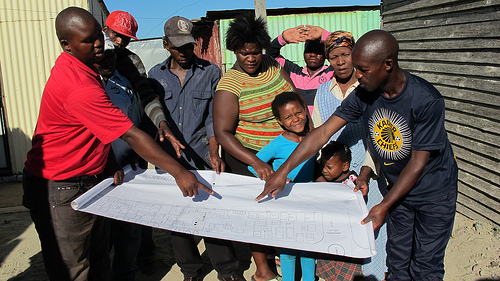
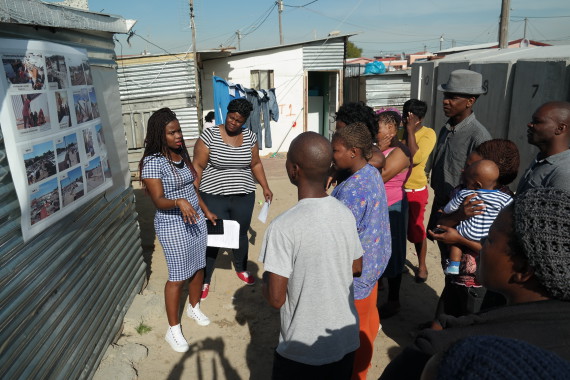
Community members discuss the re-blocked design in Sheffield Road

Community members discuss the re-blocked design in Sheffield Road


In Mtshini Wam, each and every winter they [the community] experienced flooding. And when they went to government, government was saying they can’t do anything [improvements] there because there is no space. And the community started organizing their general meetings, and trying to find a solution. Because, remember, they are the ones living in those conditions, so they had to come [up] with the solutions, and their solution was re-blocking. They went on an exchange to Sheffield Road to see what other communities were doing. When they came back, they started engaging with the people [in their community], and the technical teams of CORC and ISN went to Mtshini Wam and started helping them [with] how to design their community [reblocked layout]. At the end of the day, even if you can go today to Mtshini Wam, they will tell you that this re-blocking, it helped us a lot because, they were living in bad conditions. They were affected by their health because of the gray water that was smelling.

How did that engagement or negotiation with the state play out after the re-blocking was complete? Was there any continued engagement between the community and the state after the process was complete?

There is always a question of, ‘What else after this? What are we going to do?’ Obviously engagement is still happening between the community and the municipality, because, remember, these people, they don’t have a title deed. So they have to negotiate for the title deed. So now, their engagement is on another level. It’s not on the level of shelter; it’s on another level of getting houses, adequate houses. I remember they finished their design, where they said what they want: double stories where everyone can fit. And they even went to Joe Slovo in Langa to see how the design of Joe Slovo looked like, because it’s what they want to implement in their community.

Do you think the re-blocking projects have helped to change power dynamics within communities or empower more vulnerable members of communities?

I think firstly, what re-blocking brings to the community is security. It brings the trust between the community itself, because where they were residing before, no one would know their neighbours. But after the re-blocking, now, everyone is known in the community. It’s a community, its not an informal settlement anymore, it’s a community where the people of that community have pride in what they did. It also brings trust to the leadership—the leaders are the ones who will take us to the house.

Who would you define as vulnerable members of a community? Do you think that re-blocking has helped those vulnerable members get more of a voice in their communities?

I’m not going to answer your question directly, but I will always come out with an explanation.

If you go to Mtshini Wam, there were people that were not having income, not even a cent—so they were vulnerable in the sense that they don’t receive anything— [while] other community members were working, and received income. When we started, there were people that were vulnerable, and you can see that their situation is very bad, but once we brought the re-blocking concept, where we manage to employ 45 people, those that were vulnerable earn something. It’s where they change their lives, you know. And now, there is no one—I can guarantee to you today—that is very vulnerable. Everyone is in the same level because of re-blocking. That’s why I’m saying, re-blocking, it brings a lot of things. It brings job opportunities, it brings basic services, it’s not only about changing the structure, it’s about what government can play in your community when you say, ‘I want re-blocking.’

A community where no one is working, and no one is receiving a grant—that is what I call a vulnerable community, because there is no income.
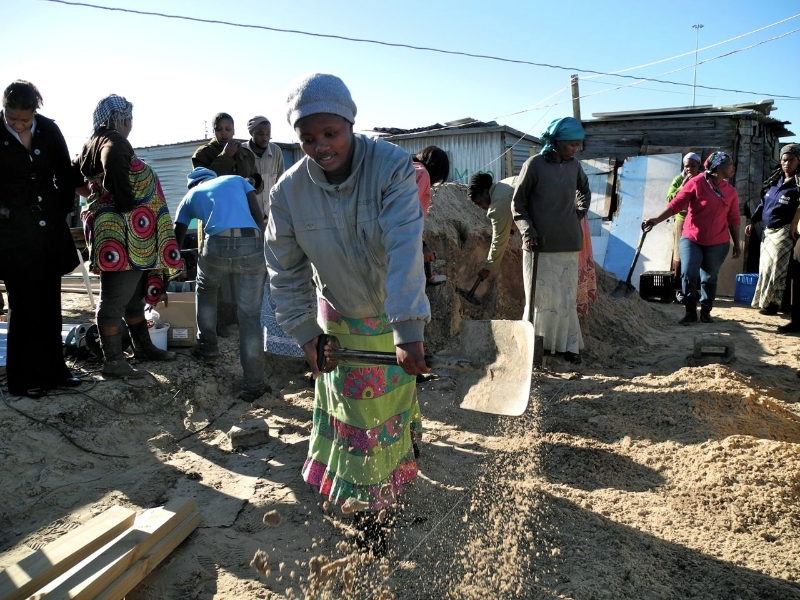
Community members at work in Mtshini Wam re-blocking

Community members at work in Mtshini Wam’s re-blocking process

How did communities and the City change through the process of re-blocking? What was that mutual learning process like?

What I can say is that, the city has changed through the system that the people brought… The government at that time would tell the community: ‘We are going to put the toilet here.’ But the challenge of that community is not a toilet. The community wants electricity. So, once we start engaging with the government, in 2010, it’s when the government started listening, now that the people know what they want. We are not fighting with their ideas, but we want them to listen to us. Because we are the ones who are residing in those conditions. We are the ones who are walking in the dark at night.

It shows that people learn a lot and the city learned, because the city put a lot of basic services in different communities. The communities that started before 1994, they’ve got basic services now. It shows that the city learned how to listen to the people. And the people know how to engage with the city now. Because the leadership—you will find different leadership going to see the mayor, you will find that the mayor is going to the communities—there is that engagement now. Re-blocking and engagement—having the ISN involved—changed a lot of people.
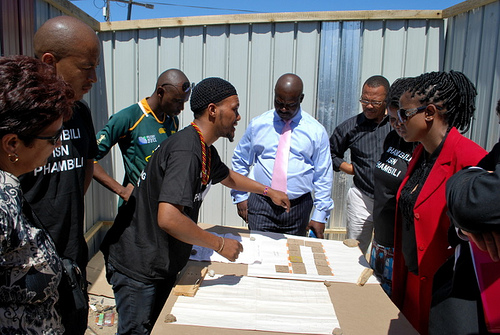
Deputy Minister of Human Settlements, Ms. Kota-Fredericks, visits the newly re-blocked Mtshini Wam in 2012

Deputy Minister of Human Settlements, Ms. Kota-Fredericks, visits the newly re-blocked Mtshini Wam in 2012

Reflections on H3 Pretoria: Can we Implement Progressive Outcomes?

By CORC, ISN, SDI No Comments

by Ava Rose Hoffman, Yolande Hendler and Skye Dobson (on behalf of CORC)

From 7-8 April 2016, the SA SDI Alliance together with Shack/Slum Dwellers International (SDI) participated in the United Nations Habitat III Thematic Conference on Informal Settlements in Pretoria, advocating for the inclusion of  the voices of the urban poor in crafting the “New Urban Agenda” (NUA).

SDI Team

SDI Team

The Problem of Mass Housing, The Potential of Informal Settlements

In his opening address, Dr. Joan Clos, emphasised that informal settlements and housing should be “put at the centre” politically and physically. Mass housing projects on the periphery of cities would need to be diminished because without economic activity and mixed (land) use they become dormitory neighbourhoods for the poor. Clos suggested that urbanisation needed to be used as a tool for socio-economic development through well-planned and managed cities, proposing that the following three dimensions of urbanisation need to be considered:

  • The Legal Dimension (requiring new rules and regulations)
  • The Physical Dimension (spatial planning and land use)
  • The Financial Dimension (enabling economic design and finance)

While Clos noted that each dimension requires strategic instruments to address the “proliferation of slum dwellers”, we wonder where the “Social Dimension” featured in this discussion. The absence of shack dwellers as central agents and decision makers in planning, implementation and access to finance produces limited and brittle results. The South African Minister of Human Settlements, Lindiwe Sisulu, alluded to this effect: “We [the Department of Human Settlements] experienced challenges from time to time because we did not always understand the environment we were going in to. We are looking to adjust this legislation.” Whereas adjusted legislation carries some impact, the underlying value lies within the experience that informs strategic contributions of slum dwellers themselves.

Opening address by Joan Clos, Executive Director of UN Habitat

Opening address by Joan Clos, Executive Director of UN Habitat

Where Planning Falls Short…

However, what purpose do master plans render if they are not implemented? And, how do we rethink the relationship between living spaces and workplaces? In a panel on the role of urban planning and land use, Julian Baskin (Head of Program Unit at Cities Alliance) emphasised that the urban agenda was not only about housing but how we access cities and livelihoods. Slum dwellers are no longer waiting for government, Baskin explained, but are organising themselves, forming their own plans and collecting their own data.

Slum dwellers are arriving at local governments around secondary cities saying, ‘We have our own information, partner with us’. When you have people in communities who understand plans and how to control their own development, you suddenly gain multiple planners….National governments need to build enabling legislation for cities, between local governments and communities, so that planning can be transferred to slum dwellers themselves.

Informal Settlements: Productive Centres for Resident Organising and Livelihoods

In two side events, community leaders affiliated to SDI spoke of the connection between informal settlements, livelihoods and mobilisation strategies through savings and data collection. The conversation was grounded by the very personal account of Catherine, a young mother from Johannesburg who spoke of her experience as a waste picker and recycler. In a soft, and, at moments, shaky voice, she recounted,

“I am a waste picker because this is how I support my children. This is how my mother supported us. I mainly work with cardboard and scale it every day. For 1Kg I am paid 90c.”

Catherine

Catherine

Based on Catherine’s account and a further presentation by SDI partner movement, Women in Informal Employment: Globalising and Organising (WIEGO), it was evident that daily life in informal settlements significantly co-exists and intersects with livelihood activities such as waste picking, street vending and home based work. Therefore,

  • Informal settlements are spaces of productivity and economic activity: homes are productive assets that contribute to economic livelihoods.
  • Basic services are inputs for informal workers’ productivity and function as a direct link to livelihoods.
  • Informal settlements are intricately connected to economic migrants and livelihood opportunities.

Rose Molokoane, Coordinator of FEDUP and Deputy President of SDI spoke about the broader involvement and mobilisation of shack dwellers in global discussions on development:

“As informal settlers we ask ourselves, what was achieved by the MDGs discussed twenty years ago ? Will the SDGs really attend to the needs of poor people in informal settlements? People who are planning for us without us are making a mistake. Informal settlements keep growing because most of the time we are taken as the subject of discussion without including us in the discussion… We use the power of savings and information about our informal settlements to organise ourselves, to reach out to our communities, to do something and to allow government to meet us half way” (Rose Molokoane, SDI & SA SDI Alliance)

Victoria Okoye (WIEGO) and Rose Molokoane on the left,

Victoria Okoye (WIEGO) and Rose Molokoane on the left,

As a collective of global movements, WIEGO, SDI and the Huairou Commission seek to ensure that the NUA promotes inclusion and produces equitable social and economic outcomes. Some of these include:

  • Recognition of all forms of work, both informal and formal
  • Greater access to affordable financial services, training new technologies and decent and secure workplaces for all women and men
  • Adequate, safe and affordable housing and basic services
  • Security of tenure for the urban poor and a stop to all forced evictions

Know Your City: Community Collected Data for Collaborative City Planning

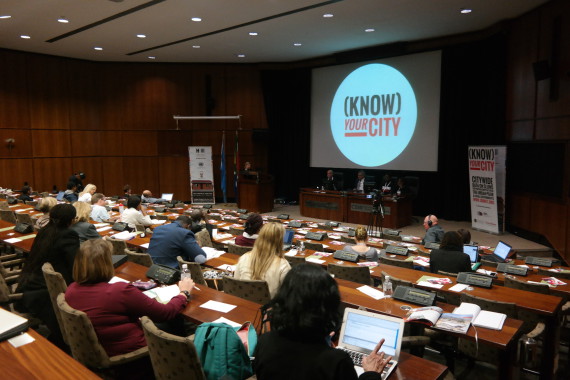
With panelists clad in Know Your City T-shirts and the presentation of a KnowYourCity explanatory video set to an upbeat soundtrack, the mood was set for a different kind of panel. Thus far, the voices of informal settlement dwellers had been sparse in the conference. That was, until the Know Your City side event.

SDI’s Know Your City (KYC) campaign emphasises that the “data revolution” is central to the New Urban Agenda (NUA). It constitutes a true data revolution as shack dwellers are organised across the Global South not only to gather invaluable data on informal settlements, but to use it as the foundation for partnerships and collaborative urban planning. While “partnerships” between communities and government are widely accepted as critical to the success of the NUA, the mechanisms for actually realising productive partnerships are poorly understood. The KYC campaign has proven a highly effective strategy for catalysing such partnership and sustained dialogue between communities and government.

Mzwanele Zulu and Joyce Lungu, community leaders of urban poor federations in South Africa and Zambia, spoke of their experience profiling, enumerating and mapping their cities. Joyce spoke of the Zambian federation’s work to profile Lusaka through the strong organisational capacity in slum dweller communities. While the challenge for non-residents concerned entering and gathering reliable data, the power this information constituted for residents was evident when it was shared with government partners in the city council to identify incremental upgrading of settlements through prioritising needs and projects.

Mzwanele Zulu appreciated the large audience at the event, but gave an impassioned plea for more government officials to make the effort to attend the panels of informal dwellers. He highlighted the critical role of household level enumerations in organising his community in Joe Slovo, Cape Town.  Initially, the government claimed there were too many shack dwellers to accommodate in the planned upgrade and advised on relocations to the outskirts of the city. The enumeration revealed the actual population to be far smaller and negotiations with government resulted in an agreement to undertake an in situ development. The enumeration data was also vital to the beneficiary registration process – something often mismanaged in upgrading projects, often at the expense of the poorest residents.

SAMSUNG CSC

Joyce Lungu, Zambian Federation Leader

Julian Baskin (of Cities Alliance) reminded the audience that a tremendous change is required to create an environment that catalyses the efforts of the urban poor to improve their communities instead of simply “controlling” urban poor communities. He applauded the efforts of organised slum dweller communities in SDI to gather critical data, plan for settlement improvements and seek partnerships with government. To meet the demand of informal settlement upgrading in the Global South, partnerships that bring the efforts of a billion slum dwellers to the service of city development will be essential.

CORC Deputy Director, Charlton Ziervogel, wrapped up the discussion by explaining the process undertaken by the SDI network to standardise profiling data. Such standardisation makes it possible to aggregate data at the regional and global level which is currently hosted on SDI’s Know Your City online platform. In South Africa, FEDUP and the Informal Settlement Network (ISN) are working on two government tenders to gather data on hundreds of informal settlements in the Western Cape. Affiliates in Uganda and Kenya are making similar progress. These cases serve as powerful examples of authentic government partnership and a data revolution that chooses communities over consultants to gather data and serve as the foundation for inclusive, collaborative planning.

SAMSUNG CSC

Know Your City Side Event

How Can we Implement Progressive Outcomes? 

The two day thematic meeting ended with the adoption of the Pretoria Declaration on Informal Settlements, which is considered as official input on informal settlements to the New Urban Agenda. UN Habitat also launched its “Up for Slum Dwellers – Transforming a Billion Lives’ campaign, hosted by UN Habitat’s Participatory Slum Upgrading Program (PSUP) and the World Urban Campaign with the aim to bring about a new paradigm regarding global responses to slum upgrading.

In its current version, the Pretoria Declaration presents progressive and people-centred recommendations that relate to embracing the importance of in-situ participatory slum upgrading approaches, pursuing a focus on people-centred partnerships as suggested by “People-Public-Private Partnerships”, using participatory and inclusive approaches to developing policy, strengthening the role of local government and recognising civil society as a key actor in participatory processes. The Declaration also emphasises that the NUA should be action-oriented and implementable.

Although the declaration indicates that action should be concentrated at the local government level and that UN Habitat support to states occurs through tools such as the PSUP (See Point 9 in the Declaration), “the how” remains a strong concern for members of the South African SDI Alliance, and SDI network. While the SDI network and “Know Your City” approach was characterised by a strong presence and the message of “plan with us, not for us” was well received the mechanisms for implementation remain unclear:

“We have this beautiful constitution, but how will South African municipalities act? Politicians and officials talk very nicely – I hope that they will open doors for us when we engage them. Since I joined ISN in 2009 we are battling to sign Memoranda of Understanding (MoUs) with municipalities for upgrading. We only have the MoU with the City of Cape Town and eight provincial agreements with national government, but those are for the People’s Housing Process and not for upgrading. Do we know what is really happening on the ground or are we just becoming advocates of theory?” (Mzwanele Zulu, SA SDI Alliance)

“The highlight for me was making sure that our voices and messages were heard. Part of my concern was when I looked at the expenses of this event. There are a lot of people who don’t have and here is our government spending so much money on this event. But when you go and ask them to assist poor people you don’t get that response” (Melanie Manuel, SA SDI Alliance)

Watch Rose Molokoane’s input to the NUA on behalf of SDI here.

Know Your City: Why we need community collected data on informal settlements

By Community-led Data Collection, CORC, FEDUP, ISN One Comment

By Charlton Ziervogel (on behalf of CORC)

Urbanization and the growth of informal settlements

Urbanization in South Africa has not followed the usual patterns as witnessed in many other developing countries from the 1980’s through to present day. This was in large part due to government interventions in the process up to the 1990’s, which saw to a very controlled restriction of movement of people from rural to urban centres (Turok, 2012) that effectively slowed the process. With the fall of the Apartheid government and the abolishment of the laws of controlled movement into urban areas the post 1994 period in South Africa saw massive increases in urbanization. Looking at the period 1980, in which 42,5% of the population lived in urban areas (Giraut & Vacchiani-Marcuzzo, 2005), in which 60% of the population lived in urban areas (United Nations, 2011), we witness a jump in the urban population of 17,5%.

It is no coincidence that during the period 1994 to 2011 informal settlements in South Africa increased in number from approximately 300 [1] to around 2700 in 2011 (SACN, 2011) due to the inability of government to keep up with housing demand. This growth in informality has been focused in urban areas with Western Cape municipalities experiencing influx due to a number of factors, including better employment opportunities, access to services and perceived increases in quality of life. This growth has resulted in shacks in backyards and shacks not in backyards accommodating almost 20% of all households in the province (HDA Western Cape, 2013).

Khayelitsha

What we lack in current data on informal settlements

Engaging with the Western Cape Province, and the City of Cape Town in particular, the scale of informality as described by 2011 census statistics is thus apparent (almost 1 in every 5 households live in informal structures). Yet, this information is already 4 years old and the continued rapid influx of people and changing spatial configurations and distribution of informal settlements over relatively short periods of time, places the province and the City of Cape Town in the very vulnerable position of trying to address problems of informality with information that is no longer reliable and in need of updating.

To effectively implement any successful upgrading plan or strategy as posited in National Upgrade Support Programme (NUSP) and the Upgrading of Informal Settlements Programme (UISP), municipalities need far more nuanced information to inform upgrading strategies. Census data is not aggregated at settlement level (HDA RSA, 2013) further compounding the ability to take into account settlement specific needs and context. The National Development Plan (NDP) also emphasizes the general lack of adequate information about the nature and conditions of each of the informal settlements, further hampering the strategic use of resources or the development of settlement specific solutions (NDP, 2012).

The value of community data and how it is collected

It is within this data deficiency, that community led housing enumeration and GIS mapping projects need to be positioned to better equip municipalities and provinces with updated information on informal settlements, placing actors in municipalities and provinces in a position to adequately plan for future upgrading developments in these settlements.

Amongst the methodologies employed for information gathering is the tool of informal settlement enumerations and the detailed mapping of settlements using GIS technology.

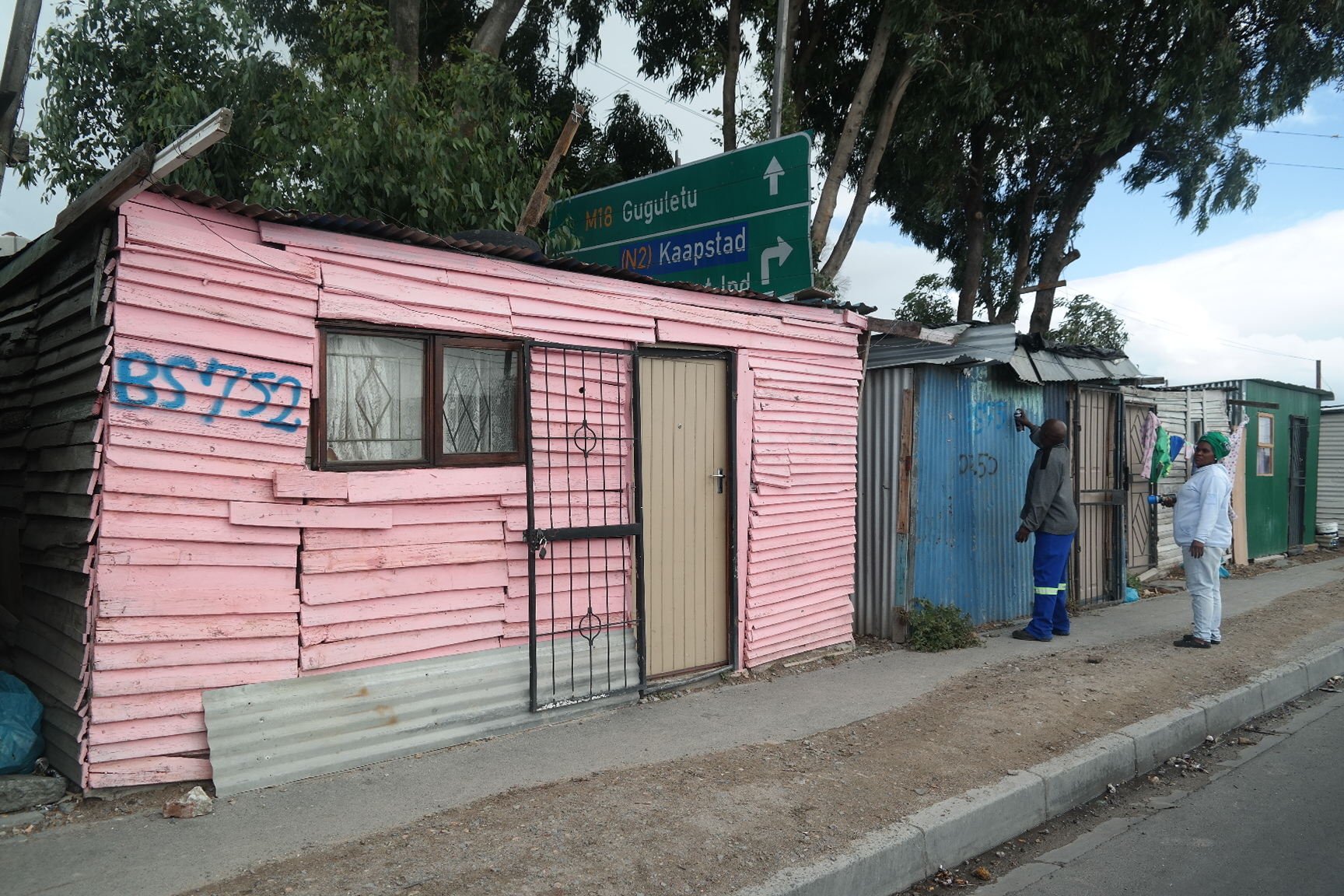
Shack numbering in Nyanga

Shack numbering in Nyanga

Mapping shack numbers in Nyanga

These tools derive their origins from the Shack/Slum Dwellers International (SDI) network, where for more than 30 years the SDI network recognized the importance of accurate and reliable data on informal settlements to help urban poor communities engage their local authorities in building effective partnerships towards a city-wide approach to in-situ informal settlement upgrading strategies (Arputham, 2012). The key difference in the SDI approach is that critical focus is placed on a community driven process, which allows for greater scale of activities and interventions as well as higher success rates in terms of the implementation of upgrading projects.

Profiling in UT Gardens, Khayelitsha

Profiling in UT Gardens, Khayelitsha

Within the context of informal settlement enumerations and mapping, this participatory approach is even more valuable as it has proven time and time again in various developing countries that when a mobilized community understands the importance of accurate data and maps and participates in the collection of this data around their own settlement, far higher degrees of accuracy are achieved than any census or survey that might utilize “outsiders” as the sole enumerators (Baptist & Bolnick, 2012, Livengood & Kunte, 2012).

Community Based Data Collection in Cape Town: Joe Slovo, Mtshini Wam, Kuku Town, and Flamingo Crescent

As urban poor people’s networks, FEDUP and ISN, together with CORC, have gathered experience in gearing communities towards self-enumeration and mapping.

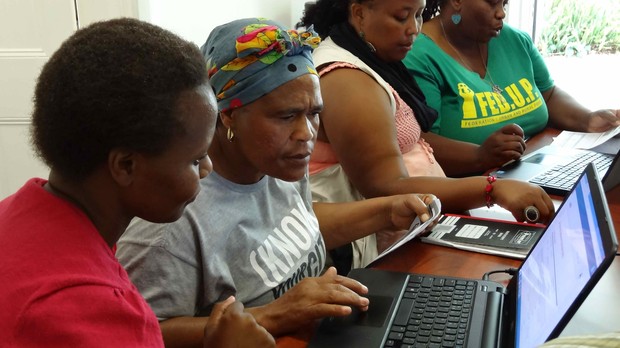
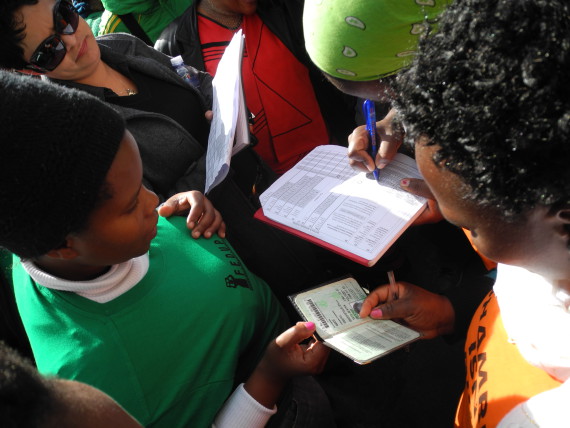
Community members capture enumeration data

Community members capture enumeration data

For example, information available to the City of Cape Town had estimated the population of Joe Slovo along the N2 (N2 Gateway project) to be way larger than reality with the proposal of only a percentage of the residents being part of the housing project causing real concerns amongst the community. An enumeration conducted in 2009 spearheaded by the SA SDI Alliance was able to ascertain a more accurate population size based on a participatory approach, which paved the way for the possibility of the housing development moving ahead with all the current residents at the time included.

Other examples in Cape Town include the re-blocking of Mtshini Wam, Kuku Town and Flamingo Crescent informal settlements which all utilized the community driven enumeration and mapping approach to set up accurate beneficiary lists. These enumeration and GIS databases developed by CORC, ISN and FEDUP have been utilized by the City of Cape Town in the provision of electricity connections, contract work through the Expanded Public Works Program (EPWP) as well as assisting in detailed layout plans for the re-configuration of the settlements.

The necessity of working relationships with government

All this is only achievable through the establishment of practical working relationships and partnerships with government. In addressing the data deficiency described above this approach is not merely to gather information but to create the added benefit of a very practical community and local authority partnership.

Participatory data collection is an approach built upon the successes and lessons learnt in over 2 decades of informal settlement enumerations by the SA SDI Alliance. The Alliance’s experience in the implementation of 144 informal settlement enumerations in South Africa over the past 6 years, covering approximately 65,400 households has shown that the approach of deep community participation, even at the level of the data gathering exercise, leads to stronger community networks with the ability to assist local governments in prioritizing upgrading initiatives within a broader strategic framework. Furthermore, this deep participatory approach mobilizes communities towards determining their own development agendas.

Community generated data informs community planning

Community generated data informs community planning

References 

  • Arputham, 2012. How community-based enumerations started and developed in India, Environment and Urbanization 2012 24:27, Sage, IIED
  • Baptist, C and Bolnick, B. 2012. Participatory enumerations, in situ upgrading and mega events: The 2009 survey in Joe Slovo, Cape Town, Environment and Urbanization 2012 24:59, Sage, IIED
  • Giraut, F. and Vacchiani-Marcuzzo, C. 2009. Territories and Urbanisation in South Africa: Atlas and geo-historical information system. Institut de Recherche Pour le Developpement, Paris.
  • Housing Development Agency (HDA), Western Cape: Informal Settlements Status 2013. Research Report, HDA
  • Housing Development Agency (HDA), South Africa: Informal Settlements Status 2013. Research Report, HDA
  • Livengood, A and Kunte, K. 2012. Enabling participatory planning with GIS: a case study of settlement mapping in Cuttack, India, Environment and Urbanization 2012 24:77, Sage, IIED
  • SACN (South African Cities Network) 2011. 2011 State of SA Cities Report. SACN, Johannesburg.
  • South African Government Information. 2012. Our Future – make it work: National Development Plan 2030. 14 November 2012. http://www.gov.za/documents/national-development-plan-vision-2030
  • Turok 2012. Urbanisation and Development in South Africa: Economic Imperatives, Spatial Distortions and Strategic Responses. Urbanization and Emerging Population Issues Working Paper 8, International Institute for Environment and Development United Nations Population Fund
  • United Nations, Department of Economic and Social Affairs, Population Division. 2012. World
  • Urbanization Prospects: The 2011 Revision

[1] Presentation made by NUSP at the Policy Consultative Workshop held on 5 September 2014 at the Town House Hotel (Cape Town)

How High-Tech Maps Could Help Urban Slums Plan Better Streets

By CORC, SDI No Comments

By Laura Bliss and Aarian Marshall (Cross-posted from CityLab)

In this Jan. 29, 2016 photo, Tainara Lourenco, who's five months pregnant, stands outside her stilt home that stands over polluted water in a slum in Recife, Brazil. Lourenco became pregnant at a scary moment — the dawn of an extraordinary Zika outbreak, as authorities came to suspect that the virus was causing an alarming spike in a rare birth defect called microcephaly. "If you have to get sick you will get sick," she said. "It's everywhere." (AP Photo/Felipe Dana)

In this Jan. 29, 2016 photo, Tainara Lourenco, who’s five months pregnant, stands outside her stilt home that stands over polluted water in a slum in Recife, Brazil. Lourenco became pregnant at a scary moment — the dawn of an extraordinary Zika outbreak, as authorities came to suspect that the virus was causing an alarming spike in a rare birth defect called microcephaly. “If you have to get sick you will get sick,” she said. “It’s everywhere.” (AP Photo/Felipe Dana)

In slums, buildings are often so densely packed that many are cut off from streets and pathways. This creates a literal roadblock to much-needed public resources.

“In South Africa, governments will often say that informal settlements are too dense to install adequate services,” Charlton Ziervogel, deputy director at the Community Organisation Resource Centre, a Cape Town-based slum advocacy and support NGO, tells CityLab. “So you’ll find municipalities that install toilets, but only at the edge of a settlement, because they perceive that there is no space inside.”

It’s a serious matter. Across the global south, hundreds of millions live in slums lacking piped water, proper drainage, and sanitation—ideal breeding grounds for virus-carrying insects and other types of disease. To fight epidemics such as Zika, experts warn, living conditions for the urban poor must be improved. But to do so, many slum communities first need to open up space.

A new tool might help. Open Reblock is a free, open-source platform designed to simplify the process of thoughtfully reorganizing slum communities. Funded through OpenIDEO, it’s the product of a major research collaboration by the Santa Fe Institute, Sam Houston State University,UC Berkeley, and Shack/Slum Dwellers International, a global network of community-based organisations representing the urban poor.

The only input that’s required for Open Reblock is a good-quality map with details on each property inside a community and its access to the street network. The tool uses an algorithm to identify the least disruptive reorganization of a cluster of slum blocks so that each parcel gets access to the street—nudging this house two meters east, extending that road a few meters south. It produces a new map of this “reblocked” community, which residents can adjust to their needs and use to push local government (or other support sources) to begin construction.

“How to change the physical slum? You tap into the knowledge of the people who live in the slum,” says José Lobo, an economist and sustainability researcher with Arizona State University who has worked on the project. The tool, he says, captures that knowledge—physically, on a map—so it “can be shared, examined, revisited, and acted on while minimizing disruption.” Indeedthe philosophy behind the tool is that no one is better positioned to help plan a community than those who actually live in it and have the social knowledge to understand how people need to move around their neighborhoods. In other words: This thing will be very useful in community meetings.

In its simplest terms, reblocking has been going on as long as there have been slums—“It’s just playing around with space,” says Ziervogel. In the past decade, organizations like his, operating under Shack/Slum Dwellers International, have worked with slum communities around the world on formal reblocking efforts using hand-drawn maps—translated into design software—to gradually improve street plans.

[vimeo]https://vimeo.com/103700821[/vimeo]

Last year, Flamingo Crescent, an informal settlement outside Cape Town, completed reblocking and installing water, sanitation, and electricity for all of its 104 households. It took nearly three years to get there, and for good reason: Neighbors had to negotiate inherently sensitive changes to their properties, and the community had to work with NGOs and local government align the plan with municipal expectations. Technology will hopefully speed up this process.

“In a lot of formal urban planning, the question is, ‘How do we solve the slums problem?’” says Christa Brelsford, a postdoctoral fellow at the Santa Fe Institute. “The conception is that this is too hard, that the only way is to start over from scratch. People who live in slums don’t agree with that assessment, and don’t want to be resettled.”

The researchers are very clear on what the Open Reblock tool will not do: command community members to raze their houses and rearrange them into straight, neat grids. The source code favors pathways that do not get in the way of existing homes or neighborhood fixtures, which means they sometimes turn out a bit wiggly. And the physical construction process is meant to be gradual, with community members working with government to upgrade clusters of blocks at a time.

The graphic below depicts a sample re-blocking project in the Epworth neighborhood of Harare, Zimbabwe. The far left shows the area before reblocking, with streets in black and properties without street access highlighted in orange. Properties with access are surrounded by dotted gray lines. In the middle is an image of the same neighborhood in the midst of reblocking, with just four properties left still isolated from road access. On the far right is the neighborhood after reblocking: All parcels now have access to the street.

A sample reblocking project in the Epworth neighborhood of Harare, Zimbabwe. (Open Reblock)

A sample reblocking project in the Epworth neighborhood of Harare, Zimbabwe. (Open Reblock)

Eventually, researchers say, the tool will be available both on and offline. They expect to finish the prototype within three months. Meanwhile, Brelsford will travel with other research team members to Nairobi, to learn more about slums from a design perspective. Eventually, SDI will select a community in South Africa in which to first use Open Reblock.

While the tool’s potential for streamlining reblocking is great, it’s not a silver bullet. “There’s a specific social process that needs to be part of the solution,” Ziervogel says. “Technical solutions cannot be simply dumped on a community. They need to be involved in shaping and leading the process.” Tools like Open Reblock wouldn’t even exist, he adds, without the foundation work of community-driven organizations like SDI and its many affiliates on the ground.

“One of the things that is defining of SDI’s work is helping communities put themselves on the map,” Lobo says. He describes the power and attention slums can draw—from governments, from government services, from other people who live in the city—by creating a way to point to the places where people work and live. “That simple map is an issue of great contention between slum dwellers and the powers that be. [They say,] ‘We are making ourselves visible.’ They want to and need to tell the authorities where they live.”

From Nairobi to Cape Town: Learning about Upgrading and Partnerships with Local Government

By CORC, FEDUP, ISN, Learning Exchanges, SDI No Comments

By Yolande Hendler (on behalf of CORC)

From Ghetto informal settlement in Nairobi, the Kenyan SDI Alliance together with an official from the nearby Kiambu County Government visited the South African SDI Alliance on a learning exchange in Cape Town from 22 – 25 February 2016. Community leaders and an official from Ekurhuleni Municipality, near Johannesburg, also joined the group.

The purpose of the exchange was to share experiences regarding informal settlement upgrading, partnership formation between community movements and local governments, project planning, preparation and mobilisation processes. Kenya’s Federation, Muungano wa Wanavijiji has been supporting Ghetto community in obtaining tenure security and identifying housing beneficiaries. Currently the settlement is set for the final phase in a government-upgrading project that requires re-planning its public spaces and houses, a familiar process that the South African Federation of the Urban Poor (FEDUP) and Informal Settlement Network (ISN) call “reblocking”.

SAMSUNG CSC

Priscilla, community leader in Sheffield Road speaks about reblocking

With introductions and an overview of the SA SDI Alliance on the first day, the visitors shared their key learning interests as relating to

  • Partnership Formation between communities themselves and between communities and local governments
  • Upgrading Processes – how communities organise themselves during upgrading, how technicalities in construction and implementation are dealt with, the role of project funding and community saving

Savings and Income Generation

With savings as the core practice of the SDI network, the afternoon visit took place at a FEDUP savings and income generation group in Samora Machel, Philippi. The group explained how its FEDUP membership enabled individuals to access small loans from the Federation Income Generation Program (FIGP). With a particular set of criteria for loan access, repayments and additional loan cycles, the group had established a number of small businesses such as beading, second hand clothing, fried chicken or locally tailored clothing.

The meeting sparked an animated discussion on how savers could maintain their momentum and interest in savings, especially after receiving a house or an informal settlement upgrade upgrading can be seen as fulfilling the “immediate savings purpose”. A loan group member explained that she viewed saving as valuable backup to draw on when problems arose. In Kenya, members became tired of “saving for nothing” – they therefore began using their savings in smaller projects while waiting for larger projects to occur. The Kenyan visitors further noted the value building trust between members through administering loans to small groups of five savers.

SAMSUNG CSC

Mary Wambui (Kenya SDI Alliance) and John Mulia (Kenya Official) look at FEDUP savings book

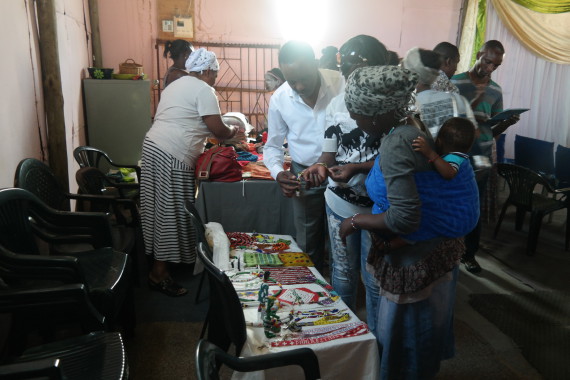
FEDUP Income Generation businesses in Samora Machel

FEDUP Income Generation businesses in Samora Machel

Reblocking in the City of Cape Town

Over the next two days the group traced re-blocking projects and informal settlement upgrading projects in the municipalities of Cape Town and Stellenbosch.

In Cape Town the SA SDI Alliance used its first re-blocking projects in Joe Slovo and Sheffield Road settlements to build a partnership with the City of Cape Town to jointly pursue future upgrading and reblocking projects. As a result the City adopted reblocking as a policy, an indicator of increased intent to engage with community-led processes. In Sheffield Road the group saw how reblocking establishes access routes, courtyards, increased space for communal water and sanitation installation as well as safer public open spaces. Since reblocking, the community has successfully negotiated for electricity installation.

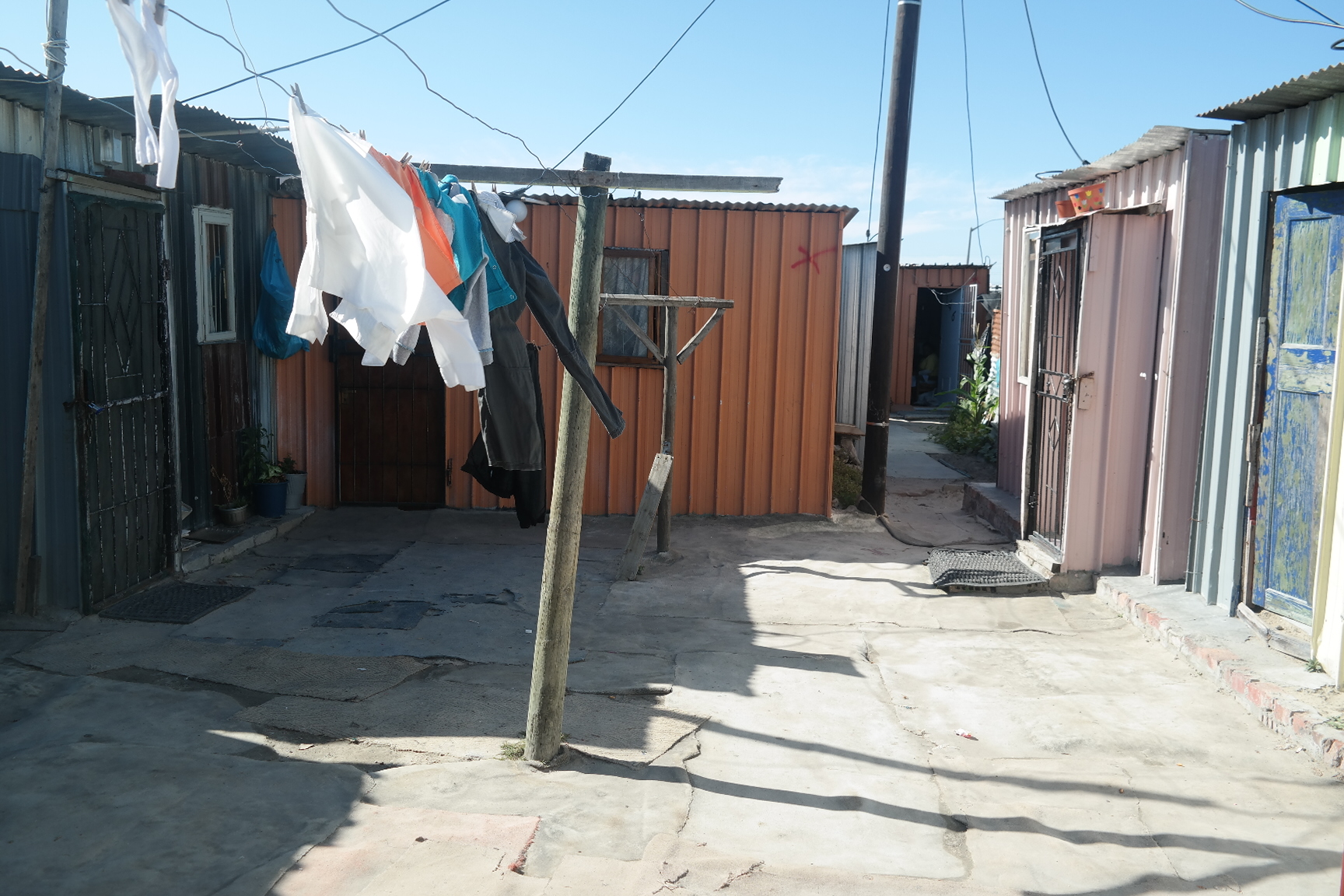
Courtyard in Sheffield Road after reblocking

Courtyard in Sheffield Road after reblocking

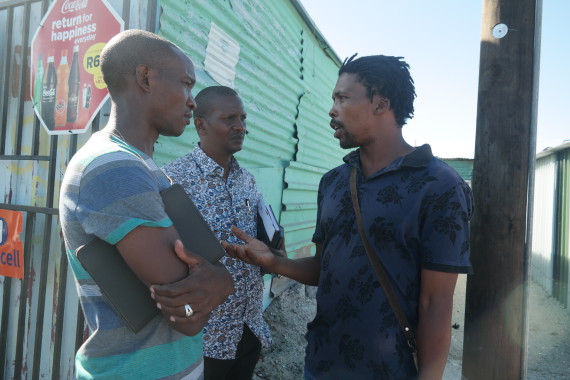
In Sheffield Road: Rashid and Samuel (Kenyan Federation) in discussion with Lulama (ISN leader for Philippi region)

In Sheffield Road: Rashid and Samuel (Kenyan Federation) in discussion with Lulama (ISN leader for Philippi region)

Mtshini Wam was the first settlement that was reblocked in partnership with the City of Cape Town in 2013. While walking through the settlement the group noticed the improved differences between the projects: the layout of Mtshini Wam enabled 2 households to share water and sanitation facilities. Noticeably, a number of residents had self-built a second storey on to their structure after having participated in a community design process for double storey units as further development after upgrading. Through persistent negotiations after reblocking, the community received municipal electricity and ground levelling to mitigate flooding. ISN National Coordinator, Mzwanele Zulu, explained that such incremental upgrading contributed to incremental tenure security.

Double storey structures in Mtshini Wam

Double storey structures in Mtshini Wam

In Flamingo Crescent, the most recently upgraded settlement (2014), community leader Maria Matthews introduced the group to the settlement’s reblocking experience: engaging fellow community members to save, planning meetings with the City and community participation during reconstruction. Due to its enumeration figures and the reblocked layout, the community succeeded in negotiating for individual service installation and electricity per re-blocked household (1:1 services). Flamingo’s site was levelled with all access roads paved and named before erecting the reblocked structures. The visitors saw that for the SA Alliance, upgrading / reblocking is a cumulative experience, with consistent improvements in new projects based on past project learning.

“Reblocking made a big difference, but upgrading is far from over,” Maria Matthews explained. “We have many social and health problems remaining here.”

(Maria Matthews, Flamingo Crescent Community Leader)

Arrival in Flamingo Crescent

Arrival in Flamingo Crescent

After reblocking in Flamingo. 1:1 Services per household.

After reblocking in Flamingo. 1:1 Services per household.

Upgrading in Stellenbosch Municipality

In Langrug the group encountered an example of partial reblocking in a settlement about ten times the population size of those in Cape Town, with about 4000 residents. Community leader, Trevor Masiy, traced the settlement’s partnership with the SA SDI Alliance and the joint partnership agreement with Stellenbosch Municipality, which informed the settlement’s upgrading initiatives in drainage and storm water projects and two Water, Sanitation and Hygiene Facilities. Trevor also highlighted the challenges experienced by disrepair of past upgrading projects. He therefore emphasised the value of community involvement not only in project planning and implementation but also in maintenance.

Walking through partially reblocked section of Langrug.

Walking through partially reblocked section of Langrug.

View on to Langrug

View on to Langrug

Water and Sanitation Facility in Zwelitsha section, Langrug

Water and Sanitation Facility in Zwelitsha section, Langrug

Partnership Meetings

Two separate partnership meetings with Stellenbosch Municipality and the City of Cape Town allowed the visitors and two visiting officials an insight into the practical workings of partnership building and project negotiations. The partnership meetings in Cape Town and Stellenbosch focussed on updating all gathered on current project progress and discussions on renewing and continuing the partnership relationships. Discussion highlights included:

Cape Town

  • Alliance emphasises that its partnership focus with the City is not only reblocking but also informal settlement and area-wide upgrading

Stellenbosch

  • The muincipality explained that reblocking is not just about structure upgrades but about enabling basic service provision
  • The municipality spoke about its partnership with Langrug and SA Alliance as fluid, moving towards different ways and means of reaching a common goal
Partnership Meeting with Stellenbosch Municipality in Franschoek

Partnership Meeting with Stellenbosch Municipality in Franschoek

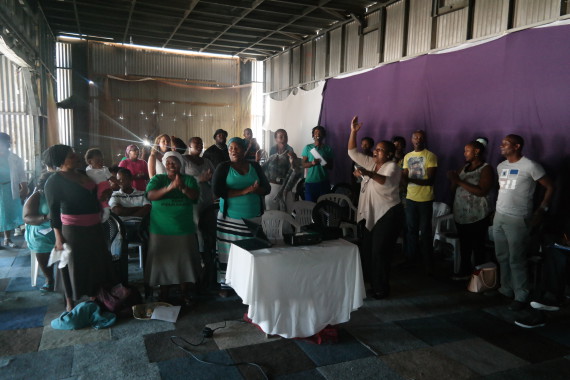
Alliance begins Cape Town partnership meeting in song in Bosasa Community Hall, Mfuleni

Alliance begins Cape Town partnership meeting in song in Bosasa Community Hall, Mfuleni

Reflections and Learnings

On Upgrading:

  • “We have been focussing on permanent houses. This can become strenuous for communities because it demands resources and scaling up. But our thinking has changed when we saw how reblocking has attracted government attention. (Rashid Muka, Kenyan Federation Leader)
  • “In Kenya we always thought that upgrading means erecting permanent structures. I am learning about incremental upgrading – something I’d like to take home” (John Mulia, Kiambu County Government, Kenya)
  • “The value of an incremental approach is that you don’t start with the end product (a house) and impose it on a community. Upgrading is not only housing. You can be in a temporary shack and as long as you have opened up spaces to basic services, then that is upgrading.” (Mary Wambui, Kenyan SDI Alliance )

On Building Parternerships

  • “What is key in achieving a relationship with a municipality? Involving the community, drafting good plans and implementing precedent setting projects that can influence policy, especially if there is no policy yet” (Sizwe Mxobo, CORC Technical Support)
  • Strong social movements that know what they want are important in building partnerships. They can remind municipalities about their commitments” (Nkokheli Ncambele, ISN Coordinator Western Cape)
  • “We want to pull stakeholders together and understand how to journey together. We want to be able to say this exchange gave birth to some of the lessons we learnt. What has come out clearly is the value of learning by doing.” (Rashid Muka, Kenyan Federation Leader)
Group gathers in a courtyard in Sheffield Road

Group gathers in a courtyard in Sheffield Road

On Community-Led Engagement

  • In this exchange I understood a lot about talking with communities. Government needs to understand the value of partners coming on board. The government of Kenya has made many plans but the community needs to point out what they want and need, not us the government. A project becomes sustainable when it is community driven.” (John Mulia, Kiambu County Government, Kenya)

Urban Sector NGOs comment on Human Settlements Draft White Paper

By CORC, Press No Comments

By Community Organisation Resource Centre (CORC), Development Action Group (DAG), Habitat for Humanity South Africa, Isandla Institute, People’s Environmental Planning (PEP), Violence Prevention through Urban Upgrading (VPUU)

Screen Shot 2016-03-08 at 12.20.43 PM

The National Department of Human Settlements is currently in the process of developing a new White Paper on Human Settlements. This process offers a unique opportunity to address the shortcomings of existing policy and to influence the future of human settlement development in South Africa.

We – a collective of six urban sector NGOs – have a vested interest in the outcomes of this process. We are thus committed to engaging critically with the discussion document developed by the National Department of Human Settlements, and to advocating for the adoption of a more progressive version that recognises the role of communities, and informal settlement upgrading in human settlements development.

On 4 February 2016, we shared an initial commentary on the discussion document at an engagement hosted by the Western Cape Department of Human Settlements. It summarises our collective position and is intended to serve as the foundation for a more in-depth submission:

Commentary on the discussion document ‘Towards a policy foundation for the development of human settlements legislation’

1. The document ‘Towards a policy foundation for the development of human settlements legislation’ seeks to provide a comprehensive approach to the complexities of human settlement development and planning, based on a detailed analysis of the achievements and limitations of current HS programmes.

Positive features of the document are, amongst others, the acknowledgement that by and large, communities and civil society organisations haven’t been meaningfully involved in processes of human settlement development to date. This admission brings attention to the need for well-designed participatory processes and partnership approaches. The explicit reference made to spatial planning, and its roles in the creation of sustainable and integrated human settlements, is also appreciated. The recognition of the importance of monitoring and evaluation as a strategy for tracking government’s progression towards the realisation of its goals is also considered to be a positive step towards a more grounded and accountable practice.

SAMSUNG CSC

2. However, in our considered view, the proposed solutions to address the shortcomings identified are not dynamic enough and are insufficiently rooted in local practice around human settlement development. The document also does not reflect the depth of inequality or the seriousness of the current fiscal realities, and what these factors are likely to mean for the human settlement sector. Instead of the ‘business as usual’ approach, we expect the new policy to reflect more deeply what a ‘business unusual’ scenario means for human settlements policy and practice.

3. Our main concern is with the state-centric orientation of the document and the centralising tendencies that the document reflects (implicitly and explicitly). While we appreciate that a public policy document will be inherently biased towards the roles and responsibilities of the state, other stakeholders (including local communities, NGOs and the private sector) are an integral part of human settlement development processes. The document fails to adequately reflect what a partnership approach entails for human settlements policy and practice.

Even in its state-centric orientation, the document reflects a predisposition towards national government (and particularly the department of human settlements) as the critical actor in transforming human settlement realities. National government undoubtedly has an important role to play in determining human settlement outcomes, providing policy guidance, developing coherent programmes, providing effective fiscal instruments, addressing institutional blockages, and monitoring progress, amongst others. However, it is primarily at the local sphere where the complexities of human settlement development need to be navigated.

4. We believe that the primary objective of a policy on human settlements needs to be local enablement – enabling local actors (municipalities, communities, civil society organisations, private sector, etc.) to choose the institutional arrangements and programmatic responses that best suit local conditions, and enabling other spheres of government to offer the necessary oversight and support in this regard. Municipalities are not merely implementation agents of national human settlements programmes; they need to assemble the requisite partnerships and processes to effectively manage the challenges, trade-offs and contestation inherent to human settlement development, and to do this in an accountable and transparent manner.

Co-planning and preparing for informal settlement upgrading plans

Co-planning and preparing for informal settlement upgrading plans

5. The role of communities in determining the development agenda, implementing development strategies, and monitoring development interventions must be reflected in the policy vision and intent. The document is disproportionately concerned with the ‘culture of entitlement’, implying that (poor) citizens lack a sense of responsibility about their own development. This individualised notion of citizens as ‘responsible consumers/end-users of public services is problematic, particularly as it is not complemented with a recognition of the agency of civic actors and local communities in human settlements processes (including planning, implementation, maintenance, co-financing and self-help options, and monitoring and evaluation).

Instead, the new policy should work towards enabling communities to participate as active citizens, and to co-create – in partnership with government and other stakeholders – sustainable, integrated and resilient human settlements.

6. As organisations with a particular interest in informal settlement upgrading, we are especially concerned with the weak articulation of informal settlement upgrading as a core human settlements strategy. The suggestion that only those settlements located close to job opportunities will be considered  for upgrading is both exclusionary and short sighted. Economic opportunities are not static and over time may show movement across a city or town. Moreover, instead of focusing exclusively on job opportunities it would be more helpful to develop proactive approaches in support of local livelihood strategies.

Informal Settlement Upgrading

Informal Settlement Upgrading

7. Signatories to this commentary will make a collective effort to develop a more robust submission that deals with the following issues:

  • Deeper understanding of the role of communities and institutional arrangements required to support meaningful community participation and co-creation approaches to human settlement planning and development
  • Financing mechanisms, such as community savings schemes, and self-build approaches that enable communities to participate in the housing market
  • Strategies for releasing and managing well-located public land for human settlements development
  • Partnership modalities for human settlement development, including the roles and responsibilities of government and other stakeholders
  • Outcome-driven monitoring and evaluation strategies that shift emphasis from compliance to the achievement of progressive goals

8. In the meantime, we call on the national department of human settlements to publicise what its ‘extensive consultative process’ (as noted in the preamble) entails, to commit to further and deeper engagement with all relevant stakeholders (including civil society organisations and community groups) in the finalisation of policy and legislation on human settlements, and to be transparent and accountable in how it deals with comments received during the course of the policy development process.

Community Voices: “In Tambo Square, residents did not give up”

By CORC, FEDUP, ISN, News No Comments

By Tambo Square community members (on behalf of ISN)

This blog was written by the community of Tambo Square in Mfuleni, Cape Town, namely: Babalwa Sabe, Nomaphelo Voyi, Nosikolise Swaphi,Asanda Kumbaca,Nokubonga Stefans,Lindiswa Lufefe,Ntandazo Mtshonono, Yoliswa Tsono,Tabisa Matiwane,Stutu Yamani,Nolusindiso Zakaza,Nomaphelo Zakaza,Ayanda Langa,Vangeliswa Sobamba,Phindile Faro and Nkosikhona Bangiso.

This is the third blog in the Alliance’s Community Voices series. Community Voices  shares community-narrated experiences that highlight the value of a people-led approach that is underpinned by an organised community structure. For the Alliance, a people-centred approach is crucial for building collaborative partnerships between local governments, informal settlement dwellers and other stakeholders. Through a series of workshops of collaborative documentation and story-telling, FEDUP and ISN members, with the support of CORC’s documentation team, produce community-generated documentation, as part of elevating the voice of the urban poor.

Documentation workshop at Tambo Square

Documentation workshop at Tambo Square

Community Documenting at Tambo Square

Community Documenting at Tambo Square

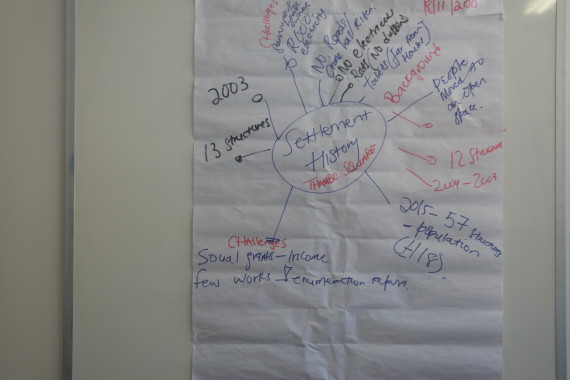
History of settlement

Tambo Square is situated in Tokwana Street and lies adjacent to the Sandra Child Centre in Extension 6 of Mfuleni. The 1846m² land size holds 60 households with a population of 119 people.

As residents of Tambo Square, we had different reasons for moving to the open space which is now called Tambo Square. Some of us were backyarders. When we saw an open space and decided to occupy it, some moved out from our surrounding family and saw a vacant land and occupied it. Others couldn’t afford renting anymore. When we saw people occupying the space, we then decided to join. In 2008 the City’s anti -land invasion unit demolished our structures, But residents didn’t give up and we decided to build our structures again.

“During winter season, this area gets flooded and our furniture gets ruined but the major issue is watching our children suffer because we can’t afford better homes for them.”

Nomaphelo Voyi, Community Leader of Tambo Square

Community of Tambo square doing house designs with technical team

Community Leaders Nomaphelo Voyi and Nkosikhona Bangiso plan the layout of their settlement with support form CORC technical team

Challenges

  • Electricity

Our biggest challenge is not having electricity. We need to find money every month to be able to connect illegally from the surrounding formal houses.  We spend almost R500 just to get our tap connected.

  • Toilets

The toilets are far for some of the residents and we have to walk quite a distance to access it. During night time or winter season we fear using them because the crime rate in Mfuleni is quite high.

  • Dustbins

We feel that our settlement would be much neater if we had dust bins to throw our unwanted materials.  Since we don’t have bins we now have rats due to people throwing dirt wherever they see a space. This is a health hazard for us.

  • Proper roads

Our settlement is dense, this makes it harder for emergency vehicles to come and help during time of need. If we can catch fire all our shacks would burn in the blaze. Another problem is because of the density of the area, criminals find it easy to do robberies here because one will not know where they went.

Tambo Square Writing and Story-Telling Workshop

Tambo Square Writing and Story-Telling Workshop

documentation workshop in Tambo Square

Documentation workshop in Tambo Square

How we met ISN

In October 2014, we decided to seek help in trying to better our living conditions since we didn’t have any basic services. This is when we met the Informal Settlement Network (ISN). The community approached Western Cape ISN Coordinator, Nkokheli Ncambele, who introduced the community to the SA SDI Alliance. ISN introduced us to the Alliance tools which meant we had to do community-led profiling and enumerations with the support of the CORC technical team. A group of us went on an exchange to Flamingo Crescent  to learn about informal settlement upgrading & reblocking. By June 2015 our community leaders had already partnered with ISN, the SA SDI Alliance and the City of Cape Town for 10 toilets and 5 water stands.This was a victory for us. At first the City said that Tambo Square is too dense for services. ISN suggested that we move a large container that was standing in front of our settlement to make space for services. When we presented this to the City their response changed and they agreed (read blog on water and sanitation here).

Documentation Workshop

Documentation Workshop

Through its partnership with ISN and the City of Cape Town, Tambo Square is set for upgrading and reblocking in February 2016, which will enable 1:1 service installation. The upgrading of Tambo Square is activating a more nuanced and community-led approach. The partnership between Tambo Square, the Alliance and the City draws on organised community (leadership) structures. These activate community- based savings, data collection and joint partnership meetings with City officials and the Alliance throughout project preparation and implementation.

*Blog compiled by Andiswa Meke and Yolande Hendler (on behalf of CORC)

An approach to community-led upgrading: TT Community Hall in Khayelitsha

By CORC, FEDUP, ISN No Comments

By Andiswa Meke (on behalf of CORC)

For years the government has been testing different solutions with regard to bringing basic services to poor people and engaging with rapid urbanisation in South African cities. At times, these approaches are characterised by technically driven solutions that do not consider social use of infrastructure by community members. At others, there is a lack of service delivery altogether due to an often expressed perception by local government that is impossible to  install services in dense and haphazardly structured informal settlements.

In response informal settlements affiliated to the Informal Settlement Network (ISN) organise themselves and explore innovative options that present alternative, community-led practice to local government and better their living conditions. TT is one of the oldest informal settlements in Khayelitsha, Cape Town. Yet they still have no basic services.

 Community Profiling and Enumerations.

Community Profiling and Enumerations.

The blog looks at the upgrading of TT community hall as an example of what communities are doing for themselves when supported with the tools to organise themselves and identify their own development priorities. Communities like TT have realised that they are the help they need to foster change and therefore need to be the ones gearing up their own upgrading processes.

Background of TT informal settlement

TT dates back to the late 80`s. According to a 2010 enumeration report by the Community Organisation Resource Centre (CORC), the settlement had a population of 995 people in 339 households. The City of Cape Town installed Toilets and taps, this is how the settlement have access to water and sanitation. TT section is located in Site B in Khayelitsha, it lies opposite Mangaliso Primary school, with 79% of the settlement depending on social grants as a form of income.

Initially the structure that is now a hall belonged to a particular lady. She then donated her shack to the community to use as a hall where they could hold meetings and church services. However, over the years the structure lost its value as the material it was built in became old and flooded during winter because it was not developed properly.

In the beginning of 2015 the community of TT approached ISN to assist them with upgrading their hall because it was old and the material allowed for bad conditions especially during the winter season.

Alliance Processes

In 2009, ISN first visited the settlement on a mobilisation trip. After intense engagements, the community was convinced of ISN’s approach and willing to engage with the tools of the SA SDI Alliance. It was after that, the community elected 15 members to enumerate the settlement. TT profiled the settlement with the technical support from CORC who also assisted the community with house modelling, planning and design. The community then identified their needs as a community which included partial reblocking and a community hall; but they wanted the hall to take first priority. There were two profiling and enumerations done, one was done 2009 and a new one is being done currently.

IMG-20150318-00016

Community doing planning

TT community planning with old structure

TT community planning with old structure

October 2015 marked the start of upgrading the hall  which  is expected to be completed within December. The steering committee is heading up the project with support from ISN and CORC.

Features of the upgraded hall

  • The main feature on the hall is that the material used is non -combustible which decreases the chances of the hall catching fire. The hall has been approved by the City of Cape Town fire department.
  • Another is that the hall has a front and a back exit which could be accessed by all the members depending which side is closest for them.
  • The floor is cemented and well paved which will prevent the flooding during winter season.
TT hall

TT  Community Hall during  upgrading process

Challenges & Learning Points

  • The challenge the community is experiencing is communication barriers with the suppliers of material and this has caused some delays.
  • The value of ISN support on the ground.
  • The value of regular site visits by all invovled actors during the projects to inspect the progress and address challenges that may arise during each stage of upgrading.
  • The community has learnt how to engage with different stakeholders regarding their needs and the importance of unity, communication and cooperation when a settlement wants to change their living conditions.

Community Voices: “Is BholoBholo a place we can call home?”

By CORC, FEDUP, ISN No Comments

By members of Bholobholo Informal Settlement (on behalf of ISN)*

For the SA SDI Alliance community-produced documentation is crucial. Engaging communities with such processes enables them to drive their own development interests and also positions them to share their experiences in community organization processes such as informal settlement upgrading. IN this way communities demonstrate the approach of the SA SDI Alliance: “Nothing for us without us”.

This blog was written by community members of Bholobholo, namely Nosipho Dzingwa,Masixole Siyaphi,Thabisa Kebe,Bulelwa Dunjwa, Thembela Spele,Nosiphathise Halile,Xolani Maqoko,Lulama Giyama,Zingiswa Tshwela and Mrs Duda.

SAMSUNG CSC

Community Documentation Workshop with BholoBholo

History of the settlement

BholoBholo is located on a traffic circle intersection in Extension 6 in Mfuleni Cape Town. This is one of the smallest informal settlements in Cape Town with a land size of 912m².

We were backyarders in the surrounding formal houses. In 2006, we moved to an open space [which later became BholoBholo]. This was the time that plot owners were going to receive RDP houses. Since then we never moved back because the plot owners claimed that they did not have space for backyarders anymore. The church was built in 2007 and several more people joined as they saw an open space too. Some residents in BholoBholo bought shacks and joined the community in this way. To date we have 15 households with 33 people.

BholoBholo is an isiXhosa name for the intestine called ileum. The name came to the settlement because of the street vendors in front of the settlement that sell meat including intestines called uBholobholo. BholoBholo was an open space separating the meat vendors and the formal houses. This space was used for meetings and other activities such as a soccer field for kids.

This blog was written by the community of Bholobholo.

Bholobholo community leaders and community design team members

 Our reality now

Like any informal settlement, BholoBholo community is faced with a number of challenges which include:

  • Electricity

The community of BholoBholo have used illegal connections for electricity, they pay a high amount to the nearest houses just to get their tap connected. These illegal connections are a danger to the kids that play in the area hence they might touch the wires and be shocked or worse, killed.

  • Toilets and Taps

There are a total of four taps in BholoBholo of which two do not work properly. There is also a strong need for taps in the community because we share the ones we have with the meat vendors.We don’t have proper toilets, we make use of the bushes or ask to use the toilet in the formal houses.

  • Multipurpose Hall and Park

We also need a hall to hold meetings and community events and a park for children to play in and be safe.

  • Proper road access

“I wonder what would happen if our settlement could be in a fire? Who would we turn to?”

Masixole Siyaphi, Community leader in Bholobholo.

We need roads so that emergency vehicles can be able to assist us in time of need. Having roads/streets would make the place look neat and easy to find because now it takes longer to find a house number when needed.

Another major problem we are faced with is the dirt caused by the street vendors who use the dumping site to dump meat that they cannot sell. This causes an odor that can be a health hazard and attracts mosquitoes and rats that later bite the children.

Writing Workshop with the community of Bholobholo.

Writing workshop with the community of Bholobholo.

How did we meet ISN?

Nkokheli Ncambele is the one who introduced us to the Informal Settlement Network (ISN) when ISN came to mobilise our settlement. We then attended meetings and learnt the rituals of the alliance. After that we started with the community organisation processes. Our settlement was enumerated by 2 members of the community which we selected ourselves. We also profiled the settlement together as the community. To date we are waiting for reblocking because we have completed the designs together with the CORC technical team. These plans are important to us because

“we want our children to have a place to call home and be safe”

Nosipho Dzingwa, BholoBholo community leader

Community identifying their

Community mapping supported by CORC technical team

*Blog compiled by Andiswa Meke (on behalf of CORC)

SA SDI Alliance and Red Cross Society explore Fire Prevention Tools

By CORC, FEDUP No Comments

By Thandeka Tshabalala (on behalf of CORC).

September-April  marks  the Western Cape Fire season.  The eight months period has the highest record  of fire disasters due to a number of reasons but mainly negligence and lack of fire prevention  education. Throughout these times, informal settlement dwellers sit in panic and uncertainty of when a devastating fire may strike their settlement costing them their  belongings and in worst cases their lives. Urban fires are  amongst the highest disaster occurrences in informal settlements,and need to be addressed.

When  fires break out in informal settlement they spread fast and the community takes longer to be alerted . Evacuations are often dangerous and depending on  the density in these settlements  emergency responders often are unable to access homes in time. In July 2015  the South African SDI Alliance,  South African Red Cross Society (SACRS) and American Red Cross Society formed partnership with Lumkani to roll out early detection fire sensor devices targeting 1000 households in 4 informal settlements (UT, TT, TB section and WB) located in site B, Khayelitsha. The purpose of the project is to reduce fire risks by increasing community resilience against shack fires.  The introduction of early warning devices in  communities contributes to alerting  communities early  to avoid fire from spreading .  Another  benefit of the project is  formulating of fire response plans and capacitation of disaster response teams within the community.

IMG-20151026-WA0004

A baseline study and GIS mapping exercise formed part of the first crucial steps of information gathering of the project. 30 community volunteers were trained in conducting community surveys and GIS mapping. The community surveys aimed at gathering first hand information on previous instances of fires.  With questions ranging from fuel used for cooking, heating,lighting to how the community responded to fires. This included identifying nearest fire hydrants and emergency exists in the informal settlement. Key informants and focus group interviews gave an in-depth understanding of the existing fire response mechanisms taken by community leaders and disaster relief organizations.

The GIS map marking access points in the settlements and hierarchy of routes classifies movement within the settlements starting  from vehicle access to footpaths forms part of the analysis. Once the community has verified the map it will then be used  as a tool to better understand the community access points that could be of use during emergencies. After analysis and feedback from community members the baseline study will be used to inform future plans for fire response and mitigation.

IMG-20151026-WA0007 (1)

Imbizos (i.e. community gatherings) were platforms used by  communities to participate and give feedback on the project. Councilors of ward 90 and 91 Luvuyo Hebe and Monde Mabandla together with emergency respondents such as the police and fire departments came in high numbers to support this initiative.During the launch of the project on the 26th August 2015 Detective Mandlana  showed appreciation  to the  South African Red cross and Informal Settlement Network (ISN) for the project  and urged the community to use the Lumkani devices.

 “Safety starts by individuals taking precautions all the time”.

Detective Mandlana from the Police department.

To strengthen the existing disaster response  mechanisms in the community, 40 community members were trained in first aid (I, II &III) and fire fighting. The community response team is equipped to assess possible disasters and also be prepared to respond to any disaster occurring in their community.The community response teams have a lifetime commitment to the community because they can help improve the safety of their communities.

“ In the middle of a disaster, these are the people who will be able to say they are here to help, give critical support and assist victims before the arrival of emergency services.”

IMG-20151026-WA0005

This project forms part of a long-term objective  which includes decreasing urban fires and strengthening the impact of the Lumkani early warning device. The device acts as an early warning system in the community, decreasing the time taken by the community to be alerted in cases of fires, with addition of the response team the community is well positioned to deal with shack fires while waiting for emergency services. This intervention was informed by the profiling and enumeration data captured by the communities to understand the community priority needs.  The long term upgrading strategy would be the addition of planned preventative measures such as opening up streets and open spaces for emergency evacuations and access of emergency services.