Tag

income generation Archives - Page 2 of 2 - SASDI Alliance

Reflections on the Southern African Hub Meeting: Blantyre, Malawi

By SDI No Comments

***Cross-posted from SDI Blog***

By: Mariana Gallo, Knowledge Management Officer CCODE; Nico Keijzer, LME Officer Southern Africa SDI; & Noah Schermbrucker, Projects Officer SDI 

The recent regional hub meeting for Southern Africa took place in Blantyre, Malawi, from 28-31st March 2015. It was the first time that Blanytre or Malawi have hosted a regional hub meeting and provided an opportunity for the Malawian alliance to showcase their work. Participants from South Africa, Namibia, Zambia, Swaziland, and Zimbabwe attended the meeting. Botswana was invited but not able to attend.

Country Reports and Field Visits

The day commenced with each country reporting on their key indicators using the new Learning, Monitoring, and Evaluation (LME) reporting format. All countries concurred that this format assisted them in measuring progress, setting realistic targets, identifying challenges, and more targeted learning to overcome them. For the first time the hub was able to produce accurate totals for Southern Africa – as illustrated in the below table.

Southern African Hub Totals
Baseline Target Achieved Total
Members  161 961,00  8 765,00  7 084,00  169 045,00
Savings Groups 2490 300 217 2707
Daily Savings  4 354 901,00  829 755,00  287 494,00  4 642 395,00
UPF Savings  1 960 417,00  210 099,00  127 794,00  2 088 211,00
         
Settlement Profiles 1553 445 316 1869
City-wide profiles 123 32 3 126
Enumerations 294 50 47 341
Maps – GIS 109 306 207 316
Maps – Hand drawn 15 24 10 25

A variety of field visits also took place. Those who visited Nancholi settlement learnt about the slum upgrading activities that were being undertaken by the federation. Work included the construction of bridges, the development of an agricultural market, the renovation of a local clinic, and the construction of additional blocks for the local secondary school. Other delegates visited a variety of groups who were involved in income generation projects. One group called “Waste for Wealth” produces and sells compost. Another group makes sausages that they package and sell, while a third group makes and sells tie-dye clothes.
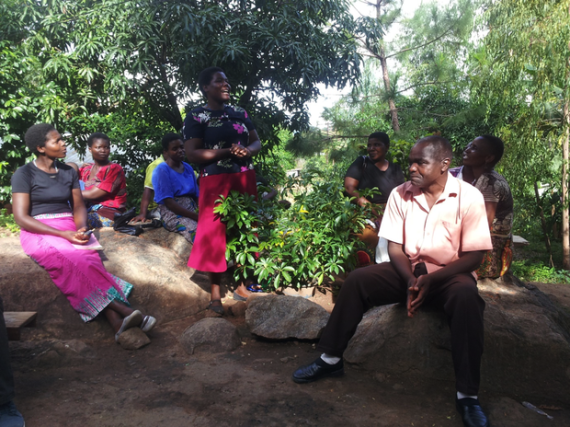
The group producing compost manure in Chilomani, explaining their experience with the enterprise.

The group producing compost manure in Chilomani, explaining their experience with the enterprise.

City Council and Discussions on Country Projects

On the third day, hub delegates visited the Blantyre City Council for a meeting with the Mayor, the Director of Planning and Development for Blantyre, and other officials. While the meeting illustrated the successful partnership between the Malawian Alliance and the Blantyre City Council (BCC) it became clear, through the lively discussions that took place, that these types of partnerships need to be underpinned by material commitments from government (e.g. land, budgetary allocations for slum upgrading). The international delegation pushed the BCC around its previous commitments to establish a citywide slum-upgrading fund. The Malawian federation needs to follow up on the space opened by this discussion.

The meeting attracted media attention, and was reported on the front page of one of the main newspapers on the following day.

Hub participants attending a meeting with the Blantyre City Council.

Hub participants attending a meeting with the Blantyre City Council.

The afternoon’s sessions provided an opportunity for delegates to reflect more deeply on their LME process. Not only in terms of challenges identified but feasible actions to address these issues. Below is an example of this work that the hub collectively committed to implementing over the next period. Outcomes will be reported at the next hub meeting.

Challenges:

1) Unrealistic targets,

2) Understanding of enumerations process or profiling is difficult,

3) Not having a system of reporting,

4) Politics delays the process,

5) Working with other stakeholders is always difficult and can delay the whole process,

6) Changing the mindset of people who expect a lot of money as some organisation does,

7) Slow implementation of projects,

8) Not practicing daily savings.

Possible Solutions:

1)     Setting of realistic targets within a specific period of time,

2)     Drawing of process maps – steps involved in saving, profiling, enumeration etc.,

3)     Mobilizing communities on why they are doing the profiling, enumeration etc.,

4)     Having standard reporting templates/systems,

5)     Signing of MOU’s (exchange visits among municipal/local officials),

6)     Joint working groups that involves stakeholders,

7)     Communities must take ownership and drive the change in the community,

8)     Communities should have one voice in getting resources from local authorities,

9)     Going back to the roots of daily savings.  Take ownership of savings and how the money is managed to build confidence.

Data, Reflections on Donor Funding, Exchanges, and Closing

The final day commenced with a presentation on the data platform from the SDI Secretariat. Federations were able to access, discuss and interact with the online platform that stores their profiling information. This is part of a process to deepen federation ownership of the information collected.

An interesting and important discussion, which is central to the work of all federations and affiliates, then took place.  The crux if this discussion is that while it is recognised that donor funding is needed for activities, the agenda and priorities of donors can sometimes be in conflict with the federation’s core vision (e.g. building unaffordable housing on the periphery of the city).  Broken into country groups delegates discussed criteria for accepting donor funding. Flexibility, equal partnerships, common vision and inclusion of the poorest were amongst the common points of consideration.

The meeting closed with a collective reflection session that gave delegates an opportunity to assess the content and structure of the hub meeting.  More substantive details can be found in the hub report. The next hub meeting was set for September in Zimbabwe.

The Malawi Alliance prepares their data for sharing
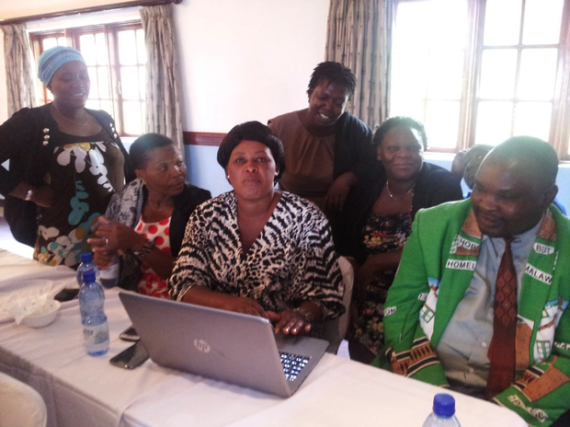
The Malawi Alliance prepares their data for sharing

Malawi Federation members work with the online data platform.
Malawi Federation members work with the online data platform.
Spotlight on Mpumalanga: “Through FEDUP we support each other”

By FEDUP, uTshani Fund One Comment

By Yolande Hendler (on behalf of CORC)

“At Ellerines in Standerton, we need to collect Dolly, then its not far: continue straight over the crossing and turn left to get to Extension 6. We want to share what we are doing in our savings scheme. Some of us have houses, and some of us are starting small businesses”

(Togo Simelane, FEDUP member, Mpumalanga)

IMG_3041

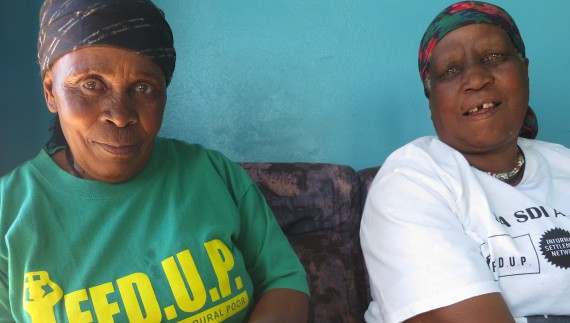
Emelina Hlabati and Beauty Nkosi, long standing members of FEDUP’s Masakane savings scheme in Standerton

As Mama Dolly Moleme and Togo Simelane arrive at their home in Extension 6 in Standerton, they lead the way to Gogo Emelina Hlabati’s home. Together with Beauty Nkosi, the three ladies make up the steering committee of FEDUP’s PHP housing projects in Standerton. Apart from acting as FEDUP’s regional financial signatories, the group is involved in negotiating with the municipality and provincial government for direct access to housing subsidies through the People’s Housing Process (PHP). Read more about FEDUP’s engagement with PHP here.

Togo Simelane (front), Beauty Nkosi (left), Emelina Hlabati (right), Dolly Moleme (back)

Togo Simelane (front), Beauty Nkosi (left), Emelina Hlabati (right), Dolly Moleme (back)

Building first houses in Extension 6

FEDUP has been active in Extension 6 since 2001, with five savings schemes (Masakane, Lethukhanya, Vukuzenzele, Masihambisane and one income generation / loan group).

Dolly explains,

“We started building all the FEDUP houses in Extension 6 in 2005. uTshani Fund supported us with pre-financing the houses. We managed the construction of the houses through our Community Construction Management Teams (CCMTs). Houses should take one week to build but we waited for one month for the materials to deliver. The role of the government is to provide an inspector to check that the houses we build meet the appropriate standards.”

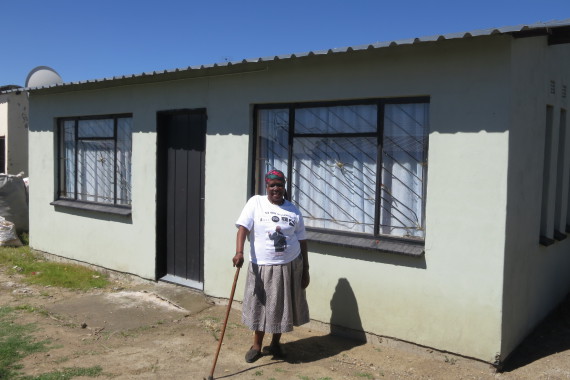
Beauty Nkosi infront of her Federation house

Beauty Nkosi infront of her Federation house

FEDUP self-financed its first three houses as “show houses” to negotiate for direct access to subsidy funds in 2001 and 2002. This enabled members to build houses with bigger dimensions than RDP houses. For the group of ladies it was clear,

“We’re not looking for municipality houses – we want Federation houses because they are much bigger and more beautiful”

Between 2005 and 2006 FEDUP has built 36 houses. Other members in the community are approved to receive a subsidy but Dolly explains that there has been little movement from the municipality. The group therefore contacts the municipality on a weekly basis to find out about proposed plans for the next subsidy houses. The likelihood of receiving subsidies in the near future, however, is small. This reflects the inability of South Africa’s provincial Departments of Human Settlements to adequately meet the country’s housing backlog. The backlog in Mpumalanga alone is close to 200 000.

IMG_3053

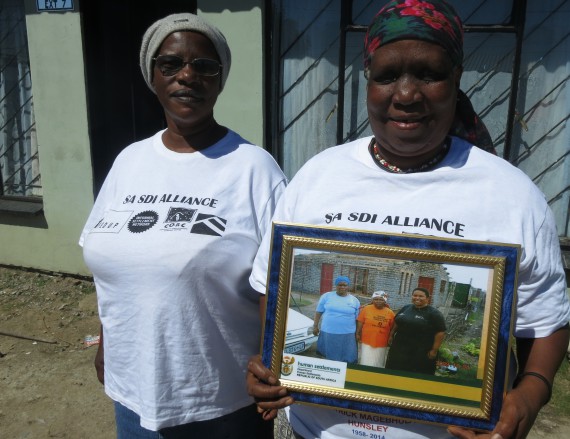
Beauty Nkosi with human settlements accredited photograph with Emelina Hlabati and Nomvula Mahlangu

FEDUP houses in Extension 6

FEDUP houses


Building Savings, Building Support

Through daily savings, however, FEDUP, has nurtured strong savings schemes and spaces in which members can support each other, regardless of the extent of municipal commitment and support.

Dolly explains,

“The Federation helped Gogo Emelina to such an extent that when she was born she was living in a shack. She started daily savings and luckily with the support of the Federation she was able to bury her husband in a dignified manner. When her husband passed away, the house was completed. Today she has a house and a chicken business. Otherwise she would be out in the open”

Dolly, Emelina and Beauty speak about their savings scheme:

“We are all part of Masakane savings scheme. Now we are about 30 members. Many of us received houses. Together we have a chicken project. We buy small chickens, we grow them and then we sell them when they have grown big. When we heard about the FEDUP loan group we decided to sell chickens because many people like to eat chickens.”

Read about FEDUP’s Income Generation Programme here.

Dolly Moleme and Emelina Hlabatis Chicken business

Dolly Moleme and Emelina Hlabatis Chicken business

Masakane savings scheme is also involved in other forms of saving such as saving towards groceries for the year-end. At the end of the year 60 members use the savings to buy a big load of groceries and one sheep each.

“Many people who live here live in shacks often don’t want to save. But when they see us building our houses they come running to us and ask how they can do this too. I like the Federation a lot! Even though I already have a house I would never dream of leaving the Federation. Many people are struggling. Through FEDUP we support each other even if the municipality doesn’t seem to want to help us”

(Dolly Moleme, FEDUP member, Standerton)

Togo Simelane in FEDUP office in Extension 6

Togo Simelane in FEDUP office in Extension 6

Stories from FEDUP’s Income Generation Programme (FIGP)

By FEDUP, uTshani Fund No Comments

By Yolande Hendler (on behalf of CORC)

IMG_3168

Elisa Ramboda

Venda Beadwork in Limpopo

My name is Elisa Ramboda. I’ve lived here in Ramahantsha* my whole life, more than 70 years. I’m the first member of Pfano, my savings scheme, and I was the first to join when the Federation of the Urban and Rural Poor (FEDUP) was launched in Limpopo because I heard about savings. When the FEDUP income generation project started I took my first loan of R 1000 – to buy beads in town and sell Venda beadwork here at my house and at paying points where people get their grants. Even when there is a wedding, people come and place orders with me to make them traditional decorations.

I sell headbands for R150, armbands for R90, belts are R150 and necklaces cost R40. I make good profits and I have already taken and repaid three loans! This helps me to pay my grandchildren’s school fees. I also support my daughter-in-law and my son.”

This blog traces the stories of FEDUP members in four South African regions who use the Federation Income Generation Programme (FIGP) to start businesses, support family members, and secure their livelihoods.

(*near Makhado / Louis Trichardt in Limpopo)

FEDUP is built on daily savings

As a network of saving schemes, FEDUP’s core practice centres on daily savings collections that establish a space for individuals to share daily struggles and for savings group to identify solutions. Most often members’ needs pertain to accessing well-located land, security of tenure, improved shelter, housing and basic services. Through daily collections and other community organisation tools FEDUP has built partnerships with government on all tiers, negotiating access to many of these needs.

IMG_2874

FIGP draws on FEDUPS’s Urban Poor Fund

Amidst successful negotiations, the lack of income generation continued to cause instability and hardship. FEDUP therefore launched the FIGP in 2014 to assist members in starting small businesses, enabling the movement to generate its own income through reinforcing the significance of daily savings itself. FEDUP (via uTshani Fund) registered with the relevant financial bodies and started up a legal and formalised microfinance institution through which members can access group loans from their own Urban Poor Fund instead of external financial institutions.

Taking loans to start a business

The criteria for accessing a FIGP loan are:

  • Formal FEDUP membership (complete once-off UPF payment of R750)
  • Active member of a FEDUP savings scheme
  • Experience as small business entrepreneur for at least 6 months
  • Be part of a group of 5 to access a loan

These criteria ensure that members continue saving and supporting one another in the development of their respective businesses because individuals can only receive loans when they are in a group of five. The whole group must also make repayments as one overall sum. Therefore individual success depends on group success. 

Sophie’s Tuckshop in Bethal, Mpumalanga

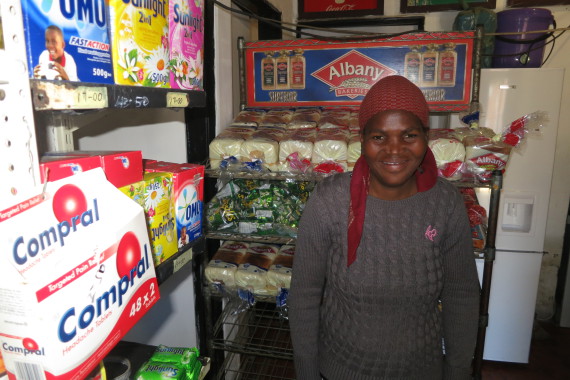
Sophie Mofokeng's tuckshop

Sophie Mofokeng’s tuckshop

As Sophie Mofokeng attends to a customer in her well-stocked tuck shop, in the front section of her house, she says that she has been a FEDUP member since 2013.

“I started my shop in 2009. But after a while I got stuck because I did not make enough profits because I did not increase my prices enough from the wholesaler prices. But now I am good at it. FEDUP has helped me a lot, especially through savings and the FIGP loan, which supports me with my shop. I have taken and repaid three loans so far: R500, R1600 and R1000. They have helped me because I don’t have to pay high interest. I have many customers especially on weekends and month end. I count my profits every day when I close and put them in my account.

Saving is good for me because I can’t always draw the money when I want it. It helps me to support my children after school, maybe through varsity (university). I want to grow the shop and buy a chips machine and a double fridge so I can stock more colddrinks.”

In Standerton (Mpumalanga), Dolly Moleme, Emelina Hlabati and Beauty Nkosi (both over 70), speak about the poultry project they started through FIGP.

“The Gogos and I are members of Masakane savings scheme. We used to be many members – now we are about 30 people. Many of us received houses but we wanted to do more to support ourselves. The Gogos and I started a chicken income generation project because many people like to eat chickens: we buy small chickens , grow them and then we sell them.”

(Dolly Moleme, FEDUP member, Mpumalanga).

Dolly has also used FIGP to make her own Achar (condiment) and sell at a public vending area in Standerton’s town centre. Other FEDUP members in Bethal have set up their FIGP businesses, selling uniforms, clothing and household items in public areas where people gather to collect their monthly grants.

FEDUP seamstresses in North West Province and Gauteng

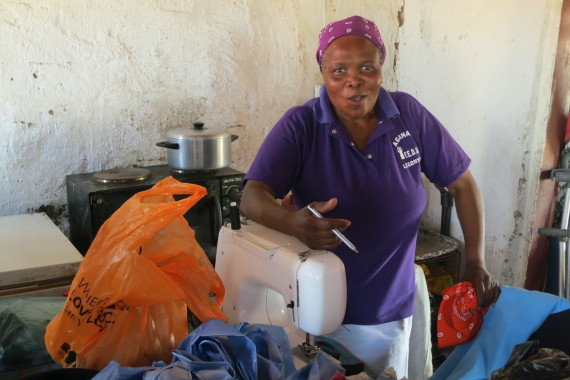
In Legonyane (North West) and Orange Farm (Gauteng) FEDUP savings scheme members are making use of FIGP loans to expand their sewing businesses. Both members are experienced seamstresses and use the loans to buy material to make graduation gowns and shwe-shwe dresses.

In reflecting on the impact of the loan system within the FIGP, Rose Molokoane, FEDUP National Co-ordinator said,

“As FEDUP, we initially got together in saving schemes so we could save towards houses.  Some people began dropping out when they didn’t see houses. But our work is not about houses only – it’s about the future. We are building a future, not a house. We are building a home, not a house. In a home there are many needs. We are using this loan programme (based on our savings) to do something about them.”

Urban Livelihoods in Cape Town

By CORC, ISN, SDI, Youth No Comments

By Ariana K. MacPherson (cross posted from SDI blog)

A different approach to livelihoods 

A national industry which offers public-sector employment to 50,000 economically disadvantaged beneficiaries should have a profound impact on the livelihoods of poor informal settlement dwellers. The Department of Environmental Affairs Working for Water Program (WfW) is therefore a primary target for Community Organisation Resource Centre’s (CORC) engagement of the state. In 2002, CORC managed 25 teams in all nine provinces to work at a staffing model which sustainably supports employees. However, due to the under-budgeted nature of the program, the majority of these teams disintegrated. The only remaining teams were privately led rather than collective in structure, with profits directed primarily to the supervisory contractor, rather than the labourers. Currently, most WfW teams operate under this model, under which the vast majority of beneficiaries earn minimal wages and secondary benefits of social development and training opportunities.

Nandipha & Noziphiwo team up to expand the community garden at the Masiphumelele Soup Kitchen

Nandipha & Noziphiwo team up to expand the community garden at the Masiphumelele Soup Kitchen

This year, CORC assembled a new team in the Western Cape based on an ambitious project: to clear neglected private areas on demanding terrain bordering the Province’s most-visited nature reserve. This effort in collaboration with nearby private landowners attracted the attention of WfW once more. Affected communities near the reserve have limited employment opportunities due to their isolation and have minimal collaboration with the Informal Settlement Network (ISN) and Federation of the Urban Poor (FEDUP).

With the help of existing contacts at Non-Profit organisations in the settlements of Masiphumelele, team leaders were drawn from youth SDI-employees from Phillipi. Young women from Masiphumelele in the South Cape Peninsula were hired as general workers with the potential for promotion conditional with training. This report follows their story.

Meet the team: youth from Masiphumelele and Philippi 

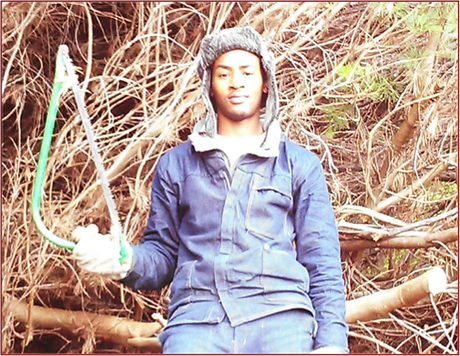
Ayanda The seeds of this project started when Ayanda Magqaza was a sprightly fifteen-year-old. He would leave his home in Phillipi to stay and work in the South Peninsula for the weekend. Agile and flexible, Ayanda quickly learned to clamber over the boulders and climb the gum trees at Castle Rock. Local landowners would hire him, first to help in the garden, and eventually to man a chainsaw alone in the depths of the forest all day long. As a CORC employee, Ayanda was the first person the project leaders called to begin working on the mountain, with the hopes that he would soon be able to lead an entire team to assist him. Within a few months the imagined team materialized, largely due to his illustrative, personal and persuasive communication abilities. When project management was absent for two months in mid-winter, Ayanda took the helm and continued to recruit new team members, coordinate logistics for certified training sessions, and lead the team to clear vegetation on the mountain slopes.

Anela All roads in Masiphumelele lead past the Pink House, a community services center managed by Catholic Welfare Development (CWD). While CORC was recruiting for the team, CWD opened their doors and provided a number of applicants. Most were men, with some construction experience; the women seemed to be looking for a desk or service job, something with a roof. But Anela Dlulane stood out, highly recommended by CWD as a lead volunteer there. During the first trial on the mountain, when the slackers stayed back to chat and move slowly, Anela kept pace with the young guys as they stacked body-length branches along the hillside. It was hard work compared to her previous job as a typist at the Department of Transport, but Anela stuck with it, with the hopes of one day fulfilling an administrative role for the CORC team.

Anela was an unpaid volunteer at the Masiphumelele Pink House when she started with CORC in June. Now she earns a wage on the CORC team, partly to help restore the Pink House community garden.

Anela was an unpaid volunteer at the Masiphumelele Pink House when she started with CORC in June. Now she earns a wage on the CORC team, partly to help restore the Pink House community garden.


Roger Prior to joining the team, most of Roger Janse’s days were indoors at the Slum Dweller International (SDI) offices. The office valued his polyglot fluency in Cape Town’s three main languages, but his studies were at a standstill and he was not sure how to advance his career. He aspired to obtain his Driver’s License and begin work as a driver for SDI, but despite repeated courses, he did not pass the test. Roger had helped Ayanda in the South Peninsula before and decided to try it again. The mountain revealed itself to be an exciting place, satisfying his interest in wildlife like puff adders and cape cobras. Roger began work as a stacker, but by the end of winter had attained his Chainaw Operator’s certificate, and qualified for three other courses. Just two months later he held his long-awaited Driver’s License in his hands, then doggedly pursued an additional commercial license. Due to his determination, the team now depends on Roger in his role of back-up driver to transport them and their equipment from home to work.

Determined to expand his skill set, Roger exceeded available WfW courses and attained his commercial Driving License

Determined to expand his skill set, Roger exceeded available WfW courses and attained his commercial Driving License

Sinjuvo She came prepared. She brought with her a record of several years of herbicide applicator experience, a list of contacts from her old team, and even wore here official yellow WfW shirt to work. At some point she had left her previous WfW team and her skills and training were left idle until she crossed paths with the SA SDI Alliance in Masiphumelele. Gudiswa Mathu may be older than the average worker, but her experience helps her know how best to contribute. When the team was still in its early stages, struggling to find women who were prepared to do labour-intensive tasks day in and day out, Gudiswa knew who to call. Within two weeks, the team ratio was balanced in favor of the better gender, 7 to 4, surpassing WfW national standards for female-to-male hiring ratios.

Sakhe With only his secondary school certificate in hand, he set out for Cape Town from the Eastern Cape. After growing up there and doing his schooling there, Sakhekile Nkohli contacted the few family members and friends he had in Cape Town and moved into Masiphumelele. He found infrequent work, mostly occasional construction jobs. But as a young worker his resume and contacts were not competitive. When given the chance on the mountain, Sakhe demonstrated what made him stand out. His fearlessness and drive earned him the position as the only team member without a previous relationship with SDI to receive and qualify for chainsaw training. With Siya or Ayanda present, Sakhe is a dependable assistant and when a more experienced manager is unavailable, he takes the helm.

Bracing himself on the steep slopes, Sakhe clears an area for the Chainsaw Operator to work, a role for which he now is also qualified as a result of training on the team

Bracing himself on the steep slopes, Sakhe clears an area for the Chainsaw Operator to work, a role for which he now is also qualified as a result of training on the team

Liso She may have the smallest shoe size, but in many ways she makes the biggest contribution. After 6 years of working on alien clearing teams, Liso Jentile offers the most insight and thoughtfulness of any team member. Her years of experience include training as chainsaw operator, which offsets the gender balance of mostly men leading with chainsaws and women following while stacking branches. Most of the time, she is quiet, and does not participate in the teatime chatter. But when the team reaches a new situation and is uncertain how to proceed, people turn to Liso for well-seasoned advice. Her thinking abilities make her a role model for other women on the team and a prime candidate for promotion to a leadership role.

Siya Initially, he was busy in the office and didn’t take the offer. Afterall, his family was in Philippi, including his newborn son. Weekdays in isolated Castle Rock sounded lonesome. And after more than a decade of chainsaw work without any career prospects, the idea of working on the mountain did not excite him. But when the opportunity to join Ayanda at a chainsaw operator training arose, Siyasanga Hermanus got involved. Within three weeks he had a team working to help him stack – a luxury after the years of working on the mountain alone. With his firm manner and steadfast approach, Siya earned his team’s trust. Now he, like Ayanda, is building up skills to eventually contract his own team. But while most WfW contractors supervise from the sidelines, Siya will remain right where he is. The only way to make sure the work gets done, he says, is to be part of the team. He won’t be letting go of his chainsaw anytime soon.

Workers are tasked with removing dense alien forest from steep mountain slopes

Workers are tasked with removing dense alien forest from steep mountain slopes

Outlook: Transitioning from labourers to leaders 

It is a fragile system, but it holds together – a web of life that benefits from its interdependent nature as much as it is defrayed by internal competition. Like the risk of wildfire on the mountain, our team confronts challenges to their health and safety every day. Competition is no stranger, and they confront one another when they disagree on an approach to an issue. Like the heat of summer, they feel it on their table at home when funding dries up and bonuses are no longer available. And when in need of assistance, if it is not offered with personal consideration, some team members may be flooded with advantages while others fail to gain ground.

Despite these challenges, the team is resilient. They depend on one another because they know that they can fell more trees working together than alone. A communicator like Ayanda can help advocate for more contracts together than the others could do alone. A veteran like Liso can help plan savings for their future together better than the others could do alone. And with perseverance, they can build a collective company with the full contribution of each team member.

While one person cleans a chainsaw, another takes inventory of the day’s supplies. A Health and Safety Officer takes note of the appearance of the deforested slopes after a day’s work while a First Aid Officer records that day’s participation of each individual. One person measures herbicide concentrations, while another speaks publicly about the value to biodiversity of their work. Each worker has their role and is valued as an essential member of the team. 

Over 35,000 South Africans are funded by the Department of Environmental Affairs to clear invasive alien vegetation in South Africa. The vast majority of them work under a private contractor. While project funds should be directed to workers, this system incentivizes the contractor to increase staff productivity to their own benefit. CORC’s team structure provides a new model, one that serves the poor populations that it is meant to support. Through this program, CORC has the opportunity to affect livelihoods across the country. It begins with the collective.

This collective has a new opportunity. In the South Cape Peninsula, a few mountain slopes dipping into the sea appear too difficult, too costly to clear. Without professional training for mountain slopes, this team has confronted Castle Rock. In doing so, they have proven their worth as recipients of intermediate training required to clear such lands safely. As an intermediate team in high demand, they may prove financially sustainable while maintaining the collective structure that can help negotiate the team members into more established careers. As a self-sustaining collective they may be able to operate independently throughout the Western Cape, and can train other teams in other provinces. A handful of youth from the South Peninsula has the chance to transition from labourers to leaders, not only in their industry, but in their communities.

Alliance youth generate income through clearing alien vegetation

By CORC, FEDUP, ISN, Youth No Comments

By Joel Kramer (on behalf of SA SDI Alliance)

The garden is in its element, the peak of spring. Tomatoes as plump as a baby’s cheek, carrots bright as the dawn sky, and enough cabbages to fill a toddler’s wagon; the community garden overflows with produce for the holiday season. Several months ago the team of women and youth from around Masiphumelele had taken a day away from their trying efforts on the mountainside to plant vegetables for the Masiphumelele Soup Kitchen. It took half a year to reach this special day, but the time for harvest has come.

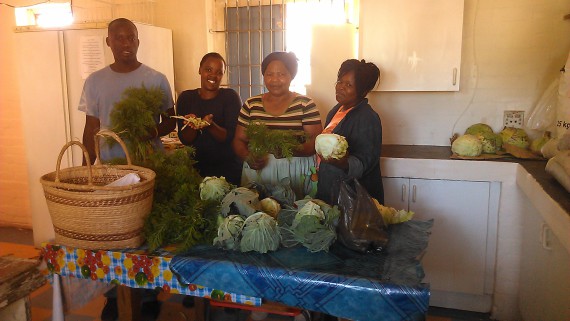
In holiday spirit, Umpheki Noks celebrates with the SA SDI Alliance and Masi Pink House staff at the Masi Soup Kitchen after the harvest of vegetables for christmas dishes of imifino (greens), seshebo (stew) and umngqusho (mash)

In holiday spirit, Umpheki Noks celebrates with the SA SDI Alliance and Masi Pink House staff at the Masi Soup Kitchen after the harvest of vegetables for christmas dishes of imifino (greens), seshebo (stew) and umngqusho (mash)

The team’s history follows much the same story of planting, care and growth. In July, to address the issue of livelihoods, reliable pay and career employment, the SA SDI Alliance assembled a team to clear alien vegetation in a steep mountain slope in the South Peninsula. With the support of local landowners and the Department of Environmental Affairs, the project employed, trained and provided leadership to 11 young residents of Masiphumelele. Over the course of the last six months, this hard-working team has transformed a fire-prone alien-ridden mountainside into a seed bed for indigenous fynbos regeneration. In a couple of years, the slopes will be blooming with wildflowers where a gum tree wasteland once cast its shadow.

The Embacwini Wetlands are a far cry from the mountainside. Flat, full of water and ruckus, a myriad of shacks and streets at the edge of the cattails make the neighborhood a busy place. With this density of homes and physical limits on new growth, Masiphumelele residents have trouble finding locations to grow vegetables for traditional dishes. The isolated location in the South Peninsula also makes it difficult for residents, especially youth, to find permanent employment.

The Alliance livelihood project sought to address shared community issues in addition to individual financial stability. The majority of the month, the team devotes itself to the clearing of alien vegetation from steep mountain slopes. However, one day each month, the team would revitalize the community garden at the Masiphumelele Soup Kitchen in partnership with Catholic Welfare Development. The revitalization began this winter and on Monday it produced roughly 20 kilos of vegetables. Lead cook Nokwakwa (Noks) was overjoyed at the baskets of lettuce, bags of beans and tomatoes and bunches of carrots. The vegetable will become seshebo (stew), umngqusho (mash) and imifino (greens) for the needy in this holiday season.

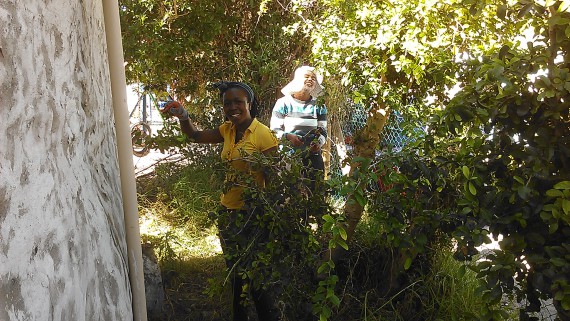
Close to the earth, Nonzukiso and Nono weed garden beds at the Masi Soup Kitchen community garden to make room for a Christmas harvest

Close to the earth, Nonzukiso and Nono weed garden beds at the Masi Soup Kitchen community garden to make room for a Christmas harvest

In the meantime, the Alliance team continues to push forward on the mountain, harvesting a completely different product: braaiwood. While removing alien invasive vegetation, rooikrans is a dominant species, and is able to be sold on the market for a profit. These profits go directly to the team members, providing an additional incentive for the hard work that they do.

Team members approach this effort with years of experience. Several women are career professionals in the wildland management industry, with multiple years of experience as an herbicide applicator or chainsaw operator. SDI’s veteran staff have more than two decades of combined mountainside chainsaw experience from working on private properties. But this new location at Castle Rock Conservancy poses new challenges. The mountainside at Castle Rock is steeper than most locations in the Western Cape, and requires intermediate training to safely clear certain areas. Severe cliffs necessitate rope access, during which time a chainsaw operator may have to brave falling branches at the edge of sea cliffs. And when all are resting for lunch after a demanding morning, workers must fend off baboon, mongoose or pigeons before they enjoy their meal. Few teams in the Western Cape are equipped and trained to this type of work, and the skill set is in high demand. Even public properties have a long waiting list for treatment, which tarries into 2016.

 After a tough day clearing the mountain slopes, Sakhe raises his chainsaw triumphantly

After a tough day clearing the mountain slopes, Sakhe raises his chainsaw triumphantly

With the  vision of the Alliance and national governmental support, this small team might stand the chance of receiving that higher training and gaining contracts to those difficult, more lucrative areas. Further, the team members could set a national precedent for funding and management by presenting the collective model.

Inside and outside of the workplace, the opportunity for collaboration and shared effort remains. After this week’s harvest, the garden at the Pink House will continue to provide lettuce and onions, cabbage and strawberries for the holidays. And when the harvest is complete, new seeds donated from a partner in Mitchell’s Plain will begin the next growing cycle. As each tree falls and each veggie grows, the density of Masi’s Embacwini may morph from trouble to triumph.

Anela and Nozi enjoy their hard-earned sunshine after clearing away the dense undergrowth in the back alleyway to clear space for vegetable beds.

Anela and Nozi enjoy their hard-earned sunshine after clearing away the dense undergrowth in the back alleyway to clear space for vegetable beds.

FEDUP launches livelihood programs: solar lights, funeral scheme & income generation

By FEDUP, uTshani Fund No Comments

By Walter Monyela and Yolande Hendler (on behalf of CORC)

IMG_1230

Sarah Makgopela of Aganang savings scheme in Legonyane (North West province) has started a small business selling hats, water boilers, sweets and other small goods through the income generation program


If about 25% of South Africans are unemployed, this percentage is even higher for communities living in informal settlements – a reality that is no different for the members of the South African Federation of the Urban and Rural Poor (FEDUP). Since the early 1990s, FEDUP members have identified their own development needs especially around accessing well-located land, security of tenure, improved shelter, housing and basic services. Through the practice of daily savings and other community organisation tools, FEDUP has built partnerships with government on all tiers and has negotiated access to many of these needs. Yet the lack of income generation has posed continuous instability and hardship on a day-to-day basis.

Over the last years, therefore, FEDUP has identified the need to strengthen the income generation opportunities of its members and in 2014 launched several livelihood programs. While these programs assist members to start their own small businesses and the movement as a whole to generate its own income and build its own assets, they are at the same time initiatives that reinforce the importance of the rituals of Shack/ Slum Dwellers International, such as daily savings.

The livelihoods programs underway are

  • Total Solar Lamps by Awango
  • Funeral Policy known as South African FEDUP Funeral Scheme (SAFFS)
  • Loan Program known as the Federation Income Generation Program (FIGP)

Total Solar Lamps by Awango

IMG_1158

A member of Aganang savings scheme in Legonyane (North West) reselling Awango solar lights by Total South Africa

Total South Africa (TSL) introduced solar lamps by Awango and entered a contractual partnership with uTshani Fund to provide FEDUP members with economic opportunities of buying Awango solar lights from uTshani Fund and selling them to potential buyers e.g informal settlement communities and businesses. Although the emphasis is on FEDUP members this opportunity is also open to non-FEDUP members who are keen to do sales. This year a total of 314 people (307 FEDUP members) in seven provinces were trained as resellers.

Training includes a presentation on the available products, how they operate, durability and logistical aspects of the business. After training each reseller ideally buys at least one of each type of solar light (3 in total). The solar lights business is aimed at members who already run an income generation initiative and are seeking to diversify their products – this would provide the financial platform for securing the first stock.

Amidst successes, the program experienced challenges in terms of sellers lacking sufficient start-up capital as well as insufficient sales experience. In response FEDUP members are devising strategies to support the growth of businesses and sellers’ capacities such as exposing sellers to more in-depth training in sales skills and exploring the potential of connecting with the Small Enterprise Finance Agency (SEFA) around increased support for start-up loans.

Funeral Policy (SAFFS)

The South African FEDUP Funeral Scheme (SAFFS) grew out of a desire expressed by FEDUP to bury its members with dignity and honour. SAFFS started its full operations in March 2014 and operates as an understudy to Imbalenhle Burial Society (IBS). It is underwritten by TransAfrica Life Funeral Policies, who are registered with the Financial Services Board of South Africa (FSB).SAFFS currently works in association with IBS to learn how to administer a funeral scheme with the intention of going solo. FEDUP members sell the funeral scheme to own members as well as the public and have sold an estimated 600 schemes to date. Sellers are compensated per policy sold.

Loan Program (Federation Income Generation Program – FIGP)

IMG_1268

“I have used the Federation Income Generation Program to sew graduation gowns as a business. This helps me support my family”


The loan program is a formalisation of the loans that FEDUP members access at individual savings scheme level. While this practice will continue, the FIGP is an initiative to expand the scope of these loans to support FEDUP members in income generation activities of their choice.

FEDUP has therefore registered with the relevant financial bodies (via uTshani Fund) and has started up a legal and formalised microfinance institution through which members can access group loans from their own Urban Poor Fund, instead of external financial institutions.The criteria for accessing a loan is:

  • Formal FEDUP membership (complete UPF payment)
  • Active member of a FEDUP savings scheme
  • Experience as small business entrepreneur for at least 6 months
  • Be part of a group of 5 to access a loan

These criteria ensure that members continue saving and support one another in the development of their respective businesses because individuals can only receive loans when they are in a group of five. The whole group must also make repayments as one overall sum. Therefore individual success depends on group success.

In this way FEDUP broadens the scope of its livelihood programs, strengthens its membership base and positions itself toward financial sustainability within the next five years. The year 2015 will definitely mark FEDUP as another recognised, fully registered and compliant microfinance in South Africa. Through this initiative FEDUP will also be able to approach funders and private organisations to leverage further resources.

IMG_1379

” I have used the FIGP to buy shwe shwe material and sew dresses” – Elizabeth Motaung, FEDUP members in Orange Farm Gauteng

At the heart of the matter

What lies behind these varying income generation initiatives? On the one hand, FEDUP’s step towards financial sustainability to ensure continued existence in the case of decreased donor-funding. On the other hand, and at the heart of the matter, lies savings, the engine of FEDUP that enables poor women to come together, share their experiences – struggles and triumphs – and find solutions.

Sarah Mulaudzi, North West co-ordinator for FEDUP recently shared that

“In our savings groups we have R300 000 worth of savings from our members who are doing income generation programs. Through the income generation program our savings are really growing!”

As the income generation programs require savings and start up capital they strengthen FEDUP’s savings practices. Strong savings in turn build a strong group and a strong community, which widens opportunities within the income generation programs themselves.

The small business of Sarah Makgopela and Elizabeth Moletese of Aganang savings scheme in Legonyane, North West province.

The small business of Sarah Makgopela and Elizabeth Moletese of Aganang savings scheme in Legonyane, North West province.


FEDUP and uTshani Fund introduce ‘Project Permaculture’

By FEDUP, uTshani Fund No Comments

By Barbara Torresi (on behalf of uTshani Fund)

f. Trainers Site Visit November 2013

While the provision of housing to the poorest of the poor remains uTshani Fund’s main objective, it has become increasingly indisputable that, to be effective and for its effects to be long-lasting, the fight against a multifactoral phenomenon like poverty must take place on multiple fronts. This is particularly true in metropolitan areas, where shelter is but one of the necessities that the surging masses of rural-to-urban migrants are in short supply of. With dwindling job opportunities, even the satisfaction of a fundamental human need like adequate nutrition has become uncertain, as has the achievement of the well-being determinants (education, employment, health) that normally cascade from access to a balanced diet.

To use a practical example, when children are undernourished their learning ability suffers, and so does their capacity to stay in school in the face of more pressing concerns such as putting bread on the family table. Similarly, malnutrition renders adults susceptible to a host of chronic ailments, which can dramatically decrease their opportunities to secure  or keep a job in an already crowded employment market. And the lower people’s income, the worse their diet – a vicious circle that exemplifies the sinister self-replicating nature of dependency and economic deprivation.

i.  2nd week training Group 2 photos.5docx

Second week of training


It was with all of the above in mind that uTshani Fund and Fedup began to look at ways to work poverty alleviation measures such as income generation and skills training into the Alliance’s saving and upgrading rituals. A perfect opportunity to tackle more than one issue at once – and therefore to reap the benefits of synergic action – was seized by uTshani in June 2013, when the organisation won a grant by the South African National Lottery to teach informal settlement dwellers, and in particular women and other vulnerable individuals, the skills required to grow fruit and vegetables right at their doorstep. Since it provides participants with the ability to cultivate fresh produce for both their own consumption and resale in local markets, the program offers the dual advantage of addressing the issue of food security together with that of the chronic lack of income generating opportunities in the townships.

In actual fact, the scope of Project Permaculture is even larger, since the establishment of horticultural gardens in day-care centres is enabling Fedup and uTshani to not only create sustainable job opportunities in deprived communities, but also to provide education for children in disadvantaged areas, to improve the health of the urban poor, to enhance the physical environment in which slum dwellers live, to teach children from a young age the value of working with nature, and to pilot a livelihood program that can be replicated in other Federation groups.

In other words, Project Permaculture is a sustainable and scalable strategy that targets some of the major issues currently affecting the country’s most deprived urban areas.

d. 1st week training Group 1 photos

Snippet_309548D50

From a practical point of view the project, which is run by uTshani Fund’s partner Rucore and is currently in its concluding stages, started in October 2013 and took place in various settlements of the Eastern Cape (Queenstown and Port Elizabeth), Western Cape (Mossel Bay, Khayelitsha, Philippi), Gauteng (Garuankua, Nigel, Soweto, Orange Farm), and the North West (Oukasie and Hartebees). Training was divided into two phases. The first phase consisted of a six day workshop during which starter packs containing the required materials (spades, hosepipes, fencing, water tanks, shade nets, gutters, compost, manure, fruit trees, seeding trays, herbs, seeds, and posters) were handed out to the beneficiaries. After participants were given a chance to put in practice what they had learnt and to get their gardens started, Rucore conducted a second six day training session in January 2013 to troubleshoot problems and fine-tune skills.

To date, 54 Fedup members (43 of which women) have been directly capacitated by the permaculture program, but in reality the enterprise’s indirect benefits are farther reaching, since it is estimated that between 250 and 300 individuals will take advantage of the improved diets and larger incomes that the workshop attendees will be able to secure through the monetisation of their new skills. As one woman put it,

“What I learned will help my sons grow into strong and healthy adults with the ability to look after their own families and children”.

So here is proof, if any was needed, that not only poverty but also ingenuous ways to mitigate this scourge can, with the help of commitment and organisation, become powerful self-replicating forces.

Group picture at first week of training

Group picture at first week of training