Tag

Cape Town Archives - Page 4 of 4 - SASDI Alliance

2014 UCT – Europe Community Studio “The Beginning”

By CORC, ISN No Comments

By Thandeka Tshabalala and Yolande Hendler (on behalf of CORC)

Community members and students locate structures and amenities in Europe informal settlement.

Community members and students locate structures and amenities in Europe informal settlement.

On 19 February 2014, Europe community members welcomed about thirty masters students of Urban and Regional Planning from the University of Cape Town (UCT) to their informal settlement, which is located in Gugulethu, Cape Town. This first gathering kicked off a four month long ‘planning studio’ in which community members and students will work together to address some of the community’s most pressing concerns. The studio also aims to expose students to alternative planning approaches to urban informality. The Informal Settlement Network (ISN) facilitates and supports the community leadership while CORC offers technical support as the community and students develop plans for upgrading. Read more on the background leading up to the 2014 studio.

First meeting in Europe

Community members and students gathered in Europe’s community hall where ISN and CORC shared opening insights on the importance of community participation, mobilization and capacitation. Such an approach forms a solid foundation for planning community-relevant issues such as access to basic services and housing. Situated close to employment opportunities at the Airport Industria and the N2 corridor, Europe’s location is ideal for its residents. For this reason students and community members decided that it would be ideal to look at in-situ, incremental upgrading projects. In order to give students a more concrete idea of ‘life in Europe’ community members showed them around their settlement. This opened up a platform for both community members and students to reflect and share their expectations for the studio ahead.

Students' first visit to Europe.

Students’ first visit to Europe.

The purpose of the studio is two-fold: For the community, technical support around housing and upgrading are advantageous for engaging government. For the students it is advantageous to gain valuable experience in working in a highly collaborative and participatory environment around some of the most pressing issues in the city.

After the visit, CORC’s technical team joined the students at UCT in order to reflect before the next joint planning session with community members. Based on the students many impressions – for some it was the first visit to an informal settlement – a variety of ideas, concerns and suggestions arose. Some students related Europe to studies of urban informality in the global South, others explored how the meaning of boundaries in communities impacts opportunities and community interaction.  Some concerns related to the lack of public interaction spaces, lack of socio-economic activity and the need to value recycling as a source of income. Other students emphasized the importance of collaborative and participatory planning methods.  Towards the end, one of the students seemed to capture the general sentiment that

“We need to develop new sets of eyes to understand the logic systems, local assets and already present ways of doing things in Europe. We need to identify local systems. The community needs to identify its own opportunities”

Joint planning for action

The next session was an interactive one with a printed map of Europe. It was marked with some reference points, landmarks and amenities that would serve as a collaborative working document to gather information about the settlement from community members.  This meeting focused on sharing expectations and establishing specific issues the community wanted to address. Furthermore, it established where students’ interests and abilities aligned with community priorities.  With great excitement, students and community members located their homes on the map, marked off the boundaries of Europe and identified central spaces. Community members also expressed that they would like the studio’s incremental projects to support their long-term vision of attaining housing. This focus is linked to the question: “how permanent is our temporary?” As communities wait for permanent housing, there is a need of assisting well located settlements such as Europe to upgrade, but not lose sight of the long term vision.

DSCN5652

Interactive mapping at UCT

After several visits to Europe, students expressed the significance they perceived in planners moving away from physical planning to focus on the people they are planning with, i.e. understanding their background and socio-economic context within the larger context and potential of the city. The students thus based their analysis of Europe community on reinforcing socio-economic opportunities.

Through engaging with residents’ already present coping mechanisms students researched opportunities, constraints and concepts for future action. The opportunities they presented included access to employment, recreational spaces, spaces of interaction, education and small businesses. The identified constraints comprised flooding, crime, physical and social barriers, pollution and poor soil quality affecting food production. Together, community members and students developed working groups that respectively looked at socio-economic issues, transport, housing / land / tenure issues and water, sanitation and storm water services.

Working Groups 2

A working group in Europe

The working groups then identified more concrete concepts:

  • Socio-economic opportunities around Klipfontein Road

Klipfontein Road was presented as a main artery of opportunity as Europe’s main entry point and connecting point to other neighbourhoods. The industrial area at the airport was presented as a potential source of employment. A further point related to taking advantage of existing business that represent high activity nodes.

  • Easing access to public transport routes

This was particularly relevant due to the community’s reliance on pubic transport.

  • Potential upgrading and re-blocking
  • Strengthening food production

The focus would lie in increasing food security whilst decreasing poverty levels.

  • Overcoming barriers to neighboring communities

This would facilitate greater interaction between communities.

During the presentation students emphasized the knowledge they had gained from the community in developing these concepts,

“ We regard the community as experts, they have all along been able to use their human architecture to deal with the physical constraints of the space they live in.”

The next phase of the studio will comprise developing a spatial development framework. CORC and ISN will continue to share the studio’s upcoming developments.


Re-blocking Kuku Town Informal Settlement

By CORC, FEDUP, iKhayalami, ISN, uTshani Fund No Comments
IMG_1266

View of Kuku Town in the process of re-blocking

Kuku Town informal settlement is located on a little triangle of open land opposite the railway line in Kensington, Cape Town. It is also home to about 50 people that make up 20 households.  The past week has been an eventful one as community members have seen the physical layout of their settlement transform day by day. They have taken down their old homes, structures made largely from pieces of old wood, plastic, cardboard and aluminium that were a safety risk, especially during fires.  Together with iKhayalami, an Alliance partner and support NGO the community cleared and levelled the ground as the more fire-resistant structures were erected.

3 years of preparation

Over the last three years Kuku Town prepared for upgrading by building up a relationship with the City of Cape Town, the Informal Settlement Network (ISN) and Community Organisation Resource Centre (CORC). During this time the Alliance also established a partnership with Habitat for Humanity South Africa (HFHSA). In establishing its interaction with the City, the community partnered with the alliance to organise and mobilise itself. Community members were actively involved in modeling, planning and mapping the re-blocked layout as well as collecting savings to contribute to the re-blocked structures. They gathered knowledge and experience about upgrading in community exchanges and collected information about Kuku Town in community-run profile and enumeration surveys.

Re-blocking: an Alliance approach and a City policy

IMG_1267

Community-drafted plan of Kuku Town before re-blocking

‘Re-blocking’ is a term used by the South African SDI Alliance to refer to the reconfiguration and repositioning of shacks in very dense informal settlements in accordance with a community-drafted spatial framework. Generally, re-blocking occurs in “clusters” identified by the community, which result in “courtyards”, ensure a safer environment and generally provide space for local government to install better services.

As Kuku Town is a small and dense settlement the re-blocked layout had to consider creative options. Together with CORCs technical team community designers erected the new structures along the sides of the neighbouring walls with a few re-blocked structures in the centre, opening up an L-shaped pathway throughout the settlement that enables public space and easy vehicle access in emergency situations. HFHSA stepped in at a crucial time to support the re-blocking process by sourcing G5 fill material to raise the new structures and mitigate potential flooding. As part of the community’s re-blocking proposal, the City agreed to install one-on-one water and sanitation services for every structure. This made a big difference to the 50 families who previously had to share 2 taps and 4 toilets.

The re-blocking of Kuku Town is also part of three pilot projects the City of Cape Town sought to support in the coming financial year after it adopted re-blocking as an official policy on 5 November 2013. The City thus indicated a long-term commitment of resources to re-blocking projects, to departmental alignment and to meaningful interventions in informal settlements.

DSCN5728

Community designed re-blocking plan for Kuku Town


Mobilising the community, engaging the City

In 2006 Kuku Town first appeared on the City’s informal settlement database, after a community leader engaged local councilors around poor service delivery. Later, in mid-2011 after the City and ISN / CORC signed a Memorandum of Understanding (MoU) the community joined the ISN network and clarified a way forward for collaborative partnership with the City.

ISN community leader, Nkokheli Ncambele explains that the interaction between ISN and Kuku Town began when the PFO (Principal Field Officer) of the City’s Informal Settlement Management Department introduced Kuku Town community leaders to other upgrading processes in the informal settlements of Burundi and Sheffield Road. These exchanges provided an opportunity to learn, ask questions and share experiences about informal settlement upgrading. Once community leaders had met with the city and ISN a big meeting took place in Kuku Town to explain upgrading to the community.

DSCN5708

Mzwanele Zulu (ISN), City officials, Verona Joseph (Community leader)


After some initial resistance the community decided to opt for re-blocking. This meant that they needed to start saving toward contributing to their own structures.Verona Joseph, Kuku Town community leader, explains that

“over 3 years we managed to save R 15 000. Most people in our community are above 50 years. Only 3 are employed and 5 get a pension. But even the old people managed to save money”

64-year old Auntie Hana Olyn and her husband Piet Jordaan, remember how

“when we collected two bottles we would save the deposit from one bottle. We also collected tins, did the gardening or ironed people’s clothes. This is how we managed to save quickly. Most people could earn R 100 a day. Some of this they used for savings.”

Most community members chose 12m2 and 20m2 structures for which they respectively needed to save R740 and R1000.  The remaining cost of the structure was covered by the Community Upgrading Finance Facility (CUFF). Savings are recorded in personal savings books and are deposited in a community savings account. Regular bank reconciliations are communicated to the group.


IMG_1237

Verona and Auntie Hana Olyn in her new home


DSCN5727

Community savings records


In April 2012 community members also led an enumeration in Kuku Town through which they gathered relevant, verifiable, and specific data that was used to build models and draft the re-blocking plans. For Verona, the enumeration brought about another success:

“Before the enumeration we had people from different families staying in one structure. Only some of them were registered with the council. I wanted to push for every family to get their own structure. The problem was that some people did not qualify because they were not registered with the council. But with the enumeration we re-counted everyone and got them re-registered.  This was the most important thing! The council then agreed that every family could have its own structure.”

 “As a community we are more comfortable now”

Lydia and Verona, both on the leadership committee, agree that this is one of the biggest changes.

 “We don’t have rats any more and when it rains we won’t lose our clothes. But people’s way of life is also changing. It was a struggle to convince them, but now they have other things to focus on – they are fixing things in their homes. With the new structures everyone’s lives will pick up because this is a very upgraded informal settlement now”.


Building Partnerships: Comic Relief vice chair and film director Richard Curtis visits SA Alliance

By CORC, News No Comments

By Yolande Hendler (on behalf of CORC)

DSCN5524 - Kopie

Richard Curtis, Melanie Manuel (ISN), Emma Freud, Bunita Kohler (Director of CORC), Marlene Don (FEDUP) and Bukiwe Marawu (CORC)

Last week, the South African Shack Dwellers Alliance welcomed Comic Relief vice-chair and film director/producer/writer Richard Curtis with his wife, Emma Freud, and family at the Cape Town office. Before arriving he told his children,

“Today I’m meeting the people I work for”.

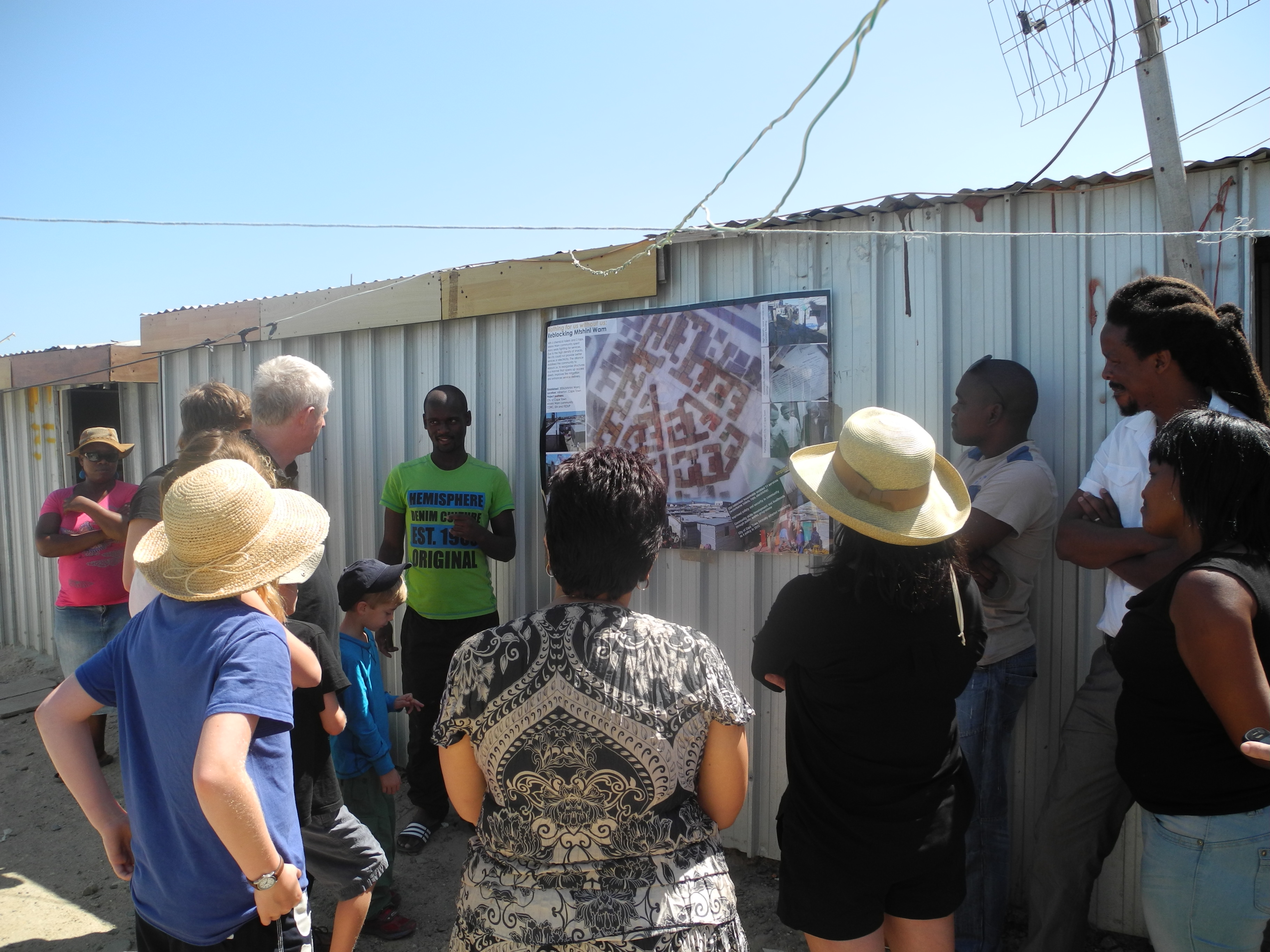
As a renowned film-maker, Curtis is also co-founder of the UK based charity Comic Relief which has been one of the alliance’s principal development partners since 2011. Together, they spent a morning meeting the alliance partners, visiting Mtshini Wam informal settlement where community members explained the process of re-blocking and showed Curtis and his family what a re-blocked settlement can look like. They also visited the Solid Waste Network, one of the alliance’s income generation initiatives.

DSCN5533

Mthsini Wam community members explain reblockingDSCN5542

Building Partnerships

To achieve the vision of more inclusive and pro poor cities it is critical to build partnerships with urban development actors who support this vision. The alliance’s association with Comic Relief as a development partner is a platform for organised communities to be at the core of building such cities. Communities are best positioned to contribute to design and to plan development solutions that have greater impact and sustainability than external development interventions. The alliance’s partnerships not only include the network of SDI affiliated countries or partnerships with government but also focus on partnerships with international aid agencies and donors, such as Comic Relief.

Founded in 1985, Comic Relief’s vision is of a “just world, free from poverty” (Reference). By raising funds through campaigns such as Red Nose Day and Sport Relief, Comic Relief spends these on projects that tackle the “root causes of poverty and social injustice in the UK and across the world” (Ibid). In particular Comic Relief supports projects “on the ground”, giving people a “leg up, not a hand out” (Ibid). Comic Relief displays a long term view of achieving this vision and therefore forms lasting partnerships with local organisations. Some projects are supported for up to six years whereby the progress of projects is tracked and funds are paid in phases.

Comic Relief and the South African Alliance

Comic Relief has been a core funding partner of the Alliance’s work since 2011 when uTshani Fund secured a grant for supporting the core activities of FEDUP housing development process. The grant is in its second year of operations and aims to support community lead projects in housing development and informal settlement upgrading (via the uTshani Fund housed funding facility Community Upgrading Finance Facility). uTshani Fund and CORC have formed a close working relationship in addressing the challenges of homelessness, landlessness and urban poverty.

The Community Organisation Resource Centre (CORC) has also been successful in applying to Comic Relief for grant funding. As part of its UK Aid Match scheme, Comic Relief formed a partnership with the Department for International Development (DFID). In December 2011 DFID agreed to provide a further £10m of funding for Comic Relief’s Urban Slums work. This sum would be matched by Comic Relief through funds raised during Sport Relief 2012, thereby totaling £20m. This new fund is intended to transform the lives of a million slum dwellers in a limited number of African cities through the strategic collaboration of agencies. The funding spans five years in total.

CORC and the South African alliance partners responded to the call for proposals and were successful in their application. The core of the funding proposal focussed on setting up a local city fund which will deliver informal settlement upgrading projects in the area of Khayelitsha in the City of Cape Town. The city fund is a responsive mechanism that aims to achieve a long term sustainable fund which could be replicated and/or recapitalised by City and Provincial government.

The beginning of Comic Relief funded projects in Khayelitsha

DSCN5045

Community leaders plan and design in KhayelitshaDSCN5063

As part of the Comic Relief grant, the alliance has been engaging with several neighbouring communities in Khayelitsha that live in UT, TT and BT sections, Litha Park and UT Gardens. Since mid 2012 these communities have been forming a horizontal relationship with ISN structures. After community members living in UT Gardens profiled and enumerated their section, they expressed the need for a crèche / multi-purpose centre for the community on a nearby open field.  Since the start of 2014 community leaders have continuously met with each other and CORC’s technical support team.

The meetings have had two aspects: On the one hand the community leaders expressed some key issues to address such as drainage and managing waste disposal. On the other, they co-designed and co-conceptualised the first drafts of the crèche / multi-purpose centre and identified existing footpaths and transit spaces. As the discussions continue, community leaders are eager to see this project lift off the ground.

This, then, is one of the projects that the Comic Relief grant supports. On the surface, it looks entirely different from Mtshini Wam or the Solid Waste Network which Curtis and his family visited. Yet the similarity lies in the tools that each community uses to organise itself. It lies in communities who lead their own design and planning. The SA SDI Alliance values long term funding agreements with international development partners such as Comic Relief (and its associations and members) that recognise the imperatives of informal settlement upgrading, housing and land, and livelihoods development.


National leaders of the Alliance congregate in Cape Town

By CORC, FEDUP, ISN, News, uTshani Fund No Comments

By  Walter Fieuw, CORC

Leaders of the South African SDI Alliance congregated between 16 – 18 January 2012 at the Lutheran Youth Centre in Athlone to follow up on progress made since the strategic meeting held at Kolping House in January 2011. At last year’s meeting, the Alliance agreed to a shift of focus towards upgrading of informal settlements. Despite one of the world’s largest housing delivery programmes, the South African government has failed to curb the demand for housing and the improvement of basic living conditions for milllions of poor people. The Alliance has pledged ‘to strengthen the voice of the urban and rural poor in order to improve quality of life in informal settlements and backyard dwellings’. This we will accomplish by supporting communities who are willing and able to help themselves.

At Kolping House strategic meeting, the following four broad strategies would define the work of the network:

1. Building communities through FEDUP and ISN using SDI social tools;

2. Building partnerships with government at all tiers;

3. Implementing partnerships through projects; and

4. Keeping record of learning, monitoring and evaluation.

Upgrading informal settlements is an inherently complex endeavour considering the various socio-political realities connect to harsh living conditions and illegality. However, across South Africa the urban poor are mobilising and building institutional capacity to engage local governments around community-initiated upgrading agendas. As the Alliance’s saying goes, “Nothing for us without us”. Dialogues and outcomes of this year’s strategic meeting focused on meeting the development indicators which the Alliance set for itself at Kolping House. This year will see a renewed focus on the following:

  • Capacitating regional leadership structures, and the creation of a national ISN coordinating team
  • Recommitment to the spirit of daily savings, daily mobilisation and daily exchanges of learning
  • Deepening the quality of selected settlement upgrading, while growing the ISN network
  • Developing relevant and sensitive indicators, guidelines and protocols for the Alliance’s core activities to spur self-monitoring and evaluation.
  • Resourcing the Alliance through effective partnerships with local governments, universities and other development agencies such as the National Upgrading Support Programme (NUSP, Dept of Human Settlements) and the promotion of establishing Urban Poor Funds, similar to the Stellenbosch experience (hyperlink: http://www.sasdialliance.org.za/blog/Memorandum/)

Building coalitions of the urban poor able to capture the imaginations of city builders, both from the top-down and the bottom-up, is not often highly regarded or understood when upgrading strategies are devised. The Alliance is committed to strengthening the voices of the urban poor through building effective, pro-poor partnerships and platforms with local government, and implementing these partnerships at project level. As the process to understand the discrepancies and commonalities between the agendas of communities and the municipality gets underway, work must begin. Communities and the municipality develop, in partnership, a mix of “quick wins” that can build trust and show real change for communities. At the same time, the Alliance is also geared towards challenging many of the assumptions that lie behind planning for the urban poor throughout cities in South Africa. Other projects that get chosen for implementation are difficult cases designed to influence the way the municipality operates so that its methods come closer to the planning priorities of communities. All the project types also influence communities. At these interfaces of bottom-up agency and top-down city management, new ways of seeing, grappling with and finding solutions for informality emerge, and shack dwellers are no longer passive by-standers to the development enterprise, but active partners and innovators of finding workable, affordable and scalable solutions to urban poverty.