Category

ISN

MORE FIRE! Deputy Minister visits Mshini Wam and Siyahlala settlements in Joe Slovo Park

By CORC, FEDUP, ISN, News No Comments

By Walter Fieuw, CORC

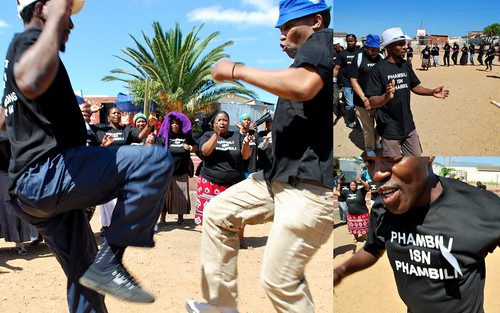
On Thursday 23 February 2012, while South Africa were debating the implications of Finance Minister Pravin Gordhan’s budget speech, another group was preparing to put action to words. Community leaders from across the country and associated with the Informal Settlement Network (ISN) were gathering in a community hall in Joe Slovo Park, Milnerton, Cape Town. This group attended a workshop during the week on enumerations, mapping and blocking out of their settlements. The energy was bouncing off the walls, and detonated into a joyous singing-dancing affair along Freedom Way.
DSC_0014-1
The group danced and sang their way to the next stop: an open field in Mshini Wam settlement where a gazebo was set up to receive the Deputy Minister of Human Settlements, Ms. Zou Kota-Fredericks. The group sang affectionate songs to the on-lookers, urging them to unite and prepare their communities for improving their living conditions.

Ndikunile isandla [I give my hand]

Ndakunika ingalo [I give my arm]

Ndakunika amabele [I give you my chest / breasts]

Andiyazi byifunayo [I don’t know what else you want]

Yona soze uyifumane [and you wont get it!] Deputy Minister visits Mshini Wam
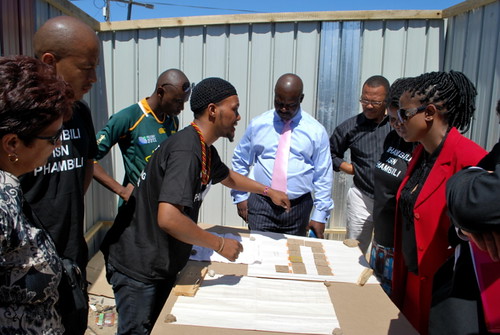
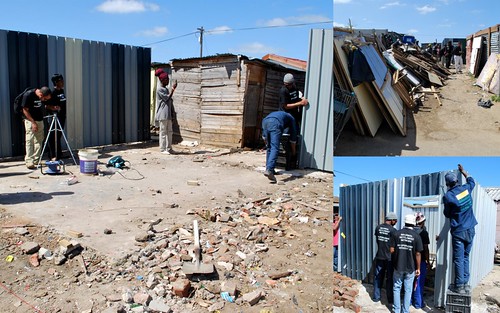
Blocking-out is a term the South African SDI Alliance uses to refer to the community based planning and design processes that lead to the re-organisation of shacks to utilise space much better. The need for blocking out could be anything from opening space to ensure better penetration of emergency services, finding solutions to flooding and fire, security and safety of children in court yards under neighborhood supervision, or better located water and sanitation services. In the case of Mshini Wam – a settlement that has been plagued with fires that not only destroy their belongings, but also have claimed residents’ lives – the community intends to open space to develop roads for emergency services, amongst others. Ms. Kota-Fredericks was led through a narrow alley way littered with the debris of shacks pulled down. However, in the place of the old: the new! Ngcambo, a leader from Mshini Wam, introduced the community designs to the minister in a practical way. He presented the previous layout of shacks with cardboard cut-outs, and rearranged them to show her what the new layout will look like. The iKhayalami team was supporting the affected households on that very same stage, and the minister could see the new synergy of professional builders working alongside unskilled communities. The skills transfer that occurs in this space is notable.
Deputy Minister visits Mshini Wam1
DSC_0095-1

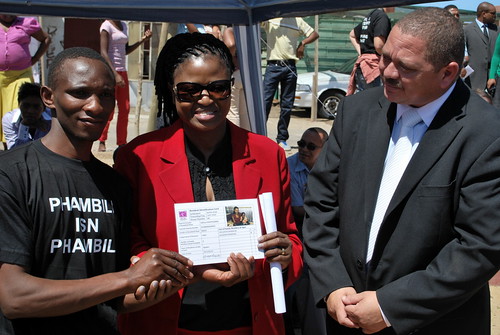
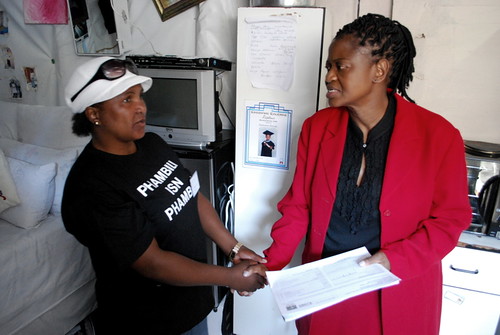
The delegation moved on to another aspect of the enumeration process that is linked to securing people’s tenure and creates a sense of belonging. This time, the minister handed over identity cards to Mshini Wam residents. The identity card contains the following household information:

  • Name and national ID number of household head, with a picture of him / her next to his / her numbered shack
  • Names and identity numbers of household dependents
  • Shack and block / cluster number
  • Number of years lived in the shack

This small gesture goes a long way. When the City’s anti-land invasion unit peruses settlements, and allegedly threatens with eviction, residents in enumerated settlements can easily produce tangible evidence to the contrary.
DSC_0118-1
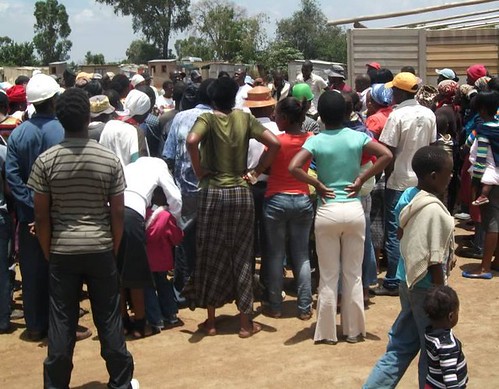
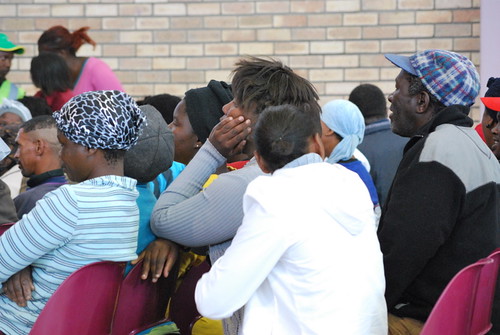
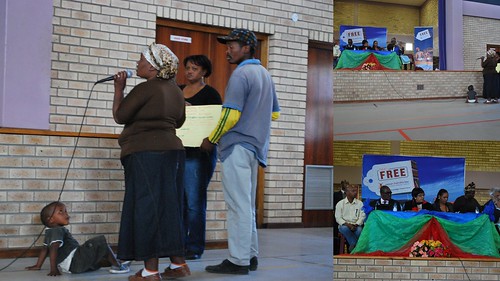
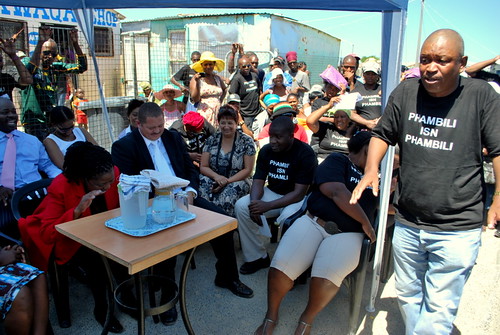
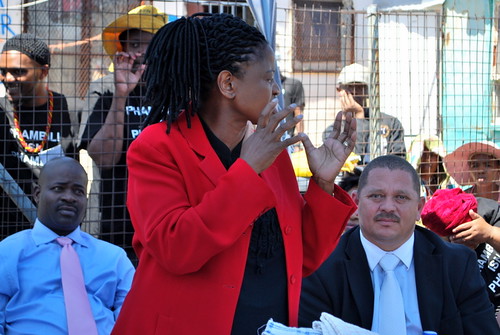
The party then moved on the next venue: Siyahlala settlement across the road from Mshini Wam. “It’s an honor to again have you here amongst the shacks, Minister” said Patrick Magebhula, chair of ISN and advisor to Tokyo Sexwale. “This is where it really matters”. Turning to the buzzing crowd he said, “You need to be a leader with a purpose. A leader that represents solutions to real problems. A leader of the elderly, of the unemployed, of the disabled, of the children. And you will only know your people and your settlement if you have enumerated and discussed the data”. Magebhula also ensured the Minister and officials from the City of Cape Town that ISN, with support of CORC, are preparing a master database of data collected in settlements over the past years.

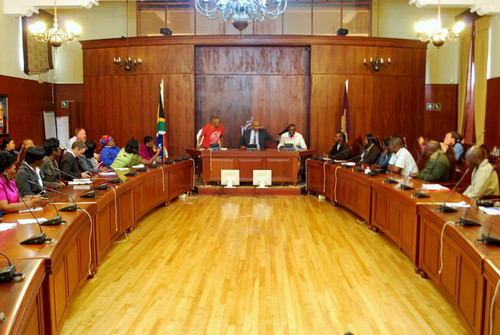
Member of Mayoral Committee for Human Settlements, Councilor Sonnenberg, also affirmed the City of Cape Town’s commitment to working alongside communities associated with the Informal Settlement Network – in particular the communities of Mshini Wam, BT Section, Burundi, and Vygieskraal. Six objectives in the partnership between the ISN and City of Cape Town were also presented:

  1. Create a shared community vision of the future, especially with regard to informal settlements upgrading and backyard rehabilitation;
  2. Identify and prioritise key issues, thereby facilitating immediate measures to alleviate urgent problems;
  3. Support community-based analysis of local issues, including the comprehensive review of long-term, systemic problems that confront particular service systems and the need to integrate different service strategies so that they are mutually supportive;
  4. Develop action plans for addressing key issues, drawing from the experiences and innovations of diverse local groups;
  5. Mobilise community-wide resources to meet service needs, including the joint implementation of sustainable development projects; and
  6. Increase public support for municipal activities and local understanding of municipal development needs and constraints.
DSC_0132-1

DSC_0141-1

Minister Kota-Fredericks reminded the delegation of minister, councillors and officials that these are the people we serve. She further remarked that the Department is in the process of finalising its budget and at the budget speech, she will report back on the collaborative upgrading initiatives she witnessed in Cape Town.

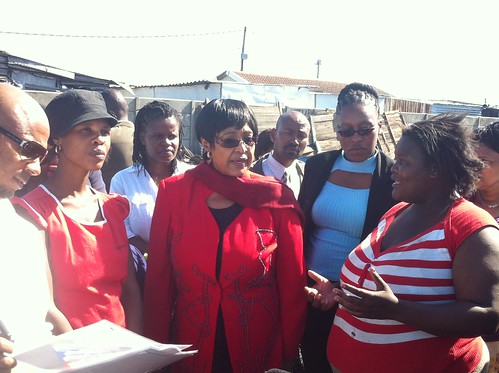
In closing, minister Kota-Fredericks talked about the “multiplier effect” that small City-wide projects have on national policy deliberations. This starts through organised communities taking the initiative to build horizontal networks of accountability and transparency. Only by building partnerships with all tiers of government, starting at the local level, meaningful engagement will be achieved. The minister walked the talk, and conducted a household level enumeration by completing the CORC questionnaire with a local resident. And in doing so, she also launched the enumeration of Siyahlala settlement.
DSC_0159-1

Ulwazi ngamandla! People’s power in the age of the informal

By FEDUP, ISN, News No Comments

By Walter Fieuw, CORC

Zeziphi ezona ngxaki ninazo e Joe Slovo? Xa unofumana ithuba lokulungisa yeyiphi eyona onoqala ngayo?

On a hot Cape Town morning, across the road from where Democracy Mini Market in Joe Slovo Park is located, a group of young men talk through the problems they face in their settlements, and what they could possibly do to remedy their harsh living conditions. Where will the money come from, and who do we speak to? A lady enters the conversation and says that her main concern for Msuluzi Village in Mpumalanga is tenure security as they face regular threats of evictions.
DSC_0094-1

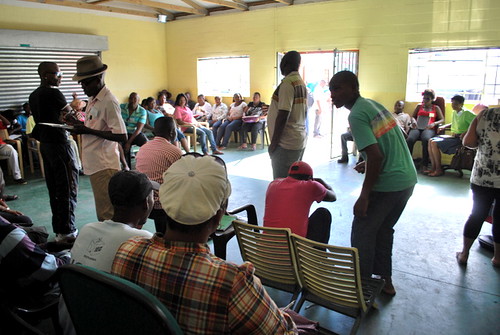
Between Monday and Friday, 20 to 24 February, community leaders associated with the Informal Settlement Network (ISN) from across the country meet in Joe Slovo Park, Milnerton, Cape Town and participate in a national workshop on enumerations. The focus of the workshop is to start a conversation about finding solutions through the information communities gather through enumeration. Enumeration is a social organising tool the ISN utilises by which the community does a survey and assessment of socio-economic and demographic profile, basic services and development aspirations. Communities use this information to build local capacity and develop spatial plans for the upgrading of their settlement.

This information is very valuable. City councils allocate funds to budgets that are aligned to 5-year-development plans – also called the Integrated Development Plan (IDP). The IDP document influences the way the City council prioritises and upgrades informal settlements. City councils need information to do this type of planning, and private consultants are often employed to do surveys and research on the development needs. Yet private consultants rarely drill down into community structures to ascertain a comprehensive vision of a preferred future. Strong organised communities therefore need to build local capacity to influence and interject the imaginations of city builders. This happens when they have self-knowledge, which become power negotiation tools. In this way, communities offer an alternative to top-down development, and offer opportunities to deepen democratic engagement and create an inclusive governance culture, which are the obligations of “developmental local government”.

At the same time, enumerations in different regions in Cape Town and other South African cities have been conducted which did not necessarily lead to stronger communities and development plans. The workshop also seeks to address how enumeration should be a mobilisation tool whereby the entire community is prepared and agrees to the development vision. This requires an in-depth mobilisation of the community. Enumerators need to be able to articulate the enumeration programme, and be able to address the community at large about what this entails and why this is important. This underscores the importance of knowing your neighbor. The congregation agreed that we are not in the business of building individuals, but communities.

The full participation of communities is the only way to have a successful enumeration. We have seen enumerations that were led by a few individuals in the communities and nothing happened there. Therefore, by sensitising the community to the process and the outcomes, you create a focus on projects that builds on community solidarity. It is the leadership committee’s responsibility to involve wide participation in the enumeration process; from the way that questions are framed, to the way data is captured and presented to the community.  A number of stories were also heard.

Siyahliwe, Johannesburg: At first, ISN members visited the councillor and the municipality and the organised structures in the community. They went back to their community, and called a general meeting, which was attended by all these parties. They introduced the enumeration programme, and identified the problems in their settlement. Once the community, councilor and municipality were on board, the leaders drew up a map of the settlement, designated blocks, and the enumeration was started.
Mshini Wam, Cape Town: Started in 2010 at the time when they started engaging the regional ISN leaders. For a long time, they were depending on water and services from the formal RDP houses in the settlement. Therefore, they should be seen as backyarders and not an informal settlement per se. They were paying up to R50 per month for water. At the regional ISN forums, they learned a lot from other settlements in their region. The City of Cape Town said they could not install services because of the density and no access roads. After a long engagement, they ensured taps were installed. The idea of enumeration was seen as a way to open space and understand the demographics and spatial relationships of the settlement. They identified the open spaces in their settlement, and have completed the initial plan for the first cluster. In this way they are opening space to construct
Manenberg, Cape Town: We approached the local housing office and asked them how many people do they estimate live in backyarder shacks in Manenberg. The office estimated about 420 people. The enumeration showed the true number to be more than 4,000 people. This revelation had major impact in the way the city saw the Manenberg backyarders; a community that was uncovered through the enumeration process.

The workshop culminates on Thursday with a visit from the Deputy Minister of Human Settlements Ms Zoe Kota-Fredericks where the community of Mshini Wam will demonstrate their validated enumeration results and draft spatial plans, and the community of Siyahlala where Ms. Kota-Fredericks will launch the enumeration at a mass meeting.


National leaders of the Alliance congregate in Cape Town

By CORC, FEDUP, ISN, News, uTshani Fund No Comments

By  Walter Fieuw, CORC

Leaders of the South African SDI Alliance congregated between 16 – 18 January 2012 at the Lutheran Youth Centre in Athlone to follow up on progress made since the strategic meeting held at Kolping House in January 2011. At last year’s meeting, the Alliance agreed to a shift of focus towards upgrading of informal settlements. Despite one of the world’s largest housing delivery programmes, the South African government has failed to curb the demand for housing and the improvement of basic living conditions for milllions of poor people. The Alliance has pledged ‘to strengthen the voice of the urban and rural poor in order to improve quality of life in informal settlements and backyard dwellings’. This we will accomplish by supporting communities who are willing and able to help themselves.

At Kolping House strategic meeting, the following four broad strategies would define the work of the network:

1. Building communities through FEDUP and ISN using SDI social tools;

2. Building partnerships with government at all tiers;

3. Implementing partnerships through projects; and

4. Keeping record of learning, monitoring and evaluation.

Upgrading informal settlements is an inherently complex endeavour considering the various socio-political realities connect to harsh living conditions and illegality. However, across South Africa the urban poor are mobilising and building institutional capacity to engage local governments around community-initiated upgrading agendas. As the Alliance’s saying goes, “Nothing for us without us”. Dialogues and outcomes of this year’s strategic meeting focused on meeting the development indicators which the Alliance set for itself at Kolping House. This year will see a renewed focus on the following:

  • Capacitating regional leadership structures, and the creation of a national ISN coordinating team
  • Recommitment to the spirit of daily savings, daily mobilisation and daily exchanges of learning
  • Deepening the quality of selected settlement upgrading, while growing the ISN network
  • Developing relevant and sensitive indicators, guidelines and protocols for the Alliance’s core activities to spur self-monitoring and evaluation.
  • Resourcing the Alliance through effective partnerships with local governments, universities and other development agencies such as the National Upgrading Support Programme (NUSP, Dept of Human Settlements) and the promotion of establishing Urban Poor Funds, similar to the Stellenbosch experience (hyperlink: http://www.sasdialliance.org.za/blog/Memorandum/)

Building coalitions of the urban poor able to capture the imaginations of city builders, both from the top-down and the bottom-up, is not often highly regarded or understood when upgrading strategies are devised. The Alliance is committed to strengthening the voices of the urban poor through building effective, pro-poor partnerships and platforms with local government, and implementing these partnerships at project level. As the process to understand the discrepancies and commonalities between the agendas of communities and the municipality gets underway, work must begin. Communities and the municipality develop, in partnership, a mix of “quick wins” that can build trust and show real change for communities. At the same time, the Alliance is also geared towards challenging many of the assumptions that lie behind planning for the urban poor throughout cities in South Africa. Other projects that get chosen for implementation are difficult cases designed to influence the way the municipality operates so that its methods come closer to the planning priorities of communities. All the project types also influence communities. At these interfaces of bottom-up agency and top-down city management, new ways of seeing, grappling with and finding solutions for informality emerge, and shack dwellers are no longer passive by-standers to the development enterprise, but active partners and innovators of finding workable, affordable and scalable solutions to urban poverty.

ISN informs relocated Bapsfontein residents about court ruling

By ISN, News No Comments

By Max Rambau, CORC

Bapsfontein12Dec1

The Bapsfontein mass meeting was held at the Mayfield Sports Ground in Extension 9. This meeting catered for people from Zenzeleni, Baghdad and Mayfield Extension 6. These are the areas to which the families that were relocated (forced removal) from Bapsfontein were taken to.

This meeting was taking place at a time when the people there had already heard about the Constitutional Court ruling on the Bapsfontein relocation. When we arrived they were eagerly awaiting to hear what was going to happen.

A lot of them were complaining about the money they were spending on transport to work and for their children to school.

The ISN gave the report-back on the Constitutional Court ruling and what it meant for the relocated families of Bapsfontein.

The people were very happy to hear these news and they requested the ISN to continue to serve them in the way they did when they were forcefully removed from Bapsfontein whereby other organisatios had left them.

They also requested the ISN to help them not to go back to the same conditions they had left in Bapsfontein. They wanted the ISN to negotiate with government so that they can have a piece of land where they can be settled and they were prepared to start paying for services.

We asked them to identify a piece of land so that we can start negotiating.

We then asked what should happen to the people who were moved to Cloverdene who were not at this meeting. It was suggested that they should also be treated the same way as those in Zenzeleni and Mayfield. The community promised to contact them so that whatever deal is struck with government should include them as well.

Some people came forward to indicate that they were from Etwatwa and had paid one leader to go and stay at Zenzeleni and Mayfield. They wanted to know what should happen to them. We advised them to go and do affidavits detailing what had happened to them and this would then be used to open cases against the leaders alleged to have sold them stands.

We promised the community that we would be starting to open negotiations with the MMC for Human Settlements in Ekurhuleni to start working with us on the matter of Bapsfontein so as to speedily deal with it.

Winnie Mandela visits re-blocked Sheffield Road

By ISN, News No Comments

By Ariana K. MacPherson, SDI

IMG_2335

A national leader of the South African Federation of the Urban Poor (FEDUP), Patrick Magebhula Hunsley,  was appointed in July 2011 to serve on the Ministerial Task Team on Water and Sanitation headed by Ms. Winnie Madikizela Mandela. The Team came into being in response to the Makhaza toilet scandal earlier this year, and was tasked with addressing the issue of open-air, incomplete and dilapidated toilets in poor communities across South Africa. By January 2012, the team is meant to report back to Minister Sexwale of the Department of Human Settlements with recommendations based on their findings on the scale and geographic spread of the problem, as well as any “irregularities or malpractices,” of which quite a few have already been unearthed.

Yesterday, Ms. Mandela was in Cape Town for a National Task Team forum, where community leaders, task teams and members of social movements such as the Informal Settlement Network, one of the members of the South African SDI alliance, presented reports on the state of sanitation in their communities. Following these reports, the SA SDI Alliance made recommendations on upgrading of urban informal settlements based on their experiences of re-blocking at Sheffield Road.

They shared how this process has led to many positive outcomes, including the incorporation of sanitation within the re-blocked clusters, rather than on the periphery of the settlement as is usually the case. Where toilets have been incorporated into clusters, community members reported a marked difference in levels of vandalism and blockages, both of which are problems that can cause the State huge costs in informal settlements. Upon hearing about Sheffield Rd., Ms. Mandela was eager to visit the community. She spent time meeting with women who have mobilized to turn what was not long ago a maze of dark alleyways with few safe or functioning toilets nearby into a vibrant community working together to bring about permanent change.

Bapsfontein community wins court case: Eviction was unlawful

By ISN, News 2 Comments

By Max Rambau, CORC

Today, the 6th December 2011 marks the most important victory for the community of Bapsfontein after they won the case against their forced removal that started in December 2010.

Bapsfontein221Feb

The case has dragged on for almost the whole year since the Ekurhuleni Municipality announced on the 16th of December 2010 that families would be relocated from  Bapsfontein.

According to the Municipality, the relocation of about 3 000 families was to be carried out between the 27th December 2010 and January 2011.

BACKGROUND TO THE FORCED REMOVAL:

The Ekurhuleni Metropolitan Municipality had devised a strategy whereby they continued to forcefully remove families from Bapsfontein, albeit at a low profile and the focus of the world and media. This removal had been targeting mostly those families with less resistance.

Some families were removed and taken to a place called Zenzeleni in Daveyton (near Gabon).

The full scale operation of the Ekurhuleni Municipality started in March.

On the morning of the 5th March 2011 I had received calls from the Bapsfontein people who were panicking and sounding emotional informing me that there were a lot of police cars (SAPS and EMPD) as well as trucks with “Red Ants”.

When I got there I found that demolishing of shacks had started taking place. People’s goods and furniture was being loaded onto trucks by the “Red Ants”. I then went to the police to ask them what was happening and demanded to speak to the person in charge. When I was referred to someone from the EMPD I said that I did not want to speak to municipal employees.

Feb28RedAnts

The heavy police presence was clearly a show of power and was meant to intimidate the people.

One SAPS officer indicated to me that they believe that this eviction was illegal and that they were just told to go to Bapsfontein.

I was then given a name of the person who was responsible for this eviction project. Her name was Reena from the Legal Department of the Ekurhuleni Metro Disaster Management. She informed me that what was happening at Bapsfontein was not eviction or relocation but evacuation. I then told her that we would meet in court that very same day.

I then contacted lawyers from SERI, LRH and CALS. They all came and it showed that they were interested in this case. I ended up giving this case to Lawyers for Human Rights (LHR) who then applied for an urgent court sitting. The case was heard at the Pretoria Supreme Court at 15h00.

The Judge of the Supreme Court stopped Ekurhuleni Metro from continuing with their action at Bapsfontein until Wednesday when the case would be heard at the Supreme Court.

Unfortunately, 98 shacks had already been destroyed and some goods and furniture had been taken away without their owners because the people had refused to go.

The community was resisting forced removal by barricading the entrance to their area and burning tyres. The Ekurhuleni Municipality had sent the “Red Ants” to bring down the people’s shacks and relocate them to some temporary (transit) place, about 20 – 22 kilometres away (next to N12) that the Municipality had identified.

Some members of the community were injured during the clashes with the police and some people (28) were arrested. One person was seriously injured and was admitted to hospital.

The Ekurhuleni Municipality had not complied with the law because they had not engaged in dialogue with the community prior to carrying out this relocation.

I met with the local leadership who briefed me about the situation and we agreed that those people who were prepared to move should be allowed to do so but that those who were not prepared to move should remain until we met with the Municipality.

More than 100 families voluntarily moved out, including some local leaders.

We engaged the Human Rights Lawyers who indicated that they were interested in assisting the community of Bapsfontein. They indicated that they were going to prepare a questionnaire for the community and that thereafter they would challenge the Ekurhuleni Municipality on this forced relocation.

The case of the so-called “evacuation” of people at Bapsfontein Informal Settlement by the Ekurhuleni Metropolitan Municipality was heard at the Pretoria Supreme Court following an application by the Lawyers for Human Rights (LHR) on behalf of the people of Bapsfontein.

The court sat on the 9th March 2011 and was attended by hundreds of people of Bapsfontein and others from different informal settlements around Gauteng who came to give support.

Bapsfontein9March1

The Ekurhuleni Metro Municipal failed to respond to the argument filed by the LHR for an interdict against the forced removal. The Supreme Court judge then requested Ekurhuleni Metro to go back and prepare their arguments because they failed, as the judge said, to reply to the arguments put by the lawyer on behalf of the people of Bapsfontein against the interdict application.

Ekurhuleni Metro had argued that this matter was “politically influenced” instead of arguing for the need to evacuate or relocate families from Bapsfontein.

On the 11th March the case had sat again at the Pretoria Supreme Court and the Bapsfontein families lost the case.

The lawyer representing the people of Bapsfontein had argued that the manner in which the people were forcibly “evacuated” or removed without show of respect and dignity was wrong. He argued that the environmental impact study report on Bapsfontein was done five years ago but the Ekurhuleni Metro Municipality had left the people there for such a long time. He then said that why was it only now that the Municipality has decided to carry out the so-called “evacuation”.

The lawyer further argued that the relocation of the Bapsfontein people was not consistent with legislation which states that people should be relocated to within five kilometres radius in terms of Chapter 12 of the Housing Code.  Families have been taken to some 22 km away from Bapsfontein, far from their workplaces and schools.

The judge seemed to be biased and favoured the Ekurhuleni Metro as he said that they (Ekurhuleni Metro) were right to “evacuate” people from dangerous land and that the people had no choice on where they could be taken to, “beggars cannot be choosers”, he said.

The judge also made an example about the Jukskei families in Alexandra who were staying next to the river and that these people had resisted being relocated but that the Municipality was right to evict because they were living in danger.

The lawyer for the Ekurhuleni Metro Municipality capitalized on what the judge had said and reiterated it. He made an example of Makause where a man fell into a hole because the land had dangerous sink holes and that this man would have been alive had he not been staying in Makause.

It became clear that the people had lost the case even before it ended. When the judge made his ruling, it was to say that the Bapsfontein people had lost this case.

Immediately after the judgment it was reported that the “Red Ants” had gathered at Bapsfontein and were destroying shacks.

An appeal was lodged against this judgment.

Many families were forcefully removed immediately after the judgment on the 13th March 2011.

CONSTITUTIONAL COURT JUDGMENT

After unsuccessful applications to the Pretoria High Court the Bapsfontein community appealed at the Constitutional Court. Their case was heard in September 2011.

At the Constitutional Court, the Bapsfontein community challenged the Disaster Management Act that the Ekurhuleni Municipality had used to evict people. The lawyers representing the Bapsfontein families based their argument on the failure by the Ekurhuleni Municipality to apply for an eviction order and that they had also failed to engage with the people of Bapsfontein before they carried out the “eviction”.

The Constitutional Court judges today (06/12/2011) ruled that the so-called “evacuation” of the people of Bapsfontein was unlawful. The Ekurhuleni Municipality has been given until February to find a piece of land where they can build for the Bapsfontein families and that the Municipality should then notify the Constitutional Court judges about it.

Bapsfontein16Sept

After the judgment news had filtered down to the people I got an email from one of the landowners at Bapsfontein indicating that they, as landowners, had no problem with people coming back to reside at Bapsfontein.

A meeting will be held on Sunday by the leadership of Bapsfontein to celebrate the victory and explain what the judgment means to the people.

The support that the people of Bapsfontein received from the ISN, FEDUP and other informal settlements is commendable. This helped to give the case prominence and media focus but most importantly it showed solidarity of the poor.

We believe that this judgment will set a precedent for other similar cases around the country. It should serve as a lesson for other municipalities not to rush into decisions that are not communicated with the affected communities.

Partnerships for change: New approaches to financing informal settlement upgrading

By CORC, ISN, News No Comments

By Walter Fieuw, CORC, and Vernon Bowers, Stellenbosch Municipality

DSC_0559

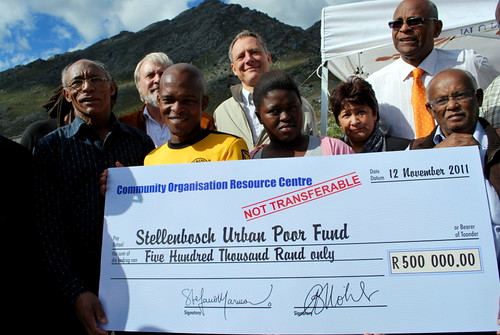
The creation of a new Urban Poor Fund was the highlight of the event: The community contributed R12,000 in savings

The enduring nature and extent of homelessness and landlessness in post-apartheid South Africa has compelled new approaches to housing the urban poor. Informal settlement upgrading – an incremental approach to securing tenure and improving basic service delivery – has gained recognition at local and national levels. The central participation of shack dwellers in the planning and implementation of settlement upgrading is integral to the creation of sustainable human settlements and inclusive cities. The anticipation for ‘deepening democracy’ through governance reform and extensive participation is arguably precursory to the prospects of ameliorating the depressing living conditions of slum dwellers. There has possibly never been a greater need for establishing effective partnerships between civil society and the state capable to navigate the turmoil currents of the urban crisis.

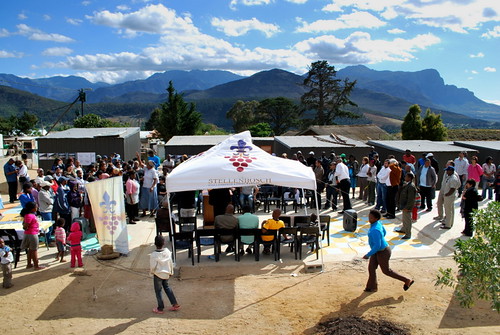
international delegation, sign sbos </p> <p>New political actors have emerged that are influencing the national upgrading agenda. Among these are the Informal Settlement Network (ISN), a bottom-up agglomeration of local-level and national-level organisations of urban poor in Cape Town, Ekurhuleni, eThekwini (Durban), Johannesburg, Nelson Mandela Bay (Port Elizabeth), and Stellenbosch. ISN, together with the Federation of the Urban Poor (FEDUP) – a woman-led federation of slum dwellers practicing savings, enumerations and partnerships with the state – and support NGOs Community Organisation Resource Centre (CORC), iKayalami, and uTshani Fund, promote pro-poor and inclusive cities through people-centred development. These organisations are linked to Shack/Slum Dwellers International (SDI), a global network of similar organisations of the urban poor in 33 countries across Asia, Africa and Latin America. SDI builds partnerships with government that put shack dwellers at the centre of upgrading their built environment. As the South African SDI Alliance saying goes: “Nothing for us without us”.</p> <p>The Alliance promotes the establishment of citywide “Urban Poor Funds” which are community-driven development funding facilities that support community-initiated projects. Urban Poor Funds are financed by contributions from the local municipality combined with the savings of the poor, and are often strengthened by international donor funding. These funds are co-managed between organised communities and the municipality, and tend to by-pass the red tape and costly bureaucracy of state delivery mechanisms. These precedent-setting funds build on the collective capacity of local savings groups and link local upgrading efforts to wider policy change. This form of development-finance has particularly gained currency in South East Asian countries where institutional innovation, transparency and accountability resulted in empowered communities and significant poverty alleviation. In South Africa, the Community Upgrading Finance Facility (CUFF), located in uTshani Fund, has provided seed capital for more than 50 pilot upgrading projects. Communities are expected to contribute ten percent to the total project cost, a significant contribution considering the depth of poverty in many settlements.</p> <p>Stellenbosch Municipality has been a trend-setter in pledging support and partnership toward such ends. The sheer scale of the housing need – a backlog of 19,701 housing subsidy applications paired with roughly 9,000 backyarder households and 9,000 informal settlement households – compared to the meagre 300 housing subsidy allocations per year, illustrates the extent of the urban crisis Stellenbosch Municipality is facing. The partnership-in-the-making has evolved over two years and key city officials, such as Mr. David Carolissen (manager of the informal settlements department) and Mr. Johru Robyn (town planner in the housing department), were exposed to upgrading projects in Uganda through the SDI learning exchange programme. “We were investigating alternative solutions to the problems being faced by shack dwellers and approached SDI about two years ago in the hope that we could not only investigate potential partnerships but also note key lessons learned in managing informal settlements. The involvement of community members is crucial in achieving any form of success and partnering with SDI cements this involvement,

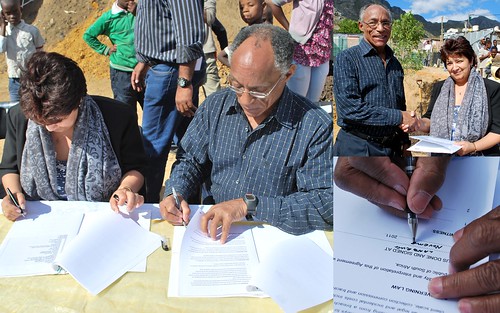
The South African SDI Alliance and Stellenbosch Municipality signed an important Memorandum of Understanding

DSC_0575

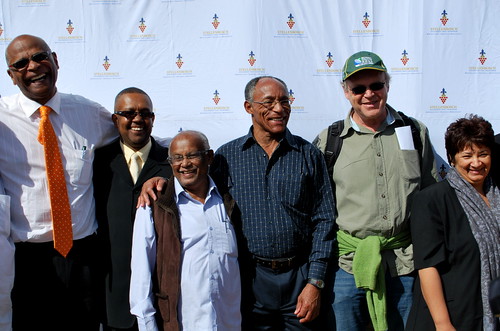
At a spirited event on 12th November in the informal settlement of Langrug on the outskirts of Franschhoek, the Executive Mayor, H.E. Mr. Conrad Sidego, said: “The benefits of this partnership are far-reaching and should be viewed as a paradigm shift in municipal governance.” This historical event was centred on the signing of a Memorandum of Understanding between the South African Alliance aligned to SDI and the Stellenbosch Municipality. The establishment of an Urban Poor Fund servicing informal settlements in the borders of the Stellenbosch Municipality concretised this pledge of partnership and renewal to “municipal governance”. Delegates from the Bill and Melinda Gates Foundation, the Swedish International Development Agency, the Governments of Norway and Uganda, and representatives from poor people’s federations in India, Namibia and Malawi were present. The Urban Poor Fund was financed by contributions by the Alliance and the municipality to the value of R3.5 million. Perhaps most significantly, R12,000 of hard-earned savings by the poor of the Stellenbosch region were also pledged.

In the first financial year, in addition to the capital and operational expenditure of community-initiated projects, the Fund will aim to “build an urban poor platform through a network of informal settlements and informal backyarders” by surveying, mapping and profiling settlements with the view of up-scaling upgrading across the municipality. Provisions are also made to invest in the social institutions of the poor in order to manage the partnership projects (e.g. setting up mini offices in five strategic clusters). Tiers of government and other interested parties to participate, especially role players in urban development, will also be engaged with the view of researching and designing “financial facility that incentivises community participation in informal settlement upgrading”.

Jockin Arputham, the president of SDI and of the National Slum Dwellers Federation of India, addressed the residents of informal settlements across the municipality: “If everyone depends on the waiting list, it might be 25 – 40 years. And then you won’t even get water or a toilet. I think that the Municipality of Stellenbosch has taken a lead, and they have come forward with a very, very big blessing that where ever you live, that is your land of ownership. If you have your land, you can improve your housing and living condition, which is designed by you. It is our pleasure to set up the urban development community fund where people will have access to the money and the work has to be done by you, the way you want it. Your frustration list is the waiting list.”

The Mayor added: “Today is about changing mindsets in providing housing … Just days ago we contemplated that we now have seven billion people on the planet and the challenges going with that … For us as the local government, we also need to understand and face the reality of what we need to do. If we continue with our old thinking, there is no way that we are going to change this.”

DSC_0510

International delegates from SDI were present to support the new partnership with Stellenbosch Municipality

Solar pilot project brings power to the people in informal settlements

By CORC, ISN, News No Comments

By Laura Carvalho, CORC

SolarEnergy1

CORC has partnered with the University of Stellenbosch’s Sustainability Institute (SI) and Specialized Solar Systems (SSS) in a pilot project that will test an incremental and innovative approach to introducing solar energy into poor urban communities whilst creating income-generation and economic opportunities via sustainable energy business hubs.

The pilot project is currently underway in two informal settlements, Ekanini (Stellenbosch) and Siyahlala (Phillipi) and seeks to conduct a field trial of an innovative starter solar energy kit that not only has been customized for poor shack households but that also entails the training of barefoot solar engineers and energy spaza. The purpose is to provide a business-based service for the ongoing maintenance and repair and upgrade of the starter solar systems.

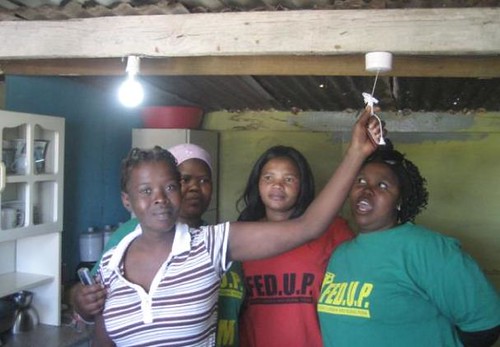
Last week the theoretical part of the training was completed, and community trainees got the opportunity to roll up their sleeves and install a few solar units. What a moment it was for all present on the day – when the lights literally went on in each of these shacks!

Through this partnership, the newly trained barefoot solar engineers and households identified to form part of the field trial have an opportunity to test the DC micro-grid system developed by SSS, as a solution to providing clean and renewable energy services to improve their quality of life, while also creating the space for entrepreneurial and community development.

Solar2

Community members were trained by the Stellenbosch Sustainability Institute as barefoot engineers

Challenges, opportunities and lessons learnt from building partnerships between the urban poor and city councils

By CORC, ISN, News No Comments

By Walter Fieuw, CORC

DSC_0384

“This is a dream come true in bringing City Councils and communities around a table to talk about possibilities of city-wide informal settlement upgrading,” said Jerry Adlard, the facilitator of the 9th November learning event organised by South African, Namibian and Malawian poor people’s movements aligned to Shack/Slum Dwellers International. Paired with these words, was the call for honest reflection on the objective, structure, achievements, lessons learnt and challenges of unfolding partnerships in the cities of Cape Town, Stellenbosch, Ethekwini, Ekurhuleni, Johannesburg, Windhoek and Lilongwe. The learning event was preceded by two days of site visits to re-blocking, sanitation and relocation projects in the City of Cape Town and Stellenbosch Municipality.

How do various actors implicated in urban development build partnerships to ensure pro-poor and inclusive cities? Contemporary African cities are juxtaposed with multiple layers of social, political, economic and environmental realities, which in many ways are aggravated by its colonial past. On the one hand, cities are the spaces of aspiration, innovation and drivers of social change, and on the other, social polarisation, poverty, conflict and environmental degradation narrate the conditions of large portions of city dwellers. In an age that is characterised by urbanisation, said to transform the cities of Africa, Asia and Latin America, there is arguably never been a time where effective partnerships are more needed.

In many cases, slum dwellers are taking the lead in building partnerships with local authorities with the view to significantly influence the way slum upgrading is conceptualised and operationalised. The full participation of slum dwellers in upgrading programmes is central to meeting the outcomes of sustainable human settlements, tending towards social (and political) change. For instance, slum dwellers of the Homeless People’s Federation of Malawi influenced the Lilongwe City Council’s bureaucracy through its large scale enumeration project which involved churches, tribal chieftaincies and other community based organisations (Lilongwe slums span municipal boundaries and averages in sizes of 50,000 residents). This inclusive project resulted in a shift on the part of the City Council from treating urban development as homogeneous to rural development. The establishment of the Informal Settlement Unit, a department which reports directly to the Mayor, was the result of effective lobbying on the part of the urban poor. This partnership illustrates the limitations of technocrats and the possibilities of communities initiating their own developmental priorities.

In Windhoek, the partnership between the Shack Dwellers Federation of Namibia (SDFN), City of Windhoek and the Polytech is challenging the limitations to transformation implicated in the inherited colonial land use management norms. Space for policy innovation is opening where the contribution and full participation of informal settlements are at the plinth.

Partnerships unfolding in South Africa through the Informal Settlement Network (ISN) and Federation of the Urban Poor (FEDUP) were also discussed at length. Some of the overarching achievements to date have included pilot projects in Cape Town, Durban, Johannesburg and the mining belt in Ekurhuleni whereby communities successfully re-blocked (e.g. Ruimsig (CoJ) and Sheffield Road (CoCT)), installed drainage (Masilunghe (CoCT)), and resettled (Langrug (Stellenbosch) and Lwazi Park (CoCT)). Innovation through upgrading is challenging the enduring (mis)conceptions associated to the subsidised housing paradigm which only looked after the interests of the nucleus family. The SA Alliance’s aspirations for establishing city-wide Urban Poor Funds – funding facilities that support the initiatives of poor communities – have also partially realised when communities successfully leveraged funds from the Stellenbosch Municipality in financing the relocation project and associated service provision.

The institutionalisation of partnerships for city-wide upgrading initiatives is underway. Reports were heard from city officials and community leaders of respective cities. As communities penetrate the seemingly perceived ‘iron towers’ of city bureaucracy and build effective partnerships that influence budgetary allocation and prioritisation, the emphases are shifting from ‘control’ to ‘participation’.

Delegates argued that if the partnership cannot affect political will, for instance to transform the ward councillor structure (in the SA case), then there is no real power to promote the upgrading agenda. One of the Namibian delegates remarked:

“There is a problem to talk about the poor’s ‘self-reliance’ when the issue actually lies with the state’s orientation. Political space is opened to engage around delivery priorities and this is a two-way process; both the state needs to be held accountable, and citizens, demanding basic human rights, need to be proud and organised. One of the main reasons why the partnerships fail to deliver is that the departments don’t understand the difference between upgrading and housing delivery”.

“We are those people…”: Deepening democracy in meeting sanitation challenges

By CORC, FEDUP, ISN, News No Comments

By Walter Fieuw, CORC

Service delivery in the Eastern Cape faces dire challenges. While the nature of the crisis is still poorly understood, poor communities are mobilising toward preparing to implement people-driven development initiatives. From 1-5 November, Winnie Madikizela-Mandela’s Ministerial Sanitation Task Team visited delegations of the Eastern Cape’s informal settlements to listen to the extent of the sanitation-related challenges they face. This roadshow formed part of Madikizela-Mandela’s effort to understand the scale and nature of the problem, its geographical spread and to identify irregularities and malpractices.

Amandla! Imali no lwazi!

With these words, Mzwanele Zulu and Blessing Mancitshana, both Informal Settlement Network (ISN) activists, greeted the delegations of Port Elizabeth’s informal settlements and township residents, congregating in the George Botha Community Centre in the KwaNoxolo township. What is power? And how is power shifted to us, the poor? An old lady answered by saying that Amadla! means power, but a young man responded saying that we don’t have power so we can not participate. Still another person was calling attention to the inherent potential of all to exert power to change for the good.

DSC_0336

Port Elizabeth delegations musing on the meaning of Amandla!

Amandla! Imali no lwazi!

Nevertheless, with no money (imali) and knowledge/ information (lwazi), power can not translate in meeting the most pressing livelihood challenges, such as access to clean drinking water, sanitation, electricity, transport and adequate housing. “We are those people who sleep among the grasses and next to pavements, but we are proud people” said Blessing. Mzwanele explained that solidarity of the urban poor in generating pro-poor and situationally responsive programmes and agendas is the key to success. In a current political dispensation where councillors ayilumi ma ihlafuna (can not bite whilst chewing;  a term to denote inaction after election), the poor should fill the void and form effective partnerships to leverage state resources. This encourages communities to mobilise around savings, enumerations and settlement profiling and mapping, which become powerful negotiation tools in the hands of the poor.

DSC_0310

Greeting Madikizela-Mandela with singing and dancing

On Madikizela-Mandela and her task team’s arrival, the delegation met them with singing and dancing. “We have spoken to your Council and Mayor and received a report on what they have done for you… but this time, you are the ones to tell us what you want” said Madikizela-Mandela. Of the 18 settlements represented – some affiliated to the ISN – the hard-pressed settlements of Missionvale, Seaview, Midrand, Kleinskool, and Zweledinga, to mention a few, shared stories of major negligence and abondonement, which is familiar to the geopolitical state of Eastern Cape service delivery. Backyarders, shackdwellers and tenants of overcrowded and delapidated rental housing raised concerns around: unaccountable councillors; non-participation in service delivery; lack of maintenance of sanitation blocks; and ratio of services (in the worst case, Moeggesukkel, the community reported that 417 people share one water tap). Evelyn, a Joe Slovo resident and ISN activist, facilitated some heated debates between the residents, the Ministerial Task Team and the Mayoral Committee

Collage

Delegations from Port Elizabeth’s informal settlements live in indignified spaces due to lack of sanition-related service delivery

The need for institutional innovation in meeting housing and housing related developmental maladies is crucial, and has been recognised both nationally and internationally. The central and full participation of communities in the delivery of essential services, and the forging of effective partnerships between active citizenry and developmental government, are some of the institutional imperatives to empowered communities. Less recognised is the imaginations and innovations of the poor who cope with the livelihood challenges on a daily basis. These groups of active and informed urban poor continue to provide alternatives to state-driven service delivery.