Category

FEDUP

When you get a front door, remember to leave it open

By FEDUP, ISN, News, SDI No Comments

This blog  was first published by openDemocracy, on the 26 September 2017. 

By SOPHIE KING 

A Manchester-South Africa exchange reveals striking similarities in the dynamics of urban inequality.

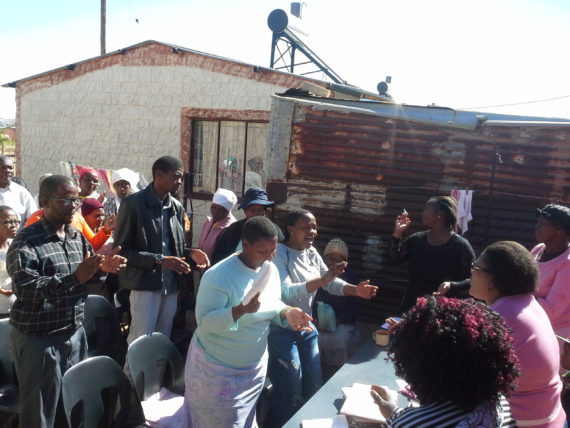
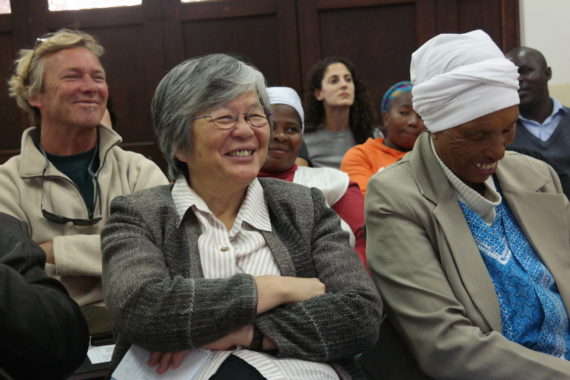
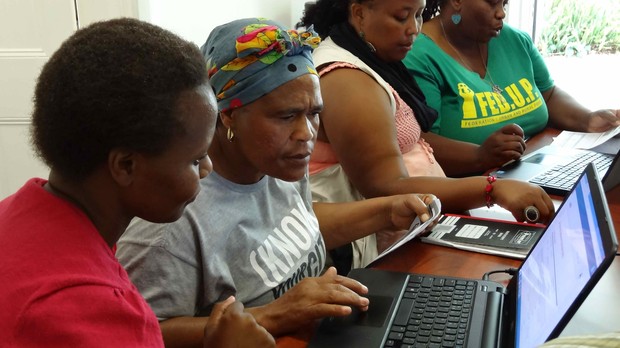
Members of Mums Mart, Lower Broughton Life and the South African Alliance in South Africa, July 2017. Copyright: Sophie King. All rights reserved

“It’s all about trust” said Marie Hampshire, two days into a week-long community exchange with members of the South African Alliance in July 2017, a grassroots movement of women-led savings schemes affiliated to Slum/Shack Dwellers International or SDI. Marie is a member of Mums Mart, a women’s group from Benchill in the British city of Manchester that brings low-income families together around food, monthly markets and, most recently, a new kind of savings scheme.

Each member saves small amounts with the support of their local group, and in the process of coming together the group learns about their needs and challenges and tries to respond collectively. Mums Mart was introduced to savings-based organising after meeting members of the Alliance in Manchester a year earlier. Now, other groups in the city are starting to explore how women’s savings federations could rebuild trust and solidarity in their neighbourhoods.

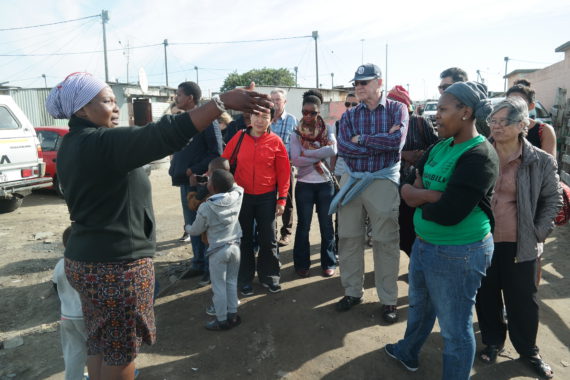
Joanne Inglis is the Chair of a new association called Lower Broughton Life, one of these groups that is based in another part of Greater Manchester called Salford. After accompanying members of the South African Federation of the Urban and Rural Poor (FEDUP) on door-to-door visits and listening to plans for a new housing development in Cape Town by the Informal Settlement Network(another partner in the Alliance), she urged her hosts: “when you get a front door remember to leave it open.”

Joanne was reflecting on how segregated life has become on estates like hers, where people look after their own affairs and many of the old spaces for communal life have closed down. She was struck that—while the signs of poverty and inequality in South Africa are only too visible in the townships and settlements she visited—poverty in the UK is often hidden from view: “our houses can look the same on the outside,” she said, “but it’s what’s on the inside that’s different.”

However, in other ways there are striking similarities between the dynamics of inequality and deprivation in both countries’ cities.  All are dealing with sharply rising property prices which push those on lower incomes further away from the city centre, and the concentration of deprivation in particular neighbourhoods which can manifest in gang-related crime and the absence of opportunities for young people. Unequal access to decisions on how public services are delivered perpetuates the disadvantages that low-income people have to deal with on a day to day basis.


Just as importantly, the different groups were also bound together by their experiences of strength and struggle as women and mothers regardless of where they live. During their visit to the UK, the South Africans were shocked to discover homeless people living in tents in the centre of one of the richest cities in the world, which gave rise to questions about the wisdom of looking to the global North for pathways to collective well-being.

For their part, members of Mums Mart and Lower Broughton Life reflected repeatedly on people’s pride and self-organisation despite living in highly challenging circumstances in South Africa. Both gained a fresh perspective on the possibilities of organising collectively in response to poverty.

As a member of FEDUP attested (echoing Marie), “the only thing that makes a person active is when you have trust and belief.” The members of the groups also gained confidence in one another as joint travellers on a journey of discovery—watching each other learn, adapt and embrace the experience (including some fantastic ululations!). People saw that some of the South African ideas might just work in Greater Manchester, and that they might be the ones to make this happen.

The trust they gained in South Africa by staying in people’s homes, accompanying them in their work and being part of their lives (even for a short time) meant that they were comfortable enough to share their doubts and fears—and to be open to the doubts and fears of their hosts in return. As Rose Molokoane from SDI shared:

“We are still doubting ourselves saying how can we keep driving this forward…it’s too big for us…especially because we are informal but the outside world wants to see us being formal. Most of our members are not educated; you have to create enough time and enough space to educate people about what you are.”

Rose also explained the significance for the older black South African activists of sharing their homes and their organising tools with white British women after living through apartheid, and as women continuing to struggle for justice in a highly segregated society.

The exchanges seem to have come at a critical time for the British participants. Combined with rising living costs, public service cuts and welfare sanctions, low-paid work, under-employment and unemployment are fostering severe precarity in post-industrial inner-city neighbourhoods. Thirty per cent of British children (and one quarter of children in Salford) are now classified as living below the poverty line, with two thirds living in families with working parents.

Manchester looks set to become the next beacon of social cleansing after London, with luxury high rise flats and the privatisation of the city centre making it increasingly difficult for individuals and families on low-incomes to find affordable accommodation. People in low-income areas around the edges of the central business district live in constant fear of relocation as they watch rents skyrocket in the plush developments that now surround their estates.

In many of the city’s low-income neighbourhoods, social and economic changes and cuts in public sector funding mean that people don’t come together in the ways they used to through faith-, place- or work-based forms of voluntary association. Libraries, pubs and community centres have closed down, making it almost impossible in some areas for groups to find somewhere to congregate together regularly. Rising living costs and cuts in benefits are pushing people towards pay-day loans and credit-based living, leaving them drowning under the burden of debts they struggle to repay.

The surge in support for the British Labour party under Jeremy Corbyn’s leadership (which is particularly visible in urban centres) suggests that increasing numbers of city-dwellers believe it is indeed, ‘time for a change.’ But how will low-income communities organize themselves and enter into movements ‘for the many and not the few’ in the years to come? That’s where networks like SDI can play an important role by inspiring new forms of mobilisation, and by linking local action into international networks for learning, advocacy and mutual support.

The savings groups they nurture are encouraged to federate, enabling them to have more influence over city and national governments in ways that are grounded in real experience. Members survey, map and profile their neighbourhoods, turning invisible challenges into concrete evidence and locally-proposed solutions. The South African Alliance, for example, has successfully advocated for a more progressive housing policy that has led to over 15,000 permanent new, affordable homes being constructed.

The SDI network used to have members in 37 countries. Thanks to a group of mums from Manchester, it may soon be 38.

The importance of saving: the pillow maker in Samora, Cape Town

By FEDUP, Savings No Comments

Compiled by Carmen Cancellari (on behalf of CORC)

Through the Federation Income Generation Programme, FEDUP savers have an opportunity to establish small businesses to generate income through accessing and repaying loans. 

The financial aspect is crucial, but how can the Federation contribute to building solidarity and sharing among FEDUP business women? The experience of Patience, a resident in the informal settlement of Samora in Philippi, Cape Town, gives us some insights about the impact of FEDUP in the life of women.

My name is Patience and I live here in Samora, Philippi.  For a living I have my own business, I make pillows. Now it’s been 7 years that I have been doing this. The first time I heard about the Federation it was in 2013, and that is also when I got my first loan.

What changed after receiving the FIGP (Federation Income Generation Program) loans was mainly in relation to the stock for my business. In fact, I was able to increase stock for my business and this also resulted in the increase of my profit. This helped me at home because I was responsible for my child’s education fees, who was studying at University of Western Cape, and since I could pay for her studies, she was able to continue and she graduated last year. So this is what was important, because my intentions and priorities have always been helping her to finish school.

Even at home I was able to fix some of the things. For example I managed to extend our house, I added two rooms and I saved some of the money… if it wasn’t for the loan I can say it was almost impossible to do all of this because I did not make enough profit from my business.

My business grew already a lot but I don’t want to stop here. At the moment, I am busy saving so that I can be able to buy a container. In fact now I cannot employ someone to help me because there is no space for both of us to work. Instead, I want someone who is going to help me because making pillows is very difficult and my business really needs me to hire someone. As a result of the stock which has increased in fact, my job has also increased and this is why I need someone to help me.

With my savings I think I will be able to buy the container next year January. And I do not want to rush it and end up having debts that I will not be able to pay back…I just want to save and know that I will be able to buy it.

Savings in fact is the heart of the Federation. My business improved a lot because through the Federation I learnt a lot about saving. Nolwando, one of the Federation coordinator, always teaches us about saving on top of the loans, and this way I have learnt how to save. There were times where I did not save at all and I was using my money on useless things.

I remember when I was working in Tsusa, there was a lady working with us who used to buy meat on a regular basis. She would make three orders a week! So one day I told her, as a person who was taught how to save, that she could save the R60 that she was spending on buying meat by, for example, eating cabbage and meals that she had prepared at home!

So the federation has helped me because now I am able to save and I can also help other people. And even today that lady has not forgotten me because I really helped her.

Patience (left) with FEDUP loans facilitator, Nolwando (centre)


How Lesotho is building an organised, urban poor movement

By FEDUP No Comments

“Saving is our heartbeat”, any member of South Africa’s Federation of the Urban Poor (FEDUP) will tell you. “This is how we organise, how we build trust, open spaces to talk and share, find ways to support each other and change our lives. We don’t collect money, we collect people.” Over the last twenty five years the South African federation has grown from a handful of savings groups in the North West and Kwa Zulu Natal Provinces to 626 savings groups in eight provinces with 43 999 members.

Lesotho federation and Tshwarellang saving scheme members (Free State) after mobilising new savers

Lesotho federation and Tshwarellang saving scheme members (Free State) after mobilising new savers

What does it look like when savings groups multiply, and federate within their cities – how does an urban poor, country-wide federation emerge? Through horizontal learning exchanges, South Africa’s FEDUP has been supporting emerging savings groups in Lesotho to do just that. Within the SDI network, the definition of an “emerging” federation is a group that has started building savings collectives but has not yet federated nor achieved citywide scale and is yet to develop a critical engagement with state institutions and other development actors.

As a tool for building strong and organised movements of the urban poor, exchange visits between federations, enable savers to “learn by doing”. In particular, the exchange visits from Lesotho to South Africa have focused on strengthening the foundational aspects of a saving scheme. These included opening a new savings scheme and mobilising members, how to collect and record daily savings, how to engage local government authorities and how to facilitate a network meeting, in which several savings scheme in a region come together to report, organise and support each other.

Manana (left) and Nthabiseng (right) display their bedding (income generation) project for Tshwarellang saving scheme in Free State during the exchange.

Manana (left) and Nthabiseng (right) display their bedding (income generation) project for Tshwarellang saving scheme in Free State during the exchange.

Some of the challenges experienced by Lesotho Federation members included poor recording of savings books, complications with opening bank accounts, and challenges with compiling savings and project information from all districts. These were the focus of Lesotho’s last exchange to Free State province in South Africa in September 2016.

During a door-to-door, daily savings collection, Lesotho federation members shared:

“I realised that the daily collection was not just about collecting money from the members but also checking on their well-being. Some savers didn’t attend meetings because Elizabeth’s husband was seriously ill, Ntswaki just delivered a baby, Sero is not well in health and Dweni’s husband is in hospital. The groups then decided to make financial contributions other than daily savings to help with transport to hospital or medication.”

Federation members singing during the evaluation meeting of the exchange

Federation members singing during the evaluation meeting of the exchange

So how do savings groups multiply and federate? Through “learning by doing” as reflected in comments by Lesotho federation members at the end of the exchange:

The mobilisation experience taught us that we can approach totally random communities for saving scheme establishment.

We learnt about saving networks and their importance and that is something we do not have in Lesotho.

We saw that feedback to members on activities such as collection of money is crucial as it enhances transparency.

We realised your love for the organisation because some of you have even reached the stage of getting houses, but you are still active members and that shows us that you were not chasing after houses.

Jemina Nkoni (left) and Malefu Semonye (right) received a certificate and trophy for the third best performing saving network in the Free State

Jemina Nkoni (left) and Malefu Semonye (right) received a certificate and trophy for the third best performing saving network in the Free State

What difference does saving make to the urban and rural poor?

By FEDUP, Savings No Comments

How can saving impact poor communities and influence inclusive development practice? On a recent visit to Manchester’s Global Development Institute FEDUP’s Patrick Matsemela responds to these questions by telling his story: 

 “When I say I was a robber, it was because I had nothing to do. When the Federation (FEDUP) started, I collected scrap metal from aluminium trollies. One day I found a group of mamas sitting together and someone told me that those mamas save R1.50 on a daily basis and deposit savings into a joint account. I did not have R50 so I knew I couldn’t open my own bank account. But I thought, “If I put money in with these mamas, they will use the money.” I thought that these people were scamming.
 
Patrick Matsemela (front centre) with SA SDI Alliance and Manchester colleagues

Patrick Matsemela (front centre) with SA SDI Alliance and Manchester colleagues

 
 At the time I was a heavy smoker. One cigarette cost R1. I had to save to smoke. Or steal to fuel my addiction. I asked people, “What happens with these savings? Do I get it back or is it just a show?”
 
They explained that you can request to withdraw the amount you saved by going to the savings collectors and treasurers of your savings group. This was better than the bank! Through joining a savings group I learnt to put money together and come together with other people. The moment you share your problem with friends you create a society. For example, if I did not eat, I could sit together with other savers and put money and food together. Over time I became rehabilitated from being a heavy smoker and drinker.
 
The leaders of these savings groups are women, about 95%. Men cannot save, that’s true. But women savers are very strict. They don’t play; they are professionals. For example, you can only withdraw what you saved. We are illiterate but still people were talking about bank charges.
 
My trust in the savings group increased because of my savings book and the record book of the savings collector. Every time I gave my savings to the collector, both of us needed to sign my savings book and the collector’s record book to prove that the money was collected. As a savings group we chose people living inside our community to be the collector, treasurer and secretary of our group. Saving is not only about collecting money but also asking people about their feelings. For example, the collector asks you how you are, why you didn’t attend the savings meeting last night.
 
IMG_2796

Report back on savings at a FEDUP network meeting in North West province

 
But there is no way to get everything correct. Mismanagement is a challenge. In some groups, the collector takes R10 saying, ‘Let me just use it now, tomorrow I will pay it back’. But then when the audit comes and other savings group treasurers come to your group to do the books and audit they ask why this was not recorded. The treasurer then feels the heat. Stealing is a bad word. Do not say steal, otherwise you won’t build a person. Rather whisper to the person and ask, “How will you repay?” First approach the individual who misused the savings, then the group. Sometimes we can call the police or influence some people in the community to take the person’s TV. Or we come as a group and hire a buggy and take the fridge and TV. We are not going to sell it but the person knows they can find us in the savings meeting.”
 
Since the early 1990s, FEDUP has used saving as a key tool to build a strong urban and rural poor social movement. Currently FEDUP counts about 43 900 members in eight provinces in South Africa. Through collective saving and critical mass, FEDUP played a key role in advocating for the People’s Housing Process (PHP). The PHP is a milestone policy on inclusive (community-led) human settlements development. Patrick Matsemela joined the Federation in 1998. He is currently the national coordinator for FEDUP saving networks in the North West province. He serves on the board of Slum Dwellers International (SDI), representing urban poor federations affiliated to SDI.
 

A FEDUP network presents the Maboloka PHP (housing) project

Community Voices: “In GxaGxa people know you. And mosquitoes bite your children”

By CORC, FEDUP, ISN No Comments

*By GxaGxa Community Members, Compiled by Shelby Lyons (on behalf of CORC)

This blog contributes to a series called Community Voices; a blog space that shares the words of community members themselves. These stories— diverse yet unified – highlight aspects of the history, challenges and daily experiences associated with life in informal settlements.

This blog draws its content from a storytelling workshop in GxaGxa informal settlement in Cape Town. In the post are the voices of: Nobuwe Biyane, Elizabeth Merane, Thembisa Magqaza, Nokwandisa Mhlandi, Peter Somina, Tlotliso Moses, Siphamandla Ntusi, Somila Shumi and Witness Qoqela

SAMSUNG CSC

In GxaGxa children play on the street

GxaGxa is a settlement located off the N2 highway in Gugulethu, Cape Town. Recently, community members here organised to complete household level enumerations of their settlement as part of gathering settlement wide data and identifying community priorities. Besides quantitative data gathered during the enumeration, qualitative accounts from settlement residents are crucial for understanding both the character of the settlement and social dynamics within it. Therefore on a chilly Tuesday, situated in a bright, turquoise room, a group of GxaGxa community members gathered together to tell their stories of life in the settlement.

Community members were first addressed by Akhona Malangeni, an engaging and passionate leader of the Informal Settlement Network (ISN), who explained to them the importance of storytelling in gaining a community-based account of life in GxaGxa. Below Akhona addresses the community.

SAMSUNG CSC

The first part of the dialogue focused on settlement history:

“The name GxaGxa stems from the birth name of the first man who settled there. As a lone settler, GxaGxa lived in this area for a few years until circumstance caused him to move back to the Eastern Cape”.

Community members seem to speak fondly of the late GxaGxa, who in 1987 was replaced by Mama Thembisa. Pictured below, Mama Thembisa now serves as a clear leader in the GxaGxa community.

SAMSUNG CSC

After a large group discussion, community members organised in smaller groups. In one conversation circle people were asked: What is the best part about living in GxaGxa?

“The best part of being in GxaGxa is that we are a family. A lot of young people [that] live in this place do things in unity. Everyone knows each other—if you arrive here, people know you before they see you. We live in spirit. Young people respect old people. Old people respect young people. People are also not worried about crime”.

The emphasis on community was echoed in many of the accounts coming out of GxaGxa. Correspondingly, people were asked: What is the difficult about living in GxaGxa?

“The rain is serious. When it get’s colder the children—everyone—get sick. The water comes into the houses. Dirty water causes rashes that later become sores. There is no electricity. Those who are unemployed are especially vulnerable during this time because they cannot afford heat”. –Siphamandla Ntusi

The conversation about life in GxaGxa continued, including stories about the more trying aspects of daily life such as challenges in access to adequate services, the lack of employment opportunities and the relationship with the municipality.

Some of these challenges regarding services are found below:

The section comes from: Peter Somina, Tlotliso Moses, Siphamandla Ntusi, Somila Shumi and Witness Qoqela

Toilets –“Services [in GxaGxa] are poor and we are struggling because it is hard to get into toilets here. Many people who have their own toilets lock them. It is common for people to have to ask others for the key to the toilet”.

Tap- “Sometimes the water is completely dry in the tap and there is no water all day. These days we don’t eat. So we have to travel very far for water. This can happen 2-4 times a month. It depends. It just happens”.

Electricity- “We don’t have electricity. People share electricity. It becomes a problem when people don’t have money for paraffin. The streetlights are also off, which means it’s completely dark”.

Management- “If it’s hot the sewage smells. There is also a pond in the middle of the settlement [behind Mama Thembisa’s house] that floods and brings in a lot of mosquitos. Drains are also blocked”.

Indeed, references surrounding the danger of the pond were a common theme in settlement accounts.

SAMSUNG CSC

Above is a photo of the pond in the middle of GxaGxa. Showing the proximity of the pond to her room, Nosipho Magqaza says, “It’s not healthy to live here”.

 After sharing about their daily experiences, GxaGxa community members shared what they would like to see happen in their settlement. Community leader Nobuwe Biyane shared her wishes for GxaGxa.

“I have two children ages 15 and 16. There is a lot of suffering in GxaGxa. There is no work. There is too little taps and they must fill the pond because mosquitoes bite our children. [We] want a house with electricity”. –Nobuwe Biyane

Another opinion came from Peter Somina, who shared his wishes for the community.

SAMSUNG CSC

Peter Somina as he addresses other community members.

“In my mind we must organise something that must be big… we must organise a big something for people to get jobs…maybe we open big things like construction that open doors for opportunity”. – Peter Somina


Scaling Up Informal Settlement Upgrading: The CODI Model Thailand

By CORC, FEDUP, ISN, SDI No Comments

By Yolande Hendler (on behalf of CORC)

While the value of in-situ informal settlement upgrading is increasingly recognised by national and global actors, its implementation as a co-productive approach rooted in meaningful community participation is inadequate. An exception, however, is the Community Organisations Development Institute (CODI), a finance facility of the Thai government that has facilitated community-led informal settlement upgrading in more than 250 cities and towns in Thailand, demonstrating how a national government not only engaged with ‘pro-poor’ development but also managed to institutionalise an approach and implement at scale.

Somsook Boonyabancha, Former Director of CODI

Somsook Boonyabancha, Former Director of CODI

In early May, the South African SDI Alliance together with Shack / Slum Dwellers International (SDI) had the pleasure of hosting Somsook Boonyabancha, the founder and former director of CODI for a seminar in Johannesburg and Cape Town on ‘Scaling up informal settlement upgrading: The CODI model, Thailand’. ISN and FEDUP coordinators additionally used this opportunity to share current partnership and project implementation challenges with Somsook during a visit to Khayelitsha. Her visit to the Alliance occurred in the context of a broader meeting* with representatives of the South African National Treasury concerning CODI’s approach and its value for the South African context.

Jubilant welcome by FEDUP and ISN

Jubilant welcome by FEDUP and ISN

CORC director Bunita Kohler offers a warm welcome

CORC director Bunita Kohler offers a warm welcome

Informal Settlement Upgrading in South Africa

The upgrading context in South Africa is marked by a tension between policy and practice. Part three of the National Housing Code states that the Upgrading of Informal Settlements Program (the national policy and finance instrument for upgrading) set out to “facilitate the structured in situ upgrading of informal settlements as opposed to relocation(s)”. The aim: to achieve tenure security, deliver basic services and build ‘social capital’ in communities through participatory processes.

In practice, however, municipal application of UISP has been weak, especially in terms of community participation or alternative approaches to tenure security beyond freehold (See NUSP). Even after the National Upgrading Support Programme (NUSP) was introduced in 2010 to support municipalities in addressing these shortfalls, the lack of meaningful community engagement or in-situ upgrading of informal settlements persisted. This is largely due to inadequate municipal capacity for meaningful participation, a recurring preference of relocating shack dwellers to greenfields sites (the Joe Slovo judgement is a case in point) or repackaging reports on greenfield relocations as UISP projects (see State of Local Governance, p.64-65).

Community leader of TT Section, Site B Khayelitsha welcomes Somsook to her settlement

Community leader of TT Section, Site B Khayelitsha welcomes Somsook to her settlement

Where the SA SDI Alliance has implemented participatory upgrading projects in partnership with a local municipality (such as the City of Cape Town), these instances remain limited to a handful of settlements. Avenues for scaling up meaningful participatory practice in South Africa are rare, if not non-existent. In the experience of the Alliance, key challenges to scaling up relate to the disjuncture between lengthy bureaucratic processes and the pace of community preparation in informal settlements. For example, party political frictions may extend the time required to mobilise a community while lengthy municipal procurement processes regularly stretch project timeframes beyond the designated one year budget allocation period. When budget allocations are annulled or project dates postpoined, it is twice as difficult to restart and remobilise the community. Tools that intend to support community-led action (such as the UISP), can therefore have the opposite effect: they are often not flexible enough to adapt to project preparation and social facilitation processes in informal settlement communities.

How CODI Works

As an alternative, the CODI model offers relevant insights for the South African context. Formed in 2000 through the merging of the Urban Community Development Office and the Rural Development Fund, CODI is an independent public organisation under the Ministry of Social Development and Human Security. CODI functions as a revolving loan fund that enables direct access to grants for upgrading and loans for housing. As a national implementing agent, CODI manages the Thai government’s Community Development Fund that engages urban poor communities and networks who are organised in housing co-operatives and informally recognised community based savings schemes. CODI supports the building of community cooperatives, through sub-group clusters that manage community grants and wholesale loans. Such subgroups bring about collective action through group guarantee, helping eachother, and collective repayment. Read more about CODI here.

Somsook speaks about the CODI model in Thailand.

Somsook speaks about the CODI model in Thailand.

Thailand’s Upgrading Initiative: Baan Mankong

The Baan Mankong City-Wide Upgrading initiative is one of CODI’s most notable programs. Introduced in 2004, it focuses on poverty alleviation, community welfare, technical support and tenure security through promoting savings, credit, loans and planning support. Baan Mankong (which means “Secure Housing” in Thai) facilitates capital transactions through an infrastructure/upgrading grant from central government and a housing loan lent to borrowers organised in housing cooperatives. Since 2004, Baan Mankong has approved a total of 850 projects in 1660 communities and benefitted about 90 000 families. Geographically, its reach covers 286 cities in 71 of 77 provinces. The average housing loan per family amounts to US$ 5000 while the average upgrading subsidy grant averages about US$ 2500 per family. The total loans granted by CODI’s revolving fund (at 3% interest) amount to about US$ 185m with a repayment rate of 97.5% (Figures drawn from Somsook’s presentation).

In her presentation, Somsook highlighted the following as significant requirements for a city-wide, scaleable approach:

  • Active communities: support for urban poor communities as owners of projects
  • City-wide approach: changes at the real scale of the problem (i.e. that affect all poor communities in the city) will link scattered communities and their priorities to each other, contributing to a more systematised and sustainable approach
  • Building strong communities: through secure housing and integrated development that includes:
    • collective land ownership or lease
    • community savings and fund (acting as a community bank)
    • welfare activities
    • activating the link between community networks and city organisations in regular meetings
    • collective management
  • Building partnerships: between community networks, local authorities and other development actors that enable deliberation and negotiation
  • New finance system: active community savings and credit, City Development Funds
FEDUP and ISN engage with Somsook around CODI's approach

FEDUP and ISN engage with Somsook around CODI’s approach

Scaling Up in South Africa?

With more than eighty representatives from NGOs, media platforms and think tanks in the sector, academic partners in planning and architecture and the Head of Department of Human Settlements in the Western Cape, the closing session of the seminar offered an opportunity for discussion. How does CODI straddle the tension between private and collective land ownership? Is collective land ownership/lease possible in South Africa? Is there government appetite for alternative finance mechanisms? While engaging with these points, Somsook continually pointed to the value of collective action:

“The key thing is to bring all actors to work together. Community is important to support each individual for a certain period of time. And land is an important factor [so we need] collective land as a project. Poor people will be weak otherwise. Its insufficient to just do one or two projects here and there… Let poor people at a big scale be the key actors to make a big change”

SAMSUNG CSC

Thando Mguli, HoD of Human Settlements in the Western Cape

Similarly to CODI, a co-finance facility in South Africa has the potential to locate poor people at the heart of upgrading interventions. Where urban poor communities shift from beneficiaries to activated citizens that identify, plan and implement development priorities, informal settlement upgrading can become more nuanced, responsive and participatory. For a co-finance approach, community saving is a valuable mobilising tool, an enabler for meaningful participation and an indicator of household buy-in at settlement level. A co-finance mechanism that is institutionalised in local government but not subject to its bureaucratic process can enable flexible time frames for project budget allocations that are not constrained by annual provincial or municipal allocations. In this sense, innovation and meaningful participation occur only when community members become significant actors in the upgrading process.

*The visit was supported by the World Bank

From left to right: Representatives from the World Bank, Cities Support Programme (Treasury), CORC, Somsook, Western Cape Human Settlements HoD and ISN Coordinator

From left to right: Representatives from the World Bank, Cities Support Programme (Treasury), CORC, Somsook, Western Cape Human Settlements HoD and ISN Coordinator

Seeing from the South: an international exchange with South African shelter activists

By CORC, FEDUP, ISN, Learning Exchanges, SDI No Comments

By Dan Silver, Diana Mitlin and Sophie King (crossposted from the Global Development Institute at the University of Manchester)

“We are poor, but we are not hopeless. We know what we are doing”.

This is Alinah Mofokeng, one of three activists from the South African alliance of community organizations and support NGOs affiliated to Shack / Slum Dwellers International (SDI) who came to visit Manchester last month. The three came to explain their approaches and to exchange knowledge with local organisations through a combination of visits around Manchester and Salford, and a half-day workshop drawing together activists from around the country.

While South Africa and the UK might initially appear to be worlds apart, previous discussions between low-income communities in the global North and South had identified commonalities in their disadvantage. Potentially there are approaches that can be drawn upon and adapted in order to resist marginalisation and improve local communities, which can work across different places and contexts. This was the basis for Sophie King (UPRISE Research Fellow) and Professor Diana Mitlin (Global Development Institute, University of Manchester) inviting the South African Alliance to meet with UK community groups in March, drawing on a long history of community exchanges. This coincided with the Alliance participating in the Global Development Institute’s teaching programme with community leaders lecturing on their experiences and methods.

Alinah Mofokeng (Federation of the Urban and Rural Poor), Nkokheli Ncambele (Informal Settlements Network) and Charlton Ziervogel (CORC) all talked about their experiences of being part of the South African Alliance of SDI. This alliance has pioneered people-centered development initiatives by and of people in poverty since 1991. Their foundations are established in the grassroots, working on issues that emerge from the daily experiences of poverty, landlessness, and homelessness to bring immediate improvements and long-term inclusive citizenship within cities.

SDI’s approach to organizing is grounded in women’s led savings schemes, in which each member saves small amounts and does so with the support of their own collective savings group, so they are able to improve their own lives, and that of the wider community also. Solidarity is central to their approach and savings schemes are encouraged to federate to have stronger influence on city and state government. In the process of coming together they learn about their respective needs and challenges and respond collectively. If one member’s family does not have enough to eat, the group may decide that week’s savings will be spent on putting bread on their table. Once one savings scheme is formed, they share their learning with other marginalised people around them and support others to form schemes of their own that can join the network.

This extends beyond initial collectives to direct community-to-community learning exchange at city, national, and international levels. From here, they are able to show that they are together and are capable, which means they can influence the government from a more powerful basis – as Nkokheli said, they have been able to say to the politicians: “you are eating our money and not doing what we want. We say, enough is enough!” Nkokheli said that once the community shows that they are capable, for example through building their own toilets in the informal settlements and developing savings, politicians are more likely to listen.

The exchange of different ways of doing things between the South African Alliance and UK organisations certainly had an impact – showing us that the exchange of ideas about solidarity, a self-reliant ethos, and having a long-term vision for more inclusive cities is powerful enough to make sense across continents. One of the participants in the meeting was Ann from a group called Five Mummies Make, which is a self-help group in Scotland who have come together to sell handmade crafts, put on events and contribute to local charities; through meeting every week, the women have improved their own well-being in the process.

After the workshop, Ann was inspired to make a bigger difference than they were already achieving, saying that:

“If we bring together a bigger group, a federation, we can make such a bigger difference within the community, so not just small differences for individuals…I want to go back now and make the changes in the community, without having to go cap in hand asking for help constantly, but saying – this is what we want…”

Alinah, Nkokheli, and Charlton visited the United Estates of Wythenshawe for an extended lunch to meet people involved in Mums’ Mart. Mums’ Mart was started by a group of parents who came together after speaking to each other in the playground at their children’s school in Wythenshawe. Through chatting, they realised that they shared experiences of feeling isolated, and that their kids weren’t getting to take part in everyday activities. To address these problems the mums now meet every other week to have a meal while their children play, and they organise ‘market days’ to bring people from the estate together and raise money to take their families away somewhere fun for a day or a week.

After the exchange, members of Mum’s Mart have begun to emulate the SDI savings model and are holding weekly savings meetings, alongside their income-generating activities and monthly committee meetings to review progress; they also have ambitions about how over the long-term they can bring practical social change beyond their immediate group.  Sharon Davies, the group’s treasurer, told us that since the visit Mums’ Mart have set up their own savings scheme and it is going well, and that they “have loads of really good ideas as to where we are going to go with Mums’ Mart from now on”.

This was certainly not just a one-way street of learning from the SDI approach. Nkokheli, who was initially surprised that poverty existed in the UK after visiting a homeless group in Manchester, told us that: “The exchanges are very important to us, because it mobilises the community…and also [helps] to train communities to do things, [to see] what other people are doing for themselves. Here in Manchester, I learnt a lot…The systems are not the same, but the look of things are the same – there are things we can learn from Manchester, and there are things Manchester can learn from us”.

Through this exchange then, there have been concrete changes that have already taken place. It also shows the value of bringing together groups who might be marginalised from politics and from economic opportunities, to share ideas, tactics and strategies. There is most certainly scope in the UK to build on the approach that SDI take: developing a more self-reliant social action approach; coming together, initially in close supportive relationships between neighbours, but with a view to wider solidarity across groups and between areas; and showing the government through practical activities the capabilities of people living in low-income areas and the direction that poverty reduction strategies should take.

As Alinah said, “we are not hopeless. We know what we are doing”.

[vimeo]https://vimeo.com/164289875[/vimeo]

Know Your City: Why we need community collected data on informal settlements

By Community-led Data Collection, CORC, FEDUP, ISN One Comment

By Charlton Ziervogel (on behalf of CORC)

Urbanization and the growth of informal settlements

Urbanization in South Africa has not followed the usual patterns as witnessed in many other developing countries from the 1980’s through to present day. This was in large part due to government interventions in the process up to the 1990’s, which saw to a very controlled restriction of movement of people from rural to urban centres (Turok, 2012) that effectively slowed the process. With the fall of the Apartheid government and the abolishment of the laws of controlled movement into urban areas the post 1994 period in South Africa saw massive increases in urbanization. Looking at the period 1980, in which 42,5% of the population lived in urban areas (Giraut & Vacchiani-Marcuzzo, 2005), in which 60% of the population lived in urban areas (United Nations, 2011), we witness a jump in the urban population of 17,5%.

It is no coincidence that during the period 1994 to 2011 informal settlements in South Africa increased in number from approximately 300 [1] to around 2700 in 2011 (SACN, 2011) due to the inability of government to keep up with housing demand. This growth in informality has been focused in urban areas with Western Cape municipalities experiencing influx due to a number of factors, including better employment opportunities, access to services and perceived increases in quality of life. This growth has resulted in shacks in backyards and shacks not in backyards accommodating almost 20% of all households in the province (HDA Western Cape, 2013).

Khayelitsha

What we lack in current data on informal settlements

Engaging with the Western Cape Province, and the City of Cape Town in particular, the scale of informality as described by 2011 census statistics is thus apparent (almost 1 in every 5 households live in informal structures). Yet, this information is already 4 years old and the continued rapid influx of people and changing spatial configurations and distribution of informal settlements over relatively short periods of time, places the province and the City of Cape Town in the very vulnerable position of trying to address problems of informality with information that is no longer reliable and in need of updating.

To effectively implement any successful upgrading plan or strategy as posited in National Upgrade Support Programme (NUSP) and the Upgrading of Informal Settlements Programme (UISP), municipalities need far more nuanced information to inform upgrading strategies. Census data is not aggregated at settlement level (HDA RSA, 2013) further compounding the ability to take into account settlement specific needs and context. The National Development Plan (NDP) also emphasizes the general lack of adequate information about the nature and conditions of each of the informal settlements, further hampering the strategic use of resources or the development of settlement specific solutions (NDP, 2012).

The value of community data and how it is collected

It is within this data deficiency, that community led housing enumeration and GIS mapping projects need to be positioned to better equip municipalities and provinces with updated information on informal settlements, placing actors in municipalities and provinces in a position to adequately plan for future upgrading developments in these settlements.

Amongst the methodologies employed for information gathering is the tool of informal settlement enumerations and the detailed mapping of settlements using GIS technology.

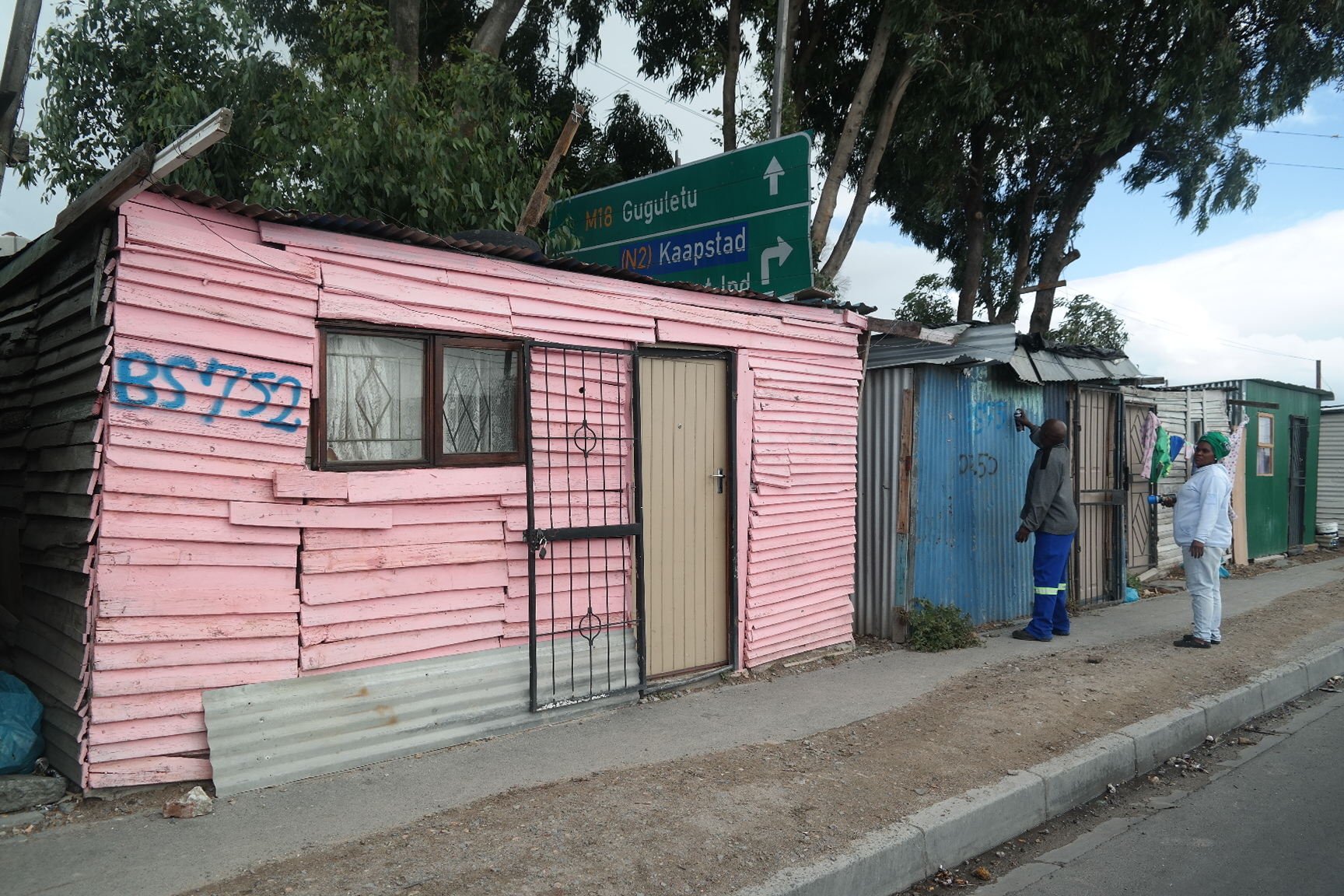
Shack numbering in Nyanga

Shack numbering in Nyanga

Mapping shack numbers in Nyanga

These tools derive their origins from the Shack/Slum Dwellers International (SDI) network, where for more than 30 years the SDI network recognized the importance of accurate and reliable data on informal settlements to help urban poor communities engage their local authorities in building effective partnerships towards a city-wide approach to in-situ informal settlement upgrading strategies (Arputham, 2012). The key difference in the SDI approach is that critical focus is placed on a community driven process, which allows for greater scale of activities and interventions as well as higher success rates in terms of the implementation of upgrading projects.

Profiling in UT Gardens, Khayelitsha

Profiling in UT Gardens, Khayelitsha

Within the context of informal settlement enumerations and mapping, this participatory approach is even more valuable as it has proven time and time again in various developing countries that when a mobilized community understands the importance of accurate data and maps and participates in the collection of this data around their own settlement, far higher degrees of accuracy are achieved than any census or survey that might utilize “outsiders” as the sole enumerators (Baptist & Bolnick, 2012, Livengood & Kunte, 2012).

Community Based Data Collection in Cape Town: Joe Slovo, Mtshini Wam, Kuku Town, and Flamingo Crescent

As urban poor people’s networks, FEDUP and ISN, together with CORC, have gathered experience in gearing communities towards self-enumeration and mapping.

Community members capture enumeration data

Community members capture enumeration data

For example, information available to the City of Cape Town had estimated the population of Joe Slovo along the N2 (N2 Gateway project) to be way larger than reality with the proposal of only a percentage of the residents being part of the housing project causing real concerns amongst the community. An enumeration conducted in 2009 spearheaded by the SA SDI Alliance was able to ascertain a more accurate population size based on a participatory approach, which paved the way for the possibility of the housing development moving ahead with all the current residents at the time included.

Other examples in Cape Town include the re-blocking of Mtshini Wam, Kuku Town and Flamingo Crescent informal settlements which all utilized the community driven enumeration and mapping approach to set up accurate beneficiary lists. These enumeration and GIS databases developed by CORC, ISN and FEDUP have been utilized by the City of Cape Town in the provision of electricity connections, contract work through the Expanded Public Works Program (EPWP) as well as assisting in detailed layout plans for the re-configuration of the settlements.

The necessity of working relationships with government

All this is only achievable through the establishment of practical working relationships and partnerships with government. In addressing the data deficiency described above this approach is not merely to gather information but to create the added benefit of a very practical community and local authority partnership.

Participatory data collection is an approach built upon the successes and lessons learnt in over 2 decades of informal settlement enumerations by the SA SDI Alliance. The Alliance’s experience in the implementation of 144 informal settlement enumerations in South Africa over the past 6 years, covering approximately 65,400 households has shown that the approach of deep community participation, even at the level of the data gathering exercise, leads to stronger community networks with the ability to assist local governments in prioritizing upgrading initiatives within a broader strategic framework. Furthermore, this deep participatory approach mobilizes communities towards determining their own development agendas.

Community generated data informs community planning

Community generated data informs community planning

References 

  • Arputham, 2012. How community-based enumerations started and developed in India, Environment and Urbanization 2012 24:27, Sage, IIED
  • Baptist, C and Bolnick, B. 2012. Participatory enumerations, in situ upgrading and mega events: The 2009 survey in Joe Slovo, Cape Town, Environment and Urbanization 2012 24:59, Sage, IIED
  • Giraut, F. and Vacchiani-Marcuzzo, C. 2009. Territories and Urbanisation in South Africa: Atlas and geo-historical information system. Institut de Recherche Pour le Developpement, Paris.
  • Housing Development Agency (HDA), Western Cape: Informal Settlements Status 2013. Research Report, HDA
  • Housing Development Agency (HDA), South Africa: Informal Settlements Status 2013. Research Report, HDA
  • Livengood, A and Kunte, K. 2012. Enabling participatory planning with GIS: a case study of settlement mapping in Cuttack, India, Environment and Urbanization 2012 24:77, Sage, IIED
  • SACN (South African Cities Network) 2011. 2011 State of SA Cities Report. SACN, Johannesburg.
  • South African Government Information. 2012. Our Future – make it work: National Development Plan 2030. 14 November 2012. http://www.gov.za/documents/national-development-plan-vision-2030
  • Turok 2012. Urbanisation and Development in South Africa: Economic Imperatives, Spatial Distortions and Strategic Responses. Urbanization and Emerging Population Issues Working Paper 8, International Institute for Environment and Development United Nations Population Fund
  • United Nations, Department of Economic and Social Affairs, Population Division. 2012. World
  • Urbanization Prospects: The 2011 Revision

[1] Presentation made by NUSP at the Policy Consultative Workshop held on 5 September 2014 at the Town House Hotel (Cape Town)

Alliance mobilises street dwellers & teaches students in Manchester, UK

By CORC, FEDUP, ISN 2 Comments

By Ava Rose Hoffman (on behalf of CORC)

From 8-12 March 2016, the South African SDI Alliance participated in a learning exchange in the United Kingdom with students at the University of Manchester and community organisations in the Greater Manchester area.

Left to right: Charlton Ziervogel (CORC), Alina Mofokeng (FEDUP), Nkokheli Ncambele (ISN) in Manchester

Left to right: Charlton Ziervogel (CORC), Alina Mofokeng (FEDUP), Nkokheli Ncambele (ISN)

Members of the of the South African SDI Alliance, community leaders Nkokheli Ncambele (ISN), Alina Mofokeng (FEDUP) and support professional Charlton Ziervogel (CORC) engaged with postgraduate students at the University of Manchester’s School of Environment, Education and Development participating in a course on Citizen-Led Development. In the course, students study inclusive, pro-poor, participatory community development approaches. The course highlighted methodologies practiced by SDI and collaborating organisations including developing savings schemes, federation building, community mobilisation, enumerations, engaging with the state, and building partnerships with NGOs, academic institutions and governments.

Arriving in Manchester as Community Lecturers

During the week of lectures at the University of Manchester, Nkokheli and Alina taught students about the ways in which the urban poor in South Africa are uniting, mobilising, organising themselves around savings contributions and building partnerships with local governments and institutions.

Reflecting on the experience of teaching students in the course, Nkokheli described the importance of public participation when professionals engage with communities:

“The professional likes to ‘do’ for poor people. That’s the first challenge. It’s a challenge on both sides because communities don’t want someone to decide on their behalf, and the government doesn’t want to listen to poor people because they say that they’re uneducated. That’s why we always try to change that mindset… It’s important to come to the people and listen to what they want. You use your professionalism to help them to achieve what they want.”

Nkokheli facilitates a community gathering with informal settlement leaders in Khayelitsha's Site B

Nkokheli facilitates a community gathering with informal settlement leaders in Khayelitsha’s Site B

Mobilising Manchester Street Dwellers & Community Movements

In addition to lecturing the students, Nkokheli, Alina and Charlton visited community groups each day, ranging from homeless support organizations to squatters occupying empty buildings to women’s income generation groups. Additionally, they participated in a half-day workshop with local community groups on 8 March 2016.

Meeting with community group Moms Mart in Wythenshawe

Meeting with community group Mums Mart in Wythenshawe

During the visits, Nkokheli and Alina described how they personally came to be involved in their respective movements, ISN and FEDUP, and then proceeded to discuss how to self-organise and start savings contribution programmes. Upon learning about how savings schemes operate in South Africa, some community organisations were receptive to the idea of starting similar savings groups of their own.

While many of the challenges that organisations and movements face in the UK are different from those encountered in the South African context, Charlton described that “what these groups needed was people to inspire them to get organised.” Referring to a past exchange with SDI back in the 1990s, Frances, a leader from one participating group, the Teeside Homeless Action Group (THAG), articulated:

“Our contact with groups from South Africa, Zimbabwe, India, etc. helped THAG to develop ways of working that matched our ethos of self-help and user involvement.  One person I spoke to on a number of occasions was Sheela Patel (SPARC, India) who liked the way THAG was working but she warned that unless we were careful we would attract large scale funding, end up with offices full of technology and lots of staff but would lose touch with our reason for existence – helping homeless people. Her warning went unheeded and it was not until 2010 that I saw what THAG had become – offices, technology, lots of staff but I had no contact with the homeless.  Since that time THAG has offloaded staff got rid of electronic gadgetry and went back to the things we did best – work with the homeless and help them to help themselves.”

This example, Charlton described, captures the richness of the network’s knowledge.

Nkokheli with fellow ISN coordinators and Provincial Minister for Human Settlements in Cape Town

Nkokheli with fellow ISN coordinators and Provincial Minister for Human Settlements in Cape Town

Furthermore, Nkokheli highlighted the importance of building solidarity, not only by creating networks among the poor but also by forming partnerships with local governments and institutions (including universities). Nkokheli described,

“By forming partnerships with other institutions, it makes government listen to the people.”

In particular, Nkokheli saw a great deal of potential for low-income communities to build partnerships with the government in Manchester given that the government issues small grants to the unemployed, which could serve as the foundation for a savings contribution programme. Nonetheless, Charlton observed that funding is limited and many people are falling into poverty in Manchester, thus to to “get ahead” it’s critical for people to organise themselves.

Reflections on Teaching and Mobilising

Charlton described that it was very significant to expose students to a different type of urban planning process given that “the opportunity to influence future urban planning has always been something that we try to achieve through CORC.”

Alina speaks to fellow FEDUP members during savings mobilisation

Alina speaks to fellow FEDUP members during savings mobilisation

Nkokheli emphasized the key message that ISN and FEDUP sought to bring to community groups in Manchester:

“The people need to network, to discuss the issues, to make sure that they’re initiating projects and also forming partnerships with the government. This was the message that we wanted to send to the people in Manchester.”

The two primary points of action that Nkokheli sought to reinforce were

  1. community organising in order to project the voices of the urban poor, and
  2. developing savings schemes.

Nkokheli described:

“What we tried to convey in Manchester is that poor people mustn’t tell themselves that they are poor and they can’t do anything. So, they need to start collecting information and organising people, making sure that they are saving so that when they go to the government, they go with something. We are trying to change the system of ‘taking’ to a system of ‘supporting.’”

Why we save: A photo story by FEDUP Mpumalanga

By FEDUP, Savings One Comment

By Ntombikayise Promise and Emgard Msibi (on behalf of FEDUP)

This photo story (text and images) was compiled by members of a FEDUP savings scheme in Mpumalanga with the purpose of introducing how urban poor women organise themselves through savings activities. 

It all starts with our ambitious citizens uniting to form one strategic society.

FEDUP members gather for a savings meeting in Kwa-Ndebele.

FEDUP members gather for a savings meeting in Kwa-Ndebele, Mpumalanga

When we stand together, we shall conquer. We create sustainable development through people-led development. Knowledge is power! We are one!

More impressions of KwaNdebele savings meeting

More impressions of KwaNdebele savings meeting

Securing our beautiful land for the poor. Umhlaba Wethu, Izwe Lethu. Our Land, Our Country. These women together with Walter Monyela [from CORC] gathered to ask the Chief of Kwa-Ndebele permission to buy the land of KwaMhlanga-Mountain View where they aim to build one hundred houses for the poor.

Screen Shot 2016-03-28 at 2.14.04 PM

As long as we are in motion, we will get there. Our vision is SMARTSustainable, Measurable, Achievable, Realistic, and Time bound.

missionvision

Mama Madonsela speaks about being a FEDUP members in Leandra, Mpumalanga:

“It is a good experience to work with the Federation of the Urban and Rural Poor (FEDUP) because it has brought us dignity and happiness. We were able to get together as a unique group to gather information and then explore our talents. Hence we showcase our skills through the great work of art”

The vision of these FEDUP members is to develop their own initiatives by using their skills and drawing on the support of FEDUP. Not only do these members have skills for art but they also have their own garden where they plant mushrooms and strawberries. They are still in search of a market to sell these.

Screen Shot 2016-03-28 at 2.33.08 PM

Saving for the near future 

Initially the community of FEDUP did not see the value of saving, up until it was introduced to FEDUP. FEDUP in Bethal continued to grow from a small number of collectives. These women gather every Sunday afternoon to save money. Saving money makes them happy and wise enough to make good financial decisions with their lives.

Screen Shot 2016-03-28 at 2.36.47 PM

The coordinators in our savings groups play different roles. In the picture below our loan facilitator is Sbongile, our treasurer is Neliswe, Thembi organises transportation, Mainah is our secretary and Nomvula Nkosi is our programme director.

savingbethal3

Our savings groups in Bethal, Mpumalanga:

Screen Shot 2016-03-28 at 2.45.50 PM